1965 Honda S600

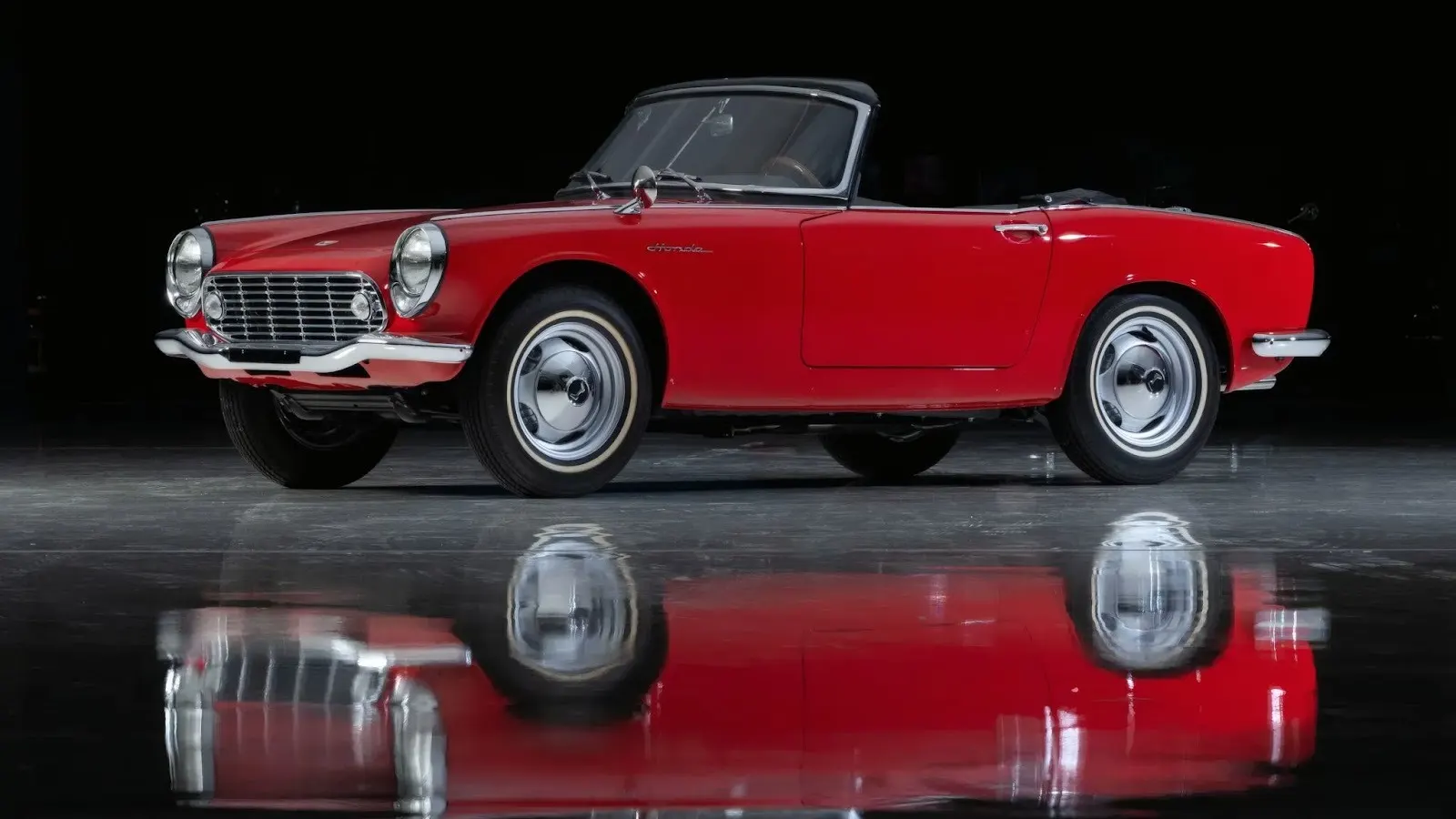
The Honda S600 represents one of the most significant chapters in automotive history - not for its sales numbers or mainstream recognition, but for fundamentally establishing Honda’s DNA as a car manufacturer. This diminutive roadster, weighing just 715 kg, combined motorcycle-inspired engineering with sports car aesthetics to create something truly revolutionary for its time. The S600 wasn’t just Honda’s first mass-produced car; it was the blueprint for generations of engineering excellence that would follow.
Honda’s journey toward producing the S600 began in the late 1950s when Yoshio Nakamura joined the company. By early 1959, Honda had developed the X170 prototype featuring a 360 cc air-cooled V4 engine - an early sign of the company’s ambition to transfer its motorcycle expertise to automobile production.
The company’s first production sports car, the S500, debuted at the 1962 Tokyo Motor Show and went on sale shortly afterward. However, Honda quickly recognized the potential for improvement and introduced the S600 in March 1964, just months after the S500’s launch. The S600 featured a larger 606 cc engine that addressed the power limitations of its predecessor.
Initially available only as a roadster, Honda expanded the lineup in March 1965 with the addition of a fastback coupé. This marked an important milestone as the S600 became the first Honda offered in two distinct body styles and trim levels - the standard S600 and the upgraded SM600.
Production numbers tell the story of the S600’s short but impactful life: Honda built 3,912 roadsters in 1964, with production climbing to 7,261 convertibles and 1,519 coupes in 1965. As the company prepared to shift to the S800, production dropped dramatically in 1966 with only 111 roadsters and 281 coupes manufactured. In total, approximately 11,284 convertibles and 1,800 coupes were produced during its brief three-year run.
What makes the S600 remarkable even today is its advanced engineering packed into such a compact frame. Under the hood sat a jewel-like 606 cc DOHC water-cooled four-cylinder engine featuring four Keihin carburetors - technology directly descended from Honda’s motorcycle expertise.
This all-aluminum powerplant produced 57 hp at 8,500 rpm - an astonishing specific output of nearly 100 hp per liter at a time when most production engines managed far less. The engine’s most impressive characteristic was its ability to rev extraordinarily high, with a redline of 9,500 rpm, though some enthusiasts report the engine could safely scream all the way to 11,000 rpm in real-world conditions.
While 57 horsepower might seem modest by today’s standards, it propelled the featherweight S600 to a top speed of 90 mph (145 km/h). Performance figures included a 0-60 mph time of 17.8 seconds and a quarter-mile run of 20.7 seconds at 63 mph - respectable numbers for such a small-displacement engine in the mid-1960s.
Perhaps the most fascinating aspect of the S600 was its unique drivetrain. Power from the high-revving engine transferred through a four-speed manual transmission to a hypoid differential, but what came next was truly innovative: each rear wheel was driven by either single or dual chains (depending on production date) contained in sealed, oil-bath lubricated cases.
These chain cases weren’t merely power transfer mechanisms - they ingeniously functioned as trailing arms for the fully independent rear suspension. This motorcycle-inspired solution allowed Honda to create a sports car with sophisticated suspension geometry at both ends, featuring independent front suspension with A-arms and longitudinal torsion bar springs.
The S600’s handling received high praise from contemporary road testers who likened its steering to the legendary Lotus Elan - exceptionally high praise for a car from a manufacturer with so little automotive experience. At just under 4.5 feet wide and 11 feet long, the S600’s compact dimensions and sophisticated suspension made it extraordinarily nimble on twisty roads.
Visually, the S600 embodied the classic proportions of a European sports car but with distinctly Japanese execution. The roadster featured clean lines, a simple grille flanked by round headlights, and minimal ornamentation that reflected Honda’s focus on engineering rather than styling flourishes.
Inside, the S600 offered a driver-focused cockpit with a wood-rimmed steering wheel, black vinyl bucket seats, and Denso instrumentation housed in a brushed metal binnacle. The SM600 trim added luxury touches including a standard heater, more comfortable seats, reversing lights, a standard radio with speaker, and special paint colors with exclusive badging.
The fastback coupe, introduced in 1965, maintained the roadster’s design language while adding a sleek roofline that enhanced both aesthetics and practicality. Despite the additional sheet metal, the coupe weighed just 15 kg more than the convertible - a testament to Honda’s relentless focus on weight management.
When introduced, the S600 didn’t receive the global recognition it deserved. In Western markets particularly, the tiny sports car was often dismissed as “more motorcycle than car,” reflecting the skepticism toward Japanese automobiles at the time. The American market, accustomed to large-displacement engines, struggled to take seriously a sports car with an engine smaller than many motorcycles.
Yet this remarkable machine represents the critical bridge between Honda’s motorcycle heritage and its future as an automobile manufacturer. The engineering principles established with the S600 - high-revving engines, lightweight construction, innovative solutions, and driving enjoyment - would become fundamental elements of Honda’s identity for decades to come.
Today, the S600 has achieved cult status among enthusiasts, with pristine examples commanding impressive prices. In 2024, a meticulously restored 1965 S600 roadster set a world record at auction, selling for $109,200 - formal recognition of its historical significance and rarity.
The S600’s DNA lives on in Honda’s later sports cars, from the CRX and Prelude to the legendary S2000 and even the current Civic Type R. Without this tiny roadster’s pioneering spirit, the performance Hondas we know today might never have existed.
In automotive history, few cars have packed as much innovation and future influence into such a small package as the Honda S600. What it lacked in raw power, it more than made up for with engineering brilliance, character, and a driving experience that continues to captivate enthusiasts six decades after its introduction.
Join the discussion
Comments
Loading comments…
Leave a comment
Share a detail, memory, or perspective. Every comment is reviewed before publication.