1967 Volkswagen Beetle

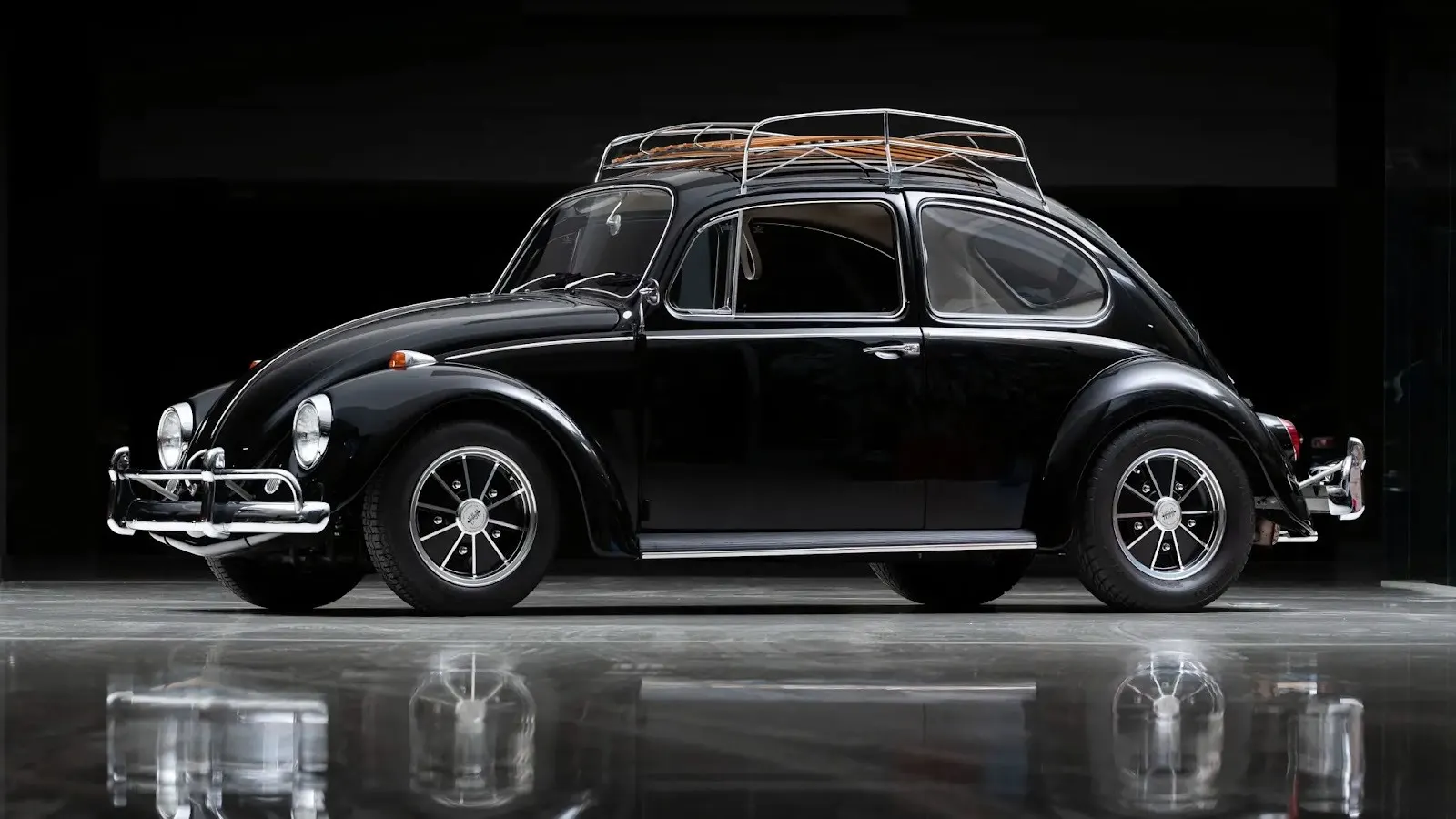
The Volkswagen Beetle stands as one of the most recognizable and beloved automobiles ever created. With its distinctive rounded silhouette, innovative engineering, and remarkable cultural impact, the Beetle transcended its original purpose as simple transportation to become a global phenomenon. Its journey from controversial origins to beloved icon reveals how a humble car captured the world’s imagination through its distinctive character and adaptability.
The story of the Beetle began in the troubled landscape of 1930s Germany. Adolf Hitler envisioned a “people’s car” (Volkswagen in German) that would be affordable for average German families and suitable for the country’s new network of highways, the Reichsautobahn. In 1934, Hitler commissioned Ferdinand Porsche to create a vehicle that could accommodate two adults and three children while using no more than seven liters of fuel per 100 kilometers.
The resulting design featured a rear-mounted, air-cooled engine with distinctive rounded bodywork. However, controversy exists around who truly created the Beetle’s concept. Although Porsche led the design team, the fundamental design concept has been attributed to Béla Barényi in 1925, almost a decade before Porsche’s involvement. Other engineers like Paul Jaray, Josef Ganz, and Hans Ledwinka may have also influenced the design.
World War II interrupted plans for civilian production. During the conflict, the Volkswagen factory primarily built military vehicles like the Kübelwagen and Schwimmwagen instead of consumer automobiles. Only 210 of the cars, then called KdF-Wagens (Kraft durch Freude or “Strength Through Joy”), were manufactured by the war’s end in 1945.
The Beetle’s remarkable story truly began after World War II. When Allied forces occupied Germany, British officer Major Ivan Hirst recognized the potential of the bombed Volkswagen factory and persuaded the British military to order 20,000 cars. By the end of 1945, 1,785 Volkswagens had been built for the occupying powers and postal service.
Under Heinrich Nordhoff’s subsequent management, production skyrocketed. The millionth Beetle rolled off the assembly line on August 5, 1955, a gold-painted model with rhinestone-encrusted bumpers to celebrate the milestone. By 1959, annual production capacity reached 700,000 units. The car was officially named the “Beetle” in 1968, though it had acquired this nickname much earlier due to its distinctive shape.
The Beetle’s growth extended internationally. Official exports to Brazil began in 1953, to Mexico in 1954, and to Australia the same year. Eventually, the Beetle would be manufactured in 14 countries beyond Germany. In 1972, the Beetle surpassed the Ford Model T’s production record, with the 15,007,034th vehicle produced in Wolfsburg. By the end of its 65-year run in 2003, more than 21.5 million Beetles had been manufactured, making it the most-produced car on a single platform in automotive history.
The Beetle’s unmistakable shape is perhaps its most defining characteristic. Those bulbous fenders, the sloping roof, and rounded silhouette created an automotive design icon that has stood the test of time. Freeman Thomas, one of the designers behind the New Beetle, noted that they approached the redesign by reducing the original to “its most geometric elements, the three arches”.
This distinctive shape wasn’t just about aesthetics, it was functional too. The curved body offered aerodynamic advantages, while the separate fenders made it easy to replace body panels after fender benders. The Beetle’s rear-mounted, air-cooled four-cylinder boxer engine created a practical layout that eliminated the need for a radiator, water pump or coolant. This simplified engineering made the car lighter, more fuel-efficient, and easier to maintain.
While the basic design remained consistent throughout its production, Volkswagen implemented over 78,000 incremental updates over the years. Early models featured a split rear window, earning them the nickname “Pretzel Beetle”. In 1953, this was replaced with a one-piece window. The most extensive design change came in 1965, with significantly larger windows increasing visibility all around.
The Beetle was never about raw speed or power, it was designed for reliability, simplicity, and affordability. Its air-cooled engine evolved over time, starting with a 1,131 cc (1.1 L) engine, then growing to 1,192 cc in 1954 producing 30 PS, and eventually offering options like the 1,285 cc engine producing 40 PS (1965) and the 1,493 cc engine with 44 PS (1967).
What made the Beetle’s engineering remarkable wasn’t its power but its practical advantages. The air-cooled engine eliminated concerns about frozen radiators in winter. The rear-engine design provided better traction in snow. The flat-four engine produced that distinctive Beetle purr that enthusiasts still love, a sound that says “I’m different, I’m special, and I’m proud of it”.
The simplicity of the Beetle’s design meant owners could perform many repairs themselves with basic tools, a significant advantage over increasingly complex American cars of the era. This practicality contributed enormously to the car’s popularity among college students, professors, and urban professionals who appreciated its economical operation and easy maintenance.
When the Beetle first arrived in America, it faced skepticism and mockery. In a land dominated by massive, chrome-laden V8 automobiles, the tiny, round Bug seemed completely out of place. However, its uniqueness eventually became its strength.
Volkswagen’s revolutionary advertising approach played a crucial role in changing public perception. The legendary “Think Small” campaign by Doyle Dane Bernbach in 1959 turned conventional auto advertising upside down. Instead of flashy promises, the ads featured stark photography, clean layouts, and witty copy that acknowledged the car’s limitations. Another famous ad, “Lemon,” showed a seemingly perfect Beetle rejected by inspectors for a minor flaw, highlighting VW’s commitment to quality control. This honesty resonated with consumers tired of overhyped domestic advertisements.
The Beetle’s timing proved perfect for capturing the zeitgeist of the 1960s counterculture movement. As young Americans questioned mainstream values, the humble Beetle became a symbol of rejection of excess and materialism. Its affordability made it accessible to students with limited means, while its simple mechanics aligned with the self-sufficiency ideals of the counterculture.
The car’s cultural significance exploded when it starred as “Herbie” in Disney’s 1968 film “The Love Bug”. This anthropomorphized Beetle with a personality of its own cemented the car’s place in American pop culture. You’d commonly see Beetles painted with peace symbols and psychedelic designs, rolling canvases expressing their owners’ hopes for a more peaceful world.
The Beetle’s influence extends far beyond its production years. It fundamentally changed how Americans thought about cars, challenging Detroit’s “bigger is better” philosophy and introducing new priorities to the automotive marketplace. The success of the Beetle forced American manufacturers to reconsider their approach, leading directly to compact cars like the Chevy Corvair and Ford Falcon.
Even after production of the original Beetle ended in Mexico in 2003, its spirit lived on. Volkswagen introduced the “New Beetle” in 1997 based on the Golf platform but with styling that clearly evoked the original’s iconic shape. Though mechanically unrelated to its predecessor, the New Beetle continued the tradition of personality and character that made the original special.
Today, the Beetle has evolved into one of the most collected vintage cars worldwide, with a passionate restoration community supporting it. Original models from the 1950s and 60s command impressive prices at auctions, while specialized parts manufacturers, restoration shops, and enthusiast forums keep thousands of Beetles on the road decades after production ended.
The Beetle stands as a remarkable case study in how an automobile can transcend its original purpose to become a cultural touchstone. From Nazi Germany’s “people’s car” to a symbol of peace and love in the 1960s, the Beetle’s journey reflects the complex ways objects acquire meaning beyond their functional purpose. In the words of Freeman Thomas: “The [Beetle] means the simplicity of the past, when things were innocent and accessible and fun. That’s really what the Beetle represented”.
What began as transportation became a statement about who you were and what you believed. The Beetle’s enduring legacy isn’t just about being an affordable, reliable car, it’s about how this humble automobile with its friendly face and distinctive personality captured our collective imagination and refused to let go.
Join the discussion
Comments
Loading comments…
Leave a comment
Share a detail, memory, or perspective. Every comment is reviewed before publication.