1995 McLaren F1

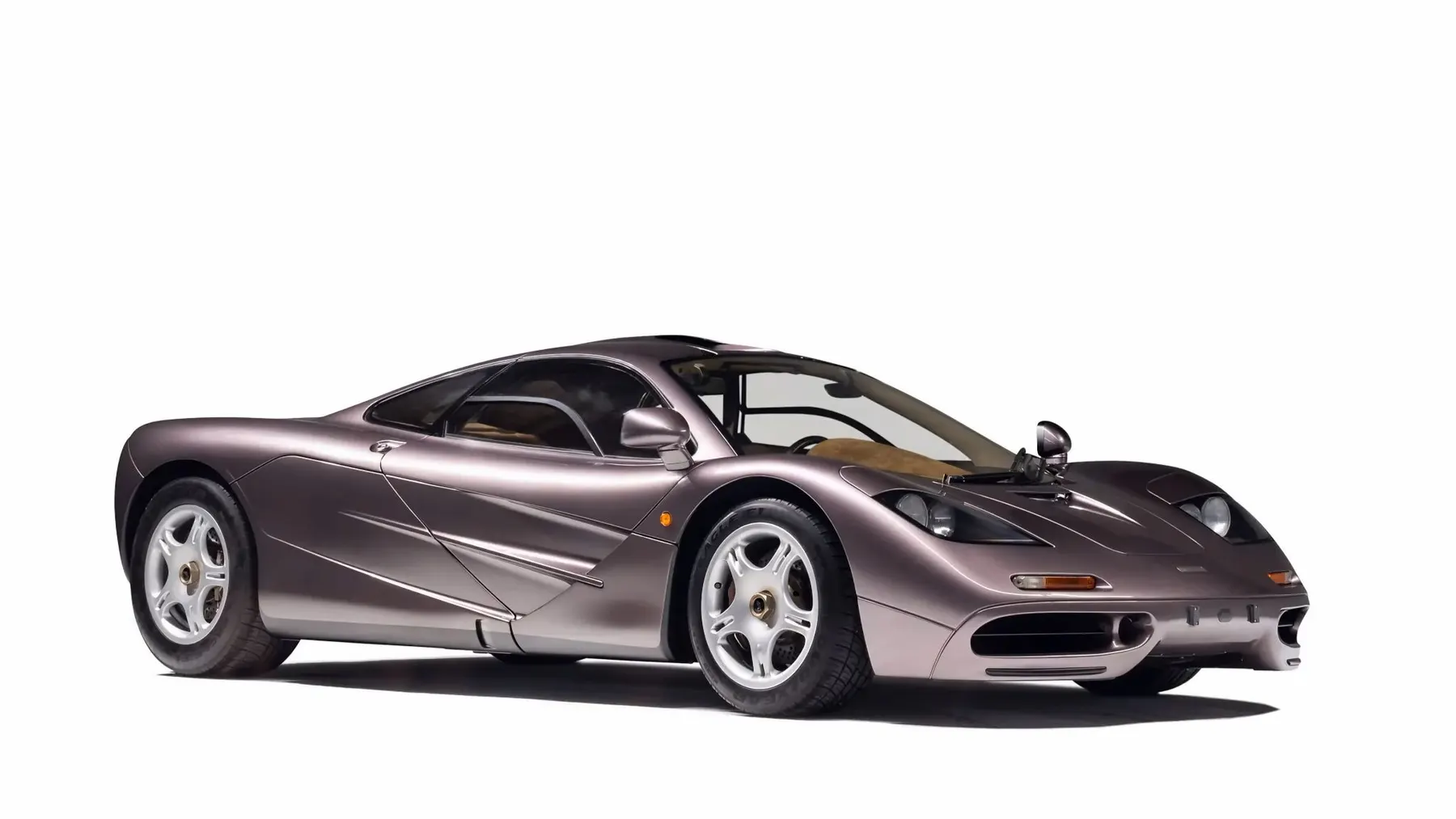
When Gordon Murray sketched a three-seat sports car concept while waiting for a flight home from the 1988 Italian Grand Prix, little did he know he was about to create automotive history. The McLaren F1 wasn’t just another supercar. It was a watershed moment in automotive engineering that completely redefined what was possible in a road-legal production vehicle. Nearly three decades later, it remains the benchmark against which all other supercars are measured, still holding the title of fastest naturally aspirated production car ever made.
The McLaren F1 story begins with a simple premise. After years of designing championship-winning Formula 1 cars, Gordon Murray wanted to create “the ultimate road car” with no compromises. He convinced McLaren boss Ron Dennis to back the project, and in 1990, a small team began work on what would become automotive legend.
Murray’s approach was refreshingly purist. No turbochargers. No power steering. No anti-lock brakes. No driver aids. Nothing that would dilute the driving experience or add unnecessary weight. Every component had to justify its existence and placement. This obsessive attention to detail extended to the smallest elements - even the titanium pedals were drilled with different patterns after Murray discovered which areas needed grip and which didn’t need extra material.
The project began with serious intent. Murray initially approached Honda (McLaren’s F1 partner at the time) to develop a bespoke engine, even visiting their Tochigi facility with Ayrton Senna. After Honda declined, Murray turned to BMW, whose M division, led by Paul Rosche, created a masterpiece: a 6.1-liter naturally aspirated V12 producing 618 HP at 7,400 rpm. The engine exceeded Murray’s power requirements while maintaining his mandated size constraints.
What makes the F1 truly special is its fundamental layout. Murray placed the driver centrally, ahead of and between two passenger seats. This wasn’t just for show - it provided optimal visibility and weight distribution. The dihedral doors (often called butterfly doors) were designed for easier entry and exit in tight spaces.
The F1’s carbon fiber monocoque chassis was revolutionary for a production road car in 1992. Murray’s team used carbon fiber not because it was fashionable, but because it was the right material for the job: lightweight, rigid, and strong. At just 1,138 kilograms, the F1 weighed significantly less than most modern supercars despite having three seats.
Perhaps most famously, the engine bay is lined with gold. This wasn’t extravagance but pure engineering logic - gold is an excellent heat reflector. About 16 grams of gold foil were used in each car, adding minimal weight while efficiently managing the considerable heat produced by the V12 engine.
The F1’s aerodynamics were equally thoughtful. Rather than relying on massive wings, Murray opted for ground-effect aerodynamics with a flat underbody and rear diffuser. Two fans extracted air from beneath the car, increasing downforce without the drag penalty of traditional wings. A small active rear spoiler deployed under braking to provide additional stability.
Inside, the F1 balanced minimalism with luxury. The central driving position is flanked by two slightly set-back passenger seats. Each car was tailored to its owner, with the seat made specifically to fit their body. The steering wheel position was fixed, but customized for each owner’s reach preference. Lightweight materials like carbon fiber, titanium, and magnesium were used throughout, yet the cabin featured leather upholstery, air conditioning, and a bespoke Kenwood sound system.
When the F1 arrived, it completely rewrote the performance rulebook. Its 0-100 km/h time of 3.2 seconds was astonishing for 1992, but even more impressive was its relentless acceleration beyond that point. It reached 160 km/h in 6.3 seconds and 200 km/h in just 9.4 seconds.
On March 31, 1998, at Volkswagen’s Ehra-Lessien test track, racing driver Andy Wallace pushed the F1 to a new production car record of 386.4 km/h (240.1 mph), with a peak speed of 391 km/h (243 mph). This record stood until 2005 when the Bugatti Veyron - using a quad-turbocharged W16 with nearly twice the power - finally surpassed it. Even today, the F1 remains the fastest naturally aspirated production car ever made.
The F1’s handling character was equally distinctive. Without power assistance for the steering or brakes, it demanded skilled, deliberate inputs from the driver. The unfiltered feedback through the controls provided a level of connection rarely experienced in modern performance cars. It wasn’t designed to flatter novice drivers with electronic aids; it was an instrument that rewarded skill and finesse.
Despite Murray’s insistence that the F1 was never designed to race, a competition version - the F1 GTR - was developed at customers’ request. In an astonishing turn of events, the F1 GTR won the 1995 24 Hours of Le Mans on its first attempt, finishing 1st, 3rd, 4th, 5th, and 13th overall. This unexpected motorsport success further cemented the F1’s legendary status.
Production of the McLaren F1 ended in 1998 after just 106 cars were built: 64 standard road cars, 5 LM models, 3 GT longtail road cars, 28 GTR race cars, and 6 prototypes. Each car took around three and a half months to build by hand.
The F1’s influence on automotive design and engineering cannot be overstated. It pioneered technologies and approaches that are now commonplace in high-performance cars, from extensive use of carbon fiber to active aerodynamics. Many of the engineers who worked on the F1 went on to shape the next generation of supercars across the industry.
Today, the McLaren F1 is one of the most valuable cars in existence. Examples routinely sell for over $20 million at auction, with particularly special cars commanding even higher prices. Owners include Ralph Lauren, Jay Leno, Nick Mason, and the Sultan of Brunei, who reportedly owns multiple examples.
What’s remarkable is how well the F1 has aged. In an era of increasingly computerized supercars, the F1’s analog, driver-focused approach feels more special than ever. Even Gordon Murray’s newest creation, the GMA T.50, explicitly references the F1 while incorporating modern technology.
The automotive journalist Andrew Frankel perhaps put it best: “The McLaren F1 remains the greatest road car I’ve ever driven, not because it’s the fastest, most expensive or most exotic, but because everything about it was designed to maximize the driving experience, not the numbers it generates.”
The McLaren F1 stands as the ultimate expression of automotive engineering purity. It wasn’t built to set records, although it did. It wasn’t designed to win races, although it did that too. It was created simply to be the ultimate driver’s car, with every decision made in service of that singular goal. That Gordon Murray and his team succeeded so comprehensively explains why, decades later, the F1 remains the high-water mark of supercar design - the car that proved what was possible when engineering excellence takes precedence over all else.
**
Join the discussion
Comments
Loading comments…
Leave a comment
Share a detail, memory, or perspective. Every comment is reviewed before publication.