1999 Prost AP02

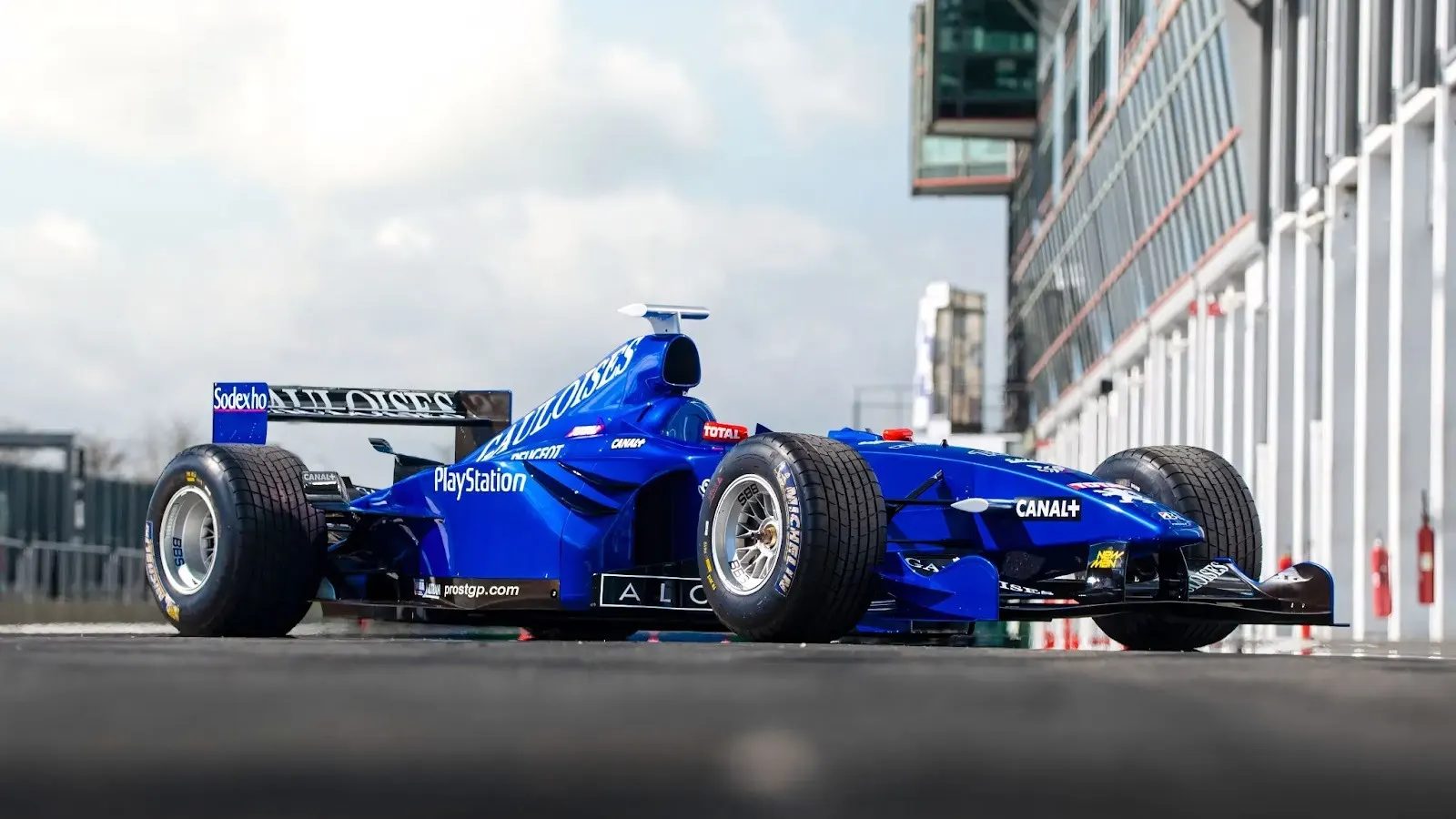
When four-time Formula One World Champion Alain Prost founded his own team in 1997, the motorsport world watched with anticipation. Here was a driver whose career had been defined by precision and intelligence, stepping into the complex role of team owner. The Prost AP02, raced during the 1999 season, encapsulates both the promise and the harsh realities of this ambitious venture. It’s a story of technical collaboration, fleeting moments of brilliance, and the relentless grind of competing in Formula One’s midfield.
The AP02 emerged during a transitional phase for Prost Grand Prix. The team had acquired Ligier in early 1997, inheriting its infrastructure and personnel. But the 1998 season had been a disaster, with the AP01 chassis plagued by aerodynamic inefficiencies and mechanical gremlins. Alain Prost, determined to reverse the team’s fortunes, made a pivotal decision: he brought in John Barnard, the visionary engineer behind Prost’s championship-winning McLarens of the 1980s, as a technical consultant. Barnard joined French engineers Bernard Dudot and Loïc Bigois, forming a hybrid design team tasked with reinventing the car.
The result was the AP02, a machine that blended Barnard’s pragmatic approach with the existing French engineering philosophy. While not a frontrunner, the car marked a tangible improvement. Its carbon-fiber monocoque chassis, paired with push-rod suspensions front and rear, reflected late-’90s F1 norms but featured refined aerodynamics and better weight distribution. At its heart lay the Peugeot A18 engine, a 3.0-liter V10 producing 785 horsepower,a unit that symbolized the French partnership but struggled with reliability compared to rival power plants.
The AP02’s potential flickered to life at the European Grand Prix at the Nürburgring. In a rain-soaked race that saw multiple leaders spin off, Jarno Trulli, then in his second full season with Prost, carved through the field to finish second. This podium,Trulli’s first in F1,remained the team’s high point of the year. Elsewhere, the car’s performance was inconsistent. Olivier Panis, a veteran of six seasons with the Ligier/Prost organization, battled unreliability; he retired from eight races, often while running in points-paying positions. Trulli, too, faced mechanical woes, but his aggressive driving style occasionally masked the car’s deficiencies.
The team’s seventh-place finish in the Constructors’ Championship, with nine points, told a story of incremental progress. While they outperformed backmarkers like Minardi and Arrows, the gap to established midfield rivals like Stewart and Williams remained significant. The AP02’s Bridgestone tires, which suited certain circuits, and its Peugeot engine’s peaky power delivery, created a car that was temperamental but capable of brilliance in the right conditions.
The AP02’s aerodynamic package, overseen by Ben Wood, avoided the excessive winglets and bargeboards that would proliferate in later years. Instead, it featured clean, elegant lines,a hallmark of late-’90s designs. The front wing, with its single central pillar, and the sculpted sidepods reflected a focus on balancing downforce with mechanical grip. John Barnard’s influence was most evident in the car’s revised weight distribution, which improved cornering stability, and the rear suspension geometry, which optimized traction out of slow-speed turns.
Peugeot’s A18 engine, while powerful on paper, often left the drivers wanting. Its narrow powerband required precise throttle control, a challenge on tracks with long straights where peak horsepower dictated competitiveness. The transmission, a six-speed sequential unit mounted longitudinally, drew mixed reactions; while reliable, it lacked the seamless shifts of rival systems.
Trulli’s podium at the Nürburgring underscored his reputation as a wet-weather specialist and marked him as a rising star. His departure to Jordan for 2000, replacing the retiring Damon Hill, was a blow to the team. Panis, meanwhile, grew increasingly frustrated. A seasoned competitor with a reputation for consistency, he found himself hamstrung by retirements,only once did both Prost cars finish a race. His move to McLaren as a test driver in 2000 signaled the end of an era for the French squad.
Behind the scenes, tensions simmered. Barnard’s consultancy role occasionally clashed with the existing technical team, highlighting the challenges of integrating external expertise. Prost’s leadership style,detailed and hands-on,sometimes conflicted with the realities of managing a resource-rich but cash-strapped operation.
The AP02’s striking livery,French racing blue with red and white accents,became a mobile billboard for national pride. Gauloises, the team’s primary sponsor, adorned the car at most races, though strict tobacco advertising laws in France, Britain, and Belgium forced creative solutions. In those markets, the blue-and-white paint scheme stood out for its simplicity, while partnerships with brands like Canal+ and PlayStation linked the team to mainstream culture.
Historically, the AP02 is a bridge between eras. It competed during Formula One’s last years before manufacturer dominance, when privateer teams like Prost could still dream of challenging giants like Ferrari and McLaren. Its role as Jenson Button’s first F1 test car in December 1999 adds a layer of nostalgia; Button, then a 19-year-old prodigy, would later credit that test with accelerating his path to a race seat.
By 2001, Prost Grand Prix had folded, undone by financial struggles and the collapse of negotiations with potential buyers. Yet the AP02 endures as a testament to Alain Prost’s tenacity. While the car never won a race, it demonstrated that a driver-turned-owner could build a competent midfield contender. Its few standout moments,Trulli’s podium, Button’s test,remain etched in the memories of F1 historians.
In retrospect, the Prost AP02 is a microcosm of Formula One’s relentless Darwinism. It represents both the ingenuity of collaboration and the harsh truth that success in F1 requires not just talent, but deep pockets and timing. For Alain Prost, the car symbolized a personal quest to conquer the sport from the pit wall,a challenge as daunting as any he faced on track. While the dream ultimately faltered, the AP02’s flashes of speed and innovation ensure its place in the annals of F1 history.
Join the discussion
Comments
Loading comments…
Leave a comment
Share a detail, memory, or perspective. Every comment is reviewed before publication.