2006 Ford Crown Victoria Police Interceptor 'Metropolitan Police Service'Untitled

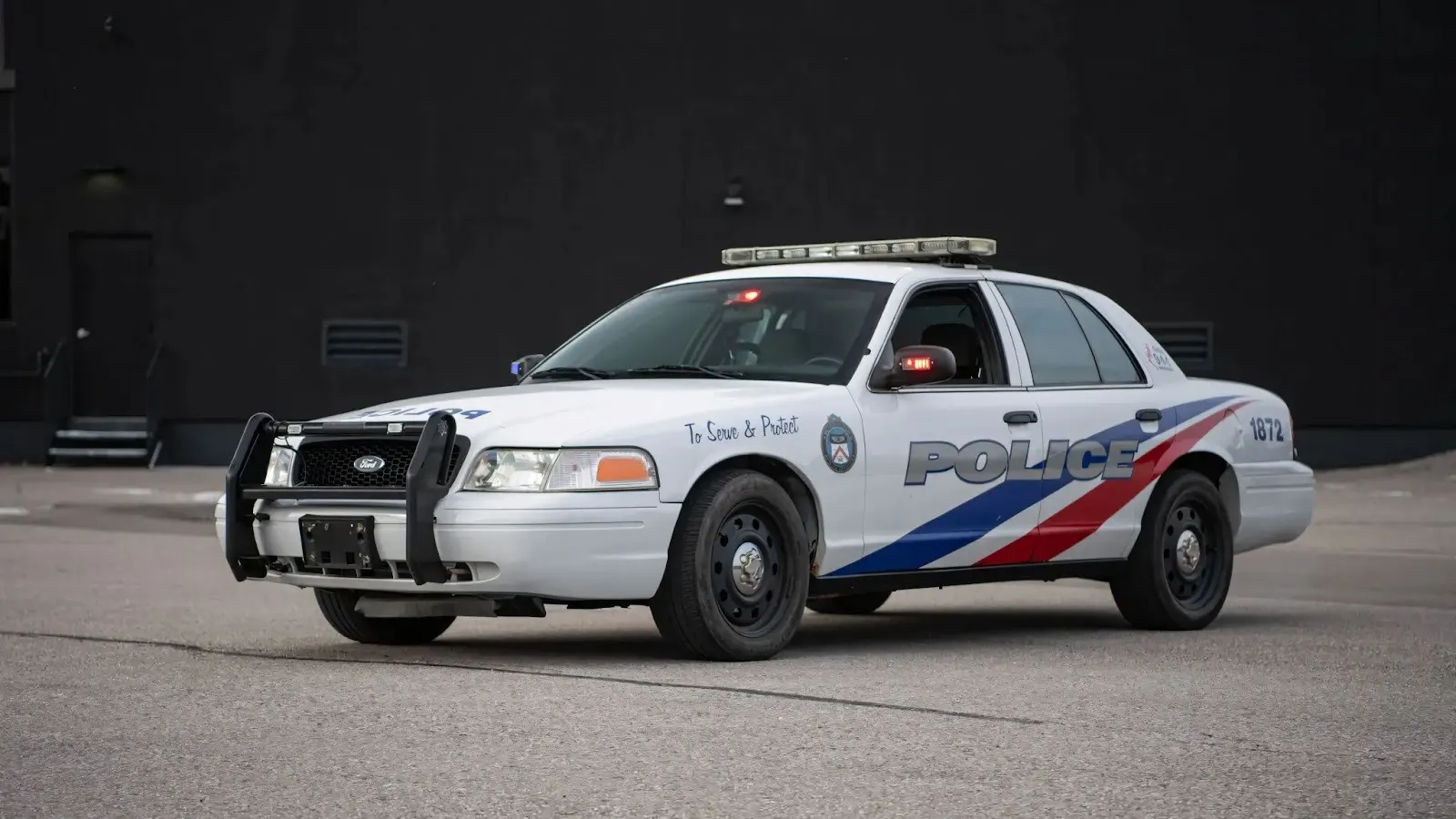
The Ford Crown Victoria Police Interceptor stands as perhaps the most recognizable law enforcement vehicle in automotive history, serving as the backbone of police fleets across North America for nearly two decades. While most commonly associated with American and Canadian police forces, this remarkable machine earned its legendary status through a combination of robust engineering, purposeful design, and unwavering reliability that made it the undisputed champion of patrol cars.
Ford’s Crown Victoria Police Interceptor, known colloquially as the CVPI, P71, or P7B, emerged in 1992 as the law enforcement variant of the civilian Crown Victoria sedan. This four-door, body-on-frame sedan represented Ford’s first use of the “Police Interceptor” nomenclature, establishing a lineage that would dominate police vehicle sales for years to come.
The timing of the Crown Victoria’s police debut proved fortuitous. Following Chevrolet’s discontinuation of the Caprice police package, Ford found itself with virtually no competition in the North American police vehicle market. From 1997 to 2013, the Crown Victoria Police Interceptor became the most widely used automobile in law enforcement fleets across the United States, Canada, and Mexico, with more limited deployment in Europe and the Middle East.
By May 2003, the Crown Victoria Police Interceptor commanded an astounding 85 percent market share of police vehicles in the United States. This dominance wasn’t achieved through marketing alone but through the vehicle’s fundamental engineering philosophy that prioritized durability, performance, and serviceability above all else.
The Crown Victoria Police Interceptor’s success stemmed from its deliberate engineering choices that perfectly matched law enforcement needs. The body-on-frame construction provided exceptional durability, allowing for cost-effective repairs after collisions without requiring chassis straightening. This design philosophy proved invaluable for agencies operating large fleets under demanding conditions.
The rear-wheel-drive configuration offered superior handling characteristics for high-speed pursuits and aggressive maneuvers compared to front-wheel-drive alternatives. This setup proved particularly advantageous when navigating urban obstacles like curbs and rough terrain that would challenge lesser vehicles.
At the heart of every CVPI sat Ford’s proven 4.6-liter SOHC V8 engine, delivering 186 kilowatts (250 horsepower) and 402 Newton-meters (297 pound-feet) of torque in its final iteration. This naturally aspirated power plant featured flex-fuel capability starting in 2008, allowing operation on both gasoline and ethanol blends.
The engine’s calibration differed significantly from civilian applications, featuring more aggressive transmission shift points and a slightly elevated idle speed of approximately 40 rpm above standard models. These modifications, combined with a heavy-duty 11.25-inch torque converter (compared to the civilian model’s 12-inch unit), provided quicker acceleration and more responsive performance under demanding conditions.
Understanding that police vehicles operate under severe duty cycles involving extended idling and high-load conditions, Ford equipped all CVPIs with enhanced cooling systems. These included larger-capacity radiators and external oil coolers for the engine, power steering, and transmission systems, preventing overheating during prolonged high-performance operations.
The 2003 model year marked the most significant engineering advancement in the platform’s history, introducing a completely redesigned hydroformed steel frame that was 20 percent more resistant to vertical bending. This structural enhancement improved crash performance while providing a more rigid foundation for the vehicle’s suspension components.
The Crown Victoria Police Interceptor’s performance credentials matched its imposing presence. Depending on the rear axle ratio, these vehicles could achieve electronically limited top speeds ranging from 192 to 208 kilometers per hour. The 1999-2001 models with 3.55:1 rear axles were limited to approximately 200 km/h, while later 3.27:1 equipped models could reach 208 km/h.
Ford’s suspension tuning prioritized stability and control over comfort, employing severe-duty shock absorbers and higher-rate coil springs that provided approximately 20 millimeters of additional ground clearance compared to civilian models. The 2003 redesign introduced coil-over front shocks, revised control arms, and monotube rear shocks mounted outside the frame rails for improved handling precision.
The transition from recirculating ball to rack-and-pinion steering in 2003 reduced weight by 10 kilograms while improving steering response and road feel. These enhancements contributed to significantly improved handling characteristics that officers immediately appreciated during high-stress driving situations.
The CVPI’s interior reflected its utilitarian mission while accommodating the unique requirements of law enforcement work. Standard equipment included manual cloth bucket seats with stab-proof backing, providing protection for officers while maintaining the column-mounted shifter configuration. The gap between seats accommodated essential police equipment including radios, computers, and weapon storage.
Ford included thoughtful details like a calibrated 225 km/h speedometer, relocated trunk release controls, and an optional “dark mode” that disabled interior lighting when doors opened to maintain officer concealment. The spacious cabin provided 3,046 liters of passenger volume, while the trunk offered 584 liters of storage capacity for equipment.
Safety enhancements included optional Kevlar-lined doors starting in 2006, addressing officer protection concerns. Later models offered optional fire suppression systems designed to mitigate fuel tank fires following rear-end collisions, a response to well-publicized safety concerns in the early 2000s.
The Crown Victoria Police Interceptor earned universal praise from law enforcement professionals who valued its combination of performance, reliability, and practicality. Officers consistently highlighted the vehicle’s exceptional acceleration, responsive handling, and ability to maintain composure during high-speed pursuits.
One California Highway Patrol sergeant noted the vehicle’s comfort, reliability, functionality, and durability, praising its performance across virtually all conditions and ease of entry and exit with full duty gear. The spacious interior and robust construction made it ideal for officers of all sizes while accommodating the extensive equipment required for modern policing.
Training instructors particularly valued the Crown Victoria’s predictable handling characteristics, with some academies continuing to use decommissioned units specifically for skid training due to their consistent oversteer and understeer behaviors. This predictability translated into officer confidence during emergency response situations.
Despite its overall excellence, the Crown Victoria Police Interceptor faced several notable technical challenges during its production run. The most significant issue involved fuel tank fires following high-speed rear-end collisions, which led to extensive safety modifications and the introduction of optional fire suppression systems in 2005.
Intake manifold failures plagued earlier models, particularly those manufactured between 1996 and 2003 with plastic DuPont-manufactured components. The combination of extended idling and emergency driving cycles caused cracks in the thermostat housing area, leading to coolant leaks and overheating. Ford addressed this issue in 2003 with revised aluminum components, though problems persisted with plastic heater hose fittings.
Steel wheel corrosion affected early 2003 models, prompting a recall and the introduction of improved 17-inch wheels in 2006. These larger wheels not only resolved durability concerns but also improved the vehicle’s visual presence and brake cooling.
Production of the Crown Victoria Police Interceptor concluded in 2011, with the final vehicle delivered to the Kansas Highway Patrol. Many agencies stockpiled final-year models, testament to their appreciation for the platform’s proven capabilities. The discontinuation marked the end of an era in law enforcement vehicles, as no direct replacement could match the Crown Victoria’s unique combination of attributes.
Ford replaced the Crown Victoria Police Interceptor with the Police Interceptor Sedan and Police Interceptor Utility, based on the Taurus and Explorer platforms respectively. However, these modern alternatives, despite their advanced technology and improved fuel efficiency, have never achieved the universal acceptance that the Crown Victoria enjoyed.
The Crown Victoria Police Interceptor’s influence extended far beyond law enforcement, becoming a cultural icon through countless appearances in films, television shows, and video games. Its distinctive silhouette became synonymous with American policing, cementing its place in automotive and cultural history.
Today, decommissioned Crown Victoria Police Interceptors remain highly sought after in the used car market, prized by enthusiasts, taxi operators, and anyone requiring a durable, spacious, and affordable vehicle. This continued demand speaks to the enduring appeal of a machine that perfectly embodied the principle of form following function, creating an automotive legend that will likely never be replicated in our modern era of electrification and efficiency-focused design.
Join the discussion
Comments
Loading comments…
Leave a comment
Share a detail, memory, or perspective. Every comment is reviewed before publication.