1972 Maserati Bora 4.7

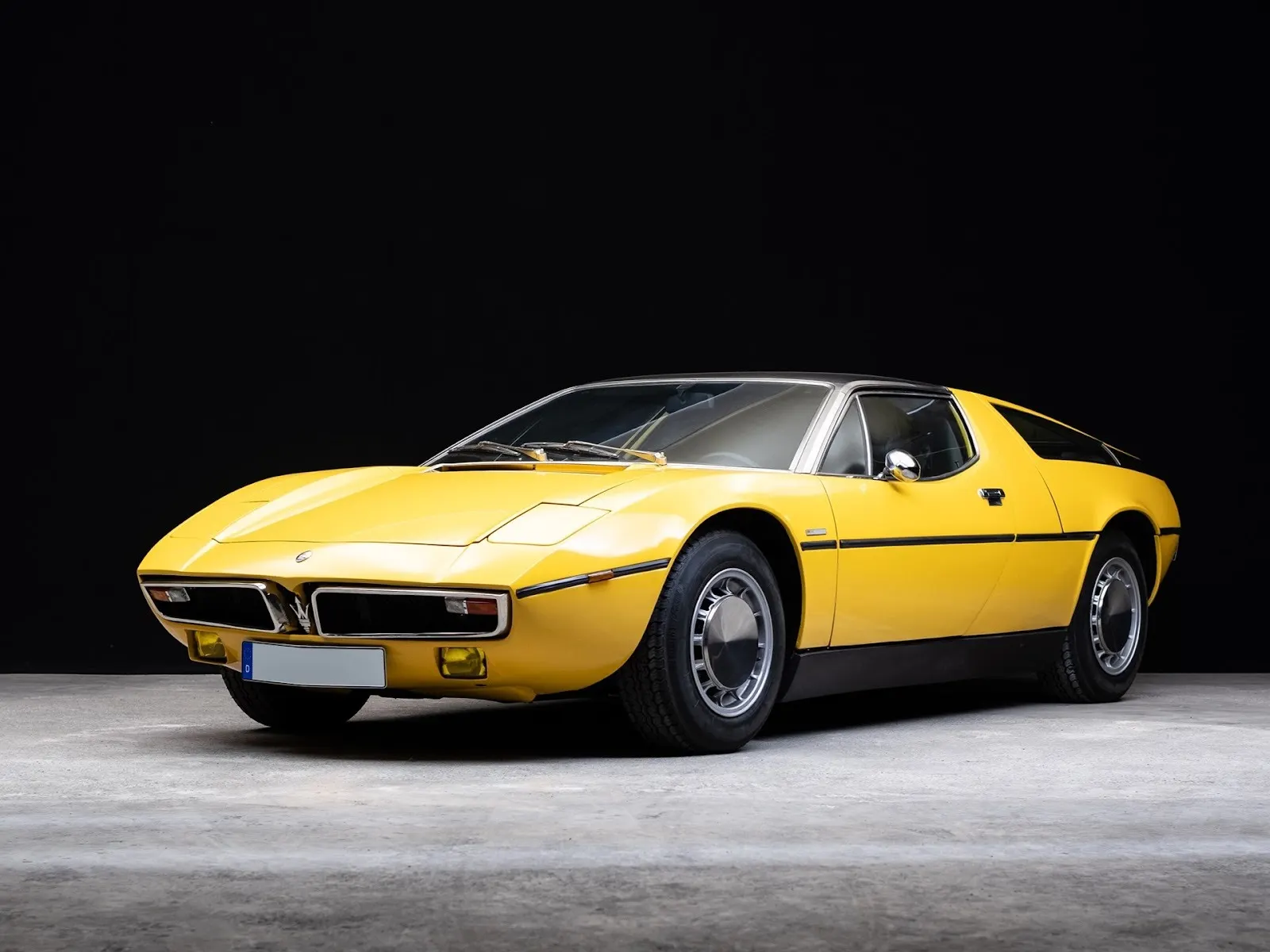
In the annals of automotive history, certain cars stand out not just as vehicles, but as legends that embody the spirit of their era. One such gem is the Maserati Bora, a masterpiece born in the early 1970s that not only marked a pivotal moment for Maserati but also left an indelible mark on the world of sports cars. As we delve into the soul of the Maserati Bora 4.7, fasten your seatbelts for a journey through time, power, and pure driving ecstasy.
The wind of Trieste, known as Bora, whispered a daring proposition to Maserati in 1968. A mid-engined, two-seat sports car , a departure from their traditional offerings. As Citroën assumed control of Maserati, the winds of change blew stronger. The concept transformed into reality, and by March 1971, the world witnessed the birth of the Maserati Bora at the Geneva Salon. It was a proclamation that Maserati had entered a new era, shedding the skin of outdated technology.
The aesthetic prowess of the Bora is owed to the genius of Giorgetto Giugiaro, the maestro behind the design curtain at Italdesign. The sleek lines, the brushed stainless steel roof, and the windscreen pillars that stood as sentinels of style , all these elements coalesced into a car that boasted a drag coefficient of a mere 0.30. A decade later, that value was still enviable, a testament to the forward-thinking design of the Bora.
As the Bora hit the streets in 1971, it was a visual symphony, drawing attention and turning heads with its distinctive features. The brushed stainless steel roof wasn’t just a stylistic choice; it was a statement of individuality in a sea of automotive conformity.
The Bora wasn’t just a pretty face; it was a blend of innovation and practicality. Step into its cabin, and you’d notice the hydraulically powered pedal cluster, a marvel that allowed adjustments with a touch of a button. The steering wheel wasn’t just for steering; it could be tilted and telescoped, addressing the perennial challenge of getting in and out of a low-slung sports car.
But the Bora didn’t stop at creature comforts. Unlike its counterparts, it offered more than a cramped footwell and minimal luggage space. It boasted a full-size trunk in the front , a surprising luxury in the realm of high-performance sports cars.
The heartbeat of the Bora was its engine, a high-revving 4.7-liter powerhouse that churned out 310 horsepower at 6,000 rpm and 461 Nm of torque at 4,200 rpm. It wasn’t just an engine; it was a legacy, tracing its roots back to the iconic 450S race car. The Bora was a pioneer, introducing a mid-engined layout and four-wheel independent suspension, a feature absent in Maserati’s previous offerings.
For the American market, Maserati switched to a larger 4.9-liter engine, complying with emission regulations. The power figures rose to 330 horsepower at 5,500 rpm and 481 Nm at 4,000 rpm. Both engines, adorned with hemispherical combustion chambers and operated by four cams, were mounted longitudinally, driving the rear wheels through a ZF-1 five-speed transaxle. It was a symphony of precision and power.
The Bora wasn’t just about what was under the hood; it was a tactile experience. The all-steel panels, crafted by Officine Padane of Modena, hugged the chassis, creating a marriage of form and function. But it wasn’t just about the metal; it was about the experience within.
Inside, the Bora cocooned its occupants in luxury. Leather-trimmed bucket seats cradled the driver and passenger, while the dash, door trim, centre console, and rear bulkhead oozed opulence. Electric windows and air conditioning were standard, elevating the driving experience to a level of comfort seldom seen in the world of high-performance sports cars.
The Bora wasn’t just a sprinter; it was a dancer on the road. The chassis, a combined steel monocoque and body, housed a tubular steel subframe for the engine and transmission at the back. This setup, combined with four-wheel independent suspension, marked a new chapter in Maserati’s playbook.
Citroën’s advanced LHM hydraulic technology played a pivotal role, controlling the ventilated disc brakes and orchestrating the dynamic adjustments within the Bora. The wheels, Campagnolo light alloy type, wore Michelin XWX tires at the front and rear, ensuring a grip that matched the car’s prowess. The Bora wasn’t just a car; it was a symphony of engineering brilliance.
The Bora’s legacy extended beyond the streets. It served as the foundation for the Merak, a 2+2 configuration that retained the Bora’s essence but embraced a smaller, lighter Maserati V6 engine. Racing ambitions loomed large as well, with Maserati developing Group 4 racing cars that showcased the Bora’s untamed spirit.
As the production curtain fell in 1978, the Bora left an indelible mark. Its brushed stainless steel roof and windscreen pillars became icons, and its innovations set benchmarks for the future. Today, with only 564 Boras in existence, each one is a piece of history, a chapter in the story of Maserati’s relentless pursuit of excellence.
In the realm of sports cars, the Maserati Bora 4.7 stands as a testament to innovation, power, and style. It was a symphony on wheels, a conductor of emotions, and a timeless embodiment of automotive artistry.
Join the discussion
Comments
Loading comments…
Leave a comment
Share a detail, memory, or perspective. Every comment is reviewed before publication.