1976 Aston Martin V8 Series III

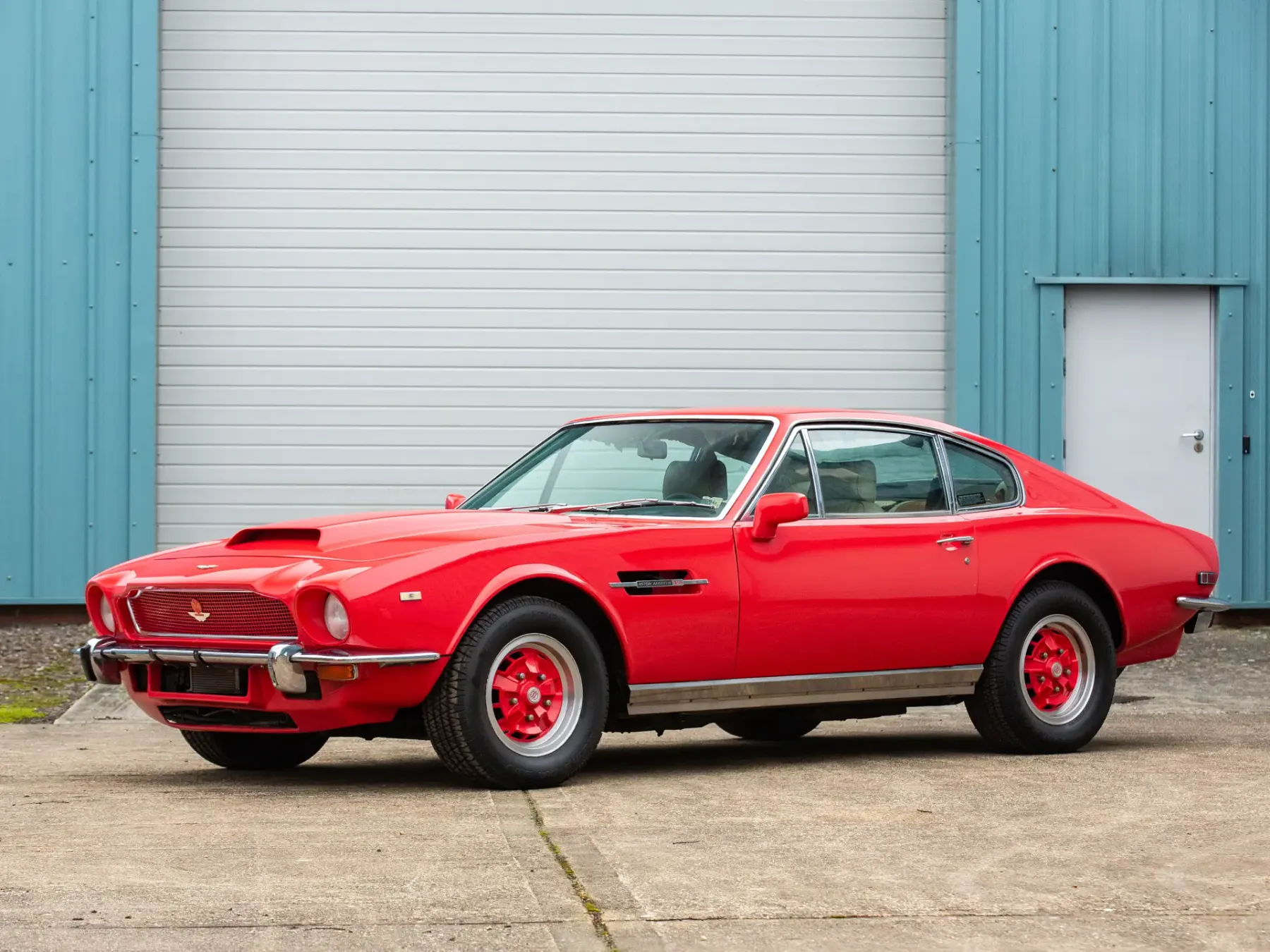
In the tumultuous landscape of 1970s automotive design, the Aston Martin V8 Series III emerged as a defiant celebration of handcrafted grandeur. Produced from 1973 to 1978, this model bridged the gap between Aston Martin’s classic era and its modern ambitions, blending raw mechanical charisma with refined luxury. As the third iteration of the venerable V8 lineage, the Series III navigated tightening emissions regulations and shifting market tastes, yet retained the visceral essence that defined the marque. With its thunderous 5.3-liter V8 engine, muscular aesthetics, and bespoke craftsmanship, it remains a touchstone for enthusiasts of analog driving excellence.
The Series III arrived during a pivotal chapter for Aston Martin. The V8 lineage began in 1969 with the DBS V8, a car conceived to modernize the aging DB6. By 1973, the model shed its “DBS” moniker, becoming simply the Aston Martin V8. The Series III, introduced that same year, marked a technical regression with purpose: to comply with stringent U.S. emissions standards, Aston Martin abandoned the problematic Bosch fuel injection of the Series II, reverting to quad Weber carburetors. This decision preserved the car’s performance ethos while adapting to regulatory realities.
Production spanned five years, interrupted only by a hiatus in 1975 as the oil crisis reshaped the automotive landscape. Despite these challenges, 967 Series III models were handbuilt, each requiring over 1,200 hours of labor,a testament to Aston Martin’s unwavering commitment to craftsmanship.
Penned by William Towns, the Series III exuded a restrained aggression. Its low-slung profile, flared wheel arches, and squared-off grille projected muscularity, while the aluminum bodywork,crafted in Aston Martin’s Newport Pagnell workshops,kept weight in check. A defining feature was the raised hood scoop, necessitated by the quartet of Weber 42 DCNF carburetors lurking beneath. This functional flourish became an aesthetic signature, distinguishing it from earlier iterations.
The rear design subtly evolved, replacing louvers beneath the backlight with a discreet lip, lending cleaner lines. Chrome accents framed the windows and bumpers, contrasting with optional matte black hood finishes favored by performance purists.
Inside, the cabin was a sanctuary of bespoke luxury. Connolly leather upholstered the seats and door panels, complemented by burled walnut dashboards and trims. Ergonomics prioritized the driver, with a three-spoke steering wheel framing Smiths instrumentation. Optional extras like Coolair air conditioning, electric windows, and premium sound systems catered to transatlantic clients, particularly in the U.S., where left-hand-drive models became symbols of discreet opulence.
At the core of the Series III lay Aston Martin’s hand-built 5.3-liter V8, a masterpiece of mechanical theater. Initially producing 310 horsepower, the engine’s growl crescendoed to a banshee wail at full throttle, aided by the Webers’ unapologetic throttle response. A 1976 dip to 288 horsepower, spurred by emissions compliance, was rectified in 1977 with a “Stage 1” upgrade,re-profiled camshafts and a freer-flowing exhaust restored output to 305 horsepower.
Paired with a ZF five-speed manual or optional Chrysler TorqueFlite automatic transmission, the Series III could sprint to 60 mph in 5.7 or 6.1 seconds, respectively, en route to a top speed nearing 160 mph. Independent front suspension and a live rear axle, tuned for grand touring comfort, delivered a ride that balanced agility with suppleness. Pirelli Cinturato tires, sized 255/60R15, ensured tenacious grip, while ventilated disc brakes reined in the momentum.
The Series III’s rarity and mechanical purity set it apart. Unlike later fuel-injected models, its carbureted engine offered an unfiltered connection between driver and machine,a symphony of induction noise and throttle response lost to modern electronics. The manual transmission, chosen by roughly 20% of buyers, became a holy grail for purists.
Unique design cues, like the optional “Oscar India” package (introduced later in the V8 lineage), were absent here, keeping the Series III focused on its core ethos. Yet discreet customization flourished: clients could specify everything from personalized luggage sets to bespoke paint codes, ensuring no two cars were identical.
Initially, the Series III faced skepticism. Critics questioned its weight and thirst in an era of oil shocks, while rivals like the Ferrari 365 GTB/4 “Daytona” overshadowed it in showrooms. Yet the Aston’s blend of brute force and refinement won a devoted following. American buyers, in particular, embraced its fusion of British elegance and Detroit-esque power, cementing its status as a transatlantic icon.
The car’s cultural cachet soared with its silver-screen debut in 1987’s The Living Daylights, where a V8 Volante (convertible) starred alongside Timothy Dalton’s James Bond. Though the film conflated multiple models, the association burnished the V8’s legacy, linking it to espionage glamour.
Today, the Series III is revered as a bridge between eras,too modern to be vintage, too analog to be contemporary. Its handbuilt nature and low production numbers (fewer than 1,000 units) make surviving examples prized. Many reside in collections, their value buoyed by originality and provenance.
Restorations often focus on preserving the Weber carburetors’ mechanical ballet or reviving faded Connolly hides. Authenticity is aided by Aston Martin’s meticulous records, detailing each car’s factory specifications. For enthusiasts, the Series III offers a tactile driving experience increasingly rare in a digital age,a reminder that luxury once meant the smell of leather and the snarl of a carbureted V8.
In an industry chasing autonomy and electrification, the Aston Martin V8 Series III endures as a monument to a brawnier, more visceral epoch. It is not merely a car, but a manifesto,a declaration that performance and craftsmanship need not surrender to pragmatism. For those who dare to engage, it remains, unequivocally, the gentleman’s express.
Join the discussion
Comments
Loading comments…
Leave a comment
Share a detail, memory, or perspective. Every comment is reviewed before publication.