Ferrari 360 Challenge: The One-Make Racer Built, Not Converted
2000 Ferrari 360 Challenge





Images: Michael Jurtin / RM Sotheby's
For its first years, Ferrari’s one-make Challenge series asked its customers to do something faintly absurd: take a road car that already worked, hand it to a dealer and have it converted into something that could race. The 348 went through that process, and so did the F355, with a conversion kit developed in-house. The 360 Challenge ended the arrangement. From the 2000 season the customer was handed a finished competition car, built from a bare shell on the Maranello production line, and taking part in the series stopped being a matter of modifying a Ferrari and became a matter of ordering one.
That shift is the whole identity of the car, and it is easy to lose behind the name. Search for the 360 Challenge today and two quite different machines turn up. One is the Challenge Stradale of 2003, a lightened, road-legal 360 that borrowed the racer’s attitude. The other, and the subject here, is the Modena-based one-make racer, which was not built to be road-legal at all. It competed from 2000 to 2005 before the F430 Challenge took over for 2006, with Ferrari splitting its fields between the Trofeo Pirelli for the fastest drivers and the Coppa Shell for gentleman drivers. Ange Barde, who won on his debut in the car at Spa in 2000, went on to take the European Trofeo Pirelli title in 2001, 2003 and 2004.
The thinking behind the series was simple enough: Ferrari wanted owners of its road-going GT cars back on circuits. The Challenge began in 1993 with the 348, the Italian series opening at Monza, and it spread to North America in 1994 and Japan in 1995. By the time the 360 arrived the format was popular enough to justify building cars specifically for it, and in a one-make championship that approach has an obvious appeal, since there are no longer dozens of dealer conversions to argue about.

It helped that the donor car was a good place to start. The 360 Modena of 1999 was Ferrari’s first car built entirely from aluminium, with a spaceframe developed alongside Alcoa that was claimed to be around 40 per cent stiffer and 28 per cent lighter than the F355’s steel structure despite a larger footprint. Pininfarina’s shape dropped pop-up headlights and met a lukewarm reception at Geneva, partly because some found its soft-edged styling hard to love, but it was wind-tunnel honed and treated the flat underbody as an aerodynamic surface in its own right rather than leaning on spoilers. Behind the cabin sat a 3,586 cc flat-plane-crank V8 with five valves per cylinder and titanium connecting rods, running to 8,500 rpm and feeding a longitudinally mounted six-speed gearbox in unit with the differential. The road car’s output is quoted as 395 bhp in most buying guides and as 400 bhp in Ferrari’s own English-language material, a small discrepancy that follows the model into its racing form.
Ferrari’s account of the Challenge is that it kept the standard mechanics and the same headline output, 400 bhp at 8,500 rpm, and found its gains elsewhere. Auction catalogues and dealer write-ups often quote 410 bhp instead, crediting a straight-through competition exhaust, so the honest position is that the figure varies by source and the gain over the road car is small whichever you believe. The weight loss was the real story. Ferrari’s own comparison puts the racer at 1,170 kg, 120 kg less than the road car, although other sources claim savings anywhere between roughly 110 kg and 180 kg. The cabin lost its leather, carpets, air conditioning, electric windows and door locks, and gained a single bucket seat, a roll cage, a plumbed-in fire extinguisher system, carbon door panels, FIA-approved fuel tanks and Lexan side windows with sliding openings. Brembo supplied larger brakes, reported as around 355 mm at the front and 330 mm at the rear, paired with Bosch ABS software tuned for racing, and a simple digital display took the place of the road car’s dials. The gearbox received an uprated oil cooler and clutch and, according to some descriptions, a control unit programmed for quicker shifts. At launch Ferrari claimed 0-62 mph in 3.9 seconds, roughly 0.6 seconds quicker than a Modena F1.

The bodywork stayed close to Pininfarina’s original shape, but the aerodynamics did not stand still. Many surviving cars wear a front splitter, revised bumpers and a large carbon rear wing derived from the 360 N-GT, Ferrari’s GT racing version of the car. Sources disagree about when that package became standard: one account places the GT-style wing on the 2004 cars, while sale descriptions of earlier cars cite the same hardware. It is safer to treat the wing and splitter as an evolution across the car’s competitive life than as a fixed feature of the car that debuted in 2000. The Challenge was also not the only track-only 360 on offer: Ferrari made a separate non-road-legal 360 GT available to customers from 2002, with the GTC replacing it in 2004.

Those who have driven these cars describe something that talks constantly through the steering wheel and the seat, and that is loud even by race-car standards. One writer who ran a road-registered example concluded that it sat too low, rode too stiffly and made too much noise for ordinary driving, which is a fair description of a car with no brief beyond lap time. The transmission shapes how the car is driven more than anything else. Hagerty describes the F1 system as the manual car’s gears and clutch operated by electrohydraulics, with the clutch engaging as the throttle is pressed, which spares the driver a third pedal but leaves the clutch under software control. Road-car checklists note that a 2003 software update improved usability and clutch life, and no source reviewed says whether the racers received an equivalent. Underneath the stripped trim you are still dealing with a 360, and Hagerty’s buying guide to the road car is a useful reminder of what that implies: instant throttle response, on-limit handling that some drivers find more demanding than the F355’s, and a premium on smooth inputs. It would be sensible to assume a car built on that platform rewards the same discipline, only with nothing left in the cabin to soften the message.

Ferrari openly mined the Challenge programme when it built the Stradale. Its own description credits experience from the Challenge and the FIA GT races for a car 110 kg lighter than the Modena, with 425 bhp at 8,500 rpm, carbon-ceramic brakes, stiffer titanium springs, a centre of gravity lowered by 15 mm and downforce up by 50 per cent. It kept the Modena’s peak torque of around 275 lb-ft at 4,750 rpm. The Stradale is a more complete car than the racer, and Hagerty calls it the best 360 of all, which is why many people searching for a 360 Challenge are actually after that one. The distinction matters in practice: the racer is the rawer and far less usable relative, and it is the Stradale that has become the collector’s car, with prices around double those of a Modena coupe.
Counting the racers is surprisingly hard. Totals in circulation run from fewer than 200 to around 300 depending on the source, and no total published by Ferrari itself turned up in the sources reviewed. A contemporary report on one European season put the field at about thirty cars, split between nineteen Coppa Shell entries and eleven in the Trofeo Pirelli, which gives a sense of the scale at which the series operated. What Ferrari was selling was not just a car but a programme: a factory-supplied racer, factory support and a calendar at some of Europe’s best circuits, with a Finali Mondiali event to round it off.
None of this made the car perfect, and the weak points are specific. The most obvious is the transmission. Every 360 Challenge used the electro-hydraulic F1 gearbox, there was no manual option, and the cars were offered in left-hand drive only, so customers in right-hand-drive markets simply had to accept it. The F1 system is also a frequent source of complaint on the road car. Buying guides warn that hydraulic actuators and pumps age badly and are expensive to replace, that clutch wear is faster than in the manual car, and that the shift can be jerky at low speed, even if it works well when driven hard. A racer shares that layout and loads it far more heavily, so it would be reasonable to expect the same weaknesses to surface sooner, although the uprated clutch and cooling may offset some of that. The second compromise is that the car relied almost wholly on subtraction. With power essentially unchanged, a weight saving of around nine per cent on Ferrari’s own figures was doing most of the work, and a roll cage and Lexan panels bolted into a road-car spaceframe is not the same thing as a purpose-built racing structure. Third, the cars age awkwardly: seats, harnesses and fire systems carry FIA expiry dates, so owners have to replace belts, seats and extinguishers just to remain eligible, on top of the usual cost of a Ferrari V8 service. Last, outside a circuit the racer is hard to live with: the factory left off even a handbrake, it sits low and stiff, and the bare cabin is tiring anywhere but a track.
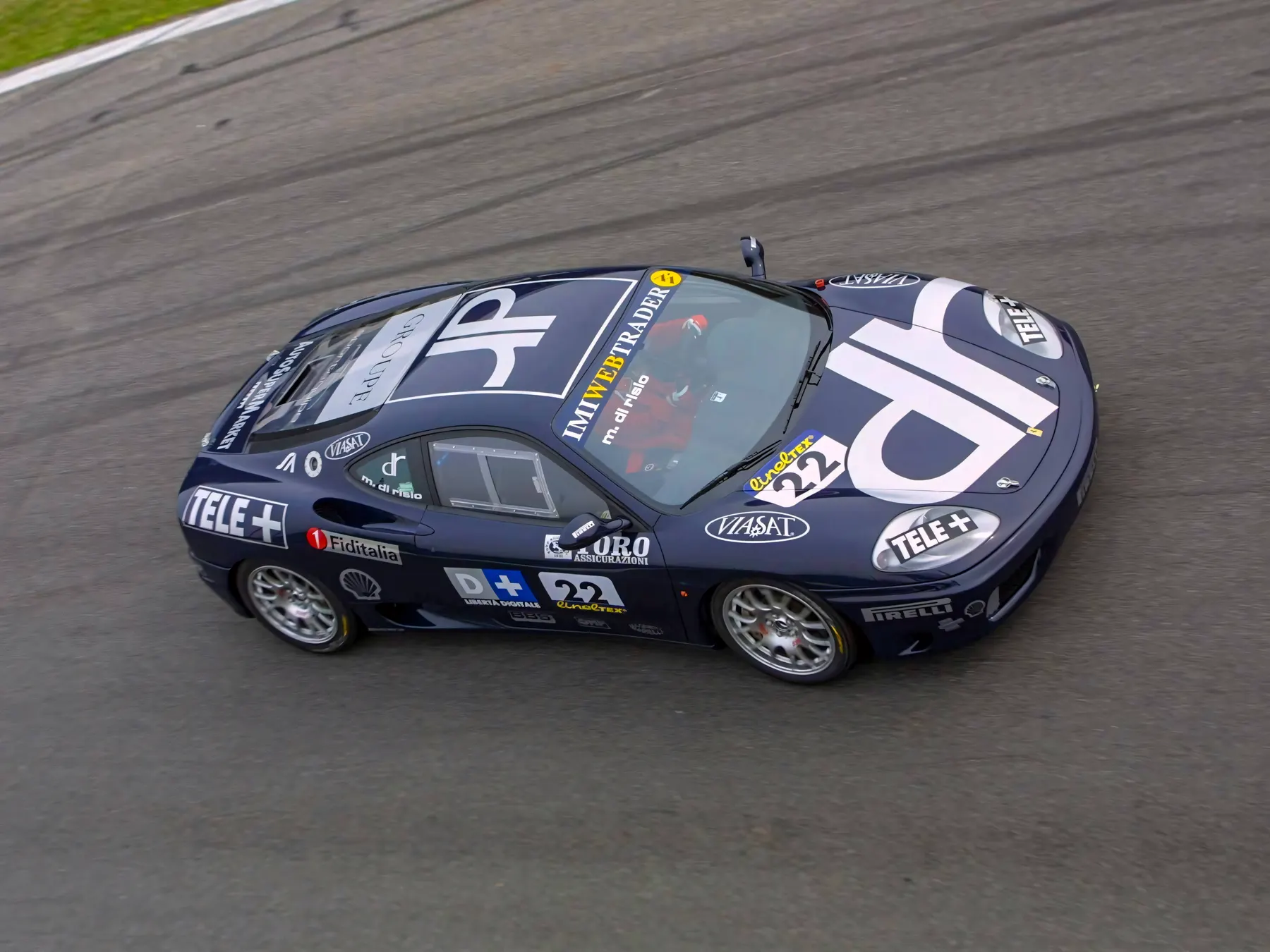
Retired cars have found a second life. They are no longer eligible for the modern Ferrari Challenge, but they turn up in Ferrari Club Racing, GT Cup, Britcar and AMOC events, as well as track days across Europe, and specialists describe them as an accessible way into a genuine factory Ferrari race car. That accessibility is relative, but it is telling that Motor Sport noted in 2019 how far Stradale prices had climbed, high enough to discourage hard track use, while the retired racers are still being used for exactly what they were built to do.
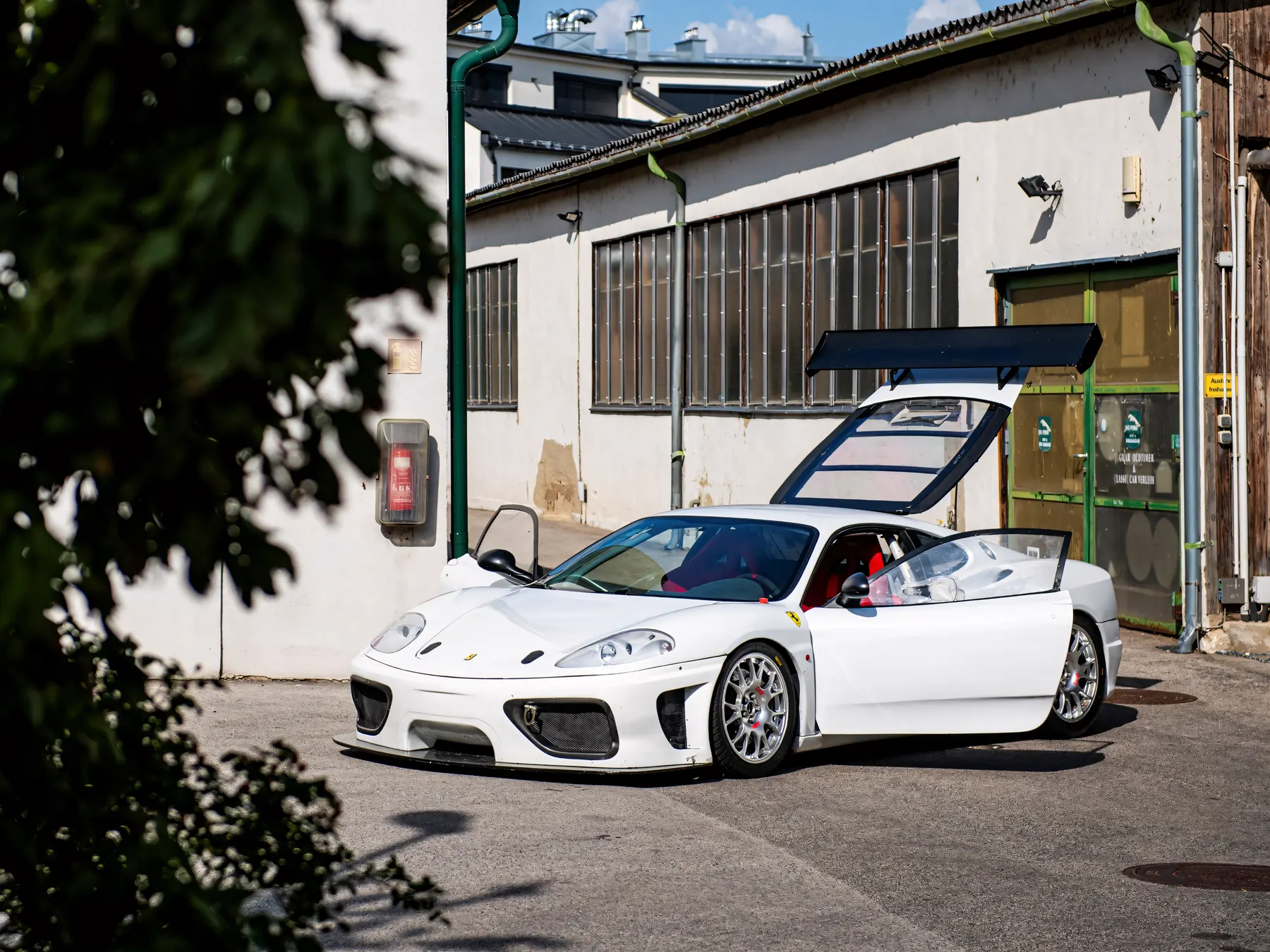
The 360 Challenge matters because it changed the contract between Ferrari and its customers. Before it, the factory supplied a kit and a series; after it, the factory supplied the race car itself, and Ferrari has kept the series going through the F430 Challenge and a succession of later cars, including the 296 Challenge. As an object, it is a road car’s bones with a race car’s noise, a gearbox that demands patience and a cabin you would not choose for a commute. The road car it came from took years to be loved, and PistonHeads has suggested its smooth lines may have blunted the emotional connection to what was then Ferrari’s most technically advanced road car. The racer was never going to have that problem. As a piece of Ferrari history it is more significant than its modest numbers suggest, because it was the first time Ferrari built a Challenge car as a car in its own right rather than as a conversion of something else.
Technical data
Performance Specifications
| 360 Modena (road car, reference) | 360 Challenge (one-make racer) | 360 Challenge Stradale (road car) | |
|---|---|---|---|
| Years | 1999 onwards | 2000-2005 in the Ferrari Challenge | 2003-2004 |
| Engine | 3,586 cc 90° V8, flat-plane crank | Same | Same |
| Bore x stroke | 85 x 79 mm | Same | Same |
| Power | 395 bhp at 8,500 rpm (Ferrari English-language material rounds to 400 bhp) | 400 bhp at 8,500 rpm (Ferrari); 410 bhp* quoted by several sale catalogues | 425 bhp at 8,500 rpm (Ferrari) |
| Torque | Around 275 lb-ft at 4,750 rpm | Not separately published by Ferrari in sources reviewed; 286 lb-ft* quoted in one catalogue | Same as Modena (Ferrari) |
| Mass | About 1,290 kg (implied by Ferrari’s 120 kg comparison) | 1,170 kg (Ferrari) | 110 kg lighter than Modena (Ferrari) |
| 0-62 mph | 4.5 seconds (Hagerty) | 3.9 seconds (Ferrari launch claim) | About 4.0 seconds (Hagerty) |
| Top speed | 183 mph (Hagerty) | Not published in sources reviewed | Not published in sources reviewed |
| Gearbox | Six-speed manual or F1 | F1 electro-hydraulic only (left-hand drive only) | F1 electro-hydraulic only |
| Brakes | Ventilated steel discs | Brembo, reported ~355 mm front, ~330 mm rear* | Brembo carbon-ceramic |
Sources
- Ferrari - 360 Challenge
- Ferrari Corse Clienti - Ferrari 360 Challenge back on track at Hungaroring
- Ferrari - Challenge Stradale
- Ferrari Corse Clienti - Ferrari Challenge 30th anniversary
- Motor Sport Magazine - Speedshop (December 2019)
- Speedhunters - Bought Not Built: Introducing Project 360
- Girardo & Co - 2003 Ferrari 360 Challenge
- RM Sotheby’s - 2004 Ferrari 360 Challenge
- Hagerty UK - Buying Guide: Ferrari 360 (1999-2004)
- Magneto - 1999-2005 Ferrari 360 supercar buying guide
- PistonHeads - Ferrari 360 manual spotted
- evo - Ferrari 360 Modena: key checkpoints when buying
- Supercars.net - 1999-2005 Ferrari 360 Modena
- Auto&Design - Ferrari 360 Modena: Svolta generazionale
- Supercar Nostalgia - Ferrari 360 Modena & 360 Spider: a Historical & Technical Appraisal
- Barrett-Jackson - 2000 Ferrari 360 Modena (model-level description)
- Petrolicious - Ferrari 360 Buying Guide
- Collecting Cars - 2002 Ferrari 360 Modena Challenge (model-level description)
- Car & Classic - 2002 Ferrari 360 Challenge (model-level description)
- Troostwijk Auctions - Ferrari 360 Challenge (model-level description)
- Iconic Auctioneers - Ferrari 360 Challenge race car (model-level description)
- Supercars.net - Ferrari 360 Challenge Stradale
- racecar.com - European Ferrari 360 Challenge Trofeo
- SB Race Engineering - Ferrari 360 Challenge
Join the discussion
Comments
Loading comments…
Leave a comment
Share a detail, memory, or perspective. Every comment is reviewed before publication.