Lincoln Model KB Convertible Victoria by Brunn: Edsel Ford's V12 Favourite
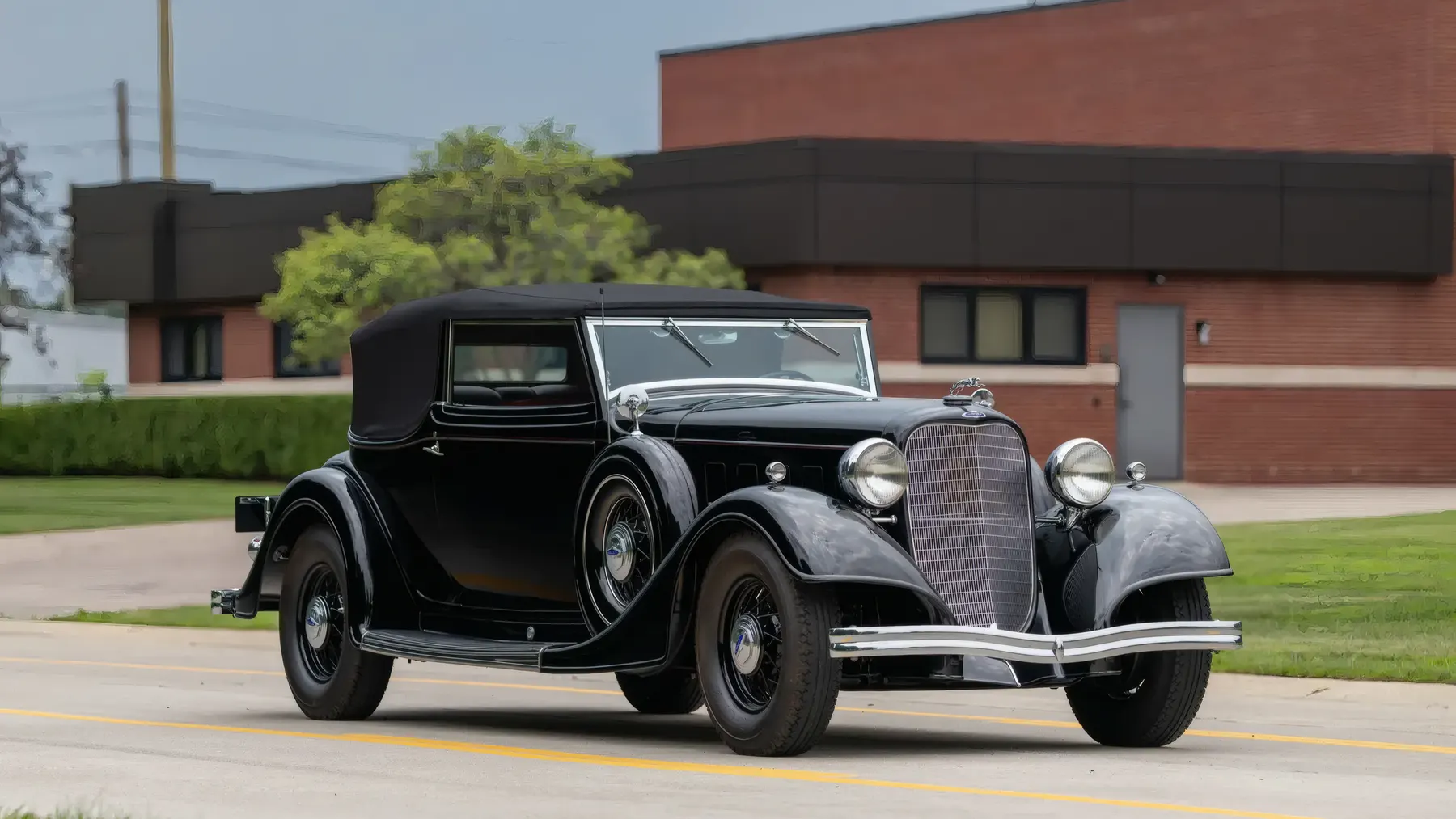
1934 Lincoln Model KB Convertible Victoria by Brunn




Images: Darin Schnabel / RM Sotheby's
Lincoln’s first V12 was engineered with a thoroughness its accountants could not afford, and the Brunn Convertible Victoria was the body that wore it best. The pairing only makes sense against the backdrop of 1932 and 1933, when Lincoln, a Ford subsidiary with Edsel Ford shaping its taste, was trying to keep pace with Cadillac, Packard, Pierce-Arrow and Marmon just as the market for very large, very expensive cars was collapsing. The Model KB was the flagship built for that fight, and the Convertible Victoria was among the most graceful, and most scarce, ways of ordering one.
Lincoln’s own history explains why a company in its position was attempting it at all. Henry Ford bought the Leland-founded firm in 1922 when it was teetering on the brink of failure and handed his son Edsel the job of turning it into a profitable luxury flagship. Edsel recognised that the marque’s conservative image needed shaking and pushed it towards offering semi-custom bodies directly from the factory alongside bare chassis for fully bespoke work. According to RM Sotheby’s, sales rose by about half within a year of his reorganisation. The Model K of 1931 carried that philosophy onto a new cruciform-braced chassis with a 3,683 mm wheelbase and a much lower stance, powered by a modernised V8 rated at 120 bhp. The KB’s V12 was the next escalation, arriving when rivals were already fielding twelves and sixteens.
A little nomenclature helps, because Lincoln’s naming was less tidy than it looks. In 1932 the Model K family split into the KA, on a shorter wheelbase of 3,454 mm, and the KB, on a 3,683 mm chassis that carried the new V12. Through 1932 and 1933 the KB’s engine was a 7.3-litre unit that shared little with the smaller V12 the KA received for 1933. For 1934 Lincoln standardised on a single 6.8-litre V12, and the KA and KB labels thereafter described only the wheelbase. “KB” therefore covers two distinct generations of engine under one badge, and a Brunn Convertible Victoria built in 1933 is mechanically a different animal from one built in 1934, even though the long chassis and the 150 bhp rating were common to both. A quick visual cue for 1932 cars: the KB wore a blue cloisonné badge where the KA had a red one, and its radiator shell was noticeably thinner.
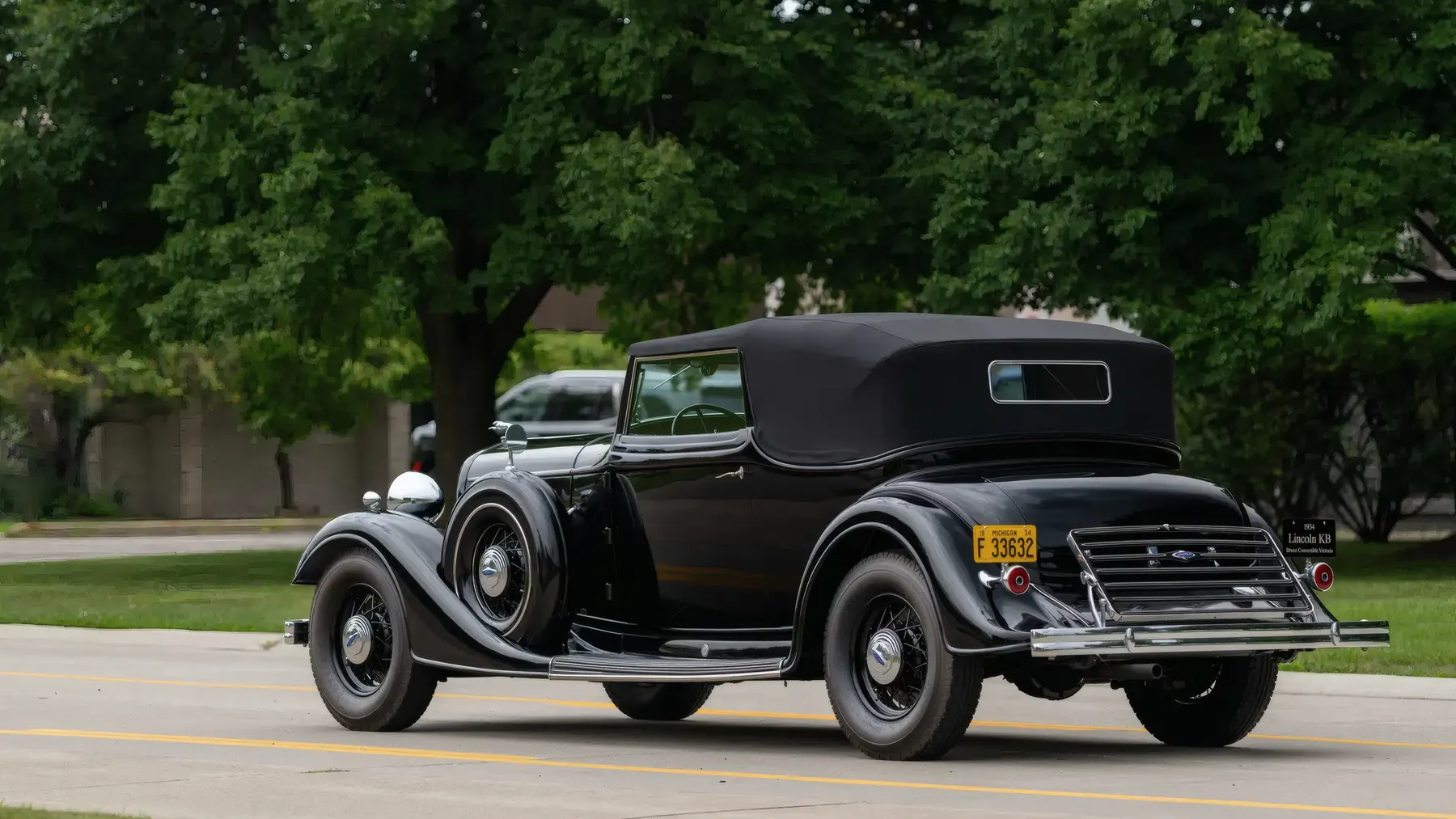
The Victoria itself was a two-door, five-passenger convertible. Lincoln’s 1933 catalogue listed the Brunn car as Style 260, a five-passenger convertible coupe, though the name American enthusiasts used then and still use is convertible Victoria. Brunn built fifteen in 1933 and perhaps half a dozen on the 1934 KB chassis, and RM Sotheby’s catalogue research, drawing on the marque’s roster keepers, puts the known survivors at three for each year. These were semi-custom cars rather than one-offs, part of a catalogue that in 1933 offered 26 KB body styles, seventeen of them from outside coachbuilders, yet saw only 533 cars delivered. For 1934 the KB catalogue was trimmed to 17 styles, and the five official coachbuilders between them produced just 159 semi-custom KBs. The Victoria was never going to be a volume proposition.
Seen against its catalogue siblings, the Victoria’s scarcity was typical of the KB’s open cars rather than exceptional. LeBaron’s Convertible Roadster, which RM Sotheby’s notes was not a true roadster but had a substantial top and wind-up side windows, was built, by RM Sotheby’s count, 125 times in 1932. Dietrich’s convertible sedan, with smoking sets and hassocks for the rear passengers, managed just fifteen in 1933, exactly matching the Brunn Victoria’s tally. The Victoria’s own pitch was five seats and a folding top behind only two doors.
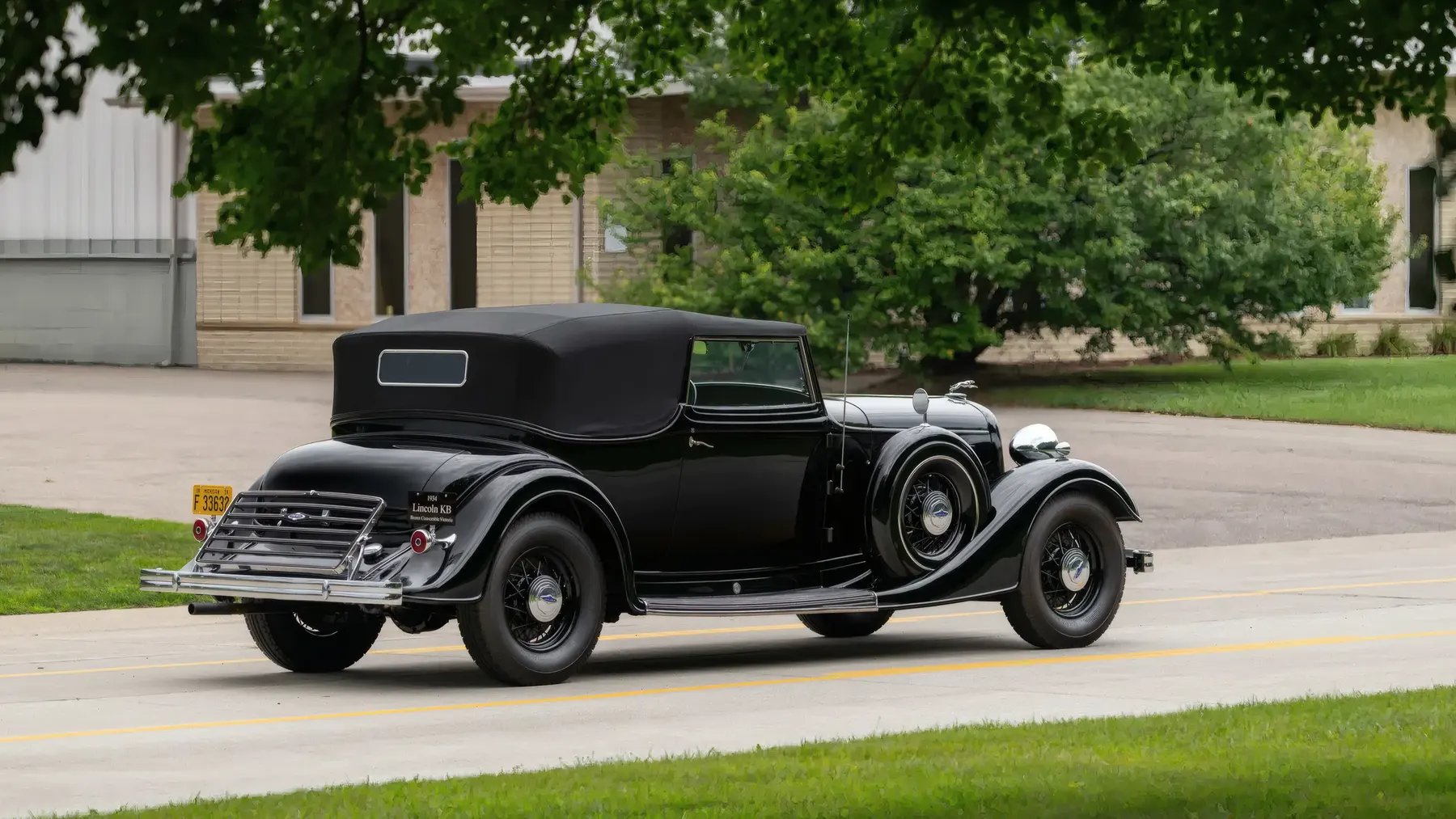
Brunn & Company of Buffalo, New York, was the natural house for it. Founded in 1908, the firm took Lincoln as its first corporate customer in Henry Leland’s day and kept the relationship when Ford took over, with the founder, Hermann A. Brunn, and Edsel Ford getting on famously. Edsel liked his suppliers to specialise. Judkins was given berlines and coupes, Willoughby the limousines and LeBaron the convertible sedans, while Brunn took town cars and convertibles: broughams, cabriolets, victorias and dual-cowl phaetons, which happened to be the styles Edsel favoured himself. At its peak Brunn employed some 150 craftspeople and turned out around twenty bodies a month, most of them for Lincoln, and the founder’s son, Hermann C. Brunn, had spent a year apprenticed to Kellner in Paris before joining the business. The bodies were built in Buffalo in small batches and sent to Detroit, where they were fitted to Lincoln chassis and finished to the customer’s specification. Brunn also built two of the four salon show cars Lincoln prepared for the KB’s 1932 launch, including a dual-windshield phaeton with windscreens raked at an extreme 45 degrees and a rear screen that cranked down into the back of the front seat. It was a reminder that Buffalo’s range stretched well beyond the Victoria.
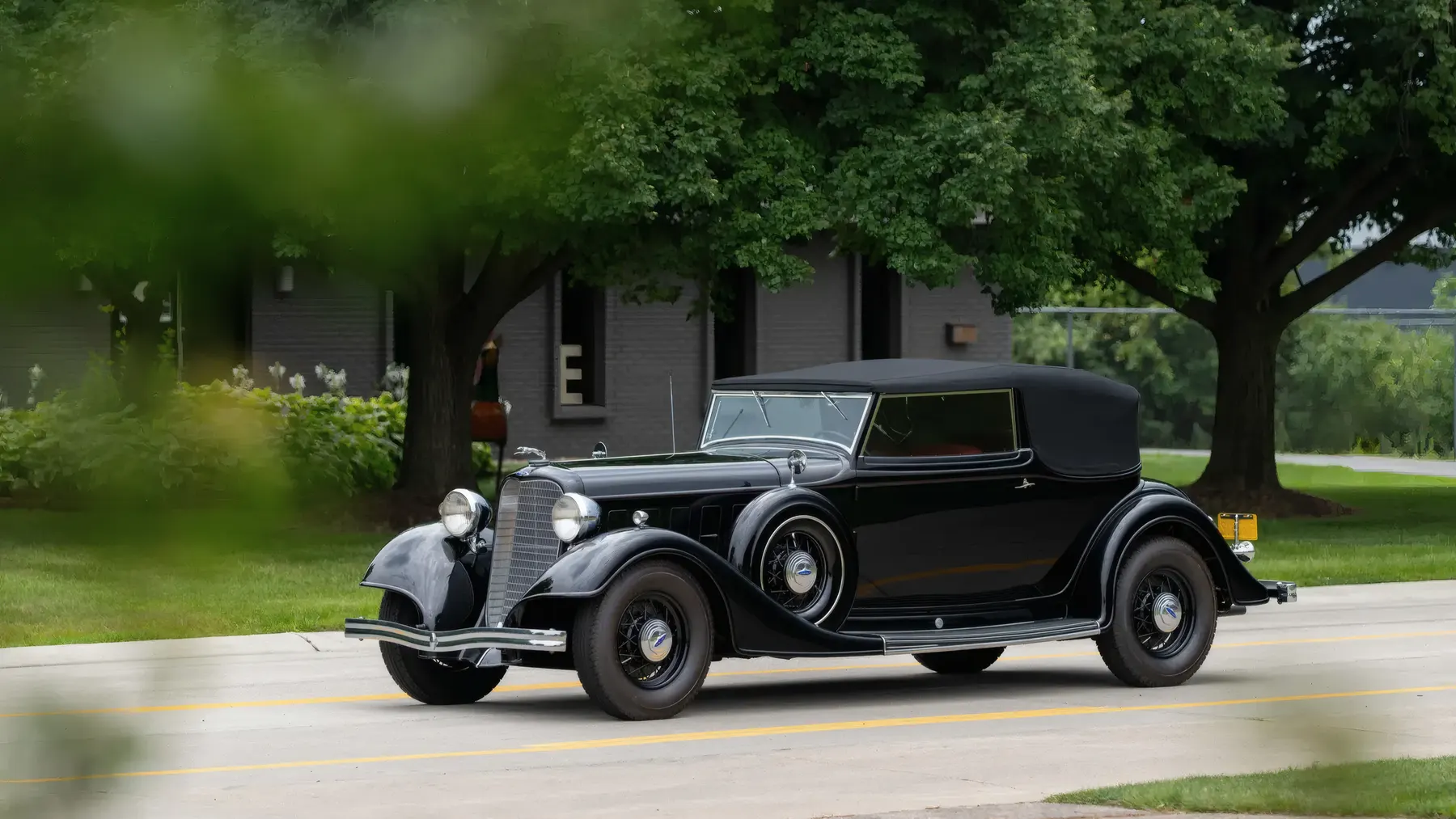
The engine is why the KB matters. It was a 65-degree side-valve V12 of 7.3 litres, and 150 bhp at 3,400 rpm is the figure the sources give consistently. That was 30 bhp more than the V8 that powered the 1931 Model K. Lincoln was not chasing specific output. It was chasing smoothness and a kind of mechanical pedigree: seven main bearings, a crankshaft that on its own weighed about 42 kg, separate cylinder blocks and, as a final nod to Henry Leland, fork-and-blade connecting rods. In that arrangement one rod straddles the other so that two cylinders can share a single crankpin bearing, which also reduces the offset between the cylinder banks. The KB was the last Lincoln engine to use the design. The whole unit weighed roughly 500 kg, and at 7.3 litres it was larger than any Lincoln engine built until the mid-1960s. A Stromberg downdraft two-barrel carburettor fed it, and the figure usually quoted for torque is 292 lb-ft at 1,200 rpm. That number comes from secondary sources and deserves some caution, but it squares with the tractable, torque-rich character that the car’s admirers describe.
The 1933 model year brought the changes that give the Convertible Victoria its look. Lincoln fitted a new cruciform double-drop frame, vacuum-booster brakes with adjustable assist, thermostatically controlled shock absorbers and a redesigned gearbox in which free-wheeling became optional. The frame mattered as much to style as to engineering, because it let the body sills curve low over the frame rails and echo the sweep of the running boards. Up front the radiator shell was raked back with grille work over thermostatically controlled shutters, the exposed horns disappeared behind it, and the headlights became free-standing. Skirted wings followed in late January 1933, with dealers told to fit them to unsold cars and to swap the wings free of charge on cars already delivered if customers asked. Underneath, the layout was conventional for the class: a solid front axle and live rear axle on semi-elliptic leaf springs, with mechanical drum brakes at all four corners.
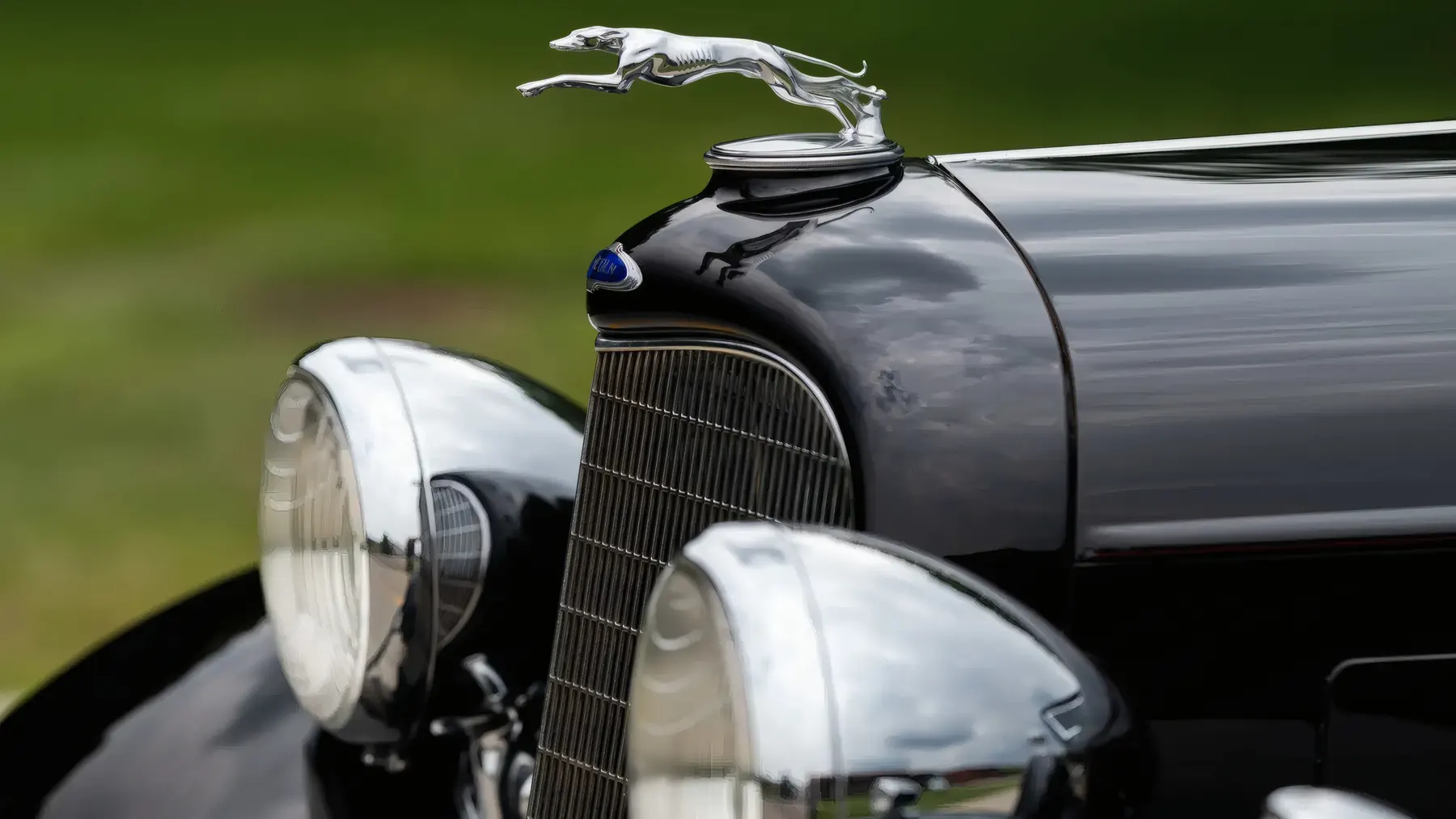
For 1934 the Victoria took on the new 6.8-litre V12, an enlarged version of the KA’s engine and rated at the same 150 bhp. RM Sotheby’s credits it with being cheaper for Lincoln to build while offering better torque, flexibility and fuel economy than the larger unit, which is a fair summary of why the company walked away from the fork-and-blade design after two model years. The 1934 cars also gained a new bonnet with five thermostatically controlled doors on each side and, as standard, a body-coloured grille shell, still topped by Lincoln’s greyhound mascot.
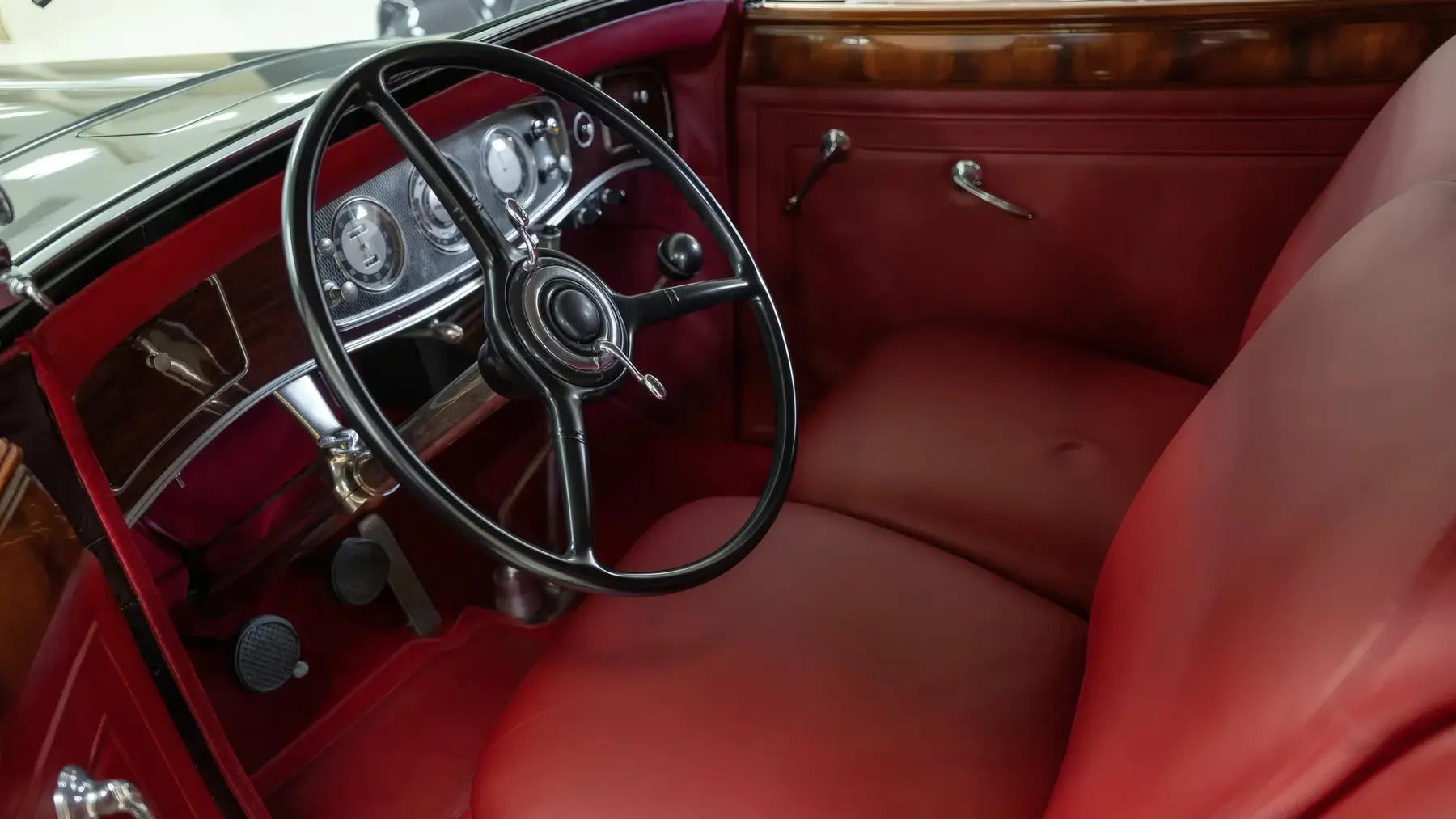
What the car was like to use has to be pieced together from catalogue descriptions and enthusiast accounts rather than period road tests, none of which surfaced in researching this piece. The picture that emerges is of a machine built for effortless, unhurried travel rather than sport. The low-speed torque, the free-wheeling that allowed clutchless changes between second and top (synchromesh and free-wheeling had both arrived with the 1931 Model K), and the adjustable vacuum assistance on the brakes all point the same way: a heavy car made easy to drive. A documented 1933 KB dual-cowl phaeton was catalogued at about 2,500 kg, and other sources put KBs higher, so weight varies by body, and no verified figure for the Brunn Victoria specifically turned up. The same caution applies to top speed. Dealer copy repeats a figure of around 100 mph, but without a period test or factory document that is a claim, not a measurement.
None of this makes the KB Convertible Victoria a flawless machine, and its weaknesses were real in period as well as in hindsight. The deepest was financial. The V12 was so costly to build that Lincoln replaced it after two years, and the Victoria stacked a coachbuilt body on top of that expensive chassis. RM Sotheby’s notes that the sportier open styles sold in minuscule numbers precisely because of their price, so the Victoria was a prestige exercise rather than a product that could ever be scaled up. Mass was the second problem. At roughly 2,500 kg or more, the KB asked a great deal of its brakes. Auction copy credits the adjustable booster with making light work of stopping the car, but mechanical drums on a machine of this mass remained a limitation of the era. The engine’s efficiency is also open to question. At about 20 bhp per litre, the 7.3-litre side-valve KB was out-gunned in specific output by Cadillac’s overhead-valve V12, which managed 135 bhp from roughly 6.0 litres, or about 22 bhp per litre, so Lincoln’s extra capacity bought smoothness and torque rather than genuine efficiency. And the timing could hardly have been worse: the KB’s 1933 catalogue ran to 26 body styles, yet only 533 cars found buyers. Lincoln’s entire output for 1934, across every model, was just 2,149 cars.
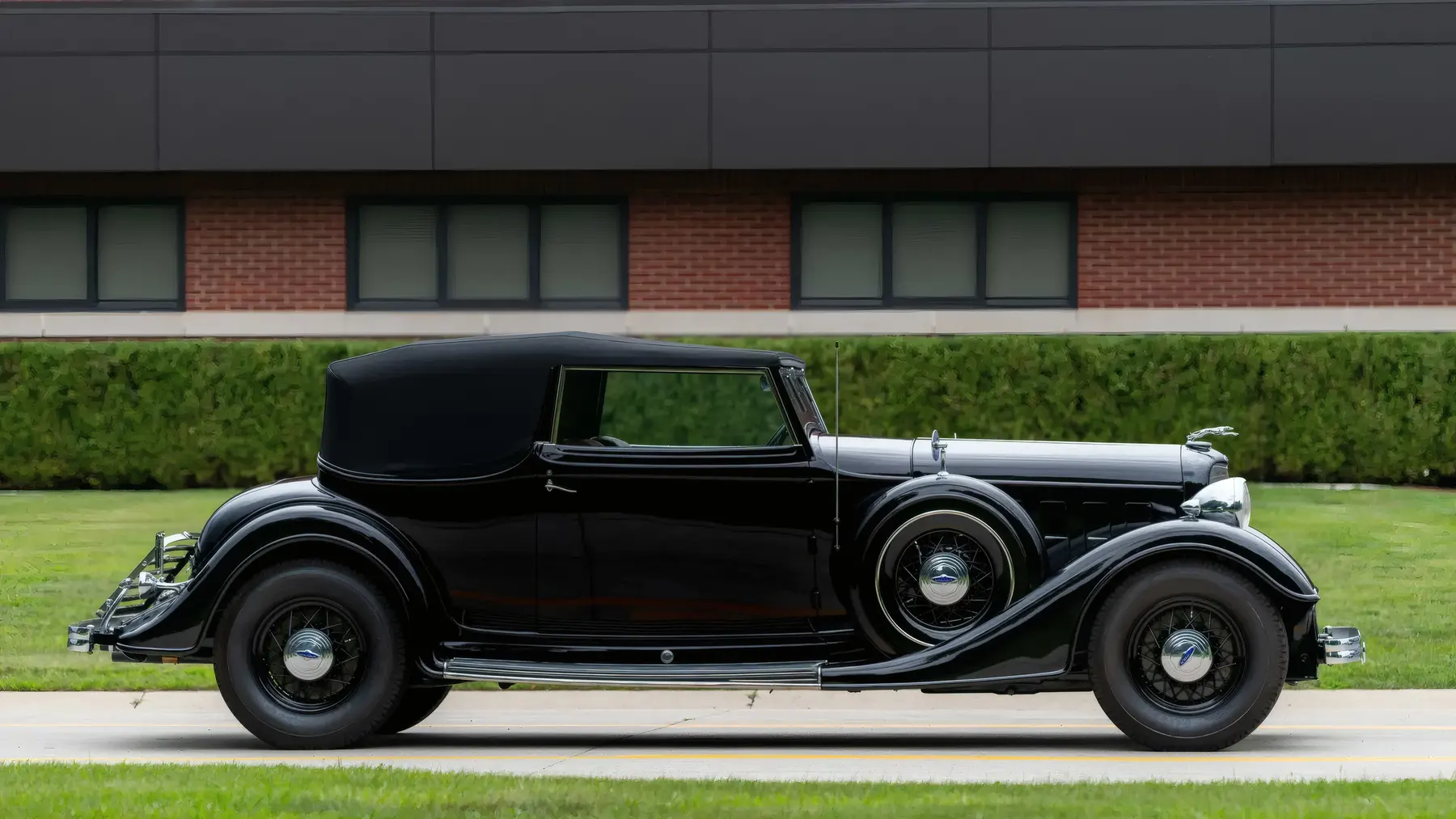
Today the Brunn Convertible Victoria occupies a rarefied corner of the Classic Car Club of America’s Full Classic world, a status the KB line as a whole enjoys. Catalogue writers and dealers routinely single out the Victoria as among the most attractive bodies on the KB chassis, a judgement that is hard to dispute given how cleanly the low sills, raked radiator and folded top resolve into one shape. Rarity compounds the appeal: three known survivors from fifteen cars in 1933, and three from perhaps six in 1934. Brunn kept the style going on later Model K chassis, building ten in 1936, thirteen in 1937 and eight in 1938, but those rode on shorter wheelbases in at least the 1936 and 1938 cases and arrived as Lincoln’s attention was shifting towards the Zephyr. The 1936 cars brought pontoon-style wings, pressed-steel wheels and lowered headlamps, a sign of how quickly fashion was moving on from the KB’s proportions. The long-wheelbase KB version belongs to the last moment when Lincoln could still behave like Henry Leland’s company inside a Ford-owned suit, over-engineering the mechanicals and hand-finishing the body regardless of cost. That is why it is admired, and also exactly why so few were ever made.
Technical data
Performance Specifications
| Specification | 1933 Model KB Brunn Convertible Victoria | 1934 Model KB Brunn Convertible Victoria |
|---|---|---|
| Brunn Convertible Victoria built | 15; three known to survive | Perhaps six*; three known to survive |
| Engine | 65-degree L-head V12, seven main bearings, fork-and-blade connecting rods | L-head V12, enlarged KA-type unit |
| Displacement | c. 7.3 litres (447.9 cu in) | c. 6.8 litres (414 cu in) |
| Power | 150 bhp at 3,400 rpm | 150 bhp (engine speed not corroborated) |
| Torque | 292 lb-ft at 1,200 rpm† | Not corroborated; omitted |
| Transmission | Three-speed manual; free-wheeling optional | Three-speed manual‡ |
| Wheelbase | 3,683 mm | 3,683 mm |
| Weight | c. 2,500 kg§ | Not corroborated; omitted |
| Brakes | Four-wheel mechanical drums, adjustable vacuum booster | Not separately corroborated |
| Suspension | Solid front axle, live rear axle, semi-elliptic leaf springs | Not separately corroborated |
| Top speed | Not verified; c. 100 mph claimed in dealer copy§§ | Not verified |
Sources
- RM Sotheby’s – 1934 Lincoln Model KB Convertible Victoria by Brunn (Hershey 2024)
- RM Sotheby’s – 1933 Lincoln KB Five-Passenger Convertible Coupe by Brunn (St. John’s 2011)
- RM Sotheby’s – 1932 Lincoln Model KB Dual-Windshield Phaeton by Brunn (Hershey 2015)
- RM Sotheby’s – 1936 Lincoln Model K Convertible Victoria by Brunn (Hershey 2013)
- RM Sotheby’s – 1938 Lincoln Model K Victoria by Brunn (Hershey 2022)
- RM Sotheby’s – 1937 Lincoln Model K Convertible Victoria by Brunn
- RM Sotheby’s – 1933 Lincoln Model KB Convertible Sedan by Dietrich (Amelia Island 2012)
- RM Sotheby’s – 1932 Lincoln KB V-12 (Hilton Head 2016)
- RM Sotheby’s – 1932 Lincoln Model KB Convertible Roadster by LeBaron (Hershey 2025)
- RM Sotheby’s – 1934 Lincoln Model KB Convertible Roadster by LeBaron (Arizona 2012)
- Christie’s – 1933 Lincoln Model KB Dual Cowl Phaeton (Browning Estate)
- ConceptCarz – Lincoln Model KB
- Wikipedia – Lincoln K series
- Unique Cars and Parts – Lincoln KB Convertible (dealer page; used only to note the unverified speed claim)
Join the discussion
Comments
Loading comments…
Leave a comment
Share a detail, memory, or perspective. Every comment is reviewed before publication.