Mercedes-Benz W187 220 Coupé: A Pre-War Shape for a New Elite
1954 Mercedes-Benz 220 Coupé

Images: RM Sotheby's
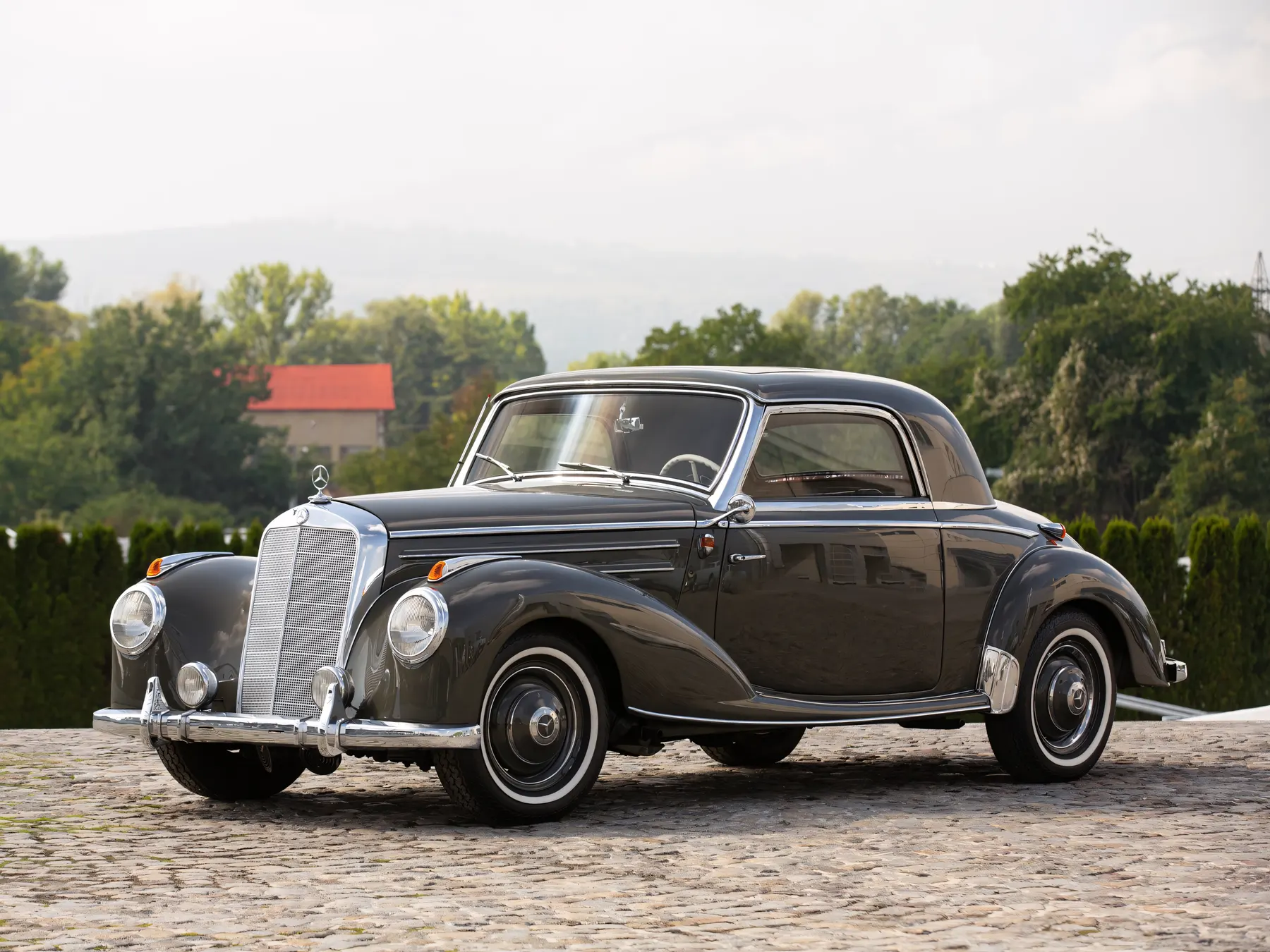
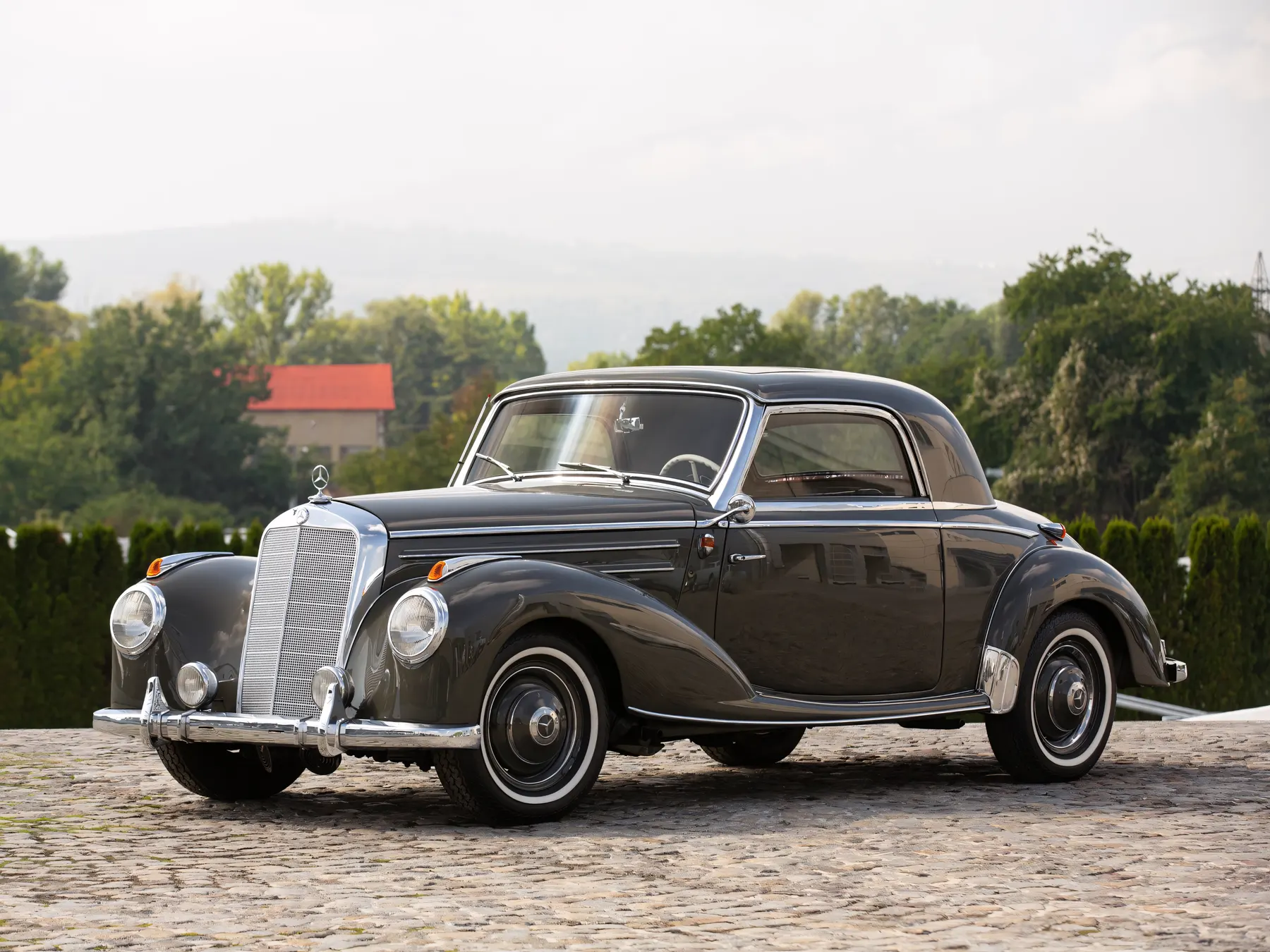
Mercedes-Benz did something quietly perverse with the 220 Coupé: it wrapped the costliest, most exclusive body in the entire 220 range around a shape its own engineers already knew was out of date, then asked buyers to pay nearly double what the saloon cost for the privilege.
The car arrived in December 1953, tacked onto the tail end of a model line that had launched two and a half years earlier at the 1951 Frankfurt Motor Show. That original W187 220, shown alongside the flagship 300 “Adenauer” (W186), marked something genuinely important for Mercedes-Benz: the company’s return to six-cylinder passenger cars after several years of building nothing but four-cylinder economy models in postwar West Germany. The 220 and 300 were the first Mercedes sixes since the war, and for a manufacturer whose pre-war reputation rested heavily on multi-cylinder refinement, that mattered enormously to how the company wanted to present its own recovery.
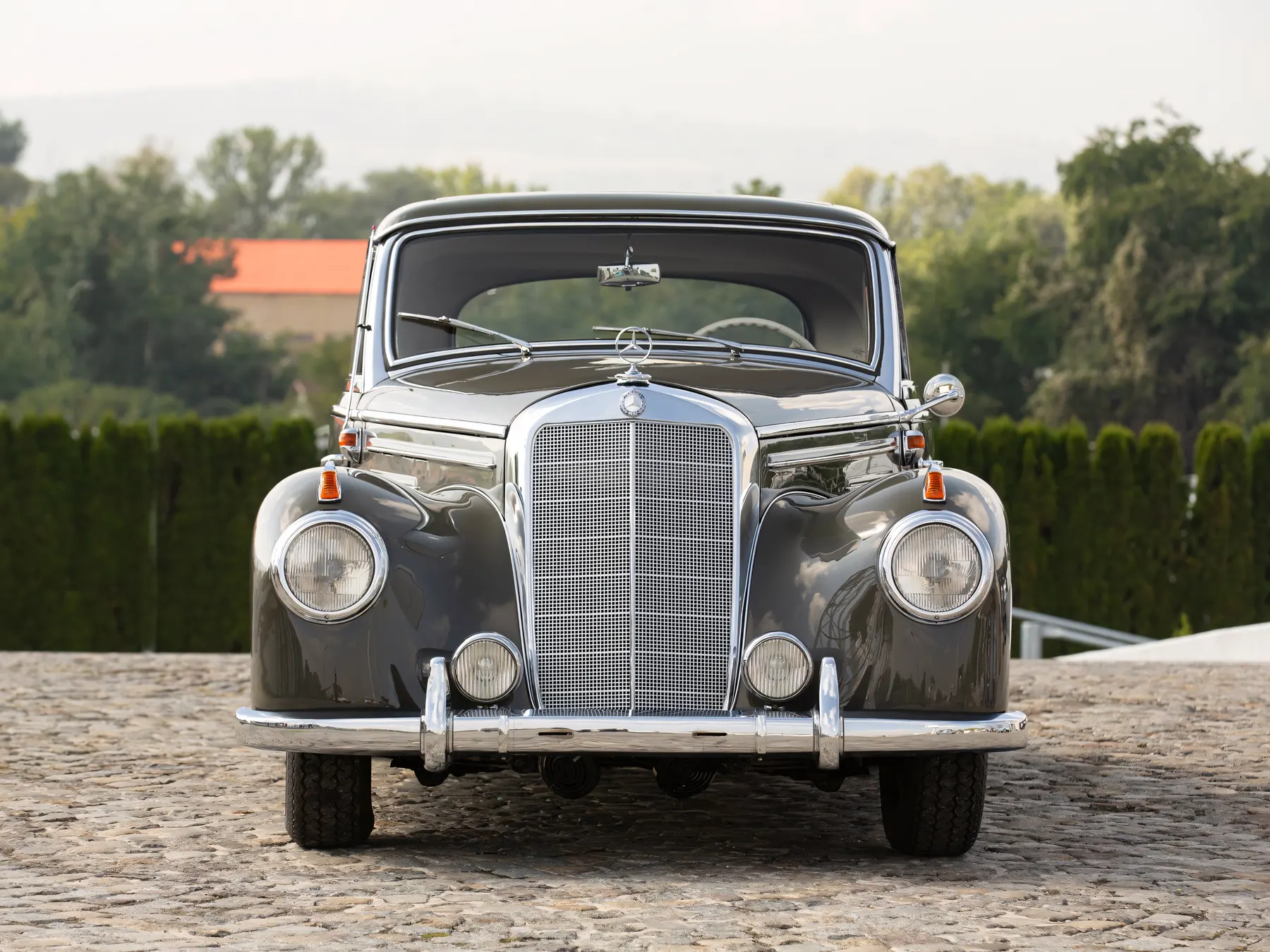
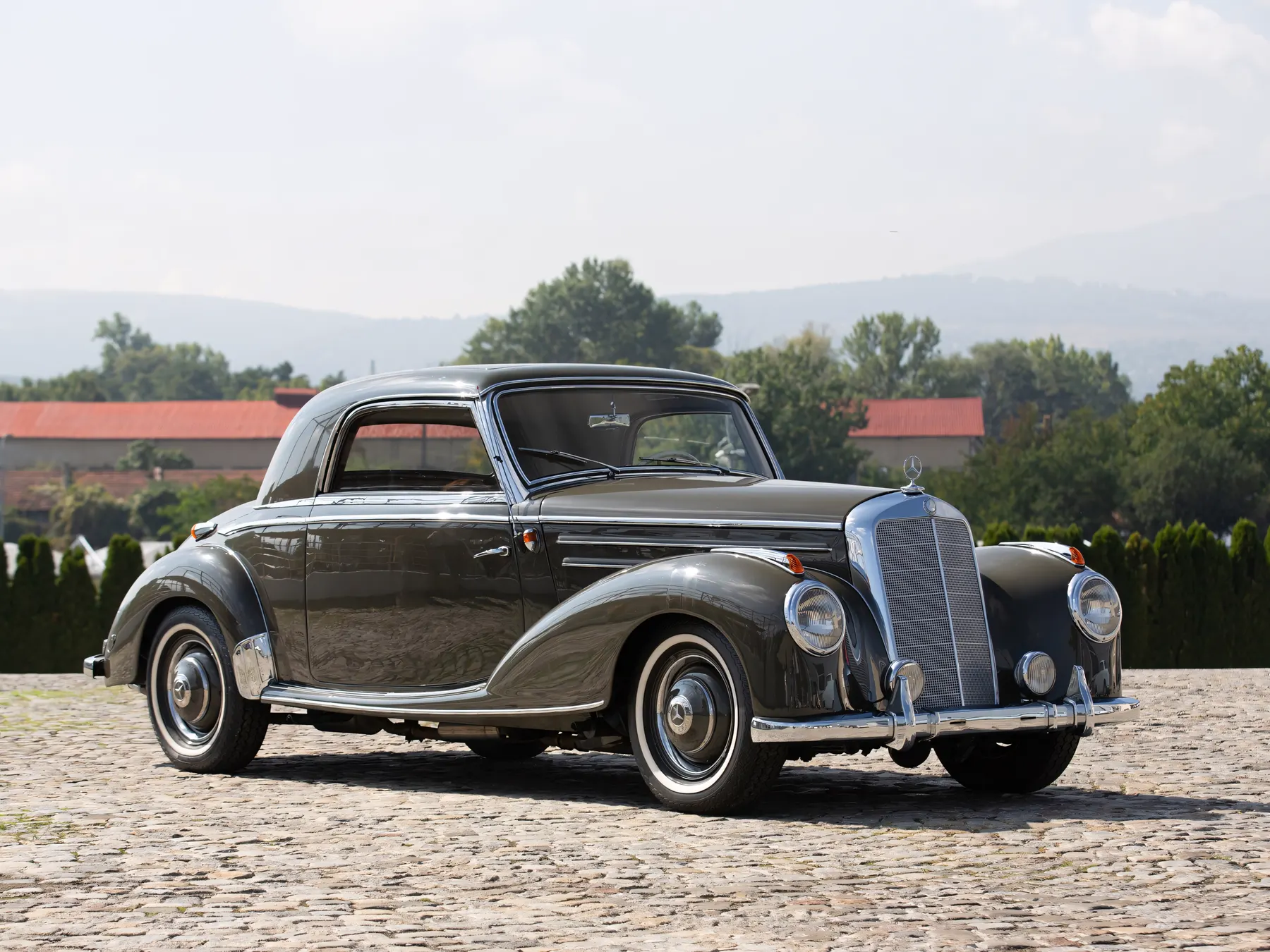
The saloon did the heavy commercial lifting, priced at DM 11,925 and positioned as the accessible end of the six-cylinder range. Two open variants followed a format Mercedes had already used on the smaller 170 series: a lavish two-seat Cabriolet A, priced at DM 18,860 and aimed at wealthy private buyers who wanted the most expensive and best-trimmed open Mercedes money could buy, and a plainer, more practical four-seat Cabriolet B at DM 15,160 that shared most of its style with the saloon. The pricing ladder makes the coupé’s position obvious at a glance: at DM 22,000, it sat above even the flagship Cabriolet A, making it the single most expensive way to buy a 220 badge. A further, unrelated niche variant appeared too: a small run of 41 open-topped OTP touring cars built for the West German police between August 1952 and May 1953, a reminder of how widely Mercedes was prepared to stretch the same running gear. Then, in December 1953, with the saloon and Cabriolet B both about to be discontinued, Mercedes added a fourth 220 body: a steel-roofed coupé built on the Cabriolet A’s shorter, close-coupled two-door structure. It turned out to be the rarest 220 of them all, and by some distance the most expensive.
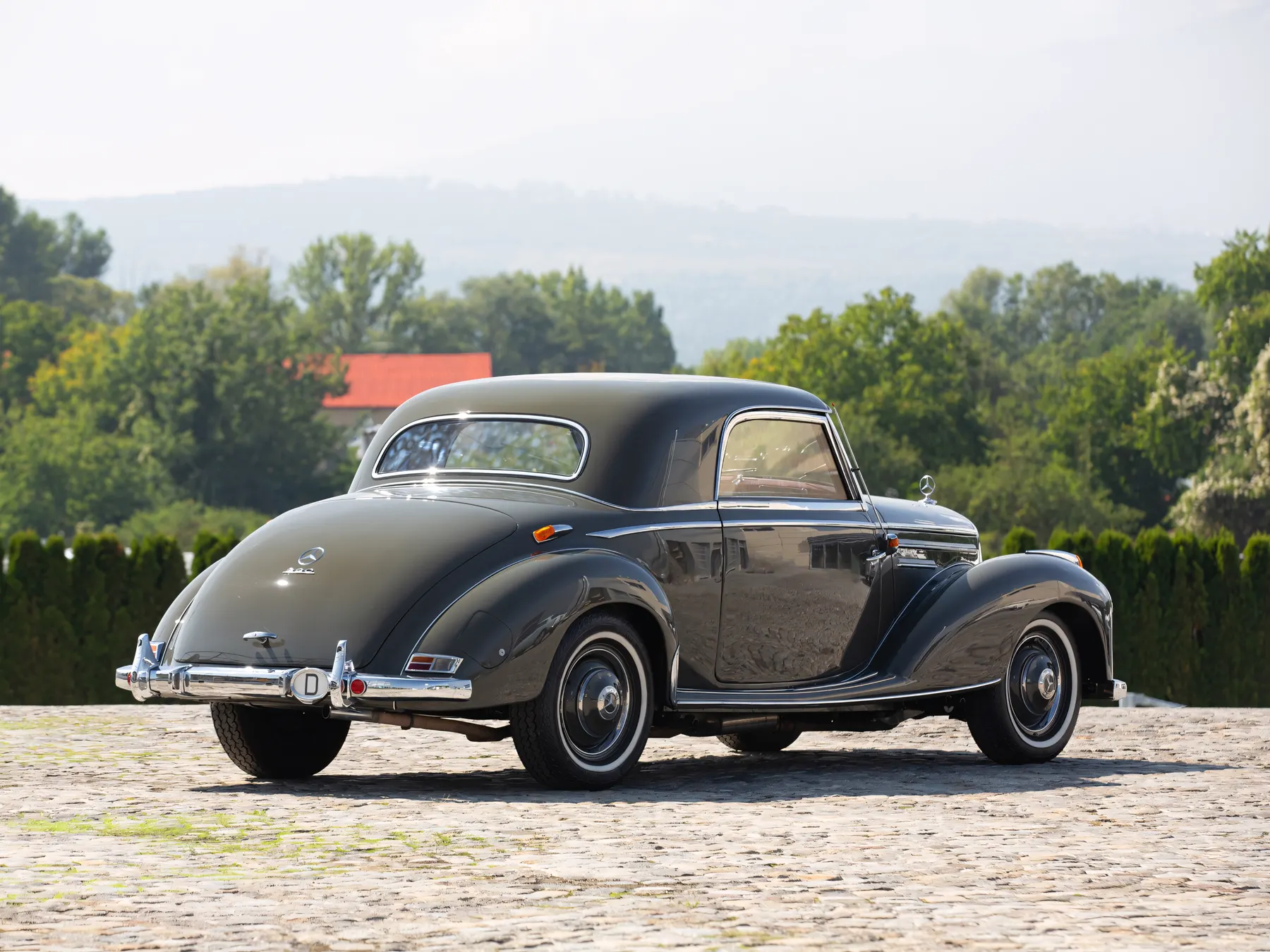
None of this happened in a vacuum. The 220’s body, cabin, and platform trace almost directly back to the 170S (W191), itself little more than the 1938-vintage W153 reheated with a four-cylinder engine. The main visual difference between the 220 and the smaller 170S was that the 220’s headlamps were faired into the front wings rather than sitting freestanding on stalks - a modest styling update wrapped around an essentially pre-war silhouette, with tall doors and upright glass that had more in common with the 1930s than the 1950s. Contemporary observers noticed at the time, and retrospective assessments have kept making the same point since: the W187 was criticised in period for clinging to traditional looks, with the faired-in headlamps standing as more or less the only visible concession to the new decade. Two years before the 220 appeared, the Borgward Hansa had already shown German buyers what a genuinely modern, low, wide envelope-bodied saloon could look like, and Mercedes’ own 180 “Ponton” - a unitary-construction, low-waisted design that arrived in 1953, a year before the coupé itself went on sale - made the point even more directly. The 220 Coupé, in other words, reached the market at almost exactly the moment its own maker’s engineering department had already moved on from the platform it sat on.
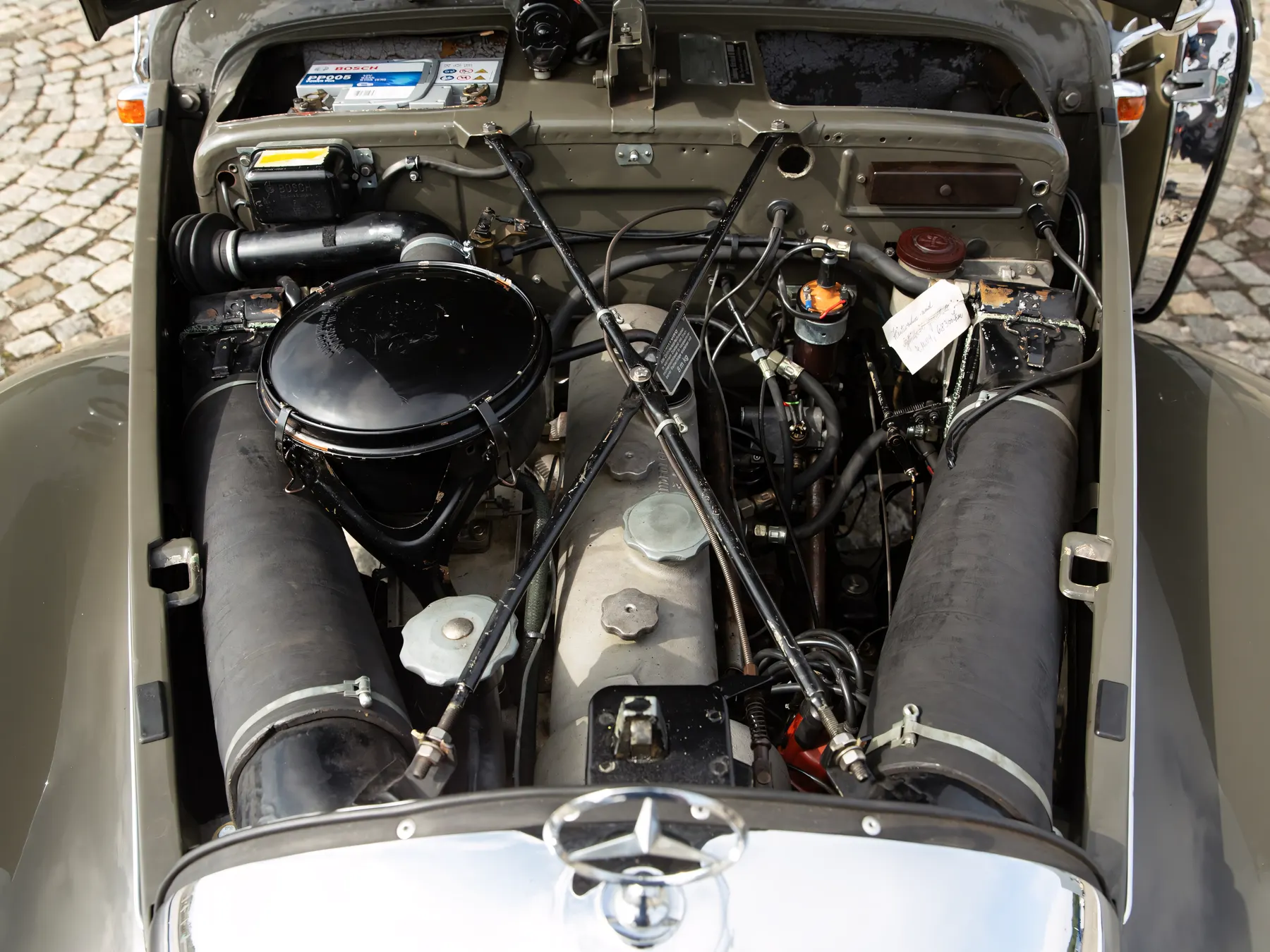
What justified the deception was hidden underneath the old-fashioned skin. The 220 range used the new M180, a 2,195cc single-overhead-camshaft straight six and the first genuinely new engine Mercedes-Benz had presented in more than a decade. It was unusual for a European engine of its era in being oversquare - a bore of 80.0mm against a stroke of just 72.8mm - a layout that allowed a compact, efficient reverse-flow cylinder head and let the unit rev more freely than the long-stroke sixes most contemporaries were still building. In its original form, fed through a single two-barrel Solex downdraft carburettor on a modest 6.5:1 compression ratio (postwar European fuel quality left little choice), it produced 79bhp at 4,850rpm and 105 lb-ft of torque at 2,500rpm - enough, Mercedes claimed, for a saloon top speed of around 87mph and a Cabriolet A closer to 90mph, figures the coupé, sharing the Cabriolet A’s driveline, would have matched closely. From April 1954, Mercedes fitted the Cabriolet A and Coupé with a higher-compression, 84bhp evolution of the same engine - one developed originally for the forthcoming Ponton-based 220a - giving the two most expensive body styles a useful, if modest, edge over the saloon they had effectively replaced in the range.
The running gear beneath the coupé was inherited wholesale from the pre-war-designed W153: an oval-section tubular X-frame chassis carrying double wishbones and coil springs at the front, and a high-pivot swing axle, also on coil springs, at the rear. It was advanced for 1938 and still entirely respectable in 1954, but it was also, by then, a decade and a half old in its fundamentals. Front brakes were upgraded to duplex drums specifically to cope with the extra weight and power the six-cylinder engine had added over the four-cylinder 170 the chassis was originally designed around. Drive went through a four-speed manual gearbox with a column-mounted lever - there was no automatic option anywhere in the 220 range, at a time when American luxury buyers, and increasingly some European ones too, were beginning to expect one - and the whole car ran on a 6-volt electrical system.
Inside, the coupé was trimmed to match its price: full leather, generous wood veneer across the dashboard and window surrounds, and, on twelve of the eighty-five cars built, an optional sliding steel sunroof - the first time Mercedes-Benz had offered such a feature on a production model. Beyond the column-mounted gear lever, little about the cabin would have surprised a pre-war Mercedes owner, though the fit and finish were a clear step up from the four-cylinder cars in the range below it; this was never an austere car in the way some later German saloons would be. By contemporary accounts the overall effect was of a quiet, beautifully finished car that rode and cruised with real dignity; the six-cylinder engine’s biggest contribution wasn’t outright pace but smoothness, isolating occupants from the mechanical harshness that four-cylinder Mercedes models of the period couldn’t fully disguise.
None of that made the 220 Coupé a genuinely quick or modern car, and it’s worth being honest about where it fell short. Loaded weight across the closely related Cabriolet A and Cabriolet B sat between roughly 1,680kg and 1,785kg; the coupé, sharing the Cabriolet A’s structure, would have weighed in around the same region, which is a great deal of car to move with 79 or even 84bhp. Contemporary comparisons made the point bluntly: one retrospective of the Cabriolet A noted that its period performance was roughly on par with a Porsche 356 1300- a far smaller, far lighter, four-cylinder sports car costing a fraction of the price. For a coupé priced at 22,000 Marks, nearly double the 11,925-Mark standard saloon, that was a hard trade to justify on outright ability alone. The old-fashioned bodywork compounded the problem: buyers paying the highest price in the entire 220 range were, in engineering terms, buying the least modern structure Mercedes still sold, a design whose lineage ran back through the 170S to a shape first seen on the 1938 W153, at the exact moment the company’s own Ponton generation was demonstrating a genuinely modern alternative. Add drum brakes all round, no automatic gearbox, and a 6-volt electrical system already looking dated next to what some rivals were adopting, and the coupé reads less like a technical flagship than an extremely well-finished, extremely expensive way of buying exclusivity and craftsmanship rather than outright modernity. Mercedes itself seemed to understand this: it built just 85 of them across roughly twenty months of availability, a production run so small that the coupé functioned closer to a specialist commission than a mainstream model, generating a fraction of the volume - and presumably the profit - of the saloon it was derived from.
Commercially, the wider numbers tell their own story. Mercedes built 16,154 of the 220 saloon between 1951 and 1954, plus 1,278 Cabriolet As and 997 Cabriolet Bs across the wider run - respectable figures for a small, wealthy postwar market, even if they were dwarfed by contemporaries such as Citroën’s 15-Six, which sold more than 30,000 units over a comparable span; closer to home, BMW’s rival six-cylinder 501 managed roughly half the 220 saloon’s volume in the same window, a reminder that even qualified success in this class was hard won in a West Germany still short on disposable income. Export volumes were modest too: German luxury cars struggled internationally in the early 1950s, and only a few hundred Mercedes-Benzes reached American buyers in 1952, even as the marque was already quietly building a following in Asia, the Middle East, and South America. Against that backdrop, the coupé’s 85 units were a rounding error, and its role in the story was never really about sales. When Cabriolet A and Coupé production finally ended in August 1955, Mercedes was left, briefly, without any open or coupé six-cylinder model in its range at all; the Ponton-based 220S Cabriolet and Coupé did not arrive until July and October 1956 respectively, on a completely new unitary structure that made the W187 look every bit as antiquated as critics had said it was back in 1951. What did carry forward, largely unchanged in principle, was the M180 engine itself - a unit Mercedes kept enlarging and refining for decades afterward, eventually powering models as late as the early W116 S-Class line in the 1970s.
That’s really the honest way to understand the 220 Coupé: not as a great driver’s car, or even as a particularly forward-looking one, but as an unusually candid snapshot of a manufacturer caught mid-transition, still selling yesterday’s silhouette to help fund tomorrow’s engineering. Its real significance was never in the eighty-five bodies Sindelfingen built, but in the engine hiding underneath them - the first genuinely new Mercedes-Benz six of the postwar era, dressed, for a little while longer, in a coat its own maker already knew was out of fashion.
Technical data
Specifications
| Specification | Detail |
|---|---|
| Engine | M180, 2,195cc SOHC inline six, oversquare 80.0mm x 72.8mm bore/stroke |
| Power, 1951-54 engine | 79bhp @ 4,850rpm |
| Power, Coupé/Cabriolet A from April 1954 | 84bhp (higher-compression evolution) |
| Torque, 1951-54 engine | 105 lb-ft @ 2,500rpm |
| Compression ratio | 6.5:1 (early engine) |
| Fuel system | Single Solex 30PAAJ two-barrel downdraft carburettor |
| Transmission | 4-speed manual, column shift, rear-wheel drive |
| Front suspension | Double wishbones, coil springs, anti-roll bar |
| Rear suspension | High-pivot swing axle, coil springs |
| Brakes | Duplex front drums, drum rear |
| Wheelbase | 2,845mm |
| Kerb weight, Coupé (estimated)* | approx. 1,680-1,785kg, based on Cabriolet A/B |
| Top speed (estimated for Coupé)† | approx. 87-90mph |
| Coupé production | 85 units, December 1953-August 1955 |
| Coupé launch price | DM 22,000 |
| Total W187 production, all body styles | 18,514 (Saloon 16,154 / Cabriolet A 1,278 / Cabriolet B 997 / Coupé 85) |
Sources
- Wikipedia: Mercedes-Benz W187
- Wikipedia: Mercedes-Benz W180
- RM Sotheby’s: 1954 Mercedes-Benz 220 Coupe (Munich, model background)
- Bonhams: 1955 Mercedes-Benz 220 Coupé (model background)
- Curbside Classic: 1953 Mercedes-Benz 220 (W187) – Transition to Greatness
- Classic Driver Market: 1951 Mercedes-Benz 220 Cabriolet A (W187)
- Classic.com: Mercedes-Benz 220 Coupe – W187 Market
- Hagerty Valuation Tool: 1958 Mercedes-Benz 220S Base
Join the discussion
Comments
Loading comments…
Leave a comment
Share a detail, memory, or perspective. Every comment is reviewed before publication.