Ferrari 500 TR: The Four-Cylinder Spider Behind the Testa Rossa Name
1956 Ferrari 500 TR Spider by Scaglietti





Images: Tim Scott / RM Sotheby's
Every great Ferrari name has to start somewhere, and the most enduring one in the company’s history began as a workshop detail rather than a marketing decision. When Ferrari’s engineers reworked their two-litre four-cylinder sports racing engine for 1956, they finished its cam covers in a crackle-textured gloss red rather than the usual unpainted alloy. Mechanics started calling the resulting car testa rossa - red head - and the name outgrew its modest carrier almost immediately. Unveiled in April 1956 as the 500 TR, the car that actually earned the name was a lightweight, four-cylinder privateer’s racer built in a run of just seventeen examples, sold mostly to Ferrari’s paying customers rather than reserved for the works team. That contradiction, a low-key customer car with a headline-grabbing name, has shadowed it ever since, even as “Testa Rossa” went on to grace some of the most celebrated Ferraris ever built.
The 500 TR did not appear from nowhere. Its engine traced back to Aurelio Lampredi, better remembered for the V12 that carried Ferrari to victory at the 1954 24 Hours of Le Mans, but also the designer of a four-cylinder unit that had powered Ferrari to back-to-back Formula Two World Championships in 1952 and 1953 before being adapted for sports car duty in the 500 Mondial and 750 Monza. That engine’s high-revving, lightweight character made it a formidable weapon on shorter, twistier circuits, where it could out-accelerate heavier V12-engined opposition through the turns even while giving away outright speed on the straights. By 1956, though, even updated Series II Mondials had been comprehensively outclassed by Maserati’s brilliant A6GCS in the fiercely contested two-litre sports category, and Enzo Ferrari needed a fix. He turned to Vittorio Jano, the celebrated engineer whose early work at Alfa Romeo had made his name before a long spell at Lancia; hired away from Lancia for 1956, Jano led a team that included Alberto Massimino, Luigi Bellentani and the young Andrea Fraschetti in reworking Lampredi’s four-cylinder design into a more serious sports-racing engine.

Badged internally as the Tipo 131, the reworked engine kept its predecessor’s basic 90mm bore and 78mm stroke but gained a revised cylinder head, a strengthened bottom end and improved connecting rods, and displaced 1,985cc in twin-overhead-camshaft, two-valve-per-cylinder form. Fed by twin Weber 40 DCOA3 carburettors and running an 8.5:1 compression ratio, it produced 180bhp at 7,000rpm - enough, in a car claimed to weigh just 680kg dry, to give a power-to-weight figure well north of 250bhp per tonne, brisk by any two-litre standard of the mid-1950s. Just as significant was what happened around the engine: the Mondial’s complicated rear transaxle and de Dion rear suspension were abandoned in favour of a conventional engine-mounted gearbox and a simpler live rear axle located by trailing arms and coil springs, while the front end gained proper coil-sprung double wishbones in place of the Mondial’s transverse leaf spring. The whole car sat on a tubular-steel chassis with a 2,250mm wheelbase and stopped, at all four corners, on drums.
Clothing that chassis was the job of Carrozzeria Scaglietti, Sergio Scaglietti’s Modena workshop, which by the mid-1950s had become Ferrari’s default coachbuilder for pure competition machinery. The resulting spider, open, two-seat, its front wings blended into a single flowing body line, followed the general idiom the factory had established with the Mondial, but sat lower and read as tauter and more purposeful. Where Pinin Farina increasingly handled Ferrari’s road-going grand tourers through the mid-1950s, Scaglietti’s workshop specialised in the harder-edged discipline of pure racing bodywork, turning out lightweight aluminium panels in the kind of small, hand-finished batches that suited a car built in single-figure annual quantities for a demanding, safety-conscious customer base. The bulk of the seventeen 500 TRs built went straight to Ferrari’s most valued private clients and teams around the world, though the factory itself campaigned examples through the 1956 season too, contributing to Ferrari’s Manufacturers’ Championship that year: a dual identity, works weapon and customer car simultaneously, that not every Ferrari sports racer of the era managed successfully.

None of the surviving period road tests go into great mechanical detail, but the specification alone tells most of the story. At 680kg with 180bhp on tap and a chassis tuned around lightness rather than outright mechanical grip, the 500 TR needed comparatively little provocation to change direction, and rewarded a driver willing to keep the engine spinning hard through the middle and upper reaches of its rev range rather than lugging it low down. The live rear axle asked for a more deliberate, patient style through fast corners than the Mondial’s de Dion layout had allowed, but in exchange it offered predictable, progressive breakaway rather than sudden snap. Contemporary and latter-day accounts alike single out the combination of handling balance and mechanical reliability as the model’s defining strength, an unusual pairing for a mid-1950s sports racer and one that goes some way to explaining why it proved so effective in the hands of talented privateers as well as works drivers. Inside, there was little to distract from the job: a simple two-seat cockpit open to the elements, minimal instrumentation, and an engine note that would have filled the cabin with the hard, metallic bark typical of a highly strung four spinning to 7,000rpm, quite unlike the smoother multi-cylinder wail of Ferrari’s contemporary V12 sports racers.

Whichever cars wore factory colours on any given weekend, the 500 TR’s first season was a genuine success story. Its most significant outing came at the 1956 Grand Prix Supercortemaggiore at Monza, where factory-entered cars finished first, third and fourth ahead of an imposing field of two-litre Maseratis, with a further ten privately entered 500 TRs and 500 Mondials filling out the grid; sources differ on whether the works cars at Monza ran the standard 1,985cc unit or enlarged, Touring-bodied 2.5-litre development engines, though the result stands either way. From there the model collected class wins across Dakar, Sebring, Montlhéry and Reims through the rest of 1956, with well over thirty class and overall victories recorded across North America and Europe that season alone. Franco Cortese took the Italian sports car championship’s two-litre class in a privately entered Scaglietti-bodied car, and in the United States the model earned a reputation as a genuine giant-killer: light, high-revving and, in the right hands, a consistent embarrassment to opposition with far larger and more powerful engines.

None of that success should obscure the real compromises built into the 500 TR. Abandoning the Mondial’s de Dion rear axle for a simpler live axle was a genuine trade against outright sophistication: a de Dion layout keeps the driven wheels more consistently located through a corner and controls unsprung mass more effectively than a live axle ever can, and Ferrari’s engineers understood that as well as anyone. They made the change anyway because a conventional live axle was cheaper to build, simpler to set up, and dramatically easier for a privateer’s own mechanic to service at a circuit far from Maranello with no factory support on hand; it was the right call for the customer-racing business Ferrari was running, but not obviously the right one for outright handling precision. The all-drum brakes carried a similar trade-off, reliable and simple to maintain but increasingly behind the curve at a moment when disc brakes were beginning to transform endurance racing elsewhere, leaving the 500 TR more exposed to fade under sustained braking than its better-financed rivals. More fundamentally, a two-litre four-cylinder engine, however cleverly reworked, had a hard ceiling against the sixes and twelves it regularly humiliated on class results; the 500 TR’s victories, real as they were, came almost entirely at class level rather than outright, and it never seriously threatened for outright honours at the biggest single events the way Ferrari’s larger-engined works cars could. Add a spartan, weather-exposed cockpit with no real creature comforts and a production life cut short within a year by a regulation change the factory could see coming, and the 500 TR reads less as a fully rounded statement of intent than as a brilliant, narrowly focused tool: extremely good at exactly the job it was built for, and not much else.
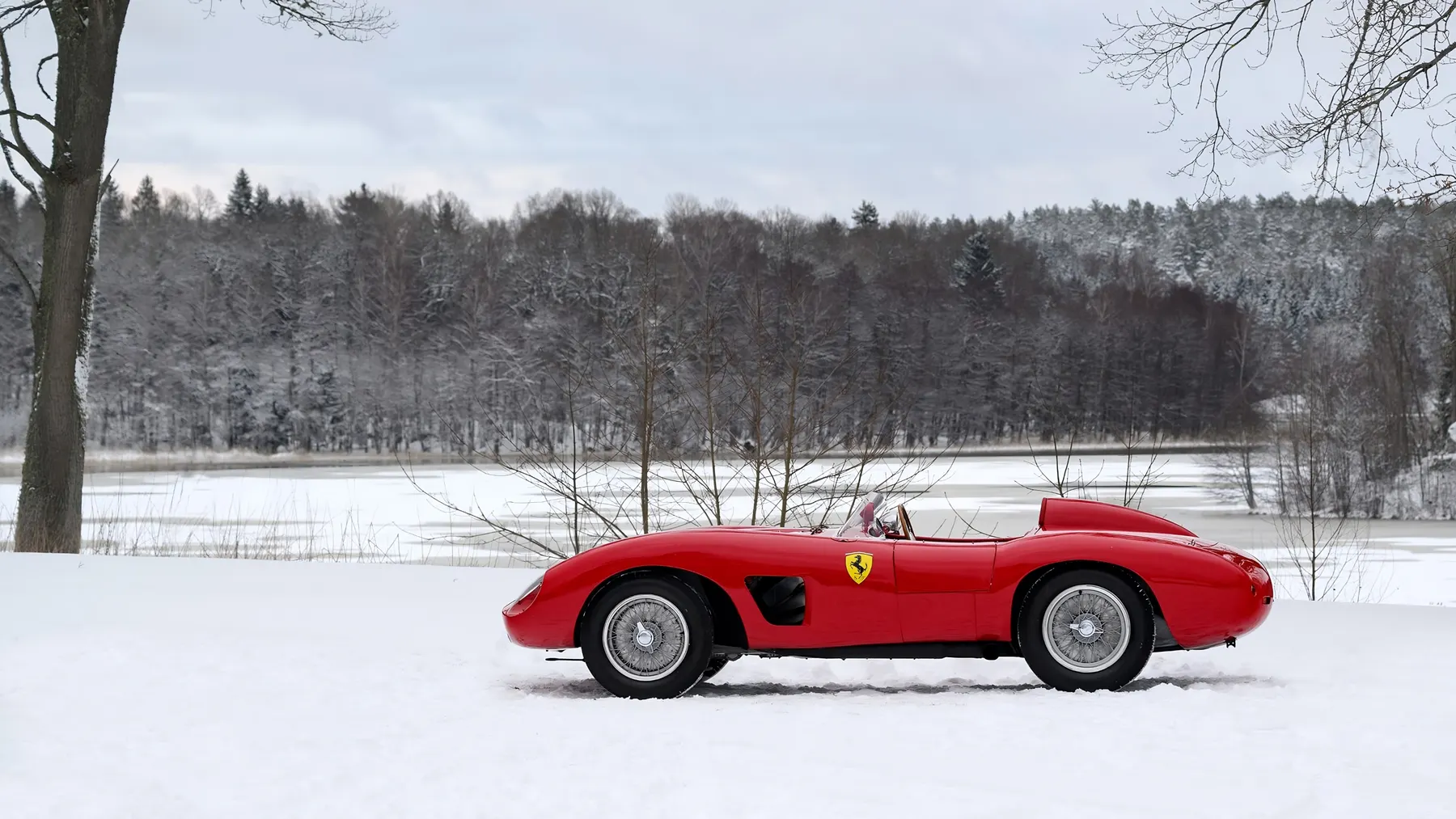
That regulation change arrived on schedule for 1957, when the FIA’s new Appendix C rules for the sports category outlawed several specifics of the 500 TR’s bodywork: the windscreen now had to be a symmetrical, full-width unit of defined minimum dimensions, a passenger-side door became mandatory, and minimum fuel capacity was set at 120 litres. Rather than patch the existing car, Ferrari and Scaglietti redesigned the body from the ground up, lowering it by roughly 10cm, widening the cockpit and giving it one of the most fluid fender lines of any 1950s Ferrari, while the reinforced chassis mounted the same 1,985cc four lower in the frame to improve the centre of gravity. Badged 500 TRC, the C denoting Appendix C compliance, the reworked engine reached a peak of 190bhp, the most this particular four-cylinder family would ever produce, and period-derived sources credit the car with a top speed in the region of 153mph. Nineteen cars wore TRC-specification Scaglietti coachwork during 1957: seventeen ran the standard two-litre engine as definitive 500 TRCs, while two more were enlarged to 2.5 litres and sold as 625 TRCs. Unlike the 500 TR, the TRC was never campaigned by Scuderia Ferrari itself, remaining a privateers-only tool throughout its single season; even so, class wins followed at the Sebring 12 Hours, the Mille Miglia, the Nürburgring 1,000km and Le Mans. Within that one year, though, the four-cylinder era at Ferrari was effectively over: the 500 TRC was the last of its kind, handed on almost immediately to the V12-engined 250 Testa Rossa.
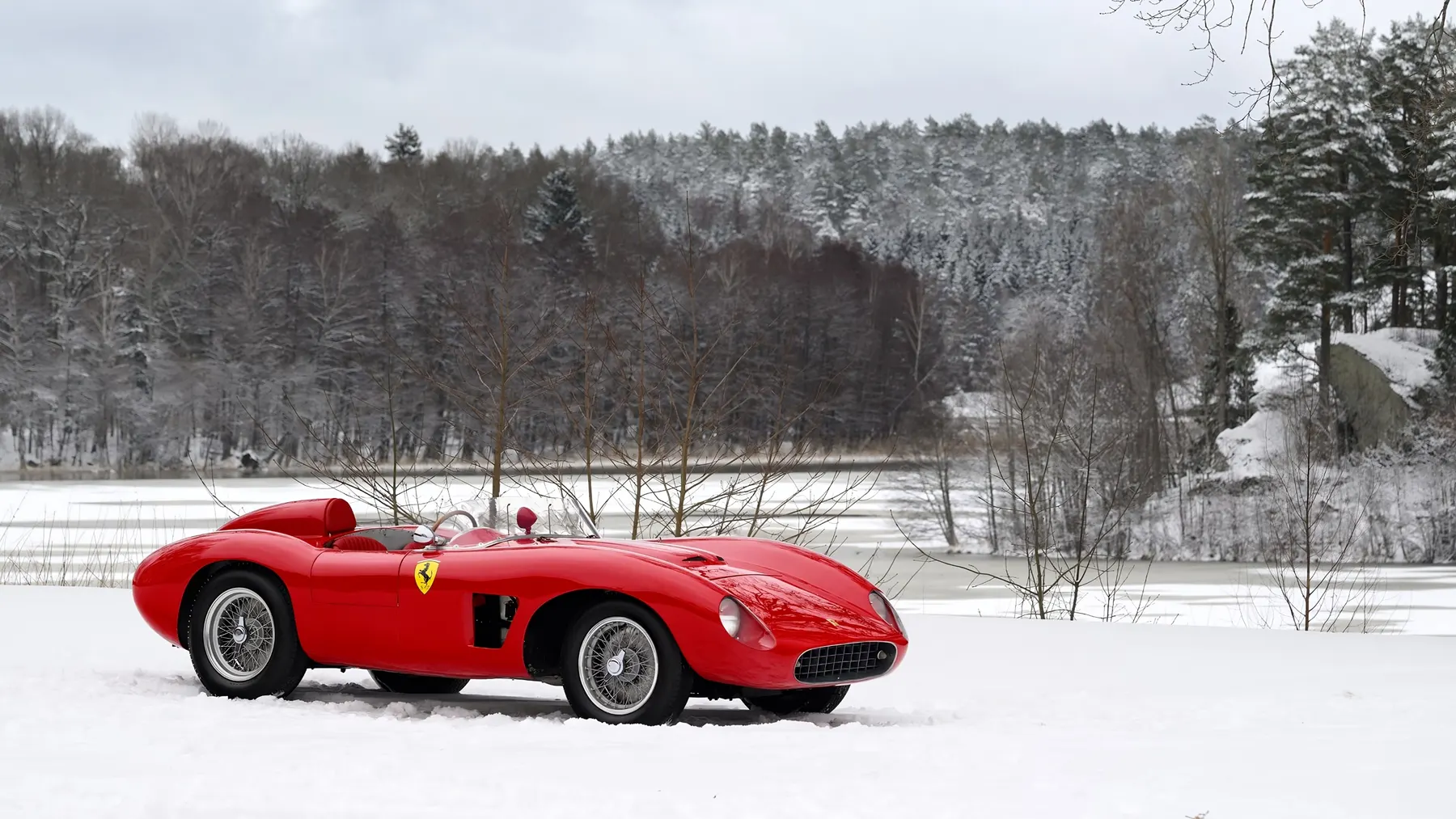
That handover is the real measure of the 500 TR’s place in the story. It was never the fastest or most decorated Ferrari sports racer of its era; its own direct successor eclipsed it within twelve months, and the 250 Testa Rossa that followed that became one of the most celebrated racing Ferraris ever built, a status the original four-cylinder car never came close to matching on outright results. But the name it created proved far more durable than the engine configuration that inspired it, carried forward through the V12 250 TR and, decades later, revived for Ferrari’s flagship road car of the 1980s. Within Ferrari’s broader four-cylinder sports-racing story, which ran from the 500 Mondial’s debut in 1953 through the 625 TRC’s retirement at the end of 1957, the 500 TR occupies a pivotal middle chapter: not the beginning, and not the most numerous or most successful by results, but the point at which the whole lineage acquired the identity that would outlast it. What survives of the original car today is treated as among the rarest and most historically consequential four-cylinder Ferraris in existence, prized not chiefly for outright pace but for having been there first: the modest customer racer whose crackle-red cam covers gave Ferrari a name it has returned to, in one form or another, for the best part of seventy years.
Technical data
Performance Specifications
| Specification | Ferrari 500 TR (1956) | Ferrari 500 TRC (1957) |
|---|---|---|
| Production | 1956 | 1957 |
| Number built | 17 | 17 (plus two 2.5-litre 625 TRC variants) |
| Coachwork | Scaglietti spider | Scaglietti spider (revised, lower body) |
| Engine | Tipo 131, DOHC inline-four | Tipo 131, DOHC inline-four (as 500 TR) |
| Displacement | 1,985cc | 1,985cc |
| Bore x stroke | 90mm x 78mm | 90mm x 78mm |
| Compression ratio | 8.5:1* | 8.5:1* (assumed carried over) |
| Carburettors | 2x Weber 40 DCOA3 | 2x Weber 40 DCOA3 |
| Power | 180bhp @ 7,000rpm | 190bhp (peak) |
| Weight (dry) | 680kg | 680kg (unchanged from 500 TR) |
| Wheelbase | 2,250mm | 2,250mm |
| Front suspension | Independent double wishbones, coil springs | As 500 TR |
| Rear suspension | Live axle, trailing arms, coil springs | As 500 TR |
| Brakes | 4-wheel hydraulic drums | 4-wheel hydraulic drums |
| Gearbox | 4-speed manual | 4-speed manual |
| Fuel tank | Not reliably corroborated | 120 litres (Appendix C minimum) |
| Top speed | ~150mph* | ~153mph* |
| Works team status | Campaigned by Scuderia Ferrari and privateers | Privateer-only; never run by Scuderia Ferrari |
Sources
- RM Sotheby’s - 1956 Ferrari 500 TR Spider by Scaglietti, Villa Erba 2023
- Gooding & Company - 1956 Ferrari 500 TR, Pebble Beach Auctions 2024
- RM Sotheby’s - 1957 Ferrari 500 TRC Spider by Scaglietti, Villa d’Este 2011
- RM Sotheby’s - 1957 Ferrari 500 TRC
- duPont Registry (hosting RM Sotheby’s Monterey 2022 catalogue text) - 1957 Ferrari 500 TRC Spider by Scaglietti
- Motor1.com - Ferrari 500 TR, the Origins of the “Testarossa” Myth
- SB Race Engineering - Ferrari 500 TR Technical Specifications
Join the discussion
Comments
Loading comments…
Leave a comment
Share a detail, memory, or perspective. Every comment is reviewed before publication.