AMG-Mercedes 190 E 2.5-16 Evolution II DTM Gruppe A: The Wing That Won
1992 AMG-Mercedes 190 E 2.5-16 Evolution II DTM Gruppe A





Images: Keno Zache / RM Sotheby's
Group A’s homologation rules put a blunt question to anyone who wanted to go touring-car racing: how many will you sell? At least 500 of the specification you intend to race, delivered to customers. Mercedes-Benz answered in 1990 by selling 502 four-door saloons whose rear wing was so tall that the company fitted a cover that shrank the rear window to keep the arrangement within the rules, at a list price more than three times that of a 190 E 1.8. That awkward, slightly absurd bargain is the 190 E 2.5-16 Evolution II, known to enthusiasts simply as the Evo II, and it explains almost everything about the AMG-Mercedes DTM racer that carried its name.
The foundation was an unlikely one. The W201 arrived in 1982 as Mercedes’ third main model line, a compact saloon slotted beneath the upper and upper-mid ranges and soon nicknamed the Baby-Benz, with Bruno Sacco styling and an industry-first multilink rear axle. Its performance career began with the Cosworth-headed 190 E 2.3-16 of 1984, a project PistonHeads says was conceived with rallying in mind until Audi’s quattro made a rear-drive rally car look obsolete, after which the 16-valve car was sent racing instead. It opened the new Nürburgring grand prix circuit that year in a race won by a then largely unknown Ayrton Senna, and in 1988 Mercedes entered the DTM as a factory effort alongside AMG, its long-time technical partner. Of roughly 1.9 million W201 saloons built, the Evolution II accounts for just 502.
The trouble was BMW’s M3. Autorevue’s retrospective describes it as slimmer, more focused and more of a sports car than the 190 E, while the early Cosworth engine was neither as responsive as its output suggested nor as robust as Mercedes’ reputation implied. Stepping up to the 2.5-16 in 1988 did not settle the argument, and the answer was the 1989 Evolution: 502 road cars with a radically reworked engine, a shorter stroke and larger bore than the standard 2.5-16, built to rev harder and to be more tunable in racing form. Work on its successor began in August 1989. The result debuted at the Geneva Motor Show in March 1990, and the last of the 502 Evolution IIs was built in Bremen that May.

The engine is where the badge gets slightly misleading. It says 2.5-16 on the boot lid, yet the 2,463 cc, 97.3 x 82.8 mm four-cylinder is the short-stroke Evolution design rather than the longer-stroke unit that name usually implies. Under Jörg Abthoff, Mercedes’ engine department reworked it again, and the changes read like a racing programme in miniature: lighter connecting rods, four crankshaft counterweights instead of eight, a single-row roller chain replacing the duplex cam drive, a new oil supply, revised port geometry, hotter cams with more lift, 10.5:1 compression, and recalibrated ignition and Bosch fuel injection. Two metal catalytic converters were standard, which makes the output more impressive than it first sounds: about 232 bhp at 7,200 rpm and 181 lb-ft at 5,000 rpm, with the limiter at roughly 7,700 rpm (sources differ by a hundred or so rpm on the exact figure). Mercedes claimed 7.1 seconds to 62 mph and 155 mph flat out from a car weighing 1,340 kg.

The bodywork was the real announcement. The box-shaped rear wing was developed by Mercedes aerodynamicist Rüdiger Faul with Professor Richard Läpple of Stuttgart, and it was not a fixed ornament: the upper flap extended, the lower rear spoiler bar tilted, and the front spoiler could be set in two longitudinal positions. Add bumpers with integrated spoilers, flared arches blended into the bodywork and 17-inch wheels, and the Evolution II looked like nothing else in the Mercedes range. Mercedes quoted maximum downforce of 57.1 kg at the rear and 21.2 kg at the front, figures that come without a stated speed and hardly suggest a road car pinned to the tarmac; Auto Motor und Sport, looking back, spoke only of slight downforce. Opinions on the styling split. Hagerty’s writer felt the flares sat awkwardly against Sacco’s original lines and likened the wing to a German reading of the Ferrari F40, whereas PistonHeads thought the kit added theatre without the try-hard feel that usually accompanies big bodykits. Every car left the factory in blue-black metallic, and none was officially sold in the United States.
Beneath that, the hardware was more refinement than revolution. Autorevue credits the Evolution II with a hydraulic self-locking rear differential, whose warning lamp PistonHeads found glowing in tighter corners, and with a three-position ride-height adjustment whose default setting sat 45 mm lower than a standard 2.5-16. It also describes stiffer springs and strengthened hubs, yet the period Auto Motor und Sport test was struck by how comfortably it rode, so accounts differ on how firm the car really was. The gearbox was a Getrag five-speed with a dog-leg pattern, the wheels wore 245/40 ZR17 tyres, and the cabin was mostly the standard 2.5-16’s, with chequered cloth manual seats where leather and electric adjustment could be specified.

The driving impressions fall into two camps, and the gap between them is instructive. Period testers were struck by how civilised it was. Auto Motor und Sport’s 1990 test, quoted in Mercedes’ anniversary material, called it a gifted cornerer and by far the most agile Mercedes, while Automobil Revue found largely neutral handling at the limit and controllable oversteer when pushed. Hagerty’s recent drive is similarly warm. It praises steering that is deceptively light yet communicative, a suspension that controls roll without fuss, and a car you could drive hard for hours. The engine, though, wants working. Autorevue says it barely stirs until about 4,000 rpm before hammering to the limiter with a hoarse, unsilenced edge, while Hagerty finds decent torque low down and an induction roar that builds from around 6,000 rpm. PistonHeads’ Mike Duff, driving a Mercedes Classic car on the Immendingen handling circuit, found a rattly idle that clears as the revs build, a throttle responsive enough to trim the line, and balanced grip that made it easy to widen a corner without descending into hooliganism. It is easy to see why the Evolution II is remembered as a driver’s car rather than a quick one.
That distinction matters, because the Evolution II had real limitations as a road car. Start with the price: Mercedes listed it at DM 115,259.70, or DM 119,717.10 with air conditioning, which Autorevue noted would have bought a very capable V8 S-Class instead. Then the performance. Duff points out that 232 bhp in 1,340 kg gives a power-to-weight ratio not far from that of a fairly tepid modern hot hatch, and that even when new it was possible to buy quicker saloons. His steering verdict is mixed, too: the recirculating-ball box feels muted next to the crisp feedback of an E30 M3, even if you adapt to it quickly, which sits oddly beside Hagerty’s rave. On track, the brakes began to soften after a few big stops, the gently bolstered seats gave poor lateral support, and the steering wheel could not be moved closer, so a surprising amount of effort went into not sliding around the cabin. The window cover that kept the wing legal also meant the view astern was deliberately compromised. A good share of the price, in other words, was paying for the right to go racing rather than for a better road car, and the usable result was a saloon with the dynamics of a very good sports saloon rather than the pace its looks promised.
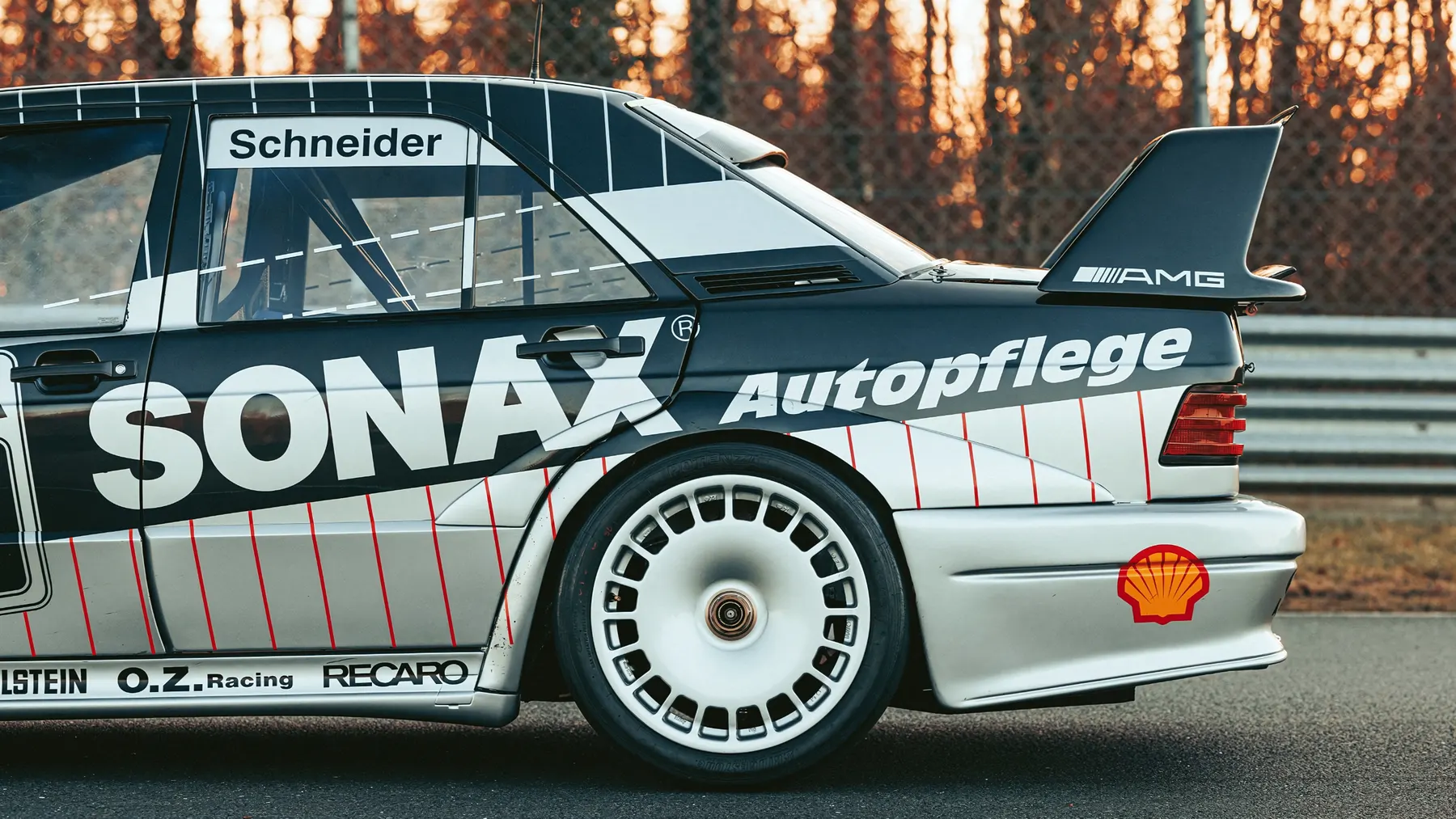
The racing car is where that bargain paid out. Once the road cars were built, AMG took responsibility for converting examples at Affalterbach, fitting bonnet, boot lid and spoiler in lightweight plastic and raising output to about 368 bhp at 9,500 rpm, up from roughly 328 bhp in the earlier Evolution racer. Mercedes describes it as the last DTM engine developed in its own engine department before AMG took over that task. The Evolution II raced for the first time on the Nürburgring Nordschleife on 16 June 1990, Kurt Thiim gave it its first win at Diepholz on 5 August, and by the season finale at Hockenheim in October every works-supported team had one. It was not an instant champion. Thiim finished third in the 1990 standings, Audi’s four-wheel-drive V8 took the 1990 and 1991 drivers’ titles, and Klaus Ludwig was runner-up in 1991.
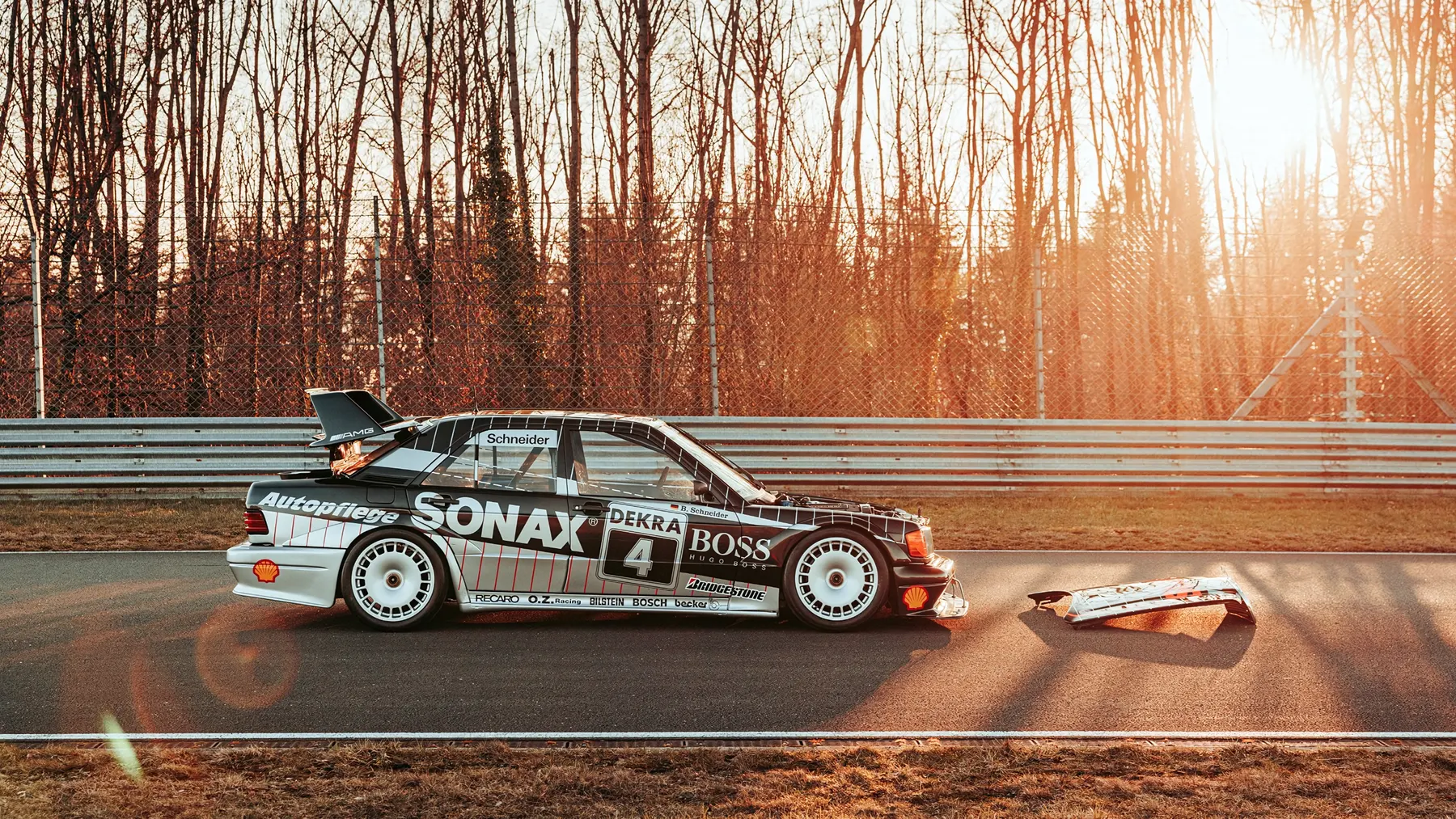
Then came 1992. AMG ran a four-car team of Ludwig, Keke Rosberg, Ellen Lohr and Bernd Schneider, and Mercedes drivers won 16 of the 24 races, with 17 second places and 13 third places. Ludwig took the drivers’ title and AMG-Mercedes the constructors’ crown, with Thiim, in a Zakspeed-run Evolution II, second and Schneider third, separated by a single point; Mercedes cars also filled fifth and sixth. BMW managed seven wins and Audi’s V8, the dominant force of the previous two seasons, only one. Lohr’s win at Hockenheim on 24 May is still the only DTM race victory by a woman. The aero kit made the Evolution II as controversial as it was effective: rival teams protested it vehemently, to no avail, and BMW’s research chief reportedly joked that the company would have to redesign its wind tunnel if that wing really worked.
Even so, the racer was never quite the unqualified hero its record implies. Schneider, arriving from Formula 1 and Porsche’s 962 sports prototype, told PistonHeads that the car was not as fast as he expected, that it was hard to be competitive when he joined the series in 1991, and that he was looking forward to the C-Class and more power. The title also took three seasons to arrive, and it was won in a climate of rising budgets and rapid development in which, as Duff puts it, manufacturers needed deep pockets to reach the front. A car that dominated one season and was underwhelming to a driver with sports-prototype experience is a more interesting story than the clean legend, and a fairer one.
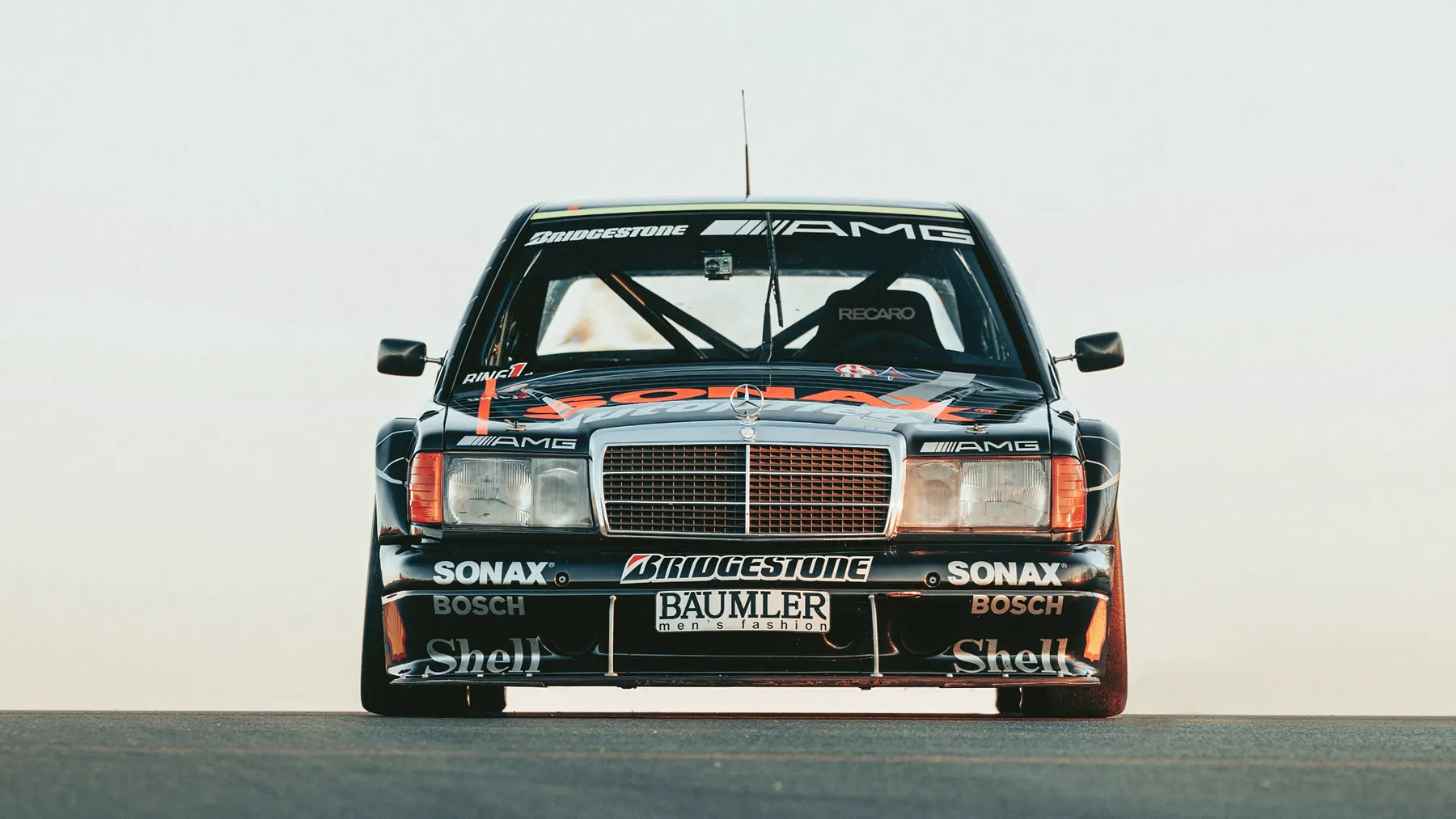
What endures is the shortness of the line between road and race. Duff wrote that the connection between the Evolution II and its motorsport sister is about as short as it can be among homologation specials, and the fact that a showroom customer could buy the thing that beat BMW is the root of its appeal. The market has noticed. In 2011 an acceptable example could be found for under £40,000 and a really good one for about £70,000, at a time when an E30 M3 cost about £25,000. By 2020 one sold at auction for £180,000, and Hagerty tracked 24 auction sales over the five years to spring 2024 at an average of about $296,000, against roughly $50,800 for an excellent 2.3-16. Mercedes Classic has campaigned a works-spec Evolution II in historic events, and Mercedes’ own anniversary material credits the car with laying the foundations of the high-performance tradition that Mercedes-AMG carries on. That is a flattering lineage, but the more convincing legacy is simpler: for three seasons a compact saloon with an oversized wing was the car every rival had to beat, and the 502 customers who bought its road-going twin were, in effect, paying the entry fee that made it possible.
Technical data
Performance Specifications
| 190 E 2.5-16 Evolution II (road-going homologation car, 1990) | AMG-Mercedes 190 E 2.5-16 Evolution II DTM Group A racer (1990–92) | |
|---|---|---|
| Production | 502 units; premiered March 1990, last car built May 1990 (Bremen) | Converted by AMG (Affalterbach) from road cars; raced from 16 June 1990 |
| Engine | M102 (type 102.992) inline-four, 16-valve DOHC, short-stroke Evolution design | Evolution II-derived inline-four, 16-valve |
| Displacement | 2,463 cc | not corroborated† |
| Bore × stroke | 97.3 × 82.8 mm | not corroborated† |
| Compression ratio | 10.5:1 | not corroborated† |
| Power | approx. 232 bhp at 7,200 rpm | approx. 368 bhp at 9,500 rpm |
| Torque | 181 lb-ft at 5,000 rpm | not corroborated† |
| Rev limit | approx. 7,700 rpm (sources vary slightly) | not corroborated† |
| Transmission / drive | Getrag five-speed manual (dog-leg), rear-wheel drive, hydraulic locking differential | not corroborated† |
| Kerb weight | 1,340 kg | not corroborated† |
| 0–62 mph | 7.1 seconds (Mercedes-Benz claim) | n/a |
| Top speed | 155 mph (Mercedes-Benz claim) | n/a |
| Wheels / tyres | 17-inch, 245/40 ZR17 | not corroborated† |
| Length / wheelbase | 4,530 mm / 2,665 mm* | n/a |
| Launch price (Germany, 1990) | DM 115,259.70 (DM 119,717.10 with air conditioning) | not sold |
| Competition record | n/a | 1992 DTM drivers’ and constructors’ champion; 16 wins from 24 races in 1992 |
Sources
- Mercedes-Benz – 30 years of Evo II
- Mercedes-Benz – The “Baby-Benz” as a super sports car (25 years of the 190 E 2.5-16 Evolution II)
- Motor1 Deutschland – Mercedes 190 E 2.5-16 Evolution II: Der krasseste Baby-Benz wird 30
- Motor1 – Mercedes Revisits 190E Evo II In Stunning DTM Footage
- Sports Car Digest – Celebrating DTM Dominance for Mercedes-Benz (1992 season)
- Autorevue – Achtung! Spoiler-Alarm: Mercedes 190 E 2.5-16 Evo II
- PistonHeads – Mercedes 190E 2.5-16 Evo II
- Hagerty UK – Driving the Brilliant 1990 Mercedes-Benz 190E 2.5-16 Evolution II
- Auto Motor und Sport – Mercedes-Benz 190E 2.5-16 Evolution II (1990)
- Auto Motor und Sport – Mercedes 190 E 2.5-16 Evo II: Technische Daten
- autoevolution – 5 Legendary Cars From the Glory Days of the DTM
- RM Sotheby’s – 1990 Mercedes-Benz 190 E 2.5-16 Evolution II (general model background only)
- RM Sotheby’s – 1992 AMG-Mercedes 190 E 2.5-16 Evolution II DTM Gruppe A (1992 season context only)
Join the discussion
Comments
Loading comments…
Leave a comment
Share a detail, memory, or perspective. Every comment is reviewed before publication.