Mercedes-Benz G63 AMG G850 6×6 by Brabus: A Six-Wheeled Study in Excess
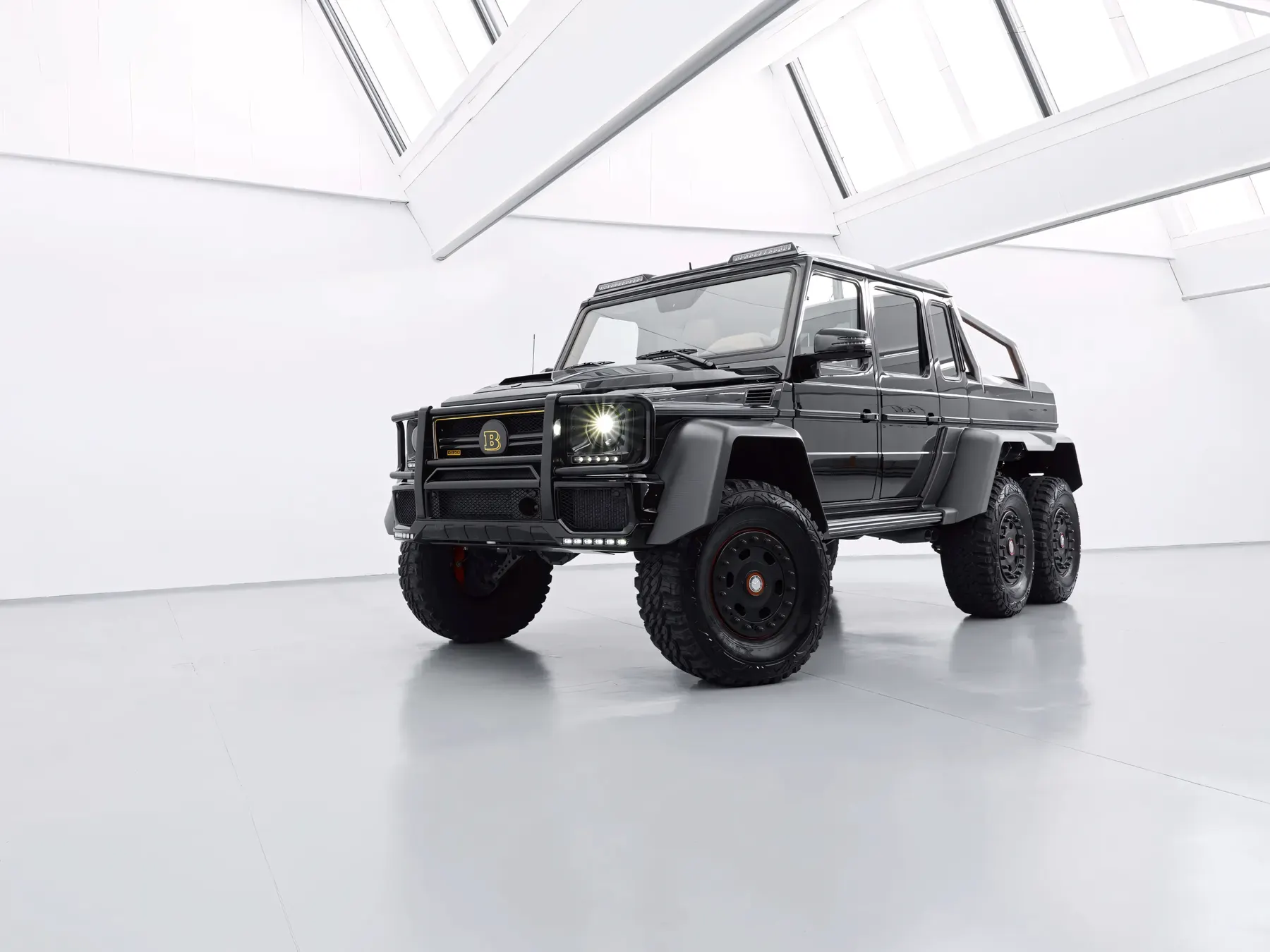
2016 Mercedes-Benz G 63 AMG G850 6×6 by Brabus

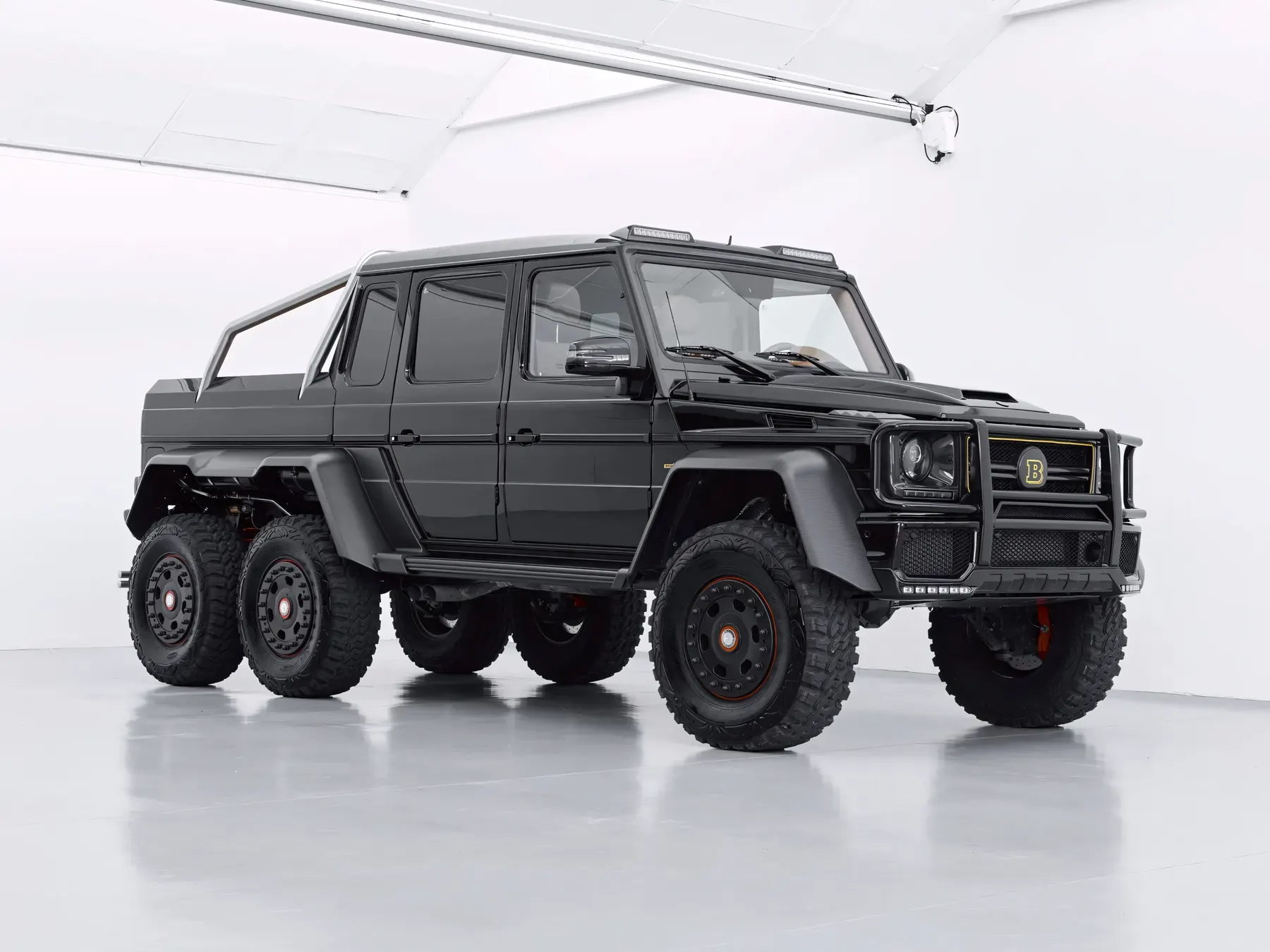
Images: Joel Kernasenko / RM Sotheby's
A European army wanted a truck that could cross deserts without getting stuck, and Mercedes-Benz built it one. Then, almost as an afterthought, the manufacturer discovered that a small number of extremely wealthy civilians wanted the same truck, minus the troop-carrying duties and plus a pair of heated leather armchairs. That collision of military hardware and private opulence produced the Mercedes-AMG G63 6x6, and it is the reason Brabus - the Bottrop tuning house that has spent decades finding more power inside every G-Class engine bay it can get its hands on - eventually turned its attention to a vehicle that was already, by any sane measure, finished with excess before Brabus arrived.
The 6x6 concept did not begin as a rich person’s toy. The underlying six-wheel-drive Geländewagen platform was developed from the mid-2000s for a military customer, and it was only once that hardware existed that Mercedes-AMG saw the opportunity to build a civilian derivative around it. The result, launched in 2013 and built by Magna Steyr in Graz, Austria, paired the G63 AMG’s 5.5-litre twin-turbocharged M157 V8 - producing 536bhp and 561 lb-ft in this application - with three portal axles, a pickup-style bed, and a cabin trimmed in leather and Alcantara. At the time of its launch it was Mercedes-Benz’s largest off-road vehicle and, briefly, the second most expensive street-legal model in the range behind only the SLS AMG Electric Drive. Fewer than a handful of body panels were shared with the standard G-Class; everything below the beltline was reengineered around portal-axle gearing borrowed conceptually from Unimog practice, five electronically controlled differential locks capable of 100 per cent lockup across all six wheels, a two-speed transfer case splitting torque 30:40:30 front-to-rear, and a compressed-air system that could drop or raise tyre pressure across all six 37-inch tyres in under twenty seconds to suit sand, mud or tarmac. Ground clearance stood at 460mm and the truck could ford water up to a metre deep. None of it was for show. Road testers who drove it came away startled by how genuinely capable the chassis was off-road, even if nobody pretended the 4,083kg kerb weight (some contemporary sources place lighter Brabus-modified examples closer to 3,850kg, a gap likely explained by differing specification levels and measurement conventions rather than a single settled figure) made for anything resembling agility once the road turned twisty.
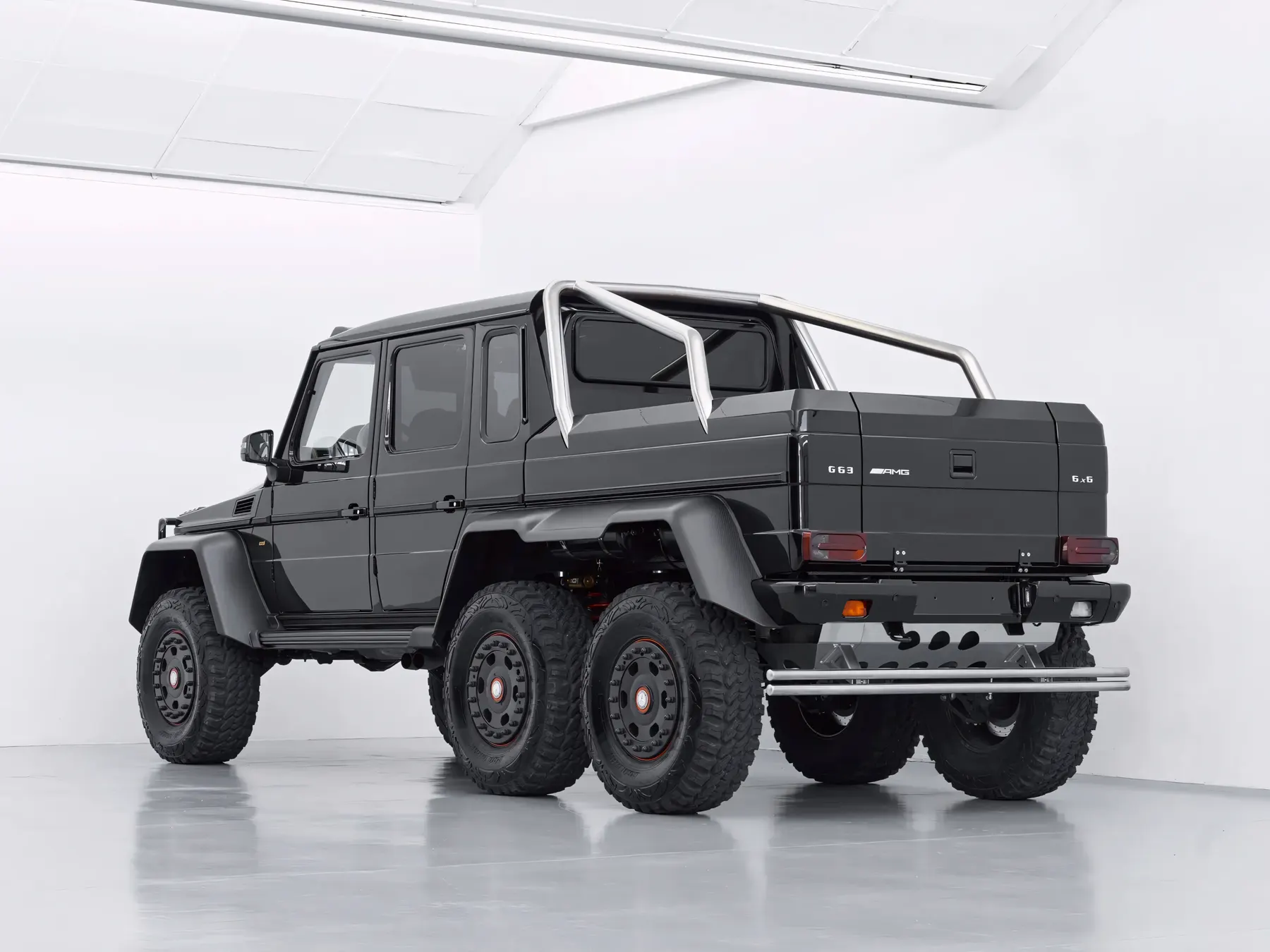
Mercedes never intended the 6x6 to be a volume product. Production ran from 2013 until 2015, comfortably exceeding 100 units before the company deliberately called time on the model to preserve its exclusivity, with the final example leaving Graz in May of that year. Right-hand-drive demand proved strong enough that at least two dedicated conversion runs were commissioned - ten units for a South African businessman and a separate batch for the Malaysian market, arranged through distributor Naza World - underlining just how bespoke and commission-driven this corner of the market had become even before Brabus got involved.
Brabus’s interest in the 6x6 surfaced almost as soon as Mercedes’ version existed, with a tuned derivative shown at the Frankfurt Motor Show in 2013 and sold under names that varied by market - B63S 700 6x6 in some literature, G700 6x6 in others. The formula was straightforward by Brabus standards: larger-compressor turbochargers and recalibrated engine management lifted the 5.5-litre V8 from its factory 536bhp to a claimed 700PS (roughly 690bhp), with torque rising to around 708 lb-ft. Straight-line performance improved to roughly 7.4 seconds to 62mph, though top speed remained capped at around 99mph, a limit dictated not by the engine but by the heavy-duty off-road tyres the truck rides on. When Naza World brought right-hand-drive examples to Malaysia, it did so as a minimum order of fifteen vehicles, priced from roughly €700,000 before local taxes - a figure that illustrates how far removed this end of the G-Class range had drifted from anything resembling a normal purchasing process.
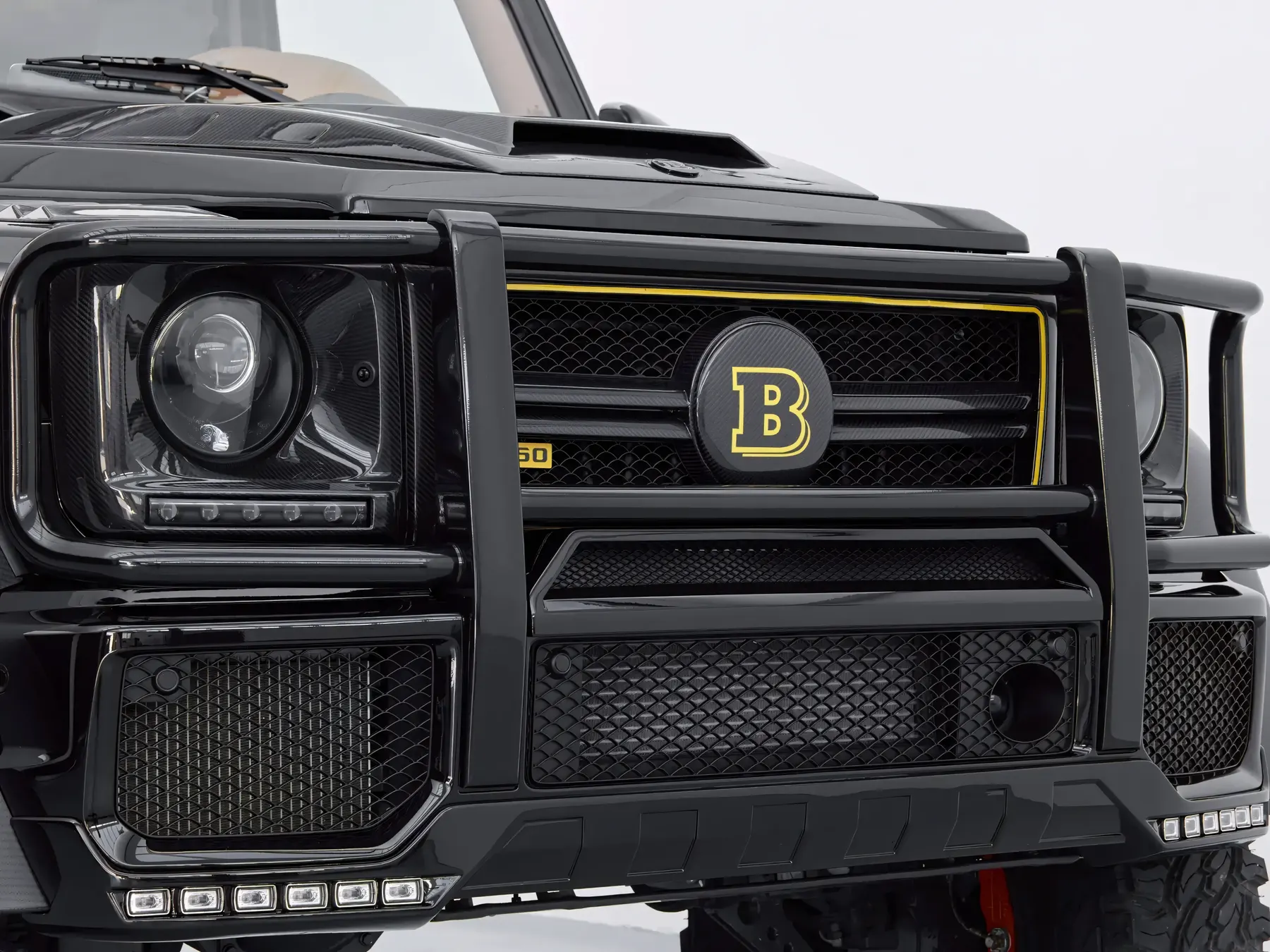
The “850” designation that has since attached itself to some 6x6 conversions traces back to a separate but related piece of Brabus engineering: the firm’s 6.0-litre biturbo V8, built by boring the standard M157’s cylinders out from 5,461cc to 5,912cc, fitting forged 99mm pistons and a billet crankshaft with a longer 96mm stroke, and pairing the enlarged block with Brabus’s own turbochargers and cooling hardware. In its original application, fitted to the conventional four-wheel-drive G63 Widestar, this engine was rated at 625kW - 850PS, or 838bhp - with 1,069 lb-ft of torque, enough to send a 2,550kg SUV to 60mph in around four seconds and on to an electronically limited 162mph. Brabus has continued to apply this same 850-badged engine, and the naming convention that goes with it, across successive G-Class generations, including farewell editions of the outgoing W463 chassis. It is worth being candid about what “G850 6x6” actually denotes in the used and specialist market: rather than a single, homologated factory product with a fixed production run, it describes the combination of Brabus’s 850-specification engine with a 6x6 axle configuration - a pairing that has appeared through Brabus’s own commissioned builds and, in at least some documented cases, through further conversion work carried out by separate specialist workshops using a Brabus-tuned donor car as their starting point. Buyers and researchers alike should treat “G850 6x6” as a description of a specification rather than the name of one consistent, traceable model line.
Whatever the precise lineage of any individual build, the appeal was never really about lap times. The G63 6x6 and its Brabus derivatives found their audience in the Gulf states, in Los Angeles, and in the pages of celebrity social media, where a vehicle built to survive a desert crossing photographed just as well parked outside a hotel. Hollywood noticed too: the standard 6x6 appeared in Beyond the Reach in 2014 and, more memorably, in Jurassic World in 2015, an appearance press coverage at the time likened to the debut of the original M-Class in The Lost World two decades earlier. That cultural visibility did more for the model’s reputation than any road test could, cementing it as shorthand for a very particular strain of automotive spectacle.
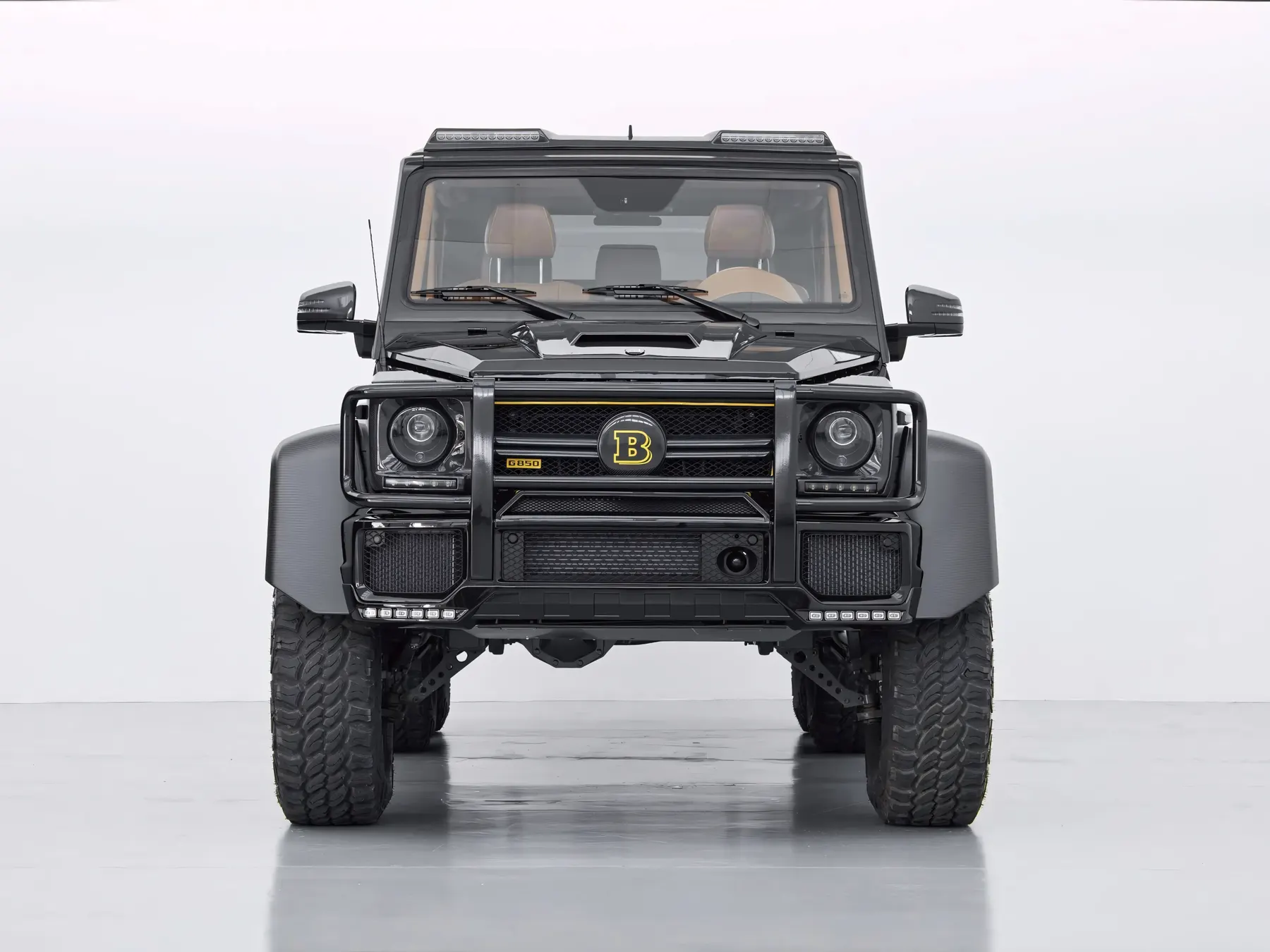
Mercedes-Benz walked away from the format in 2015, but Brabus never really did. The tuner’s current 6x6 offerings, the XLP 800 6x6 Adventure and the more powerful XLP 900 6x6 Superblack, are built on the latest-generation G63 platform and represent a full in-house reengineering rather than a bolt-on conversion: the standard ladder frame is cut and extended by roughly 1.5 metres to accommodate the third axle and a carbon-fibre pickup bed, with independent suspension developed for all three axles and portal-axle hardware delivering around 470mm of ground clearance. Reported outputs vary slightly by source - Brabus’s own materials and some outlets cite 800bhp and 738 lb-ft from the twin-turbo 4.0-litre V8, while other coverage of the same truck quotes closer to 788bhp - but the broad picture is consistent: 0-62mph in around 5.8 seconds and a 130mph limited top speed, built to order from roughly €1.1 million. The range-topping Superblack pushes a claimed 900bhp, with peak torque electronically reined in to around 774 lb-ft for driveline protection, at a price approaching €1.2 million. These are not old stock being cleared out; they are current products, built to order, aimed squarely at buyers who have already owned every other version of the G-Class Brabus offers.
For all the engineering spectacle, the format carries specific and unglamorous compromises that no amount of leather or carbon fibre disguises. At just over two metres wide and close to six metres long, the 6x6 will not fit into a great many multi-storey car parks, standard residential garages, or the narrower streets of most European cities, turning ordinary errands into logistical planning exercises regardless of how many differential locks are fitted underneath. Top speed is artificially strangled by the vehicle’s off-road tyre construction rather than by the engine: even Brabus’s most powerful 6.0-litre tune, capable of well over 160mph in a lighter four-wheel-drive application, is limited to around 99-100mph once fitted to the 6x6 chassis, meaning owners are paying supercar money for a truck that a mid-range hot hatchback would embarrass in a straight line above city speeds. The weight penalty is real and consequential - figures cluster near four tonnes, with portal-axle gearing adding unsprung mass and rotational inertia at each corner - and while period road tests found the standard 6x6’s off-road traction and axle articulation genuinely impressive, nobody pretended the chassis was built for cornering; on tarmac it rides high, leans hard under load, and stops over considerably longer distances than a conventional SUV. The provenance question compounds matters for anyone shopping this market seriously: because some of the most powerful 6x6 builds have been assembled piecemeal - a Brabus engine upgrade completed at one point, a 6x6 axle conversion carried out separately by a different specialist workshop at another - establishing exactly what a given vehicle consists of, and what warranty coverage actually applies to it, is far from straightforward; Brabus’s own tuning warranty, typically pegged at three years or 100,000km, does not automatically extend to axle work performed by an unrelated shop. And there is a deeper irony sitting underneath all of it: a vehicle engineered from the ground up for desert-crossing military duty, whose diff locks, portal axles and metre-deep fording capability represent genuine engineering achievement, spends the overwhelming majority of its life on driveways, at car meets, and in the backgrounds of social media posts. The capability is real. For nearly every owner, it is also almost entirely theoretical.
None of that undermines what makes the 6x6 format worth taking seriously as a piece of automotive history rather than dismissing it as a novelty. The underlying hardware - the portal axles, the triple locking differentials, the genuinely usable fording depth - came from real military-derived engineering, not a body kit grafted onto a standard chassis, and that distinguishes it from a great deal of what passes for “extreme” in the tuning world. Brabus’s contribution was never really about making the 6x6 more capable; the standard truck already did more than any owner would reasonably ask of it. What Brabus offered instead was an escalation of spectacle to match the exclusivity of the platform itself, applying the same numbers-as-names philosophy - 700, 850, 900 - that it has used across the rest of the G-Class range for years. Mercedes built the 6x6 as a genuine engineering exercise that happened to find an unexpected luxury audience; Brabus built on that discovery by giving that audience exactly the kind of escalating, faintly absurd excess it was already primed to want, and has kept doing so through two full generations of G-Class since the factory original went out of production. That persistence, more than any single horsepower figure, is what makes the format worth understanding.
Sources
- Mercedes-AMG G 63 6x6 - Wikipedia
- Mercedes-Benz G63 6x6 Road Test - Top Gear
- Brabus B63S 700 6x6 (G700 6x6) in Malaysia - paultan.org
- Official: 2016 Brabus G63 AMG 850 6.0 Widestar - GTspirit
- Brabus 850 4x4² Final Edition Gives Old Mercedes G-Class 838 HP - Motor1
- AMG G63 Turns Into Two Six-Wheeled Pickups By Brabus With 800 And 900 HP - Motor1
- Brabus 6x6 G-Class Proves There’s No Escaping Bad Taste - CarBuzz
- BRABUS Unveils New $1.3M XLP 800 6x6 ADVENTURE - duPont Registry
- Brabus G Wagon Pricing And What You Get For The Money - TopSpeed
- Mercedes-Benz G63 AMG 6x6 By Brabus Has 700 HP, $1 Million Price Tag - Carscoops
Join the discussion
Comments
Loading comments…
Leave a comment
Share a detail, memory, or perspective. Every comment is reviewed before publication.