Porsche 718 Cayman GT4 (982): The Cayman Stuttgart Tried to Hold Back
2022 Porsche 718 Cayman GT4
%3A%20The%20Cayman%20Stuttgart%20Tried%20to%20Hold%20Back%20%7C%20Motor%20Archive)
Images: Mike Bouckaert / RM Sotheby's
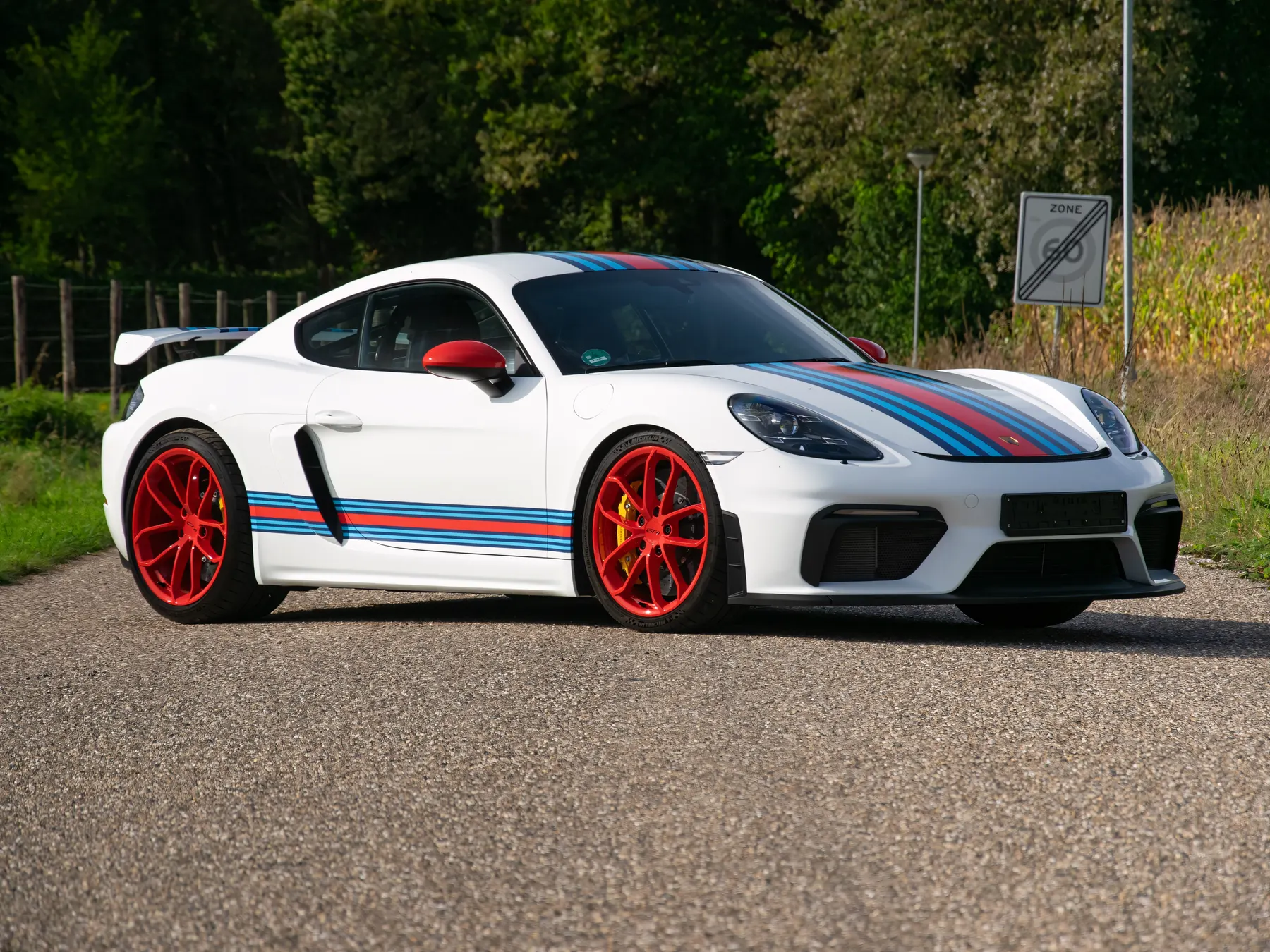
For most of its life, the Cayman existed inside a cage of Porsche’s own making. Engineers understood from the original 2005 car onward that a mid-engine layout gave better weight distribution than the 911’s tail-heavy architecture, yet for a decade Porsche was careful never to let its junior coupe fully prove it, unwilling to let a cheaper model embarrass the flagship sitting above it in the range and the price list. The 718 Cayman GT4, built on the 982-generation platform and sold from the 2020 model year, is the second time Porsche finally opened that cage, and the tension at its centre - a car engineered to be genuinely excellent, built by a company that had spent years making sure its little coupe never quite got there - explains almost everything interesting about it, including why it still isn’t quite perfect.
The first Cayman GT4 didn’t appear until 2015, a full ten years after the model line began, and only after Porsche’s GT department was allowed to raid the 991-generation 911 Carrera S parts bin. That 981-generation GT4 used a 3.8-litre flat-six making roughly 380bhp at 7,400rpm and 310lb-ft of torque, sent through a six-speed manual only, good for 0-62mph in about 4.4 seconds and a top speed near 183mph. It sold out almost instantly and became one of the most talked-about driver’s cars of its era. When the range was renamed 718 for 2016, though, the standard Boxster and Cayman switched to turbocharged flat-four engines, and the press response to their sound was close to unanimous: Car and Driver called it raspy and grating, Top Gear said it cheapened the whole experience. So when Porsche confirmed in June 2019 that the GT4 name would return, and that it would come with a proper naturally aspirated six again, the news mattered well beyond the usual model-update churn - this was Porsche re-admitting that its cheapest sports car deserved a real engine.
That engine is a 4.0-litre flat-six sharing its architecture with the turbocharged 3.0-litre unit fitted to the contemporary 992-generation Carrera, enlarged in displacement and stripped of forced induction for GT4 duty. Bore and stroke are 102.0mm and 81.5mm, compression ratio is a high-for-Porsche 13.0:1, lubrication is dry-sump, and the car uses cylinder deactivation under light throttle - a first for the company on this kind of engine. Peak output is 414bhp at 7,600rpm with a redline around 8,000rpm; manual-gearbox cars are quoted at 310lb-ft of torque across a 5,000-6,800rpm plateau, while Porsche’s own data for PDK-equipped cars shows a marginally higher 317lb-ft, likely reflecting a slightly different measurement point on what is otherwise the same torque curve rather than a genuine mechanical difference. The six-speed manual was the only gearbox available at launch; a seven-speed PDK dual-clutch arrived as an option for the 2021 model year, cutting the 0-60mph time from 4.2 seconds to roughly 3.7 seconds while adding about 30kg. Top speed for both is in the region of 189mph.
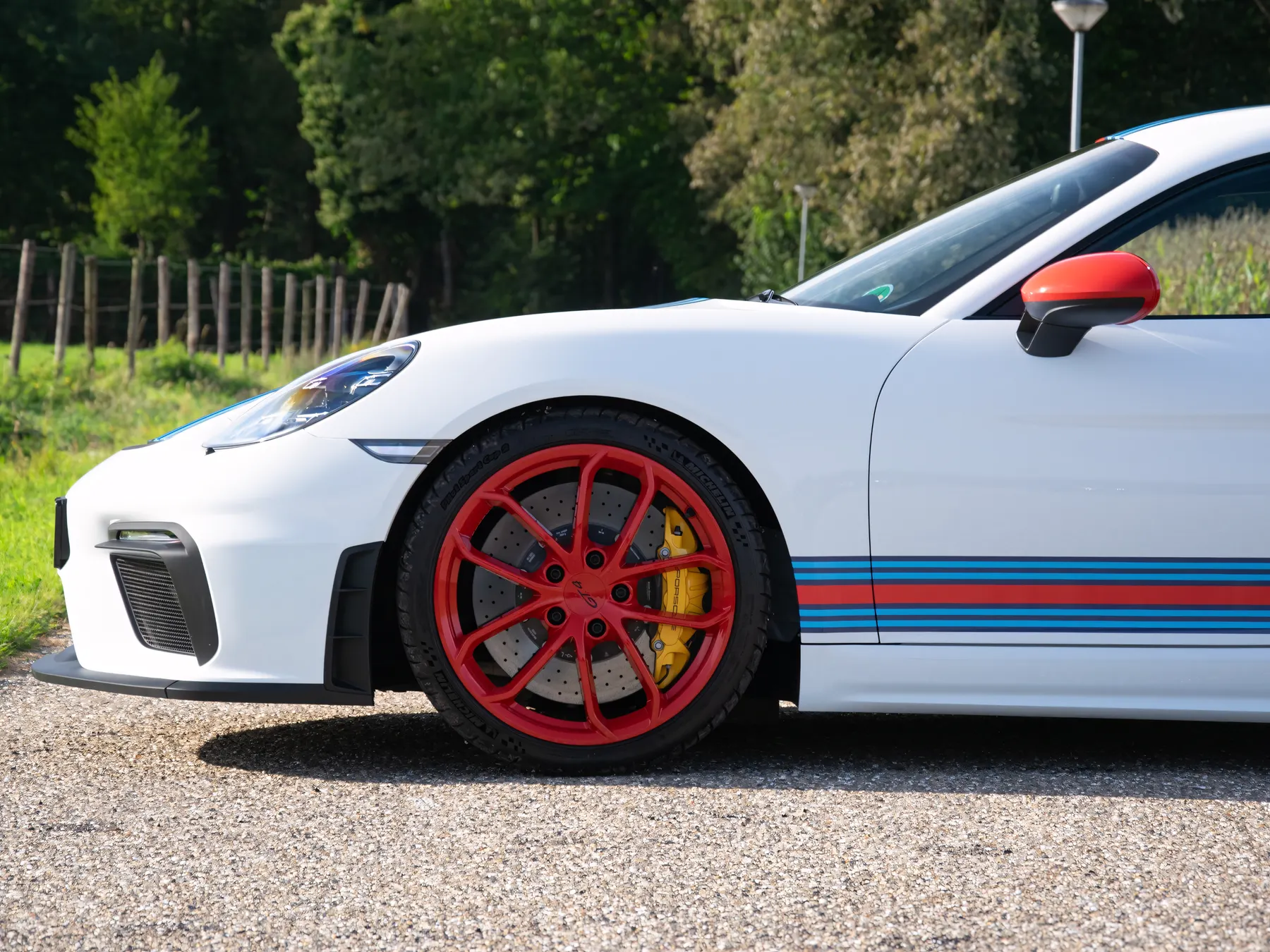
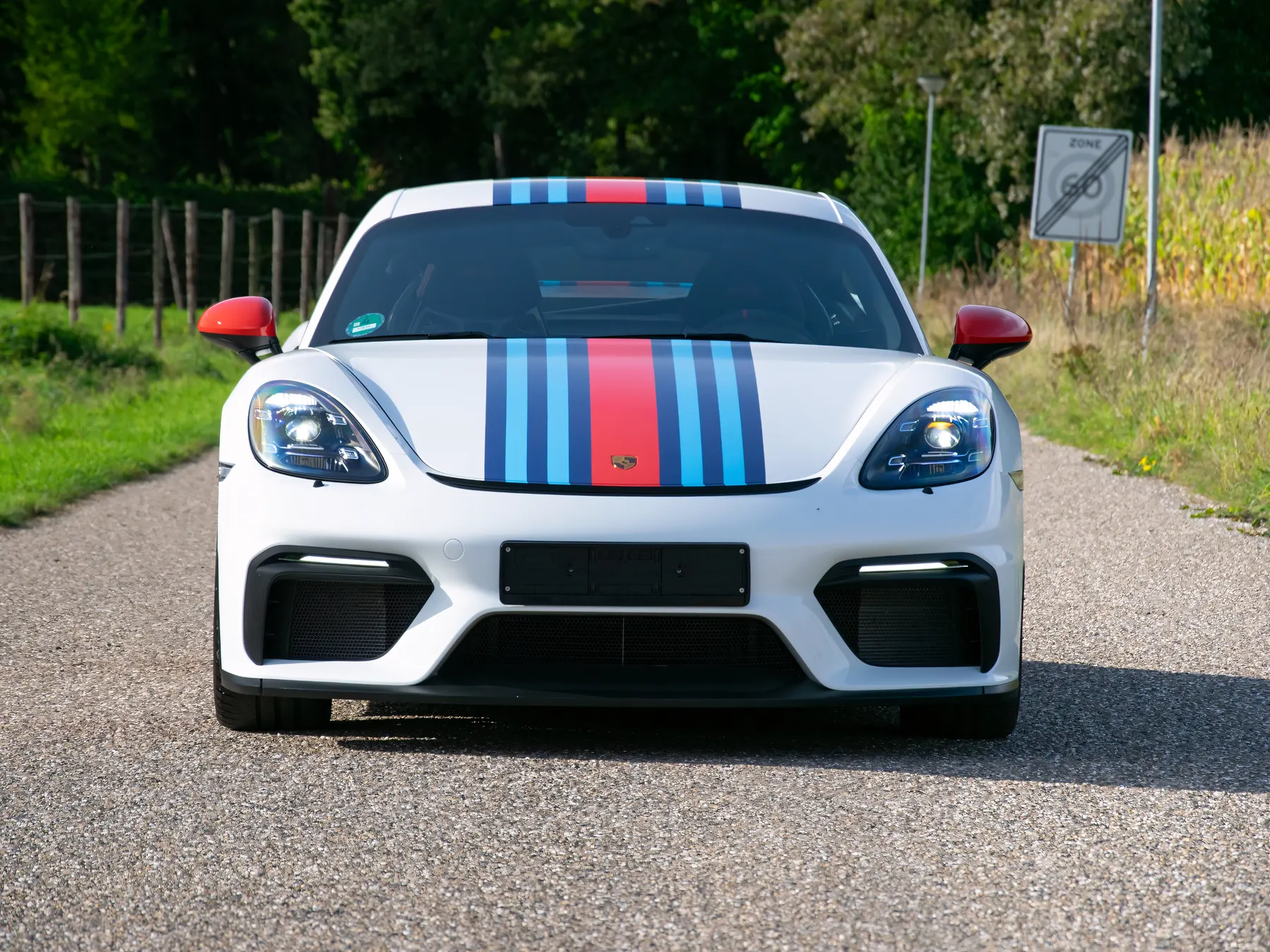
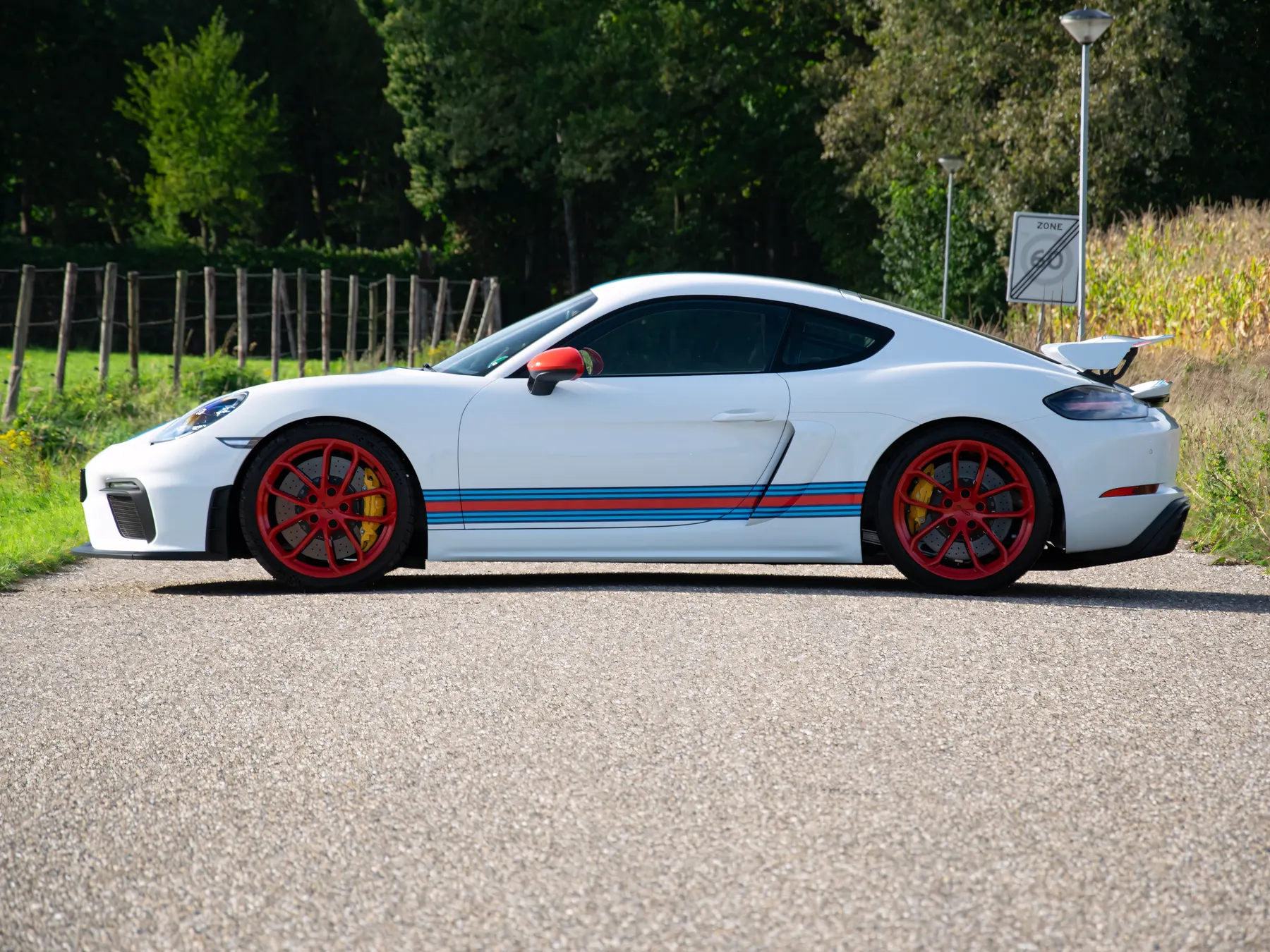
Underneath, the GT4 borrows its front axle, brakes and much of its damping and stability-control software from the contemporaneous 911 GT3, while the rear suspension is a bespoke design not shared with any other 718. Ride height is fixed, 30mm lower than a standard Cayman, with camber, toe and anti-roll bar settings all manually adjustable for track use. A larger front splitter, a genuine underbody diffuser and an adjustable rear wing combine to generate roughly 50 percent more downforce than the outgoing 981 GT4 produced, without a meaningful drag penalty - Porsche’s own figures put peak downforce in the region of 150kg. None of this is subtle. The GT4 looks, from most angles, more purposeful than the 911 GT3 it borrows so heavily from, and on road or track it largely delivers on that promise: reviewers consistently single out the steering for its clarity, the chassis for talking to the driver at every stage of a corner rather than just at the limit, and the whole car for being unusually forgiving of a ham-fisted input given how sharp it is when driven properly. Top Gear’s testers found it rode acceptably around town, cruised quietly enough on a motorway and returned fuel economy in the high twenties on the UK’s imperial scale when driven with any restraint - a genuinely usable daily car wrapped around a genuine track weapon, which is not a combination most manufacturers manage convincingly.
None of that comes free, and the compromises are worth naming rather than waving away as charm. The most immediate one is mass: despite the jump in power over the 981-generation car, the 982 GT4 actually weighs more than its predecessor - roughly 35kg more, largely down to the gasoline particulate filter and additional exhaust silencing needed to meet tightened emissions rules - and at launch it was, by some margin, the heaviest model in its own 718 range. Reviewers noticed; more power arriving alongside more weight is the kind of trade-off that blunts a car’s outright pace even as it looks better on a spec sheet, and against a genuinely lightweight rival like the Alpine A110 the GT4 simply cannot match the sensation of shifting mass around that a sub-1,150kg car offers, whatever its steering feels like. Pricing tells a related story. The GT4 launched in the United States at $99,200 before options, a significant jump over its predecessor, and by the time buyers had worked through Porsche’s notoriously thin standard-equipment list - a car this expensive still shipped without wireless CarPlay as standard, with modest door-pocket storage and a single USB-A port in some markets - cars regularly left dealers closer to double that figure once a Weissach-adjacent options list had been ticked through. In the UK, list price climbed toward £75,000 with typical as-tested cars closer to £95,000. None of this makes the GT4 bad value against genuine competitors from Ferrari or McLaren, but it does undercut the idea that this was ever a bargain-basement 911 GT3 substitute; by the time most buyers finished specifying one, it wasn’t far off being priced like one.
The second real weakness is one Porsche would rather enthusiasts forgot: reliability during the car’s early production run was not flawless. In March 2021, Porsche issued a stop-sale and recall covering 190 examples fitted with the new 4.0-litre engine - a mix of Cayman GT4, Cayman GTS 4.0, Boxster GTS 4.0 and 718 Spyder - after a supplier’s connecting rods failed internal quality checks and were found capable of cracking and loosening in service, with the potential to cause engine damage, a stall, or in the worst case a fire. Porsche replaced the connecting rods, or entire engines in cars already delivered, at no cost, and there were no confirmed real-world failures reported before the fix - but for a car whose entire pitch rested on motorsport-grade engineering, a supplier quality lapse on the very engine doing the selling was an awkward look. It wasn’t an isolated incident either: in 2024, Porsche recalled certain 718 Cayman GT4 RS and Spyder RS models over centre-lock wheel bolts that could fracture and allow a wheel to detach, a serious safety issue on cars built specifically for hard track use. Neither recall affected a large number of cars, and Porsche’s response in both cases was prompt, but they’re a useful corrective to any assumption that GT-department provenance guarantees flawless execution.
Porsche pushed the concept further in November 2021 with the 718 Cayman GT4 RS, the first time the RS badge - usually reserved for 911s - had been applied to a Cayman. Rather than tuning the existing 4.0-litre unit further, Porsche fitted an actual 911 GT3 engine, rotated 180 degrees to fit the Cayman’s mid-mounted engine bay, a packaging change that altered exhaust backpressure enough to cost the GT4 RS roughly 10bhp relative to the GT3’s own output. Even detuned, it’s a serious unit: 493bhp at 8,400rpm, 332lb-ft of torque at 6,750rpm, and a 9,000rpm redline. Notably, the GT4 RS is available exclusively with the seven-speed PDK - Porsche has never offered a manual gearbox with this engine in this car, reportedly because the torque exceeds what the existing manual transmission could reliably handle, a decision that still frustrates purists who considered the GT4’s manual shift one of its defining pleasures. Weight was cut through carbon-fibre front fenders and bonnet, with an optional Weissach package adding further carbon components and forged magnesium wheels that shave close to 10kg of unsprung mass; US curb weight is quoted at around 1,464kg, though European road tests using different measurement conventions have recorded closer to 1,444kg. The result is 0-60mph in roughly 3.2 seconds and a 196mph top speed, alongside a fixed swan-neck rear wing derived from Porsche’s 911 RSR endurance racer, up to 25 percent more downforce than the standard GT4, and, for the first time on a 718, centre-lock wheels. Porsche’s own testing put the GT4 RS around 23 seconds faster than the standard GT4 over a Nürburgring Nordschleife lap. Priced from $141,700 at launch and rising to over $164,000 by its final 2025 model year, the GT4 RS sits below the 911 GT3 in Porsche’s internal hierarchy on paper, while on a circuit it regularly matches or embarrasses cars that cost considerably more - the same contradiction that has followed this nameplate since 2005, now inverted into a selling point rather than a limitation.
The GT4 name extended well beyond the road cars. A dedicated GT4 Clubsport racing version was revealed in January 2019 ahead of the Roar Before the Rolex 24, using a destroked 3.8-litre version of the same engine family - stroke reduced from 81.5mm to 77.5mm - producing 419bhp through a six-speed PDK, with a welded-in roll cage, natural-fibre composite body panels, forged wheels, slick tyres and a kerb weight around 1,320kg; it went on to underpin one-make series including the Porsche Sprint Challenge GB. A GT4 RS Clubsport followed in late 2021, adopting the road car’s 493bhp engine for customer teams. Porsche even used the nameplate as a testbed for electrification, showing a battery-electric GT4 e-Performance concept in 2022 sharing its drivetrain with the Mission R concept and claimed to be capable of beating a 911 GT3 Cup racer around most circuits - a signal, whether or not it ever reaches production, of where Porsche expects performance benchmarks to move once combustion 718s are gone. That moment arrived in October 2025, when Porsche ended production of the combustion-engined Boxster and Cayman entirely, the GT4 RS having outlasted the standard GT4, which had already been discontinued the year before.
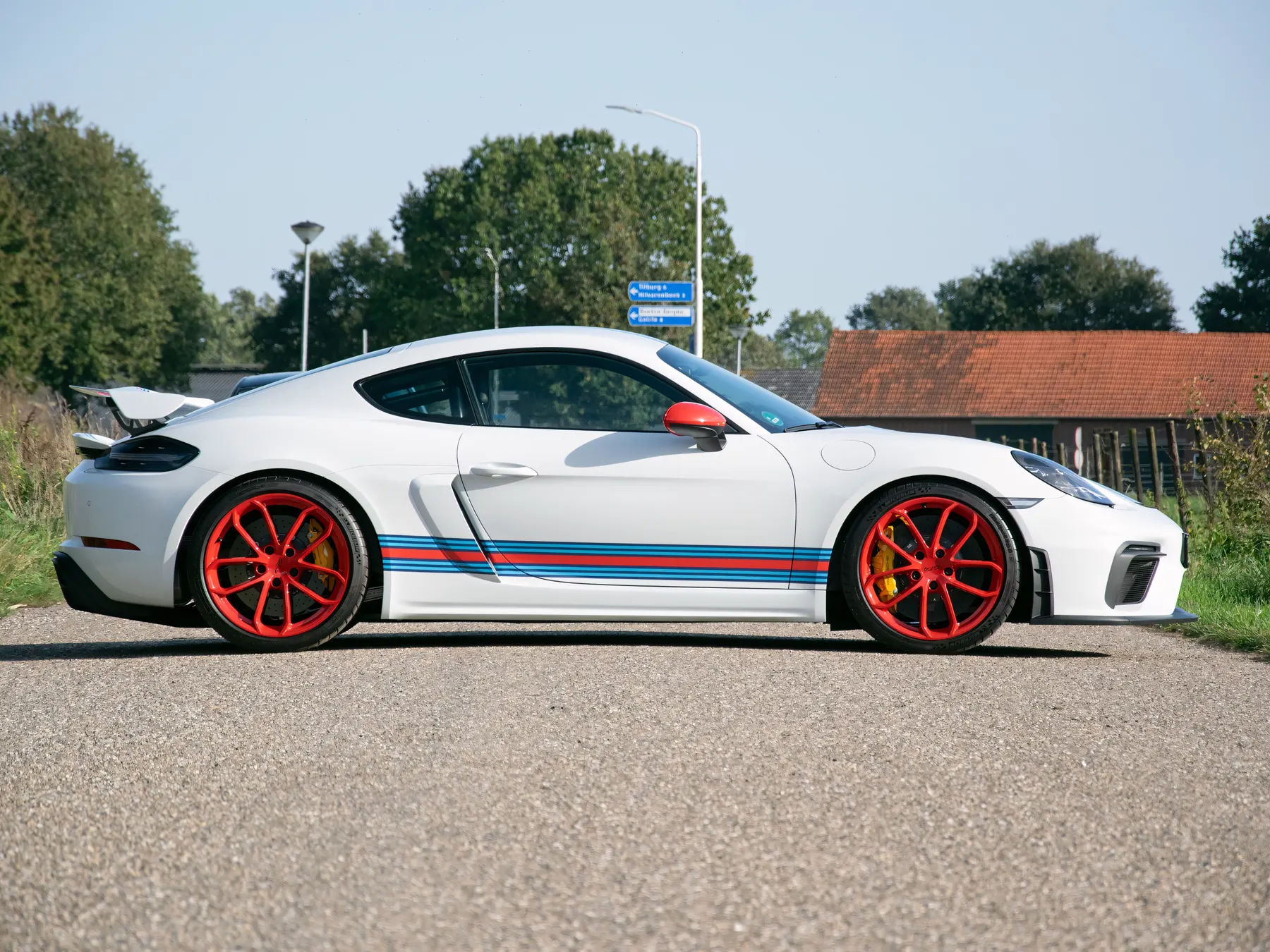
What the 982-generation GT4 and GT4 RS leave behind is a nameplate that enthusiasts often describe, only half-jokingly, as the more attainable alternative to a 911 GT3 - attainable being relative, given how quickly options and RS badges pushed prices toward six figures and beyond. It was never the fastest thing Porsche built in this era, and it was heavier, pricier and less flawless in early production than its motorsport-adjacent marketing implied. But it did something the 911 GT3 structurally cannot: it let a genuinely mid-engined chassis, rather than one compromised by decades of accommodating a rear-mounted flat-six, show what that layout can actually do when Porsche stops holding it back. That the company kept doing this reluctantly, generation after generation, only to watch each GT4 become an instant favourite among people who actually cared about how a car felt rather than what badge it wore, is the closest thing this nameplate has to a moral.
Sources
- Porsche 718 Boxster and Cayman (982) – Wikipedia
- 718 Cayman GT4 Technical Data – Porsche Newsroom
- 718 Cayman GT4 RS Press Kit – Porsche Newsroom
- The Porsche 718 Cayman GT4 RS – Porsche Newsroom USA
- Porsche 718 Cayman GT4 Review – Top Gear
- Porsche 718 Cayman GT4 Driving, Engines & Performance – Top Gear
- Porsche 718 Cayman GT4 (2020-2025) Review – evo
- Used Porsche Cayman GT4 (981) Review – evo
- The Porsche 718 Cayman GT4 and 718 Spyder are just flat (six) wonderful – Hagerty Media
- 2022 Porsche 718 Cayman GT4 – Hagerty Valuation Tool
- 9 Thoughts About the Porsche 718 Cayman GT4 – Autoblog
- Porsche Issues Stop-Sale Order, Recall of 2021 718 Boxster, Cayman Models – Autoblog
- 190 Porsche 718s Recalled for Connecting Rods That Failed Quality Checks – Porsche Club of America
- Porsche 718 Cayman Recalls – Cars.com
- 2020 Porsche 718 Cayman GT4 Pricing, Photos & Specs – CarBuzz
- 2020 Porsche 718 GT4 Coupe RWD Specs – CarBuzz
- The GT4 Porsche That Proves 911 Isn’t Always the Answer – CarBuzz
- Used 2022 Porsche 718 Cayman GT4 RS Specs & Features – Edmunds
- Porsche 718 Cayman GT4 RS Review, First Drive – Autocar India
- The Porsche 718 Cayman GT4 RS Is the Mid-Engine Porsche to Beat – HotCars
- An Analysis of Why the GT4 Is the Cayman We Always Dreamed Porsche Would Make – Car Throttle
- Porsche 718 Cayman GT4 and GT4 RS Buyers Guide – Exotic Car Hacks
Join the discussion
Comments
Loading comments…
Leave a comment
Share a detail, memory, or perspective. Every comment is reviewed before publication.