Sunbeam Tiger Mk I: Carroll Shelby's Civilised Anglo-American Sports Car That Chrysler Killed Too Soon
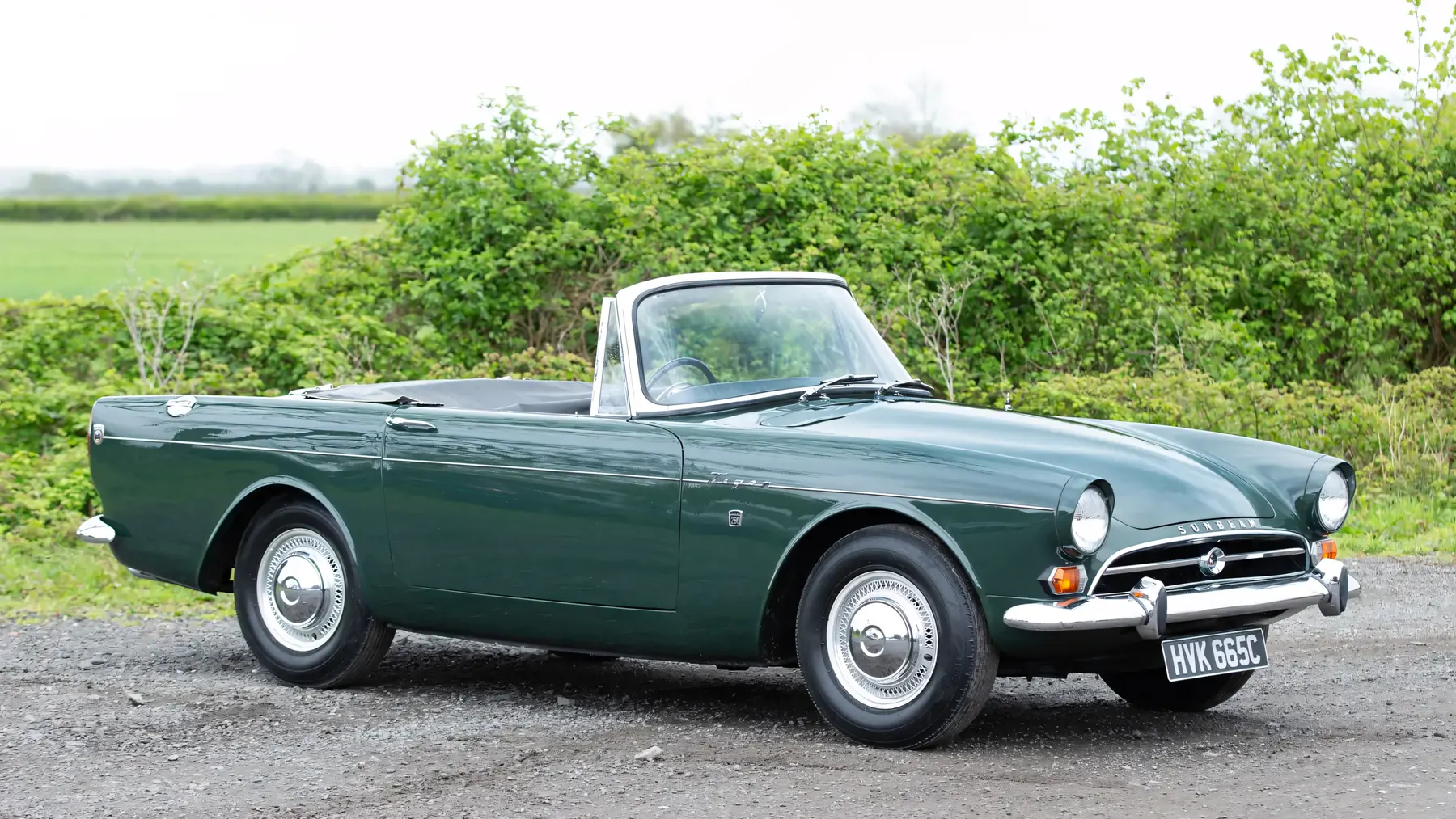
1965 Sunbeam Tiger Mk I

Images: Simon Clay / RM Sotheby's
The Sunbeam Tiger Mk I was born with two things most cars don’t have to contend with at the factory: a sledgehammer and a royalty cheque. The sledgehammer was used by Jensen assembly workers in West Bromwich to bash a section of the already primed and painted bulkhead inward, creating just enough clearance for a Ford 260 V8 to slide into an engine bay designed for an inline-four. The royalty cheque was written to Carroll Shelby, who had proved the conversion possible, been passed over for the production contract, and been compensated instead on a per-car basis. Both details say something revealing about how this Anglo-American sports car came to exist and the pragmatic compromises that shaped it.
The Alpine itself was already a stylish, if modest, four-cylinder roadster from the Rootes Group, introduced in 1959 and selling respectably in the United States, where British sports cars still carried their postwar romance. But Rootes knew the Alpine lacked the power to compete against the Austin-Healey 3000 and an emerging generation of American-market alternatives, and the company lacked the resources to develop a proper high-performance engine of its own. They had even approached Ferrari, hoping that a “Powered by Ferrari” badge would add the necessary glamour; those negotiations failed. When Jack Brabham suggested to Norman Garrad, head of Rootes Competition, that a Ford V8 might solve the power problem, the idea was passed to Ian Garrad - Norman’s son and West Coast Sales Manager for Rootes American Motors - who lived near Carroll Shelby’s Shelby American operation in Venice, California.
What followed was an engineering genesis as informal as it was rapid. Ian Garrad dispatched his service manager Walter McKenzie to nearby dealerships, measuring engine bays with a wooden yardstick and returning with the conclusion that the Ford 260 cubic-inch V8 looked feasible. At approximately 200 kg the Ford small-block was relatively light, and at just 89 mm longer than the Alpine’s inline-four, its width rather than its length was the primary concern. Two prototypes were commissioned almost simultaneously: one by Carroll Shelby in Venice using a $10,000 budget and a four-speed manual gearbox, and a quicker proof-of-concept by racing fabricator Ken Miles, built in roughly a week on just $800 using an automatic. Both fitted. Lord Rootes, initially furious that such work had proceeded without his knowledge, drove Shelby’s finished prototype in July 1963 and was so impressed he telephoned Henry Ford II directly to negotiate an engine supply deal. Rootes placed an order for 3,000 V8 units - the largest single engine order Ford had received from a car manufacturer up to that point.
From Shelby’s approved prototype to production readiness took eight months. Rootes’ typical development timeline was three to four years. Bodies were built and painted at Pressed Steel in Oxfordshire and sent to Jensen’s factory in West Bromwich - Jensen had just lost its Volvo P1800 assembly contract, making it conveniently available - where Ford V8 powertrains imported from America were fitted. The engine went in with extreme difficulty. The shoehorn quality was no exaggeration: Shelby himself later wrote that there was a place for everything and a space for everything, but positively not an inch to spare. At Jensen, workers used a sledgehammer to bash the bulkhead inward. The left bank of spark plugs could only be changed through a dedicated access hole cut in the driver’s side footwell, normally sealed with a rubber bung. The oil filter had to be relocated from its standard block position to a higher mounting on the right-hand side. These were not engineering elegances.
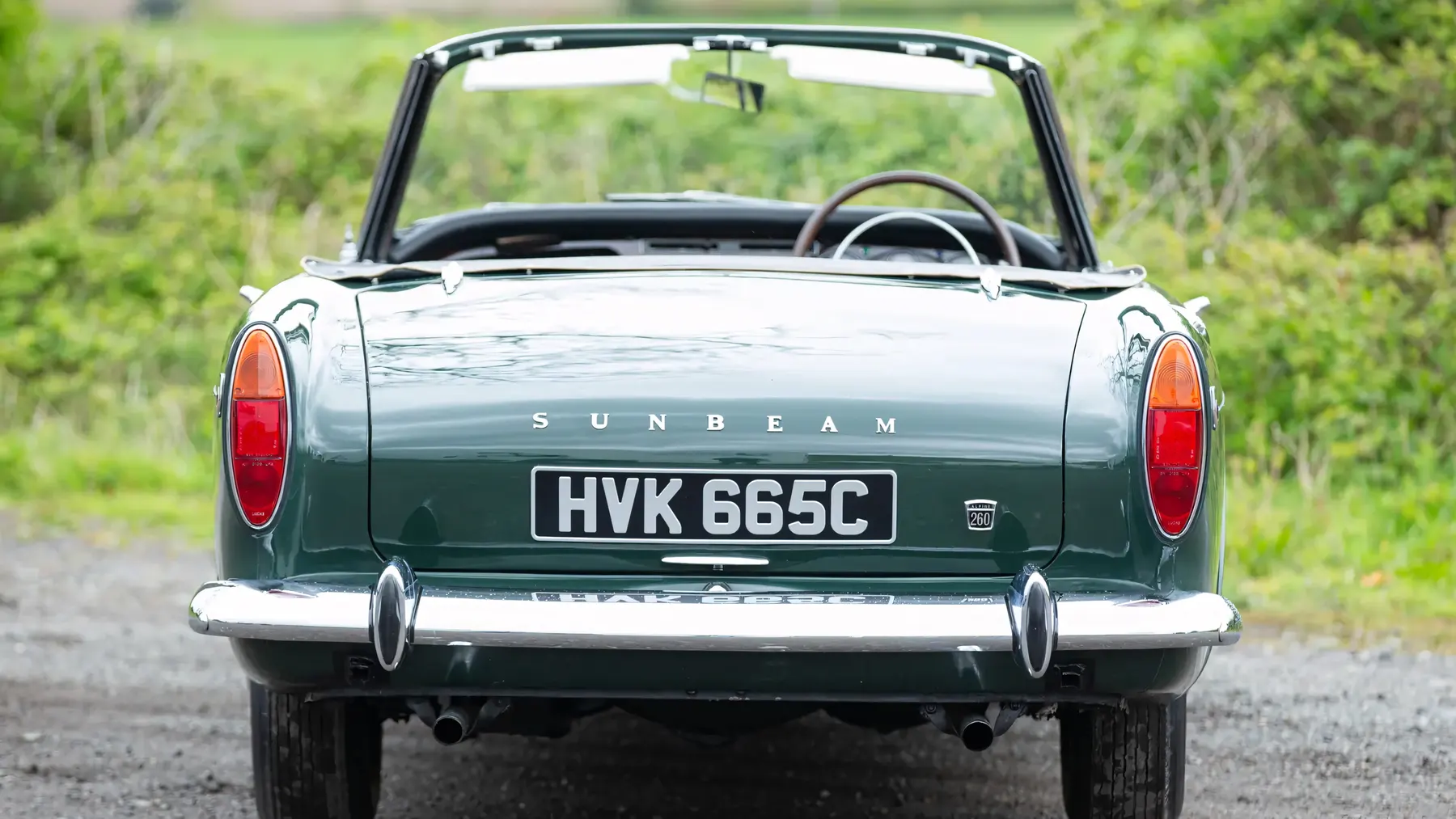
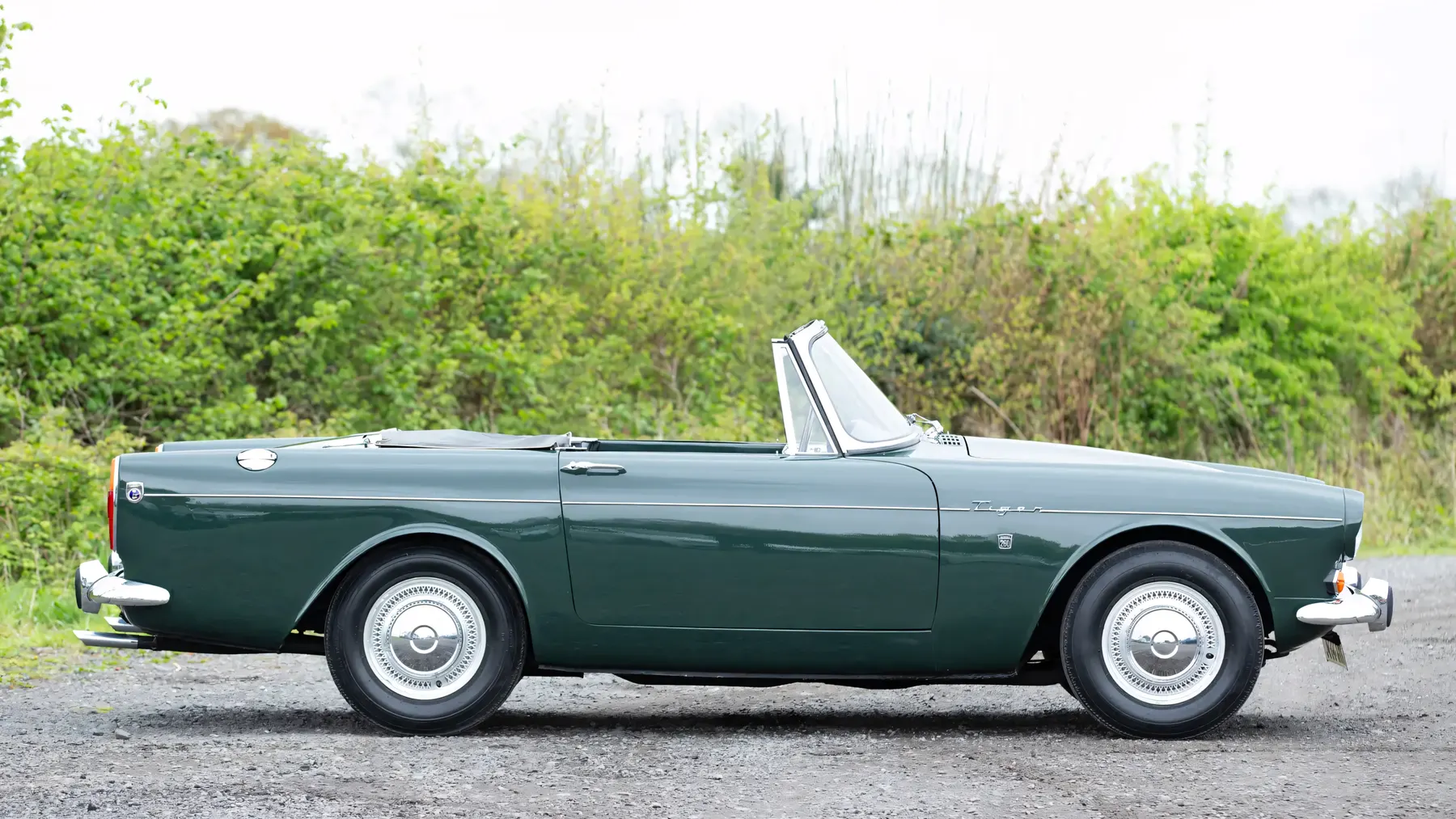
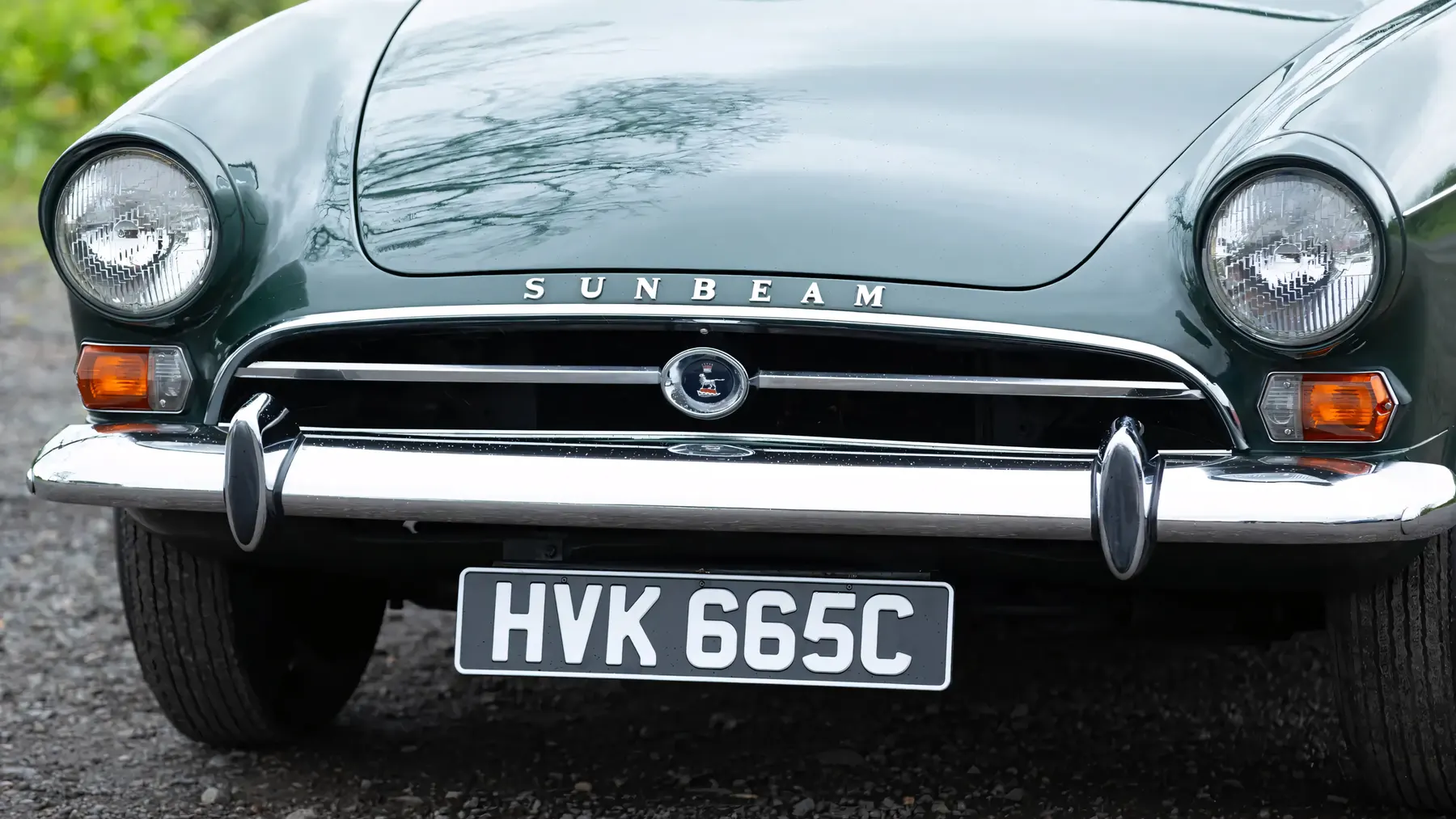
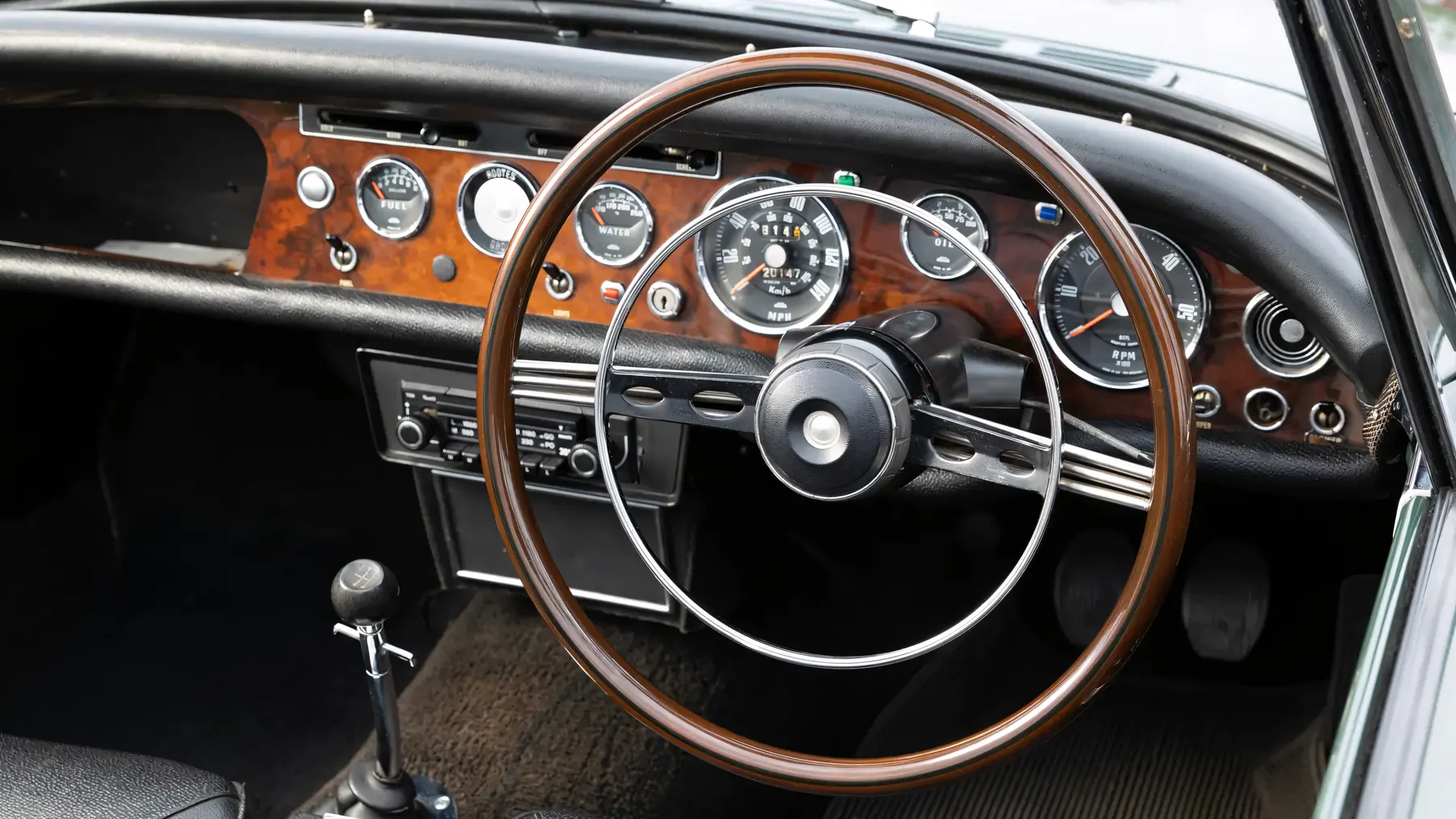
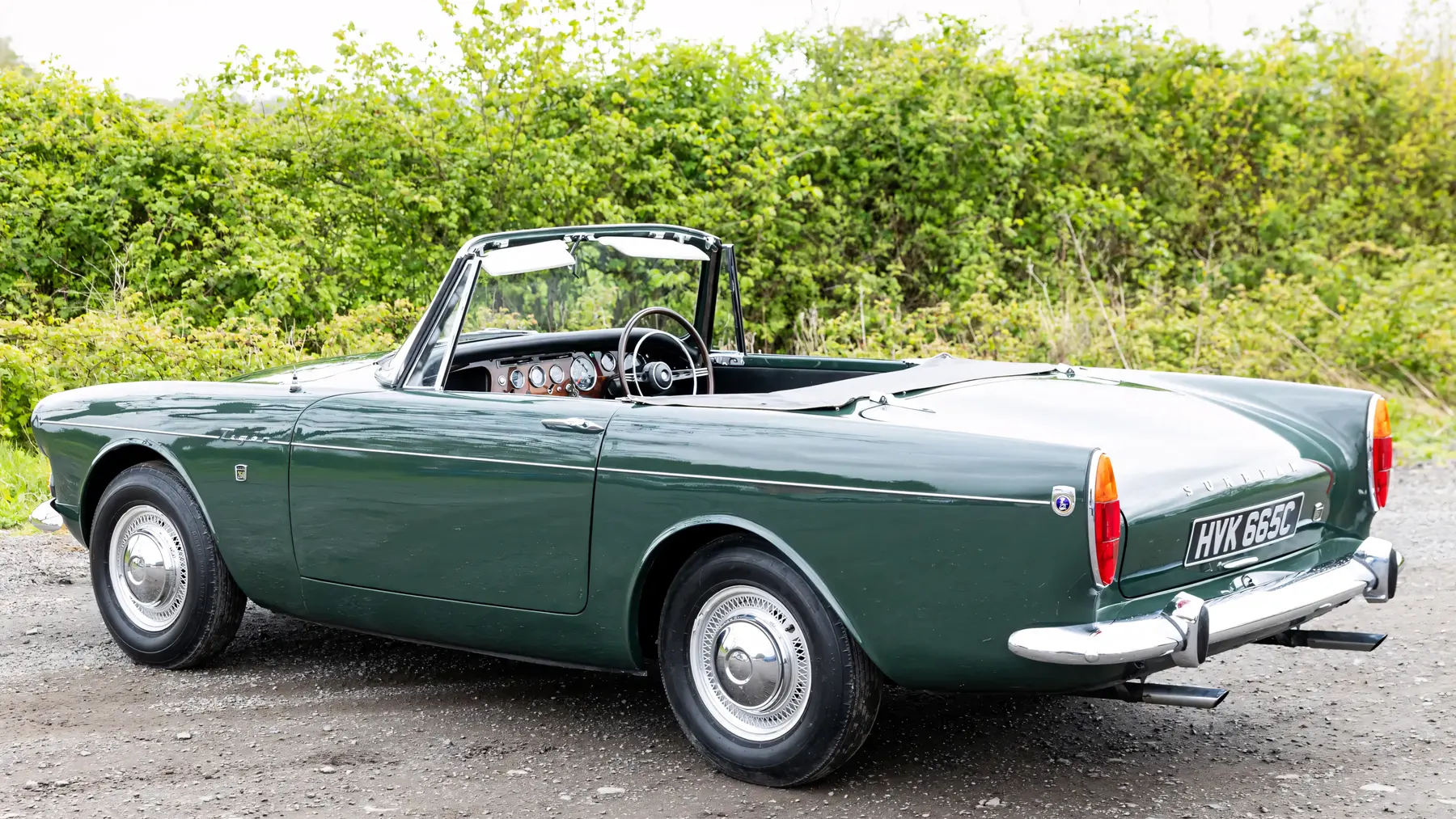
The production Tiger - launched at the 1964 New York Motor Show and named for Sunbeam’s 1925 land speed record car, having briefly been called the Thunderbolt - looked almost identical to the Alpine Series IV it was based on. The exterior sheet metal was essentially unchanged; only the Tiger badging on the front wings, “V-8” scripts below it, a horizontal-bar grille with a central Sunbeam emblem, and a pair of exhaust pipes exiting at the rear distinguished it from its four-cylinder sibling. Inside, every Tiger received a wood-veneered dashboard and a wooden steering wheel that gave the cabin an air of cultivated British sporting propriety. The battery, displaced from behind the passenger seat to make room for the SU electric fuel pump that replaced the mechanical Ford unit, now lived in the boot, and the spare tyre lay horizontally under a false floor.
The mechanical engineering beneath the familiar body went considerably further than the engine swap alone. The Burman recirculating ball steering was replaced by a rack and pinion unit - the same component found in the MG MGA - that transformed the Alpine’s somewhat imprecise front-end communication into something meaningfully more direct. The front coil-spring independent suspension received stiffer springs to carry the heavier V8, and a Panhard rod was added to better locate the solid rear axle, which used a Dana 44 dropout differential produced at the Salisbury Division in England. Girling-manufactured disc brakes measuring 250 mm in diameter handled the front, with 229 mm drums at the rear. Kerb weight climbed from approximately 1,010 kg in the standard Alpine to around 1,203 kg in the Tiger - a roughly 20% increase - yet the front-to-rear weight distribution remained very close to the Alpine’s figure of approximately 52:48, a consequence of the Ford V8’s unexpectedly modest weight penalty.
The 260 cubic-inch (4.3-litre) Ford V8, in its road-going state of tune, produced 164 bhp at 4,400 rpm through a two-barrel Autolite carburettor. In the Tiger, the small-block was not pushed to its limits. Road & Track, testing the car in November 1964, reported 0 to 60 mph in 7.8 seconds and a top speed of 118 mph, while also recording fuel economy of around 20 Imperial miles per gallon - figures that positioned the Tiger as surprisingly tractable and even frugal for a V8 sports car of the period. The magazine praised the engine’s driveability alongside its performance. Motor Sport, in 1965, concluded that no pairing of an American V8 and a British chassis could be happier. The torque character of the small-block, peaking low in the rev range, meant the Tiger rewarded relaxed driving; it was not an engine that demanded to be wrung out, and in standard trim it rarely needed to be. The deep-cushioned bucket seats, roll-up windows, and adjustable steering column gave the Tiger a level of interior refinement that the more violent Cobra never offered - which was precisely the point.
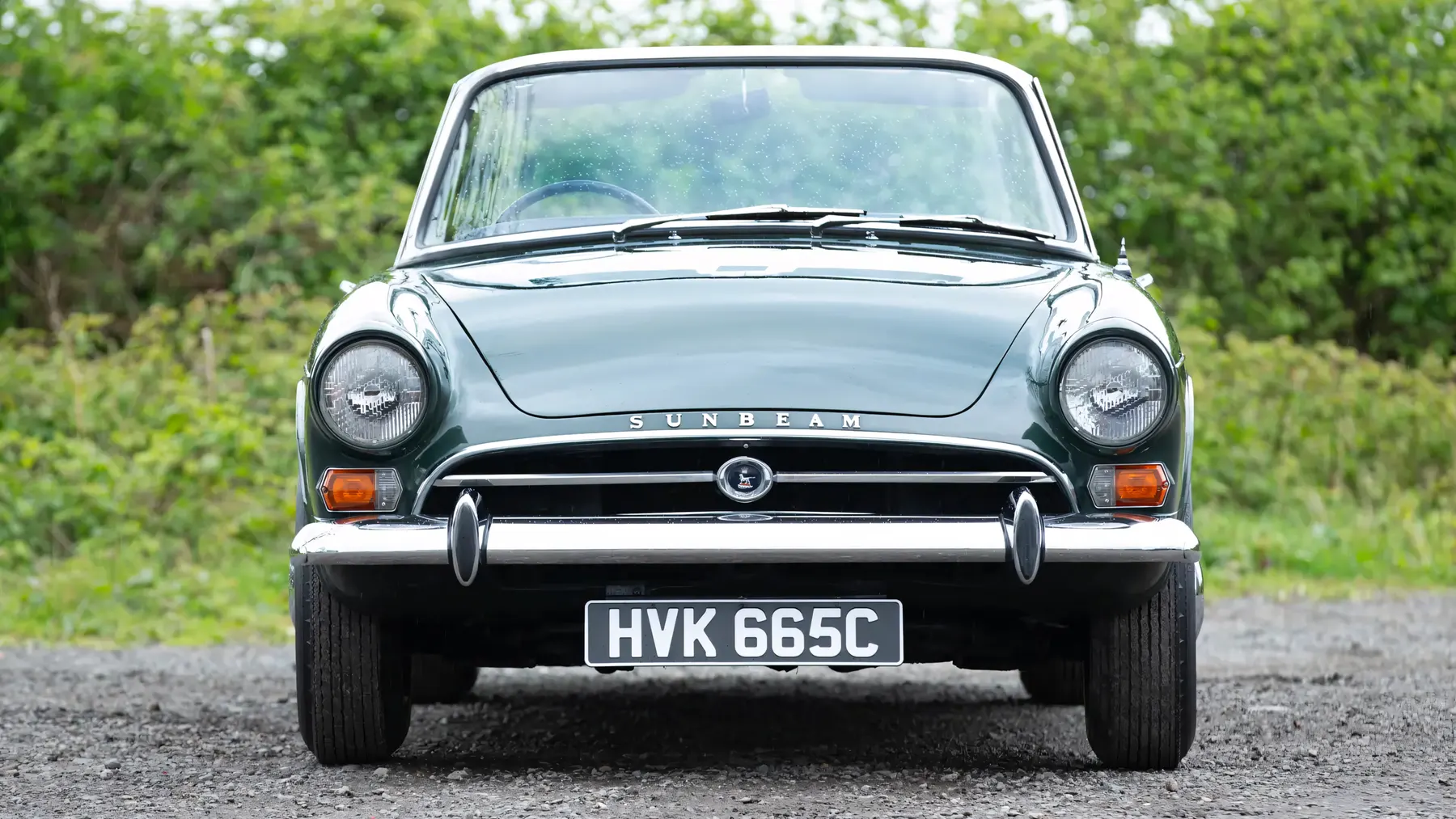
The Mk I production run spanned two distinct body styles, though the factory never formally differentiated them. The original cars, built on the Alpine Series IV bodyshell, had rounded lower corners on the doors, bonnet, and boot lid. After approximately 3,700 cars, the bodyshell transitioned to the Alpine Series V, bringing squarer door corners and sharper body lines. Enthusiasts designate these later cars the Mk IA, though the factory designation remained simply Mark I. The Mk IA also received a vinyl hood boot in place of the earlier metal cover and improved cabin ventilation. Production peaked in 1965 when just over 3,000 Tigers were assembled in a single year - nearly half of all Mk I production. The car was initially available only in North America; British customers had to wait until March 1965, when the Mk I entered the UK market at £1,446, approximately £500 less than an E-Type Jaguar.
Rootes took the Tiger to motorsport with the particular urgency of a company needing to establish a performance reputation quickly. Three highly modified Tigers, fitted with fastback coupé bodies designed by Rootes stylist Ron Wisdom and built by Brian Lister at a cost of approximately $45,000 each, were constructed for the 1964 24 Hours of Le Mans. Up to the A-post the body was essentially identical to the production car’s; from there, a raked windscreen created a lower roofline leading to a fastback rear section with an abruptly truncated Kamm tail, refined through quarter-scale wind tunnel testing. One car served as a prototype; two were entered in the race, running in the prototype class with close-ratio BorgWarner gearboxes and a projected top speed approaching 160 mph on the Mulsanne straight. The exercise was not a success. Both cars retired early - one with a piston failure after three hours, the other with a broken crankshaft - victims of engines that had not been properly developed for endurance running and that overheated badly. The cars were also considerably heavier than their class rivals: their steel monocoques made the Le Mans Tigers roughly 270 kg heavier than the winning Ferrari. Shelby eventually refunded Rootes the development costs. In European rallying, results were more encouraging - the Tiger took the top three places in the 1964 Geneva Rally and one Tiger finished fourth overall in the 1965 Monte Carlo Rally, the highest placing by a front-engined rear-wheel-drive car in that event - but by the 1966 Acropolis Rally, the low-slung bodyshell was plainly unsuited to the increasingly rough rally stages the sport was evolving toward. The Tiger’s SCCA career in the United States, initially handled by Shelby American before being passed to the Hollywood Sports Car dealership, produced some victories in B Production class but was cut short by Shelby’s growing commitments to the Ford GT40 programme.
The Mk I’s genuine weaknesses are rooted in the speed and improvisation of its creation. The standard suspension and braking, inherited almost unchanged from the Alpine, had been calibrated for a car producing around 80 bhp from an inline-four, not 164 bhp from a V8. At relaxed road speeds, the Tiger felt balanced and engaging. But drivers who pursued the performance more aggressively encountered rear axle hop - a consequence of the solid rear axle’s tendency to wind up under hard acceleration - and found the standard 13-inch cross-ply tyres quickly overwhelmed. The LAT catalog, a performance accessories programme run through Ian Garrad’s International AutomobilesAlpine operation, acknowledged these limitations by offering traction bars, limited-slip differentials, and uprated carburettor packages through the port of entry. Some dealers offered four-barrel Holley carburettor conversions on Edelbrock manifolds that raised output to around 245 bhp, but the Wikipedia-cited contemporary sources note these modifications “proved problematic for the standard suspension and tyres, which were perfectly tuned for the stock engine.” Hagerty’s buyer’s guide is unambiguous on this point, noting that stock Tigers are best driven at something short of their absolute limits - a candid admission for a car sold on V8 performance. The 260 V8 itself had a known weakness above 5,000 rpm, where the valve springs could fail, a problem severe enough to be addressed as a matter of course in the Mk II through upgraded components. The predictable result of all this mechanical accessibility and low-cost upgradeability is that very few Tigers survive today in original factory specification; the ease and affordability of powertrain modifications meant most owners at some point departed from standard, making genuinely unmodified Mk I examples exceptionally rare survivors.
The Tiger’s life was curtailed not by market failure but by corporate politics. Chrysler had begun investing in the financially stretched Rootes Group in 1964 and achieved full control in 1967. The new American parent had no enthusiasm for producing a Ford-powered car. Chrysler’s own 273 cubic-inch small-block was too wide to fit under the Tiger’s bonnet without extensive re-engineering, and its rear-mounted distributor made the packaging problem worse still, in direct contrast to the Ford V8’s front-mounted unit that had allowed the original conversion to work. Chrysler ordered production to end once existing stocks of Ford engines were exhausted. Jensen assembled the last Tiger on 27 June 1967. In its final marketing, Chrysler quietly de-emphasised the Ford connection, describing the Tiger as simply having “an American V-8 power train.” Rootes design director Roy Axe later reflected that Chrysler did not understand the Tiger’s place in the range and lacked the same interest in it as the family car products.
The production Tiger was not, in truth, a ferocious machine - period critics occasionally pointed out that the name rather overstated the car’s wildness - but it offered something genuinely distinctive: the torque and character of a Ford small-block packaged inside a compact, well-finished British roadster that could return 20 miles per gallon and seat two adults in well-appointed comfort, priced below an E-Type Jaguar. It was not the Cobra. But it shared with the Cobra its most engaging quality: the persistent, pleasurable sense that the engine was always slightly more than the car around it had bargained for.
Sources
- Wikipedia - Sunbeam Tiger
- Hagerty Media - Definitive 1964–68 Sunbeam Tiger Buyer’s Guide
- Hagerty Media - 1964–67 Sunbeam Tiger Buyer’s Guide
- Hagerty Valuation Tools - 1964 Sunbeam Tiger Mk I
- ConceptCarz - 1965 Sunbeam Tiger Mk I
- ConceptCarz - 1966 Sunbeam Tiger Mark IA Specifications
- GB Classic Cars - Sunbeam Tiger Specification and History
- Sunbeam History (Australia) - Sunbeam Tiger
- Bonhams - 1964 Sunbeam Tiger Le Mans Coupé Catalogue Entry
- Car & Classic - Sunbeam Tiger Models, Specs and Buyer’s Guide
- Sunbeam Tiger Owner’s Association - What Is a Sunbeam Tiger?
- International Car Events - Sunbeam Tiger 60th Anniversary
Join the discussion
Comments
Loading comments…
Leave a comment
Share a detail, memory, or perspective. Every comment is reviewed before publication.