Porsche 911 Carrera RS 2.7 Lightweight: Once Porsche's Cheaper 911
1973 Porsche 911 Carrera RS 2.7 Lightweight

Images: Jasen Delgado / RM Sotheby's
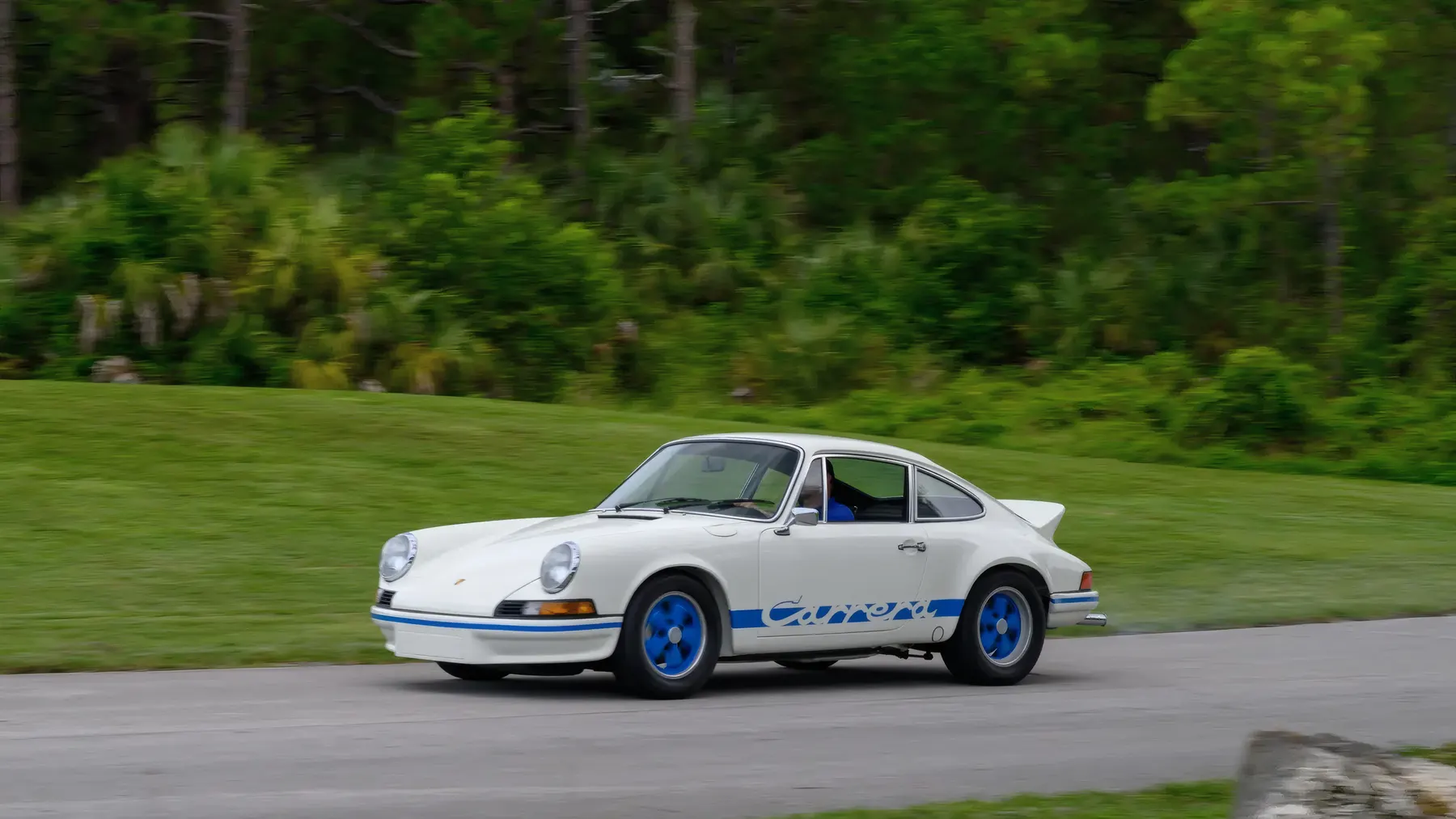
When Porsche drew up the price list for its new 911 Carrera RS 2.7 in 1973, something happened that reads almost like satire from today’s vantage point: the stripped-out, spartan version - the one collectors now call the Lightweight - was priced lower than the plusher Touring sitting next to it in the brochure, at around DM34,700 against DM36,500. Fifty-odd years on, that gap has inverted itself so completely that a genuine Lightweight can fetch close to double what an equivalent Touring commands at auction. It is a neat encapsulation of how this car’s identity has flipped over time, from the value-conscious, no-frills option nobody quite trusted Porsche’s own sales department to shift, into the single most coveted air-cooled 911 in existence. The Lightweight, internally coded M471 and officially badged “Sport,” was never meant to be a curiosity. It was, in the engineers’ own minds, the RS as originally intended - the Touring came along slightly later as a concession to buyers who wanted a Carrera RS without quite so much sacrifice.
The RS 2.7 exists because of a rulebook. At the end of 1972 the FIA’s regulations left Porsche’s 917 sports prototypes obsolete for international racing, and rather than chase Ferrari and the Cosworth DFV brigade into pure prototype racing, Porsche found a more promising opening in the new European GT Championship’s Group 4 class, where its road-based 911 was eligible. The looming rival was Ferrari’s 365 GTB/4 Daytona in “Competizione” trim, a car with nearly twice the displacement of any 911 engine then in production. To have a chance, Porsche needed a homologated 911 that was both lighter and considerably more powerful than the outgoing 911 S. A small team of around fifteen engineers, working under Peter Falk, then head of testing for series production cars, began development in May 1972, using the 911 S as their starting point. Group 4 homologation required at least 500 identical road-going examples to be built and sold, a target Porsche’s own sales management reportedly viewed with some scepticism.
The engineering response centred on two things: more displacement and less mass. Boring the existing flat six out from 84mm to 90mm took capacity from 2.4 to 2.7 litres - 2,687cc precisely - and, paired with a magnesium-cased engine (Porsche’s type 911/83), Bosch mechanical fuel injection and a single overhead camshaft per bank with two valves per cylinder, output rose to around 207bhp at 6,300rpm. That was a substantial jump over the 911 S it replaced and made the RS 2.7 the fastest series-production car built in Germany at the time of its launch, with a 0–60mph time in the high fives and a top speed that period sources place somewhere in the region of 150–152mph, though a few accounts push that as high as 158mph - a spread that likely reflects differences in test conditions and gearing as much as anything else. To put that power down, Porsche fitted wider rear tyres than front for the first time on any production 911: 185/70 VR15s up front on 6J wheels, 215/60 VR15s at the rear on 7J Fuchs alloys, which in turn required the rear wheel arches to be flared outward by 42mm. A firmer Bilstein damper set-up, aluminium front trailing arms, thicker anti-roll bars and reinforced rear control arms and cross-member accompanied the wider footprint, along with brakes borrowed from the 911 S.
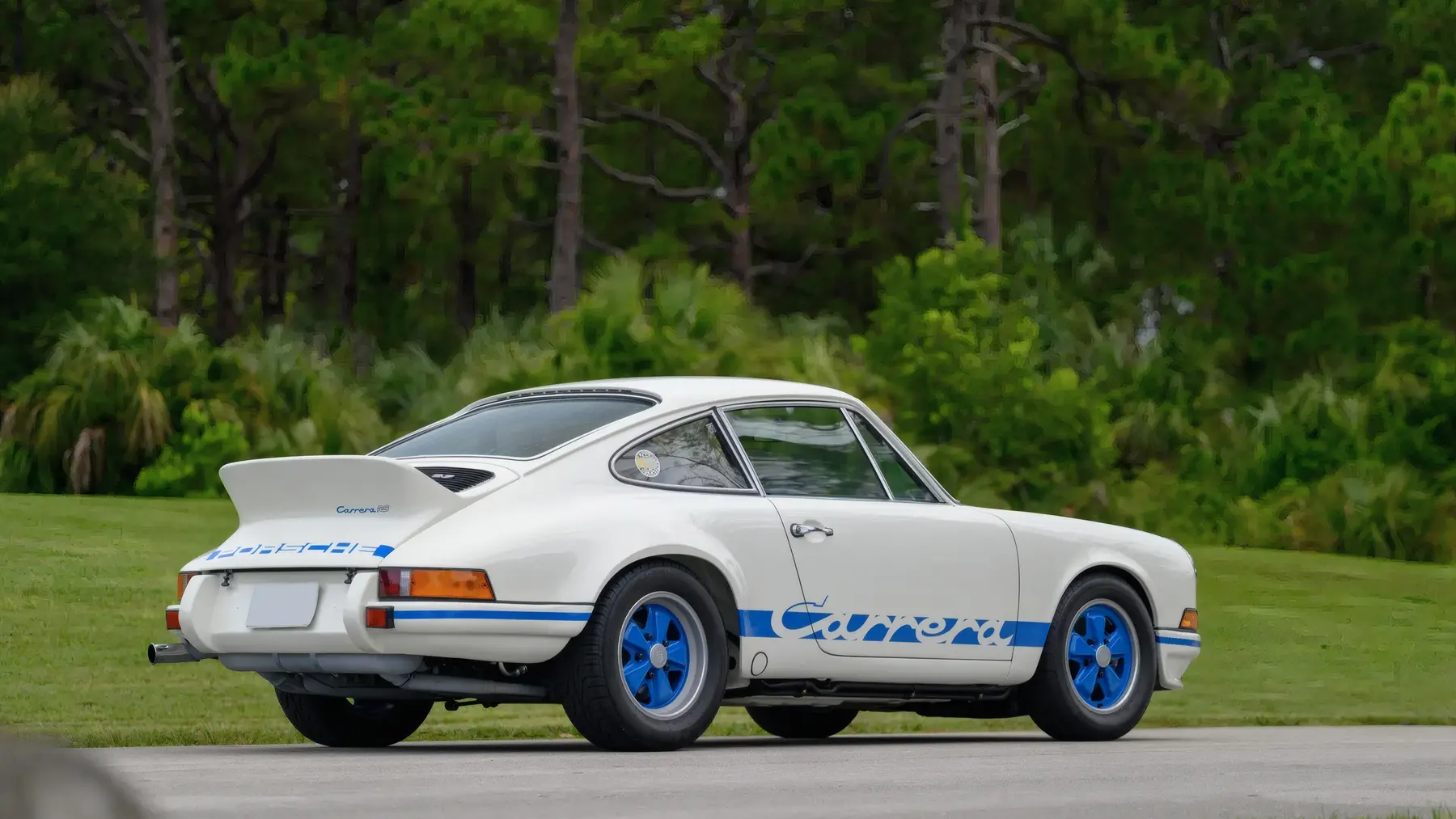
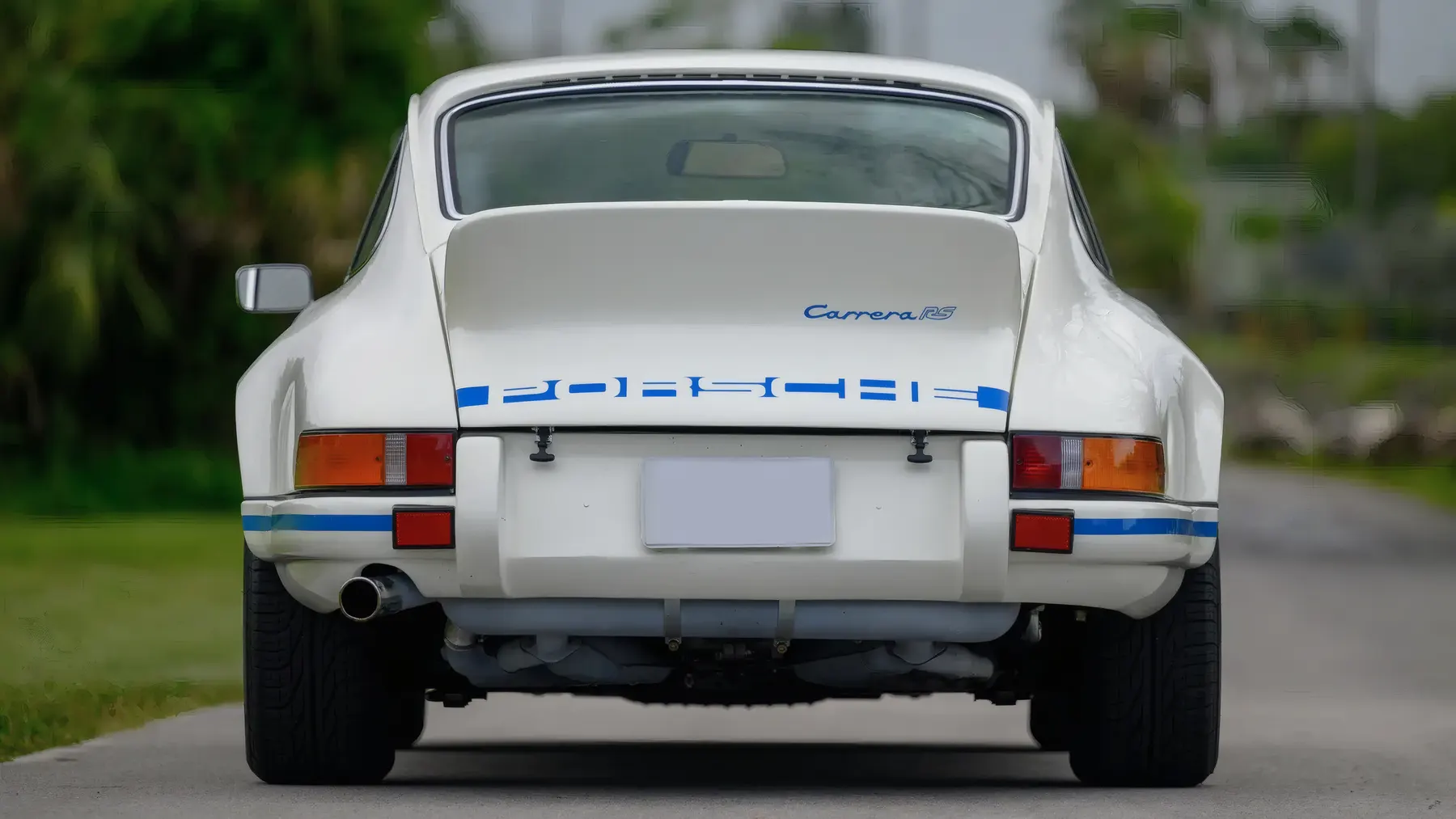
None of that, however, is what most people picture when they hear “2.7 RS.” That would be the ducktail. Porsche’s engineers had discovered that the 911’s tail generated troubling amounts of aerodynamic lift at speed, and development engineer Hermann Burst, working with aerodynamicist Tilman Brodbeck under development chief Helmuth Bott, spent time in Weissach’s wind tunnel devising a small upturned rear spoiler to counteract it. Porsche filed a patent for the device in August 1972, and after test driver Günter Steckkönig demonstrated its stabilising effect on the new test track, Bott approved it for production - not as an aftermarket accessory, which had initially been the plan, but fitted as standard alongside a matching front airdam, cutting rear-end lift by roughly a third. It was the first time a production car had worn both spoilers from the factory, and Burst himself has since said it took him years to appreciate that what he’d solved as a technical problem had actually become an icon. The other visual signature, the “Carrera” script running along the lower doors in a contrasting colour, was chosen partly because vinyl lettering weighed less than a conventional badge - an early sign of how thoroughly weight-saving shaped even the car’s cosmetics.
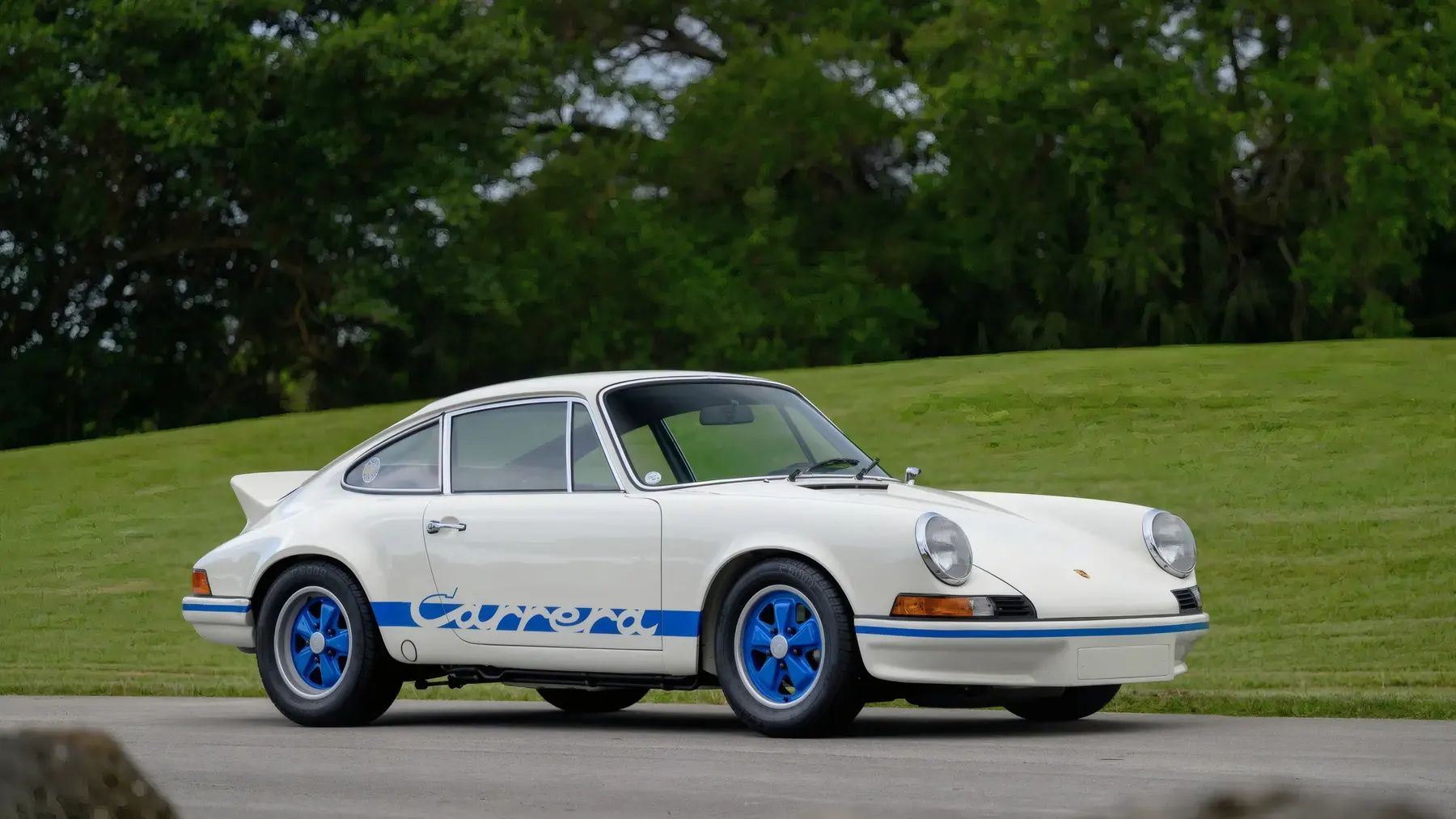
That philosophy is what separates the Lightweight from its siblings. Porsche actually built the RS 2.7 in four distinct forms from a single production run of 1,580 cars: a tiny batch of seventeen bare RSH homologation cars with no comfort package at all, the 200-strong M471 Sport - the Lightweight - that added items like carpet in the luggage bay and a marginally better passenger seat back to the RSH’s starting point, the far more numerous 1,308-strong M472 Touring aimed at buyers who wanted RS performance without giving up rear seats, sound insulation, and a passenger door mirror, and finally 55 cars pulled off the line as unfinished shells and diverted to Porsche’s Werk 1 competition department to become the racing RSR. Compared with the Touring, the Lightweight did without carpeted door panels, a rear seat, a clock, and the Touring’s chrome sill trim and front bumper trim, while thinner-gauge steel body panels and lighter-weight glass shaved further mass. Porsche’s own factory figures put the Lightweight’s unladen weight at around 960kg with the optional lightweight sports seats fitted - some 115kg less than a Touring - though other published specification databases list figures ranging from as low as 900kg to over 1,000kg, a spread that likely reflects different equipment levels, fuel states, and measurement conventions rather than any single “correct” number. Buyers could specify the car in Grand Prix White with the Carrera script picked out in blue, red or green, or in one of several bold solid colours such as Light Yellow or Blood Orange, all of which have become closely associated with the model’s identity.
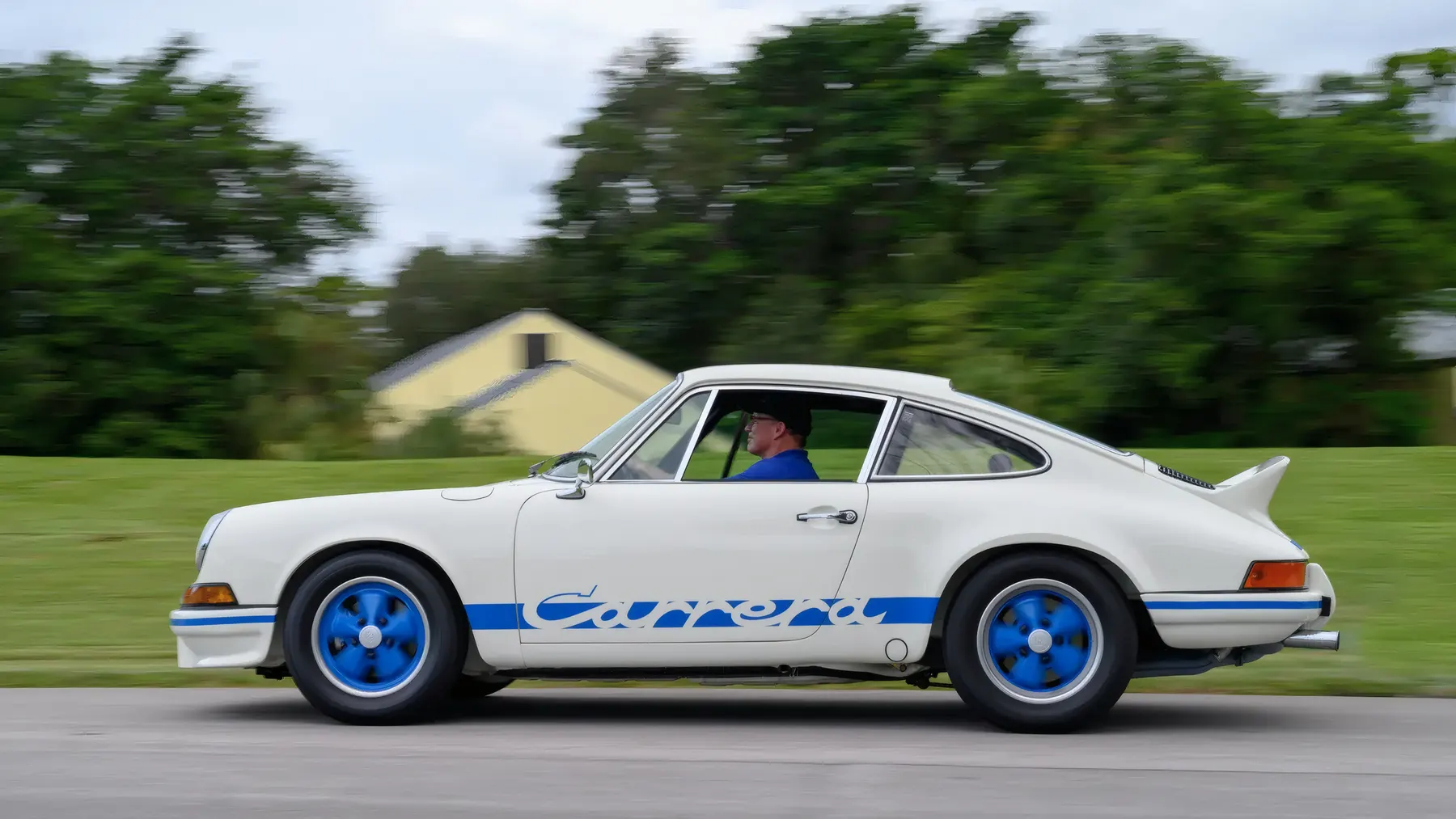
On the road, the Lightweight rewards a very particular kind of commitment. The unassisted steering is light and quick, and because so little mass sits over the nose, the front end needs active, deliberate management through corners rather than the set-and-forget confidence of a modern car - you drive it with the throttle as much as the wheel, using the RS’s famously sharp fuelling response to shift the car’s balance mid-corner. It’s a chassis that rewards familiarity: tentative inputs feel nervous, committed ones feel telepathic. That directness, though, comes at a real cost the moment the road stops being a race circuit. This is worth dwelling on, because it’s easy to romanticise the compromises away. The stiffened suspension and reduced sound deadening that make the Lightweight so alert also make it genuinely tiring over distance - owners and testers alike have long noted the way stones thrown up from the road can be heard, loudly, hitting the thin floorpan, and the combination of minimal insulation and a highly strung, responsive chassis tends to encourage speeds well beyond what’s sensible on public roads, which is a strange thing to say about a car this valuable. The thin-gauge steel that helped the car hit its weight targets also made these early-1970s 911s notably prone to rust, a real ownership concern in period and a significant factor in why surviving, unmolested examples are so scarce and so exhaustively scrutinised today; enthusiast researchers and marque specialists still debate the precise production split between the RSH, Sport and Touring variants, a reflection of how inconsistent Porsche’s own build records were at the time. And there’s a broader irony worth naming plainly: a car engineered from the outset to be the honest, no-nonsense, drive-it-like-you-stole-it version of the RS has, through decades of appreciation, become far too valuable for most owners to use that way. The model built to be the accessible option is now the opposite of accessible.
The Lightweight’s deeper importance, though, lies less in what it achieved on track itself and more in what it made possible. Fifty-five cars from that same production run were pulled aside before their engines and gearboxes were fitted and sent to Porsche’s Werk 1 racing department to be built into the 911 Carrera RSR, badged with the M491 conversion code. There, the flat six was bored further to 92mm for 2.8 litres, compression rose to 10.5:1, and output climbed to around 300bhp in a car weighing roughly 900kg - a genuinely fearsome specification for 1973. The RSR’s season was extraordinary: an outright win at the Daytona 24 Hours for Peter Gregg and Hurley Haywood, further outright and class wins at the Sebring 12 Hours, and, most memorably, an outright victory at the 1973 Targa Florio for Herbert Müller and Gijs van Lennep - Porsche’s final win at an event it had dominated for years, in what turned out to be the Targa’s last running as a round of the World Sportscar Championship. The RSR also swept six of nine rounds to take the 1973 European GT Championship outright. None of that was the Lightweight’s doing directly - it’s important not to credit the road car with victories won by its purpose-built racing cousin - but without the 200 Sport-specification cars (and the wider 1,580-car run) satisfying Group 4’s homologation requirement, none of it would have been possible either. The Lightweight’s real motorsport legacy is as the enabling document, not the trophy-winner.
Porsche replaced the 2.7 RS with the 3.0-litre Carrera RS in 1974, a rarer and considerably more expensive car built in just 109 units and fitted with brakes derived from the 917 racing programme, but the 2.7 Lightweight had already done the important work of establishing a template. The ducktail spoiler and the colour-matched Carrera script have been referenced repeatedly on later Porsches, most visibly on the modern 911 Sport Classic, and the underlying idea - that subtracting weight is a more honest route to speed than simply adding power - remains the philosophy explicitly cited by Porsche’s own GT department to this day. It’s a strange legacy for a car that fewer than 120 examples ever reached right-hand-drive markets in period, and one that Porsche’s sales staff worried might struggle to find buyers at all. Instead the wider 1,580-car RS 2.7 run - Lightweight, Touring, RSH and RSR alike - sold out well beyond its homologation minimum almost immediately, and the leanest, cheapest, least accommodating version of it has ended up as the version everyone wants. Few cars illustrate quite so clearly how a market can eventually value a thing for exactly the qualities its original buyers were being asked to give up comfort for in the first place.
Sources
- Porsche: “The game-changing Porsche 911 RS 2.7 sportscar”
- Hagerty Media: “Gold Standard: Driving the Porsche 911 2.7 RS Sport and Touring as they turn 50”
- Hagerty UK: “Gold standard: As the Porsche 911 2.7 RS Sport and Touring turn 50, we drive them”
- Octane Magazine: “Porsche 911 Carrera RS 2.7 – full history and review”
- Ultimatecarpage.com: “1972 - 1973 Porsche 911 Carrera RS 2.7 Lightweight”
- Ultimatecarpage.com: Porsche 911 Carrera RS 2.7 Lightweight specifications
- Supercars.net: “1973 Porsche 911 Carrera RS 2.7 Lightweight”
- Stuttcars: “Porsche 911 Carrera RS 2.7 Lightweight (1973)”
- Stuttcars: “Porsche 911 Carrera RS 2.7 (1973) – The Deep Dive”
- Stuttcars: “Porsche 911 Carrera RSR 2.8 (1973)”
- Renndriver: “Porsche 911 Carrera RS 2.7: History, Specs, Ducktail, and Values”
- Classic Motorsports: “Car Catcher: 1973 Porsche 911 Carrera RS 2.7 Lightweight”
- Classic Motorsports: “In 1973, Porsche built something very special: the 911 Carrera RS”
- Porsche Knowledge: “Porsche 911 Carrera 2.7 RS Touring (M472)”
- Leland West Insurance: “Porsche - The 911 Carrera RS”
- Autosport Forums: “Porsche 911 Carrera RS 2.7 - Production” (TNF’s Archive)
- Revs Institute / Automedia: “Porsche 911 Carrera RSR”
- Motor Sport Magazine: “Targa Florio’s final hero: Gijs van Lennep on his historic 1973 win with Porsche 911 RSR”
- Petrolicious: “This 911 RSR Print Truly Honors Porsche’s Final Targa Florio Win”
- Topspeed: “1973 Porsche 911 Carrera RSR”
Join the discussion
Comments
Loading comments…
Leave a comment
Share a detail, memory, or perspective. Every comment is reviewed before publication.