Bugatti EB110 Super Sport Prototype: Carbon, Boost and Rebirth
1993 Bugatti EB110 Super Sport Prototype

Images: Remi Dargegen / RM Sotheby's
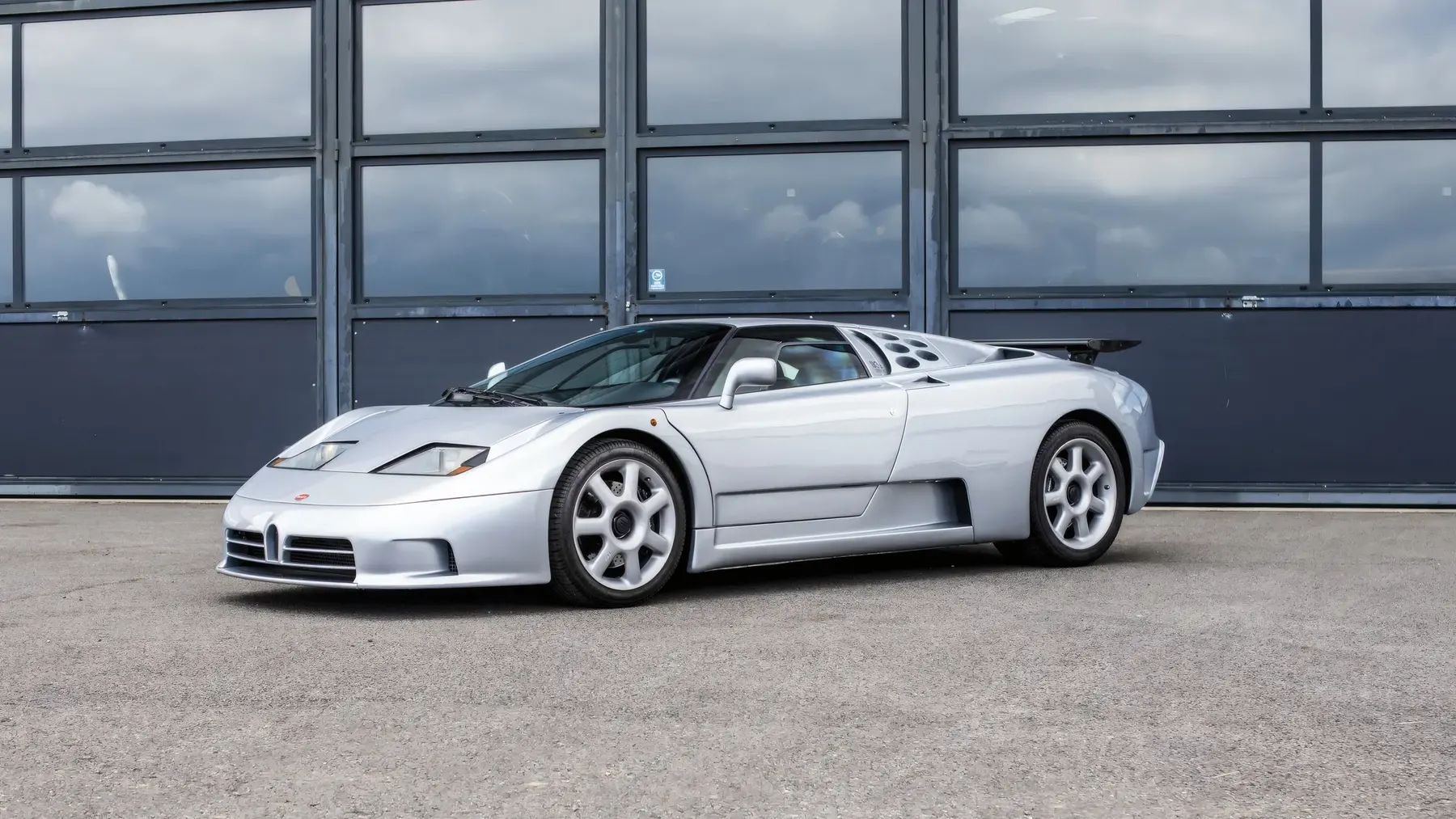
The Bugatti EB110 Super Sport Prototype is where the Italian-era Bugatti project stops feeling like an extravagant resurrection exercise and starts looking like a serious attempt to redraw the top end of the supercar market. The standard EB110 GT was already an audacious object: a newly revived Bugatti, built not in Molsheim but at Campogalliano near Modena, with a carbon composite structure, four-wheel drive, a six-speed manual gearbox, and a 3.5-litre quad-turbo V12. The Super Sport prototypes took that dense technical manifesto and asked a colder, more competitive question: what would happen if Bugatti stripped weight, raised boost, sharpened the chassis brief, and aimed the car less at grand touring and more at the emerging carbon-age hypercar class?
That matters because the EB110 was not simply another early-1990s exotic. Romano Artioli’s Bugatti Automobili S.p.A. was trying to revive one of the most revered names in automotive history after decades of dormancy. Artioli acquired the Bugatti trademark rights in 1987, built a strikingly modern factory at Campogalliano, and launched the EB110 on 15 September 1991, timed to the 110th anniversary of Ettore Bugatti’s birth. It was a romantic gesture, but the car itself was not nostalgic. Where many revived marques lean on retro styling or simplified mechanical theatre, the EB110 was obsessively modern: carbon monocoque, all-wheel drive, dry-sump lubrication, five valves per cylinder, four turbochargers, and electronic management in a package intended to carry Bugatti into a new technical era.
The Super Sport, also known in period as the Sport Stradale or SS, followed the GT with remarkable speed. It was shown at Geneva in March 1992, before customer GT production had properly found rhythm, and it made the original EB110 look almost conservative. The GT’s mission was already ambitious, combining luxury appointments with immense speed, but the SS was the more focused expression. It was around 150 kg lighter than the GT and more powerful, with specialist sources commonly listing output at about 611 bhp at 8,250 rpm and 477 lb-ft at 4,200 rpm. Bugatti’s own later summaries quote the EB110 family’s output as varying by version around the low-550s to just over 600 bhp, so the sensible way to read the SS is as a roughly 600 bhp development of the GT rather than as a car defined by one perfectly fixed number.
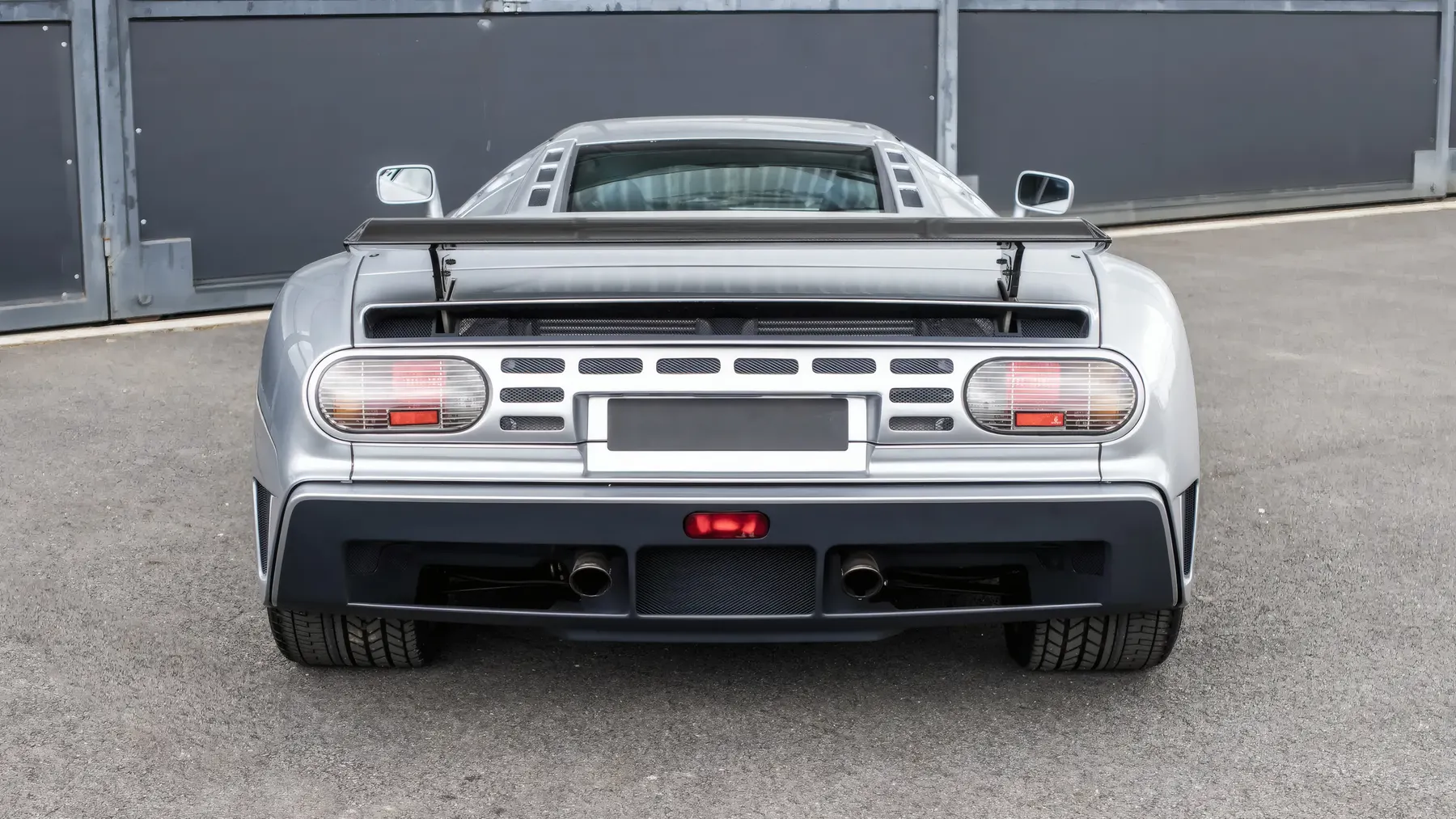
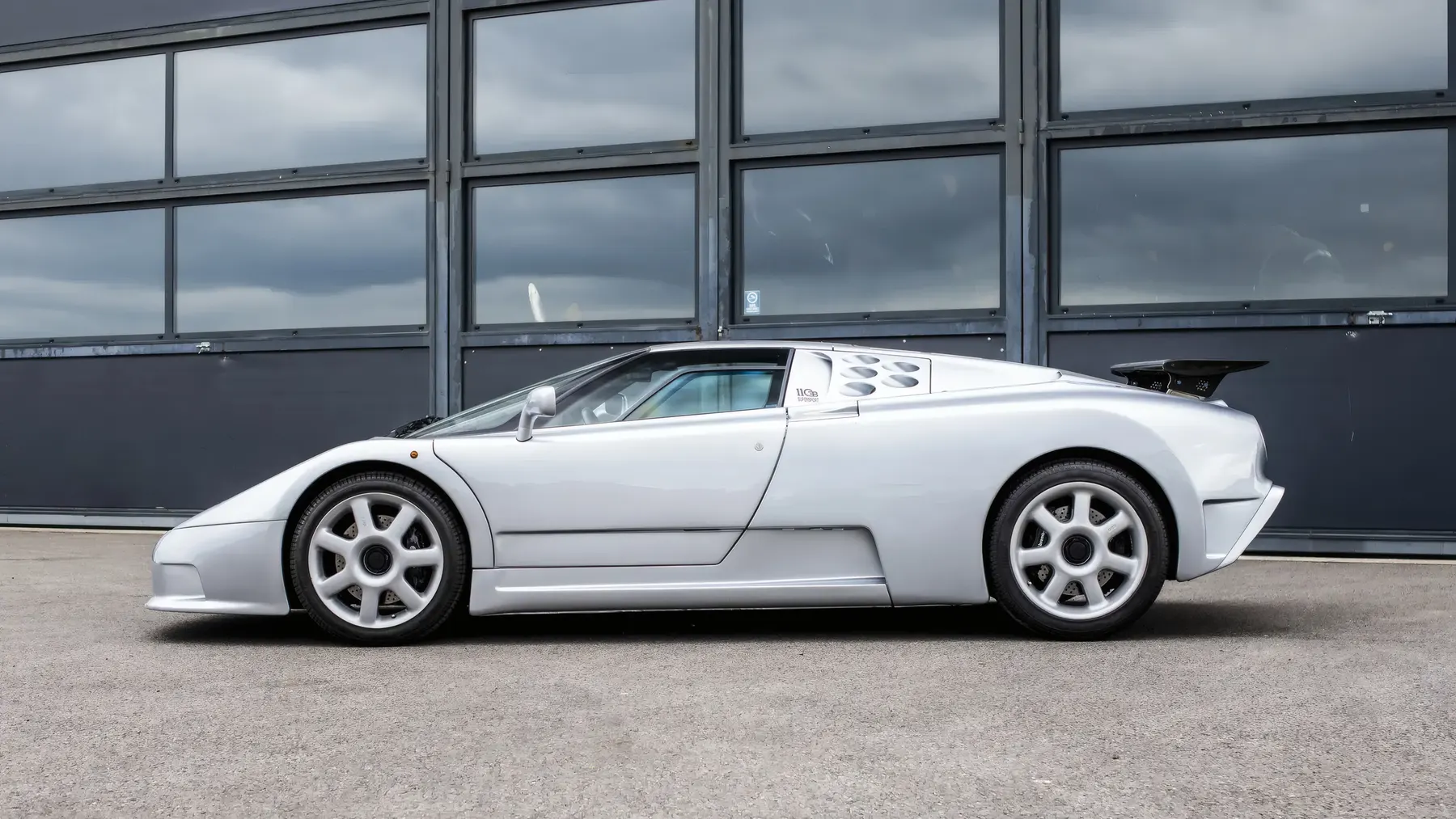
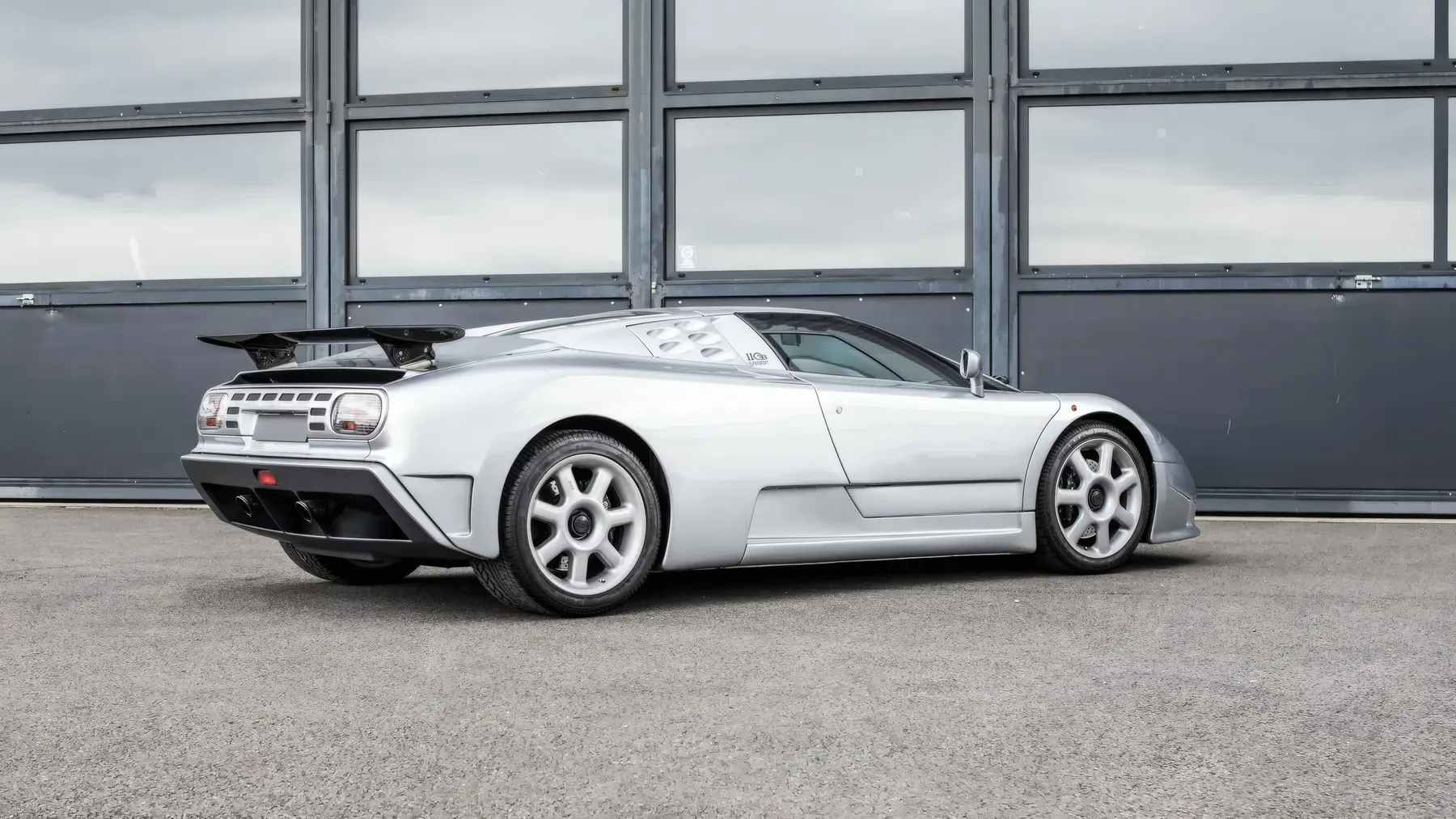
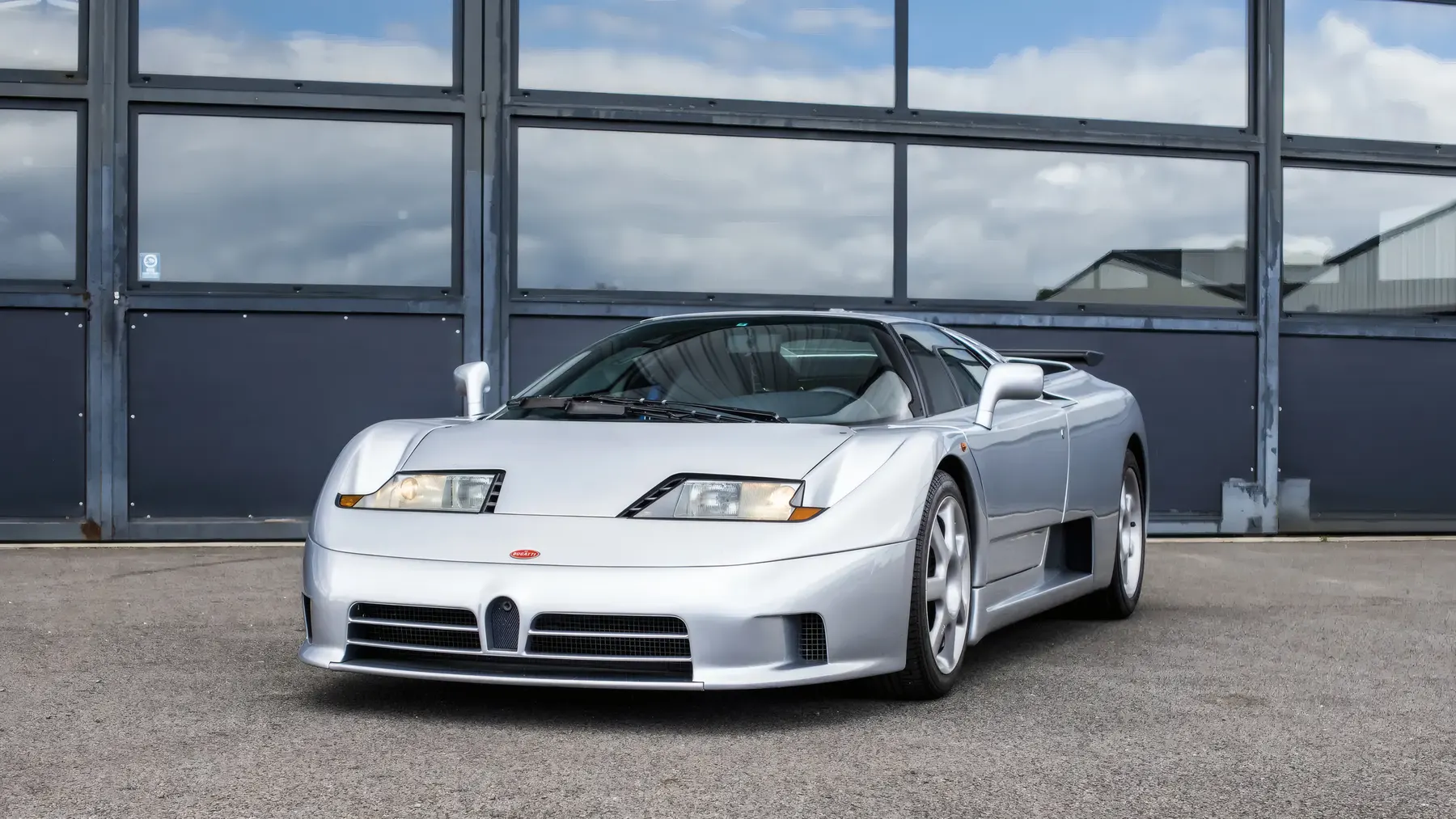
The prototypes are important because they show that transformation taking shape. Before the first customer Super Sports were delivered, Bugatti built a small run of EB110 SS prototypes. Specialist histories record seven Super Sport prototypes, and some were visibly different from later production SS cars, with details such as seven sail-panel portholes rather than the production car’s five and rear spoiler supports arranged differently. These were not cosmetic trivia. The EB110’s body was an active part of its cooling, aerodynamic, and packaging strategy, and the SS programme was a process of turning a technically lavish GT into a lighter, harder, more visually purposeful machine.
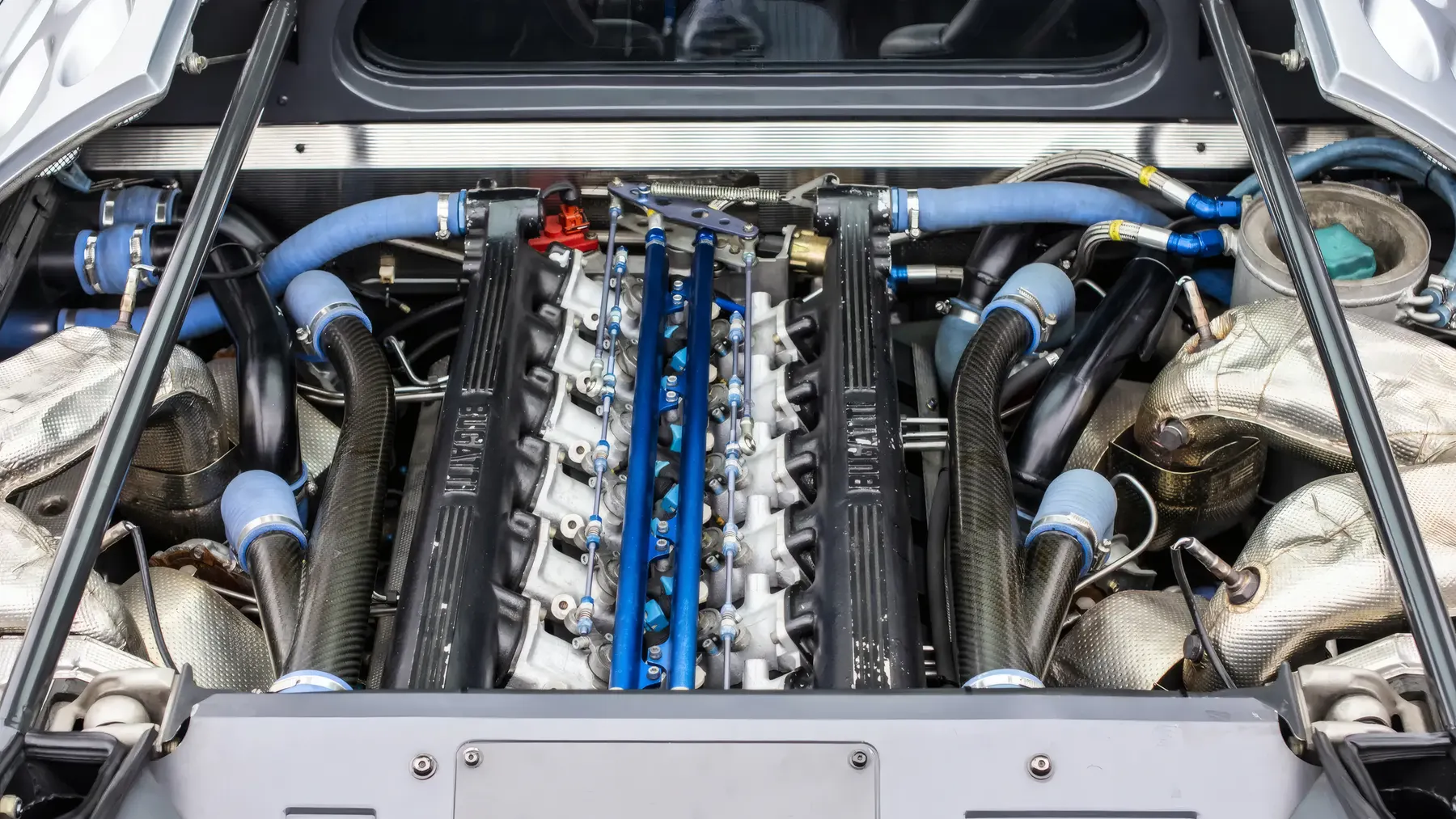
Mechanically, the Super Sport remained faithful to the EB110’s defining architecture. The engine was a 60-degree V12 of 3,499 cc, with an 81 mm bore and a 56.6 mm stroke, four overhead camshafts, five valves per cylinder, four IHI turbochargers, intercooling, and dry-sump lubrication. It was an unusually intricate answer to the supercar problem. A Ferrari F40 was rawer and more elemental, a Jaguar XJ220 had its own controversial turbocharged agenda, and the McLaren F1 would soon pursue lightness, natural aspiration, and purity with almost religious conviction. Bugatti chose the opposite kind of virtuosity: compact displacement, extreme airflow management, all-wheel-drive traction, and a huge rev ceiling for a forced-induction V12.
The SS engine was not merely a GT motor with a badge and a louder exhaust. Boost rose from the GT’s 1.05 bar to about 1.2 bar, and the Super Sport used revised engine management, larger injectors, and a less restrictive exhaust. Power still went through a six-speed manual transmission to all four wheels, with a rear-biased 27:73 torque split, a viscous locking system, and a rear limited-slip differential. In engineering philosophy, the EB110 SS was less a wild oversteer machine than a traction weapon. The prototype’s job was to validate that higher-output version of the concept without losing the EB110’s remarkable stability.
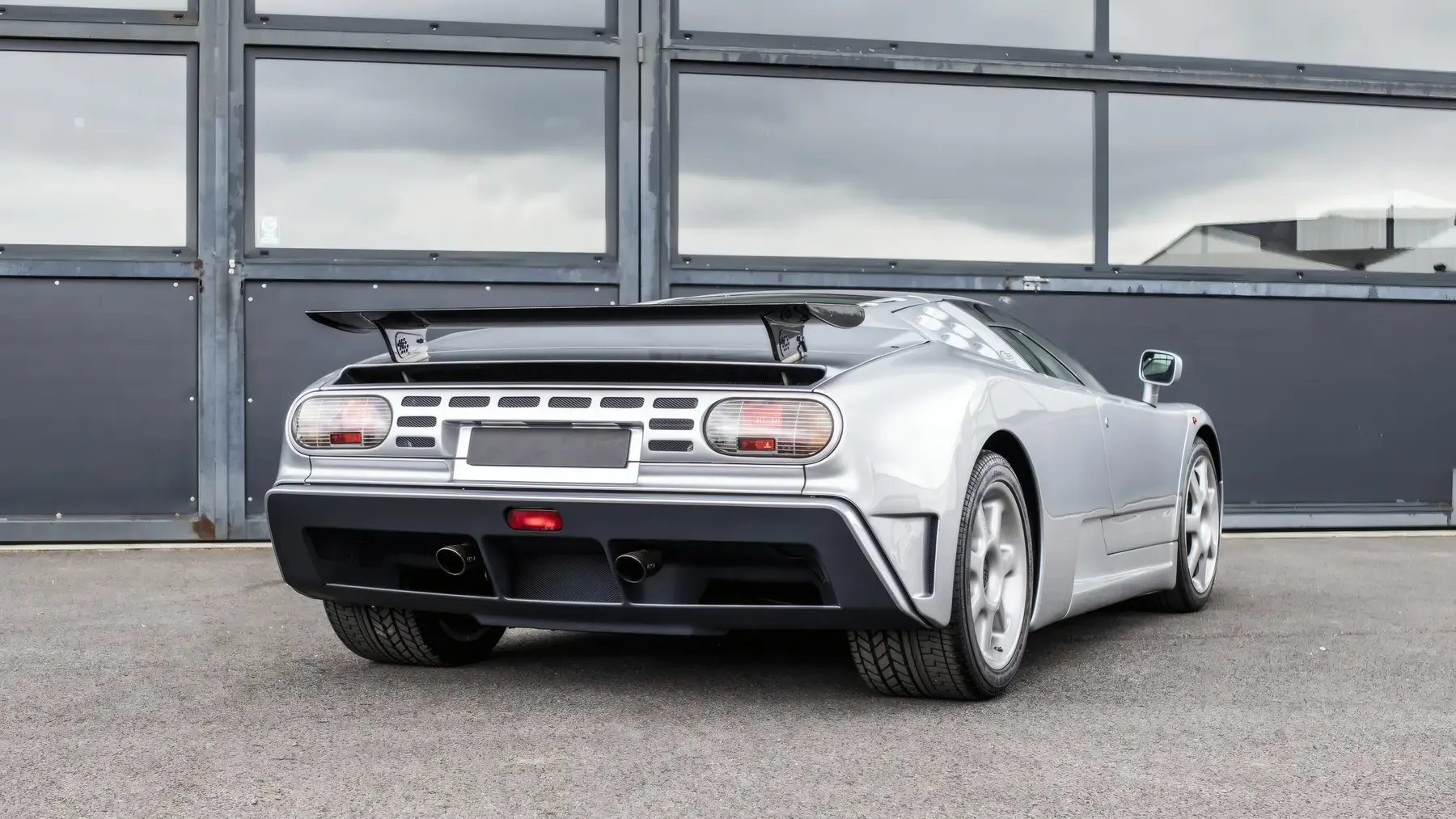
The chassis was the EB110’s great structural claim. The carbonfibre tub was developed by Aerospatiale and fabricated by Composites Aquitaine, and Bugatti later described the monocoque as weighing only 125 kg. The SS built on that expensive foundation but used carbonfibre body panels in place of many of the GT’s aluminium pieces, with those panels bonded directly to the carbon structure. Suspension was independent all round, with double wishbones, pullrod-actuated front spring and damper units, and a simplified rear arrangement compared with the GT. The braking package carried over 322 mm ventilated and cross-drilled discs with four-piston Brembo calipers, while the SS used cast magnesium BBS wheels and broad Michelin rubber, with 245-section tyres at the front and 325-section tyres at the rear.
The weight reduction changed the EB110’s personality on paper and, by implication, in intent. At about 1,410 kg, the SS was still not a featherweight in the way a McLaren F1 would be, but it was meaningfully leaner than the GT. The claimed 0-62 mph time dropped into the low three-second range, and top speed was quoted around 217 mph. Those figures placed the Super Sport among the most serious road cars of its period, but the more interesting point is how Bugatti reached them. It did not delete the all-wheel-drive system or turn the car into a stripped racing special with number plates. It kept a usable structure, traction, air conditioning, central locking, and a sound system, while removing some luxury mass and replacing electric windows with manual ones. That is a very Bugatti sort of extremity: advanced, costly, and slightly paradoxical.
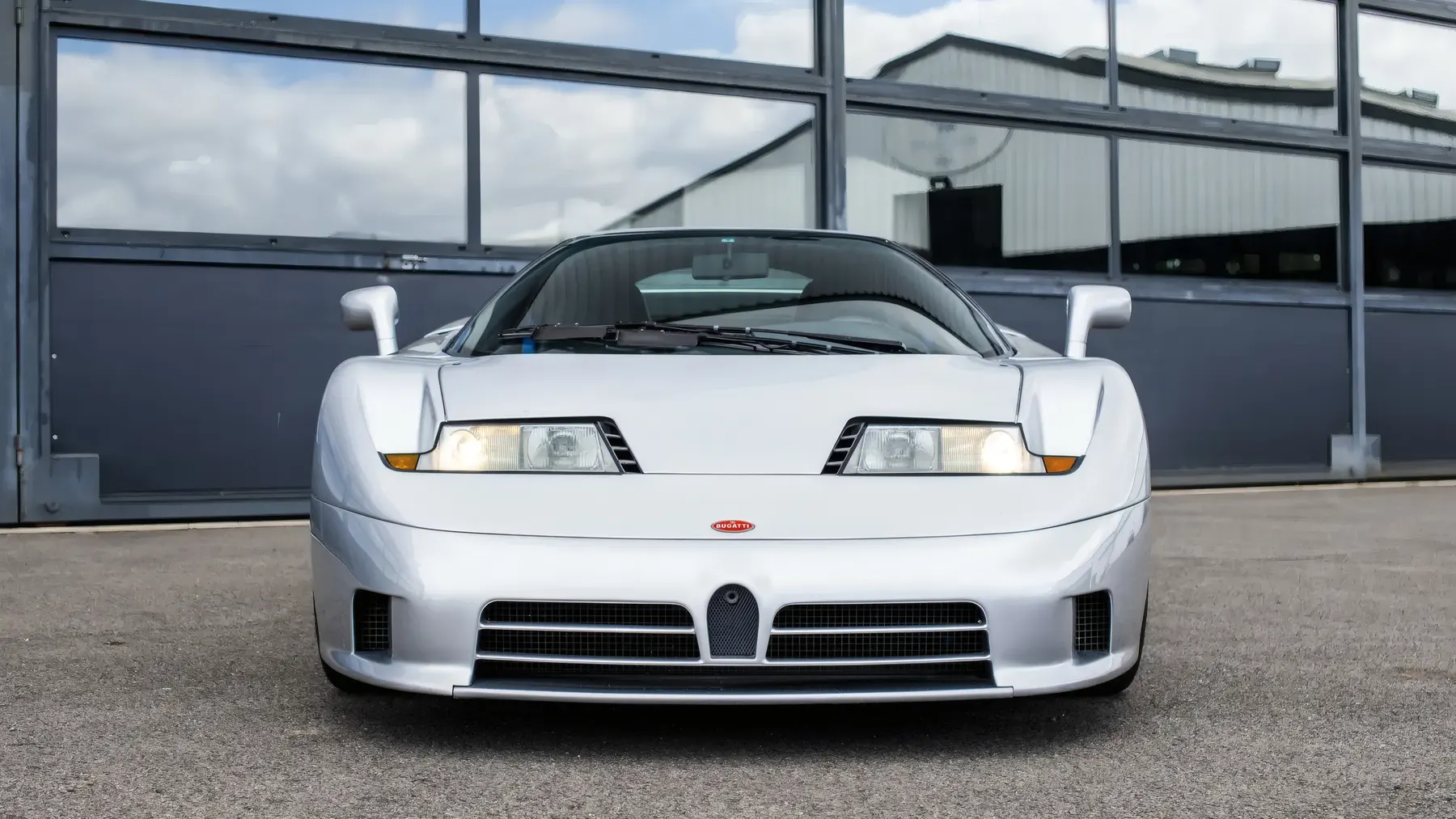
Stylistically, the EB110 has always been more complicated than its specification sheet. Marcello Gandini’s wedge vocabulary is visible in the car’s proportions and scissor doors, but the EB110 never had the clean brutality of a Countach or the effortless drama of a Miura. The nose is low and technical rather than beautiful in a classical sense, the headlamp treatment is unusual, and the small horseshoe grille reads almost like a ceremonial signature applied to a piece of aerospace hardware. The Super Sport improved the visual argument. Its body-coloured B-pillars, altered intakes, carbon panels, and more purposeful details made the car look less like a very expensive GT and more like a prototype that had escaped development with its edges still exposed.
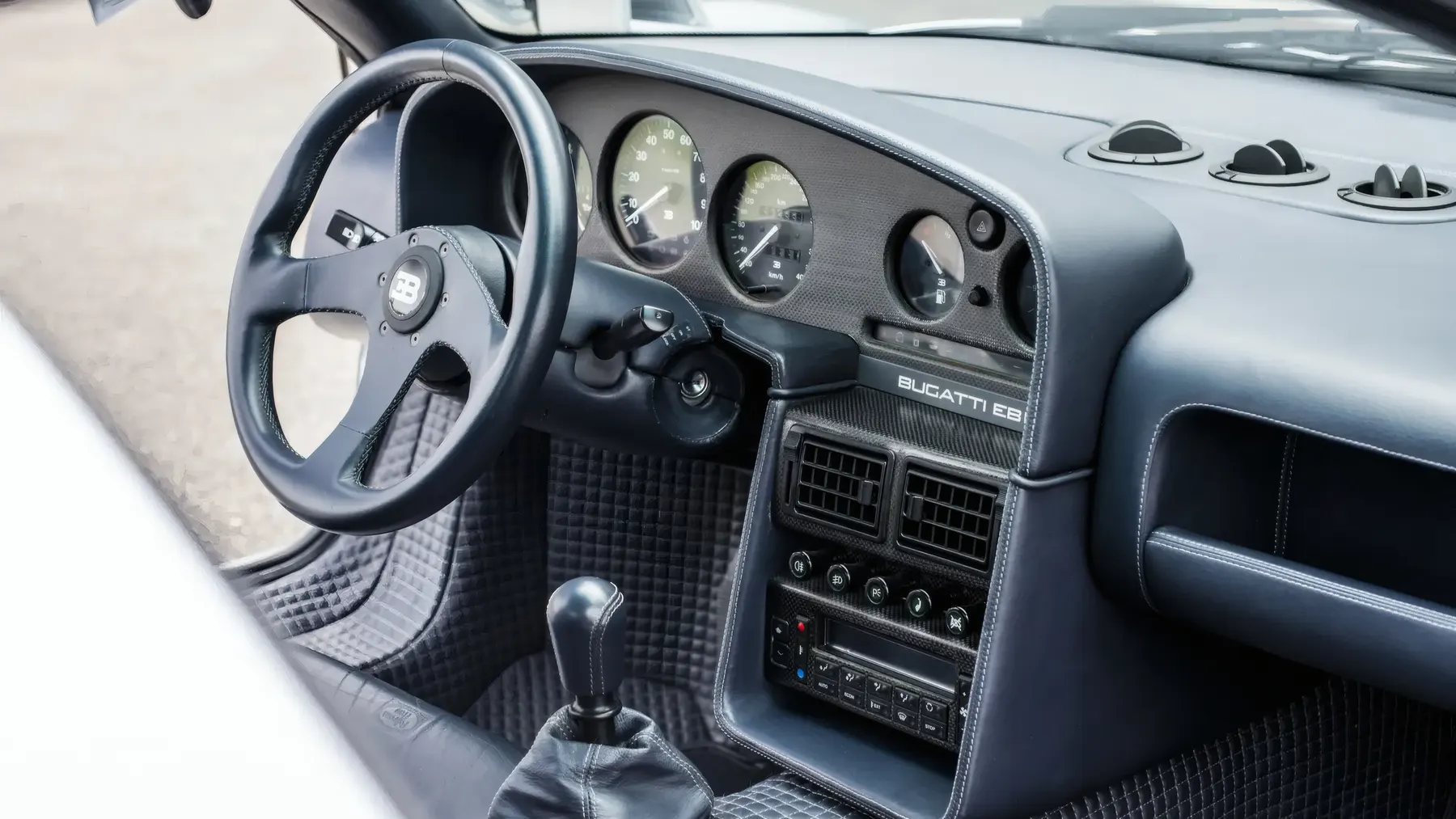
Inside, the SS also revealed the tension in the whole EB110 project. The GT cabin had leather, wood trim, electric adjustment, climate control, and a level of equipment that set it apart from more ascetic exotics. The SS stripped some of that away, but not all of it. It was still a Bugatti, not a kit of homologation excuses. Yet the packaging limitations were real. The EB110’s wide sills made entry awkward, the cabin was tight for taller drivers, rearward visibility was compromised, and luggage space was minimal. The Super Sport’s manual windows and lighter trim made sense for weight, but they also underlined the fact that this was a very expensive machine asking buyers to accept inconvenience in the name of speed.
The honest caveat is that the EB110’s technical brilliance did not automatically make it the most emotionally rewarding supercar of its generation. A Car and Driver archive drive of a pre-production EB110 GT praised the gearbox, clutch, steering, ride compliance, grip, and stability, but it also identified the core dynamic compromise: the turbos were slow to wake fully below about 4,800 rpm, the engine note had more whoosh and mechanical noise than operatic V12 drama, and the chassis was guarded by strong understeer at the limit. The Super Sport’s lighter body and extra power sharpened the formula, but they did not erase the basic character of a small-displacement, heavily boosted, all-wheel-drive supercar. On a fast road, that meant staggering ability, but not necessarily the delicacy or instant throttle response that made some rivals more playful at sane speeds.
That distinction is crucial to understanding why the Super Sport Prototype is fascinating rather than merely flawless. Bugatti engineered the EB110 to be stable at tremendous speed, and it succeeded. It was not designed to feel nervous, overpowered, or theatrical in the manner of older turbo exotics. The all-wheel-drive system helped make its performance deployable, the carbon structure gave it serious modernity, and the short-throw manual gearbox kept the driver involved. But there was a price. The EB110 SS could feel more like a high-speed system than a simple sports car. It demanded revs and commitment before the full force arrived, and its safety-biased handling meant that some of its excitement lived beyond what public roads could reasonably offer.
The Super Sport’s motorsport connections gave the prototype idea additional legitimacy, even if racing never became the grand Bugatti comeback story Artioli might have imagined. A racing EB110 SS ran at Le Mans in 1994 in GT1 trim with Alain Cudini, Eric Hélary, and Jean-Christophe Boullion. It qualified 17th and, according to contemporary race histories, climbed impressively during the race before turbo-related problems and a late accident ended its run after 230 laps. The result was officially a non-finish, but the performance demonstrated that the EB110 platform was not a decorative road-car fantasy. It had enough pace and structural seriousness to be credible in endurance racing, even if reliability and resources were not on the side of the programme.
The later EB110 SC’s appearances in American racing sharpen that bittersweet impression. At the 1996 Daytona 24 Hours, an EB110 run by Monaco Racing with Olivier Grouillard, Derek Hill, and Gildo Pallanca-Pastor was classified 59th after retiring with gearbox trouble. The recurring theme is hard to miss: the EB110 had the ingredients of a serious GT racer, but not the industrial depth, budget, or development continuity to become a sustained competition force. For a revived manufacturer still trying to sell road cars in a collapsed exotic-car market, racing was validation and strain at the same time.
Production reality was harsher than the engineering dream. Bugatti’s own retrospective says about 95 EB110 GTs and 39 EB110 Super Sport vehicles were produced up to 1995, a total of approximately 134 including prototypes, with two official factory race cars. Specialist histories often separate the SS count as seven prototypes plus 32 post-prototype Super Sports. The difference is not especially mysterious; it depends on whether prototypes, retained factory cars, and race conversions are counted within the main model tally. What is beyond dispute is that the EB110 arrived into a brutal market. The late-1980s supercar boom had gone cold, the GT was already extremely expensive, the SS was costlier still, and Bugatti Automobili closed in 1995.
That commercial failure should not be confused with engineering failure. In many ways, the EB110 Super Sport Prototype was too serious for the moment that received it. It previewed the kind of recipe that would later define modern Bugatti: carbon structure, four driven wheels, multiple turbochargers, vast speed, and a sense that the car itself was an integrated technical statement rather than a traditional sports car with a large engine. The Veyron would later make that philosophy famous at a much greater scale, but the EB110 SS had already explored the intellectual territory.
The most compelling thing about the Bugatti EB110 Super Sport Prototype is that it was both an answer and a warning. It answered the question of whether a reborn Bugatti could build a genuinely advanced supercar: yes, emphatically. It also warned that technical audacity, brand romance, and extreme performance are not enough if timing, cost, production stability, and market confidence are working against you. The SS prototypes remain the sharpest expression of the Campogalliano dream because they carry all of its brilliance and all of its fragility in the same carbon shell: aerospace ambition, Italian drama, French mythology, and a V12 that needed four turbos to make the old Bugatti name feel brutally modern again.
Sources
- Bugatti Newsroom: 30 Years of the Bugatti EB 110
- Supercar Nostalgia: Bugatti EB110 SS Historical & Technical Appraisal
- Supercar Nostalgia: Bugatti EB110 GT Historical & Technical Appraisal
- Car and Driver: Driven: 1995 Bugatti EB110 Is Potent, but Not Necessarily Entertaining
- Racing Sports Cars: Bugatti EB110 Complete Archive
- Endurance-Info: Retour sur la Bugatti EB110 SS des 24 Heures du Mans 1994
Join the discussion
Comments
Loading comments…
Leave a comment
Share a detail, memory, or perspective. Every comment is reviewed before publication.