Lamborghini Miura P400: How Bertone's Design Created the First Supercar
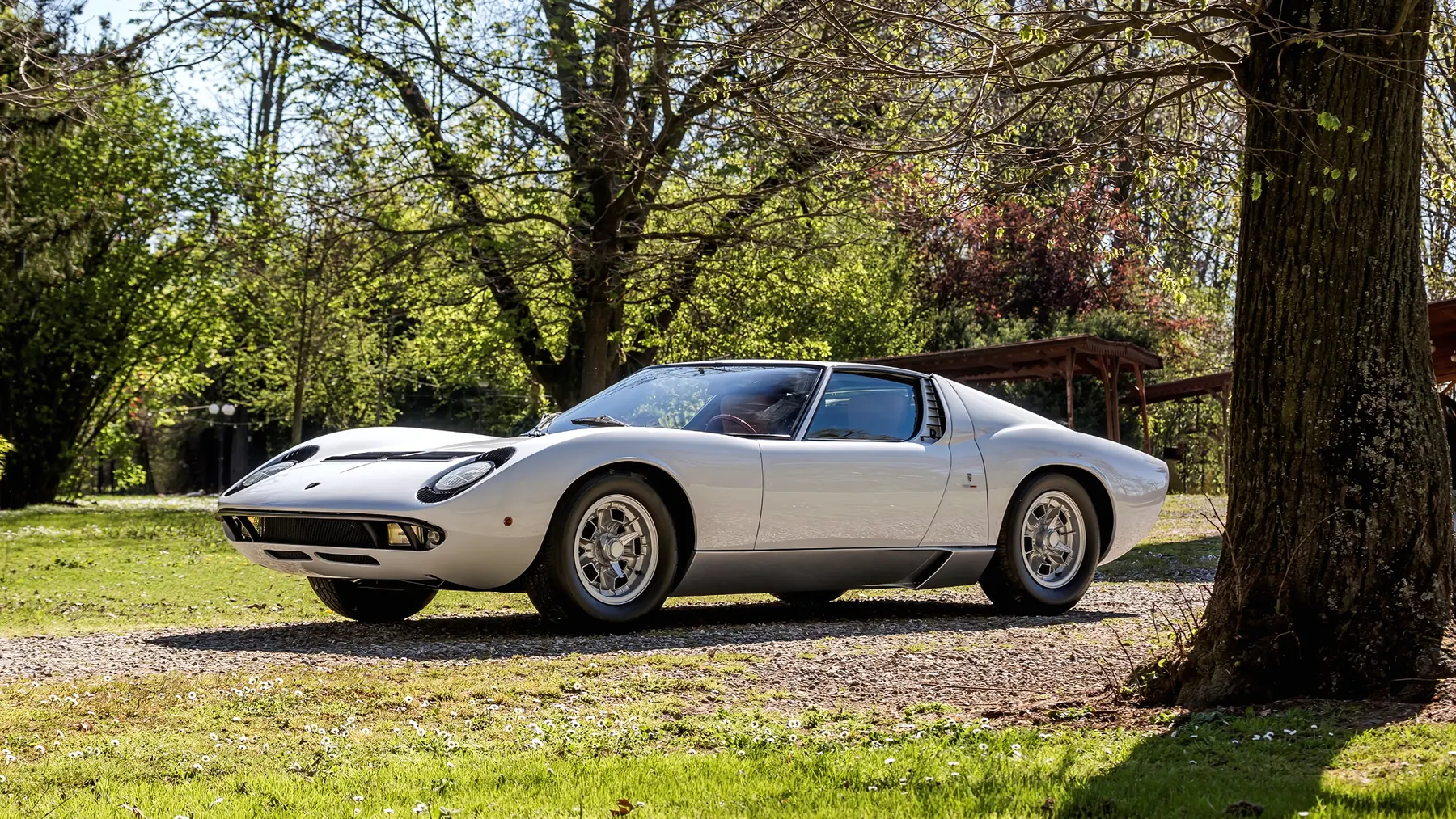
1968 Lamborghini Miura P400 by Bertone

Images: RM Sotheby's
Ferruccio Lamborghini spent the mid-1960s building his reputation on refined, front-engined grand tourers for buyers who found Ferraris too highly strung for daily use, and the Miura exists largely because three of his own engineers decided to defy him. Giampaolo Dallara, Paolo Stanzani and test driver Bob Wallace spent their evenings developing a mid-engined chassis that had nothing to do with the sober 350 GT and 400 GT then rolling out of Sant’Agata Bolognese. They wanted a car with racing pedigree that could still be driven on the road, and they pursued it largely on their own time, wary that their boss would see it as an expensive distraction from a young company that could ill afford one. When the rolling chassis was finally shown to him, Ferruccio didn’t kill it. He backed it, and in doing so let his engineers hand the world a template that every mid-engined performance car since has followed in some form.
That naked chassis, drilled for lightness and devoid of bodywork, caused a stir when it was displayed at the Turin Salon in 1965, with showgoers placing orders before there was anything to sit inside. The commission to clothe it went to Carrozzeria Bertone, in part because Bertone had no standing relationship with Ferrari and could give the project undivided attention, and in part because Ferruccio was taken with the quality of Bertone’s recent work. Early styling exploration had begun under Giorgetto Giugiaro, Bertone’s chief designer at the time, but Giugiaro departed for a rival studio before the project was finished, and it fell to his 27-year-old replacement, a largely unproven designer named Marcello Gandini, to take the sketches from paper to metal in only a few months. Gandini and his engineering collaborators cited the Ford GT40 as a touchstone for the car’s low, muscular stance, but the finished shape was something else entirely: impossibly low, with a nose that swept back into faired headlamps and a tail defined by slatted engine covers that read as pure sculpture as much as cooling ductwork. The car was finished so close to its Geneva debut in March 1966 that nobody on the team had confirmed the engine actually fit inside the bay. Rather than delay, Lamborghini’s people filled the compartment with ballast, kept the bonnet locked for the entire show, and let the car’s silhouette do the talking. It worked. The reaction from showgoers and press was immediate, and the name chosen for production, Miura, borrowed from a celebrated Spanish breeder of fighting bulls, gave Lamborghini both a mascot and a badge that would define the brand from then on.
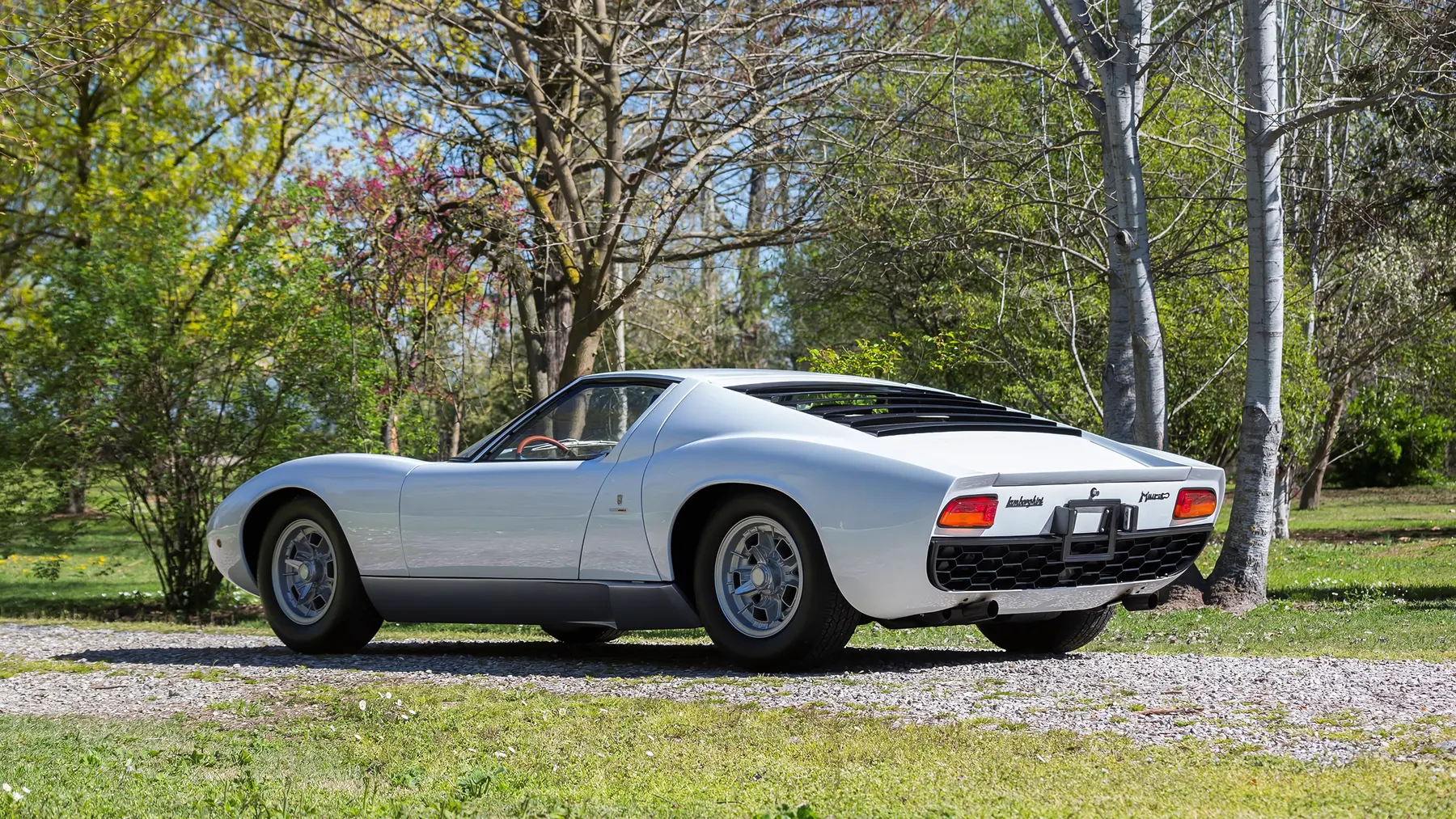
The production car that followed carried the internal designation P400, for Posteriore and the four-litre displacement of its V12, and it was, by any measure available in 1966, sensational. The transversely mounted, 3,929cc 60-degree V12 was a development of the unit already doing service in Lamborghini’s front-engined GTs, but turning it sideways behind the cabin, ahead of the rear axle, was the genuinely radical move. A conventional longitudinal mid-engine layout would have demanded a wheelbase too long for the compact, low-slung body Gandini had drawn, so the engineers borrowed a trick from an unlikely source, the Austin Mini, and cast the engine and gearbox together as a single unit, sharing one sump of engine oil between both. It was a clever solution to a genuine packaging problem, and it also planted the seed of one of the car’s more persistent mechanical compromises, which the story returns to later. In its original P400 tune, the engine produced 350 bhp at 7,000 rpm and 262 lb-ft of torque at 5,000 rpm, fed by four triple-choke Weber carburettors and breathing through chain-driven double overhead camshafts on each bank. Dry weight came in at around 1,125 kg, and period testing put the P400 at roughly 171 mph and a 0-60 mph time in the high six-second range, figures that made it, at launch, the fastest production car sold to the public. It was priced at around $20,000 in the American market of the day, a genuinely steep sum, yet demand outstripped even Lamborghini’s own expectations.
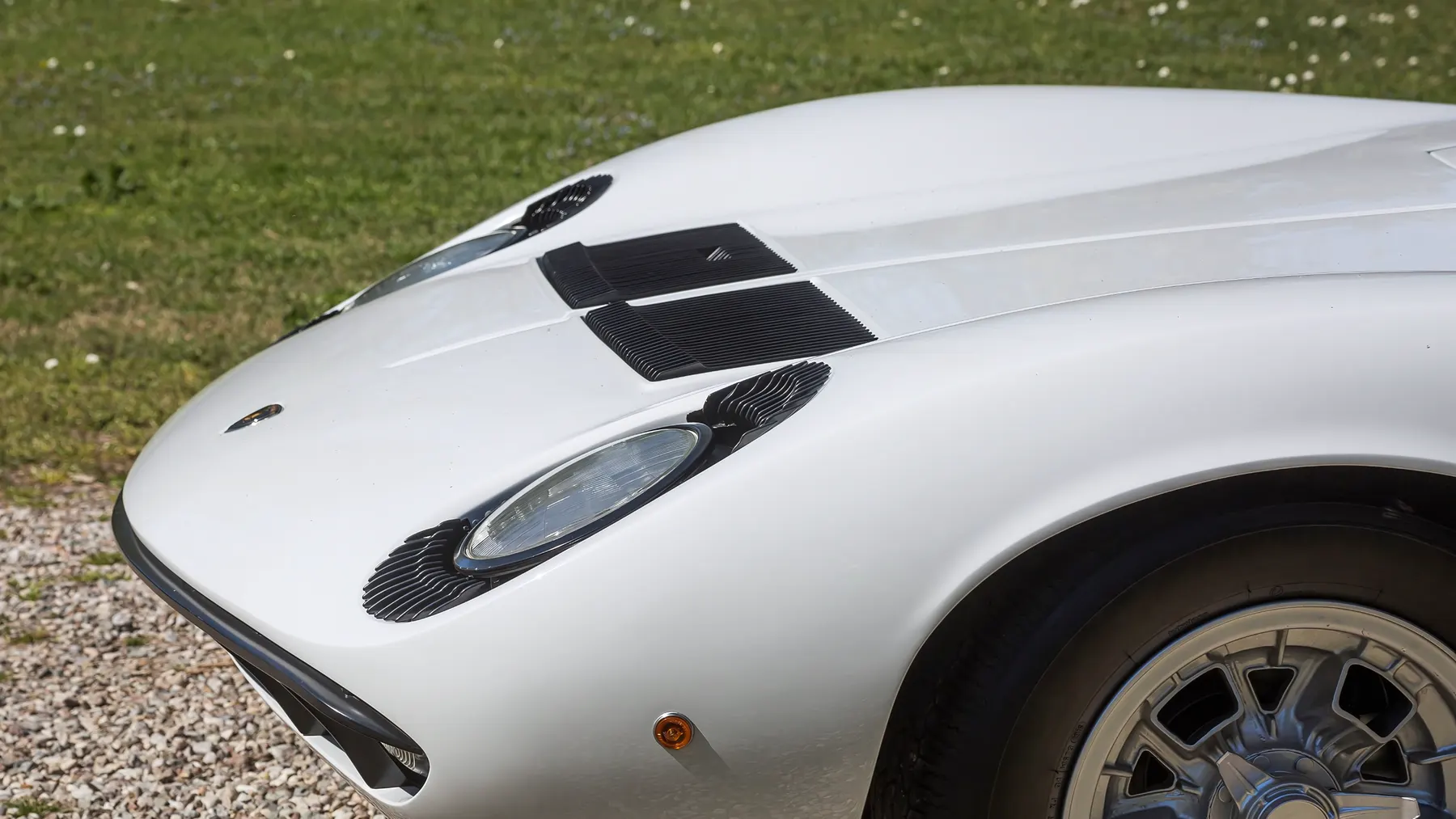
Lamborghini refined the car steadily rather than reinventing it. Early in production, from around chassis number 125, the monocoque was built from thicker-gauge steel after concerns about the strength of the original specification. Late in 1968 the Miura S, or P400 S, arrived with a reworked induction system and camshaft profiles that lifted output to 370 bhp at 7,700 rpm and 286 lb-ft at 5,500 rpm, alongside power windows, a locking glovebox, chrome window surrounds and, for the first time, an optional air conditioning system. Ventilated disc brakes followed in April 1970. The final and most desirable series-production version, the P400 SV, arrived in 1971 with output raised again to 385 bhp at 7,850 rpm and 295 lb-ft at 5,750 rpm, wider rear bodywork to cover new nine-inch rear wheels, a redesigned rear suspension, and a lower nose that went some way toward taming the car’s high-speed lift, discussed below. The SV also dropped the slatted “eyelash” trim that had ringed the headlamps on earlier cars, giving it a more purposeful, slightly less whimsical face. Mechanically, the last batch of SV engines, roughly the final 96 built, finally split the shared engine and gearbox lubrication system into two separate circuits, which allowed the correct oil grade for each and made a proper limited-slip differential a viable option for the first time.
Alongside the regular production run sat a handful of specials that have since become the most coveted Miuras of all. In 1970, development driver Bob Wallace built a single test mule intended to explore what a Miura built to FIA Appendix J competition rules might look like, using the lightweight aluminium alloy Avional for much of the chassis and bodywork to cut roughly 360 kg from the car’s weight, along with dry-sump lubrication, a raised compression ratio and reworked cams that pushed output into the low 400s and beyond. Named the Jota, after the Spanish pronunciation of the letter J, it survived only briefly before being destroyed in a road crash in 1971. Its legend, however, outlived it, and Lamborghini’s factory subsequently built a small handful of road-legal cars finished to a similar specification, referred to as SV/J models, that borrowed the Jota’s bodywork changes and additional power without the full competition-oriented weight-saving measures. Bertone itself later built a one-off open-topped Miura, more targa than true roadster, that toured motor shows as a design exercise before spending decades as a company display vehicle for a metals trade group. None of these specials were ever intended as a broader model line; they exist as footnotes to the P400 story, evidence of how much further the basic architecture could be pushed.
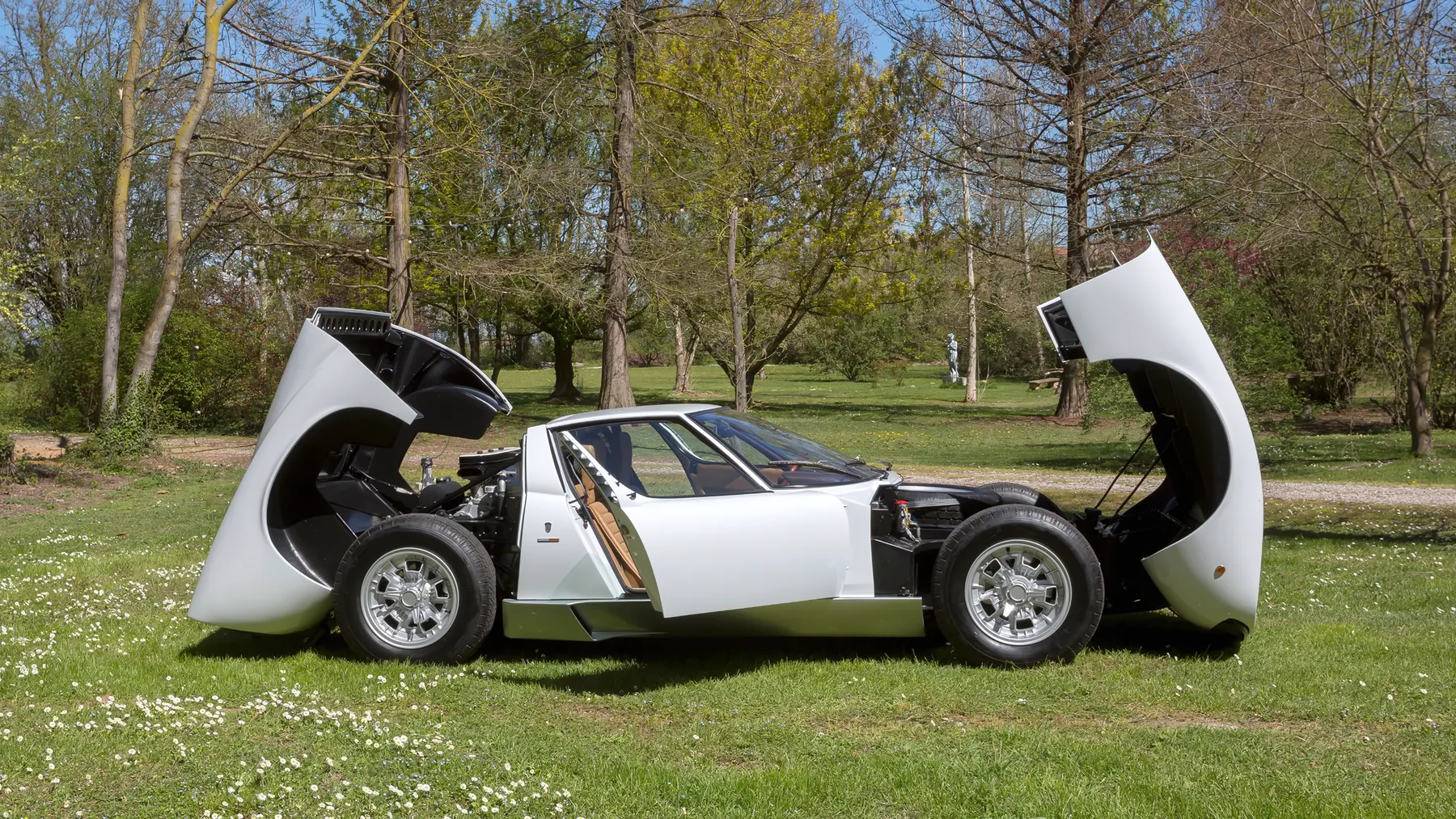
To drive a Miura in period was to be reminded, constantly, that beauty and ease of use were not the same thing. All three series share the same fundamental character: a shrieking, mechanically busy V12 sitting directly behind your shoulders, heavy unassisted steering, a firm clutch, and a gated five-speed shifter that rewards patience far more than aggression. Getting into the cabin at all requires a small ritual, sliding down onto the sill before hauling your legs in after you, and once inside, the driving position is intimate to the point of being cramped, with controls, including manual window winders on early cars, placed with more concern for symmetry than ergonomics. Access to the engine is its own small performance: both doors have to be opened so that a pull-handle set into each jamb can release the vast rear clamshell, and forgetting to push those handles back in before closing the doors bends both handle and door, a flaw later cars addressed but early owners simply learned to live with. None of this diminished the theatre. The exhaust note, four triple-choke Webers gulping air just behind the driver’s head, remains one of the most celebrated sounds in the car world, and even in traffic the Miura draws attention that few cars, then or now, can match.
That theatre came bundled with real compromises that go beyond charming eccentricity. The most serious was aerodynamic: with no meaningful front downforce and a fuel tank mounted ahead of the passenger cabin that grew lighter as it emptied, early Miuras generated genuine, unsettling lift at the nose above roughly 100 mph, a problem serious enough that Lamborghini redesigned the front suspension and lowered the nose for the SV specifically to address it. Driving one hard on an open road, in other words, meant learning to trust a car that behaved less predictably the faster it went, exactly backwards from what a supercar buyer might expect. The shared engine and transmission lubrication system, elegant as a packaging solution, was a persistent mechanical headache in the other direction: it ruled out a proper limited-slip differential for almost the entire production run, since metal particles from a wearing gearbox could migrate straight into the engine’s oil supply, and it demanded scrupulous, correctly specified oil changes to protect two very different sets of internals sharing one sump. The shift action itself, routed through a transverse gearbox mounted alongside rather than behind the engine, was famously heavy and slow to accept a quick change, a complaint substantial enough that Lamborghini rotated the entire powertrain layout for the Miura’s successor, the Countach, specifically to put the gearbox directly beneath the driver’s hand. Add to this a cabin with no meaningful sound insulation, no air conditioning at all on early P400s, thin aluminium body panels and barely-there bumpers that offered no real protection in everyday knocks, and headlights whose placement was dictated far more by the silhouette Gandini wanted than by how much road they actually illuminated, and the Miura reveals itself as a car that asked a great deal of its owners in exchange for its looks and its noise. None of this makes the Miura a bad car for its era; it makes it a car whose priorities were unmistakably about drama and visual impact first, everyday usability a distant second, a trade-off that was entirely deliberate and that plenty of contemporaries made just as readily, but one worth naming honestly rather than waving away as mere old-car charm.
None of it stopped the Miura from becoming one of the most culturally resonant cars of its decade. An orange Miura opened the 1969 film The Italian Job with a mountain drive through the Alps that remains one of the most replayed sequences in motoring cinema, and the car’s celebrity clientele, including Frank Sinatra, only reinforced its status as a symbol of a very particular late-1960s glamour. Production wound down through 1973, with the SV the last series built before Lamborghini’s attention, and its financial fortunes, shifted toward the far more radical Countach, a car that owed its wedge-shaped aggression as much to Gandini’s evolving design language as to lessons learned, mechanically and dynamically, from the Miura’s shortcomings. Roughly 763 Miuras were built across the P400, S and SV series combined, a genuinely small number for a car that reshaped an entire category of the industry, and it did so specifically because Lamborghini’s engineers refused to accept that a road car needed to look, sound or behave like anything that had come before it.
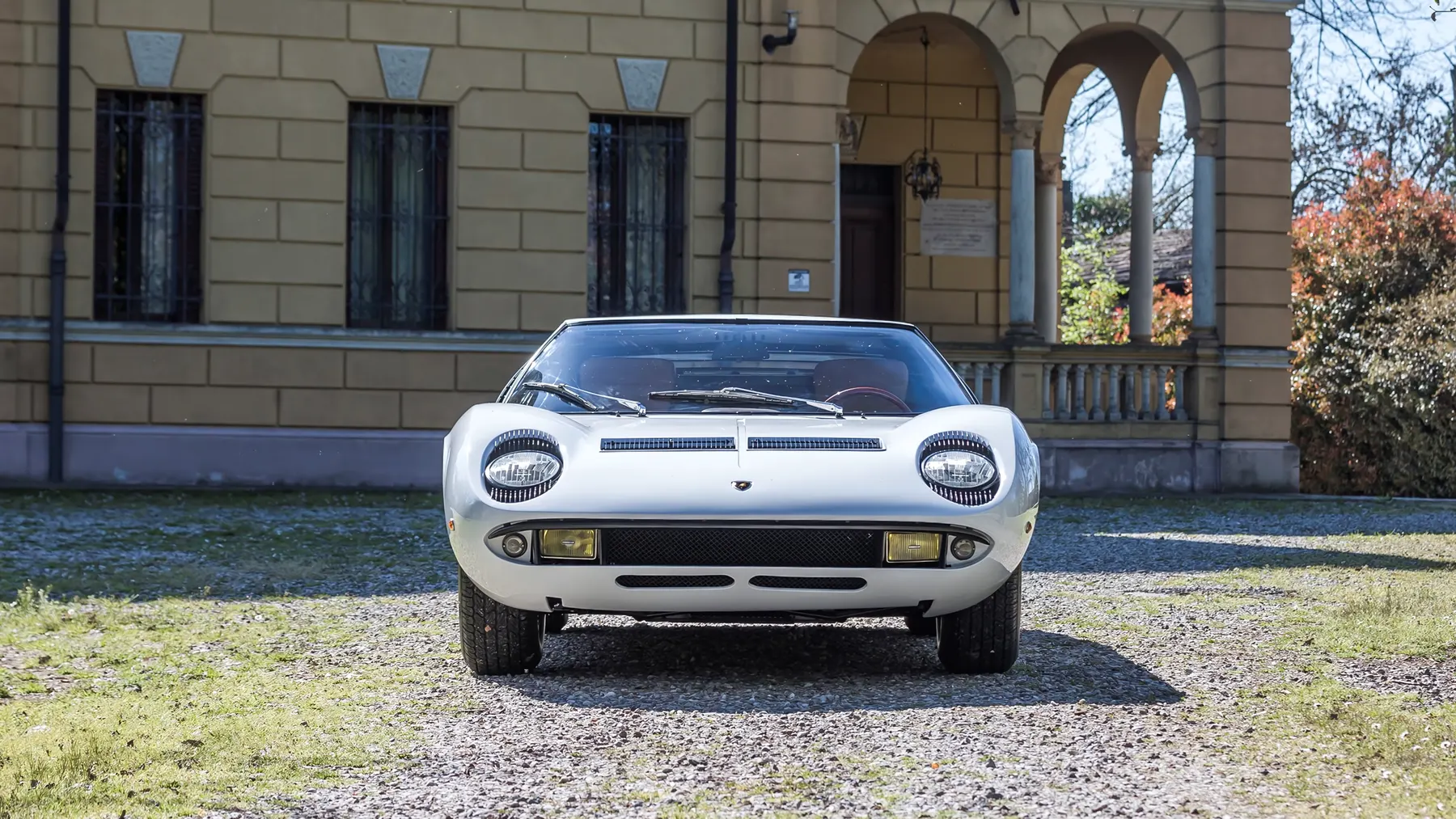
What endures about the Miura P400 is less any single figure on a spec sheet than the fact that it forced everyone, Ferrari included, to reconsider where a road car’s engine belonged. It was not the most usable car Lamborghini ever built, nor the most sorted, and its own designer would later admit some ambivalence about a shape he’d drawn in a hurry as a very young man. But it set the terms, transverse or longitudinal mid-engine layout, low dramatic bodywork, a cabin built around theatre rather than comfort, that the entire supercar category has spent six decades either following or reacting against.
Sources
- Lamborghini Miura - Wikipedia
- Lamborghini History: Miura - Lamborghini.com
- Lamborghini Miura: The First Supercar in History - Lamborghini.com
- Lamborghini Miura P400 SV Guide - Supercar Nostalgia
- Lamborghini Miura: The Original Supercar Turns 60 - Hagerty Media
- Same Year, Same Power: '67 Mustang GT500 Meets the Lamborghini Miura - Hagerty Media
- I Just Had to Own a Lamborghini Miura - Hagerty Media
- Lamborghini Miura Buying Guide - Classic Trader
- Marcello Gandini - Wikipedia
- Marcello Gandini Drove a Renaissance in Automotive Design - Hagerty Media
- Marcello Gandini: Father of the Lamborghini Miura - Barchetta
- Lamborghini Miura: The Making of a Legend, Part 2 - Derivaz-Ives Magazine
Join the discussion
Comments
Loading comments…
Leave a comment
Share a detail, memory, or perspective. Every comment is reviewed before publication.