Lamborghini Countach LP400 Periscopio: Purest Wedge, Toughest to Live With
1977 Lamborghini Countach LP400 'Periscopio' by Bertone

Images: Maximilian Vogl / RM Sotheby's
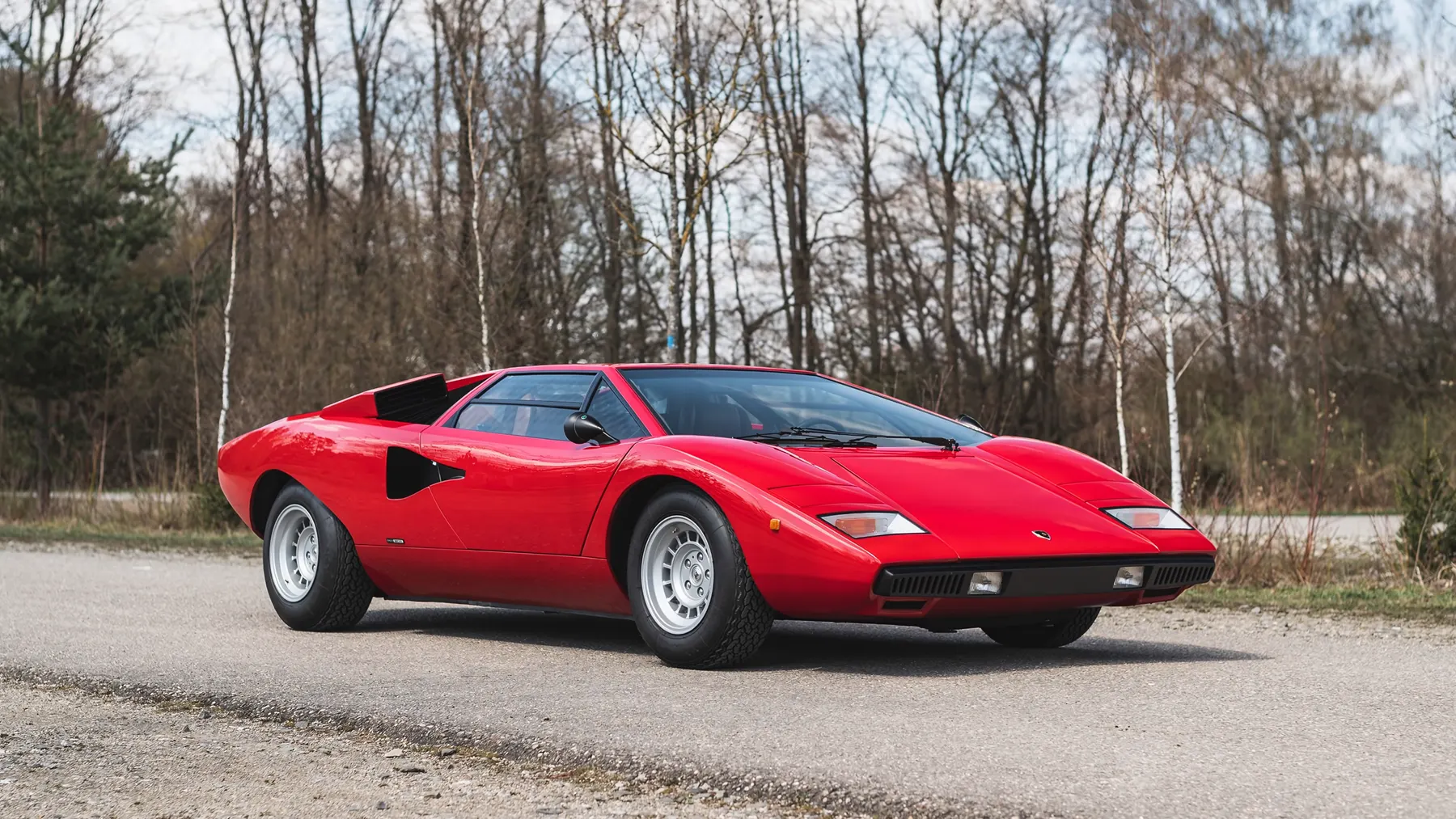
Every LP400-generation Countach carries a small fossil of an idea Lamborghini never quite got to work: a shallow channel pressed into the roof panel, running back from above the driver’s head to a little window at the rear. It was designed to house a periscope-style mirror that would let the driver see what was happening behind the car. The periscope itself never really made it past the prototype stage in any usable form, and was effectively abandoned before the first customer cars left the factory. The channel stayed anyway, because by then it had already become part of the car’s identity, and because nobody at Sant’Agata had found a better way to give a driver sitting this low, in a cabin this wide and this radical, any real view rearward. That gap between styling ambition and unfinished engineering solution is, in miniature, the story of the whole car. The LP400 is the purest expression of one of the most consequential shapes in automotive history, and it is also a car that never entirely solved the practical problems its own design created. Both things are true, and neither cancels the other out.
By the start of the 1970s, Lamborghini needed a successor to the Miura, and needed one that fixed the things the Miura hadn’t. Chief engineer Paolo Stanzani, working alongside test driver Bob Wallace, wanted better high-speed stability, a stiffer structure and a more precise gearchange than the transverse-engined Miura could offer. Stanzani’s solution was to turn the V12 through ninety degrees and mount it longitudinally, with the five-speed gearbox bolted to its front end and positioned down the centre of the cabin between the two seats, rather than behind the engine as in a conventional layout. Drive ran back from the gearbox through an enclosed shaft passing through the engine’s own sump to a differential mounted at the rear. It sounds convoluted, and it is, but it centralised the car’s mass and gave the shift a directness that a Miura, with its gearbox hung off the side of a transverse engine, could never quite match. The styling brief went to Marcello Gandini at Bertone, who had already drawn the Miura and was now asked to design something that owed it nothing. What emerged, badged LP500 and shown in bright yellow at the Geneva show in March 1971, was a flat, wedge-shaped shock: sharp trapezoidal panels, a cabin pushed forward almost to the base of the windscreen, and forward-hinged scissor doors that instantly became a Lamborghini signature. According to a well-worn story repeated in various forms ever since, the car’s name arrived on the spot, as an exclamation of astonishment in the Piedmontese dialect, allegedly from Nuccio Bertone himself on first seeing it.
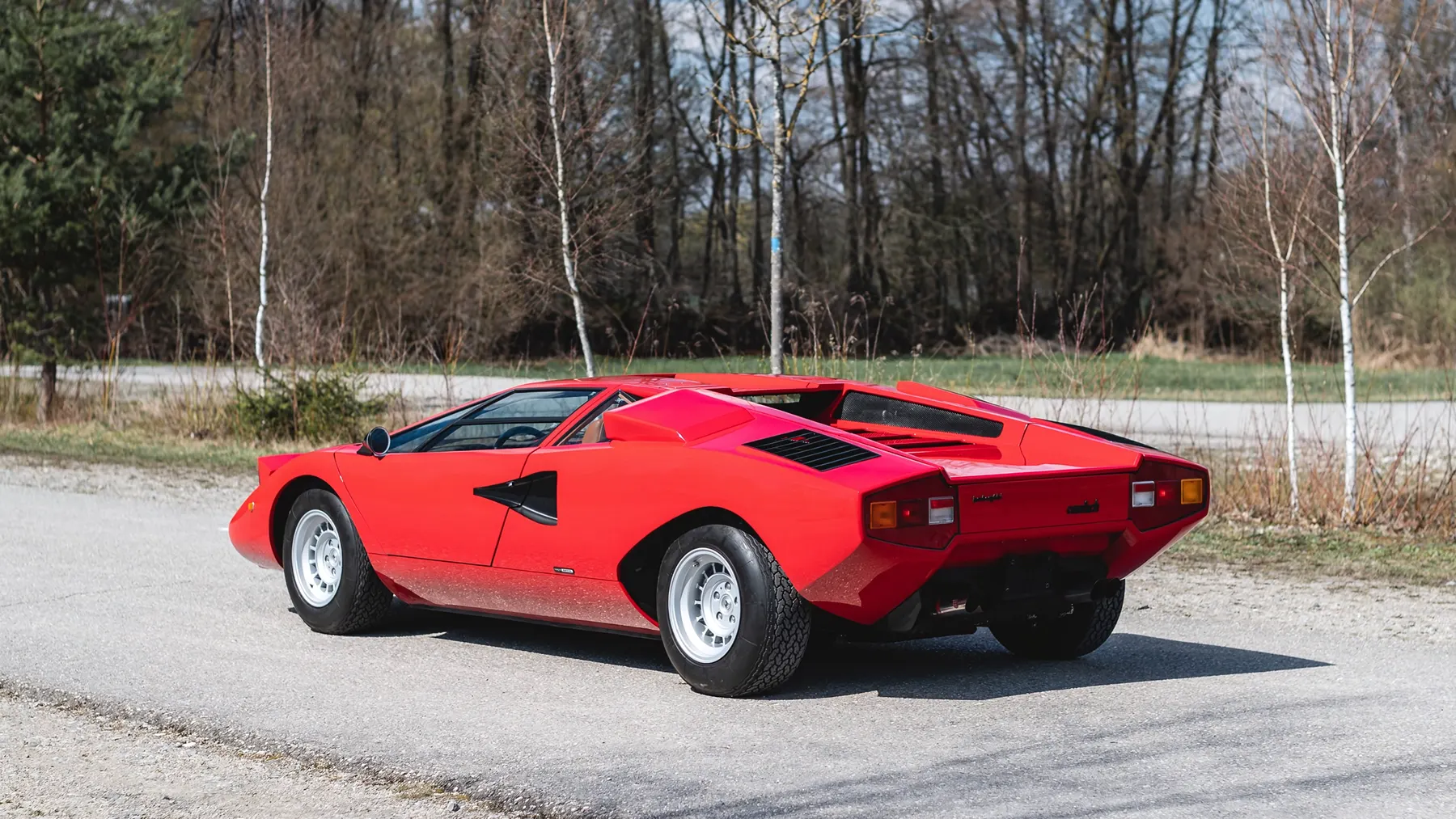
Turning that show car into something sellable took three more years, and nearly didn’t happen at all. The LP500’s original 4,971cc V12 was a largely untested unit, built with a significant amount of magnesium and, by some accounts, requiring a rebuild after as little as 20,000 miles; the sole complete example failed during testing in late 1971, and Lamborghini, short of the money to develop it further, reverted to the well-proven 3.9-litre V12 already familiar from the Miura. Cooling the experimental five-litre engine proved persistently difficult, and the fix, carried over into production spec, was a set of NACA ducts and intake boxes grafted onto the flanks and engine cover to force more air into the engine bay. The prototype’s part-monocoque platform chassis was abandoned for production in favour of a full tubular steel spaceframe, with aluminium body panels riveted on and glassfibre-bonded floors, bulkheads and inner wheel arches. Unlike the Miura, whose bodies had been built, painted and trimmed at Bertone’s Turin works before being shipped to Sant’Agata for final assembly, the production Countach’s aluminium panels were hand-beaten in-house at the Lamborghini factory itself - a first for the company, and a detail that complicates the neat idea of the LP400 as simply “a Bertone car.” Gandini and Bertone supplied the design; Lamborghini’s own panel-beaters built it. The original LP500 prototype, meanwhile, met an unglamorous end: having covered years of development mileage, it was deliberately destroyed in a crash test at the MIRA proving ground in England in March 1974, just as the production car it had made possible was going on sale.
That production car was badged LP400: Longitudinale Posteriore for the rear-mounted, longitudinally sited engine, and 400 for the 3,929cc unit’s rounded-off capacity. Exact production numbers vary depending on the source, but this original “low body” specification is generally put at somewhere between roughly 150 and 158 cars, built between 1974 and 1978 - a genuinely tiny run even by the standards of 1970s exotica, and one reason these are now the most sought-after Countaches on the collector market. The nickname Periscopio, or Periscopica, followed directly from that unfulfilled roof-mirror idea and stuck to every LP400 regardless of whether an individual example ever carried the actual mirror hardware.
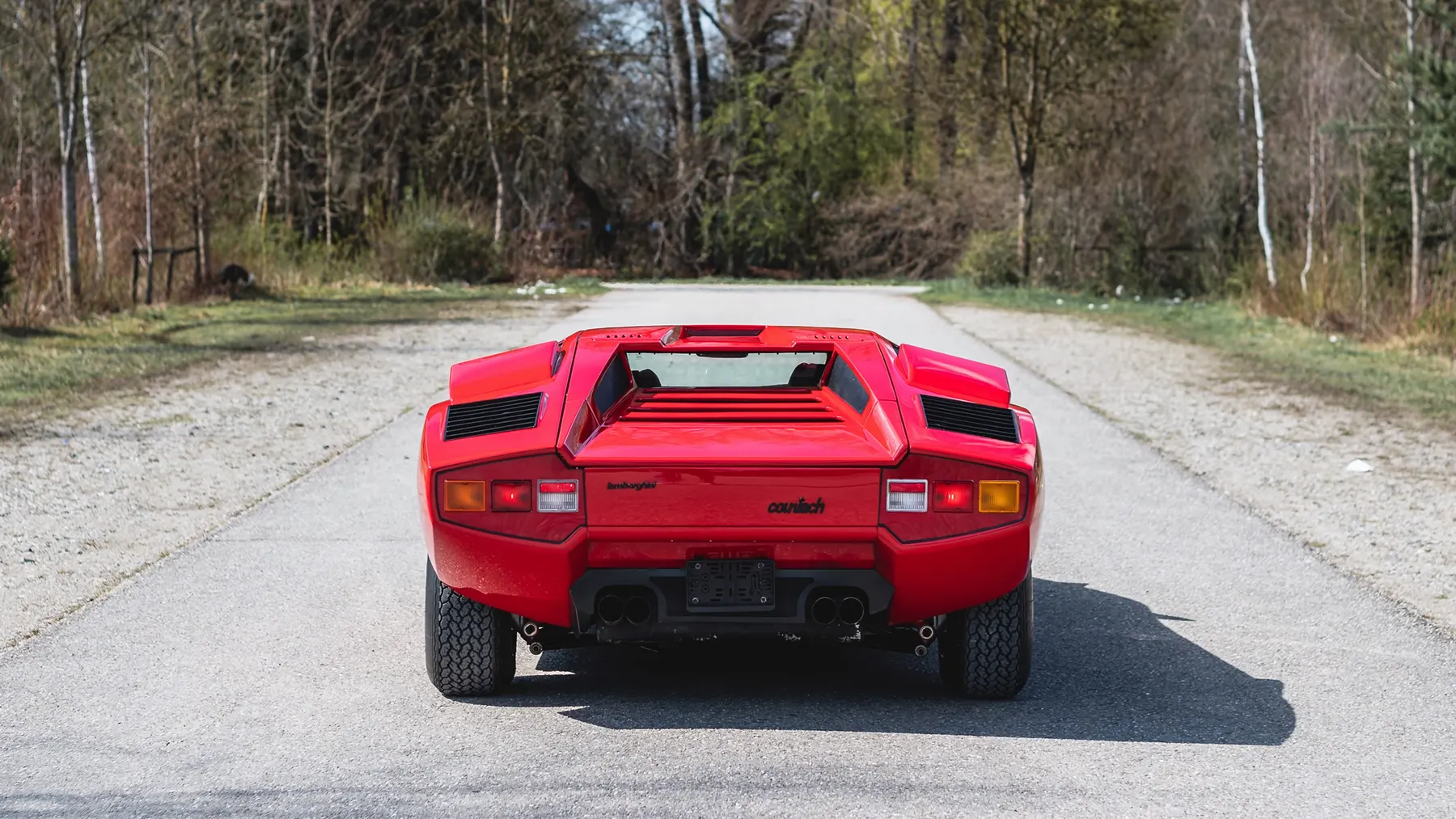
Underneath the theatre sat a genuinely serious piece of engineering. The 3,929cc V12, internally designated Tipo L406, was an evolution of the quad-cam, all-alloy unit Giotto Bizzarrini had originally conceived for Lamborghini’s first road car more than a decade earlier, reworked here with a notably oversquare 82mm bore and 62mm stroke that gave it a racing engine’s willingness to rev. Six sidedraught Weber 45 DCOE carburettors, a 10.5:1 compression ratio, twin coils and twin Marelli distributors, and wet-sump lubrication combined to produce 375bhp at a heady 8,000rpm, with some period-style sources citing a slightly more conservative 370bhp; torque is generally put in the region of 266 to 269lb-ft, arriving somewhere in the low-to-mid 5,000rpm range. It is not a particularly torquey engine by modern standards, but it is an extraordinarily willing one, and the free-revving nature that Bizzarrini’s architecture gave it remains one of the LP400’s most-praised traits. Drive went through a single dry-plate clutch sourced from Fichtel & Sachs - notoriously heavy in use - to Lamborghini’s own five-speed manual and a limited-slip differential.
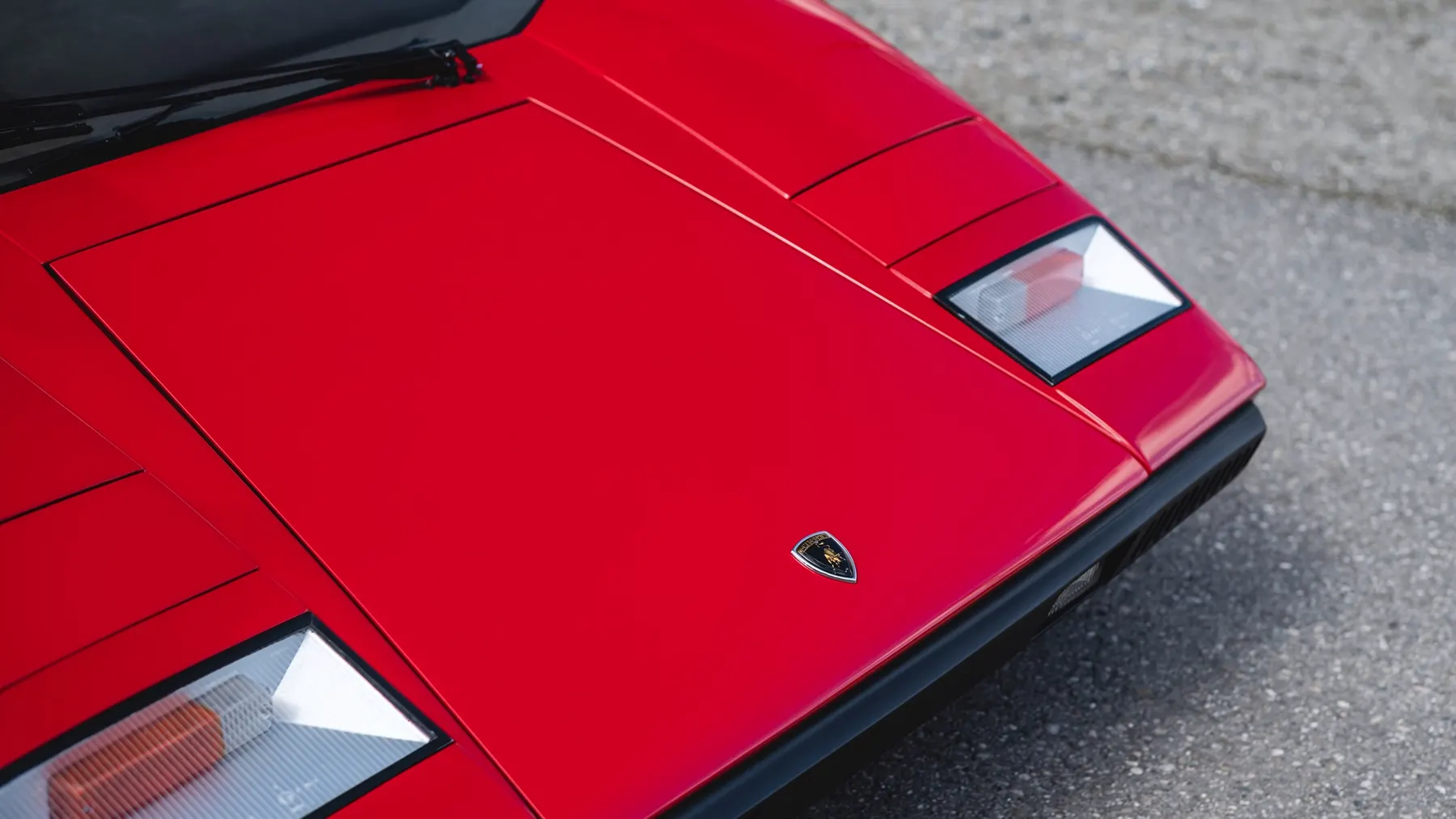
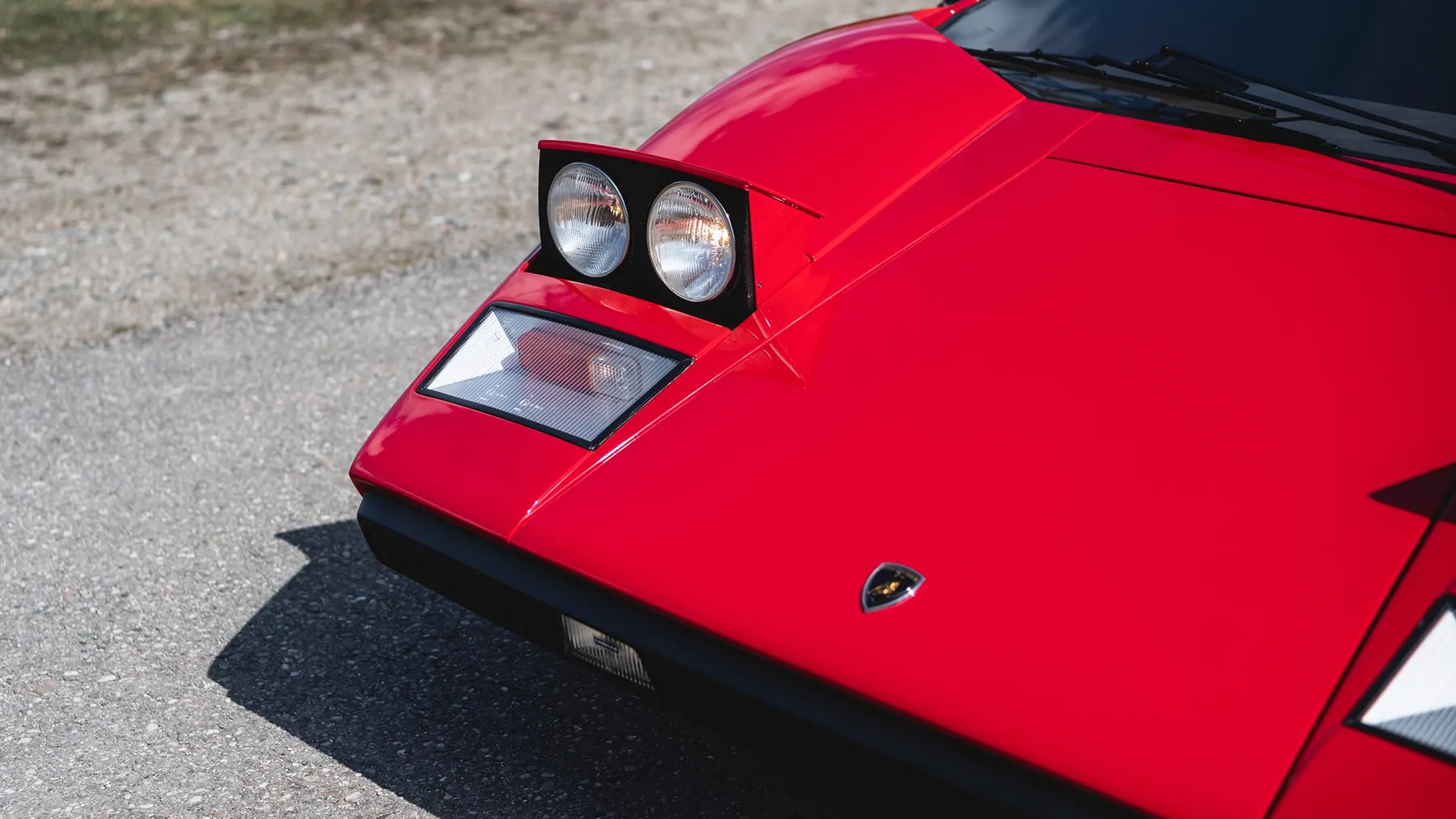
The chassis matched the engine’s seriousness. Double wishbones, coil springs and telescopic dampers at each corner, with a second pair of spring-and-damper units at the rear, were all located through rose joints rather than the rubber bushings used on more ordinary cars, giving a directness to the way the suspension communicated the road surface back to the driver. Unassisted rack-and-pinion steering is heavy at parking speeds - genuinely hard work - but consistently described, in period and since, as coming alive above roughly 30 to 40mph, at which point it turns direct and precise rather than merely light. Braking came from four-wheel vented discs. Tyres were narrow by later Countach standards: Michelin XWX rubber, 205/70 VR14 at the front and 215-section at the rear, on comparatively modest 14-inch wheels, because the new-generation Pirelli tyres Lamborghini had originally hoped to launch the car on, the P7s that would later define the wider-arched cars that followed, simply weren’t ready in time. Ferruccio Lamborghini, needing cash and unwilling to delay further, put the LP400 into production on what was available rather than what had been promised.
It is worth being honest about where the LP400 falls short, because the flaws are real and they mattered in period, not just as retrospective footnotes. Rearward visibility is the obvious one: even with the periscope idea abandoned, the tiny rear window, thick pillars and a roofline that sits barely over a metre off the ground mean the driver genuinely cannot see much of anything behind the car, a problem period testers and modern owners alike describe in almost identical terms. Reversing typically means opening the door, sitting half out on the sill, and feeling the way back by ear and instinct rather than sight - a piece of theatre that has become part of Countach lore, but which began life as a real, unresolved usability compromise. The cabin itself is tight in a way that goes beyond mere snugness: this original “low body” roofline gives so little headroom that drivers of much above average height struggle to fit inside at all without modification, while the pedals are pushed hard to the right by the intrusion of the front wheel arch and packed closely enough together to make deliberate footwork genuinely awkward. Getting in and out means an ungainly backwards shuffle over wide box-section sills, each of which conceals a fuel tank of around 60 litres. Cooling, addressed for production with the added NACA ducting, was never entirely resolved either; low-speed running and traffic could still see temperatures climb, and heat soak into the cabin on a warm day remains a familiar owner complaint. The spaceframe-and-riveted-aluminium construction, with its bonded glassfibre floors and welded steel roof section, is also a genuine corrosion risk if moisture becomes trapped against the tubular structure, and any serious LP400 purchase today still starts with a careful inspection of exactly that. None of this was helped by the state of the company building the cars: Lamborghini was in serious financial difficulty through the mid-1970s, with Ferruccio Lamborghini selling off his remaining stake in the business in 1974, even as the LP400 was reaching showrooms, and the small-scale, hand-built nature of production meant output was slow and, by several accounts, inconsistent in quality from car to car.
None of which stops the LP400 from being, by most accounts, the most rewarding Countach to actually drive. Once past the heavy controls and the acclimatisation the driving position demands, what emerges is a chassis that talks back: tyres that let go progressively rather than suddenly, brakes with more initial bite than their modest disc size suggests, and a lightness, in both senses, that the later, wider, heavier cars traded away in the pursuit of outright grip and stability. Drivers who have compared an early LP400 back-to-back with a later, more powerful Quattrovalvole have generally preferred the smaller car’s balance and feedback, even while acknowledging that the newer model’s limits sit considerably higher. The received wisdom, repeated by more than one journalist who has driven both, is that a Countach rewards commitment: the harder and more confidently it is driven, the better and more composed it feels, right up to a top speed that Lamborghini claimed as high as 192mph but that independent period road tests more consistently recorded in the high 170s to around 180mph - still a genuinely startling number for a 1974 production road car regardless of which figure is closer to the truth.
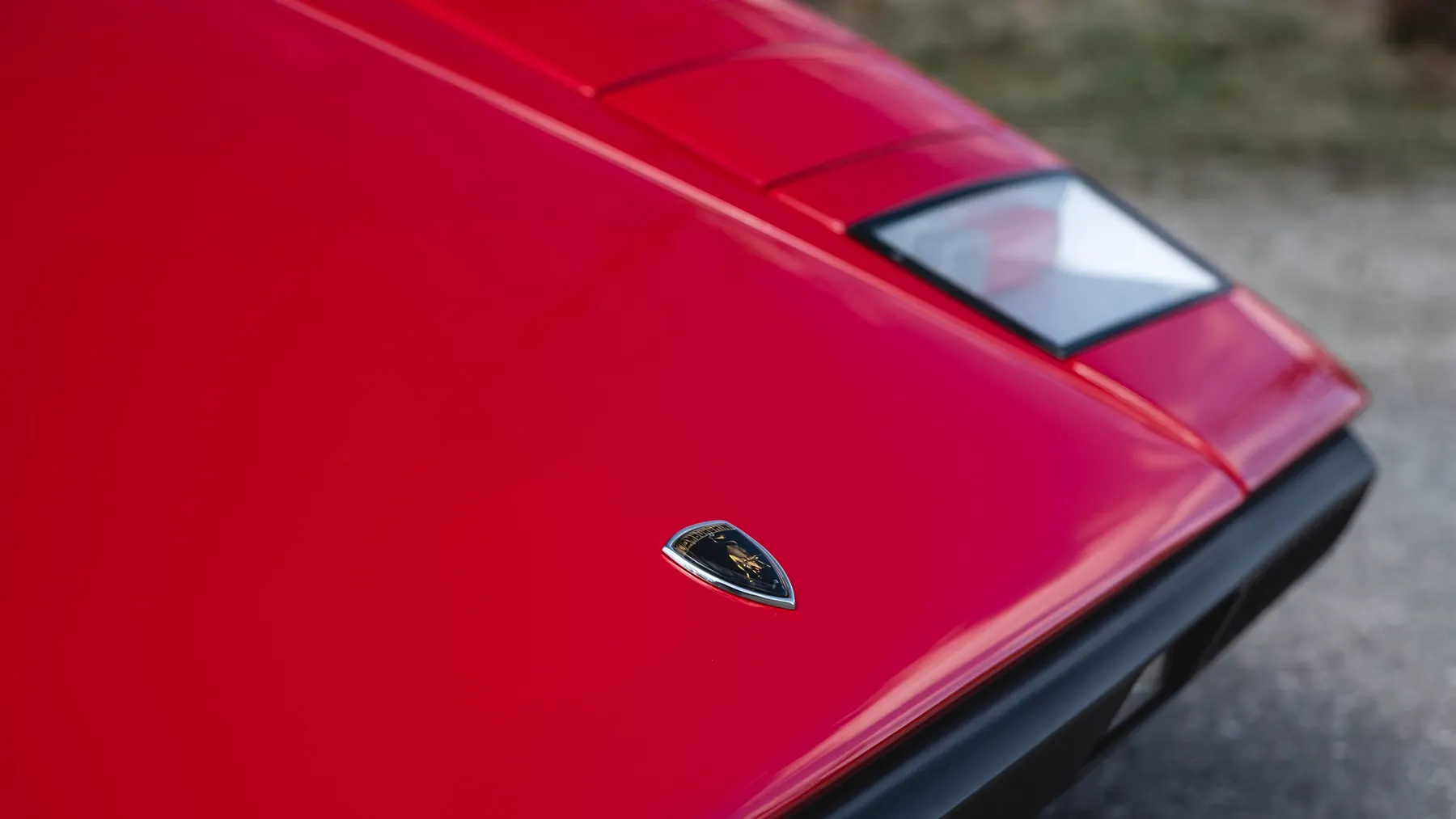
The LP400 did not stay in this pure, unadorned form for long. From 1978 the LP400S introduced flared wheel arches to cover much wider Pirelli tyres, together with an optional front spoiler and a non-standard rear wing that many owners fitted regardless of homologation status. The improvements to grip and high-speed stability were real, but they came at the direct expense of the wedge’s original, unbroken surfaces, and the periscope roof channel itself disappeared with the LP400S “low body” before the roofline was raised again in 1980 to finally give taller drivers some genuine headroom. The LP400 itself saw essentially no factory motorsport programme; it was conceived, developed and sold purely as a road-going statement rather than a competition tool, its role limited to setting the visual and engineering template that the rest of the Countach range, and much of what followed it from other manufacturers, would spend the next decade and a half responding to.
That template is really the point. The LP400 established the longitudinal-engine, central-gearbox layout that Lamborghini would keep using for decades, eventually adapting it to drive all four wheels in the Diablo. It fixed scissor doors as a permanent part of the brand’s identity. Its silhouette, more than any specification on a data sheet, is what most people still picture when someone says the word “supercar,” even if the poster-bedroom version of that image usually belongs to a later, flared and winged Countach rather than to this original, purer car. Among collectors and specialists today, it is precisely that purity - the narrow tyres, the unbroken bodywork, the small numbers built, and yes, the pointless little periscope channel in the roof - that makes the LP400 the most desired and increasingly the most valuable Countach of all, more so even than later cars with considerably more power. It is not the easiest classic Lamborghini to own, or the most comfortable, or the most practical, and it never entirely solved the problem it was named after. What it did instead was prove that a shape this radical could be engineered, built in small numbers, and sold, flaws intact, and that turned out to be more than enough to change what a supercar was allowed to look like for the following fifty years.
Technical data
Specifications - Lamborghini Countach LP400 “Periscopio” (1974–1978)
| Specification | Figure |
|---|---|
| Engine | 3,929cc naturally aspirated V12, DOHC per bank (Tipo L406) |
| Bore x stroke | 82mm x 62mm |
| Compression ratio | 10.5:1 |
| Fuelling | Six Weber 45 DCOE sidedraught carburettors |
| Power | 375bhp @ 8,000rpm* |
| Torque | approx. 266–269 lb-ft @ c.5,000–5,500rpm* |
| Transmission | Five-speed manual, rear-wheel drive, limited-slip differential |
| Clutch | Single dry-plate (Fichtel & Sachs) |
| Chassis | Tubular steel spaceframe, riveted aluminium panels, bonded glassfibre floor/bulkheads |
| Suspension (F/R) | Double wishbones, coil springs, telescopic dampers, anti-roll bar; twin spring/damper units at rear |
| Steering | Unassisted rack and pinion |
| Brakes | Four-wheel vented discs |
| Tyres | Michelin XWX, 205/70 VR14 front, 215-section rear* |
| Wheelbase | 2,450mm |
| Length | 4,140mm |
| Width | 1,887mm |
| Height | approx. 1,070mm |
| Kerb weight | approx. 1,300–1,370kg* |
| 0–60mph | 5.4 sec (factory claim); 6.8 sec recorded in a period-style road test* |
| Top speed | 192mph (factory claim); c.179–180mph typically recorded independently* |
| Production | approx. 150–158 units, 1974–1978* |
Sources
- RM Sotheby’s: 1977 Lamborghini Countach LP400 ‘Periscopio’ by Bertone
- RM Sotheby’s: 1976 Lamborghini Countach LP400 ‘Periscopio’ by Bertone
- RM Sotheby’s: 1986 Lamborghini Countach LP5000 QV by Bertone
- Hagerty UK: Driving the Greats – The Lamborghini Countach
- Hagerty UK: Driving My Childhood Dream Car, the Countach, Wasn’t What I Expected
- Hagerty UK: Historic Maserati Factory, Home of Bertone’s Brilliance, Is Listed for Sale
- Hagerty Valuation Tools: 1974 Lamborghini Countach LP400
- Octane Magazine: Lamborghini Countach LP400 – Driving Gandini’s Masterpiece
- Classic & Sports Car: Lamborghini Countach Buyer’s Guide
- Silodrome: 1975 Lamborghini Countach LP400 Periscopio
- Silodrome: Rod Stewart’s Lamborghini Countach LP400 ‘Periscopio’
- Supercar Nostalgia: Lamborghini Countach LP400 Guide
- Supercar Nostalgia: Why Lamborghini Had to Destroy Its Most Valuable Creation
- Classic Driver Magazine: Timeless Classics – Lamborghini Countach LP400 ‘Periscopio’
- Classic Driver Magazine: Crashed Decades Ago, the Lamborghini Countach LP500 Returns
- Wikipedia: Lamborghini Countach
- Motor1: The Lamborghini Countach Turns 50 – How It Was Built Back Then
- Supercars.net: Linea 1 in Sant’Agata in 1974, the First Lamborghini Countach Is Being Built
- Supercars.net: 1977 Lamborghini Countach ‘Periscopio’ by Bertone
- Gulf News: Countach – The Name Says It All
- Carrozzieri Italiani: The Lamborghini Countach – Bertone’s Masterpiece
Join the discussion
Comments
Loading comments…
Leave a comment
Share a detail, memory, or perspective. Every comment is reviewed before publication.