Ferrari Scuderia Spider 16M: The F430 Era's Hardest Farewell
2009 Ferrari Scuderia Spider 16M

Images: Peter Singhof / RM Sotheby's
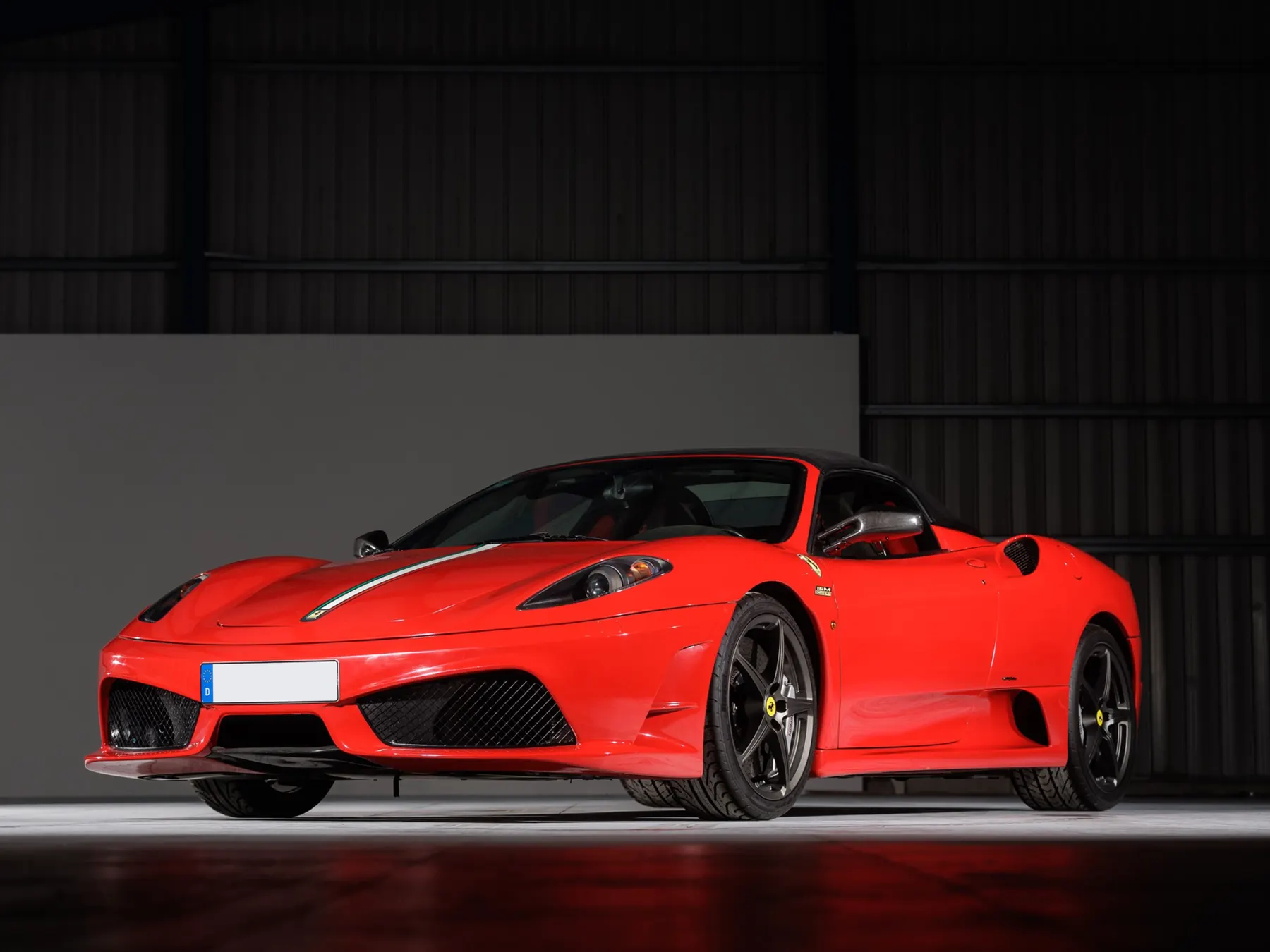
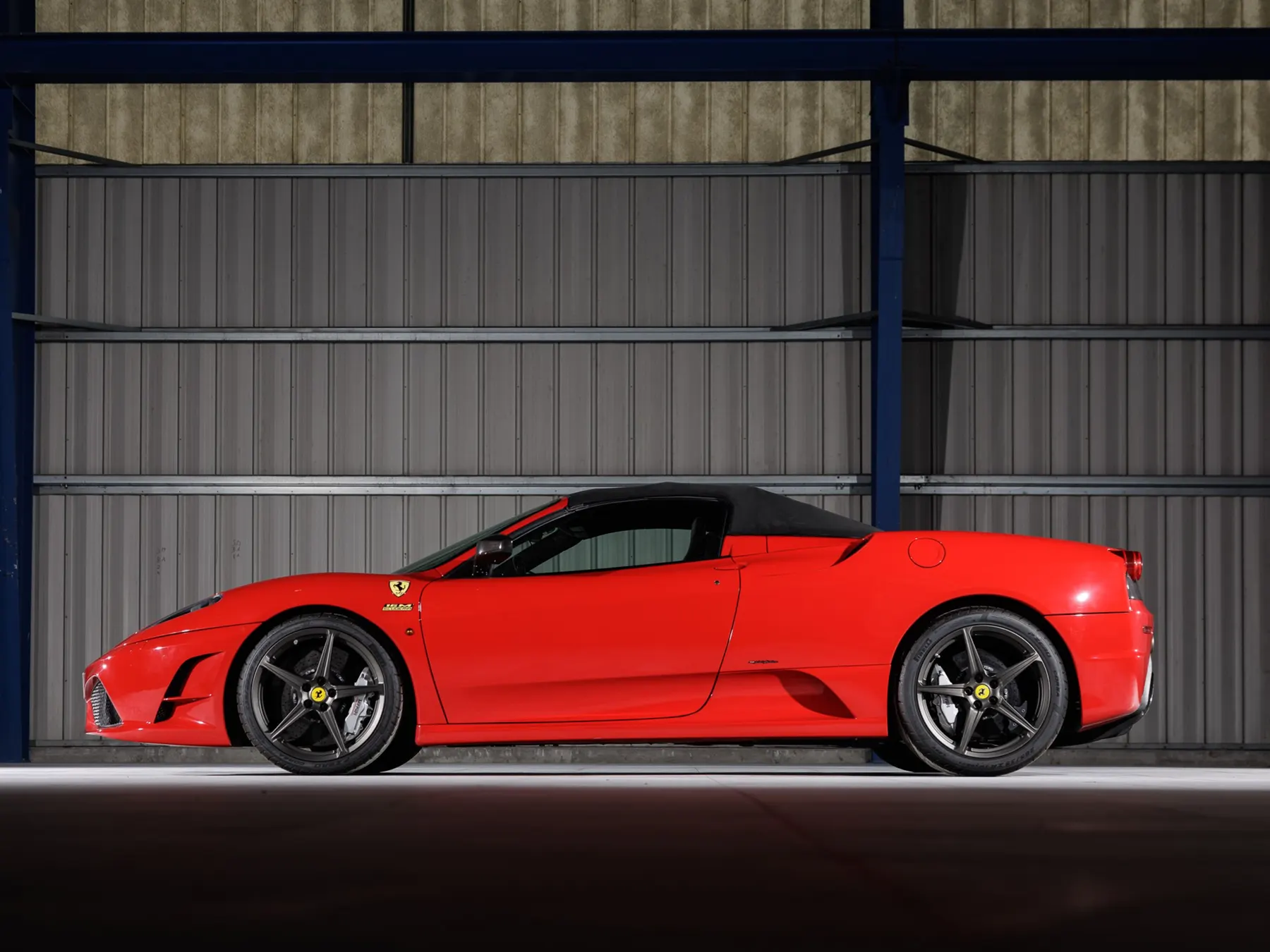
Take Ferrari’s most single-minded interpretation of the F430 - a car stripped of sound-deadening, fitted with carbon-shelled racing seats and a steering-wheel dial borrowed straight from Formula 1 thinking, engineered obsessively enough over weight to specify titanium road springs - and then remove its roof. On paper that looks like sabotage. Rigidity is usually the first casualty of any convertible conversion, and rigidity was precisely the currency the 430 Scuderia had been built to hoard. Yet the Scuderia Spider 16M, unveiled at Ferrari’s World Finals at Mugello in November 2008, pulled the trick off with enough conviction that all 499 examples were reportedly spoken for before the first production car had even left the line.
The 16M did not appear from nowhere. Ferrari had spent the best part of a decade refining a formula for hardcore, track-oriented versions of its junior V8 models, a lineage running from the 348 GT Competizione through the 360 Challenge Stradale of 2003. The 430 Scuderia, launched at the Frankfurt Motor Show in September 2007, was the next chapter, developed with input from Michael Schumacher and honed further by Ferrari test driver Marc Gené. Unlike the Challenge Stradale before it, the Scuderia was never conceived to homologate a GT racing programme; it existed purely to push the F430 platform as far as Ferrari’s engineers could take it, and it retailed at roughly 30 per cent more than a standard F430 coupe as a result. Built around the same aluminium spaceframe as the standard F430, itself derived from the outgoing 360 Modena, the coupe was claimed by Ferrari to match an Enzo’s 0–62mph time and lap Fiorano two seconds faster than the regular car. Fourteen months later, at the Ferrari World Finals in Mugello, Ferrari opened the roof and renamed the result 16M, in reference to the marque’s sixteenth Formula 1 Constructors’ Championship, sealed that season by Kimi Räikkönen and Felipe Massa despite what was, for the wider car industry, an increasingly grim economic backdrop. It marked the first time Ferrari had offered one of its track-honed junior specials in drop-top form.
Power came from a reworked version of the F430’s naturally aspirated V8: Ferrari’s Tipo F136 ED, a 4,308cc, flat-plane-crank 90-degree unit with dry-sump lubrication, variable timing on both camshafts, and four valves per cylinder, built around a 92mm bore and 81mm stroke. Compression rose from 11.3:1 to 11.88:1, which demanded new pistons with re-profiled crowns, while a reworked engine-management system and cylinder-specific knock sensors let the engine run cleanly on lower-octane fuel without unnecessarily retarding ignition timing. The result was 503bhp at a screaming 8,500rpm and 347lb-ft at 5,250rpm - an increase of 20bhp and 4lb-ft over the standard F430 Spider - sent to the rear wheels through a six-speed automated-manual gearbox whose SuperFast2 software could execute shifts in 60 milliseconds, less than half the time of the system it replaced.
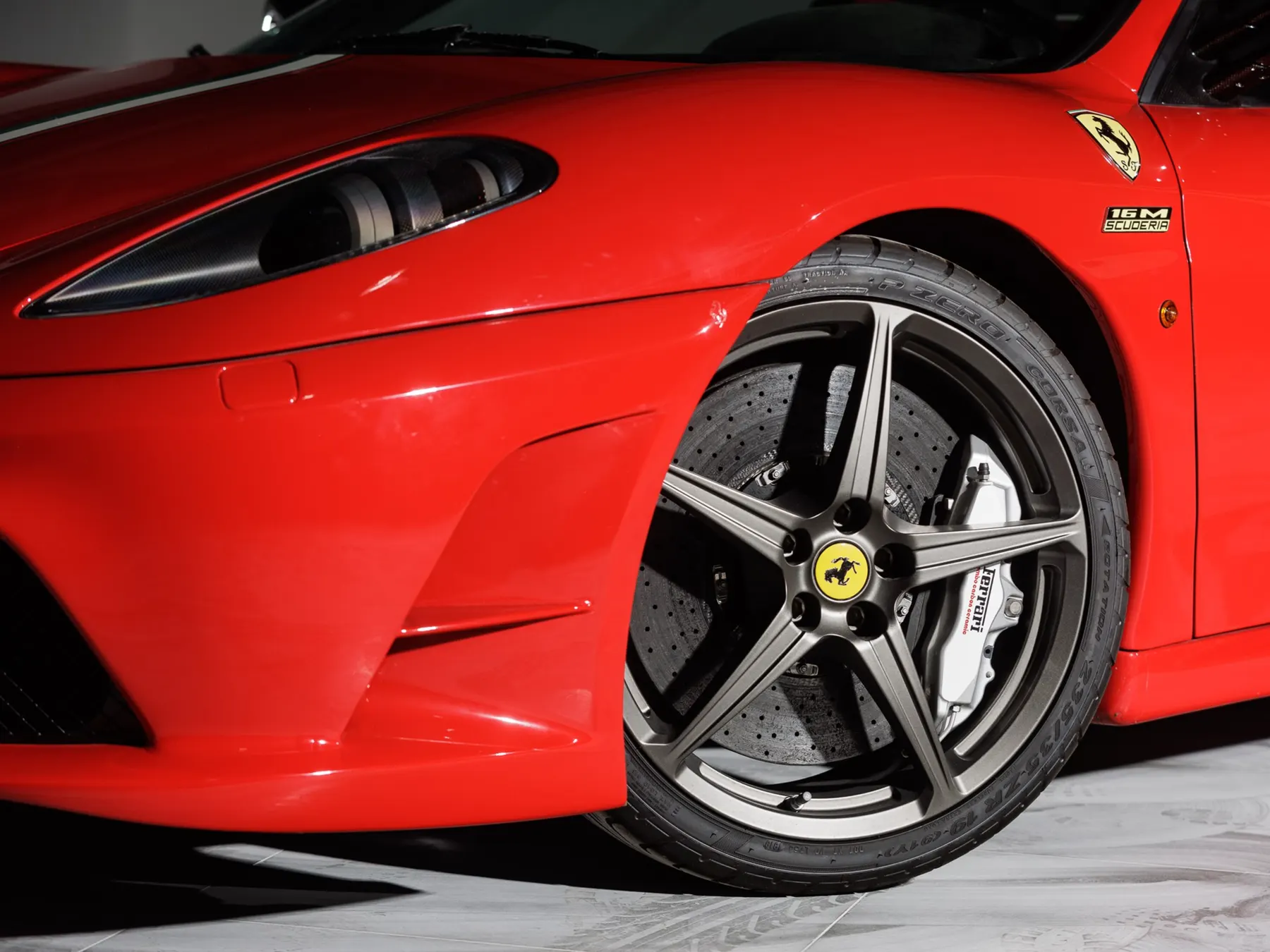
Underneath, the 16M inherited the coupe’s entire chassis programme rather than a watered-down version of it. The aluminium spaceframe, built at Scaglietti’s Modena works, was twenty per cent stiffer than the outgoing 360’s and gained a reinforced front structure to meet updated crash regulations, even as Ferrari stripped mass everywhere else it could. Titanium springs, hollow anti-roll bars and stiffer dampers dropped ride height by 15mm, while a dedicated console switch let the driver dial in a softer “bumpy road” damper setting independently of the rest of the manettino’s controls, reportedly at Schumacher’s own insistence. Carbon-ceramic brakes grew to 398mm discs at the front, gripped by six-piston calipers, with 350mm discs and four-piston calipers at the rear. New forged 19-inch wheels, their front rims 10mm wider than the standard car’s, wore Pirelli P Zero Corsa tyres measuring 235/35 at the front and 285/35 at the rear. The net result was a dry weight of 1,340kg and a kerb weight of 1,440kg, around 80kg lighter than a standard F430 Spider, with weight split 43 per cent front and 57 per cent rear.
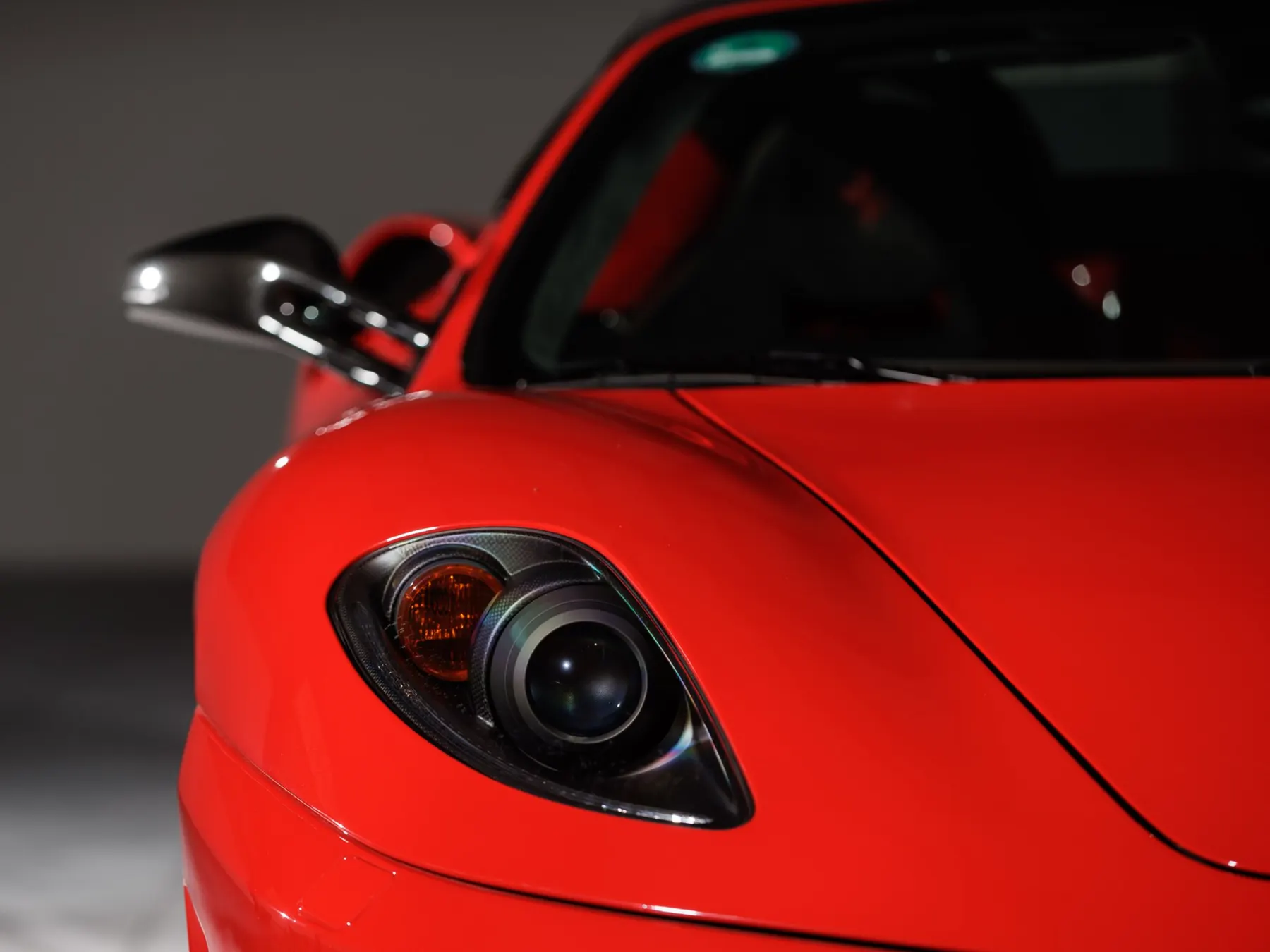
Electronically, the 16M carried over F1-Trac, a traction and stability system first developed for the front-engined 599 GTB, paired with Ferrari’s electronically controlled limited-slip differential, E-Diff2. Aerodynamically, it wore the Scuderia’s angular front bumper, whose intakes - unlike the decorative scoops fitted to some rivals - genuinely fed the oil radiators and directed air along the car’s flanks and underbody. A carbon-fibre diffuser, lightweight composite bumpers and sills, and a Lexan rear screen all helped offset the mass that any folding-roof mechanism inevitably adds back in.
On the road, reviewers found the 16M rewarding rather than simply loud, though it was certainly that too: intake resonators amplified the flat-plane V8’s wail into something road testers described as overwhelming at first exposure, a soundtrack unlike anything else Ferrari built at the time. What impressed testers just as much was how little the open bodyshell had apparently given up in outright composure. Across broken tarmac and unannounced road furniture alike, period road tests reported remarkably little shake or shimmy through the structure - a genuine achievement given how much rigidity typically evaporates once a roof is cut away. The steering was praised as accurate and well-weighted without being artificially heavy, the carbon-ceramic brakes as immensely powerful and resistant to fade, and the automated-manual gearbox as smooth enough in its automatic mode to pass for a twin-clutch unit, while still capable of savage manual shifts when asked. Evo’s road test judged the car “close” to its hard-top sibling in outright ability, close enough that all 499 cars sold before Ferrari had even needed to advertise them.
Inside, the 16M was unapologetically close to a race car with number plates. Carbon-fibre-shelled seats trimmed in Alcantara and a woven technical fabric replaced the standard Spider’s more accommodating chairs, four-point harnesses came as standard, and a good deal of the cabin’s sound insulation was simply left out to save weight. Buyers could specify a roll cage, though it was not road-legal everywhere, alongside options including an iPod dock housed in an Alcantara pouch and a tricolour livery offered through Ferrari’s Carrozzeria Scaglietti Personalisation Programme, beyond the standard black-with-grey-trim scheme. Boot space, split between a small forward compartment and the area behind the seats, totalled around 250 litres - enough for an overnight bag, and not a great deal more.
None of this arrived without genuine compromise, and it is worth naming where the 16M actually fell short rather than filing every shortcoming under charm. Losing the roof cost real, measurable performance: Ferrari’s own hard-top Scuderia was reported to be around 90kg lighter still, and evo’s road test found the convertible roughly a second and a half slower around Fiorano, with handling its testers judged not quite as nuanced as the coupe’s, and steering that, while accurate, was said to lack the ultimate intimacy of a dedicated track car. At least one period road test also noted a shudder passing through the structure under full-throttle, race-mode upshifts that simply was not present in the fixed-roof car - a reminder that no amount of titanium bracing fully substitutes for a welded-in roof when it comes to outright rigidity. The cabin, for its part, demanded real sacrifices from anyone hoping to use the car day to day: minimal sound insulation, a ride that stayed firm even in its softest damper setting, and seats shaped more for lateral support during hard cornering than for long-distance comfort made it a demanding rather than accommodating companion once the enthusiasm wore off. And then there was the matter of actually getting hold of one. Ferrari announced no official price at the November 2008 unveiling; by the time UK cars reached customers, the list price had settled at around £220,581, and the entire run had already been allocated to existing clients before series production had properly begun. The 16M therefore functioned as much as a reward for Ferrari’s most loyal customers as it did a car any interested buyer could simply order - an early and unusually pure example of the allocation-driven scarcity that has since become central to how Ferrari sells its most desirable special series.
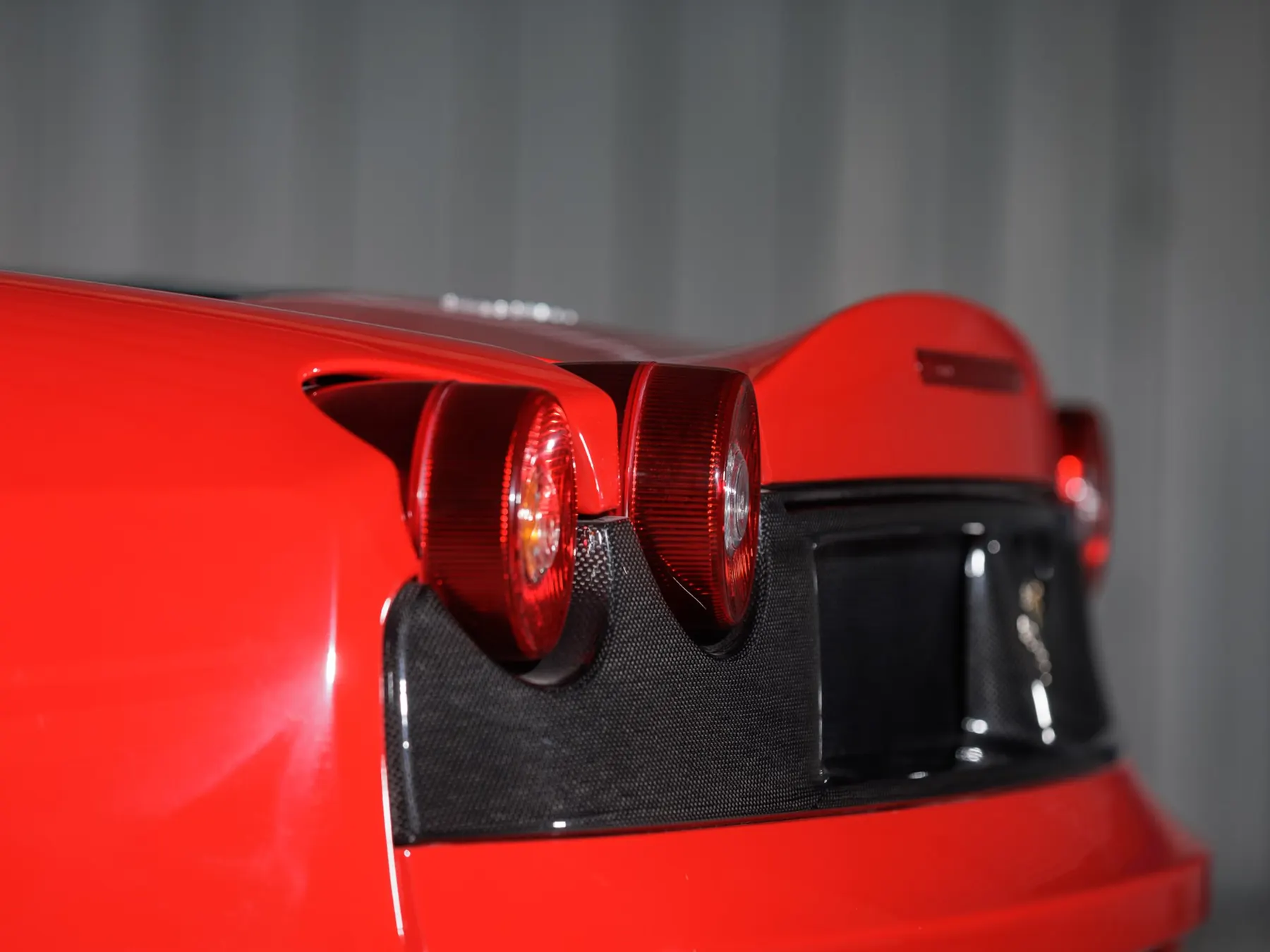
The Scuderia Spider 16M turned out to be more than a limited-edition curiosity. Production of both the coupe and the Spider wound down during the summer of 2009, bringing the F430 era to a close just as the 458 Italia, with its dual-clutch transmission and direct fuel injection, prepared to redefine Ferrari’s junior supercar formula almost entirely. In that light, the 16M stands as the last and most extreme expression of a particular kind of Ferrari V8: naturally aspirated, flat-plane-crank, and shifted by a single-clutch automated manual rather than the twin-clutch gearboxes that would soon become standard across the range. It was never intended to be a volume seller, and it wasn’t one, but as a distillation of everything Ferrari’s engineers - with a Formula 1 world champion looking over their shoulders - understood about building an open car that refused to apologise for the roof it had lost, it remains one of the most complete expressions of the F430 story.
Technical data
Specifications
| Ferrari Scuderia Spider 16M | |
|---|---|
| Engine | 4,308cc naturally aspirated V8 (Tipo F136 ED), flat-plane crank, dry sump, DOHC 4v/cyl |
| Bore x stroke | 92mm x 81mm |
| Compression ratio | 11.88:1 |
| Power | 503bhp @ 8,500rpm |
| Torque | 347lb-ft @ 5,250rpm |
| Transmission | 6-speed “F1 SuperFast2” single-clutch automated manual, rear-wheel drive |
| Differential | E-Diff2 electronically controlled limited-slip |
| 0–62mph | 3.7 seconds (claimed) |
| Top speed | 196mph |
| Dry weight | 1,340kg |
| Kerb weight | 1,440kg |
| Weight distribution | 43% front / 57% rear |
| Length / width / height | 4,512mm / 1,923mm / 1,216mm |
| Wheelbase | 2,600mm |
| Brakes | Carbon-ceramic; 398mm front (6-piston), 350mm rear (4-piston) |
| Wheels / tyres | 19in forged alloy; 235/35 ZR19 front, 285/35 ZR19 rear |
| Fuel tank | 95 litres (twin tanks) |
| Production | 499 units, 2008–2009 |
| UK launch price | approx. £220,581 (no official price announced at the November 2008 unveiling) |
Sources
- Ferrari.com - Scuderia Spider 16M official specifications
- Ferrari.com - Scuderia Spider 16M, Ferrari History Garage
- Supercar Nostalgia - Ferrari 430 Scuderia & 430 Scuderia Spider 16M Guide
- Classic Driver Magazine - Ferrari Scuderia Spider 16M
- Supercars.net - Ferrari Scuderia Spider 16M Ultimate Guide
- evo - Ferrari 430 Scuderia 16M road test
- autoevolution - Ferrari Scuderia Spider 16M specs and history
- Rosso Automobili - 2008 Ferrari Scuderia Spider 16M (production-count cross-reference only)
Join the discussion
Comments
Loading comments…
Leave a comment
Share a detail, memory, or perspective. Every comment is reviewed before publication.