Mercedes-Benz SLR McLaren 722 S Roadster: An Open-Top 208mph Farewell
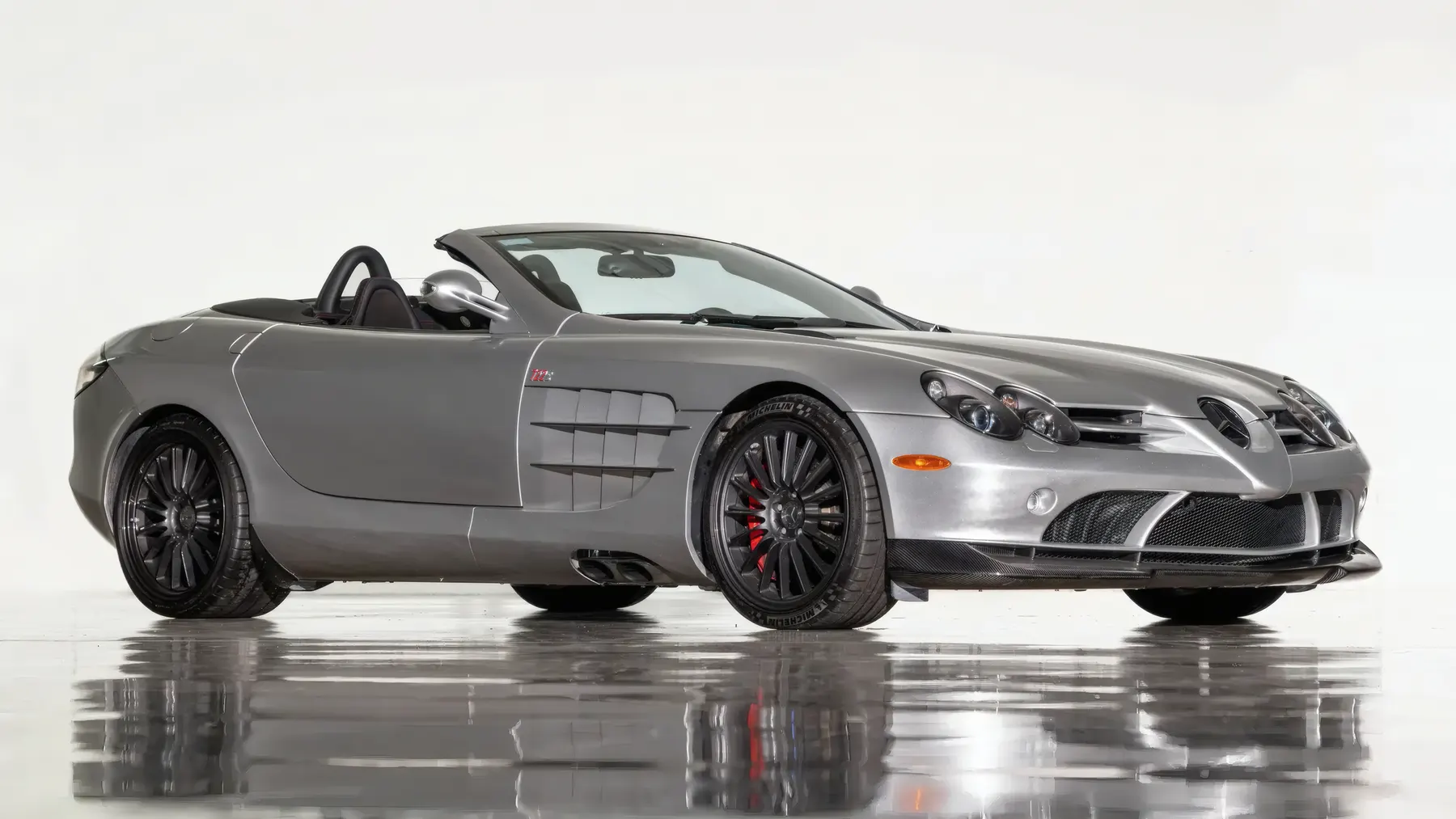
2009 Mercedes-Benz SLR McLaren 722 S Roadster

Images: Robin Adams / RM Sotheby's
By the time Mercedes-Benz and McLaren finally built the SLR McLaren Roadster 722 S, the whole SLR project had been arguing with itself for the better part of a decade. It began as two quite different ideas for the same car. McLaren’s Gordon Murray, fresh off designing the McLaren F1, wanted something light, naturally aspirated and mid-engined, true to the marque’s racing instincts. Mercedes-Benz wanted a heavy, front-engined, long-legged grand tourer wrapped around the biggest supercharged V8 that AMG could build, styled as a tribute to the 300 SLR of 1955. Neither side got exactly what it wanted, and the car that resulted spent six model years trying to be both things simultaneously. The 722 S Roadster, released right at the end of that run, is the version that pushed hardest towards the AMG-supercar end of that argument, without ever fully escaping the compromises that had been designed in from the very start.
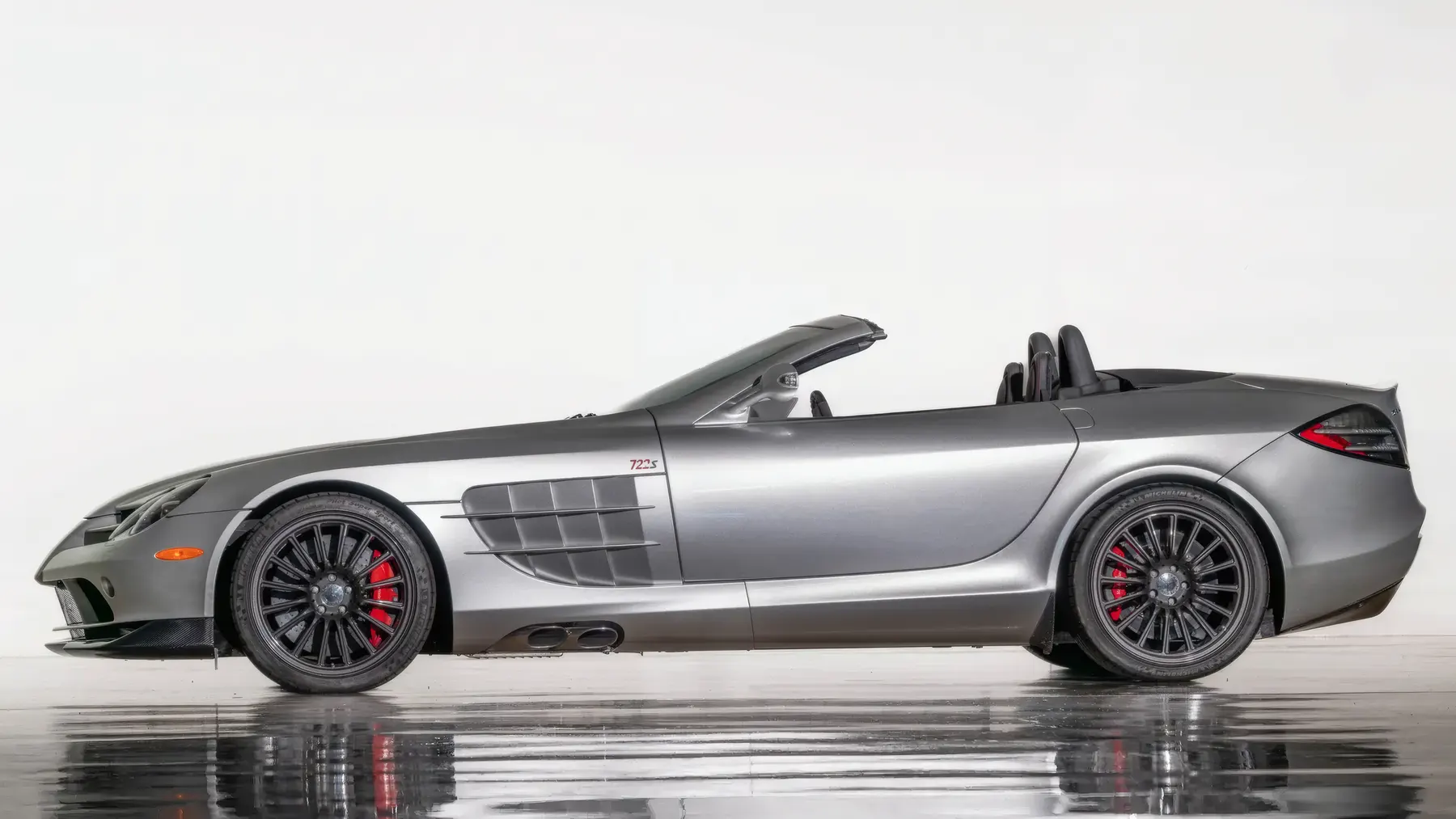
The starting point was the Vision SLR concept shown in Detroit in 1999, born out of a relationship in which Mercedes-Benz held a substantial minority stake in McLaren and had supplied its Formula 1 engines since the mid-1990s. Murray, who had overseen McLaren’s road-car division since the F1, was brought in to give the project engineering credibility, and by his own later account he was startled by how little the original design brief resembled anything McLaren would have built on its own, describing early Mercedes styling proposals as closer to a boulevard cruiser than to the 300 SLR it was supposed to honour. He pushed back where he could: the supercharged V8 was shifted almost a metre further back in the chassis than Mercedes had planned, turning a front-engined layout into a front-mid-engined one and improving the weight distribution considerably. The body and structure were built as a bonded carbon-fibre monocoque, a genuine novelty for a Mercedes road car at the time, and the need for a completely flat underbody pushed the exhaust system out through vents ahead of the doors rather than at the rear. The result was the elongated, F1-nosed shape with butterfly-hinged doors that became the SLR’s calling card, distinctive but also, by Murray’s own admission, some way removed from the lighter, purer machine he had originally envisaged.
Production began in 2003 for the 2004 model year, with the closed coupé arriving first at around 617bhp and 575lb-ft of torque, hand-assembled largely at McLaren’s own facility in Woking rather than a conventional Mercedes plant. A more focused coupé followed in 2006, badged 722 Edition in honour of Stirling Moss and his navigator Denis Jenkinson, who won the 1955 Mille Miglia outright in a Mercedes-Benz 300 SLR carrying the race number 722, denoting their 7.22am start time. That car covered the roughly 1,600km Brescia-to-Rome-and-back route in a little over ten hours, a time that, in Mercedes’ own telling, has never been beaten. The 722 Edition carried a reworked engine map, lighter forged wheels, a trimmed oil tank and lowered, stiffened suspension, taking output to around 641bhp. A standard SLR Roadster arrived in 2007, revealed at that year’s Frankfurt show, before Mercedes finally combined the two ideas in September 2008, announcing the Roadster 722 S ahead of the Paris Motor Show and putting it on sale from 1 January 2009. Just 150 were built, and Mercedes was candid that this was intended as the closing statement for the entire SLR line.
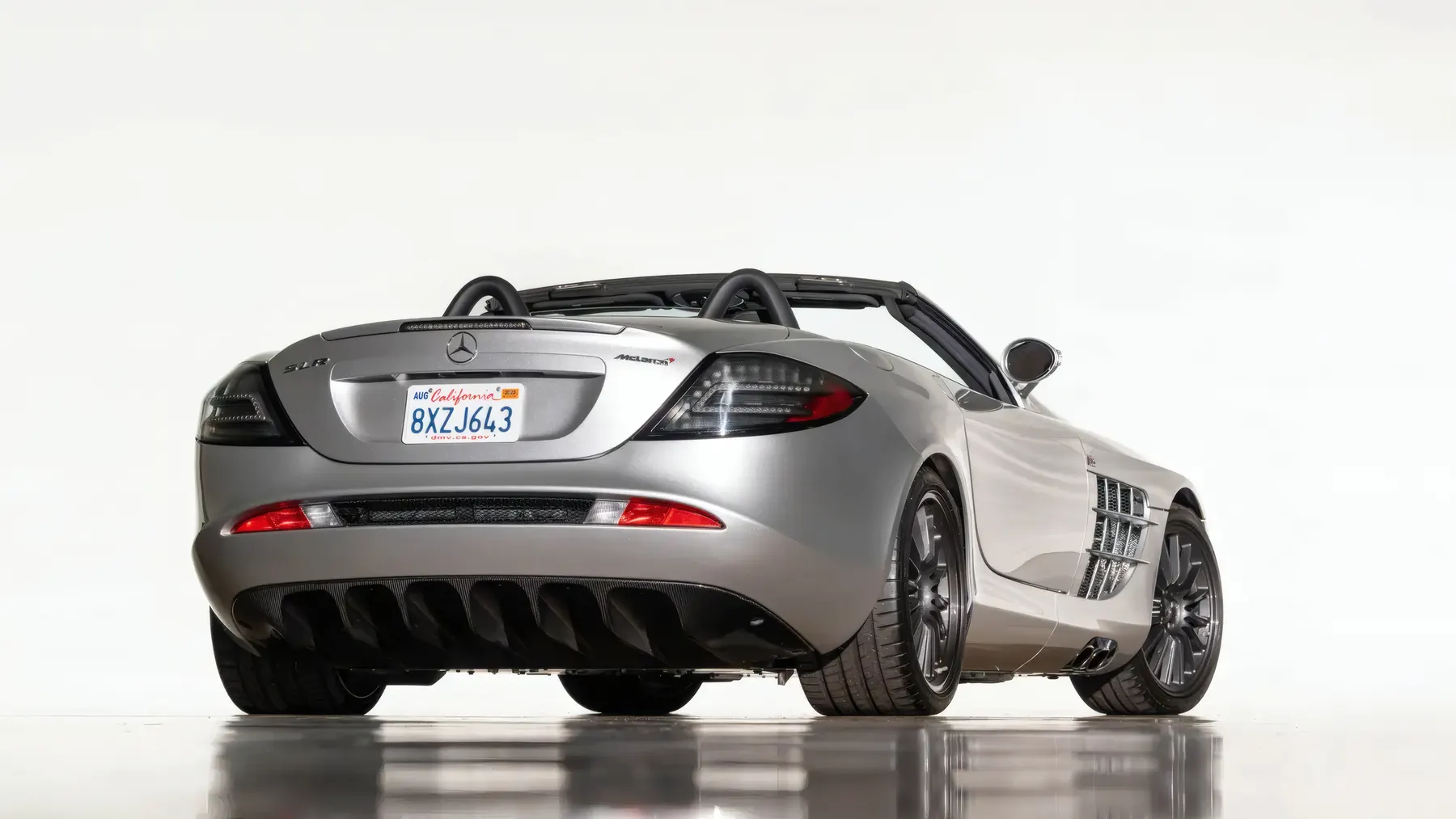
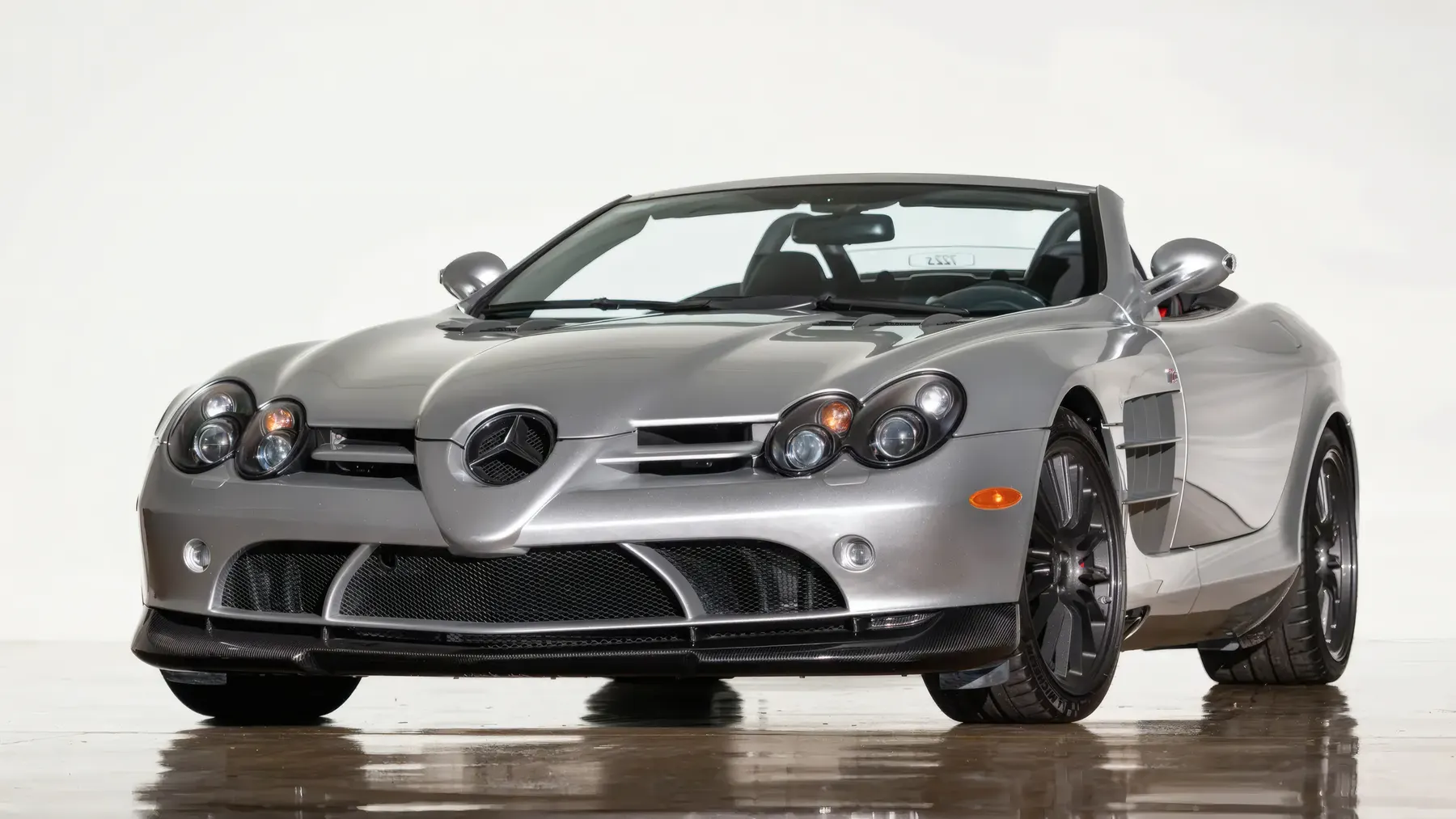
Under that long bonnet sat a hand-built, 5.5-litre (5,439cc) supercharged V8, assembled at AMG’s Affalterbach workshop rather than on a conventional production line, with a 97.0mm bore and 92.0mm stroke and a 9:1 compression ratio. Mercedes quoted an output of 650PS, which converts to 641bhp rather than the 650bhp figure that period magazines and brochures often repeated after mixing up metric and imperial horsepower; torque was a more straightforward 605lb-ft. Fed through a five-speed torque-converter automatic with paddle-shift control and two driver-selectable shift programmes, the 722 S Roadster claimed 0-62mph in 3.7 seconds, 0-124mph in 10.6 seconds and 0-186mph in around 30.5 seconds, topping out at 208mph. That was, by contemporary reckoning, among the fastest speeds ever claimed for a series-production open-top car, an achievement made possible by 19-inch forged wheels finished in palladium grey, a front carbon-fibre splitter, a rear diffuser set at around 20 degrees, and an automatically deploying air brake on the boot lid. Six-piston front calipers, painted red, clamped 390mm carbon-ceramic discs, while the whole car sat 10mm lower than the standard Roadster on a stiffer damper set-up.
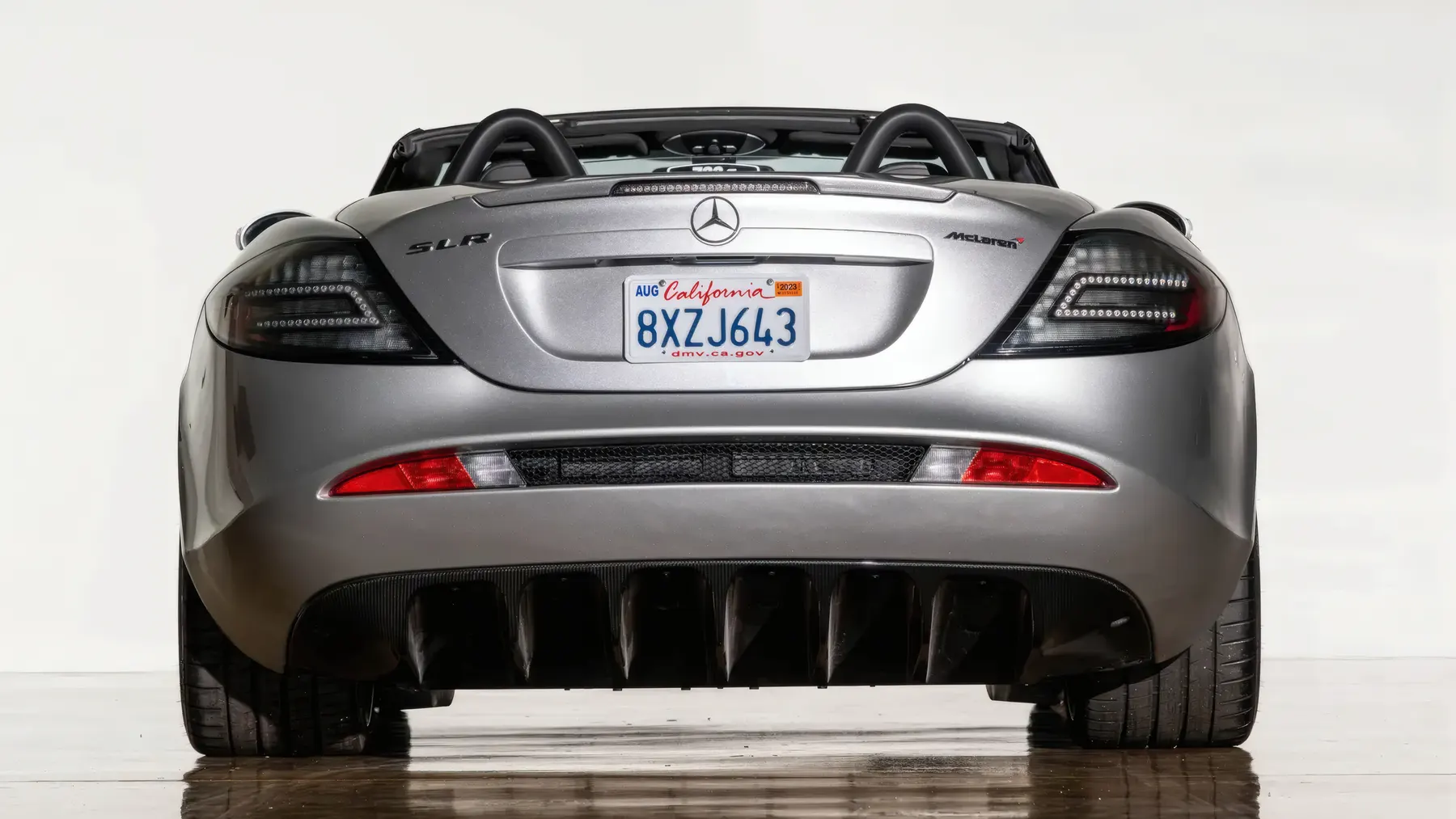
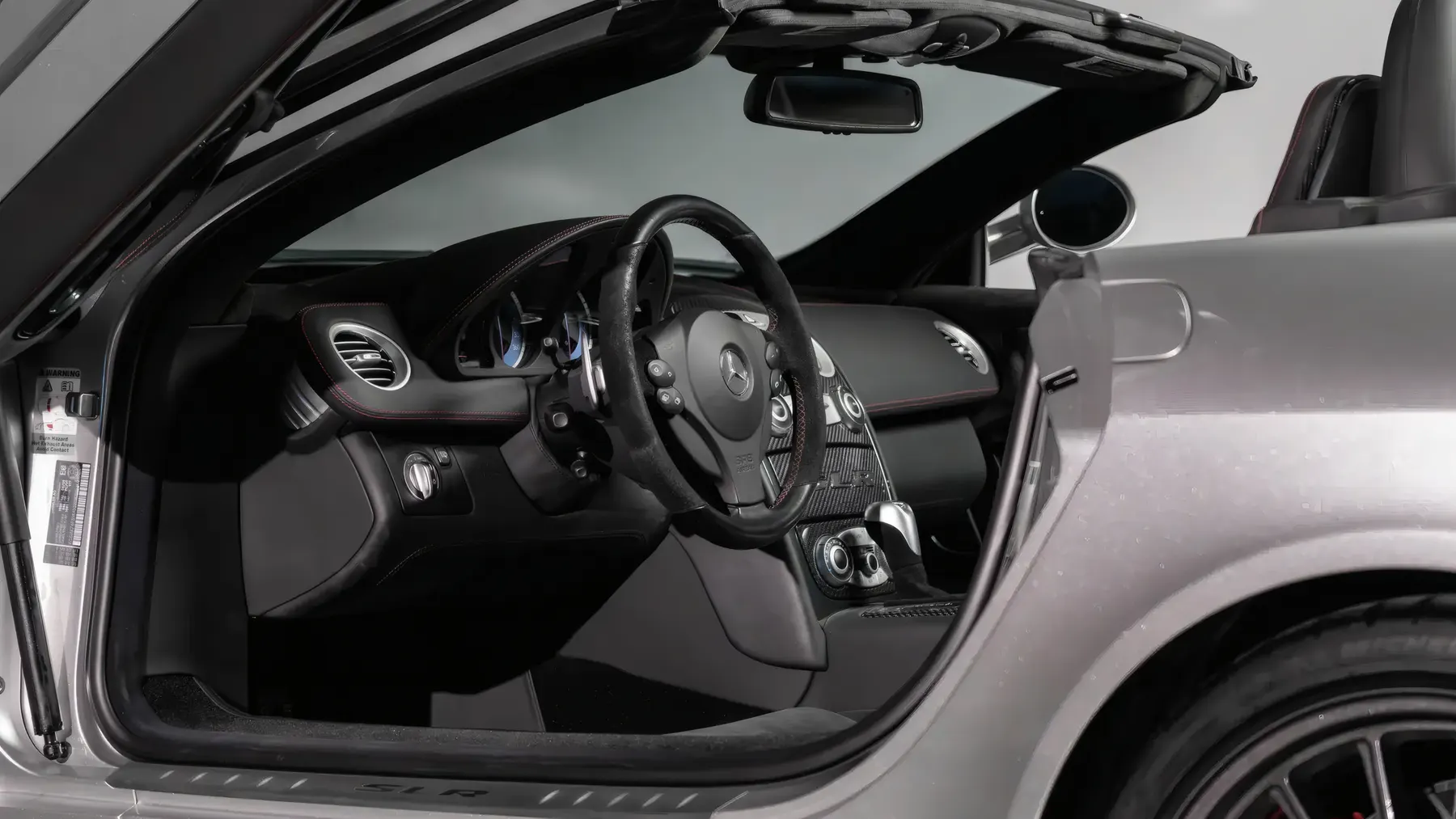
Visually and inside the cabin, the 722 S made its intentions obvious. Every car left Woking finished in a crystal antimony grey paint reserved for the model, with palladium-grey headlamp surrounds and wheel-spoke detailing, black grille-style bonnet vents, a painted carbon-fibre front splitter and matching rear wheel spoilers. Inside, semi-aniline leather was combined with Alcantara and suede on the gearlever, handbrake and door pulls, set off by 300 SL-red stitching and red seatbelts, with “722 S” badges embossed into the head restraints and lettered onto the door sills, plus an AMG Racetimer stopwatch mounted on the dashboard. It is a cabin that leans hard into motorsport theatre, and largely succeeds at it, though several road testers were less impressed by some of the switchgear beneath the surface trim, noting that plastic vents and detailing finished in silver paint looked cheap for a car costing several times as much as contemporary rivals.
Making an open car usable at those speeds took real engineering rather than marketing bluster. The fabric roof was woven from black and anthracite yarn that shifted colour with the light, stiffened by an integrated aluminium and composite panel designed specifically to stop it ballooning under aerodynamic load, and it folded semi-automatically in around ten seconds once unlatched by hand at the windscreen header. A tall wind deflector behind the seats was tuned to keep buffeting and noise low enough that conversation remained possible well past 100mph, while the carbon monocoque’s reinforced A-pillars and two fixed rollover hoops gave the open car torsional stiffness closer to the coupé’s than most drop-top supercars of the era managed. It is a genuinely clever piece of engineering, and one that let Mercedes claim the 722 S as a roadster you could drive flat out with the roof down rather than a coupé with a party trick.
Mercedes marketed the 722 S as losing nothing in everyday usability compared with the standard car, and on paper the case was reasonable: a 97-litre fuel tank, a 204-litre boot behind the engine, and an official combined fuel economy that converts to somewhere around 19 to 20mpg. In practice, a supercharged V8 that pulls hardest above 4,000rpm and a driving style that encourages exactly that meant real-world consumption dropped a long way below the official figure, and running costs were compounded by carbon-ceramic brakes and specialist tyres that were never going to be cheap to replace. None of this made the 722 S impractical in the way a mid-engined track special might be, but the “everyday supercar” framing in Mercedes’ own brochures asked a lot of buyers who were, in reality, paying grand-tourer running costs on top of a supercar price.
Whether the driving experience matched that ambition is a different question, and this is where the SLR family’s reputation has always been shakier than its specification sheet suggests. Road testers across several markets, from Auto Express in Britain to Wheels magazine in Australia, converged on the same complaints: steering that was accurate but strangely inert, giving the driver little sense of what the front tyres were doing, and a floor-hinged brake pedal that delivered enormous stopping power yet proved almost impossible to modulate smoothly at town speeds. That brake pedal was no accident of packaging; the SLR used Mercedes’ Sensotronic Brake Control, an electro-hydraulic brake-by-wire system that had already triggered two large recalls elsewhere in the Mercedes range, covering roughly two million cars between 2004 and 2005, after software and pump faults left some vehicles defaulting to a longer-travel hydraulic back-up mode. Rather than re-engineer the low-volume SLR to use a conventional master cylinder, Mercedes simply carried SBC through to the end of production, meaning 722 S buyers inherited a braking system with an already tarnished reputation. The five-speed torque-converter gearbox, meanwhile, was starting to look old-fashioned against the dual-clutch transmissions beginning to appear in rival supercars, and despite its extensive carbon-fibre structure the 722 S Roadster still weighed around 1,825kg, blunting some of the agility its Formula 1-derived construction seemed to promise. One Australian road test of the car summed up the general verdict bluntly, describing it as a machine with plenty of potential but a driving experience that never quite delivered on it, while an earlier UK test of an original SLR found the front and rear axles seemingly working to different scripts under hard cornering.
Commercially, the whole programme struggled more than Mercedes had hoped. The company had reportedly planned to sell around 3,500 SLRs over roughly seven years simply to break even on the joint venture, yet across six model years and five variants only 2,157 examples were ultimately built and sold, a shortfall serious enough that some observers viewed the increasingly extreme 722-badged cars, including this Roadster, as much a way of moving remaining stock as a purist’s final flourish. Resistance was strongest in markets where buyers had ready access to more modern rivals: one contemporary account noted barely a handful of sales in Japan, where the SLR’s old-school supercharged V8 and torque-converter automatic compared poorly with newer competition. At an ex-factory price of roughly €435,000 before tax in its home market, the 722 S Roadster also sat well above many of the Ferraris, Lamborghinis and Porsches it was nominally competing with, without matching the outright drama that buyers at that price point increasingly expected.
None of that has stopped the final SLRs from becoming seriously desirable. The rarity of the 150-car run, combined with the model’s slowly improving critical reappraisal, has pushed 722 and 722 S examples into a different collector tier from the standard Coupé and Roadster, with specialist dealers now typically pricing these variants somewhere between roughly £500,000 and £1 million depending on condition and specification. Some of that renewed enthusiasm is genuine rather than purely speculative: McLaren itself has noted that many SLR owners keep more than one example and use them regularly, drawn to precisely the unfiltered, occasionally uncouth character that period road testers found so hard to love. That does not erase the car’s real shortcomings, but it does suggest the 722 S rewards owners who approach it as a raw, deliberately old-fashioned analogue supercar rather than as a rival to the more polished, digitally assisted machines that followed it.
Viewed with some distance, the SLR McLaren 722 S Roadster reads less as a failed supercar than as an unusually candid record of what happens when two very different car companies refuse to fully agree with each other: a car that never resolved the tension between raw motorsport ambition and cosseting Mercedes grand-touring comfort, and chose, in its final and most extreme form, to turn the volume up on that unresolved argument rather than settle it.
Technical data
Specifications
| Variant | Production years | Engine | Power | Torque | 0-62mph | Top speed | Kerb weight | Production run |
|---|---|---|---|---|---|---|---|---|
| SLR McLaren Coupé / Roadster (standard) | 2003–2009 | 5.5-litre (5,439cc) supercharged V8 | 617bhp | 575lb-ft | 3.8s | 208mph | approx. 1,746kg (Roadster)* | part of ~2,157 total SLR production |
| SLR McLaren 722 Edition (Coupé) | 2006–2007 | 5.5-litre (5,439cc) supercharged V8 | 641bhp | 605lb-ft | 3.6s | approx. 209mph** | approx. 1,724kg* | 150 |
| SLR McLaren Roadster 722 S | 2008–2009 | 5.5-litre (5,439cc) supercharged V8, hand-built at Affalterbach | 641bhp | 605lb-ft | 3.7s | 208mph | 1,825kg | 150 |
Sources
- Autoblog – Mercedes-Benz Reveals SLR McLaren Roadster 722 S
- Classic Driver Magazine – Mercedes-Benz SLR McLaren Roadster 722 S
- Mercedes-Benz / Daimler AG – Official SLR McLaren Roadster 722 S Sales Brochure (2008)
- WhichCar / Wheels Magazine – Mercedes-McLaren SLR 722 S Roadster Review
- evo – Mercedes-Benz SLR 722
- Auto Express – Mercedes McLaren SLR 722 Review
- Hagerty Media – 2023 Bull Market Pick: 2004–10 Mercedes-Benz SLR McLaren
- Hagerty Media – A Mixed Market for the Mercedes-Benz SLR McLaren and SLS AMG
- Hagerty UK – The Beast Is Back: Taming the ‘New Improved’ McLaren SLR HDK
- Hagerty Valuation Tools – 2009 Mercedes-Benz SLR McLaren 722 S
- 500SEC.com – Sensotronic Brake System (SBC)
- CarBuzz – How Mercedes and McLaren Made the World’s First Everyday Hypercar
- autoevolution – Remembering the Mercedes-Benz SLR McLaren
- Kelley Blue Book – 2007 Mercedes-Benz SLR McLaren 722 Edition Coupe Specifications
- Kelley Blue Book – 2009 Mercedes-Benz SLR McLaren Roadster Specifications
- Classic Trader – Mercedes-Benz SLR Market Overview
Join the discussion
Comments
Loading comments…
Leave a comment
Share a detail, memory, or perspective. Every comment is reviewed before publication.