Ferrari SF90 Spider 'Atelier': Inside Maranello's Hybrid Flagship
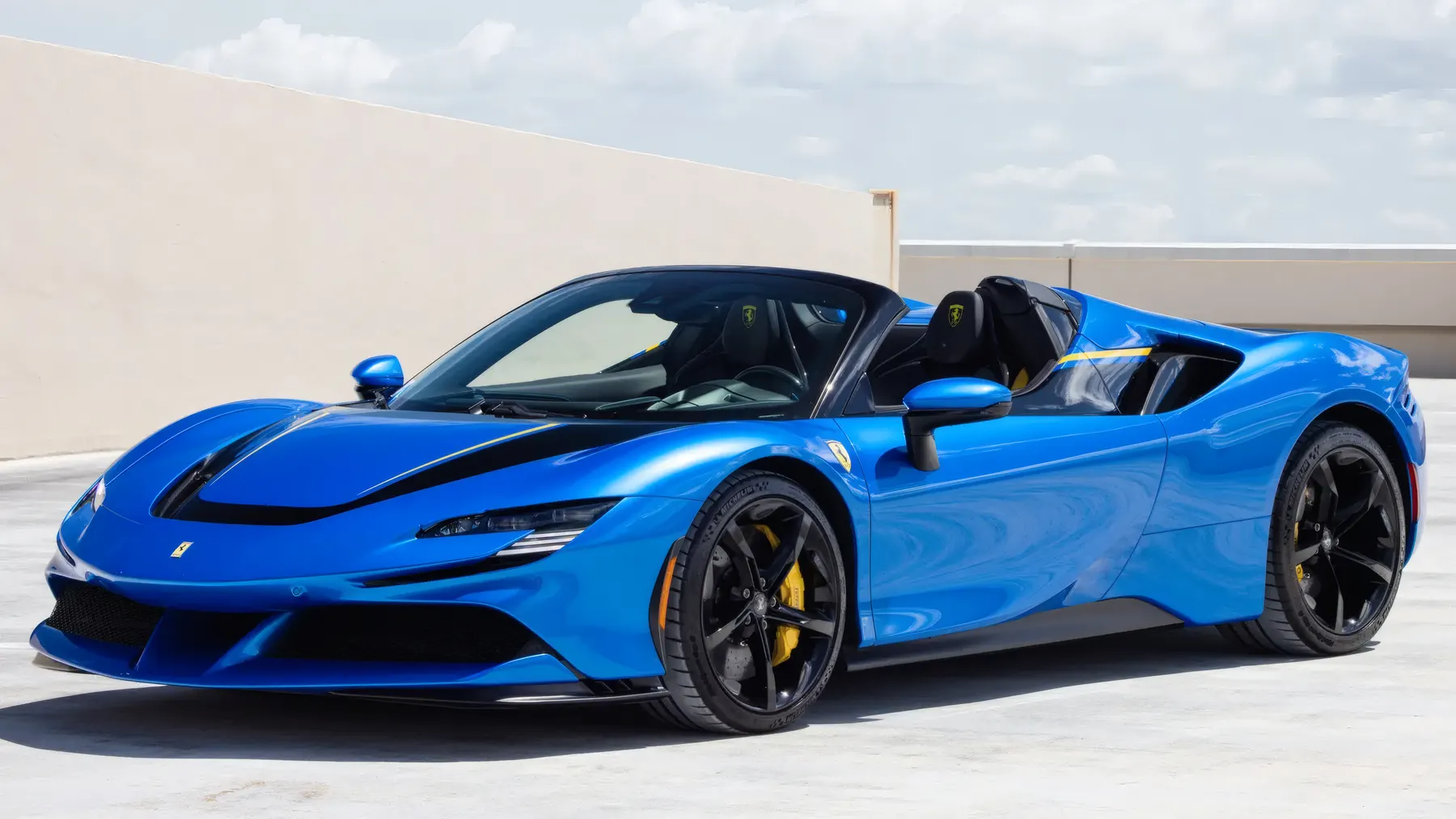
2023 Ferrari SF90 Spider 'Atelier'

Images: RM Sotheby's
Roll a Ferrari SF90 Spider out of the garage in its default electric mode and the first thing that hits you is the silence. No bark from the exhaust, no shudder through the seat at idle, just tyre noise and a faint whirr as Maranello’s fastest-ever road car creeps along like a golf cart. For a company that built its identity on the drama of naturally aspirated engines, arriving at a flagship that can, and by default does, start up mute is one of the more significant departures Ferrari has ever made. It isn’t the only one. This is also the first series-production Ferrari with all-wheel drive, the first one buyers can plug into a household socket, and, at launch, the quickest thing the factory had ever sent around its own Fiorano test track, LaFerrari included.
The SF90 name borrows from Scuderia Ferrari’s Formula 1 car of the same era, marking the racing team’s 90th anniversary. “Stradale” - the badge on the coupe that arrived first, in May 2019 - simply means “made for the road,” an acknowledgement that this hybrid architecture had no direct competition car to homologate against, unlike so many Ferraris before it. The open-top SF90 Spider followed in November 2020, built on the same Type F173 platform and running the identical drivetrain, differing chiefly in its folding roof and a modest weight penalty. Where earlier Ferrari flagships were defined by one big, emotive engine - the Enzo’s naturally aspirated V12, the LaFerrari’s 6.3-litre - the SF90 marked a genuine changing of the guard: a smaller-capacity twin-turbo V8 doing much of the work, with three electric motors filling in the rest.
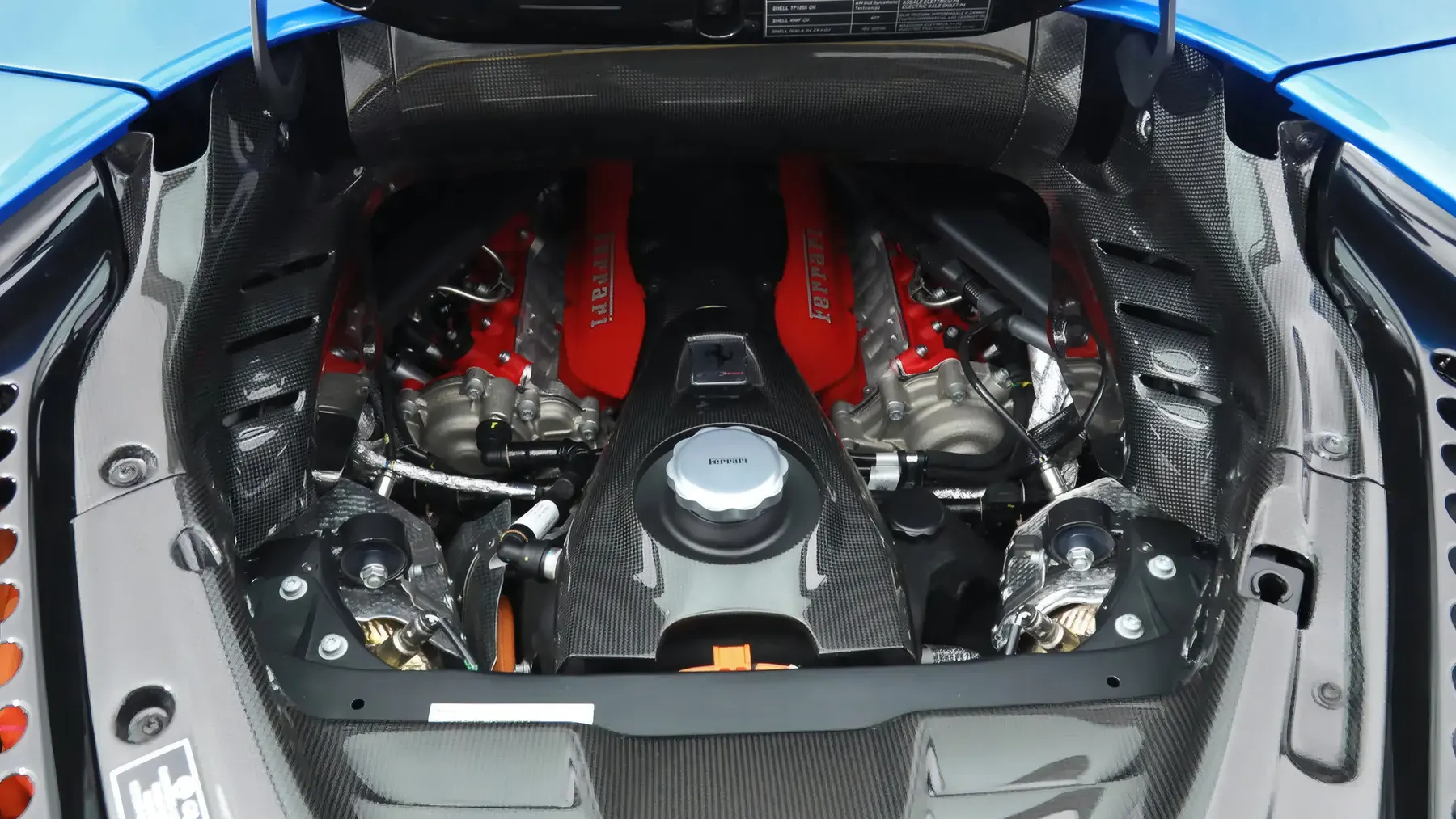
That V8 is a heavily reworked evolution of the unit found in the 488 Pista and F8 Tributo, bored out to 3,990cc, with narrower cylinder heads and completely redesigned intake and exhaust tracts. The turbochargers sit lower in the vee, the exhaust runs higher, and the whole assembly is mounted 50mm lower in the chassis than in Ferrari’s other mid-engined V8s, dropping the centre of gravity. An Inconel exhaust manifold and a smaller flywheel trim weight wherever they can. On its own, the engine produces 769bhp, a specific output of around 195bhp per litre that puts it near the top of any V8 in production anywhere. Bolted to it is a new eight-speed dual-clutch gearbox, 10kg lighter than the seven-speed unit it replaces and quicker-shifting, with one notable omission: there’s no reverse gear at all. Reversing is handled entirely by the two electric motors on the front axle, a genuinely novel piece of packaging logic that only makes sense once the rest of the hybrid system is understood.
Those front motors form what Ferrari calls RAC-e, an electric axle that also manages torque vectoring, sending different amounts of power to each front wheel to sharpen turn-in and tidy the car’s balance. A third motor, mounted between engine and gearbox, fills in torque wherever a turbocharged engine would otherwise leave a gap, and doubles as a generator for the battery. Combined, the three motors add 217bhp, for a total system output of 986bhp, a figure Ferrari prefers to round up to “1,000 cv” in its own marketing material, using the metric horsepower unit rather than the slightly lower bhp figure independent outlets tend to quote. A 7.9kWh lithium-ion battery gives around 26km of pure-electric range and can be topped up from a household socket. A steering-wheel-mounted eManettino dial, sitting alongside the usual Manettino for chassis settings, toggles between eDrive, Hybrid, Performance and Qualify modes, spanning silent-running errands through to a setting that keeps the engine spinning purely to hold maximum electrical reserve in readiness.
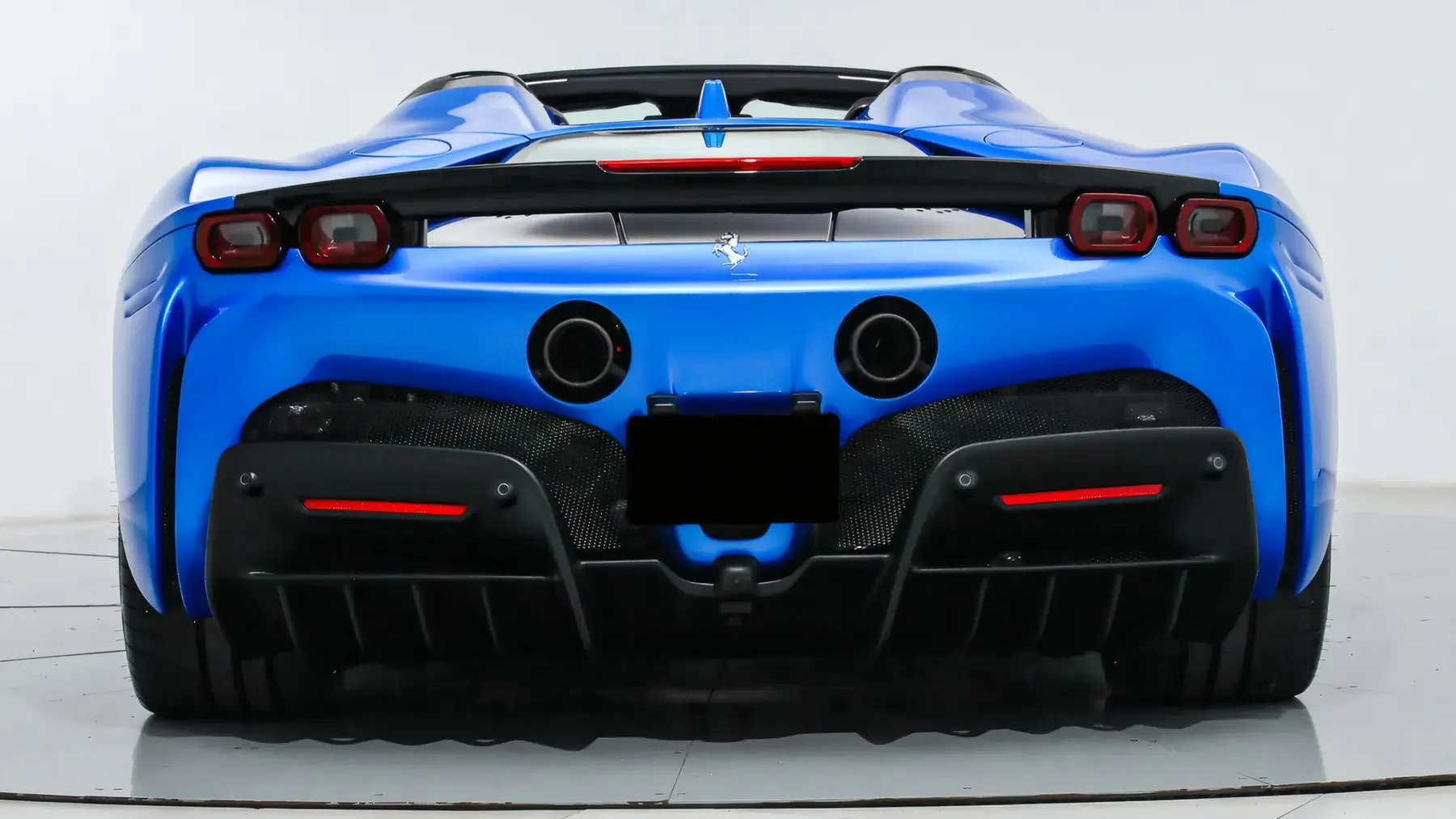
The numbers this powertrain produces are startling even by supercar standards: 0-62mph in 2.5 seconds, 0-124mph in 6.7 seconds, and a top speed of 211mph, with peak torque of 590lb-ft arriving at 6,000rpm. At its 2019 launch, the Stradale coupe lapped Ferrari’s own Fiorano circuit seven tenths of a second faster than the LaFerrari it effectively usurped as the fastest road-legal Ferrari, a startling result for what was, on paper, a “mere” flagship V8 rather than a limited-run halo car. The aerodynamics do plenty of the work too: a cab-forward body shape frees up space for the hybrid system’s radiators, a twin-part rear wing borrows its shut-off Gurney flap logic from Formula 1’s drag-reduction systems, and front-mounted vortex generators, aided by a chassis raised 15mm at that specific point, help balance out the downforce the rear end generates. Ferrari claims up to 390kg of downforce at 155mph, a genuinely serious number for a car with number plates and a boot, however small.
On the Spider, all of this sits beneath a folding hard top rather than a fixed roof, and Ferrari treated the engineering of that roof as seriously as everything else. Built from aluminium rather than the heavier steel or magnesium structures used elsewhere in the industry, it saves around 40kg over a conventional folding metal roof, packs away compactly above the engine, and can raise or lower in 14 seconds, even while the car is still rolling at low speed. The bodywork needed genuine changes to accommodate it: the engine cover is wider and flatter than the coupe’s to make room for the stowed roof, and the shark-fin antenna that sits on the coupe’s roofline had to move elsewhere. Ferrari says the Spider loses less than 100kg of torsional rigidity compared with the coupe, and in practice that is an academic distinction rather than something a driver notices from behind the wheel.
The trade-off for open-top motoring is weight, and this is where the SF90 story gets genuinely complicated. Ferrari’s official dry-weight figures, 1,600kg for a standard Stradale and 1,570kg for one fitted with the weight-saving Assetto Fiorano pack, flatter the car considerably, because “dry weight” excludes fluids and typically assumes every lightweight option has been ticked. Ferrari’s own published kerb-weight figure for the Spider is 1,670kg, but independent testers have suggested that a genuinely standard-specification car, filled with fuel and without the lightweight extras, is likely to weigh closer to 1,700-1,770kg at the kerb, several hundred kilograms heavier than the leaner headline figures suggest, and a meaningful amount of mass for any chassis engineer to disguise, however clever the software.
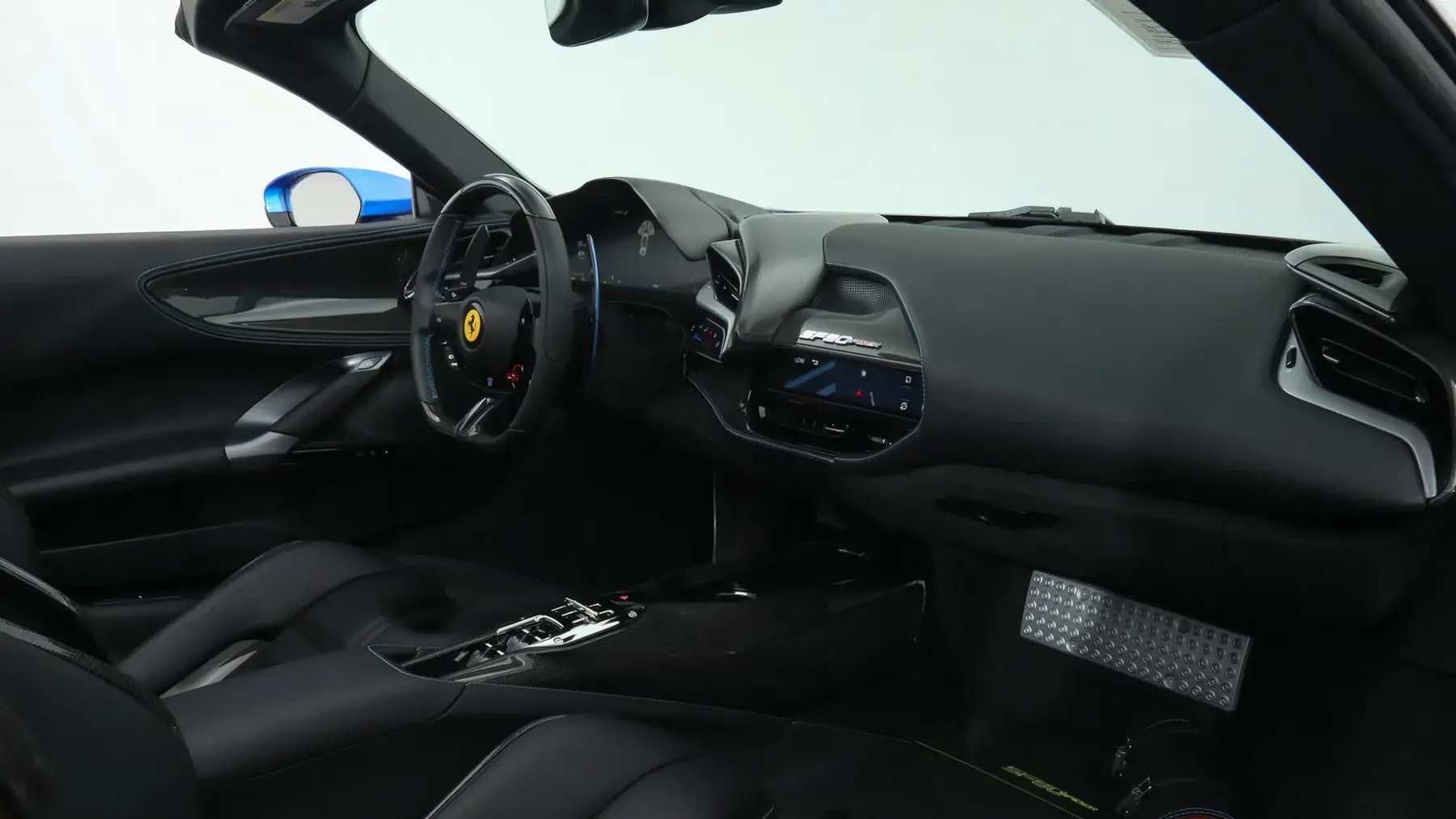
And the software is doing a great deal of disguising. This is arguably the single biggest talking point among road testers: reviewers have consistently noted that the SF90’s steering, now electrically assisted rather than hydraulic, lacks the last degree of feel and connection Ferrari’s V8s have historically been known for, and several have wondered aloud whether that comes down to the electric rack itself, the extra mass sitting over the front axle, or some combination of both. The brake pedal tells a similar story at low speed: because the system is entirely brake-by-wire, blending regenerative and friction braking electronically rather than through a direct hydraulic link, gentle stops around town carry a slightly artificial, disconnected quality, even though the same system is genuinely excellent once loaded up hard on a circuit. Driven hard on track, independent testers have also found that the SF90 doesn’t necessarily out-handle Ferrari’s own, considerably cheaper, non-hybrid F8 Tributo. The extra power and the electronically managed all-wheel-drive system make it ferociously quick in a straight line and out of corners, but some testers have come away feeling that the experience at the limit is more managed than it is flowing or intuitive, with the electronics quietly doing work that, on a lighter, simpler Ferrari, the driver would be doing personally. The cabin’s capacitive touch-sensitive steering wheel controls, praised for their resolution and graphics, have likewise drawn criticism for being fiddly to operate precisely on the move, a common complaint about Ferrari’s touch-based interfaces of this era. As a plug-in hybrid, its real-world efficiency benefit is modest rather than transformative: an electric-only range of around 26km suits short errands more than genuine commuting, and once the V8 is doing the bulk of the work, official efficiency figures for a car this powerful are unsurprisingly unremarkable for a technology often sold on its green credentials.
None of which makes the SF90 Spider anything less than astonishingly capable. Turned fully loose, traction control off, dampers stiffened, the manettino wound round to its final, most aggressive setting, it will still oversteer eagerly and reward a driver who knows what they’re doing, backed by brakes and chassis electronics precise enough to inspire real trust even at speed. In its more relaxed modes it’s also a genuinely comfortable, quiet, long-legged car, something not every Ferrari flagship before it managed to be, riding well enough on its softest suspension setting to make a case for covering serious distances rather than just blasting between corners.
Buyers wanting the sharpest version could specify the Assetto Fiorano pack, which brings Multimatic dampers derived from Ferrari’s GT racing programme, along with carbon-fibre and titanium components, a lightweight titanium exhaust, and forged or optional carbon-fibre wheels wrapped in Michelin’s stickiest Pilot Sport Cup 2 rubber, trimming around 30kg from a coupe and a smaller but still useful amount from the inherently heavier Spider. For those wanting to go further still, Ferrari eventually offered the SF90 XX Stradale and Spider, road-legal but track-focused specials drawing on the company’s XX test-driver programme, with 1,016bhp, 593lb-ft of torque, a fixed rear wing and considerably more downforce than the standard car. Production was capped at 799 XX Stradale and 599 XX Spider examples, all reportedly allocated to customers before deliveries even began.
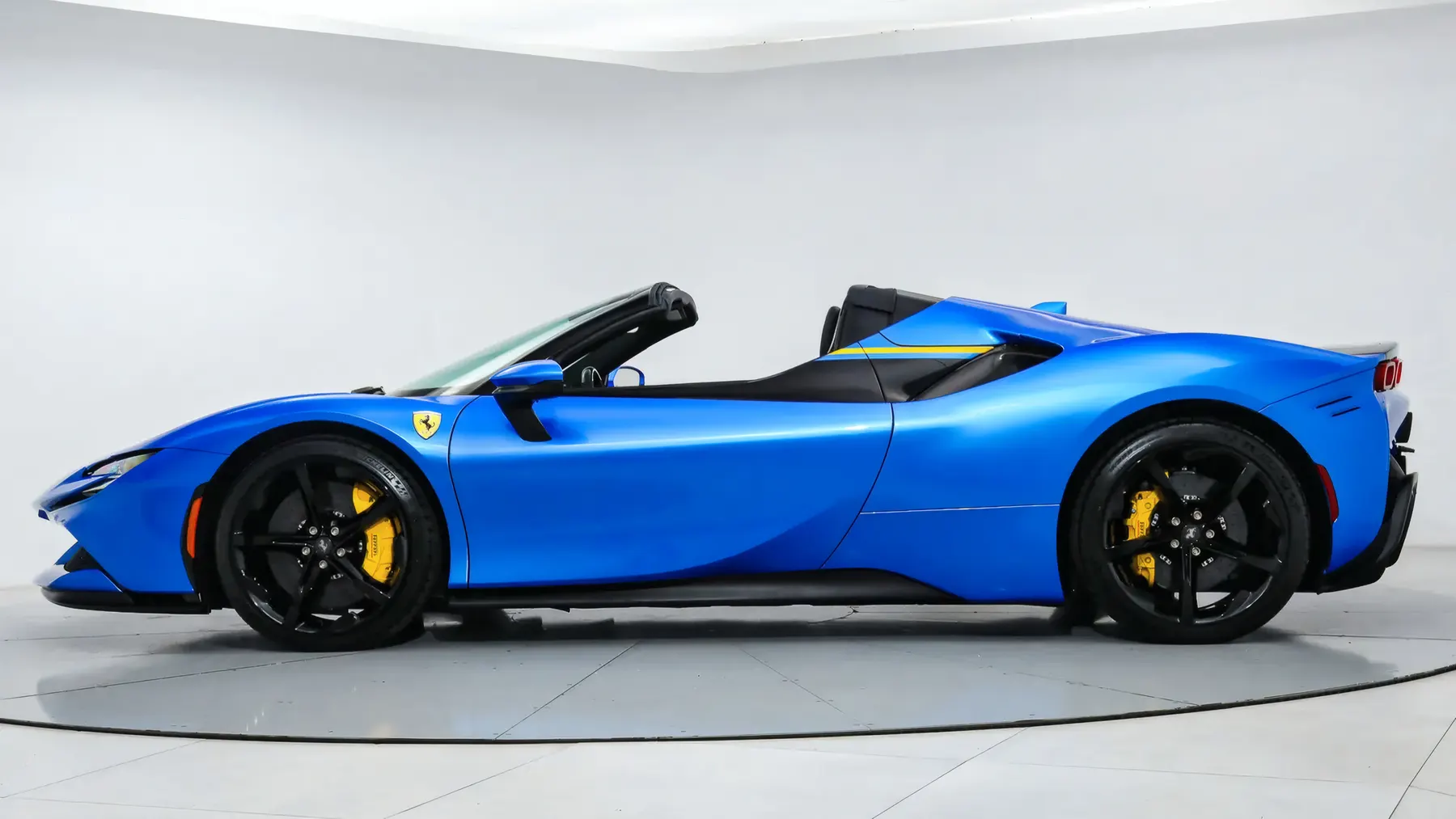
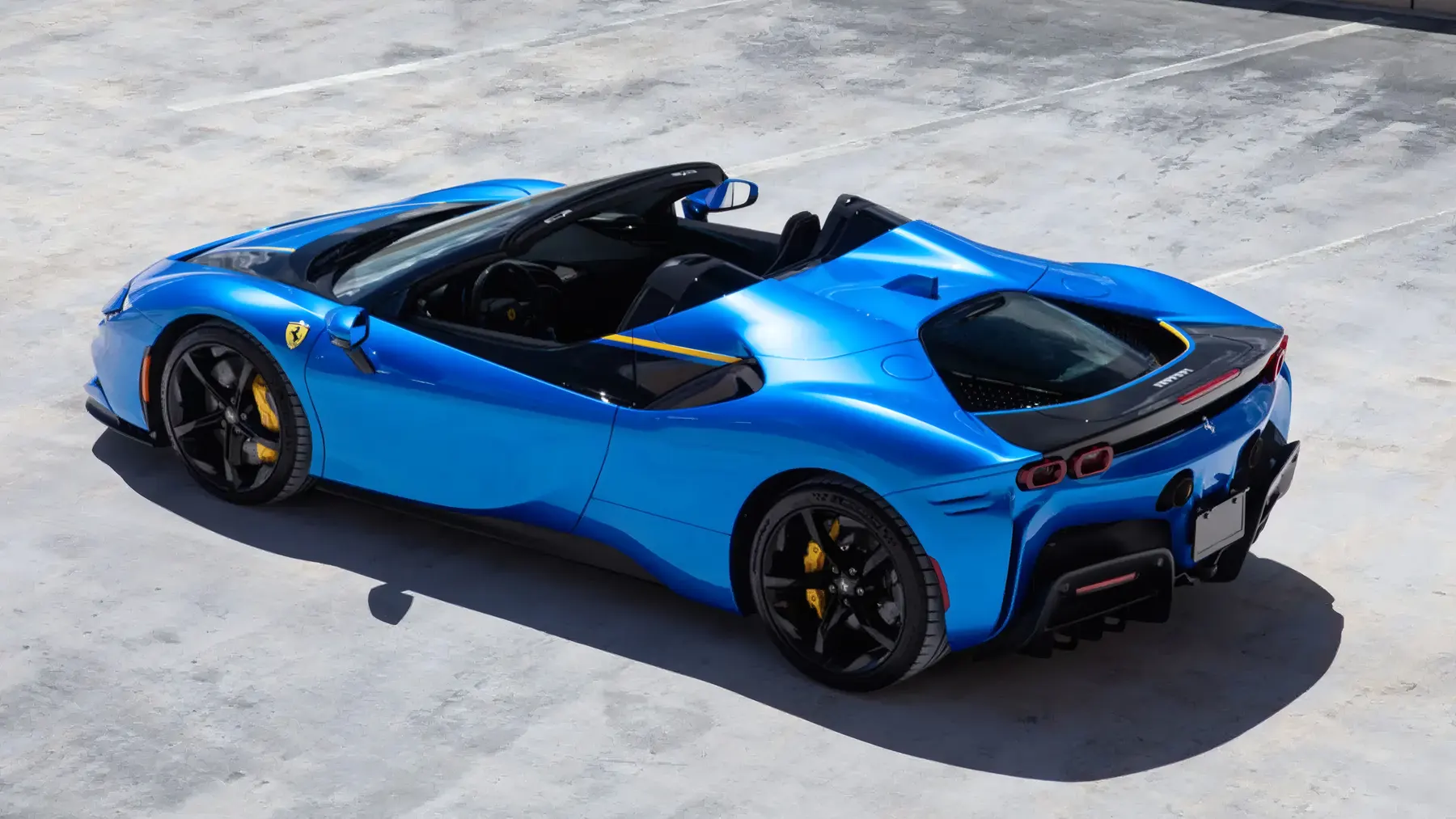
Because so much of what makes any individual SF90 Spider feel special lies in its specification rather than its mechanical layout, Ferrari’s personalisation studios have become almost as central to the car’s identity as its powertrain. Buyers wanting a lighter touch of individuality can work with Ferrari’s Atelier programme, an in-house studio, staffed by dedicated personalisation specialists, that lets clients choose from an enormous range of paints, liveries, interior leathers and trim finishes using a 3D configurator and physical samples, without committing to the far deeper, far slower Tailor Made process that effectively lets a client help design elements of their car from scratch. It’s worth being precise about what that word means, because it’s easy to assume “Atelier” describes some kind of factory performance variant in the way Assetto Fiorano does. It doesn’t. An Atelier-built SF90 Spider runs the identical 986bhp hybrid powertrain as any other, wrapped in whatever paint, livery and interior specification its owner chose during that consultation process. Because no two heavily personalised cars end up specified quite the same way, extensively optioned Atelier examples occasionally surface at major collector-car auctions as effectively one-of-one pieces, a reflection of how central bespoke personalisation has become to how Ferrari sells its most demanding customers on a car that, mechanically, every other SF90 Spider buyer can also have.
That price is not modest to begin with. US list prices for the SF90 Stradale coupe opened north of $600,000 at launch, with the Spider commanding a further premium before a single option is ticked, and few cars leave Maranello without a significant list of them, routinely pushing real-world transaction prices well beyond that starting figure. For that money, buyers are getting a car engineered right at the edge of what Ferrari’s V8 hybrid technology can do, but also one that asks difficult questions about what a Ferrari flagship is supposed to feel like: whether a car whose driving experience relies so heavily on invisible software, and whose steering doesn’t quite talk back the way a 458’s or an F40’s did, still delivers the emotional core of the brand, even while comfortably outperforming both of them. Ferrari has clearly wrestled with that same question in different ways with each hybrid flagship since, which suggests this is less a flaw unique to the SF90 than an inherent trade-off of the direction the entire hypercar segment has moved in.
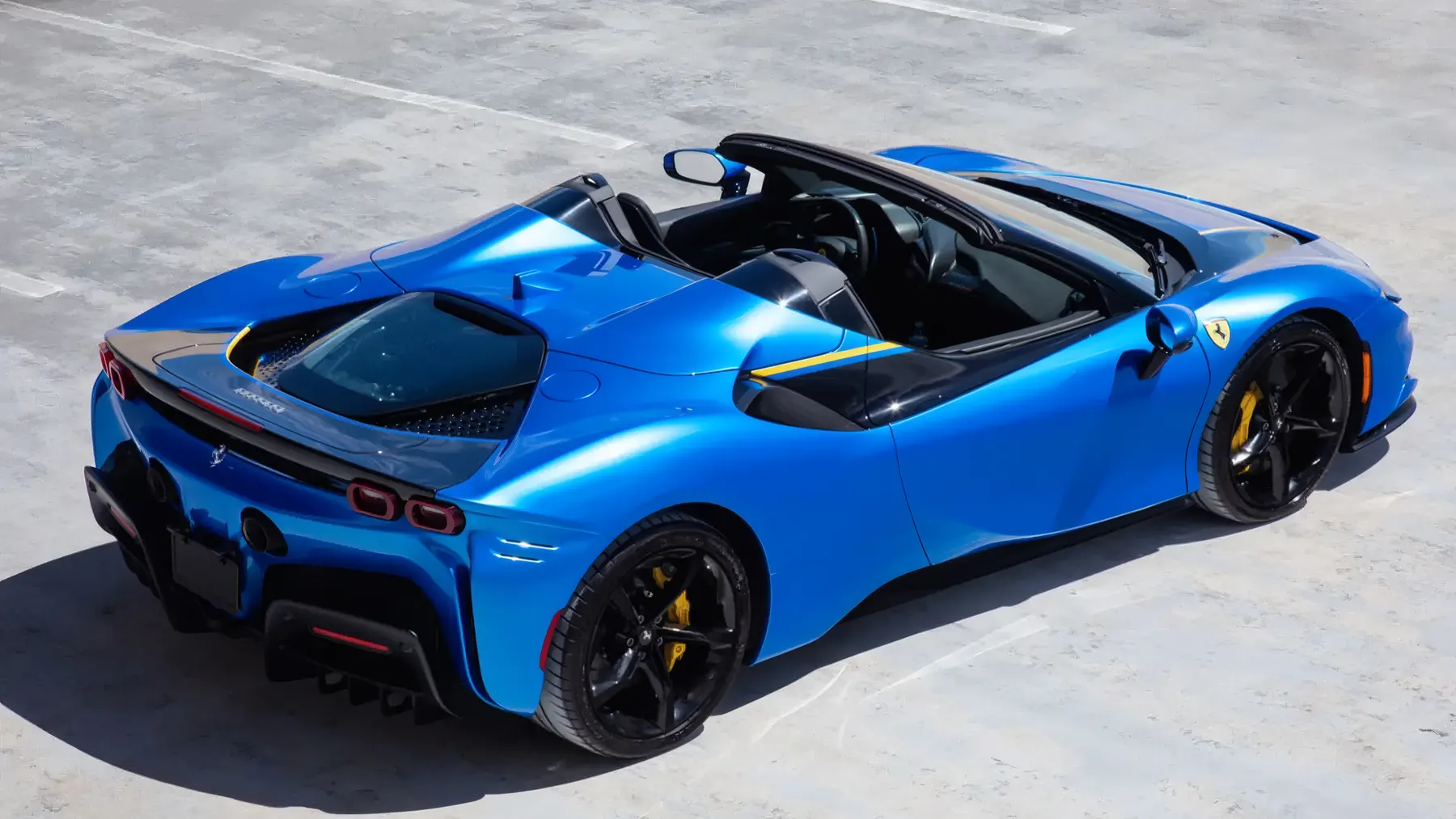
By the time production wound down in 2024, succeeded in Ferrari’s line-up by the V6 hybrid 849 Testarossa, the SF90 Spider had firmly established itself as the most powerful non-limited convertible Ferrari has built, eclipsing the previous record held by the naturally aspirated 812 GTS, and doing so without the production caps and years-long waiting lists that governed cars like the LaFerrari Aperta. That distinction, genuinely enormous performance made available, eventually, to any sufficiently patient and wealthy client rather than rationed to Ferrari’s most favoured collectors, is arguably the SF90 Spider’s most significant legacy: proof that Ferrari could build a plug-in hybrid, all-wheel-drive flagship without diluting the brand’s competitive relevance, even if doing so permanently changed what driving the fastest Ferrari on sale actually feels like.
Technical data
Specifications
| Specification | Figure |
|---|---|
| Model type | Ferrari SF90 Spider, Type F173 |
| Engine | 3,990cc twin-turbocharged V8 (F154-family), 88mm bore |
| Engine power | 769bhp |
| Electric motors | 3 (1 rear-mounted MGU-K; 2 front-axle RAC-e motors) |
| Electric power | 217bhp combined |
| Combined system power | 986bhp (marketed by Ferrari as “1,000 cv”) |
| Peak torque | 590lb-ft at 6,000rpm |
| Transmission | 8-speed dual-clutch; no reverse gear (reverse via front motors) |
| Drivetrain | Hybrid all-wheel drive |
| Battery | 7.9kWh lithium-ion |
| Electric-only range | c. 26km |
| 0–62mph | 2.5 seconds |
| 0–124mph | 6.7 seconds |
| Top speed | 211mph |
| Wheelbase | 2,650mm |
| Length | 4,710mm |
| Width | 1,972mm |
| Height | 1,186mm |
| Dry weight, standard car* | 1,600kg |
| Dry weight, Assetto Fiorano* | 1,570kg |
| Factory kerb weight (Spider)* | 1,670kg |
| Estimated real-world kerb weight† | c. 1,700–1,770kg |
| Retractable hardtop deployment | 14 seconds |
| US launch price, coupe‡ | From c. $600,000 |
| Production | 2020–2024 (Spider); non-limited |
Sources
- Ferrari.com - SF90 Spider
- Ferrari.com - SF90 XX Spider
- Wikipedia - Ferrari SF90 Stradale
- evo - Ferrari SF90 Stradale review
- Autocar - Ferrari SF90 Stradale road test
- Goodwood Road & Racing - Ferrari SF90 Stradale review
- Hagerty Media - 2020 Ferrari SF90 Stradale review
- DrivingElectric - Ferrari SF90 Stradale review
- Top Gear - Ferrari SF90 Stradale review
- Motor Authority - Ferrari SF90 Spider preview
- CarBuzz - Ferrari SF90 Spider first drive
- JD Power - 2020 Ferrari SF90 Stradale trim levels
- Ferrari.com - Personalization Programme
Join the discussion
Comments
Loading comments…
Leave a comment
Share a detail, memory, or perspective. Every comment is reviewed before publication.