Auburn 851 Custom Coupe: Rarer Survivor Than the Boattail Speedster
1935 Auburn 851 Custom Coupe




Images: Darin Schnabel / RM Sotheby's
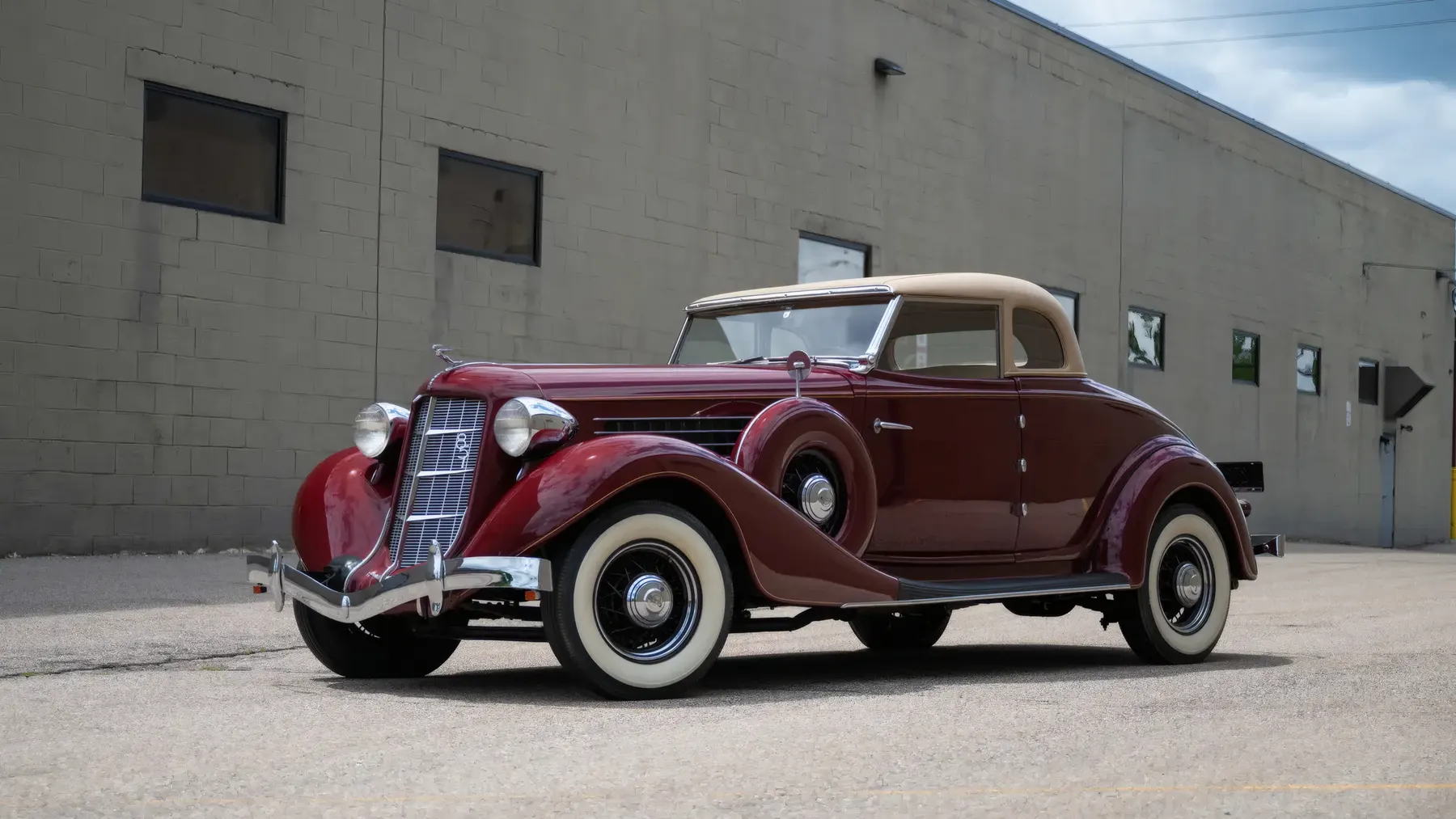
The surest way to lose an Auburn 851 Custom Coupe was to take its roof off. Auburn built the closed car on the cabriolet’s body and changed three things: a fixed top in place of the folding hood, a boot where the rumble seat would have been, and a package shelf where the hood would have stowed. That kinship made conversion easy, and RM Sotheby’s notes that plenty of coupes were “decapitated” into the more glamorous open cars. The same auction house puts the number of eight-cylinder coupes surviving in original form at fewer than ten, which makes the Custom Coupe a rarer survivor than the boattail Speedster that dominates every conversation about Auburn’s last two model years.
The car makes more sense once you understand the company that built it. E.L. Cord had turned Auburn into a maker of fast, stylish and keenly priced cars, and 1931 was a record year, with 28,103 sold according to Old Cars Weekly. The Depression then caught up with the firm: around 11,000 cars in 1932, then somewhere between five and six thousand in 1933, with sources disagreeing on the exact figure. The 1934 range, styled by Alan Leamy, failed to arrest the slide, Leamy left, and with Cord now living in England, Harold Ames, Augie Duesenberg and Gordon Buehrig were called in to rework the 1935 line and create a new Speedster on very little money. Buehrig kept the best of Leamy’s 1934 themes, revised the grille and added semi-pontoon front wings. The Speedster, built largely from leftover earlier bodies with a new tapered tail, was the halo and a late addition to the catalogue; the eight-cylinder 851 range in the 1935 brochure was illustrated with the sedan, Phaeton Sedan, coupe, Brougham and cabriolet. RM Sotheby’s reckons that six- and eight-cylinder engines, multiplied by Standard, Custom and Salon trim, produced 35 different Auburns for 1935. The Custom Coupe is one of them: a two-passenger closed car in the up-level Custom trim, wearing the same face as the Speedster. For 1936 the line carried on as the 852, which Classic & Sports Car says is distinguished from the 1935 car essentially by its designation alone.
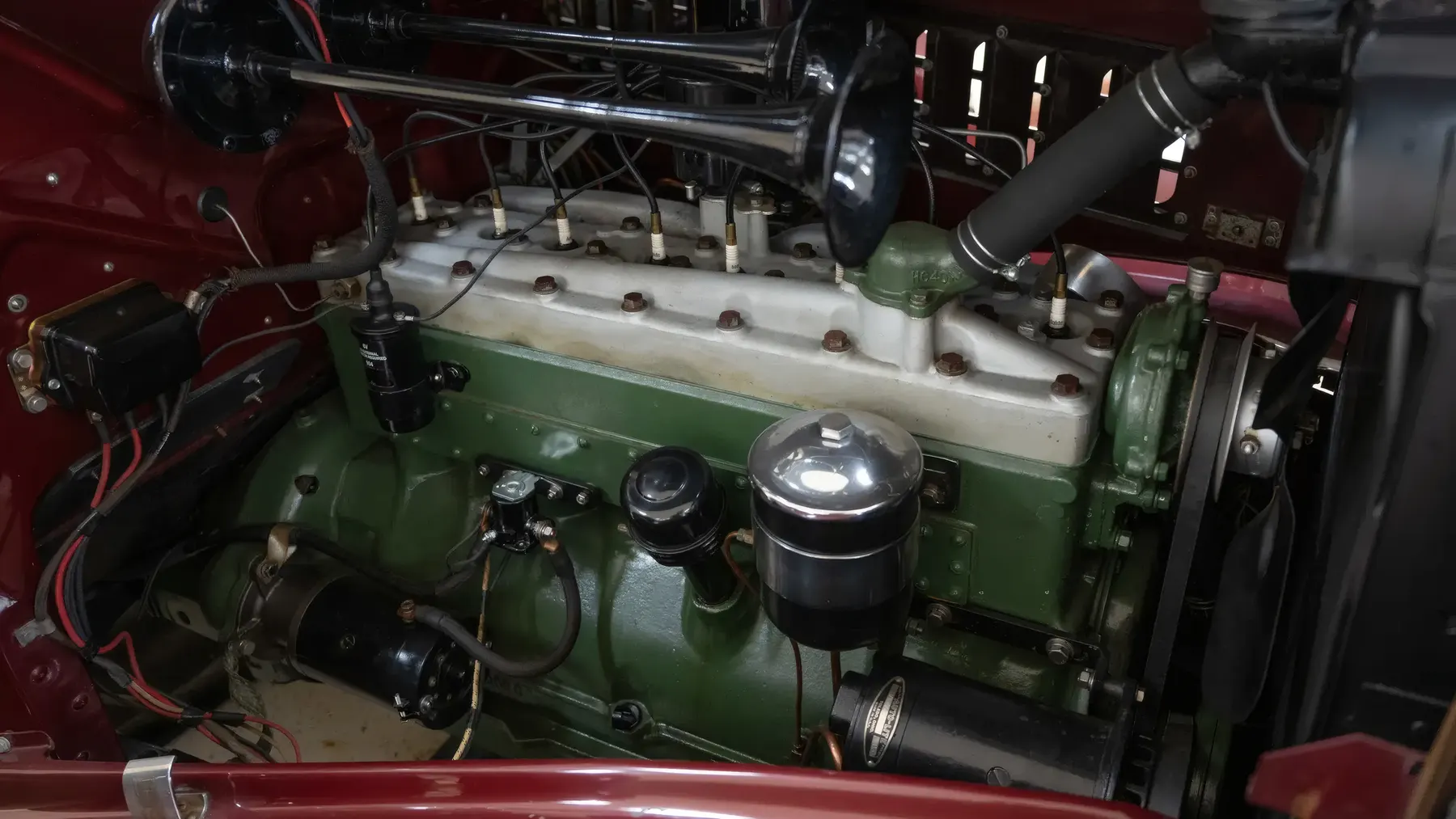
Under the long bonnet sat Lycoming’s side-valve straight-eight, a 4.6-litre unit with an aluminium cylinder head, five main bearings and a long stroke: Old Cars Weekly quotes a bore and stroke of roughly 78 by 121 mm. Unblown, it made 115 bhp at 3,600 rpm. A Schwitzer-Cummins centrifugal supercharger, adapted to the Lycoming by Augie Duesenberg and Pearl Watson and running at six times crankshaft speed through a planetary friction drive, lifted that to 150 bhp at 4,000 rpm and cost an extra $220 on the 851 line. The blower was standard on Speedsters but optional elsewhere, so the Custom Coupe was a naturally aspirated car unless its first buyer paid extra. The rest was conventional: a wheelbase of about 3,225 mm, solid axles at both ends on semi-elliptic leaf springs with hydraulic dampers, four-wheel hydraulic drum brakes and a three-speed gearbox.
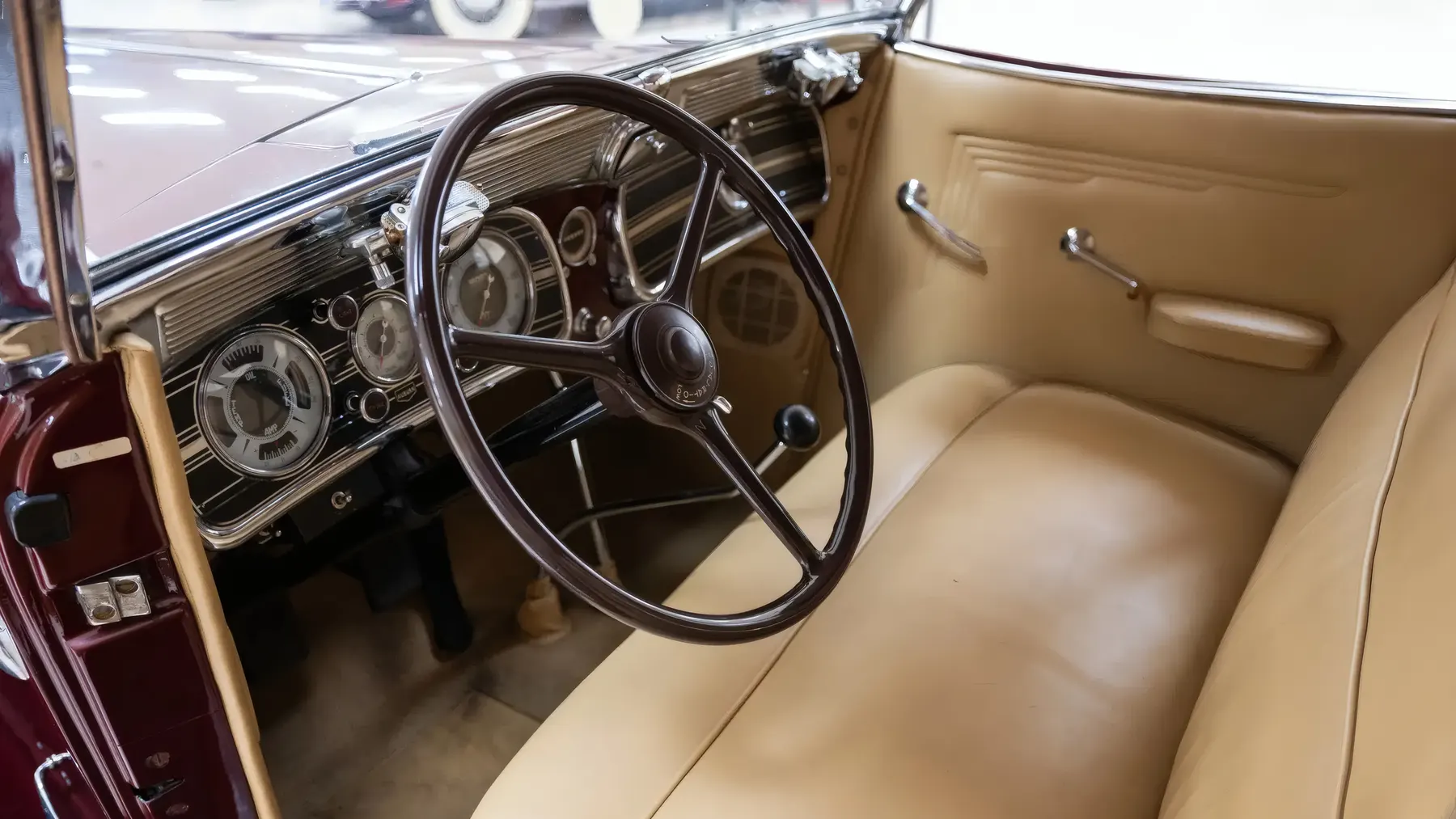
What most shaped the coupe’s character was the Columbia Dual Ratio rear axle, which RM Sotheby’s describes as standard in Custom trim. An epicyclic gear train between the crown wheel and the axle gave the car two final-drive ratios, selected by a lever on the steering wheel: dip the clutch, move the lever, and a vacuum servo made the change, announced by a clunk from the back axle that Sports Car Market says you paused a few seconds to hear. The effect was six forward speeds from a three-speed box. Motor Sport’s 1935 explanation was that a four-speed gearbox with overdrive would have done the same job, but four forward ratios were almost unheard of in America, and a rear-axle solution was probably quieter than extra gears in the box. Sources disagree on the ratios themselves, since Old Cars Weekly gives 5.1:1 for acceleration and 3.7:1 for cruising while Motor Sport describes the high setting as equivalent to 3:1, but they agree on what it did: it let a modestly tuned engine loaf along on the open road.
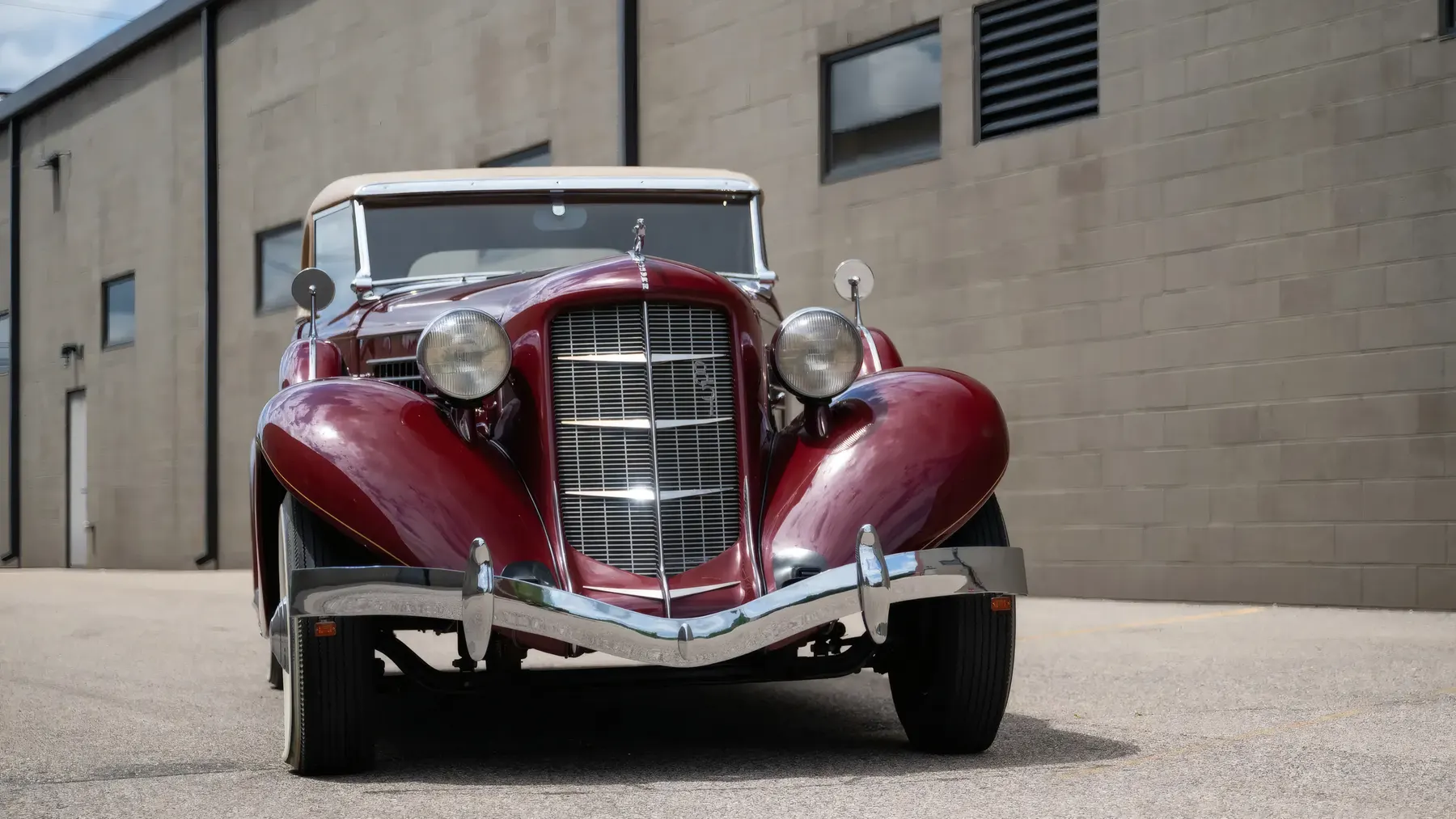
Buehrig’s styling carries a budget body well. The cabriolet’s long bonnet, short cabin and swept wings survive intact in the coupe, which adds a fixed roof made, according to RM Sotheby’s, of little more than a wooden framework bolted to the top of the body, with rear quarter windows and a fabric covering (an earlier RM description says leather). The reversed rumble-seat lid became the boot lid, and the boot is the coupe’s party piece: RM repeats an owner’s claim that it will swallow up to twenty cases of beer. The result, in RM’s reading, keeps the cabriolet’s sporting looks while adding the weather protection of a closed car, although it is still a two-seater with nowhere for anyone else to sit.
No test of the unblown coupe turned up in the period sources reviewed, so how it drove has to be pieced together. The best contemporary evidence is Motor Sport’s June 1935 test of a supercharged, Speedster-bodied Auburn imported to London, a car the magazine admitted was overdue for decarbonisation and well below its best. Even so, it found the car smooth and certain in traffic on the low ratio, then at its best on the open road, where the high ratio let it cruise between roughly 40 and 75 mph with hardly a murmur from under the bonnet, and at around 30 mph it felt as though the car might be coasting in neutral. The steering was low-geared but firm and free of backlash, the springing comfortable and free of harshness or pitching, and the hydraulic brakes strong enough to stop the car from 40 mph in about 15 m. The magazine summed the Auburn up as a “fast touring car of real merit”. Transfer that to a coupe with 35 bhp less and a fixed roof, and the character probably survives, with the relaxed cruising intact and the performance less dramatic.
The weaknesses are worth stating plainly, because the coupe is no sports car. The unblown engine’s 115 bhp is a modest return from 4.6 litres, particularly beside the 135 bhp that Sports Car Market credits to Bugatti’s 3.3-litre twin-cam Type 57, and while no kerb weight for the coupe turns up in the sources reviewed, the Speedster is quoted at around 1,700 kg, which gives a sense of the mass involved. Motor Sport felt the tall high ratio stifled the supercharged car’s response at lower speeds, so an unblown coupe will need more patience and more use of the low ratio. The chassis is of its time: low-geared steering that demanded plenty of wheel-twisting on tight roads, a body that heeled over when the supercharged car was driven hard through sharp bends on hydraulic dampers alone, and brakes that were powerful but inclined to lock the rear wheels under full pressure. The Dual Ratio axle is a vacuum-operated complication that has to work for the car to deliver what it promises, and RM Sotheby’s treats a correctly functioning one as a notable feature. The roof is a bolted-on frame rather than a purpose-designed closed structure, and two seats made the coupe less versatile than the sedan or Phaeton Sedan in the same range. Commercially, the 1935 line was a facelift of a 1934 design that had sold disappointingly, from a company that, according to Sports Car Market, lost considerable money on every Speedster it built, and the coupe had no time to establish itself before Auburn’s demise.
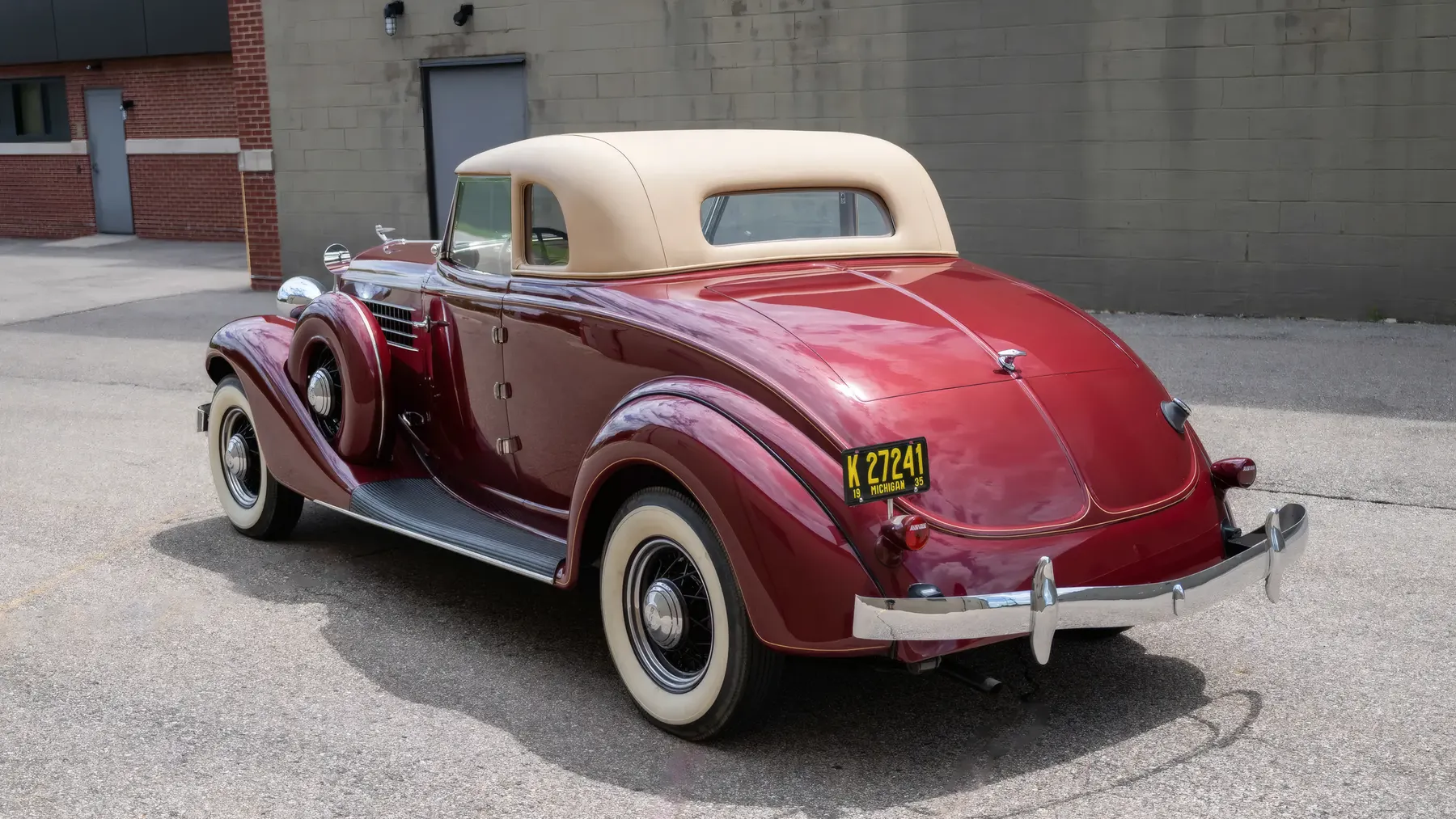
The coupe’s afterlife has been shaped by that interchangeability. RM Sotheby’s has said that many cabriolets offered today are simply altered coupes, and has described supercharger upgrades as a common and respected modification, so originality is a live question with any 851 and club certification carries real weight. The market has not rewarded the survivors in proportion to their scarcity: RM Sotheby’s has sold Custom Coupes in the high five figures, whereas supercharged Speedsters have changed hands for several hundred thousand dollars and, at the top, more than a million. The 851 and 852 are recognised as CCCA Full Classics, eligible for CARavans and club tours, which is precisely the kind of use the Dual Ratio axle suits.
What the Custom Coupe offers is the other half of Auburn’s last bet. The Speedster was the car that drew people into showrooms, built at a loss and able to back its looks with a claimed 100 mph. The coupe took the same face, the same unusual axle and a proper boot, and offered them to someone who wanted to cover distance rather than be photographed beside the car. It gave away 35 bhp and the boattail, and it gave away something more fragile too: a bolted-on roof that invited its own removal. That so few remain as Auburn built them says less about how good the car was than about how easily it could be turned into something fashionable.
Technical data
Performance Specifications
| 851 Custom Coupe (naturally aspirated) | 851 SC (supercharged; standard on Speedster, optional elsewhere) | |
|---|---|---|
| Years | 1935 (851); 1936 as 852 | 1935 (851); 1936 (852) |
| Body | Two-passenger coupe, fixed roof, boot | Speedster two-seater; also optional on other 851 bodies |
| Engine | Lycoming side-valve straight-eight, aluminium head, c. 4.6 litres | As NA, plus Schwitzer-Cummins centrifugal supercharger |
| Bore x stroke | c. 78 x 121 mm* | c. 78 x 121 mm* |
| Power | 115 bhp at 3,600 rpm | 150 bhp at 4,000 rpm (Classic & Sports Car quotes 148 bhp) |
| Torque | Not documented | Not documented |
| Transmission | Three-speed manual (synchromesh on second and top)* | Same |
| Rear axle | Columbia Dual Ratio, epicyclic (standard in Custom trim) | Columbia Dual Ratio (standard on supercharged cars) |
| Wheelbase | c. 3,225 mm | c. 3,225 mm |
| Suspension | Solid axles, semi-elliptic leaf springs, hydraulic dampers | Same |
| Brakes | Four-wheel hydraulic drums | Same |
| Kerb weight | Not documented for the coupe | c. 1,700 kg (Speedster)* |
| Top speed | Not documented | c. 100 mph (claimed for Speedster)* |
| Price new | Not documented | $2,245 (Speedster) |
Sources
- RM Sotheby’s, 1935 Auburn 851 Custom Coupe (Motor City 2014)
- RM Sotheby’s, 1935 Auburn 851 Custom Coupe (Hershey 2024)
- RM Sotheby’s, 1935 Auburn 851 Custom Phaeton (Auburn Fall 2013)
- RM Sotheby’s, 1935 Auburn 851 Custom Cabriolet (Guyton Collection 2019)
- RM Sotheby’s, 1935 Auburn 851 Supercharged Cabriolet (2019)
- RM Sotheby’s, 1935 Auburn 851 Supercharged Cabriolet Conversion (2022)
- RM Sotheby’s, 1935 Auburn 851 Supercharged Cabriolet (Hershey 2014)
- RM Sotheby’s, 1935 Auburn 851 Supercharged Speedster (Amelia Island 2023)
- Motor Sport Magazine, “The Supercharged Auburn” (June 1935)
- Old Cars Weekly, “Car of the Week: 1935 Speedster 851”
- Sports Car Market, Auburn 851 Supercharged Speedster profile
- Sports Car Market, 1935 Auburn Model 851 Boattail Speedster profile
- Classic & Sports Car, Auburn 851S/852S A-Z guide
- National Motor Museum, Auburn 851 Speedster
Join the discussion
Comments
Loading comments…
Leave a comment
Share a detail, memory, or perspective. Every comment is reviewed before publication.