Jaguar XK120 Roadster: The Borrowed-Chassis Show Car That Built a Racing Dynasty
1952 Jaguar XK 120 Roadster

Images: Peter Singhof / RM Sotheby's
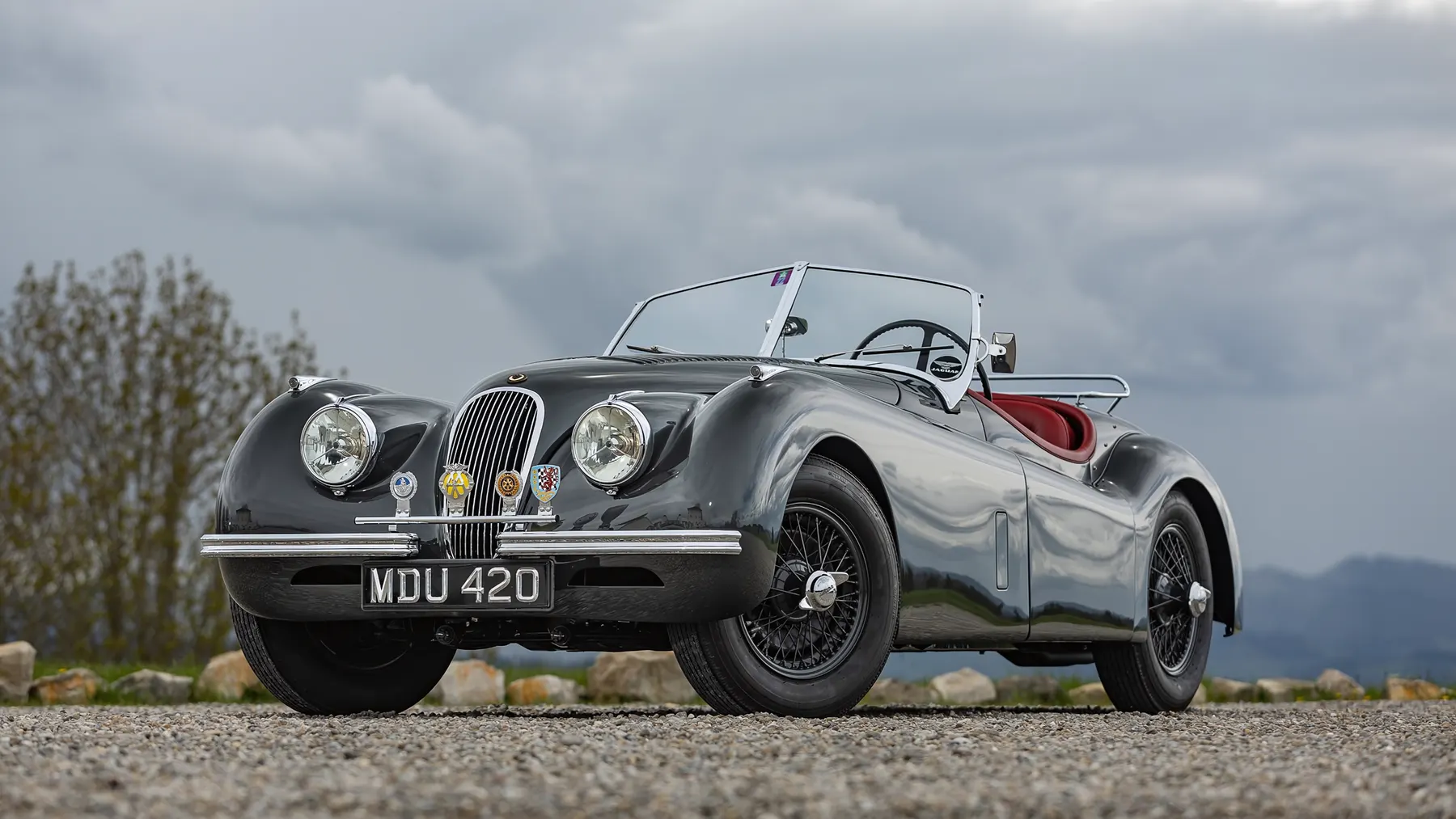
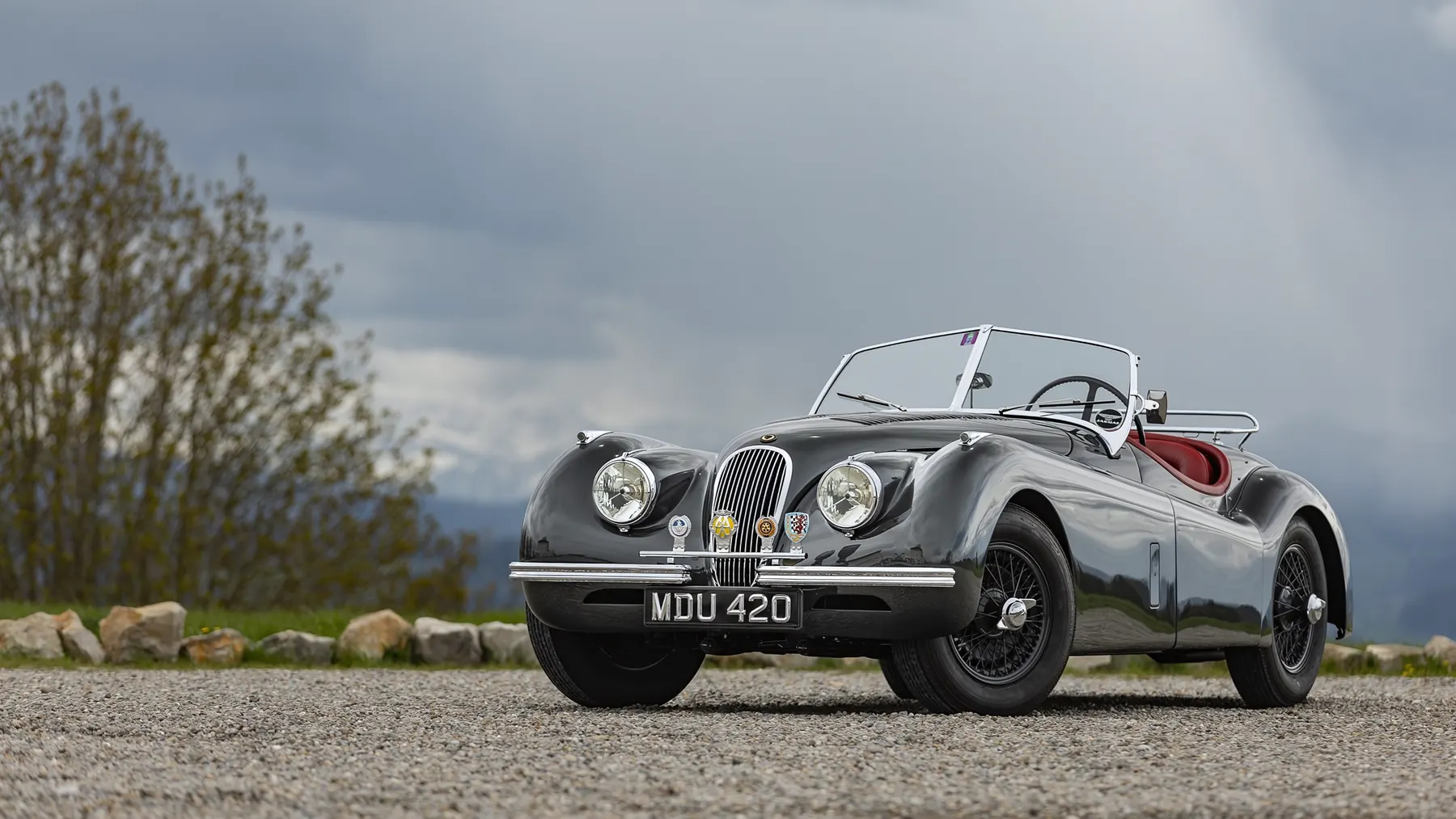
The shape that became the Jaguar XK120 was drawn in approximately four weeks. William Lyons, Jaguar’s co-founder and its determining aesthetic voice, worked against a deadline - the 1948 Earls Court Motor Show - with a truncated Mark V saloon chassis as his starting point and a brilliant new twin-cam engine as his reason for building something at all. The engine, a 3.4-litre dual-overhead-camshaft straight-six developed during the war years by chief engineer William Heynes alongside Claude Baily and Wally Hassan, was ready for public debut before the Mark VII saloon it had been designed to power. So Lyons improvised: a show car, a demonstration, perhaps 200 units if demand materialised. When the XK120 appeared at Earls Court in October 1948 - those enveloped wings flowing into a long bonnet, the rakish tail, the tight cockpit set well back, the oval grille positioned between inboard headlamps - the reaction made his modest production plan irrelevant overnight.
The technical ambition of the XK engine was genuine, and in 1948 it was extraordinary for a mass-produced unit. Cast-iron block, aluminium alloy head, twin chain-driven overhead camshafts operating inclined valves in hemispherical combustion chambers, seven main bearings for crankshaft rigidity - this was architecture previously restricted to exclusive low-volume machinery like the Duesenberg Model J or Bugatti’s racing designs. Heynes’ achievement was to make the configuration viable at factory scale and at a price that was ambitious but not prohibitive. Twin SU H6 carburettors, an 8:1 compression ratio in standard markets (reduced to 7:1 for the UK, where wartime rationing had left pump grades too poor for anything higher), and a bore and stroke of 83mm by 106mm produced 160bhp at 5,000rpm with 195 lb-ft of torque at 2,500rpm. Against a British automotive landscape largely returning to prewar pushrod engines and prewar thinking, the XK placed the car in a different category entirely.
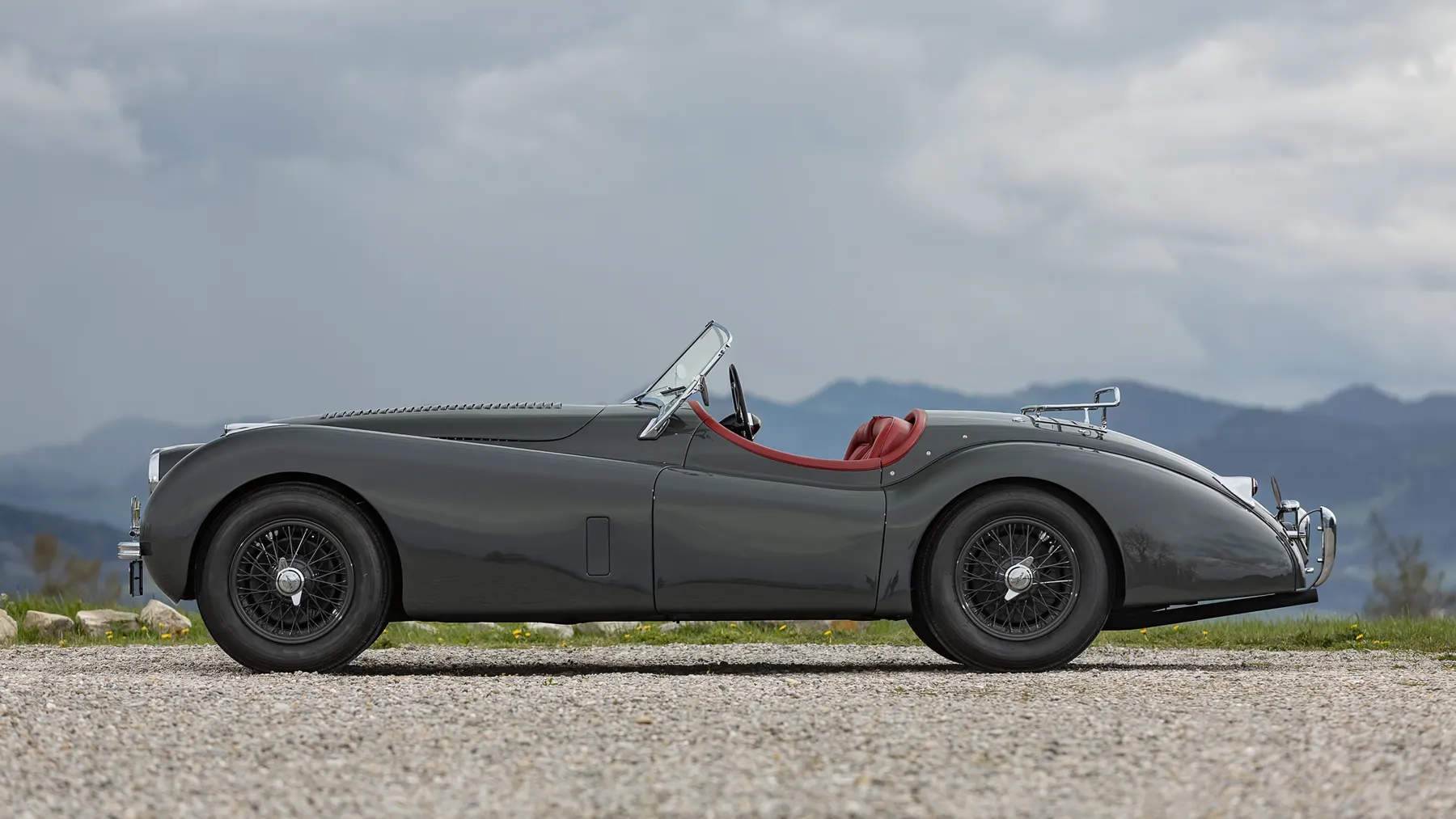
The chassis was a more honest reflection of the haste with which the XK120 came together. It was a shortened and simplified version of the Mark V saloon’s box-section frame, its wheelbase cut by 457mm to 2,591mm and the structure lightened for the sports car application. Heynes fitted it with independent torsion-bar front suspension via double wishbones - a considered modern arrangement that gave the XK120 genuine cornering composure - but the rear remained a live Salisbury axle on semi-elliptic leaf springs, standard saloon-car practice of the period. Front and rear were therefore a generation apart in engineering intent: the front reflected deliberate development thinking; the rear was an inheritance from the very saloon platform the car was nominally escaping. Drum brakes - 12-inch Lockheed units all around - completed a package that was adequate for ordinary motoring and problematic for anything more demanding.
The first 242 XK120s were hand-built with aluminium panels over an ash wood framework, the method originally envisioned for a modest limited run. The aluminium roadster weighed around 1,200kg, and its top speed comfortably exceeded the name’s promise. To legitimise the performance claim before press scepticism could settle, Jaguar took chassis 670002 to a closed section of the Ostend-Jabbeke motorway in Belgium in May 1949. Test driver Ron Sutton, running with an aluminium undertray and the tallest available gear ratio, achieved a two-way average of 126.5mph with the full hood and sidescreens in place; in a more stripped configuration with an aero screen fitted, the speed rose to over 130mph, with period sources varying on the precise figure. For context, this was a Coventry sports car improvised on a saloon platform in a matter of weeks, running faster on a Belgian motorway than anything else available at any price.
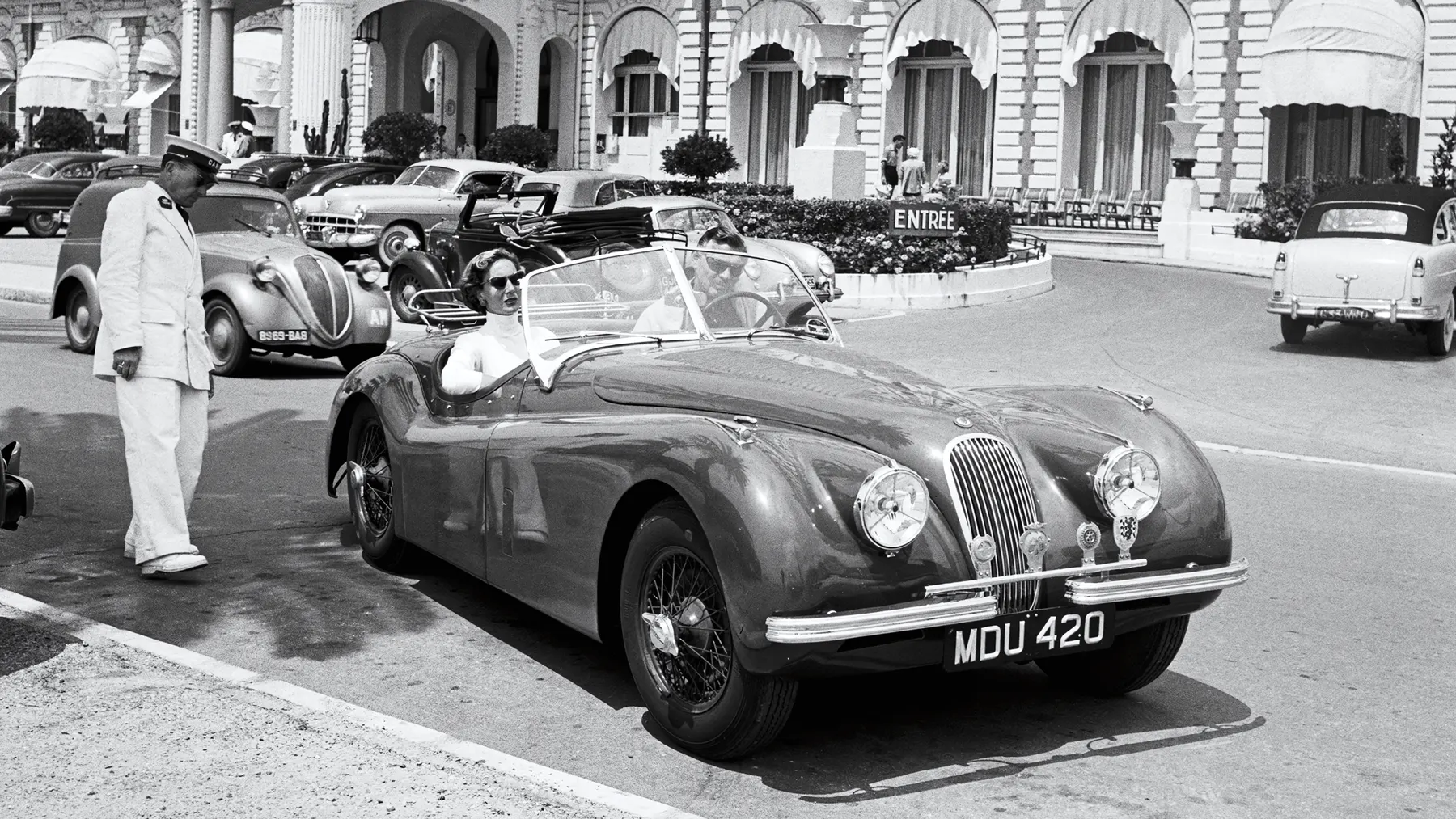
Mass production required steel, and the volume of North American orders - demand that came with the kind of transatlantic glamour Jaguar had not anticipated - made aluminium construction impossible at scale. In May 1950, the predominantly steel-bodied XK120 entered production. Only the doors, bonnet, and boot lid were retained in aluminium; the wings and body panels switched to pressed steel, adding approximately 51kg and lifting the roadster’s kerb weight to around 1,295kg. The extra weight came without any compensating mechanical improvement. Of the 7,612 roadsters eventually built, 6,437 were left-hand drive. A car conceived for 200 units had become Jaguar’s primary calling card in the world’s most important market, shaped almost entirely by North American demand.
Competition followed naturally. Three semi-works alloy XK120s were entered at the 24 Hours of Le Mans in 1950 under private names but with factory preparation - Lyons preferred arm’s-length entry against the possibility of embarrassment. There was none. Leslie Johnson was running third in the closing stages when clutch failure intervened, but the car’s endurance credentials were confirmed clearly enough for Lyons to sanction a purpose-built racing derivative. The resulting XK120C - universally known as the C-type - debuted at Le Mans in June 1951 and won outright in the hands of Peter Walker and Peter Whitehead. On the road car meanwhile, Ian Appleyard won the Alpine Rally in a semi-works XK120, Stirling Moss took the Dundrod Tourist Trophy, and in August 1952 a works-supported Fixed Head Coupé averaged 100.31mph for seven days at Montlhéry, covering 16,851 miles to set five new class records and four outright world records. This was not a cautious motorsport campaign - it was systematic, aggressive, and aimed at establishing Jaguar’s name in markets where it had not previously existed.
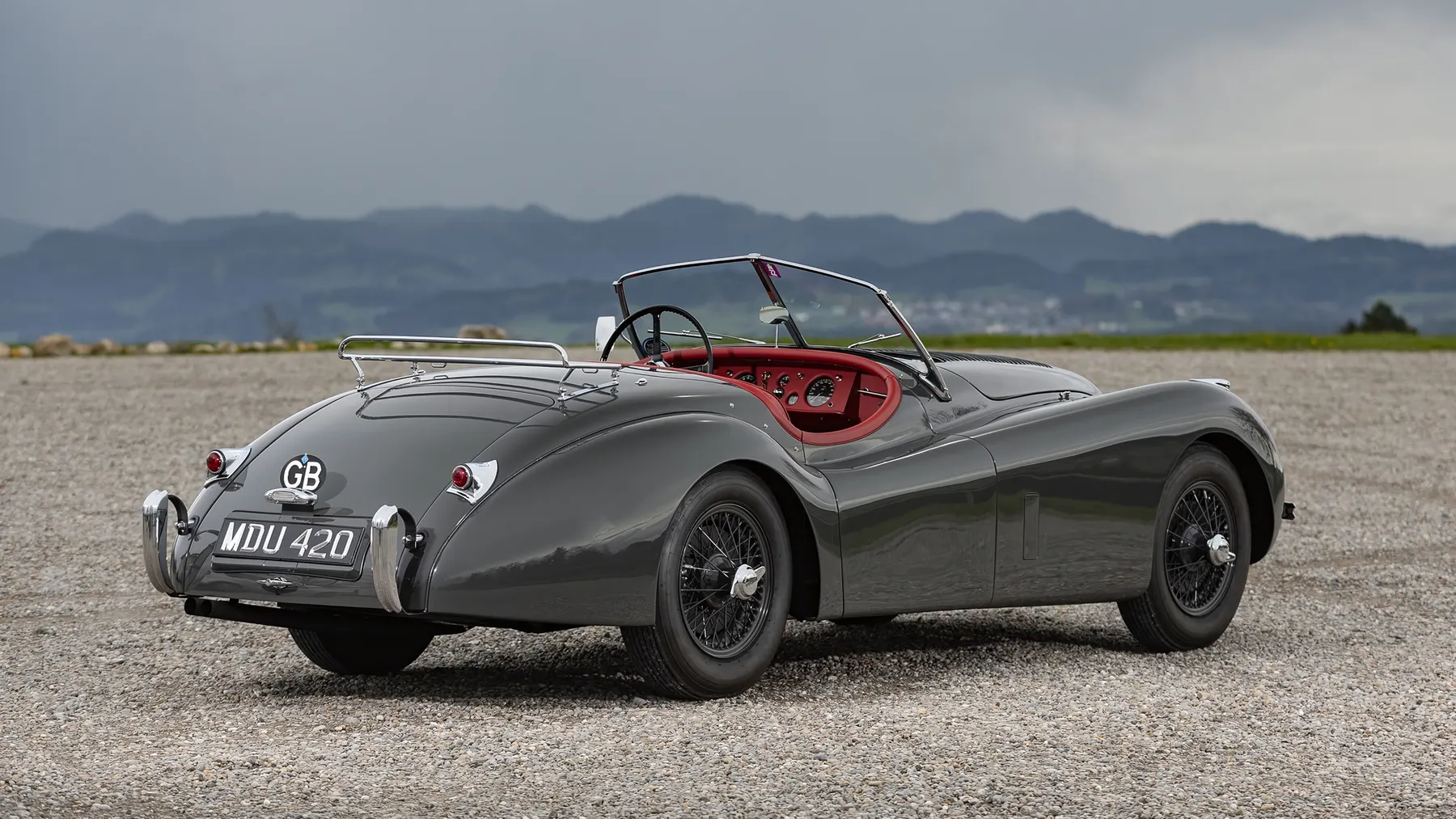
Behind the wheel, the XK120 offered an experience for which most of its contemporaries provided no genuine preparation. The driving position was low and exposed - the long bonnet stretched ahead, the exhausts spoke directly past the driver’s right elbow, and the cockpit was open enough that the sensation of speed was immediate and physical. The twin-cam straight-six, almost lazily tractable at low revs, rewarded sustained throttle with a mechanical intensity that made clear why this engine had not been built merely for saloon duty. A period road test recorded 0–60mph in 10.0 seconds and a top speed of 124.6mph with the hood and sidescreens fitted - figures that were without comparison in Britain at the time and only approached by exotic Continental machinery at several times the cost. The steering, recirculating-ball in character, demanded physical engagement and returned it with a directness that suited the car’s temperament. The overall impression was of exceptional capability requiring corresponding commitment.
The road car’s development continued in parallel with the racing campaign. In June 1951, Jaguar introduced the Special Equipment (SE) pack, available on both the roadster and Fixed Head Coupé and identified by an S prefix on the chassis number. It brought a 9:1 compression ratio, higher-lift camshafts, a lightweight flywheel, stiffer rear springs, and a twin-exhaust system, raising peak output to 180bhp at 5,300rpm and torque to 203 lb-ft at 4,000rpm. Wire wheels were offered with the SE specification, improving brake cooling marginally. The Fixed Head Coupé itself had arrived in March 1951, a genuinely distinct car: a teardrop greenhouse over a cockpit furnished with burr walnut veneer, wind-up windows, and opening quarterlights - a level of interior refinement that made the roadster’s leather-trimmed spartan cabin look deliberately ascetic by comparison. The Drophead Coupé followed in January 1953, occupying the ground between open and closed motoring while sharing the FHC’s more considered appointments. In April 1953, Jaguar made available a C-type cylinder head fitted with larger SU H8 carburettors - a dealer-supplied, owner-installed upgrade that pushed output to 210bhp at 5,750rpm, transforming the XK120 into a genuine competition-calibre machine without requiring a works programme behind it.
For all its genuine accomplishment, the XK120’s limitations were real and consequential. The drum brakes were the most persistently significant weakness. The 12-inch Lockheed units were prone to fade when pushed hard, and in a car capable of 125mph this was not a minor annoyance but a genuine safety concern in extended high-speed use. At the 1950 Palm Beach Road Race, Johnson was running second when the brakes deteriorated under sustained hard use on a tight circuit, costing him positions he could not recover. Jaguar offered finned Alfin aluminium drums as a partial remedy, but they ameliorated rather than resolved the problem; the issue went unaddressed until the XK150 adopted Dunlop disc brakes in 1957, nearly a decade after the original car’s launch. The four-speed Moss gearbox compounded the dynamic picture: mechanically sturdy but slow-witted in operation, demanding deliberate, unhurried changes from a driver whose right foot was suggesting something considerably more urgent. The driving position in the roadster was equally unresolved - the enormous four-spoke steering wheel sat close to the chest, and the ergonomics reflected the four-week design sprint rather than measured development for production. These were not peripheral complaints. They qualified every genuine strength the XK120 possessed, and experienced drivers of the period noted them plainly.
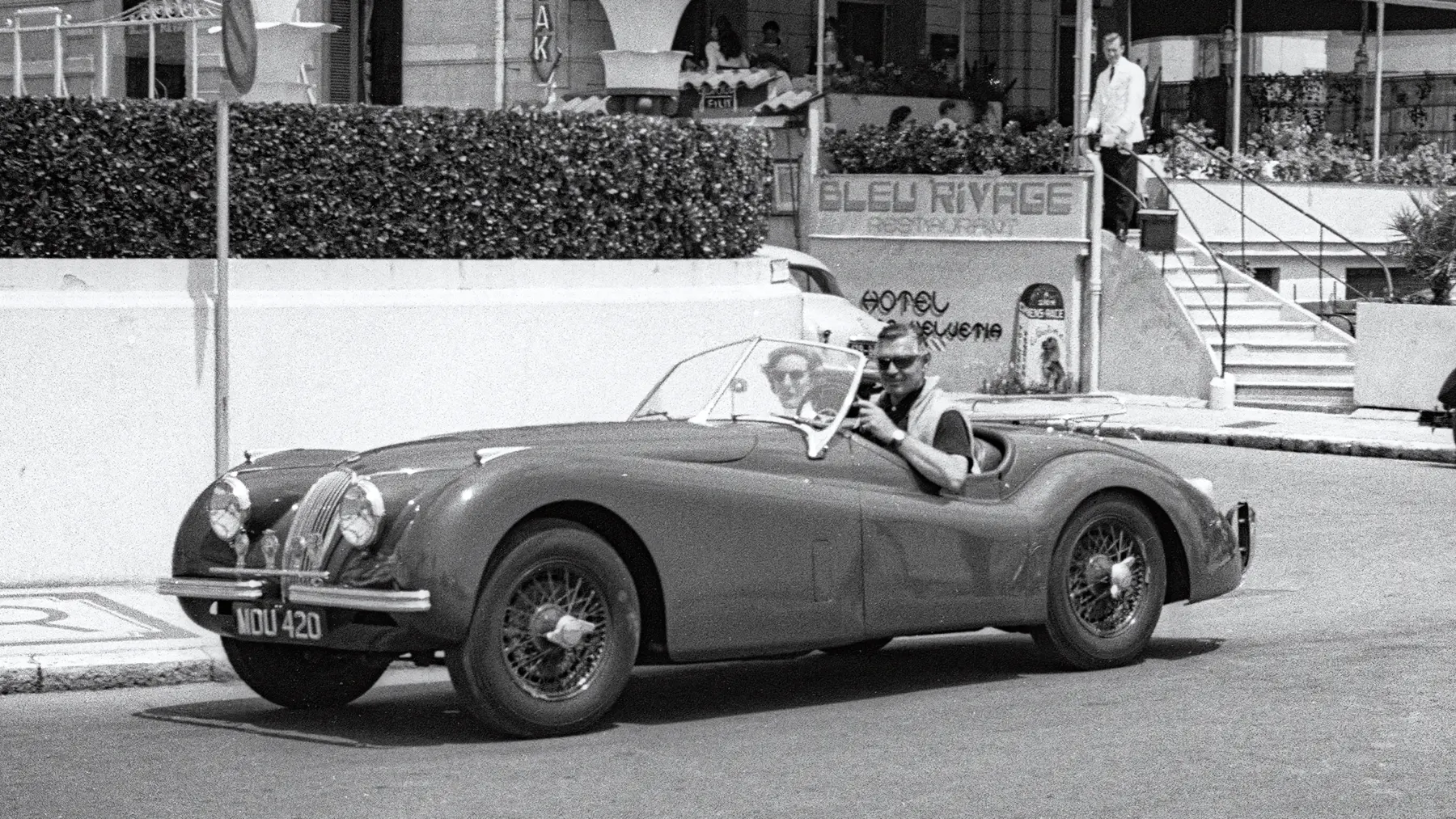
The roadster’s interior also sat awkwardly against its price. At around £999 on the road in Britain - rising to over £1,260 with purchase tax as tested - the open two-seater was trimmed in leather but otherwise austere: no wood veneer, no wind-up windows, no external door handles. Entry required operating an interior pull-cord through a flap in the sidescreens when the weather gear was up. For a car that cost roughly one and a half times a Cadillac Series 62 in the United States, this plainness invited comparison with more opulently finished European alternatives, however decisively the Jaguar outperformed them. The Fixed Head Coupé and Drophead Coupé addressed this with burr walnut dashboards and proper door furniture; the roadster did not.
What endured was the engine. The XK unit, in its original 3.4-litre form, powered the XK140 and XK150; in evolved 3.8-litre and 4.2-litre configurations it continued in Jaguar production into the late 1980s - a service life of four decades that few postwar designs have approached. The C-type and D-type competition cars took developments of it to five Le Mans victories between 1951 and 1957. The E-type of 1961 ran a direct architectural descendant. The XK120 did not produce a single great car; it produced an engine family, a competition lineage, and a market identity that sustained Jaguar for a generation.
By the time production ended in 1954, 12,055 XK120s had been built across the three body styles - a number that would have appeared fanciful to Lyons at Earls Court six years earlier. The successor XK140 brought detail improvements to what remained a fundamentally improvised platform. The XK120’s defining character had always resided in exactly this tension: an engine of extraordinary ambition lodged in a car made up at speed, and yet faster, more consequential, and more enduring than either its origins or its compromises had any right to allow.
Join the discussion
Comments
Loading comments…
Leave a comment
Share a detail, memory, or perspective. Every comment is reviewed before publication.