Porsche 356 A 1600 Super Speedster: The Bargain America Demanded
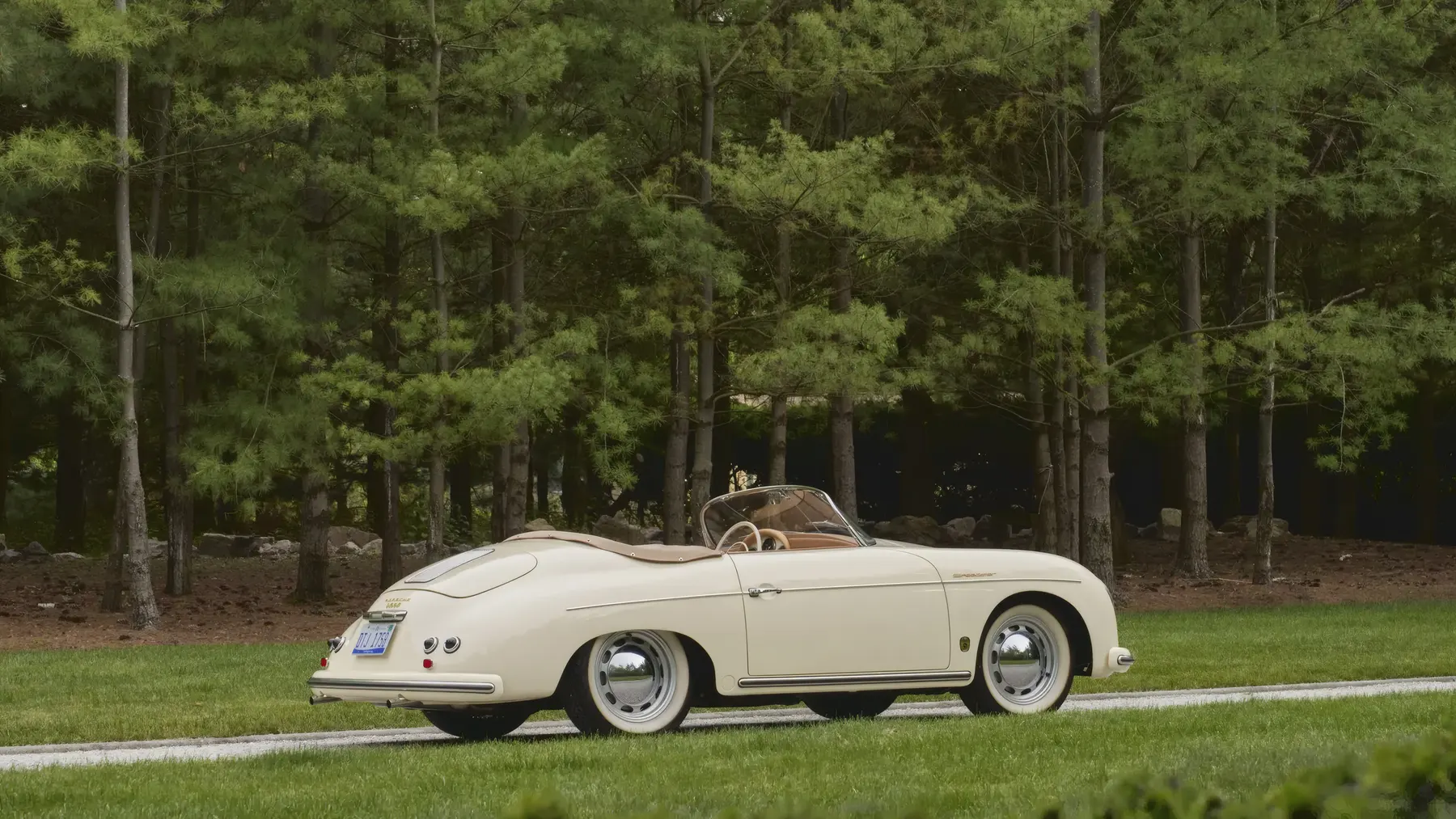
1957 Porsche 356 A 1600 Super Speedster by Reutter

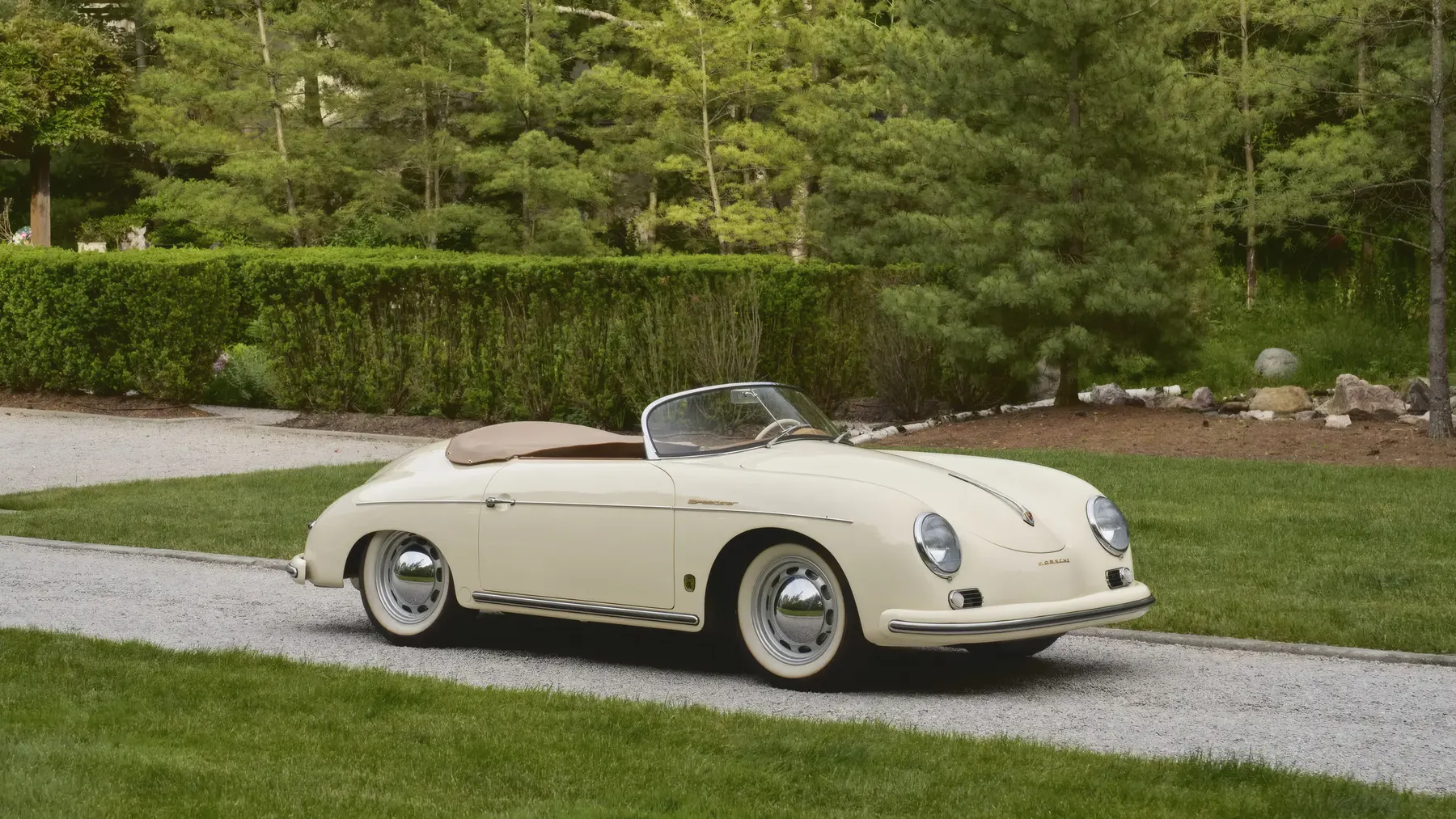
Images: Andrew Trahan / RM Sotheby's
Porsche built the Speedster to be cheap. That is easy to forget when a good one now changes hands for a sum that would buy a small apartment, but the intention in 1954 was never to create a future icon - it was to build the least expensive Porsche possible, strip out everything not strictly needed, and undercut the price of a Jaguar or a Triumph on American forecourts. The 356 A 1600 Super Speedster, the fastest and most desirable version of that stripped-down car, is the result of a strategy built on parsimony that accidentally produced one of the most charismatic sports cars of the 1950s.
The story begins not in Stuttgart but in New York, where Max Hoffman, Porsche’s sole importer for the United States, had spent the early 1950s watching American buyers gravitate toward cheaper, simpler British roadsters. Hoffman believed Porsche needed something similarly raw and inexpensive to compete, and he found his template partly in the work of John von Neumann, Porsche’s West Coast distributor, who had stripped and lightened a Gmünd-built coupe into an effective club-racing special. In 1952, Hoffman convinced Porsche to build fifteen roadsters based on that idea, a small precursor batch that led directly to the production Speedster in 1954. The production car arrived that September as a 1955 model, priced from $2,995 in its early years - a figure that undercut the coupe by a meaningful margin and made it the cheapest way into a Porsche. Even the name was borrowed rather than invented: at a time when Hoffman liked his Porsches to carry evocative American names, he lifted “Speedster” from Studebaker, itself reviving a term dating back to the stripped-down, speed-mad Fords and Chevrolets - and grand names like the Stutz Blackhawk and Auburn Speedster - of the interwar years.
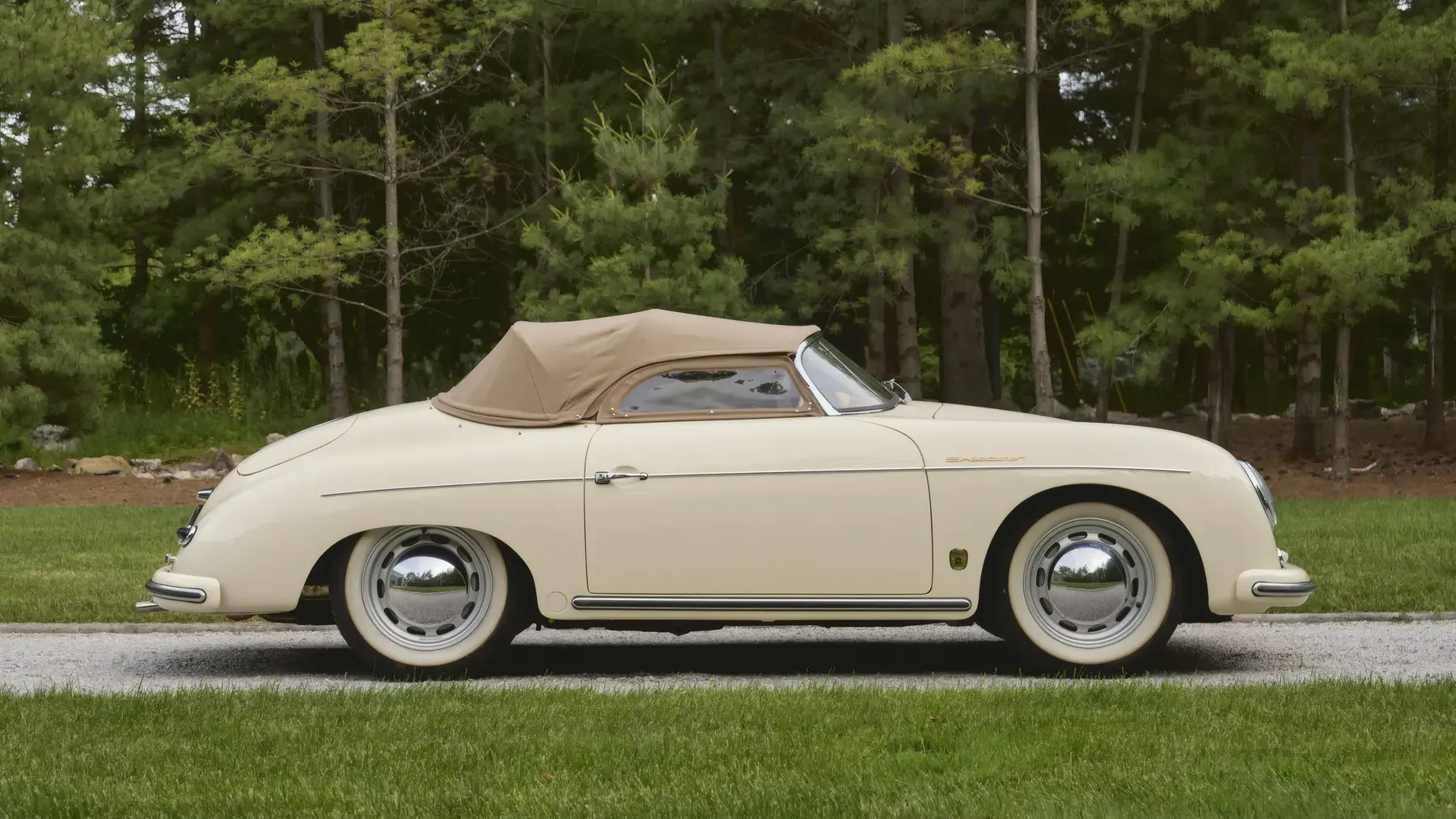
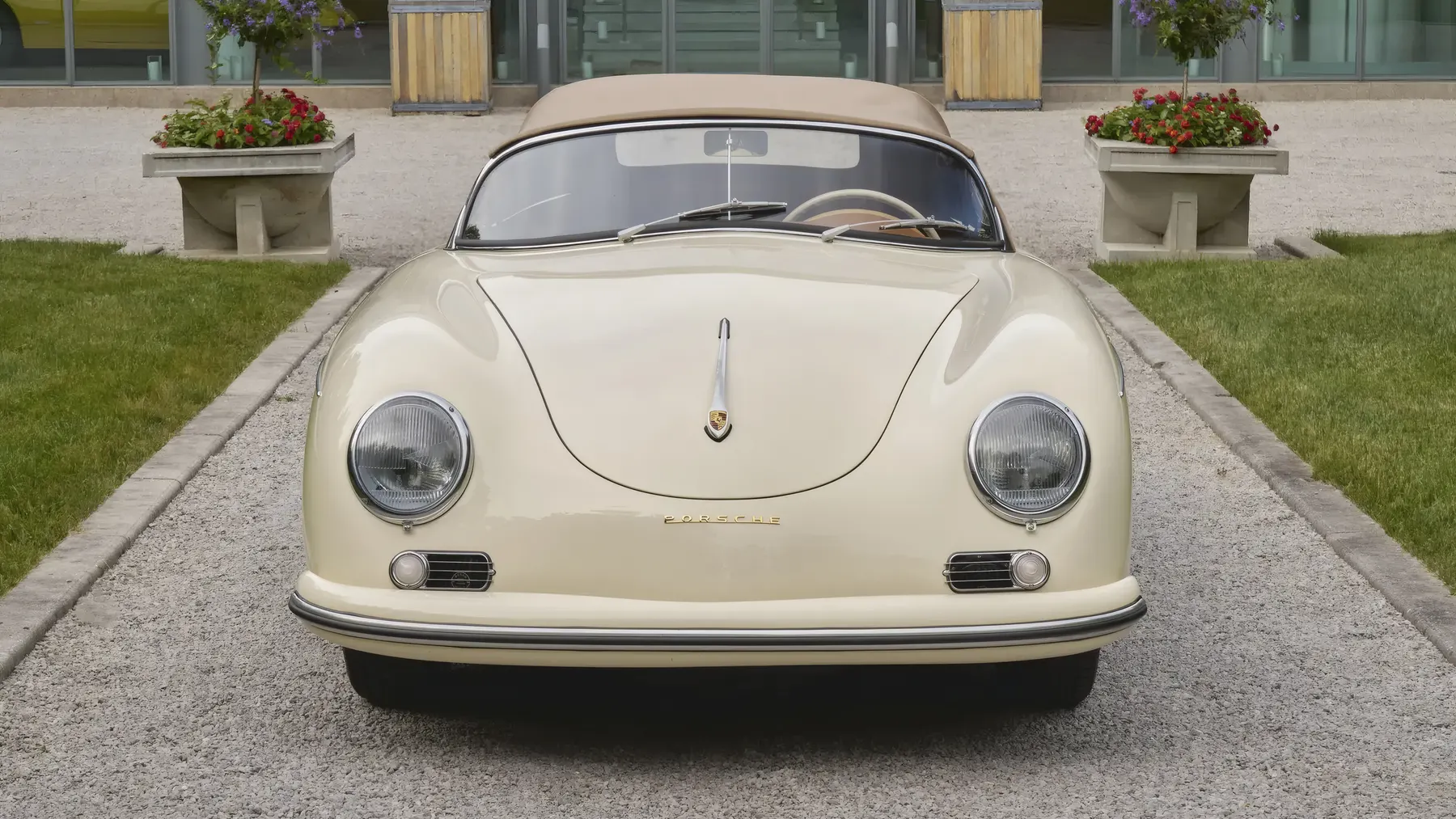
The 356 A arrived at the Frankfurt motor show in September 1955 as the first significant revision of Porsche’s original production car, and it is within this generation, built through September 1959 and split internally between the T-1 series (1956 and 1957 model years) and the T-2 series (1958 and 1959), that the 1600 Super Speedster sits. Reutter, the Stuttgart coachbuilder that had leased workshop space to Porsche in the lean years before the company built its own factory, continued to construct every 356 A body - Coupe, Cabriolet and Speedster alike - which is worth noting because “by Reutter” was less a boutique distinction than simply how Porsche’s own factory paperwork described the entire model line at the time. The 356 A brought a curved, one-piece windscreen to the Coupe and Cabriolet, rounder wheelarches, and revised sills, but the Speedster kept its own identity: a shallower, cut-down windscreen, an anodised gold belly strip running the length of each flank, and “Speedster” script pressed into the front fenders. Underneath, the changes were more substantial. Suspension travel increased and spring rates softened over the outgoing Pre-A cars, vertically mounted telescopic dampers replaced the old angled units at the rear, and a telescopic steering damper was added for precision. Wheels grew from 16 x 3.25 inches to a wider 15 x 4.5-inch fitment wearing broader tyres, while the drum brakes carried over largely unchanged save for widened rear shoes to match the fronts.
Buyers chose from four states of tune across the 1300 and 1600 ranges, but the two that mattered in the American market - the only place the 1.6-litre cars were officially sold - were the 616/1 and 616/2. The standard 1600 engine, Type 616/1, ran a 7.5:1 compression ratio and made 60bhp at 4,500rpm with 80lb-ft of torque at 2,800rpm through twin Solex carburettors. The 1600 Super, Type 616/2, raised compression to 8.5:1 and lifted output to 75bhp at 5,000rpm and 85lb-ft at 3,700rpm. Some contemporary sources place the Super’s peak closer to 74bhp, a discrepancy that likely reflects differing measurement standards of the period rather than any real disagreement about the car’s tune. What separated the Super from the regular engine was more than jetting: it used an exotic roller-bearing crankshaft, in contrast to the plain-bearing unit in the standard car, along with a heavier flywheel fitted across the range for smoother idling and hot-air ducting from the cylinders to speed carburettor warm-up. That roller-bearing crank proved to be the Super’s weak point. Porsche found the early Super engines suffered a markedly shortened service life, and when the T-2 series arrived for 1958 the company quietly switched the Super back to a plain-bearing crankshaft, while giving the standard 1600 new Zenith carburettors and cast-iron cylinders in place of the earlier alloy items to cut manufacturing cost and quieten running. A four-speed manual, initially paired with a coil-sprung clutch and later a diaphragm-spring unit on T-2 cars, sent drive to the rear wheels through Porsche’s own gearbox rather than a Volkswagen-derived unit.
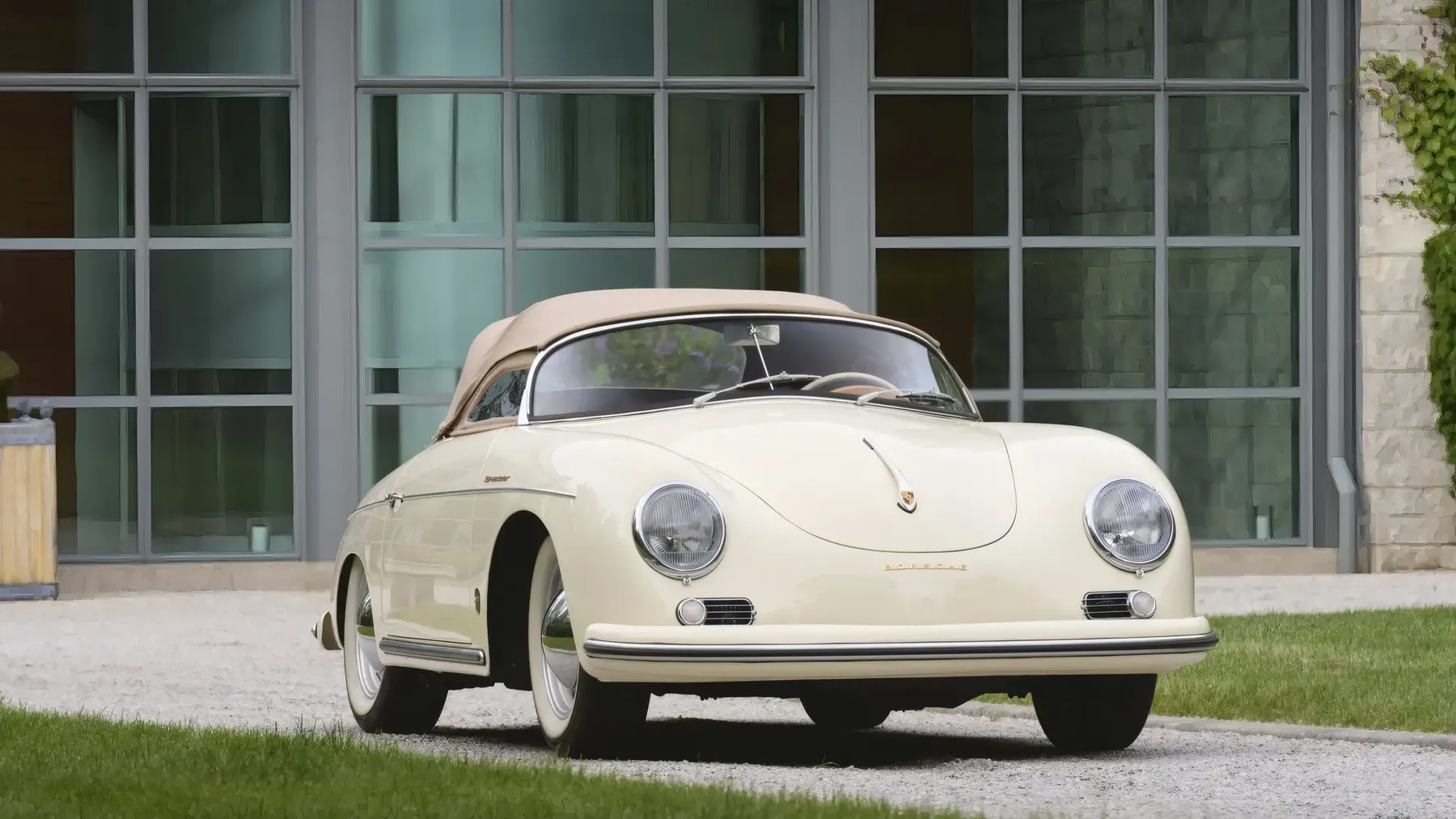
On paper the numbers look modest by any modern measure, and they were not exactly startling even in 1957. A 1600 Super-engined 356 A could reach around 110mph and cover 0–62mph in roughly thirteen seconds, figures a contemporary family saloon would embarrass today. What made the car feel special was everything around that engine rather than the engine’s raw output. The Speedster was the lightest body style in the 356 A range - stripped of the coupe’s glovebox, door pockets, reclining seat mechanisms and much of its sound deadening - so the Super’s extra fifteen horsepower had less mass to shift than in any other 356. Steering was light, direct and largely free of the assistance that would later dull feel in bigger cars, and the flat-four’s low centre of gravity combined with a rearward weight bias to give the chassis genuine agility on a twisting road, at the price of a rear-engined car’s characteristic willingness to swing wide if a driver lifted off mid-corner on the swing-axle rear suspension shared with other 356s of the era - a trait that rewarded a driver who kept the throttle committed rather than one who backed off in fright.
It would be dishonest to wave away the compromises that came with all this lightness as mere charm. The Speedster’s low, cut-down windscreen and folding top were never intended to be weatherproof, and they were not: side curtains stood in for roll-up windows, and the hood was a genuinely awkward, leaky affair in anything but dry weather, a real practical shortcoming rather than a quirky footnote for anyone using the car as transport rather than a weekend toy. The bucket seats, while evocative, were fixed and unreclining, offering none of the coupe’s adjustability, and taller drivers in period found the low-set cabin and close-fitting screen genuinely uncomfortable rather than merely cosy. One long-term Speedster owner, a tall man, recalled never feeling particularly comfortable behind the wheel of his car, and drove it only a few thousand miles over five decades of ownership as a result - a small but telling data point on how the car’s packaging suited some drivers far better than others. The roller-bearing Super engine’s shortened service life was a genuine engineering misstep rather than an endearing eccentricity, expensive and inconvenient for original owners who found themselves rebuilding a young engine, and Porsche’s own decision to abandon the design after two seasons is the clearest evidence of how real the problem was. More broadly, every 356 - Speedster included - was built before Porsche had worked out effective rust-proofing, and unitary steel bodies exposed to road salt and damp garages have proven expensive and difficult to restore properly ever since, a maintenance reality that shapes the modern buying market as much as any period road test does. None of this made the Speedster a bad car for what it was asked to do - a cheap, light, fun weekend and club-racing machine - but it does mean the model’s charm rested on a genuinely spartan specification rather than an illusion of one.
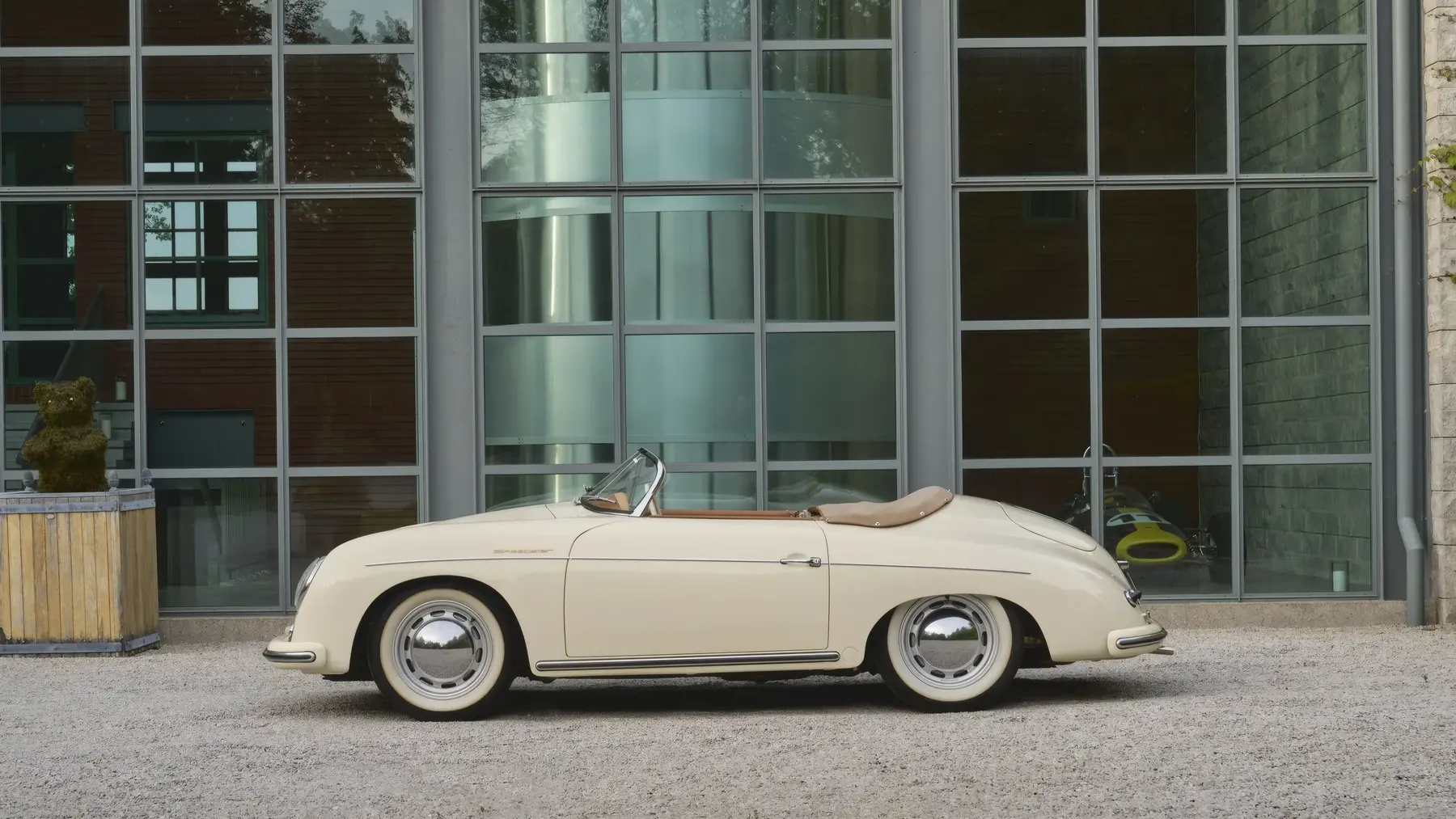
That spartan specification, ironically, made the car formidable in competition, which was rather the point. John von Neumann gave the Speedster its California competition debut over the Thanksgiving weekend of 1954 at Torrey Pines, co-driving to eighth overall in a six-hour race before returning the next day to win outright in the 1,500cc production class. Elsewhere in America, Bengt Soderstrom and Lake Underwood used Speedsters to take the SCCA’s F Production championship, and a young Dan Gurney bought a 1956 Speedster, trading in his Triumph TR2 and financing the rest at $100 a month, as his own route into serious racing. For privateers without factory backing, the Speedster’s low weight and eager chassis made it genuinely competitive against far more expensive machinery, and that reputation did as much as Hoffman’s marketing to cement the car’s standing among American enthusiasts.
The Speedster’s life within the 356 A generation was shorter than its reputation might suggest. The T-1 series, produced through September 1957, accounted for 8,364 cars in total, of which 1,690 were Speedsters, alongside 5,782 Coupes and 892 Cabriolets. The T-2 series that followed added 12,161 more cars by September 1959, including 1,131 Speedsters, 7,225 Coupes, 2,475 Cabriolets and 1,330 examples of the new Convertible D, bringing total 356 A production to 20,525 units. That puts 356 A-generation Speedster production at roughly 2,800 cars, though broader figures exist: some valuation and price-guide sources cite a combined total closer to 4,000 to 4,300 Speedsters across the model years 1955 through 1959, a range that likely reflects the inclusion of transitional Pre-A cars and different counting conventions rather than a genuine factual dispute, and readers should treat any single Speedster production figure with appropriate caution given how differently sources define the count. What is not in dispute is that the Speedster’s run ended deliberately. In August 1958, Porsche discontinued the Speedster in favour of the Convertible D, a closely related but more usable car with a taller windscreen, proper wind-up windows, a real folding roof, and standard rather than bucket seats - an unambiguous factory admission that the Speedster’s starkness, however romantic in retrospect, was a genuine liability for everyday ownership that most customers did not want to live with.
Europe, notably, never much cared. The Speedster was built for America and found its audience there almost exclusively; the European market showed little interest in a car that, to local eyes, offered less equipment for scarcely less money than a Cabriolet. That indifference is part of what makes the model’s present-day status so striking. A car conceived purely as a price leader, engineered down to a cost rather than up to a standard, sold in meaningful numbers only to one export market, and discontinued within a few years because Porsche itself judged it too basic for most buyers, is today the most sought-after body style in the entire 356 range, with 1600 Super examples - combining the range’s most usable performance with its most desirable open body - sitting at the top of that hierarchy. Values have climbed steadily for decades, driven by a collector culture that increasingly prizes honest, original cars as highly as concours-perfect restorations, and by a broader recognition that the Speedster represents something the 911 generation would spend the next several decades trying to recapture: a genuinely light, direct, unfiltered connection between driver and road, undiluted by comfort features nobody who bought one in period actually wanted to pay for.
The 1600 Super Speedster’s real legacy is not a spec sheet - modest by any objective measure even in period - but a demonstration of how little a good sports car actually needs. Porsche cut cost after cost chasing an American price point and, in doing so, produced a car whose lightness and directness has aged into virtue precisely because later, heavier, more thoroughly equipped 356s and 911s never quite recreated it. It remains a car best understood not as a scaled-down luxury roadster but as what it always was: a stripped, quick, occasionally uncomfortable machine built to be raced and driven hard, which is exactly why it is still worth driving hard today.
Technical data
Performance Specifications
| Specification | Porsche 356 A 1600 Super Speedster (Type 616/2) |
|---|---|
| Production | 1956–1958 (356 A T-1 and T-2 series; Speedster body style built 1955–1958) |
| Engine | Air-cooled flat-four, 1,582cc, pushrod OHV |
| Compression ratio | 8.5:1 |
| Carburettors | Twin Solex (exact T-2 specification uncertain)* |
| Power | 75bhp at 5,000rpm (some period sources cite 74bhp)* |
| Torque | 85lb-ft at 3,700rpm |
| Transmission | Four-speed manual, rear-wheel drive |
| Wheelbase | approx. 2,100mm* |
| Kerb weight | approx. 780–820kg (lightest body style in the 356 A range)* |
| 0–62mph | approx. 13 seconds* |
| Top speed | approx. 110mph* |
| Original list price | from $2,995 (1956, base Speedster; Super engine a cost option) |
Sources
- Hagerty: 1958 Porsche 356A 1600 S Speedster
- Hagerty: Porsche 356 Speedster - Bargain Blockbuster
- Hagerty Valuation Tools: Porsche 356
- Supercar Nostalgia: Porsche 356 A Guide - A Historical & Technical Appraisal
- RM Sotheby’s: 1956 Porsche 356 A 1600 Super Speedster by Reutter
- Stuttcars: Porsche of the Day - 1956 Porsche 356 A 1600 ‘Super’ Speedster by Reutter
- Wikipedia: Porsche 356 (context and cross-reference only)
Join the discussion
Comments
Loading comments…
Leave a comment
Share a detail, memory, or perspective. Every comment is reviewed before publication.