Mercedes-Benz 300 SL Roadster: The Better 300 SL Nobody Believes
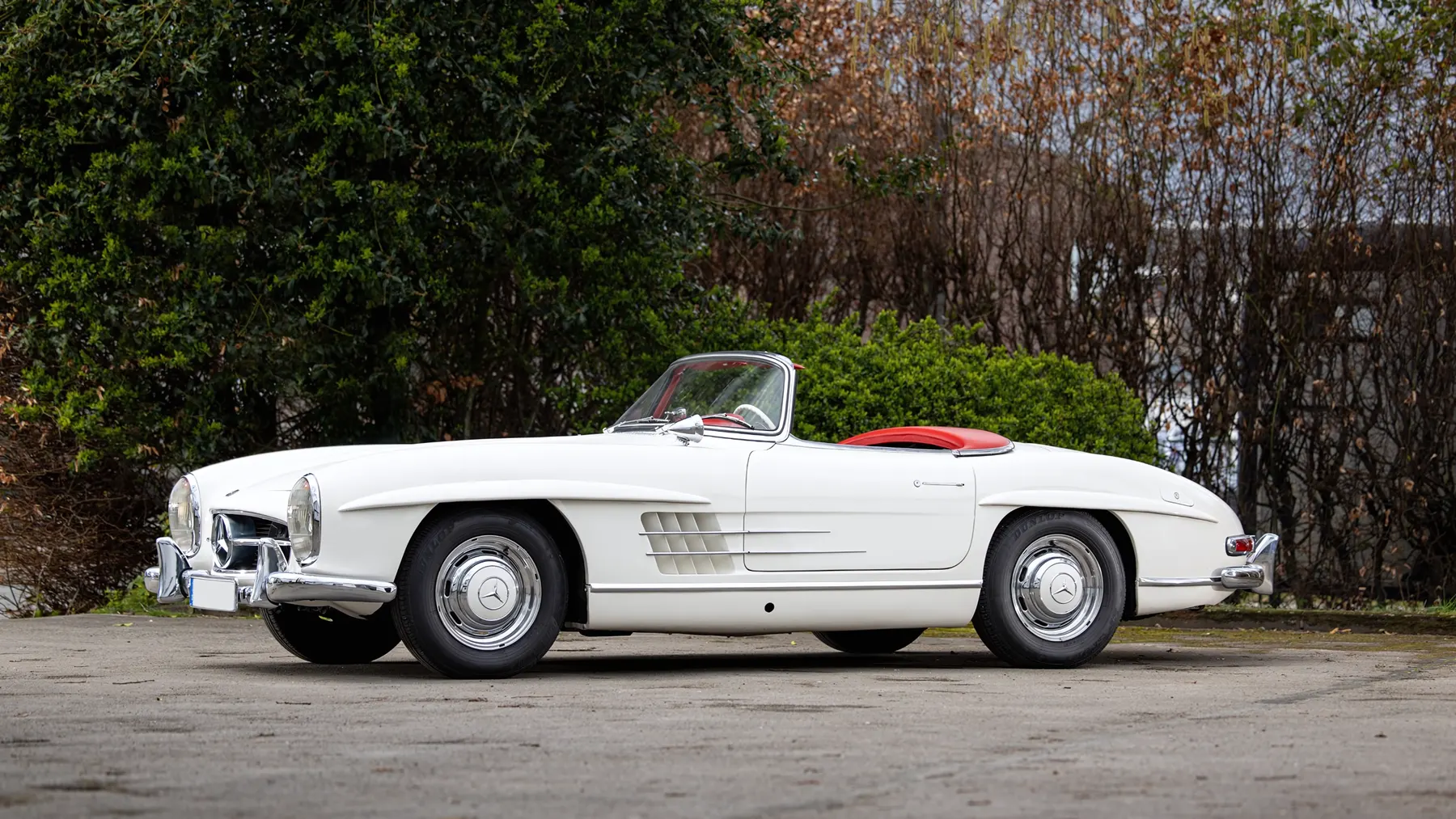
1958 Mercedes-Benz 300 SL Roadster

Images: Neil Fraser / RM Sotheby's
Mercedes-Benz built the 300 SL Roadster to fix a car that arguably didn’t need fixing so much as it needed different doors. That car was the 300 SL “Gullwing”, the sensational fuel-injected coupé whose upward-swinging doors had made it the most photographed sports car in the world by the mid-1950s, and also one of the most awkward to actually live with. Climbing over a sill roughly level with the driver’s elbow, folding the steering wheel out of the way just to get a leg in, and hoping never to end up on the roof with those doors sealed shut above you were simply the price of admission to what was, for a time, the fastest production car in the world. Max Hoffman, the Austrian-born New York importer who had talked Mercedes-Benz into building the Gullwing for America in the first place, decided the fix wasn’t to reinvent the car but to give it a second body and a proper pair of doors. The result, unveiled at the Geneva Motor Show in March 1957, was the W198 II: the 300 SL Roadster, and for six years the more usable, more forgiving, and, ever since, rather less romanticised half of the original SL story.
The Gullwing’s doors were never a styling flourish. Rudolf Uhlenhaut’s competition-derived tubular space frame ran its principal chassis members along the sills at a height level with the occupants’ elbows, leaving no room for conventional hinges. The upward-swinging doors were the only workable solution, and they came with real drawbacks that had nothing to do with glamour: awkward entry and exit for anyone not built like a racing driver, windows that didn’t wind down, and a genuine question of how you were supposed to get out if the car ever landed on its roof. By the mid-1950s the booming market for open two-seaters, and Hoffman’s confidence that a droptop 300 SL would sell at least as well as the coupé, gave Mercedes the commercial case it needed to re-engineer the car properly rather than simply bolt on a soft top.
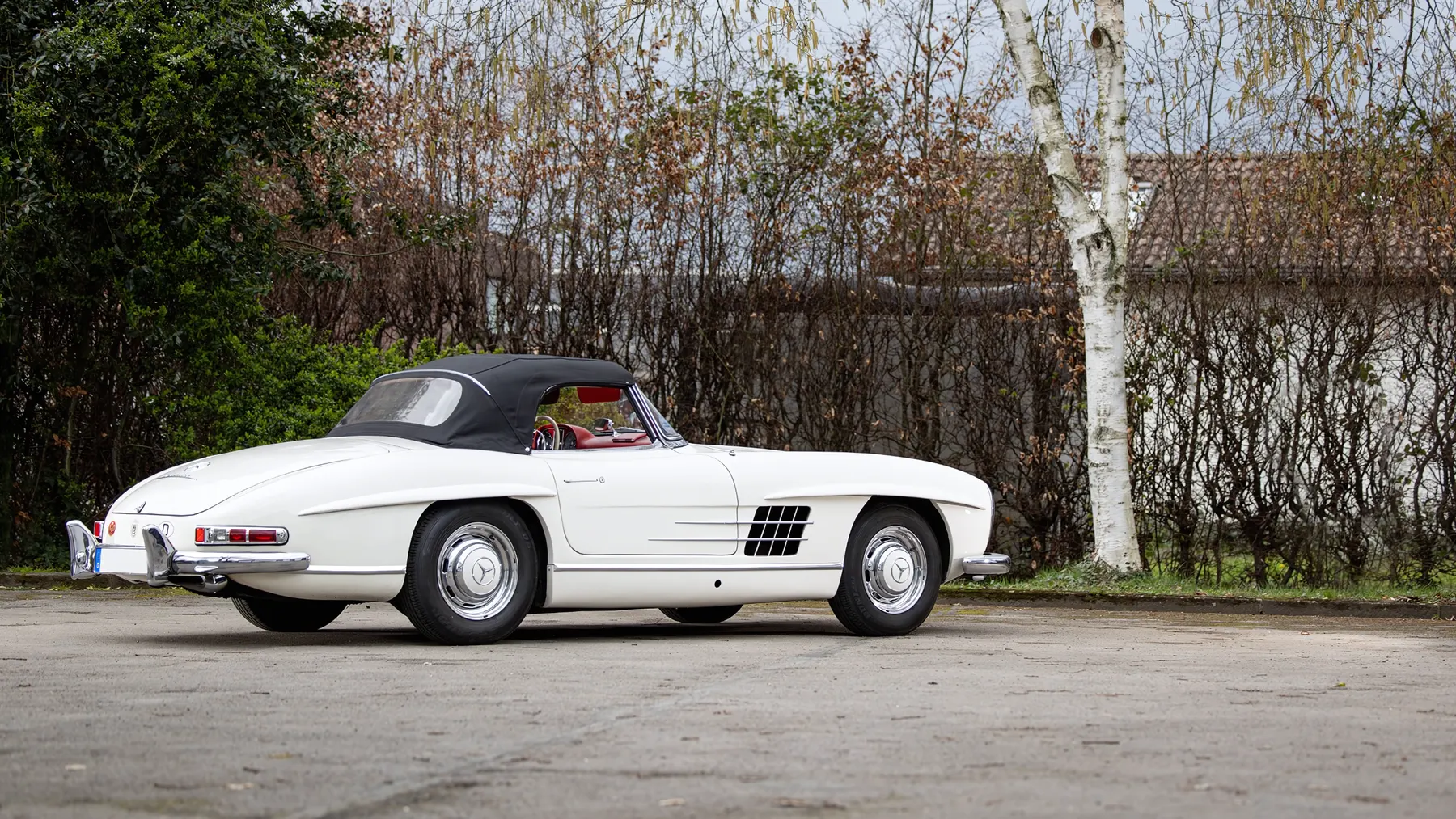
That re-engineering was substantial. To make room for front-hinged doors with wind-up glass, engineers lowered the space frame’s sill tubes by roughly half their original height and added supplementary tubing elsewhere to claw back the torsional rigidity the modification cost. At the rear, the Gullwing’s swing axle, jointed only at the differential, was replaced with a new low-pivot single-joint design fitted with a compensating spring, addressing the coupé’s tendency toward sudden, unforgiving camber change at the limit. Mercedes had already proven this geometry on its 220a saloon, and on the Roadster it produced markedly more neutral, more predictable handling, along with a noticeably more comfortable ride. Coil-sprung telescopic dampers, a front torsion-bar anti-roll bar, wider 5.5-inch wheels, and standard-fit Michelin tyres rounded out the changes, while the recirculating-ball steering went from two turns lock-to-lock on the coupé to a less frantic three.
Under the bonnet sat the M198, a 2,996cc single-overhead-camshaft straight-six with an 85mm bore and 88mm stroke, its aluminium cylinder head borrowed in principle from the flagship 300 “Adenauer” saloon but transformed by Bosch mechanical direct fuel injection, a genuine production-car first. Dry-sump lubrication, a magnesium cooling fan and valve cover, and a forged, damper-equipped crankshaft rounded out a genuinely exotic specification for the era. The Roadster launched with the high-compression, competition-camshaft engine specification that had been an extra-cost option on the coupé, quoted at 240bhp at 6,100rpm; one detailed technical appraisal of the model states this tune remained standard equipment throughout the roadster’s production, while other accounts suggest the very highest state of tune may principally have applied to the 1957 debut cars, with the exact evolution of output across the following six seasons not consistently documented. Torque is similarly reported differently depending on whether the source is quoting period SAE gross or DIN net figures, with numbers ranging from roughly 200 to 217lb-ft at around 4,600–4,800rpm. Drive went through a four-speed, fully synchromesh gearbox with helical-cut gears, a refinement over the coupé’s noisier straight-cut set, via a single dry-plate clutch.
Performance depended heavily on which of the optional rear-axle ratios a customer specified, since a numerically lower ratio traded acceleration for a taller top speed and vice versa. With the standard axle, period road tests and technical appraisals commonly cite a top speed around 145mph and 0–62mph in roughly 7 seconds, while Mercedes’ own factory figures for the most aerodynamically-geared examples claimed considerably higher, up to around 162–163mph. Fitting the optional hardtop, which added weight and altered the car’s frontal area, further reduced outright top speed compared with the lighter soft-top car. Whichever figure is used, the Roadster remained genuinely rapid by the standards of 1957, capable of humbling most contemporary Ferraris, Jaguars, and Astons in a straight line even while carrying more comfort equipment than any of them.
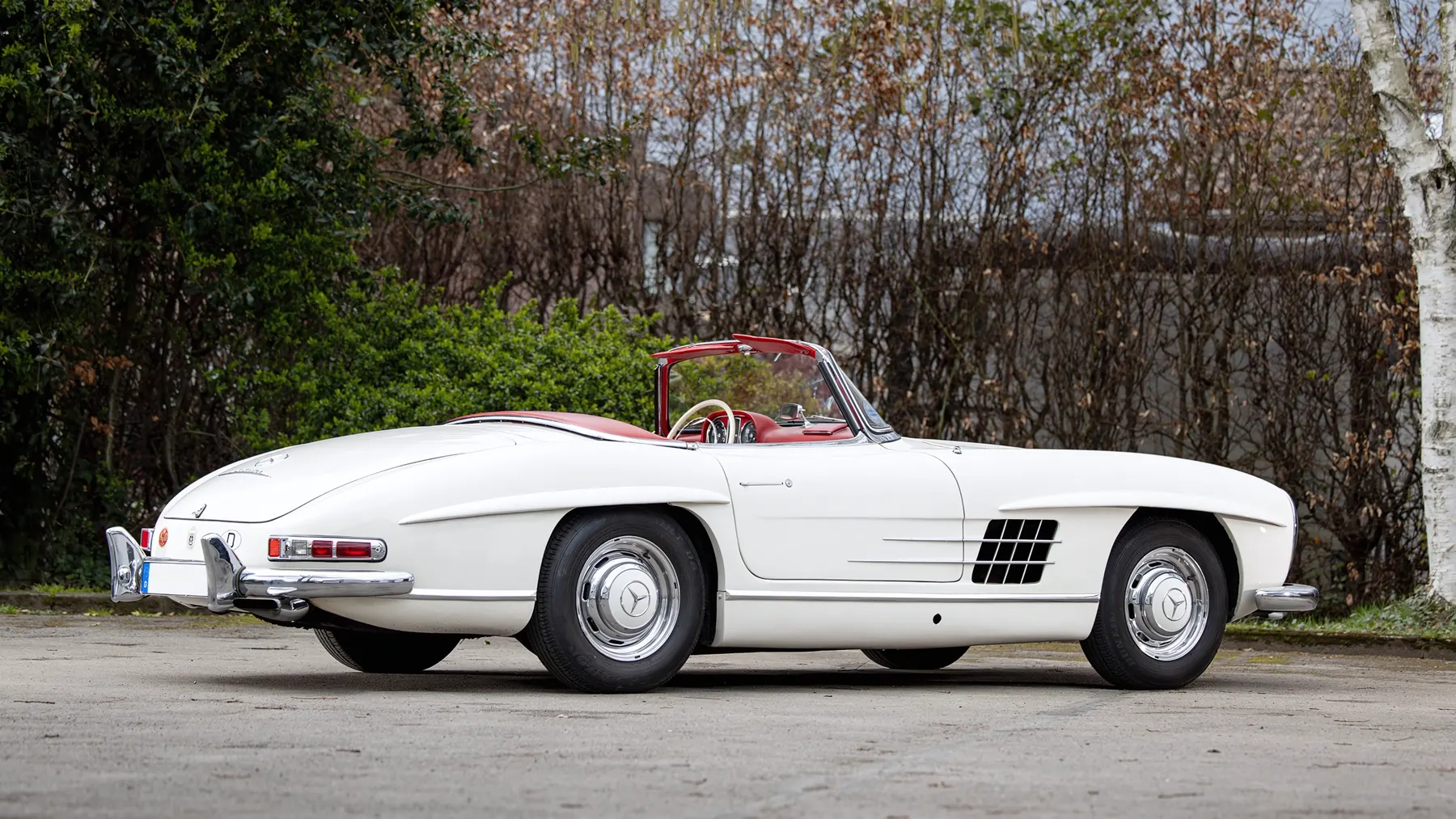
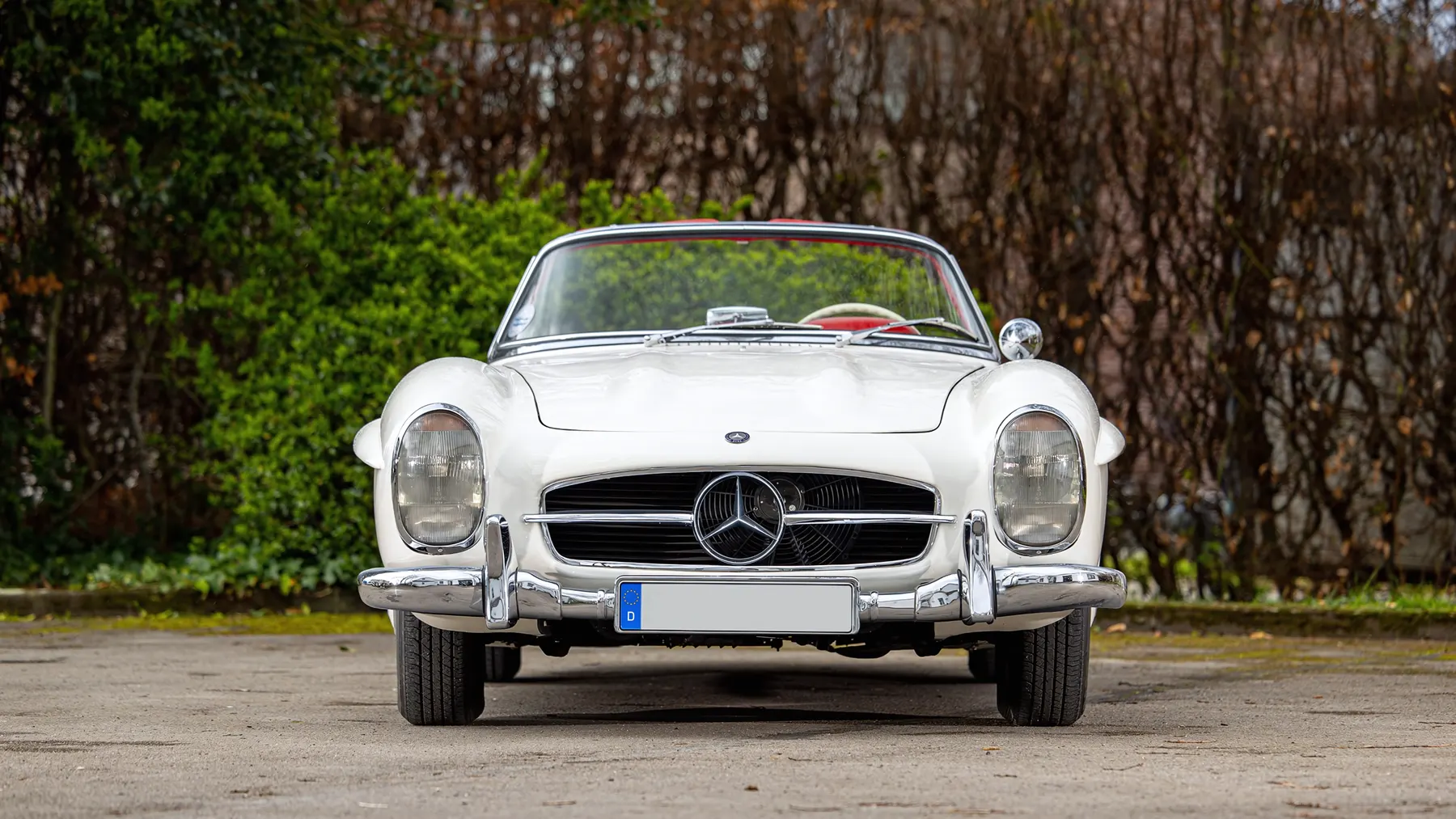
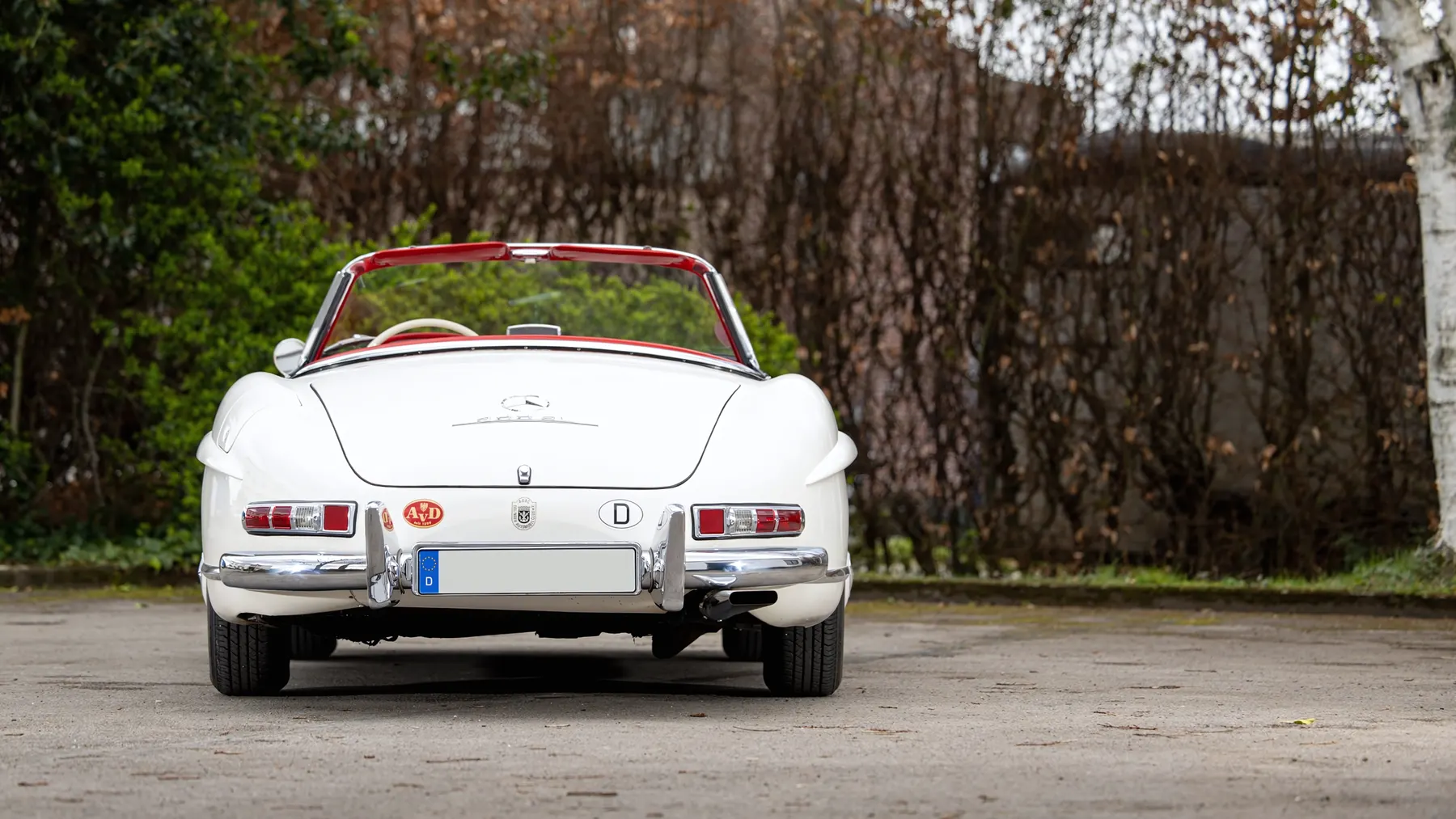
Visually, the Roadster kept the coupé’s basic proportions from the waist down, along with signature details like the full-width bumpers, wheel-arch “eyebrows,” and the sculpted engine-cooling vents in each front wing. Ahead of the screen, though, it looked distinctly different: vertical, pillar-type headlamp and sidelight clusters replaced the coupé’s round units, the tail lights grew larger within new chrome shrouds, and a wraparound windscreen sat ahead of bigger, front-hinged doors with proper wind-up glass. The folding canvas roof stowed out of sight beneath a body-coloured tonneau panel, and from September 1958 Mercedes offered an optional steel hardtop that, despite a considerable price premium, became the single most popular accessory on the car, eventually available in place of the soft top altogether at a discount. Aluminium panels for the doors, bonnet, boot lid, sills, floors, and bulkhead kept weight in check over an otherwise steel structure.
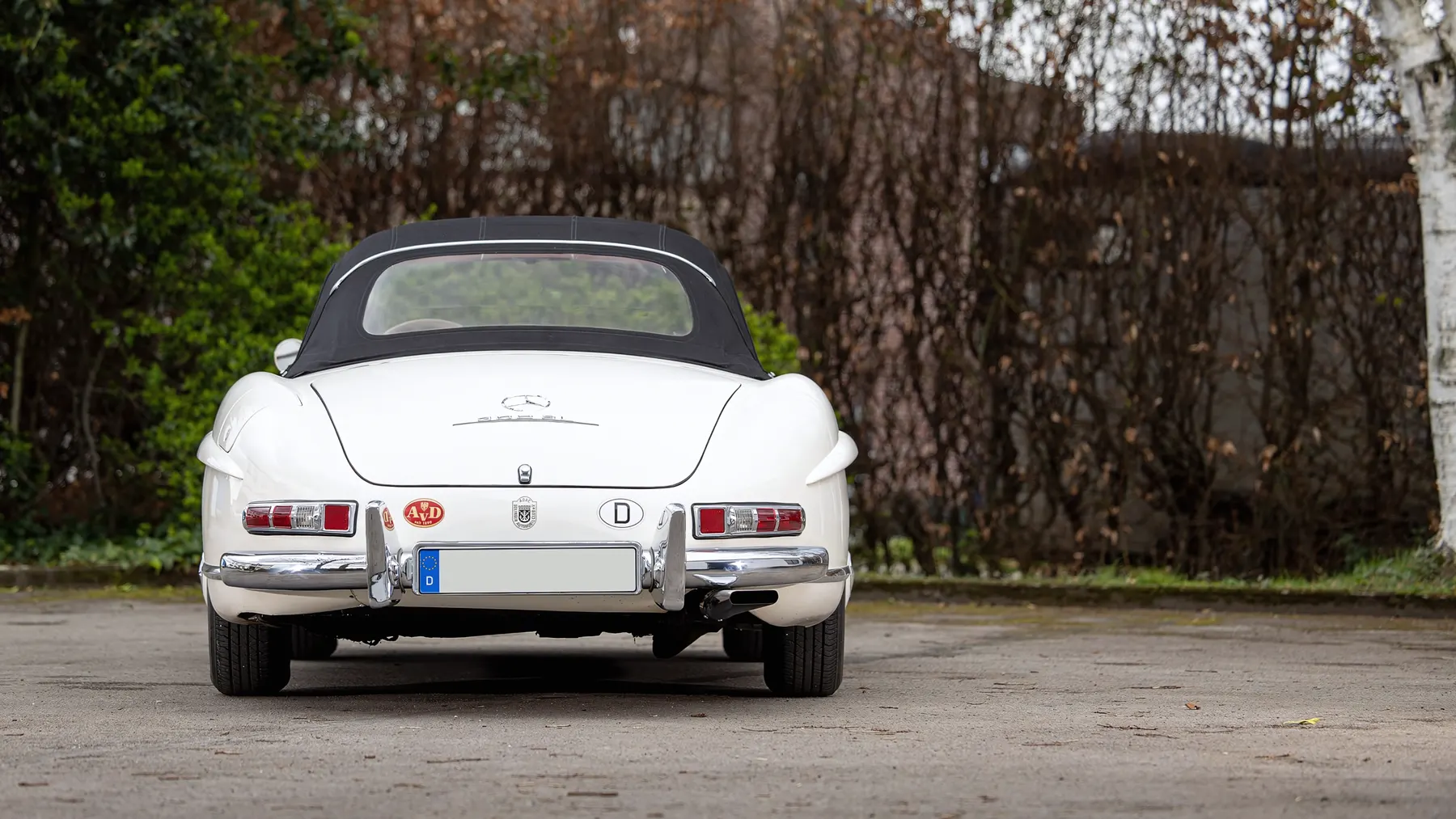
Inside, the Roadster received a larger dashboard than the coupé’s, with a redesigned instrument binnacle housing a rev counter and speedometer flanking a small rectangular auxiliary readout unique to the model, giving fuel level, oil pressure, oil temperature, and water temperature at a glance. Bucket seats were more generously padded, a wing mirror was standard, and a proper glovebox appeared for the first time. Leather trimmed nearly every surface bar the floor. A redesigned fuel tank, some 25 percent smaller than the coupé’s to free up genuine luggage space, allowed the spare wheel to move beneath the boot floor, and buyers could specify a matching set of fitted leather suitcases shaped for the space.
All of that extra civility came with a weight penalty. Most sources place the Roadster around 35kg heavier than the coupé at launch, roughly 1,330kg, though at least one detailed period technical appraisal cites a larger gap of around 95kg with a richer specification fitted; the discrepancy likely reflects different equipment levels being compared rather than a factual disagreement, but it isn’t fully resolved across sources. Cars fitted with the optional hardtop weighed meaningfully more still, by Mercedes’ own account as much as 75kg over the coupé, enough to trim top speed and blunt the sharper edges of outright acceleration without eroding the car’s fundamental character.
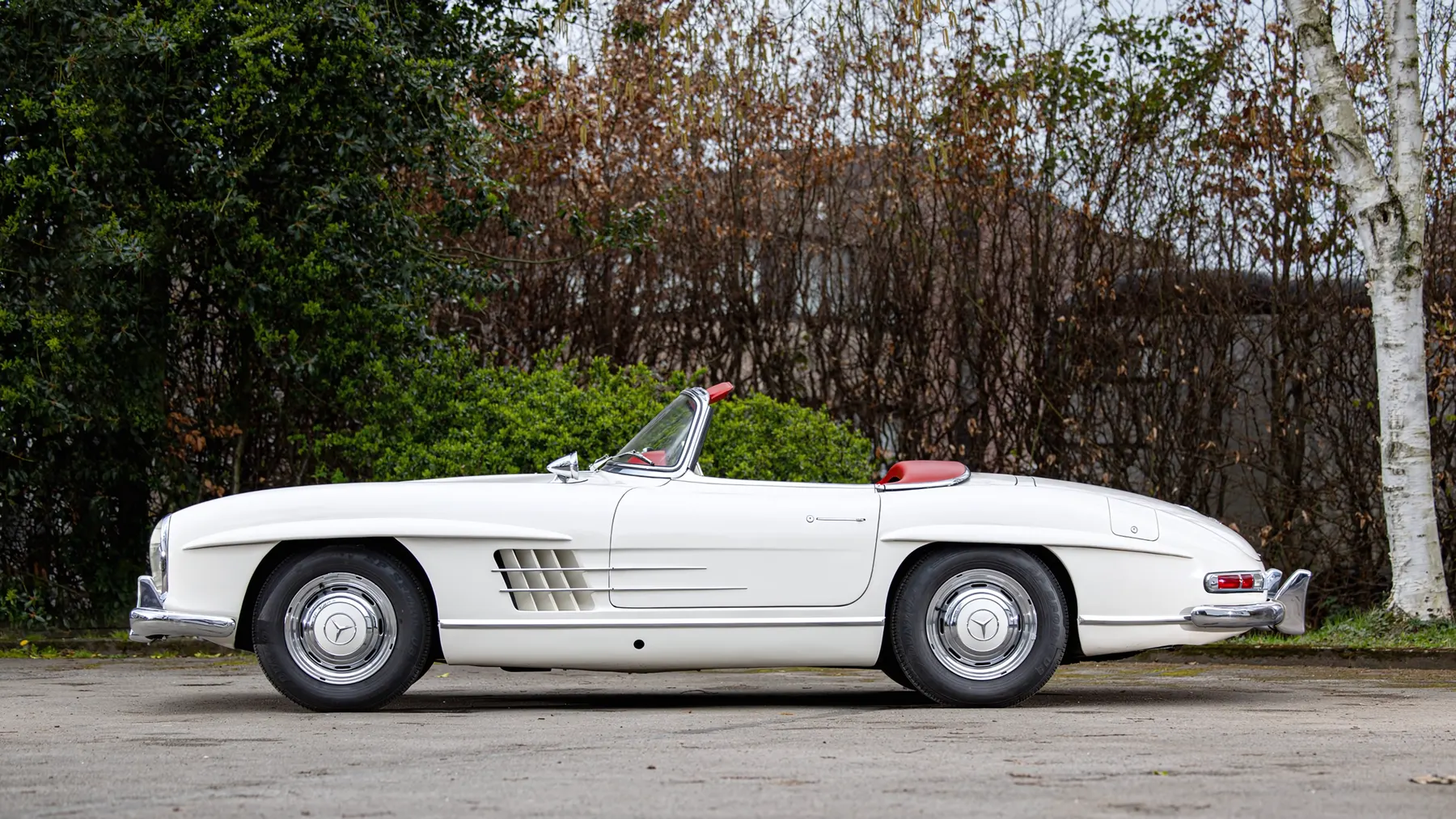
The Roadster evolved steadily across its production run at the Sindelfingen plant. Single-piece armrests and an electromagnetic mixture-control valve arrived in 1958; plastic-lined fuel tanks and dual-floating-shoe front brakes followed in 1960; and, most significantly, four-wheel Dunlop disc brakes replaced the original finned drums in March 1961, matching stopping power to a car whose performance had rather outpaced 1950s drum-brake technology. A light-alloy engine block replaced the original cast-iron unit for a final batch of around 209 to 210 cars, though sources disagree on whether this switch came in March 1962 or March 1963. Production ended in February 1963 after 1,858 roadsters, all left-hand drive, making it the last Mercedes-Benz passenger car built on a separate frame before the company moved fully to unitary construction.
None of this sophistication came cheaply. In Germany the Roadster listed at DM 32,500 with its soft top, against DM 29,000 for the coupé it replaced; in the United States it listed at $10,950, a figure that placed it pricewise among contemporaries from Ferrari, Maserati, and Aston Martin rather than against ordinary sports cars. Options added up quickly: the hardtop alone cost around 1,500 Deutschmarks in Germany, and Rudge centre-lock wheels commanded a serious premium in the US price list. Sales opened strongly, with 618 cars built in 1957 alone, before settling into a steadier rhythm of around 200 to 250 a year for most of the remaining run, tailing off toward the end as the model aged.
Competition use was modest by comparison with the works Gullwing and its 300 SLR racing sibling, since Mercedes’ factory effort had already shifted decisively toward Grand Prix and sports-racing machinery by the time the Roadster arrived. The exception was a pair of lightened 300 SLS specials built for the 1957 American season, stripped of bumpers, fitted with a low racing screen and a passenger-side tonneau, and given roughly 20 additional horsepower; driven by Paul O’Shea, one of them won the SCCA’s D Modified championship, extending Mercedes’ unbeaten run in American production-based sports car racing. But the Roadster’s real mission was always touring rather than trophies.
The Roadster’s real weaknesses lay less in outright ability than in usability and, with hindsight, longevity. Its mechanical fuel-injection pump kept cycling for as long as the engine turned, which meant it continued injecting fuel into the cylinders during the brief interval between switching off the ignition and the engine actually stopping; that extra fuel washed away the protective oil film on the cylinder walls, and the problem was compounded by a dry-sump system holding a large volume of oil that, on the short journeys many owners actually made, rarely got hot enough to boil off contamination properly. Left unmanaged, this led to accelerated ring and bore wear, and owners were advised to change oil far more often than was typical for the period to avoid it. The improved swing axle, meanwhile, was a genuine advance over the coupé’s, but it remained a swing axle at heart; the reduced but not eliminated camber change under hard cornering or on poor surfaces could still catch out a driver pushing beyond the car’s comfortable limits. Everyday usability had its own frustrations too: unassisted recirculating-ball steering that demanded real effort at parking speeds, a tall bottom gear that made town driving cumbersome, an initially heavy clutch later eased somewhat by a helper spring, and no factory air conditioning at all, only an optional heater, in a cabin that could grow uncomfortably warm with the hardtop fitted. Fuel consumption hovered around 17mpg imperial, which, combined with the roadster’s shrunken tank, limited real-world touring range for a car ostensibly built for exactly that purpose. Commercially, too, the Roadster’s appeal had visibly faded by the time production ended: the cheaper, lighter, more modern W113 “Pagoda” arrived in 1963 to supersede it, and late-production Roadsters are known to have sat unsold on dealer floors for months, victims of a market that had simply moved on.
None of this stopped the Roadster from becoming, alongside its Gullwing sibling, the foundation of an SL lineage that has run continuously ever since, through the smaller 190 SL sold alongside it, the “Pagoda” W113 that replaced it in 1963, and on through the R107 and R129 generations, with the gullwing-doored SLS AMG of 2009 to 2014 serving as a deliberate spiritual revival of the original coupé rather than the Roadster. Along the way the car became genuine Hollywood furniture, appearing in films from “Pillow Talk” to “Charlie’s Angels” and remaining, in period, the sports car of choice for a certain kind of transatlantic celebrity. Today it sits among the most valuable postwar Mercedes-Benz production cars, though public sale prices for Roadsters vary enormously by specification, originality, and documented history; auction and private-sale data show results spanning from the high hundreds of thousands of dollars to well over three million for exceptional, well-provenanced examples, and market analysts have noted that cars kept in long-term single ownership tend to command a premium over those that trade hands frequently. As with any fast-moving collector market, exact figures should be treated as a snapshot rather than a fixed benchmark. Nearly seven decades on, the Roadster still does more or less exactly what it was built to do: it corrects almost everything that made the Gullwing exhausting to live with, while keeping virtually all of the mechanical drama that made it worth owning in the first place. That it has spent most of those seven decades regarded as the coupé’s less essential understudy says more about the mythology of a single pair of doors than it does about which car Mercedes-Benz actually engineered better. Judged on the merits of what changed beneath the skin rather than what disappeared from the roofline, the 300 SL Roadster has a fair claim to being the more complete car of the two.
Sources
- MercedesHeritage: “March 1957: The SL Legacy Begins”
- Supercar Nostalgia: “Mercedes-Benz W198 300 SL Roadster Guide”
- Wikipedia: “Mercedes-Benz 300 SL”
- Classic Driver Magazine: “Mercedes-Benz 300SL Roadster”
- Classic.com: “Mercedes-Benz 300SL Roadster - W198 Market”
- Hagerty Media: “What 300SL Gullwing Sales Tell Us About Broader Market Behavior”
- Conceptcarz: “1963 Mercedes-Benz 300 SL”
Join the discussion
Comments
Loading comments…
Leave a comment
Share a detail, memory, or perspective. Every comment is reviewed before publication.