Mercedes-Benz SLS AMG Coupe: When AMG Finally Built Its Own Car
2012 Mercedes-Benz SLS AMG Coupe

Images: Courtney Frisk / RM Sotheby's
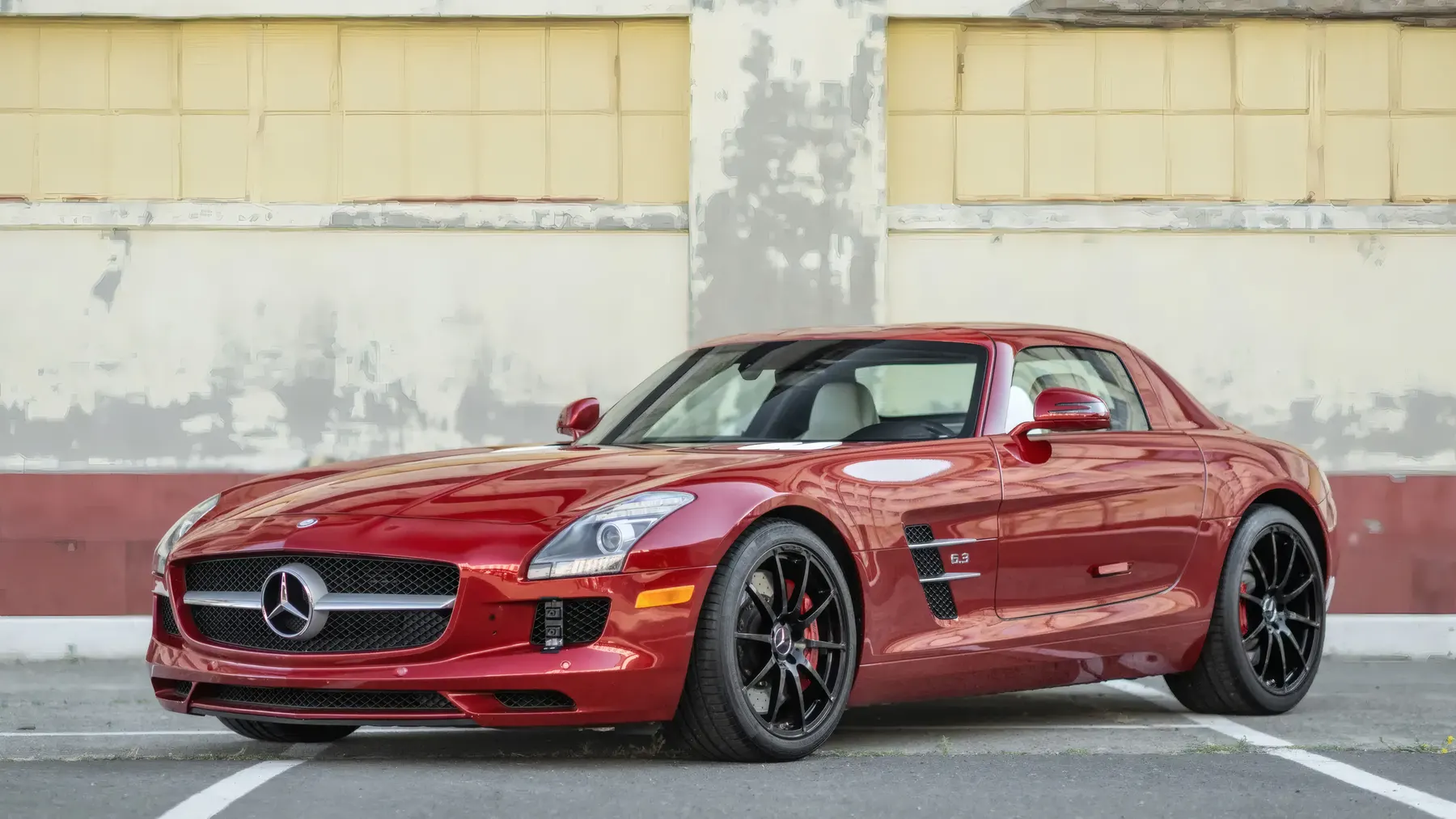
AMG had spent nearly four decades tuning other people’s Mercedes-Benzes before the SLS AMG arrived in 2010 as the first car the performance division built entirely from a blank sheet of paper, and the weight of that responsibility shows in almost every decision that went into it - including the deliberate choice not to motorise the hinges on its most famous doors.
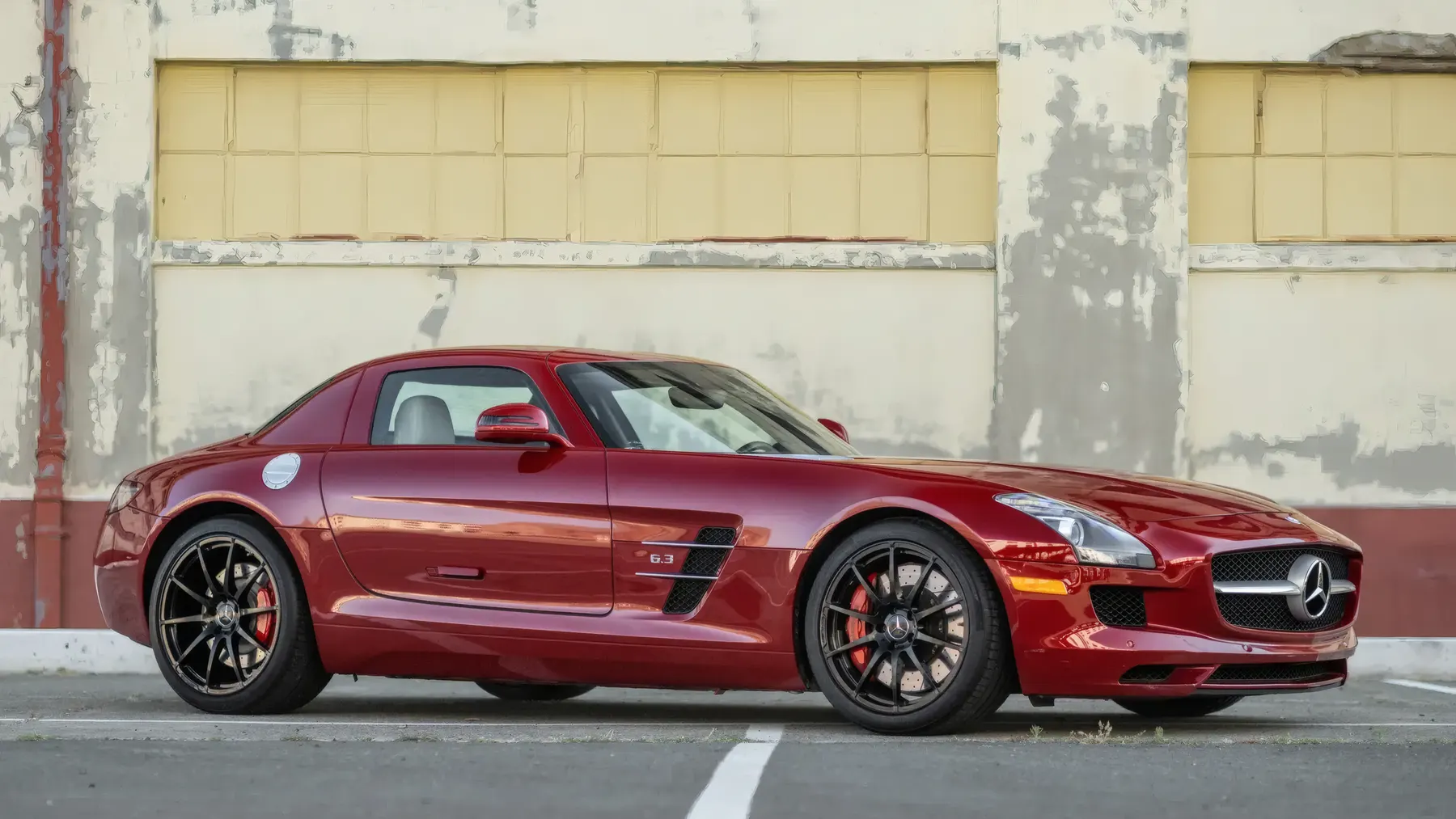
The SLS was positioned as a spiritual replacement for the Mercedes-Benz SLR McLaren, though Mercedes preferred a different lineage: the 1954 300SL “Gullwing,” whose racing-derived spaceframe chassis and upward-swinging doors the new car reinterpreted for the 21st century. Designer Mark Fetherston sketched the shape between October 2006 and April 2007, and the resulting silhouette - long bonnet, cabin pushed rearward, a body wider than an S-Class - left no doubt this was a modern object rather than a pastiche. Mercedes also positioned it deliberately apart from its own SL-Class, then sold as a plusher, V12-available grand tourer: the SLS was lighter and more track-focused, priced close to the SL65 AMG at launch and roughly £200,000 below the discontinued SLR it effectively replaced. AMG’s engineering leadership argued at the time that the SLS was quicker around a circuit, for ordinary drivers and racing drivers alike, than the heavier 1,750kg SLR had ever managed. Former Formula 1 driver David Coulthard was credited with assisting the car’s development, and later became closely tied to its marketing, including a Guinness-verified stunt catching a golf ball travelling at speed from inside a moving SLS AMG Roadster.
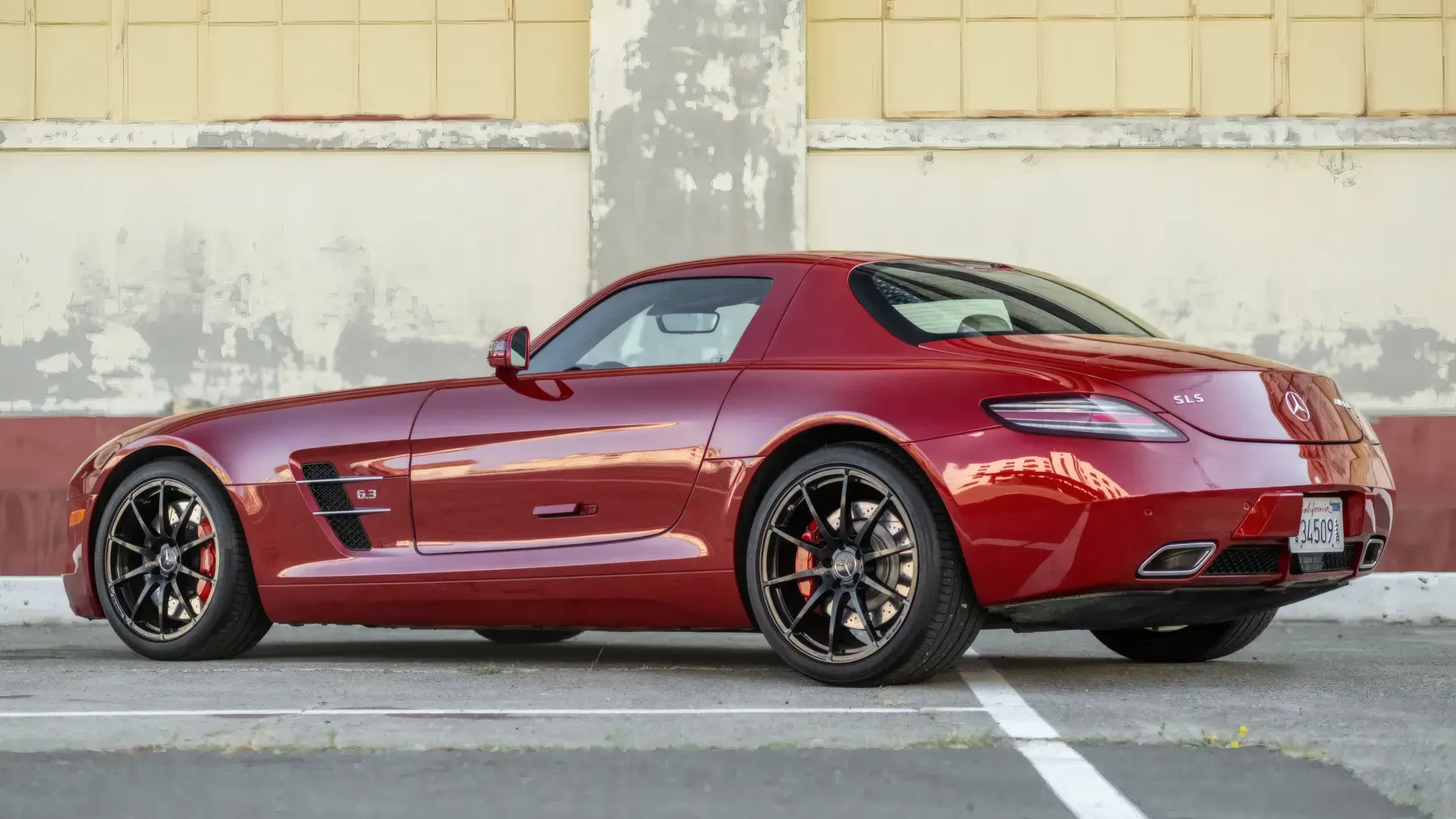
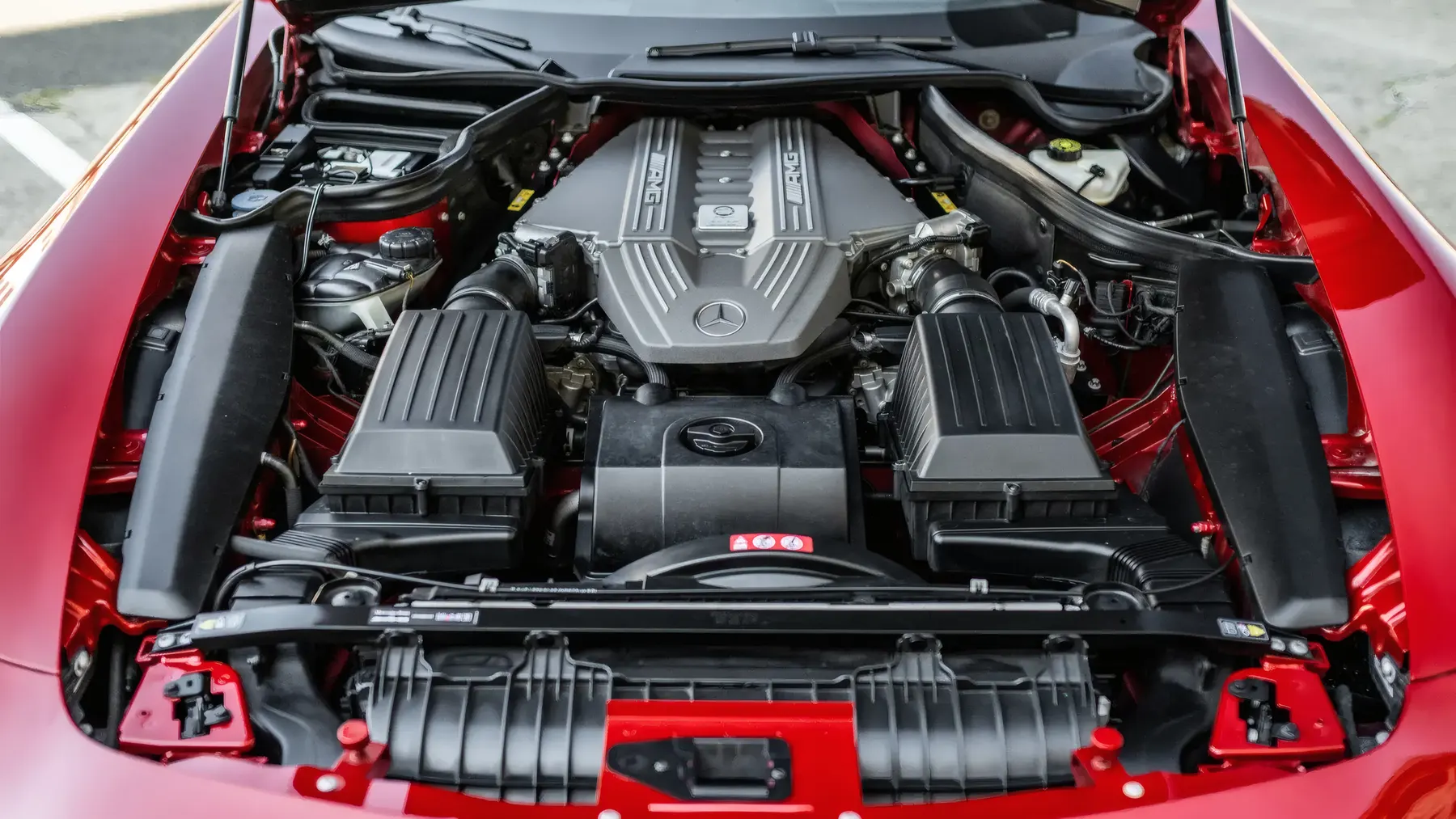
Underneath the retro-inspired bodywork sat a thoroughly modern aluminium spaceframe chassis, weighing 241kg complete, with body panels supplied by Magna Steyr in Austria and shipped to Mercedes’ Sindelfingen plant for final assembly. The 6.2-litre V8 - badged M159 to distinguish it from the closely related M156 unit found in cheaper AMG models - was hand-built at Affalterbach with more than 120 individual modifications over its donor engine, including a dry-sump lubrication system to cope with sustained high-g cornering. Autocar’s testers admitted to early scepticism that a car costing this much shared its basic architecture with the far cheaper C63 AMG, a doubt they said was dispelled the first time they let the SLS run to its 7,500rpm limit on an open road. In its original form the engine produced 563bhp and 479lb-ft of torque, enough for Mercedes to claim it as the most powerful naturally aspirated production engine in the world at launch. Drive went through a rear-mounted seven-speed Getrag dual-clutch transaxle, connected to the engine via a carbon-fibre driveshaft inside a torque tube - a layout chosen specifically to help the car achieve a near 47/53 front-rear weight distribution despite that long V8 sitting ahead of the front axle line. A conventional manual gearbox was never offered on any SLS variant; every version, however extreme, shifted through some iteration of that dual-clutch transmission.
Getting in and out remains the car’s signature experience, for better and for worse. The gullwing doors are genuinely light in operation, rising on gas struts with handles that pop out automatically as the car is unlocked, but Mercedes deliberately declined to motorise them - engineers calculated that a powered opening mechanism would have added roughly 41kg in exactly the wrong place. In a rollover, explosive bolts at the top of each door frame fire within ten to fifteen milliseconds of a detected impact, allowing the doors to be jettisoned entirely so occupants can escape - serious engineering hidden behind what looks like a party trick. Day to day, though, entry means stepping over a wide sill and folding down into a cabin that, with the standard seats fitted, leaves noticeably tight headroom; the optional carbon-backed sports seats sit lower and free up space, but arguably shouldn’t have been necessary to make the car comfortable for taller drivers in the first place. Once inside, the boot - a genuine 176 litres in the coupé - is unusually generous for something with this much performance ambition, a rare practical win among the compromises.
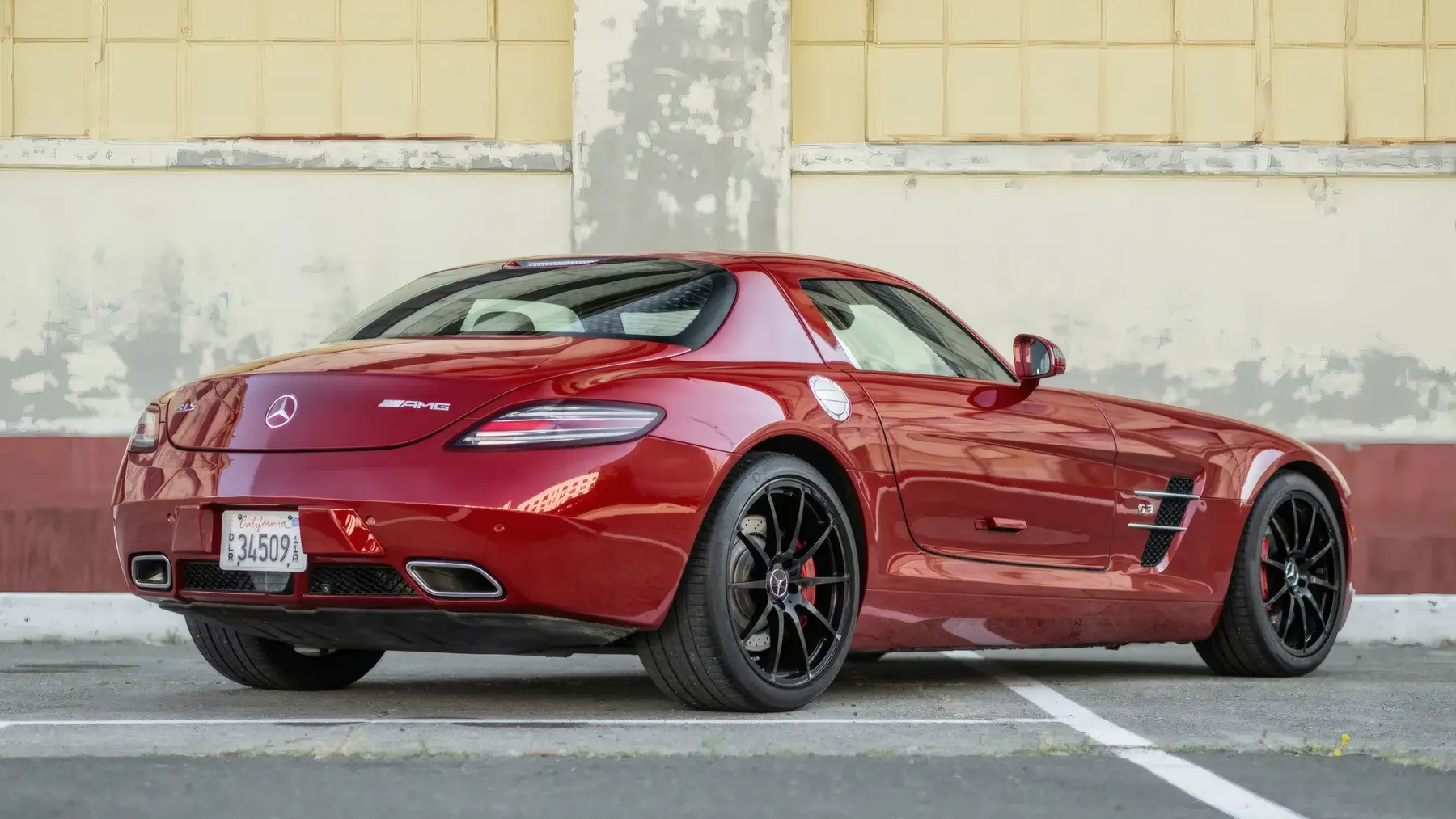
On the road the SLS earns its supercar billing without pretending to be delicate about it. Steering is unusually quick for a Mercedes at 2.5 turns lock-to-lock, and the aluminium structure feels torsionally rigid enough that turn-in happens almost without delay, the rear axle following the front’s lead with real immediacy. There is no adaptive damping on the standard car - the double-wishbone suspension is a fixed, passive set-up front and rear - and at low speed the ride is firm enough that testers flagged it as unsuited to relaxed boulevard cruising, though body control tightens up nicely and the ride smooths out as speed builds. The standard coupé’s official 0-62mph time sat in the high 3-second bracket depending on market and test methodology, with Mercedes’ own figures ranging between 3.8 and 3.9 seconds, and a top speed electronically limited to 196mph. The seven-speed transmission offered four distinct modes, from a relaxed “Controlled Efficiency” setting that kept revs low for everyday use through to a Sport Plus mode with noticeably SLS GT3 sharper shifts, and reviewers repeatedly noted how usable the SLS felt for something this fast; Autocar’s road testers argued the 0-100mph time of 8.0 seconds, rather than the more commonly quoted 0-60mph figure, told the more honest story of the car’s straight-line pace.
Mercedes broadened the range steadily through the SLS’s production run. A Roadster arrived for the 2011 model year with conventional doors, a three-layer fabric roof that opened in eleven seconds and could be operated on the move at up to 31mph, and around 40kg of extra structural reinforcement to compensate for the loss of a fixed roof - a car pitched as slightly softer and more relaxed than the coupé for buyers less interested in outright track ability. The SLS AMG GT followed in 2012, lifting power to 583bhp and trimming the 0-62mph time to 3.4 seconds through sharper throttle response, quicker shifts and an optional stiffened AMG Ride Control suspension; by the time American buyers were choosing their 2013 model year car, the GT had effectively replaced the original SLS AMG as the sole naturally aspirated model on sale, in both coupé and roadster form.
The range topped out with the 2013 SLS AMG Coupé Black Series, a genuinely track-honed variant developed in the shadow of Mercedes’ own SLS GT3 racer. Revised camshafts, a higher 8,000rpm redline and reworked intake geometry lifted the M159 to 622bhp, while extensive use of carbon fibre in the body panels and space frame, a titanium exhaust and a lighter battery cut around 70kg from the standard car’s kerb weight, along with carbon-ceramic brakes as standard equipment. Mercedes’ own claim was a 0-62mph time of 3.6 seconds, though Car and Driver’s independently timed test found the car reaching 60mph in a startling 3.2 seconds - a reminder that AMG’s factory figures tended toward conservatism rather than exaggeration. At the opposite extreme sat the SLS AMG Electric Drive of 2013, an all-wheel-drive technology showcase powered by four electric motors producing a combined 740bhp and 738lb-ft of torque, fed by a liquid-cooled 60kWh battery pack good for around 250km of range under the old NEDC test cycle. Pricing from roughly €416,500 in Germany and a genuinely tiny production run - reportedly just nine cars sold to customers worldwide - turned it into more of a rolling engineering statement than a viable commercial product, though its combined output briefly made it the most powerful series-production electric car in the world.
Away from the road, an FIA GT3-spec SLS AMG went racing from 2010 and went on to win the 2013 24 Hours of Spa outright - Mercedes’ first victory in that race since 1964 - alongside class wins at the Bathurst 12 Hour and back-to-back victories at the Dubai 24 Hour, from a production run of roughly 86 competition cars. The road car, meanwhile, spent several seasons as Formula 1’s official safety car, a fitting role for something designed to look dramatic at walking pace while carrying genuine dynamic ability underneath. Mercedes also collected a run of design honours for the SLS, including red dot’s “best of the best” award and Germany’s federal Design Award, the last of which no other production car has won.
Press reaction at launch leaned enthusiastic, at times extravagantly so - Jeremy Clarkson, reviewing the car for Top Gear, called it the greatest car on earth and rated it louder and more entertaining than its Italian and British rivals. More measured outlets landed somewhere cooler. Autocar scored the SLS a solid eight out of ten, praising its engine, lateral grip and everyday usability, but its verdict repeatedly returned to a sense that the car, for all its ability, felt a little clinical: dynamically outstanding, yet somehow short on the emotional connection its dramatic styling promised.
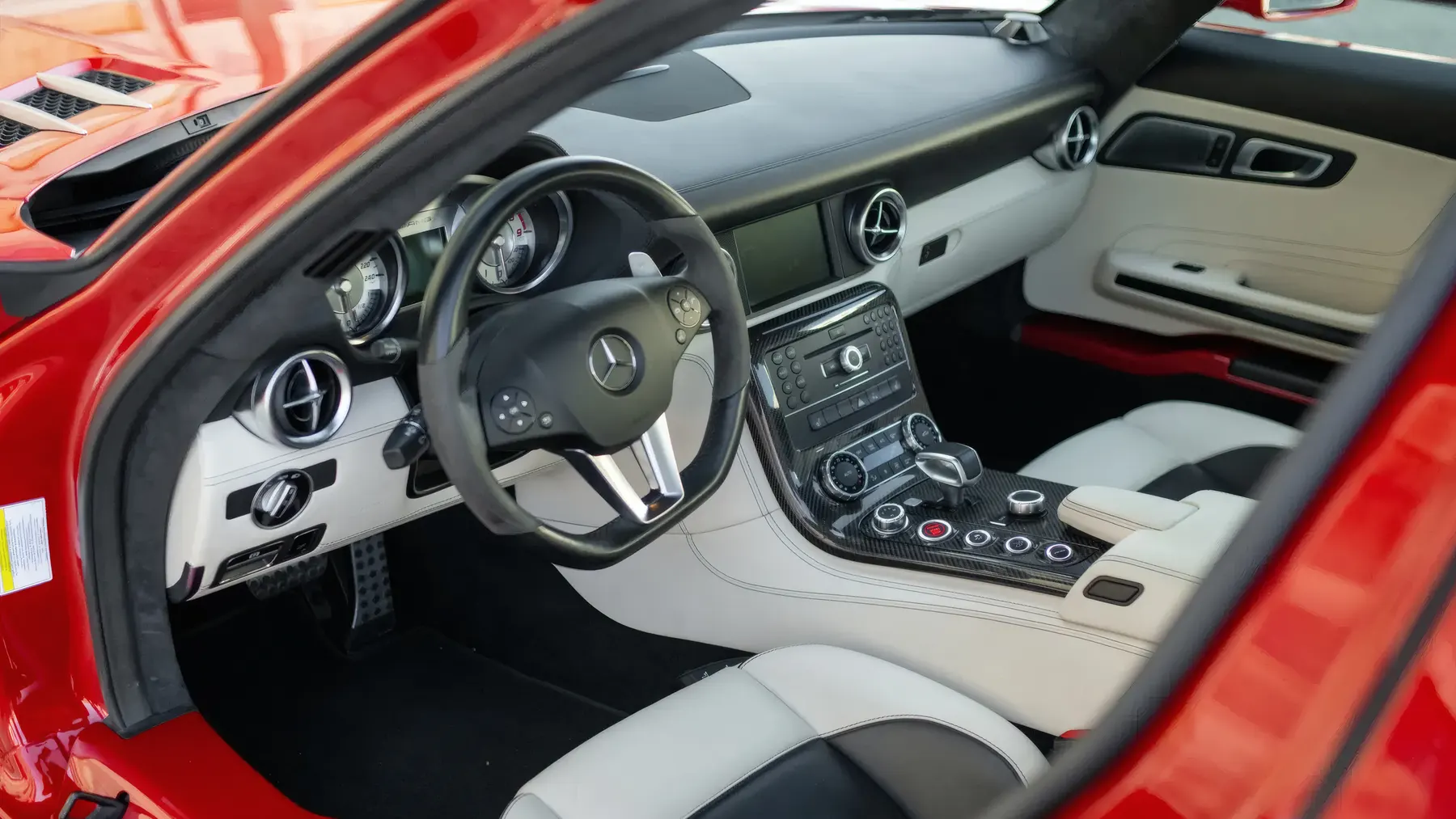
That gap between spectacle and feel runs through most of the car’s genuine weaknesses. Autocar’s testers were consistently unimpressed by a cabin that undercut the SLS’s six-figure price tag: the switchgear, stereo system and even the silver-effect dials were shared with far cheaper Mercedes models, leaving an interior they described as oddly ordinary for a flagship supercar. The standard cast-iron brakes, strong enough on the road, were reported to fade noticeably after only a few hard laps on track, pushing serious drivers toward the expensive carbon-ceramic option. Fuel economy told a similarly two-sided story: Mercedes’ claimed combined figure of around 22mpg proved achievable in gentle use, with Autocar recording 19.1mpg over a mixed test route, but that figure collapsed to 12.9mpg once track driving entered the picture, underlining that this was never a car built with running costs in mind. The unmotorised doors, whatever their weight-saving logic, made every entry and exit a minor athletic event, particularly for shorter drivers who had to grasp the door handle for balance while lowering themselves over a wide sill. And while most contemporary reviews were glowing, at least one retrospective account - from a journalist revisiting the SLS AMG Roadster years after his original test - concluded that the car’s dynamic thrills hadn’t aged as well in memory as its theatre had, arguing its charisma rested more on noise and drama than on the tactile engagement offered by its Italian and British rivals. Mercedes has never published a definitive worldwide production figure either, and the resulting uncertainty - specialist estimates put the combined coupé and roadster run somewhere in the region of 12,000 cars, though nobody can say for certain - hints at a car whose eventual demand may not have entirely matched the ambition, or the hype, that greeted its 2009 unveiling.
Mercedes never built a direct successor. When the SLS bowed out in 2014, it was replaced not by another naturally aspirated flagship but by the smaller, cheaper, turbocharged Mercedes-AMG GT, aimed more squarely at the Porsche 911 than at Ferrari or Lamborghini; AMG’s boss at the time, Tobias Moers, said plainly that the company had no plans to build another car in the SLS’s league. That makes the SLS AMG something of a full stop for a particular era of AMG ambition - the moment the division proved it could design and engineer an entire car, not merely rework someone else’s, and did so with a naturally aspirated V8 built one engine at a time by a single technician, at almost the exact moment the rest of the performance-car industry was turning to turbochargers. Its reputation among enthusiasts has settled somewhere between the two poles that defined its reviews: a car whose engineering, motorsport record and sheer visual drama were never seriously in doubt, but whose cabin, ride and outright emotional connection never quite matched the theatre written into its most famous feature.
Technical data
Specifications
| Variant | Power | Torque | 0-62mph | Top Speed | Kerb Weight |
|---|---|---|---|---|---|
| SLS AMG Coupe (2010) | 563bhp | 479lb-ft | 3.8-3.9 sec (claimed) | 196mph | 1,619kg |
| SLS AMG Roadster (2011) | 563bhp | 479lb-ft | ~3.9 sec (claimed) | 196mph | 1,659kg |
| SLS AMG GT (2012) | 583bhp | 479lb-ft | 3.4 sec (claimed) | 196mph | ~1,620kg |
| SLS AMG Coupe Black Series (2013) | 622bhp | 468lb-ft | 3.6 sec (claimed); 3.2 sec (Car and Driver test) | 196mph | 1,549-1,550kg* |
| SLS AMG Electric Drive (2013) | 740bhp | 738lb-ft | 3.9 sec (claimed) | not verified in sourcing | 2,110kg* |
Sources
- Mercedes-Benz SLS AMG - Wikipedia
- Used Mercedes-AMG SLS 2010-2015 review - Autocar
- Mercedes-AMG SLS first drive - Autocar
- 2012 Mercedes-Benz SLS AMG Review & Ratings - Edmunds
- 197 series SLS AMG Coupés, 2010-2014 - Mercedes-Benz Classic Archive
- Mercedes-Benz C197 SLS AMG Guide - Supercar Nostalgia
- Mercedes SLS AMG Buyers Guide - Romans International
- The Mercedes SLS AMG Roadster Was The Most Disappointing Performance Car I’ve Driven - Car Throttle
- Retro review: Mercedes-Benz SLS AMG Roadster - Top Gear
- 2013 Mercedes-Benz SLS AMG Black Series (C197) Specs, Performance & Photos - autoevolution
- Mercedes-Benz SLS AMG Buyers Guide and Review - Exotic Car Hacks
Join the discussion
Comments
Loading comments…
Leave a comment
Share a detail, memory, or perspective. Every comment is reviewed before publication.