Alfa Romeo Giulia TZ1: Obsolete on Arrival, Yet It Won Anyway
1965 Alfa Romeo Giulia TZ1

Images: Darin Schnabel / RM Sotheby's
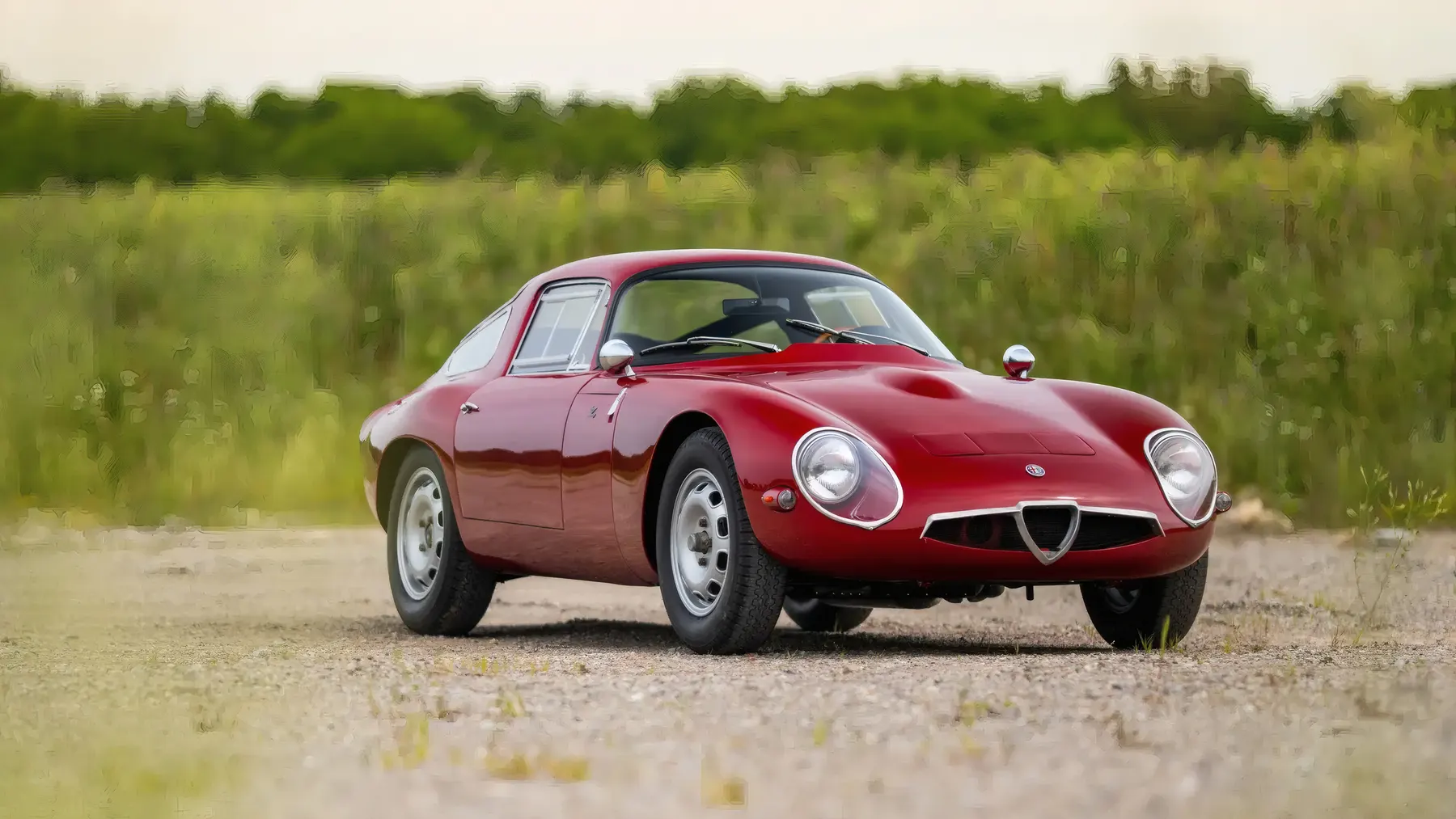
By the time the Alfa Romeo Giulia TZ1 finally reached a starting grid, the argument it had been built to win was already changing underneath it. Alfa Romeo spent the better part of four years developing a front-engined, tubular-chassised coupé at precisely the moment the rest of sports car racing was working out that the engine belonged behind the driver. That the TZ1 went on to beat faster, newer opposition anyway, repeatedly, says as much about Alfa’s engineering discipline in the early 1960s as it does about the car’s genuinely awkward place in automotive history: a technical dead end that still somehow worked.
The car’s roots lie in the Giulietta SZ, the small aluminium-bodied coupé Zagato built around Alfa’s Giulietta Sprint Speciale mechanicals from 1960. At 840kg against the 1,110kg of the standard Sprint Speciale it was based on, the SZ was startlingly light for the era, and it embarrassed far more expensive machinery in production-based racing, including a class win at the 1956 Mille Miglia in its earlier SVZ form. Its success posed an obvious question inside Alfa Romeo: if a lightly modified road car could do this well, what might a purpose-built racing chassis achieve? At the end of 1959 the answer was entrusted to Giuseppe Busso, one of Alfa’s most respected engineers, and the project that became the Tubolare Zagato was born.
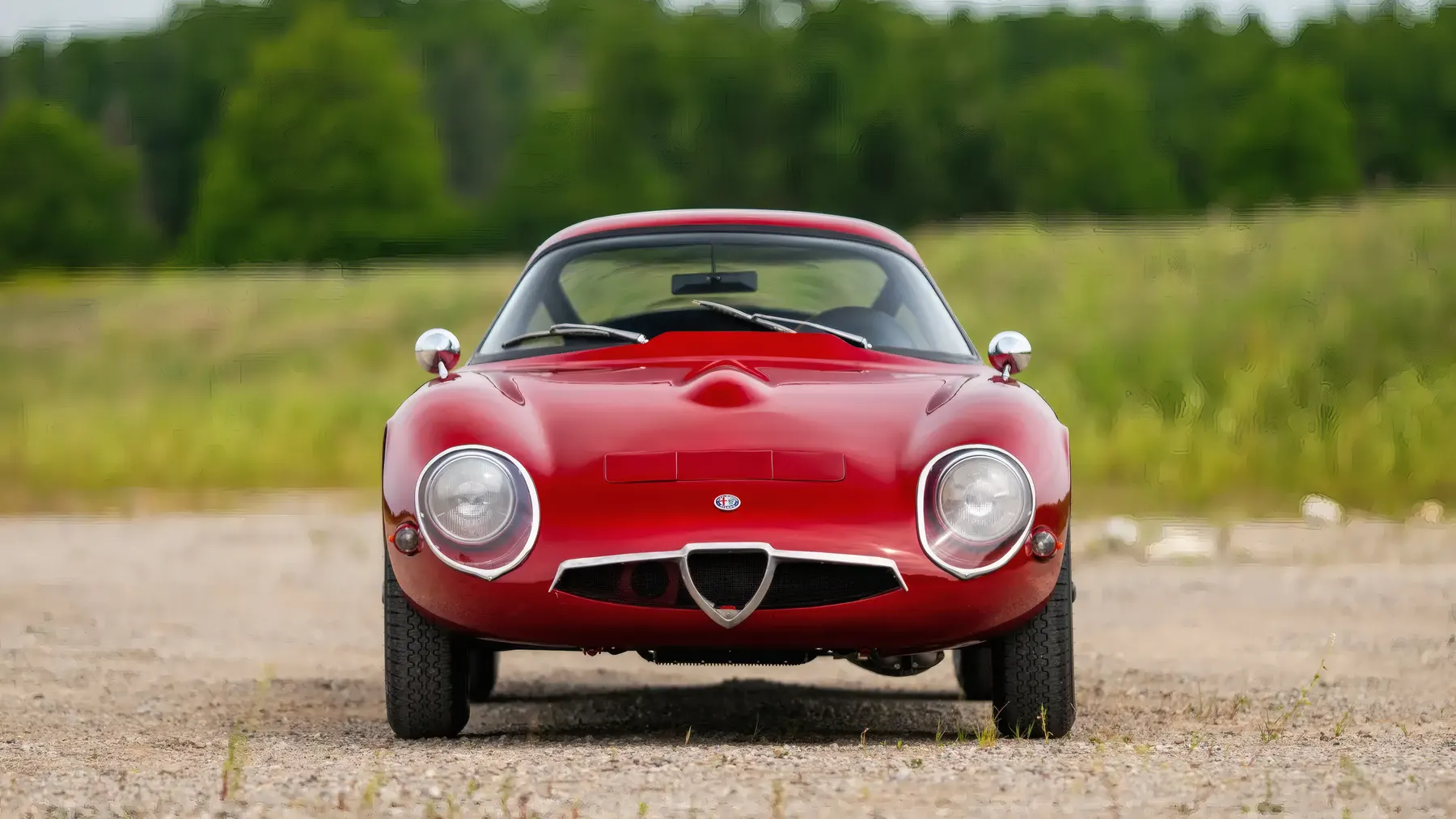
Busso’s brief was to start from nothing. Rather than adapting an existing Alfa platform as the SZ had done, his team built a completely new spaceframe chassis from small-diameter steel tubing, farmed out to the aircraft manufacturer SAI Ambrosini in Perugia, which brought the finished structure down to around 62kg. Suspension at the front was a conventional double-wishbone layout, but the rear broke new ground for Alfa Romeo entirely: a fully independent design using a lower wishbone with the driveshaft itself acting as the upper link, plus radius arms, in place of the SZ’s live axle. It was a genuinely sophisticated solution for a small European manufacturer in 1960, more advanced in fact than the live axle and leaf springs still doing service under Ferrari’s contemporary 250 GTO. Disc brakes were fitted at all four corners, with the rears mounted inboard to cut unsprung weight, and power came from a new 1,570cc twin-cam four being developed in parallel for the Giulia road saloon, canted over by 20 degrees in the chassis to keep the bonnet line as low as possible - a packaging trick that demanded a specially cast intake manifold and sump, and which left a visible bulge in the bonnet over one cam cover that became one of the car’s visual signatures.
None of this went smoothly. It took a full year simply to get a rolling chassis to Zagato, and when Alfa’s veteran test driver Consalvo Sanesi finally lapped an early open-topped prototype at Monza in late 1961, it couldn’t match the lap times of the SZ it was meant to replace - a genuinely alarming result for a car that was lighter, more sophisticated and carrying a larger engine. The problem was twofold: an aerodynamically poor open body shape, reportedly favoured early on by Busso himself, and a trick independent rear end that was, in this state of tune, making the car harder to drive rather than easier. Zagato’s young stylist Ercole Spada, barely into his twenties and already responsible for the SZ’s own bodywork and the Aston Martin DB4 GT Zagato, was set to work on a closed coupé body with a longer tail, drawing on pre-war German aerodynamic research into truncated, or “coda tronca”, rear-end shapes. The fix worked dramatically: Sanesi’s times fell from over two minutes to the low 1min 50s bracket, eventually settling some twelve seconds quicker than any SZ had managed, with the young Lorenzo Bandini also posting times in the 1min 53s range during the same test programme.
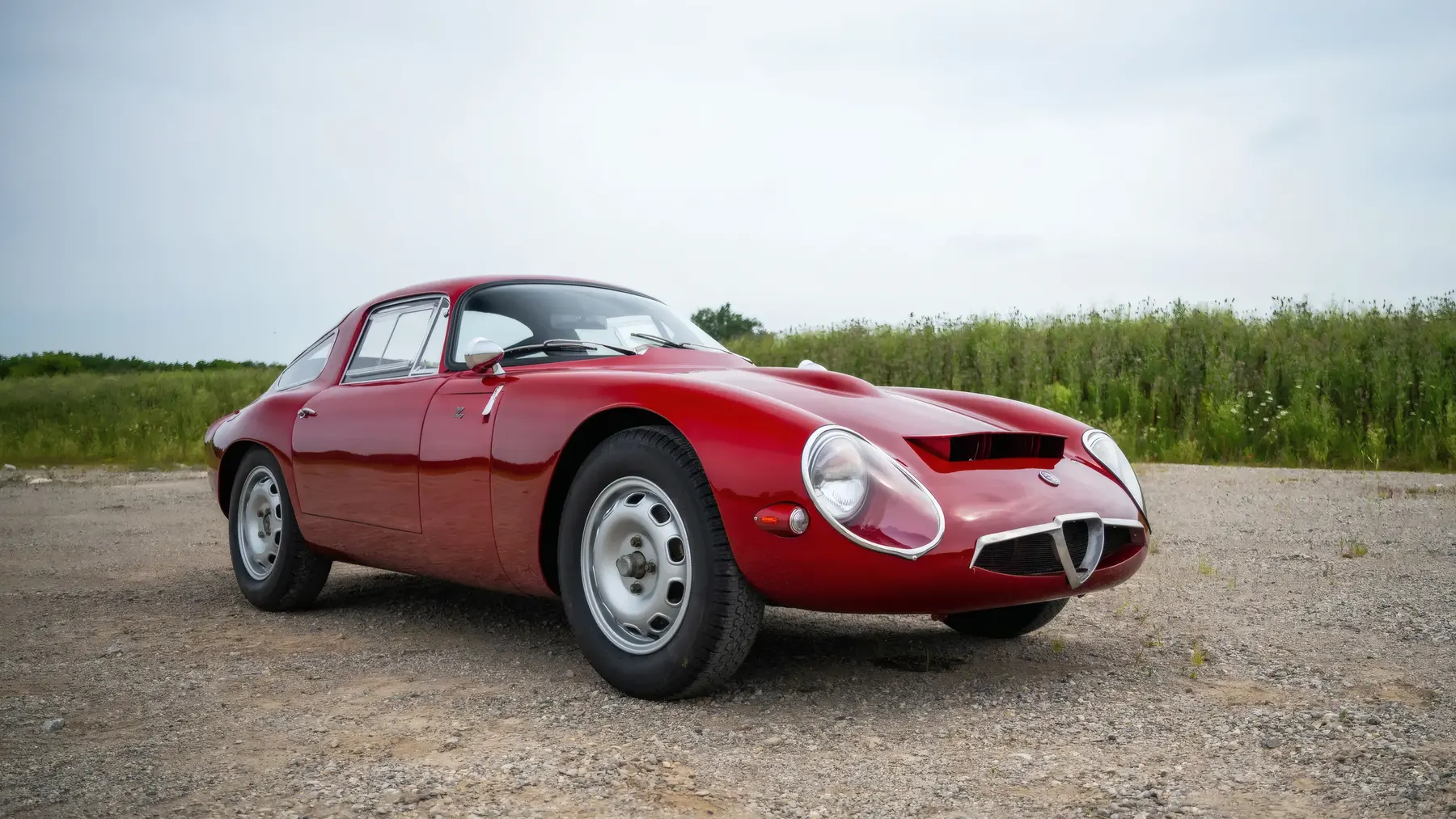
A finished prototype finally appeared at the Turin Motor Show in October 1962, badged Tubolare Zagato in reference to its tubular frame construction, though production would not start in earnest until March 1963. Rather than build the car in-house, Alfa spread the job across three specialists: SAI Ambrosini continued to supply the chassis, Zagato built the aluminium bodywork in Milan, and a small outfit called Delta, founded by ex-Ferrari engineer Carlo Chiti, handled engine preparation and final assembly. Delta was renamed Autodelta in March 1963 and would go on to become Alfa Romeo’s works competition department in its own right - arguably the TZ programme’s most lasting legacy, quite apart from the car itself. The TZ made its competitive debut at the Monza Coppa FISA in November 1963, where Bandini took a class win, and was formally homologated into the FIA’s Group 3 GT category on 14 January 1964, a category requiring a minimum production run of 100 examples. Sources differ on exactly how many were eventually built - figures of both 112 and 117 units appear in reasonably reliable accounts - but all were left-hand drive, and the final few cars swapped Zagato’s aluminium panels for lighter glassfibre items, foreshadowing the even more extreme TZ2 that followed in 1965.
Once homologated, the TZ1 delivered on the promise those early Monza test sessions had eventually shown. Through 1964 it collected class wins across the biggest sports car races on the calendar: the Sebring 12 Hours, the Nürburgring 1000km, the Le Mans 24 Hours, the Tour de France Automobile, and the Targa Florio, where it finished third outright overall, beaten only by two mid-engined Porsche 904s - a small but telling sign of where the sport was actually heading. Drivers including Bandini, Giancarlo Baghetti, Sanesi and Roberto Bussinello all won in the car, usually run by quasi-works outfits such as Scuderia Sant Ambroeus rather than the factory directly, since Alfa Romeo sold the TZ1 through its dealer network to genuine privateer customers rather than keeping the programme as an in-house works exercise. In road trim, with a single-plug head, twin Weber 45 DCOE carburettors and 9.7:1 compression, the engine produced a modest 112bhp at 6,500rpm and 98lb-ft at 4,200rpm; enthusiasts wanting more could specify a higher-compression tune worth around 140bhp, while the ultimate twin-plug racing versions, introduced from March 1965, are variously credited with anywhere from around 160 to 170bhp depending on the source. That spread of outputs was wide enough that period cars were fitted with a rev counter carrying no marked redline at all, since Alfa and Autodelta simply couldn’t guarantee what any individual engine’s safe limit was - a detail that still complicates precise identification of any given car’s original specification today. At just 660kg dry, even the milder examples were properly rapid, with a top speed commonly cited between around 133 and 140mph depending on gearing and state of tune, and buyers could specify from a wide range of final-drive ratios depending on whether a given car was destined for a tight circuit or a flat-out event like Le Mans.
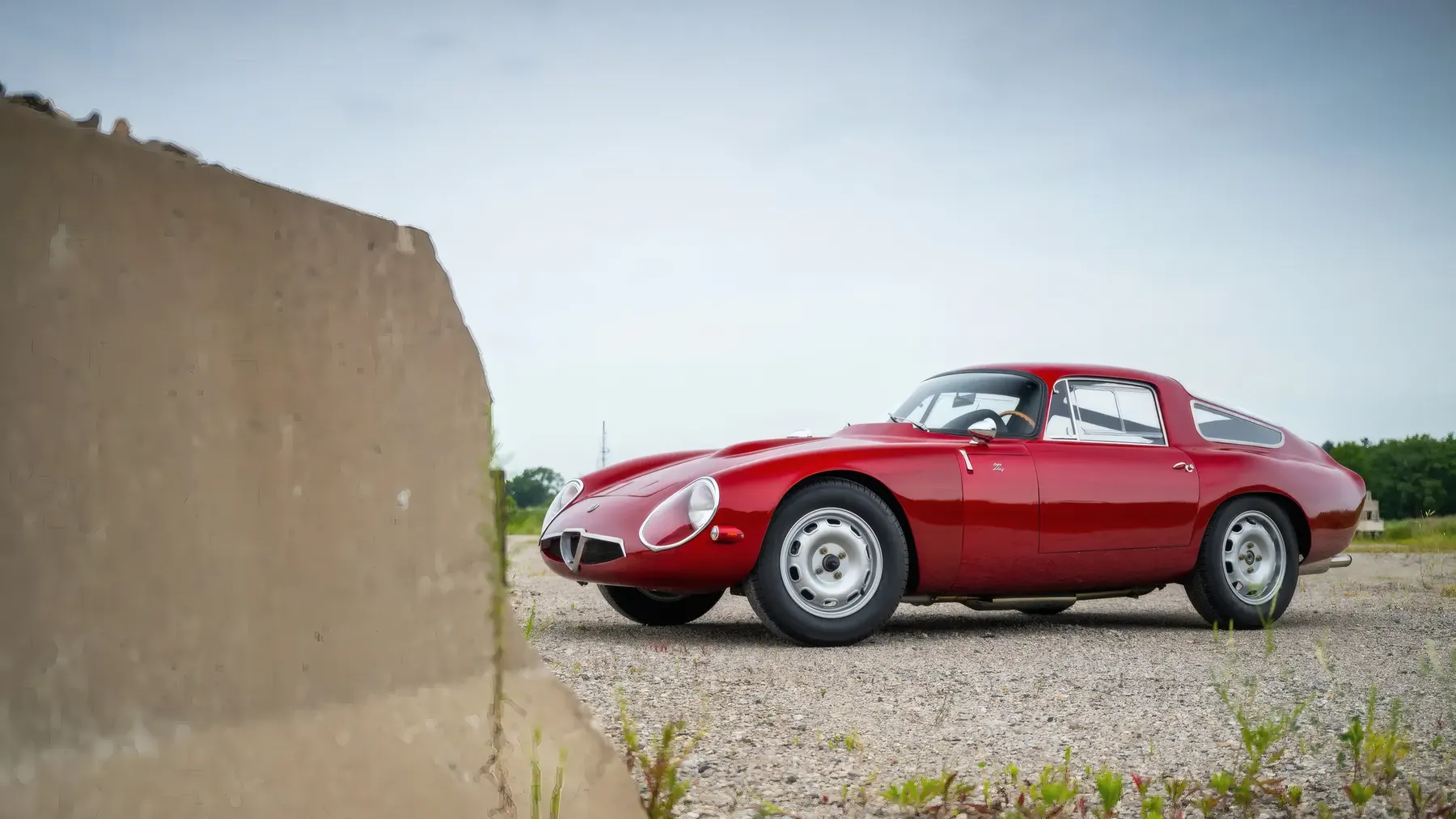
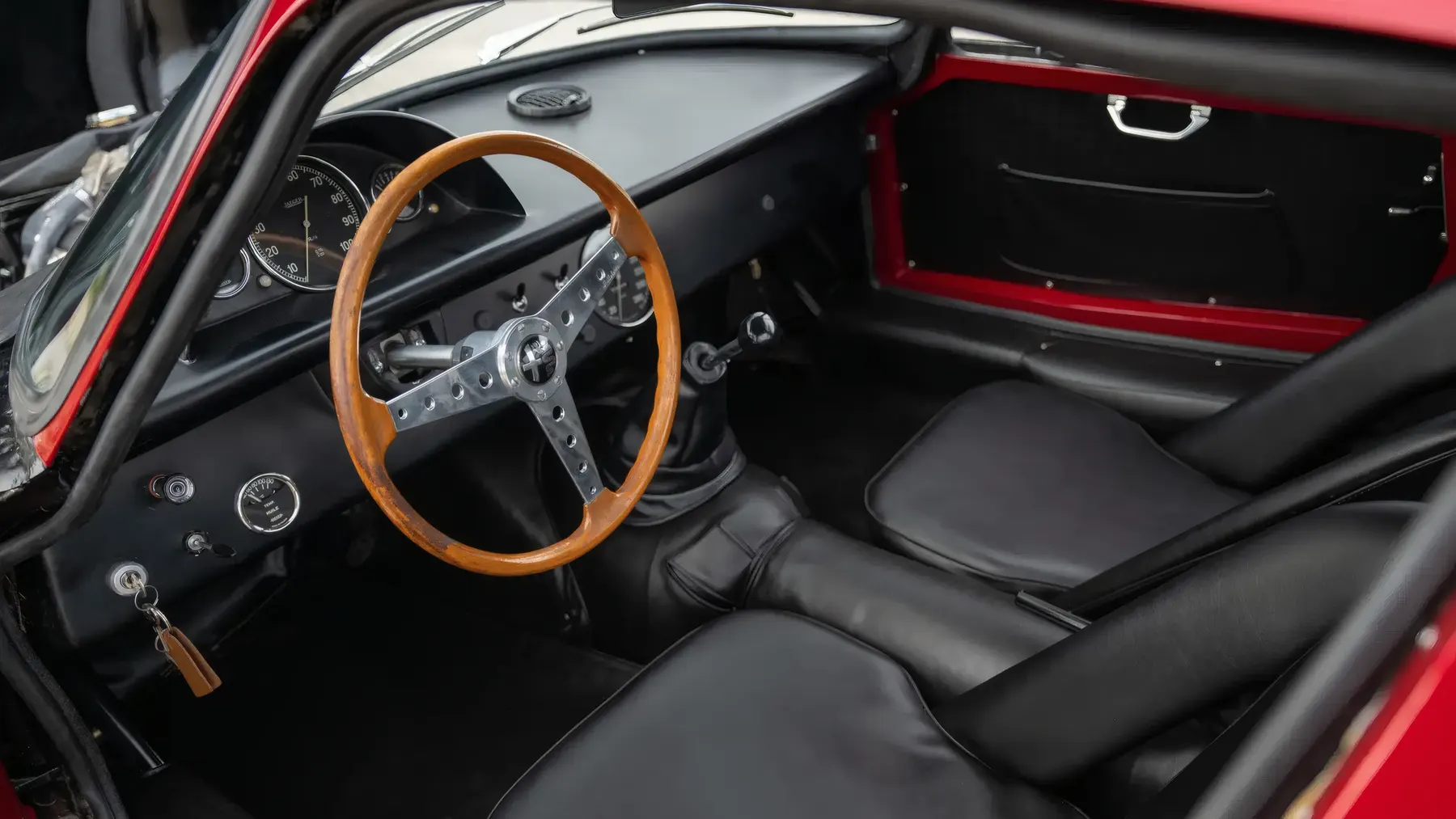
To drive, the TZ1 is an event before the engine even fires. Getting in is a project in itself - the sills sit high and the cabin is minuscule - though the driving position settles into something genuinely comfortable once you’re inside, framed by a wood-rimmed wheel and a large Jaeger rev counter dominating the dashboard. Everything about the experience is raucous and immediate: the twin-cam does very little below 4,500rpm and wants to be worked hard toward its near-8,000rpm limit, at which point the little four-cylinder produces genuinely startling performance for its size and era. The five-speed gearbox is unusually precise for a car of this vintage, and the chassis rewards commitment with flat, accurate cornering and steering that carries real feel through the wheel, tending toward a reassuring, controllable understeer at the very limit rather than anything nastier.
Set against all that ability sit some genuine, specific compromises that shouldn’t be waved away as period charm. The TZ1’s coupé roof does not open at the rear at all, which means the spare wheel has to be manhandled out through the doors and past the slim bucket seats - a real nuisance on a car nominally homologated as a road-legal GT rather than a pure racer. The speedometer, fitted because the car was road legal, sits directly above the gearlever and well away from the driver’s natural line of sight, an ergonomic afterthought on a car whose primary instrument was clearly meant to be the rev counter. Rearward and over-the-shoulder visibility is genuinely limited despite the elegant perspex fillets let into the tail, and the ride itself, tuned throughout for the track, is stiff enough that at least one modern road test has suggested it would benefit from real softening for everyday use - this was never a comfortable long-distance companion. More fundamentally, the entire front-engined, tubular-spaceframe concept the TZ1 represented was already being overtaken even as the car began winning: a mid-engined Porsche beat it outright at the Targa Florio in the very season the TZ1 was proving itself, and Alfa’s own engineers understood well enough that the layout had reached the end of its useful development. As a commercial proposition it barely existed outside racing circles at all - this was a homologation special built to legalise a competition car, not a road car that happened to race, and Alfa’s factory attention had already begun shifting to its successor before the TZ1’s own competition career had properly finished.
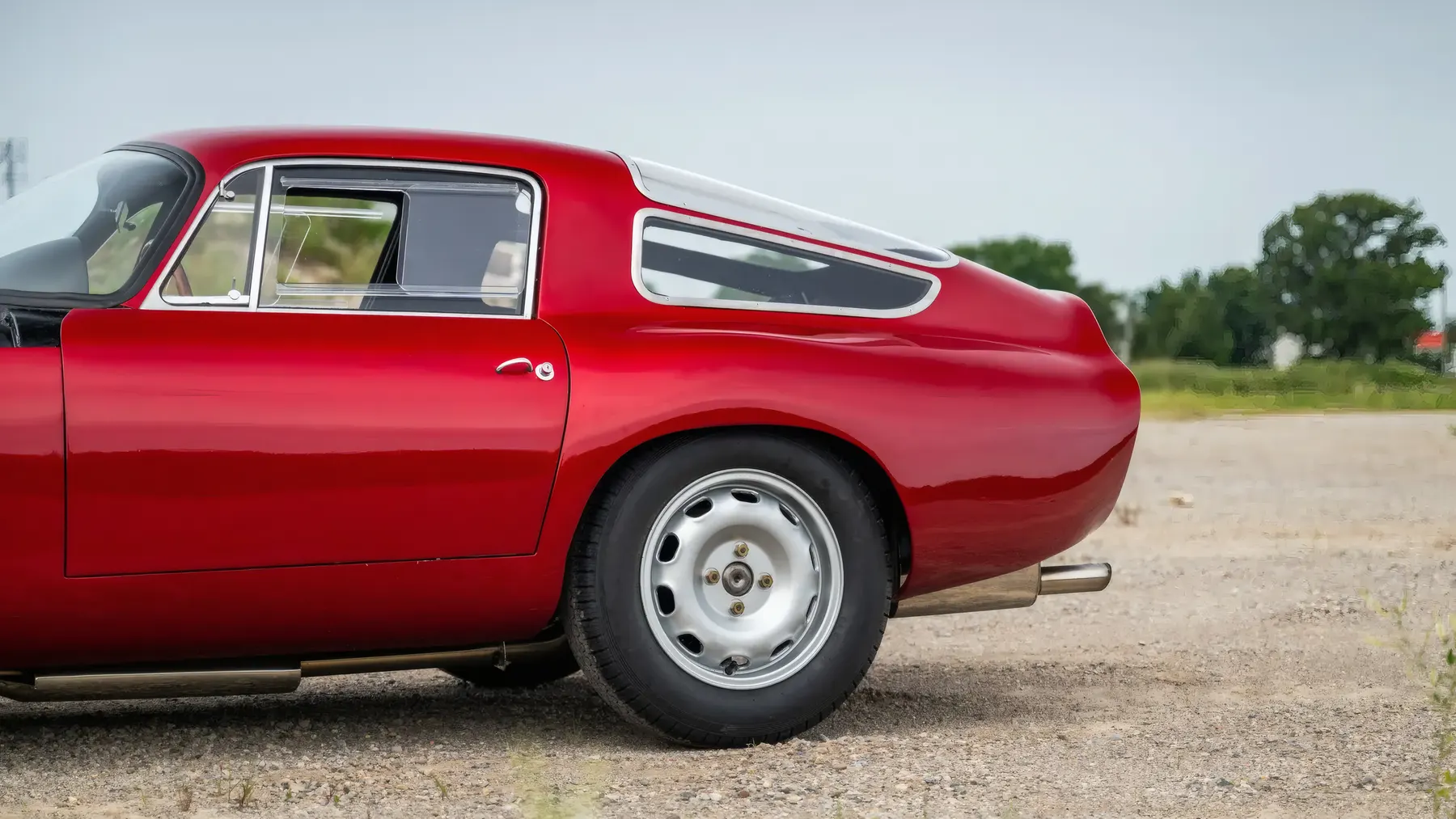
That successor, the TZ2, arrived at the 1965 Turin Motor Show wearing a lighter, more streamlined glassfibre body that brought weight down to around 620kg, paired with the same family of twin-plug, dry-sumped engines in their most powerful state of tune. Only around a dozen TZ2s were ever built, making it less a production model than a rolling prototype, but it continued the class-winning habit into 1966 at Monza, Sebring, the Nürburgring and the Targa Florio before Alfa’s competition ambitions moved on entirely. The real destination of all this development effort arrived in 1967 in the shape of the mid-engined Tipo 33, the car the TZ programme had effectively been proving the case against all along, which would itself evolve over the following decade into the flat-12 33TT12 that won the 1975 World Championship for Makes.
Judged purely on results, the Giulia TZ1 has a stronger case than its slightly awkward, in-between engineering position might suggest. It won consistently against genuinely quicker cars, it gave Alfa Romeo a serious competition department in Autodelta that would run the marque’s motorsport efforts on and off for years afterward, and it did all this on a fraction of the money and displacement of the “Baby GTO” comparisons still made about its Zagato-penned silhouette. Among collectors today it occupies a similarly specific niche: prized less as a comfortable classic to be driven casually than as a genuinely usable, historic-race-eligible piece of engineering history, still welcome at events like the Le Mans Classic and the Tour Auto more than six decades on. But its real significance sits less in any individual result and more in its position as the last serious front-engined expression of Alfa’s sports-racing ambitions - a beautifully resolved answer to a question the sport itself was already moving past, built by engineers sharp enough to know it, and to start building its replacement before the TZ1 had even finished proving what the old layout could still do.
Technical data
Specifications
| Specification | TZ1 – road (“Stradale”) | TZ1 – competition, high-compression | TZ1 – competition, twin-plug | TZ2 (for comparison) |
|---|---|---|---|---|
| Production years | 1963–1965 | 1963–1965 | from March 1965 | 1965–1966 |
| Engine | 1,570cc DOHC I4, single-plug head, twin Weber 45 DCOE, 9.7:1 compression | as road spec, 11.4:1 compression | 1,570cc DOHC I4, twin-plug head, dry sump | 1,570cc DOHC I4, twin-plug head, dry sump |
| Power | 112bhp @ 6,500rpm | approx. 140bhp* | 160–170bhp* | approx. 170bhp* |
| Torque | 98lb-ft @ 4,200rpm | not reliably documented | not reliably documented | not reliably documented |
| Kerb weight | 660kg | 660kg | 660kg | approx. 620kg |
| Top speed | approx. 133–134mph* | not reliably documented | up to approx. 140mph* | not reliably documented |
| Gearbox | 5-speed manual | 5-speed manual, multiple final drive ratios available | 5-speed manual | 5-speed manual |
| Chassis | Tubular steel spaceframe, approx. 62kg | as road spec | as road spec | as road spec, lighter glassfibre body |
Sources
- Motor Sport Magazine – “Test Drive: Alfa Romeo TZ” by Andrew Frankel
- RM Sotheby’s – 1965 Alfa Romeo Giulia TZ1, Monterey 2024
- FIA Historic Database – Giulia TZ Homologation Record
- Wikipedia – Alfa Romeo Giulia TZ
- Classic Driver Magazine – “Alfa Romeo TZ1: The ‘Baby GTO’”
- Coachbuild.com – Zagato Alfa Romeo Giulia TZ1
- Supercar Nostalgia – Guide: Alfa Romeo Giulia TZ
- Girardo & Co – 1964 Alfa Romeo Giulia Tubolare Zagato
- Magneto Magazine – How Designer Ercole Spada Designed the SZ and TZ Alfa Romeos
- Classic Driver Magazine – “The Wonderful World of Ercole Spada”
Join the discussion
Comments
Loading comments…
Leave a comment
Share a detail, memory, or perspective. Every comment is reviewed before publication.