Mercedes-Benz CLK DTM AMG Cabriolet: A DTM Racer Without a Roof
2005 Mercedes-Benz CLK DTM AMG Cabriolet

Images: William Walker / RM Sotheby's
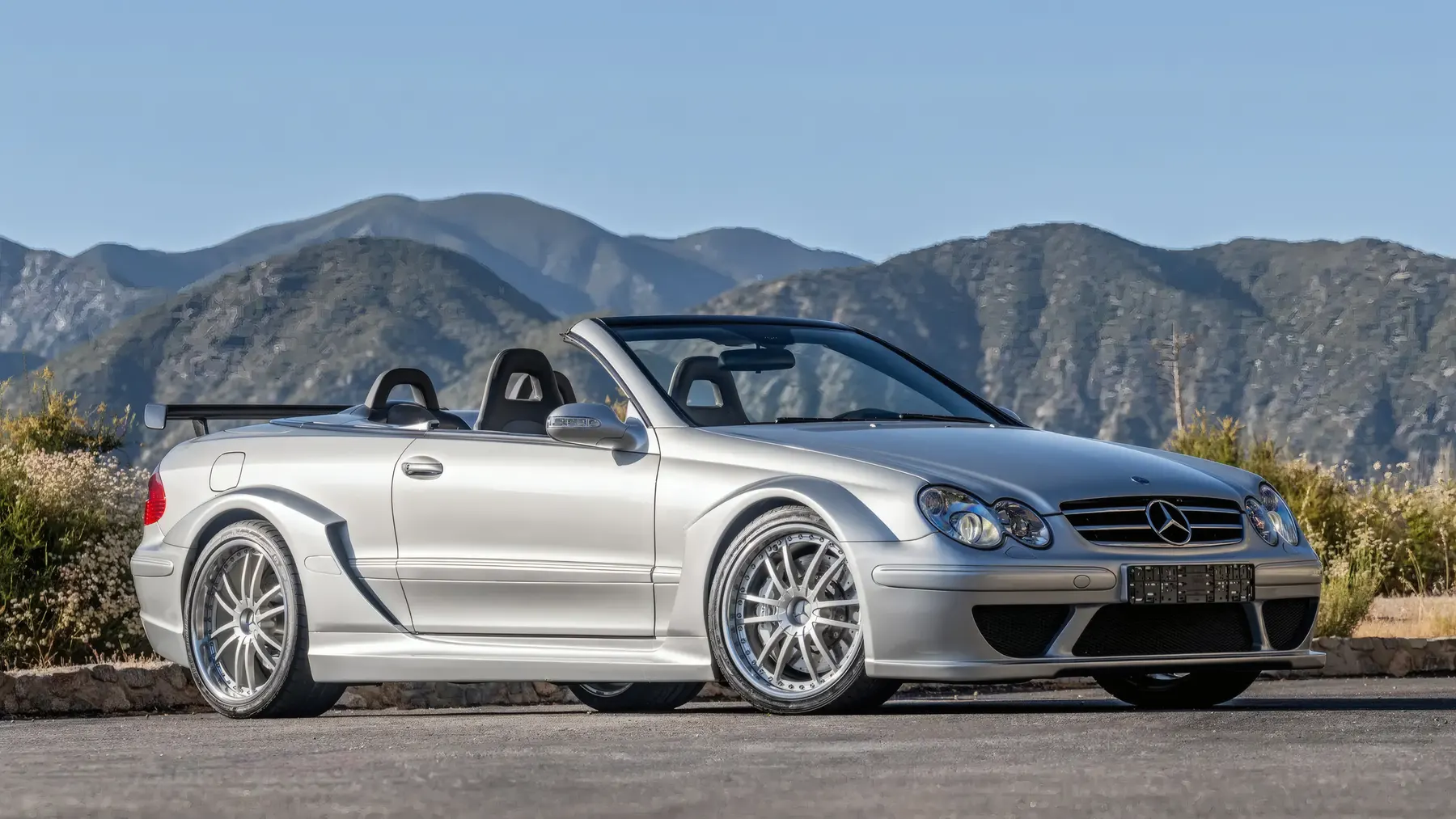
When AMG’s engineers signed off on the CLK DTM AMG coupé in 2004, they built the entire car around things a convertible cannot have: a fixed roof to brace the structure, a stripped-out cabin to save weight, and a silhouette lifted wholesale from a touring car that was never meant to flex. Two years later, having watched all 100 coupés disappear within weeks of an invitation-only sale, AMG did the thing its own engineering logic argued against and built a soft-top version anyway. The result was the CLK DTM AMG Cabriolet, arguably the least likely follow-up to a homologation-flavoured supercar that Mercedes-Benz ever greenlit, and one of the rarest, angriest open-top cars to wear the three-pointed star.
The “DTM” in the name is not a marketing flourish. It refers directly to the Deutsche Tourenwagen Masters, the German touring car series that returned in 2000 with silhouette-bodied, tube-framed racers wearing the skins of production saloons and coupés. Mercedes-AMG’s entry wore CLK bodywork over a carbon-and-steel racing structure, built and run by HWA, the Affalterbach-based motorsport outfit that has handled Mercedes’ DTM programme for decades. Bernd Schneider, already a multiple champion from the DTM’s earlier incarnation, took the title in the CLK-DTM racer in 2000 and 2001, was runner-up in 2002, and won again in 2003 - his fourth championship overall and third specifically with the CLK. It’s worth noting that nothing in the DTM’s regulations of that era required Mercedes to sell a single road car off the back of any of it; unlike the Group A homologation specials of the 1980s, this was a voluntary exercise in turning championship glory into a very expensive, very exclusive product line, not a rulebook obligation.
AMG and HWA built that road car first as a fixed-roof coupé, unveiled in 2004 and limited to 100 units, sold by invitation at a list price of around €236,000 and gone almost immediately; roughly 40 of those were built in right-hand drive, and reported early buyers included Formula 1 drivers Jenson Button, Kimi Räikkönen and Takuma Sato. The demand for that car is what pushed AMG toward a Cabriolet, which followed for the 2006 model year, with deliveries beginning in the first half of that year and continuing into 2007. Production of the Cabriolet was capped at 80 cars - twenty fewer than the coupé - sold, like the coupé, only in European markets, hand-assembled through the same AMG-and-HWA arrangement rather than through Karmann, the Osnabrück coachbuilder that built standard A209 CLK convertible bodies (the CLK Cabriolet, as a model line, would in fact be among the last complete cars to leave Karmann before that historic coachworks closed in 2009). Right-hand-drive Cabriolets were rarer still: only around six were built, which meant most buyers in the UK and other right-hand-drive markets were effectively shut out. Reported Cabriolet owners have included the Formula 1 drivers Juan Pablo Montoya and Mika Häkkinen. Curiously, Mercedes’ own original press materials describe the Cabriolet itself as “a limited edition of 100,” seemingly reusing or misquoting the coupé’s figure; that error appears to have followed the cars into the metal, since surviving Cabriolets are reported to carry a centre-console plaque reading “one of 100” rather than the correct “one of 80.” List prices reported at the time range from roughly €230,000 to €277,820 including German VAT, depending on source and market - nearly double what a standard CLK 55 AMG Cabriolet cost.
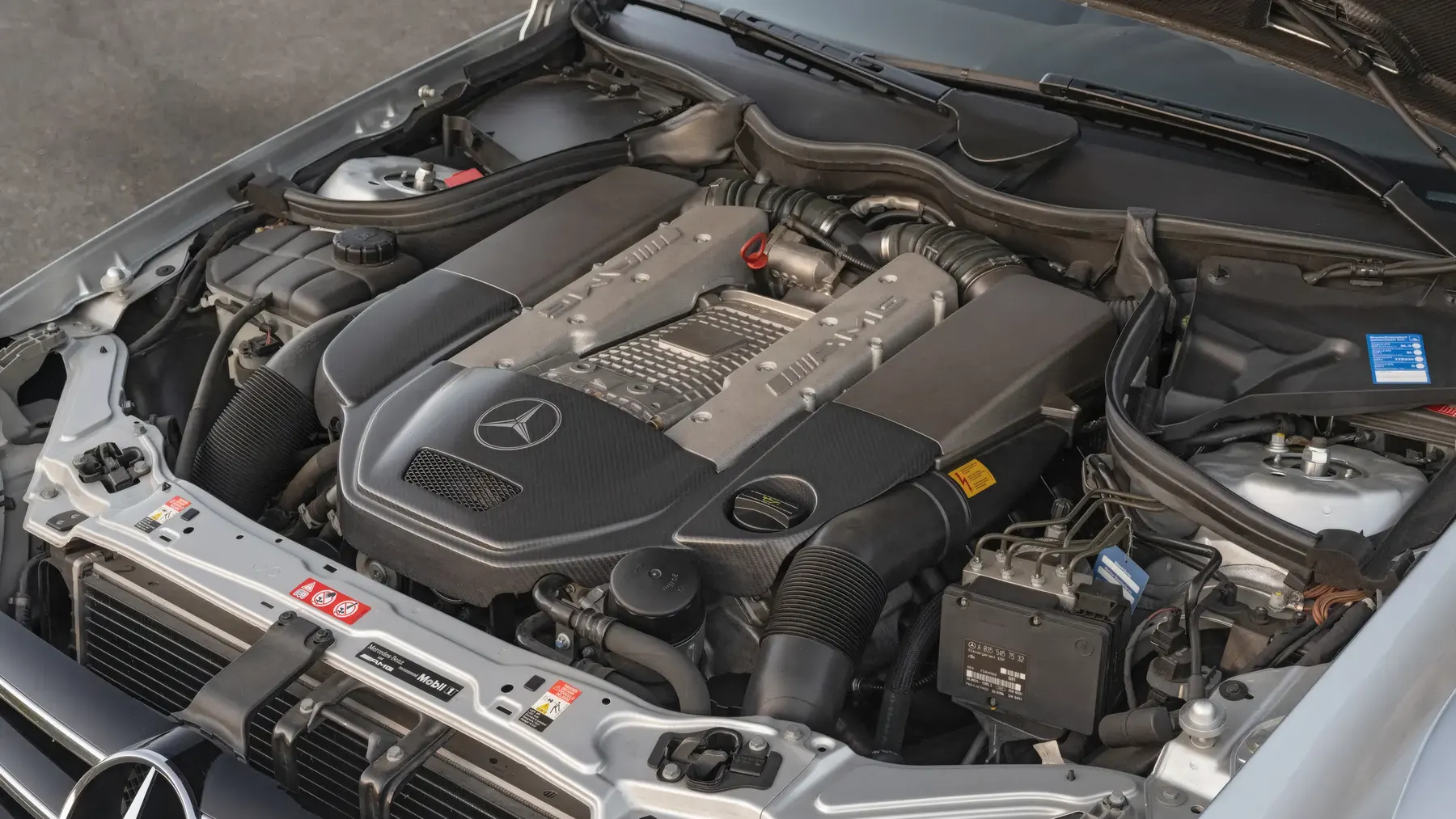
Under that flared bonnet sits a heavily reworked version of AMG’s familiar supercharged 5.4-litre V8, internally coded M113K. The basic architecture - a SOHC, three-valve-per-cylinder aluminium block with a Roots-type supercharger - was shared with other AMG products of the era, but the DTM-spec engine received its own crankcase, pistons, valve gear, cooling circuit, intake manifold, supercharger and exhaust system. The result, at 5,439cc, 97mm bore and 92mm stroke, with a 10.5:1 compression ratio, was 574 bhp at 6,100rpm - 582 PS, the figure AMG itself used in period marketing - and 590 lb-ft of torque from 3,500rpm, revving to around 7,000rpm. Drive went through a five-speed AMG SPEEDSHIFT automatic transmission, changed via paddles on the steering wheel, and on to the rear wheels through a mechanical limited-slip differential. Mercedes quoted a 0–62mph time of around 4.0 seconds for the Cabriolet - a fraction behind the lighter coupé, which is generally reported at closer to 3.8–3.9 seconds - and, because the fabric roof structure couldn’t be trusted with the coupé’s full 199–200mph, the Cabriolet’s top speed was electronically capped at 186mph, still enough for Mercedes to market it at launch as the fastest open-top four-seater then in regular production.
The chassis was reworked to match. Height-adjustable, coil-over-style suspension replaced the standard car’s set-up; the rear axle got new spring links and wheel carriers along with reinforced driveshafts, while uni-ball joints took over from the usual rubber bushings on both axles for sharper, more consistent geometry under load. Acceleration skid control and the Electronic Stability Program were both recalibrated for the extra performance rather than simply carried over. Stopping power came from a bespoke high-performance braking package: 360mm front discs gripped by six-piston fixed calipers, with 330mm discs and four-piston calipers at the rear, tucked behind forged 19-inch front and 20-inch rear AMG alloy wheels wearing wide, low-profile performance rubber - 285-section tyres at the rear alone gave a sense of how much grip AMG was chasing.
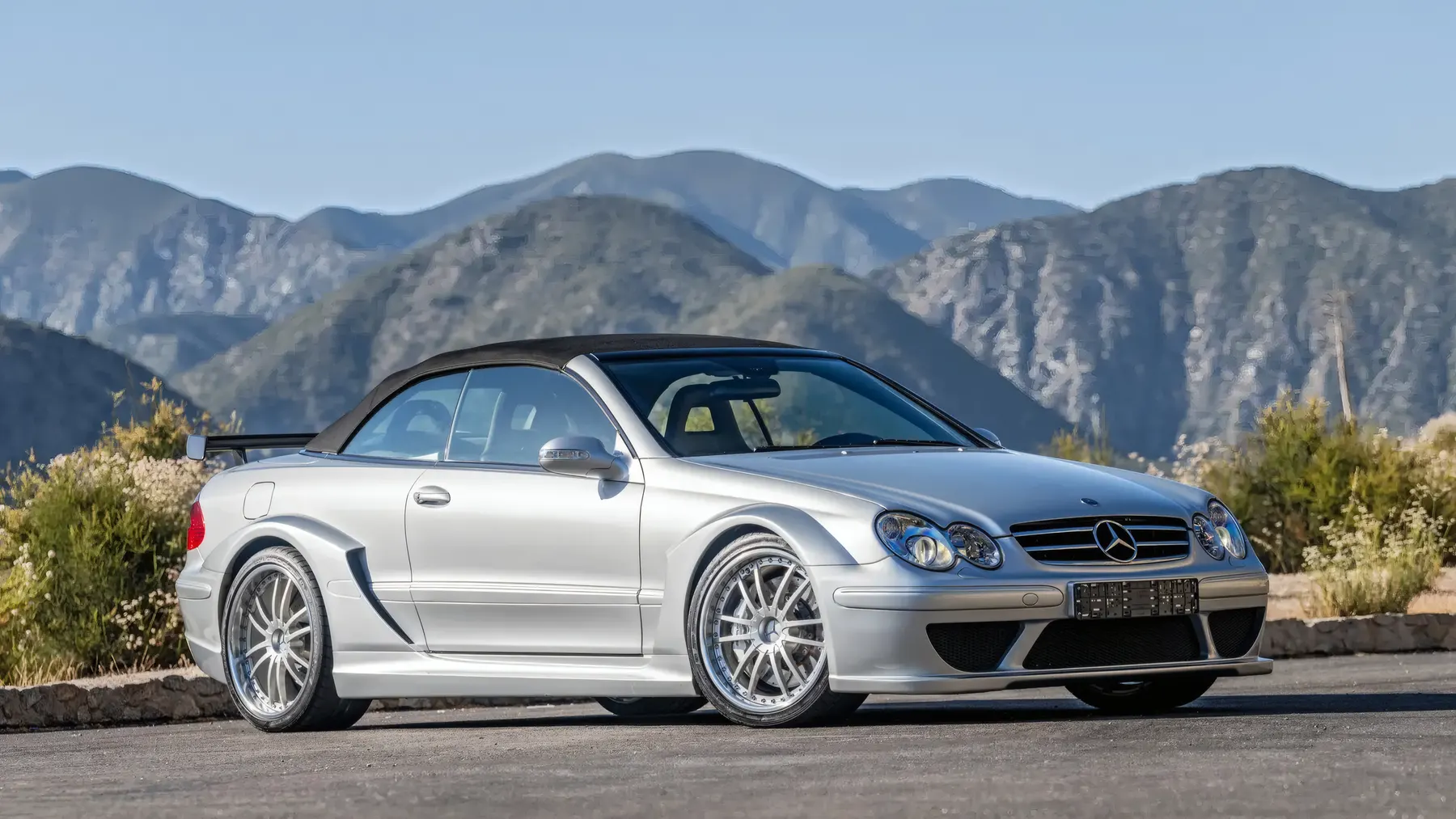
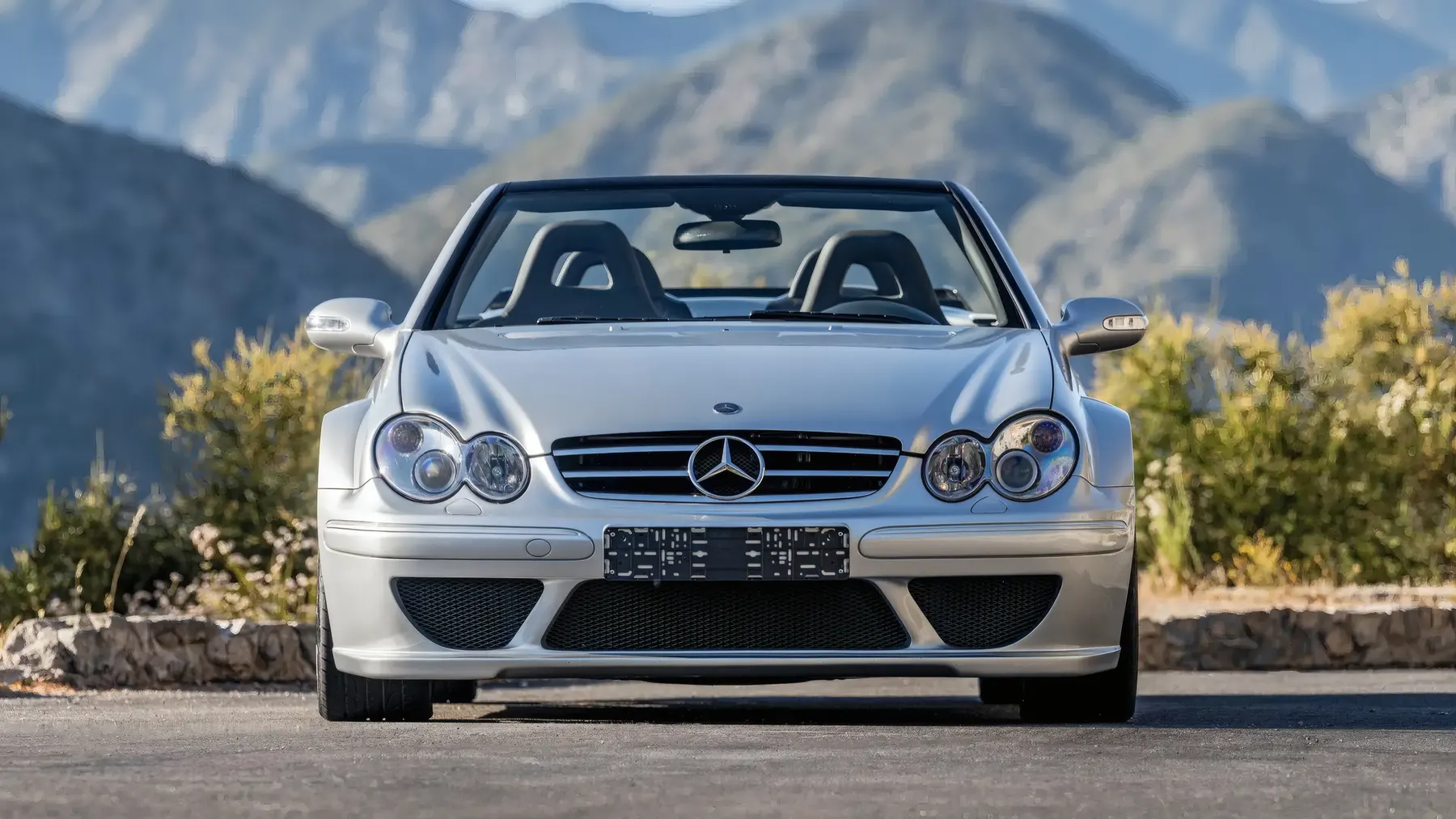
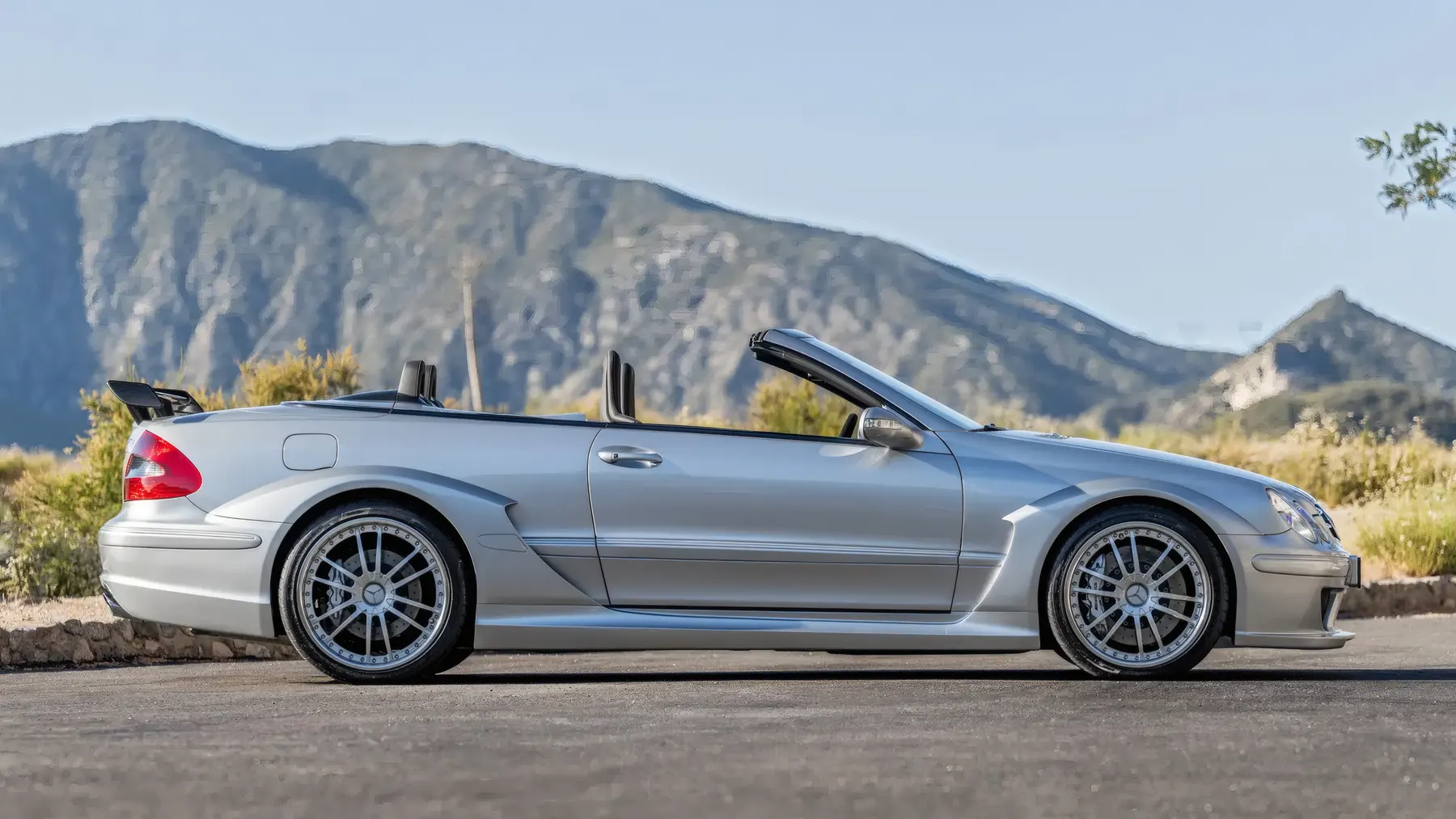
Visually, none of this was subtle. The DTM bodywork widened the car by roughly 60mm on each side over a standard C209 CLK, with a deep-drawn front apron and enlarged air intakes, dramatically flared wheel arches, and a diffuser-style rear treatment finished off by a fixed, boot-mounted aerofoil - a direct, unapologetic lift from the actual DTM silhouette racer’s proportions. Bonnet, doors, front wings, the flared rear arches and the wing itself were all moulded in carbon-fibre-reinforced plastic to keep weight in check. It’s a look that still divides opinion today: some see a faithful, purposeful translation of a race car onto the road; others find the standard CLK’s clean, understated grand-tourer lines rather better resolved than this aggressively arched, appendage-heavy reinterpretation of them.
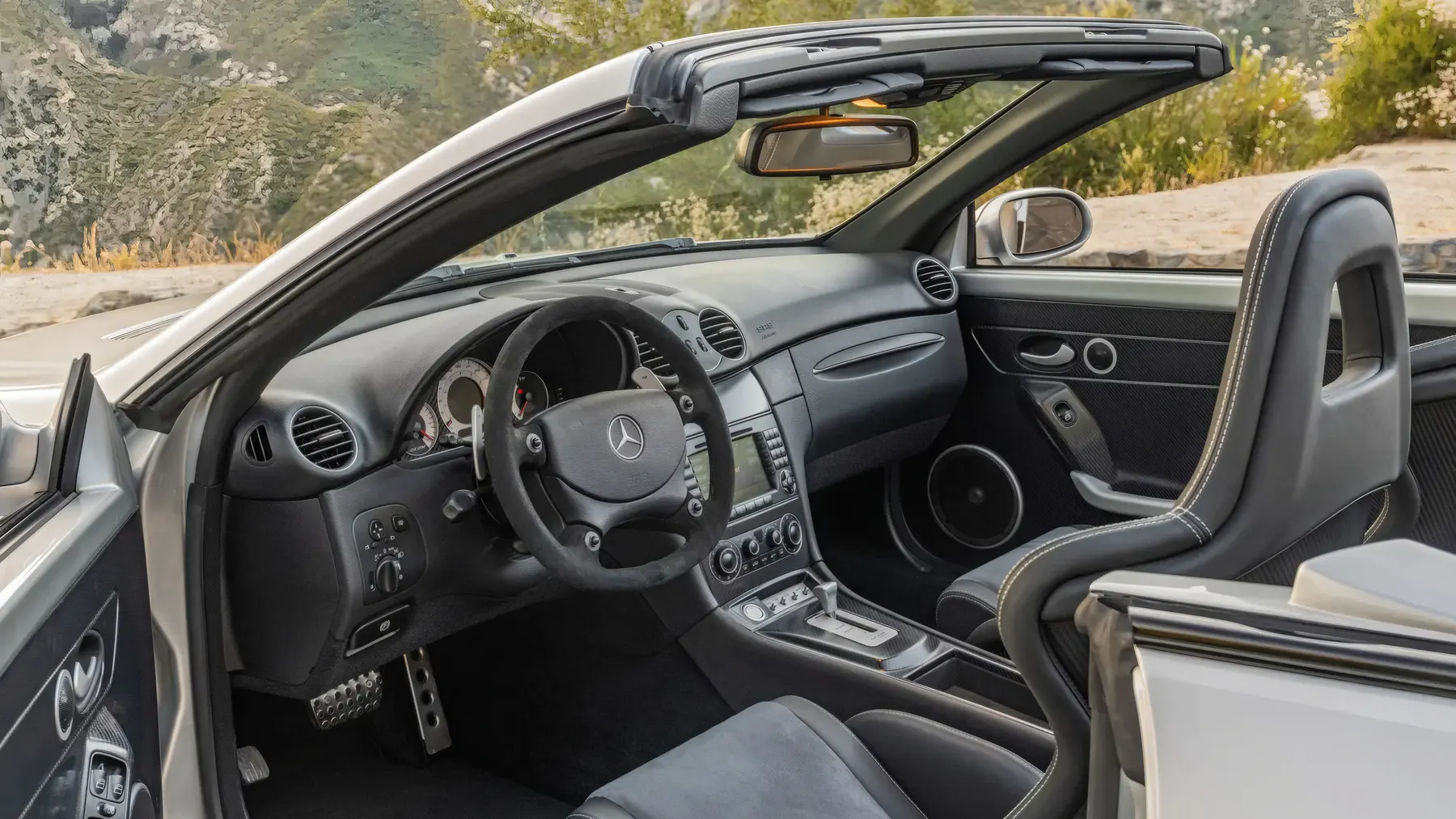
Inside, the racing theme continued with a similarly firm hand. AMG’s carbon-shelled bucket seats, trimmed in leather and Alcantara, replaced the standard front chairs, while an oval, buckskin-wrapped AMG steering wheel carried the shift paddles ahead of an instrument cluster scaled to a 360km/h speedometer. Carbon-fibre trim spread across the door panels, centre console and instrument surrounds. Here the Cabriolet actually diverged from its fixed-roof sibling in a way that’s easy to miss: the coupé deleted its rear seats altogether, replacing them with a structural cross-brace to help claw back some of the rigidity a pillarless coupé shell gives up, whereas the Cabriolet kept a rear seat, albeit a deeply sculpted, thinly padded carbon-fibre bench rather than the standard car’s cushioned pair. That made the Cabriolet, rather than the coupé, the one that could genuinely carry four - one of the more counter-intuitive quirks of the pair, since the open car is usually the one asked to sacrifice practicality, not gain it.
On the road, period impressions of the closely related coupé - mechanically all but identical to the Cabriolet bar the roof and its structural consequences - described a car that could behave itself completely at low speeds: a quiet idle, a light, undramatic automatic gearbox, steering that didn’t demand effort, and a ride that, despite the stiffened suspension, rarely jarred. The moment the throttle opened, that changed entirely. The supercharged V8’s lack of turbo lag meant response was immediate rather than building, with a deep, bassy soundtrack and enough shove to make the five-speed gearbox’s relatively low ratio count feel almost old-fashioned in the best way - easy to keep track of, rather than hunting through eight or nine ratios. The reworked suspension and quicker, higher-geared steering were reported to resist understeer strongly, with lateral grip approaching 1.35g, though the big 19-inch front wheels were also noted as limiting steering lock more than most testers would like. In Cabriolet form, with roughly 120kg of extra structure and mechanism over the coupé and 14mph shaved off the top end by the soft top’s limits, some of that razor-edged focus would inevitably have been softened in exchange for open-air theatre - the classic convertible trade, made explicit on a car whose entire concept had been engineered around not needing to make that trade at all.
That trade-off is, in fact, the clearest way to understand where the CLK DTM AMG Cabriolet falls short, and it’s worth being specific rather than simply noting that a hardcore special loses something when you cut its roof off. Structurally, the Cabriolet gave up real performance for its open top: top speed fell by roughly 14mph compared with the coupé, kerb weight climbed by an estimated 120kg or so, and torsional stiffness - never officially quoted for either body style, but an unavoidable consequence of removing a car’s roof structure - was inherently compromised relative to a shell designed from the outset as a fixed-roof racer’s road-going twin. The five-speed automatic transmission, while mechanically honest and well suited to the engine’s torque, was already beginning to look dated by 2006 against the six- and seven-speed transmissions rivals were introducing, and no manual gearbox was ever offered. Some contemporary road testers also found the cabin’s switchgear - toggle-style buttons and a scattering of what one reviewer likened to components from an electrical supplier - an oddly unglamorous touch for a car costing a quarter of a million euros, carbon-fibre trim notwithstanding. The rear seats themselves, while retained on the Cabriolet unlike on the coupé, were thin, minimally padded carbon-fibre shells rather than genuinely usable perches for grown adults on anything but short journeys. And the tiny right-hand-drive run of around six cars locked most buyers outside continental Europe out of ownership entirely. There was even a small, telling quality slip in the finished cars themselves: the “one of 100” plaques fitted to Cabriolets that were, in fact, one of only 80. None of this makes the car any less extraordinary on its own terms, but it does mean the Cabriolet asked a genuine premium - in weight, in outright pace, in everyday usability - for the experience of doing all of the above with the roof down.
The CLK DTM AMG Cabriolet’s place in AMG’s story is really about timing as much as specification. It arrived at a moment when Mercedes-AMG was shifting from building fast versions of showroom cars toward building genuinely uncompromising, motorsport-referencing limited runs sold on rarity and spectacle as much as outright ability - a template the marque would refine further, and take even further from the road-car mainstream, with the naturally aspirated, even more stripped-out CLK 63 AMG Black Series that followed a year or two later. Unlike that car, the DTM Cabriolet kept the old-school supercharged character that AMG would soon move away from, and it did so in a production run so small - 80 cars, European market only, a handful in right-hand drive - that it remained something of a footnote for years even among Mercedes enthusiasts, its market values notably slower to catch up with its rarity than those of some more feted contemporaries. That’s changed more recently, as low-mileage examples have begun commanding six-figure sums befitting a car built in numbers smaller than most people’s imagination of “limited edition.” What it represents, more than any single number in its specification sheet, is a moment when AMG let a customer waiting list talk it into building the version of a race-car homage that its own engineering brief said shouldn’t exist.
Sources
- Supercars.net: 2006 Mercedes-Benz CLK DTM AMG Cabriolet
- RM Sotheby’s: 2006 Mercedes-Benz CLK DTM AMG Cabriolet, Paris 2025
- autoevolution: 2006 Mercedes-Benz CLK DTM AMG Cabriolet (A209)
- Wikipedia: Mercedes-Benz CLK-Class (C209)
- Autocar: 2004 Mercedes-Benz CLK DTM AMG – driving a legend
- Top Gear: Five reasons why you need this Mercedes-Benz CLK DTM AMG
- MercedesHeritage: Mercedes AMG CLK DTM Coupe/Cabriolets
- MBWorld: Ultra-Rare RHD Mercedes-Benz CLK DTM AMG Could Fetch a Fortune
- CarBuzz: The Angriest AMG Convertible Ever Made Is Also One Of The Rarest
- Mercedes Blog: Mercedes CLK DTM AMG Cabriolet with only 152 km on board is for sale
- Netcarshow: Mercedes-Benz CLK DTM AMG Cabriolet (2006)
- Wikipedia: Bernd Schneider (racing driver)
Join the discussion
Comments
Loading comments…
Leave a comment
Share a detail, memory, or perspective. Every comment is reviewed before publication.