Mercedes-Benz CLK GTR Roadster: A Homologation Racer Without a Roof
2002 Mercedes-Benz CLK GTR Roadster

Images: Neil Fraser / RM Sotheby's
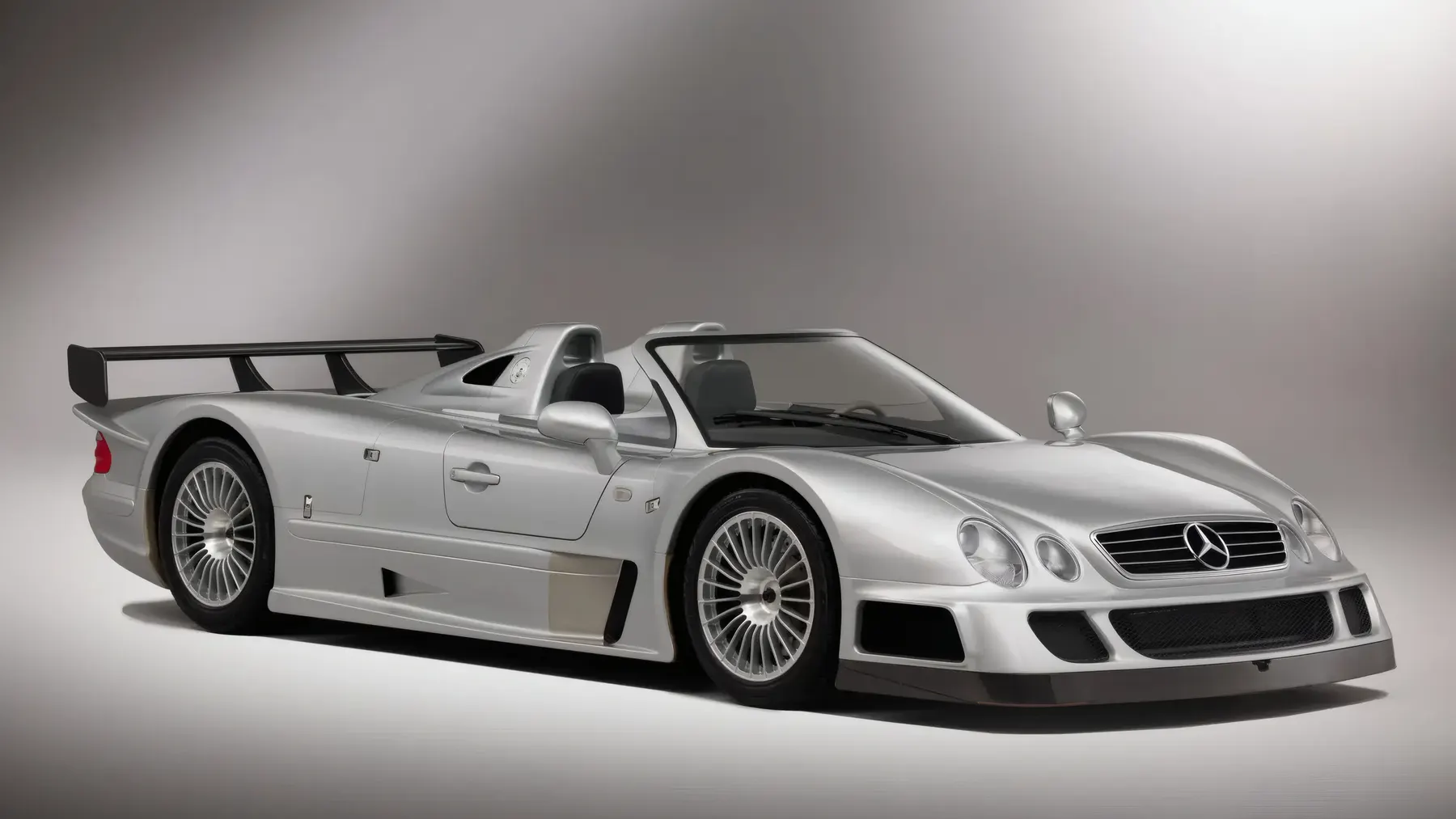
Cutting the roof off a car is normally the easy part of building a roadster; putting the lost stiffness back some other way is the hard part. Mercedes-Benz and AMG had already solved a much stranger version of that problem twice before anyone at Affalterbach seriously considered an open CLK GTR. The first time was when they turned a pure racing car into something road-legal enough to satisfy homologation inspectors. The second was years later, once the production run had technically already finished, when a handful of buyers wanted to do it all over again without a windscreen header rail overhead. What resulted was one of the strangest supercars of its era: not a roadster conceived from a clean sheet, but an open-air afterthought grafted onto a competition monocoque that had never been designed to lose its roof, built in a quantity so small that most enthusiasts have never actually seen one.
The CLK GTR’s story begins with Mercedes-Benz’s return to top-level sports car racing after decades away. Having withdrawn factory involvement following the 1955 Le Mans disaster, and having dominated the German Touring Car Championship through the mid-1990s before that series collapsed under its own costs, Mercedes needed a new stage. It found one in the fledgling FIA GT Championship, which by 1997 pitted the marque against a dominant McLaren F1 GTR and a newly aggressive Porsche 911 GT1 programme. Rather than adapt an existing road car, AMG built a purpose-designed racer and worked backwards from it. Development was compressed into just 128 days, a timeline made possible by buying a McLaren F1 GTR chassis from Larbre Compétition to use as an engineering mule while AMG’s own carbon bodywork and Mercedes V12 were readied. The result, badged CLK GTR for its passing resemblance to the road-going CLK coupé around the headlights and grille, proved instantly competitive. Bernd Schneider took pole and fastest lap on the car’s Hockenheim debut, and although both cars retired that day, Mercedes recovered to win the 1997 Drivers’ and Constructors’ titles in its maiden season, adding a second Constructors’ crown in 1998 before handing endurance duties to the related CLK LM for Le Mans.
Winning the championship, though, came with an obligation. FIA GT1 regulations required a minimum of 25 road-going examples of any homologated car, though a concession allowed manufacturers to build just one before racing and complete the rest within twelve months of the season’s end. McLaren, having designed the F1 as a road car from the outset, cleared that bar without difficulty; it built well over a hundred. Mercedes and Porsche instead worked in the opposite direction, reverse-engineering their racers into customer cars, which gave both manufacturers a straight-line performance advantage over McLaren but made their homologation specials considerably more compromised as everyday transport. A single Straßenversion prototype appeared at the 1997 Frankfurt Motor Show; the rest of the production run, a further prototype plus twenty coupés, was assembled by AMG in partnership with the newly formed HWA at Affalterbach through 1998 and into the middle of 1999.
The roadster was never part of that original arithmetic. Only one open car was completed during the main production window, held back by AMG itself and not sold until 2002, to American businessman Mark Johnston. It would be several more years before Mercedes built the other five, converting spare CLK GTR chassis into open cars through HWA and offering them to buyers from 2006 onward. In effect, a car remembered as a product of the late 1990s quietly stayed in limited production for the better part of a decade, and the roadster body style existed almost as an afterthought to a homologation programme that no longer had any racing purpose to serve.
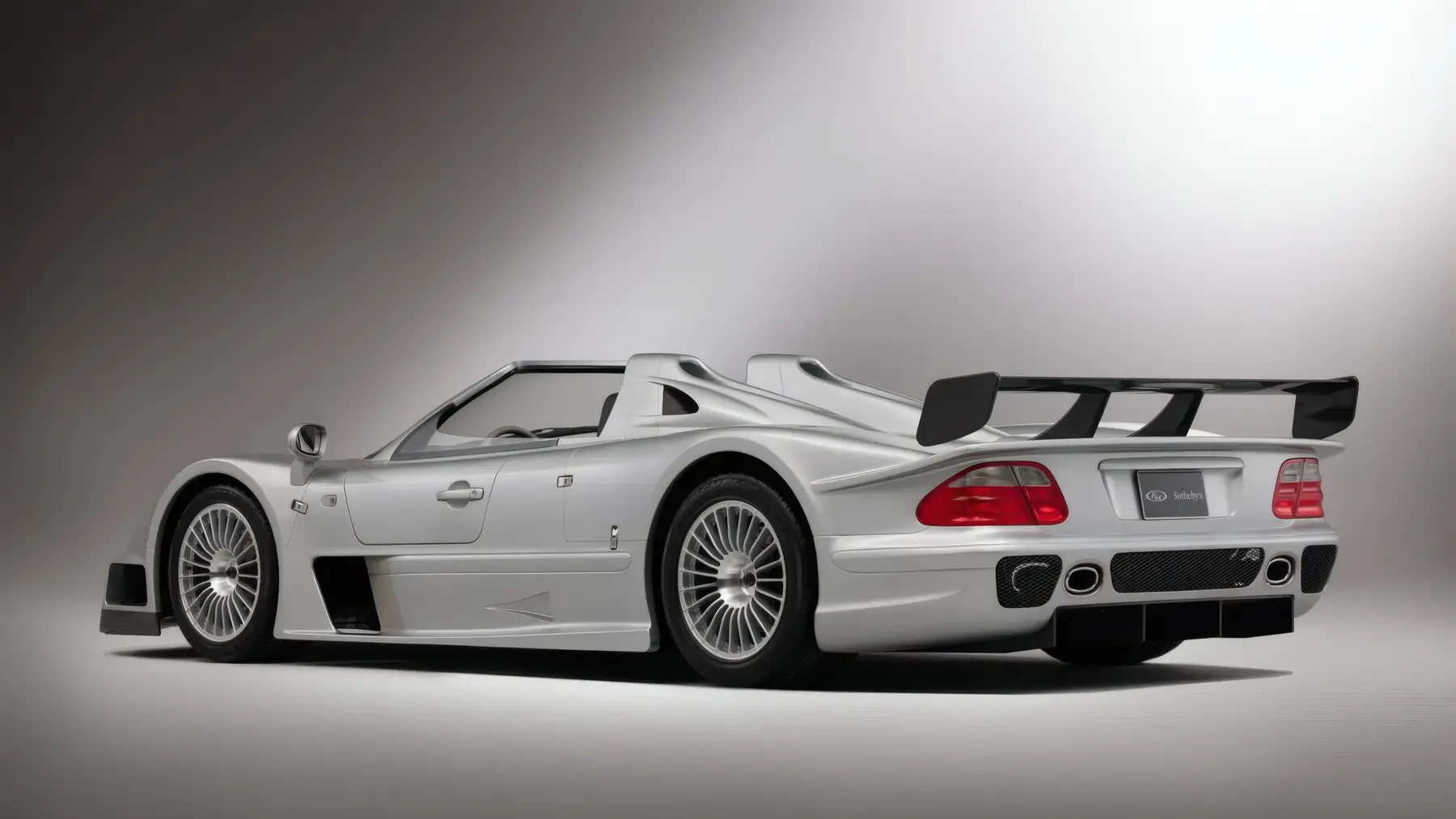
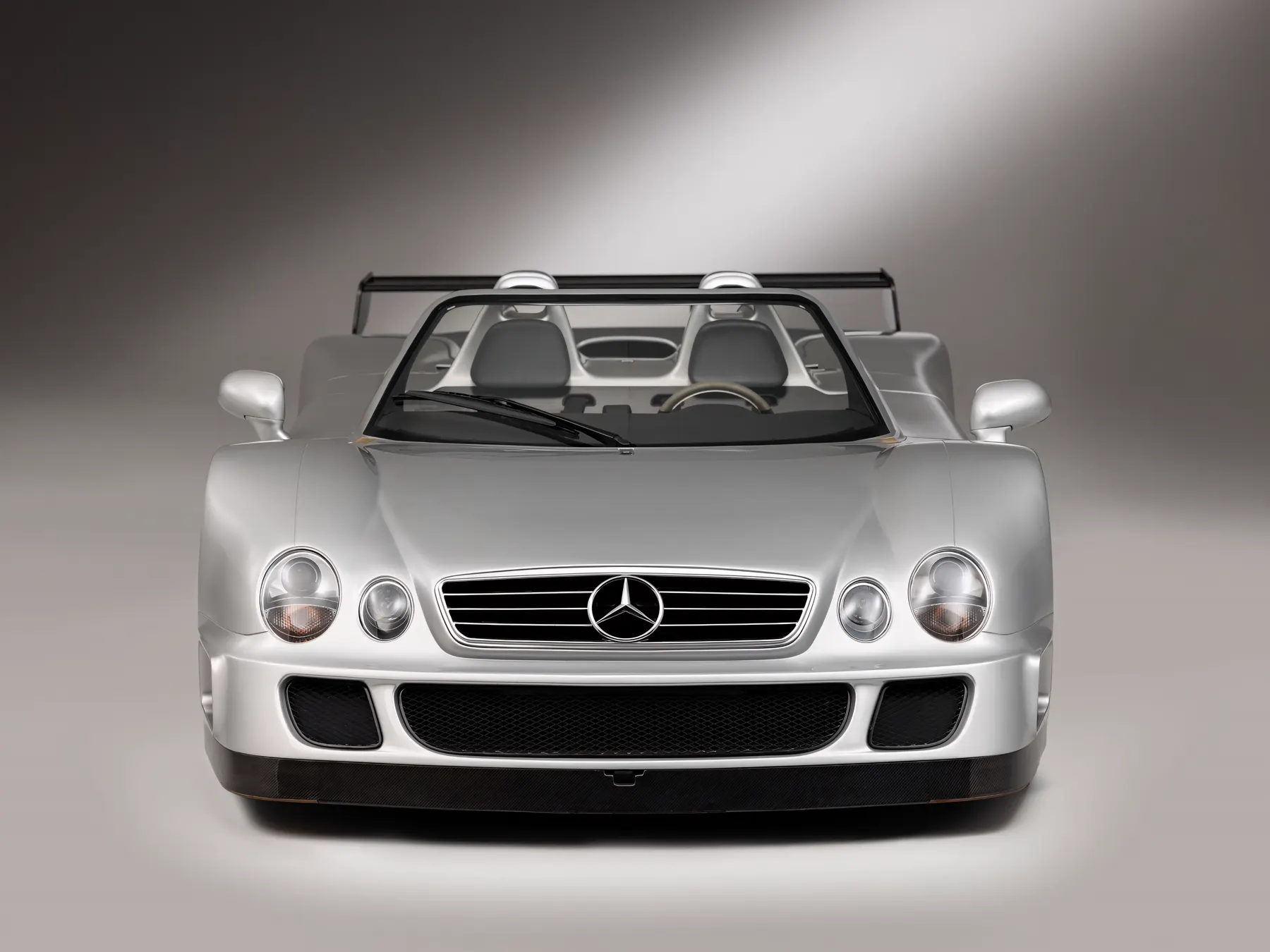
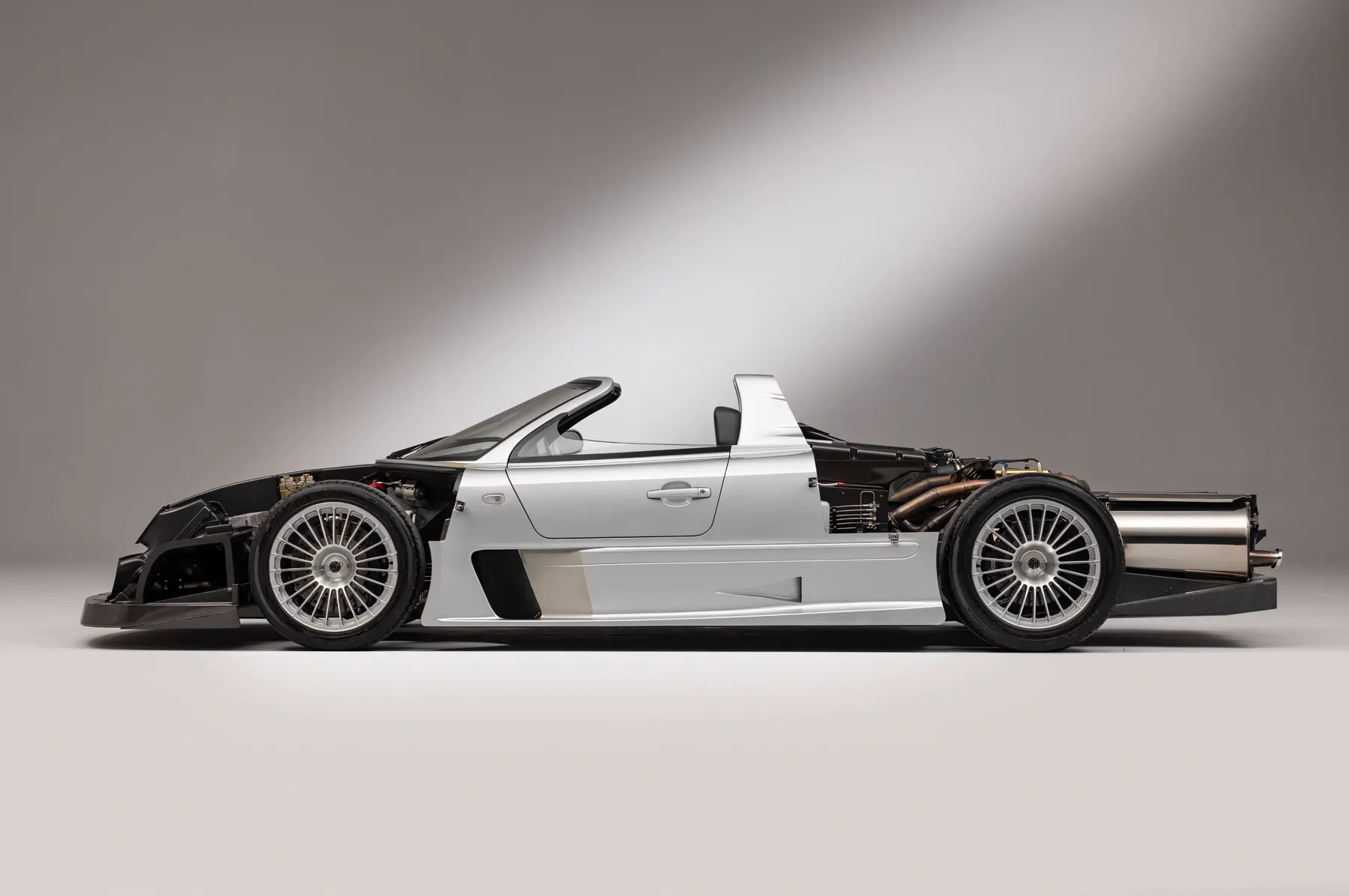
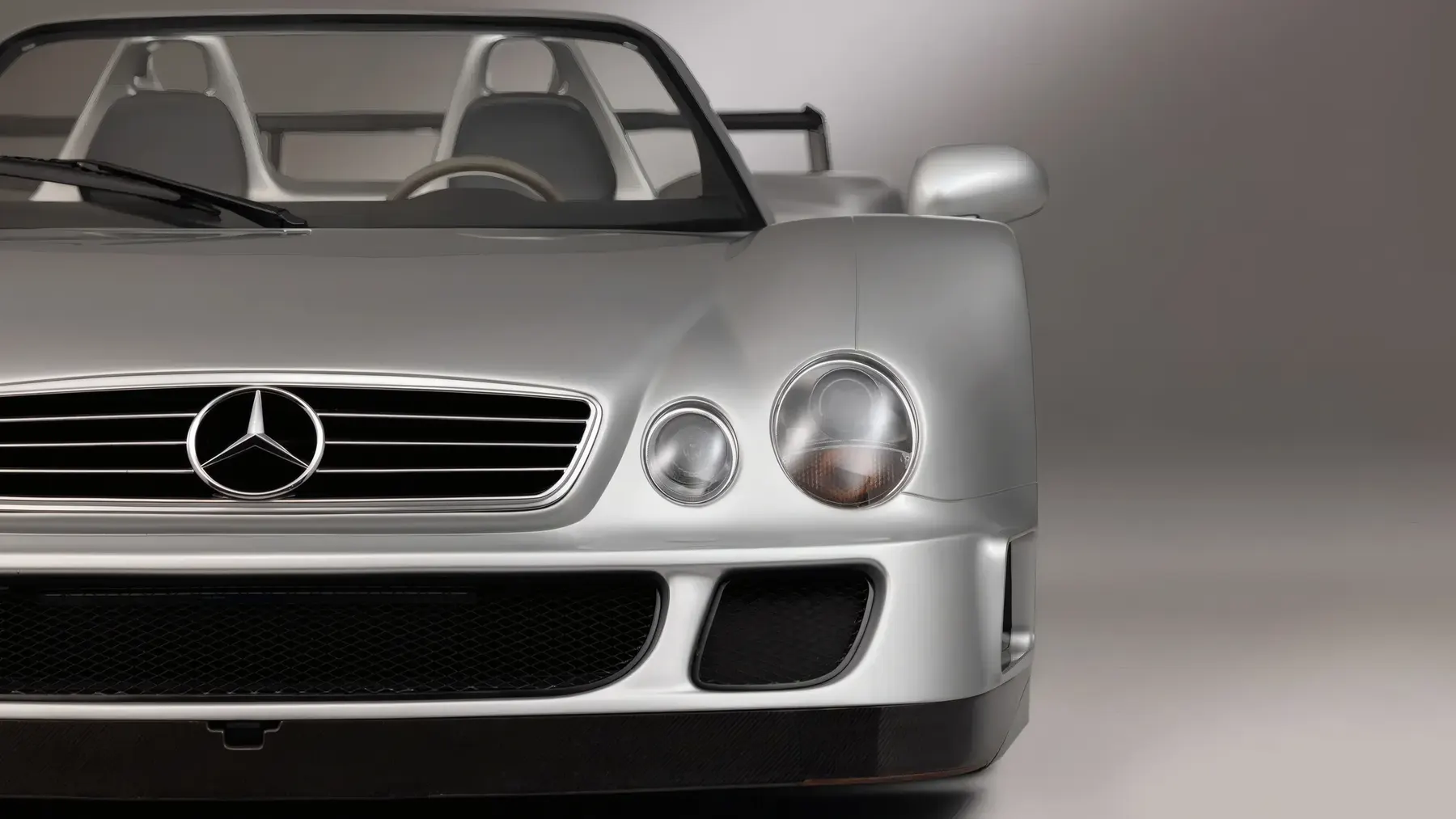
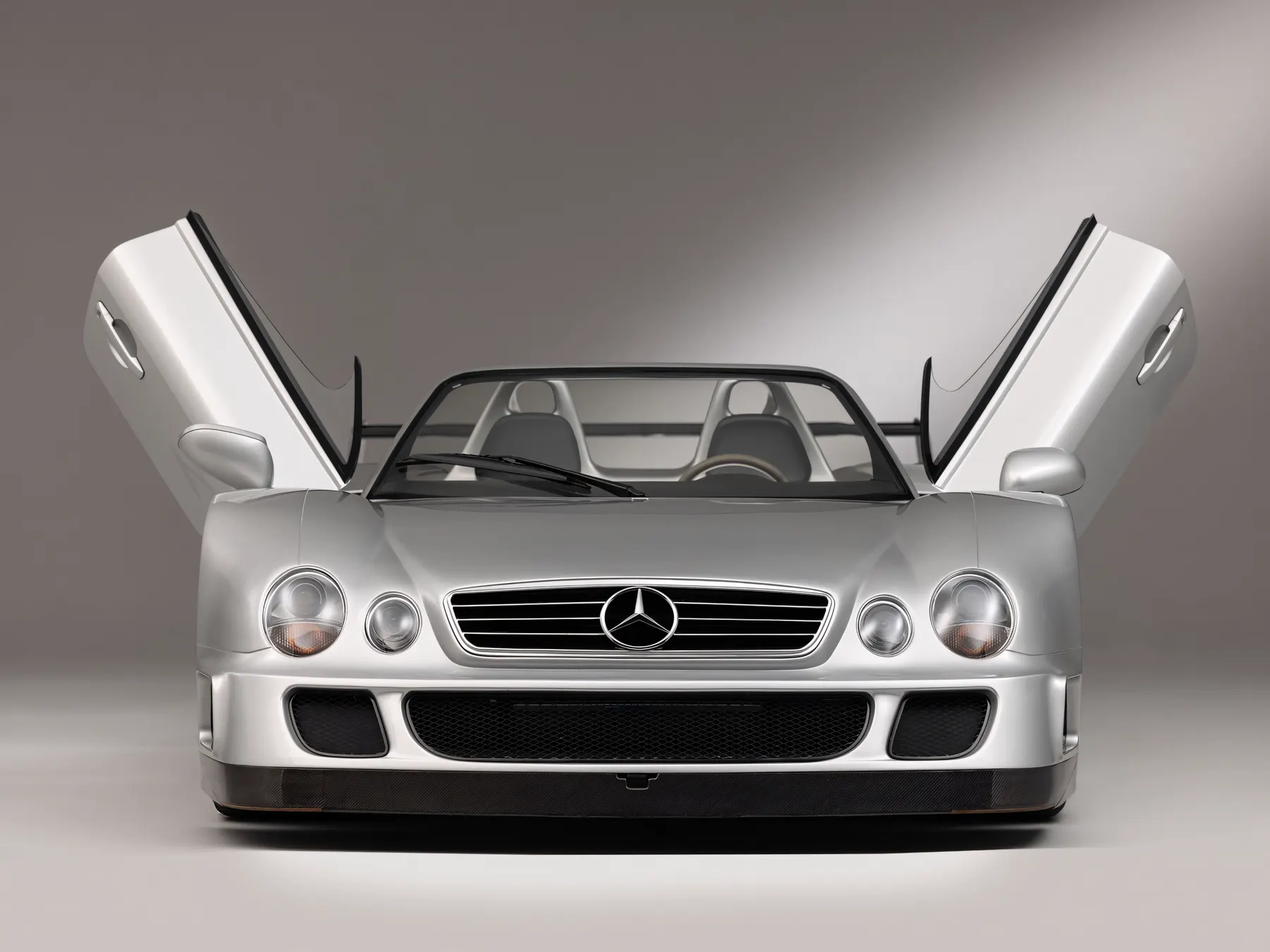
Underneath the altered bodywork, the roadster carried over essentially everything mechanical from the coupé and, by extension, from the race car. The tub was a carbon-fibre and aluminium-honeycomb monocoque built in England by Lola Composites, with an integrated steel roll cage and double-wishbone suspension front and rear, using inboard, pull-rod-actuated coil-over dampers lifted almost unchanged from the competition car. The wheelbase measured 2,670mm, and the whole structure sat unusually low and wide for anything that would eventually be registered for public roads. Turning the coupé into an open car required a specific set of changes: the engine’s air intakes, previously fed by a scoop mounted on the roof, were relocated to the flanks of the body since there was no roof left to draw from; the rear wing was swapped for a fixed, twin-pylon design that echoed the actual GT1 racer rather than the coupé’s more smoothly integrated spoiler; the front grille was revised with a large, centrally mounted three-pointed star in place of the coupé’s separate badge; and rollover hoops were built into the structure directly behind each headrest to help compensate for the torsional stiffness a fixed roof would otherwise have provided. There was no fabric top, no removable panel, and no weather protection of any kind on offer - this was an open car in the most literal sense, built for occasional, fair-weather use rather than as an everyday convertible.
Power came from the same 6.9-litre naturally aspirated V12 fitted to the coupé, itself derived from AMG’s GT112 competition unit (also referred to as the LS600), which traced its roots to the ordinary M120 V12 used in Mercedes’ S-Class and SL-Class road cars. For the Straßenversion, Ilmor stroked the engine from its 5,987cc racing displacement out to 6,898cc, and fitted it with forged pistons, titanium connecting rods, a lightweight flywheel, and magnesium cylinder-head covers, running dry-sumped with a carbon-fibre oil tank. Mercedes and AMG quoted 622bhp at 6,500rpm and 539lb-ft of torque at 5,250rpm for this configuration, though period technical documentation is not perfectly consistent; some contemporary specification sheets list figures closer to 612bhp and 572lb-ft for what appears to be the same engine, a discrepancy that has never been fully reconciled in the decades since. Drive went through a six-speed X-Trac sequential transmission carried over directly from the racer, adapted for road use with paddle-shift actuation and a foot-operated clutch pedal added purely to extend the clutch’s service life, since it was needed only for setting off rather than for every gearchange. A four-plate carbon-fibre clutch and a Quaife limited-slip differential completed the driveline. Separately, a small number of coupés and one prototype were later fitted by HWA with a larger 7.3-litre version of the engine under a “SuperSport” designation, producing well over 650bhp; none of the six roadsters received this treatment, and their performance figures should not be confused with it.
On the road, or more realistically on a private test track, given how few owners ever used these cars for daily transport, the CLK GTR family earned a reputation for being genuinely, almost alarmingly, competent for something so close to its racing origins, while also being a real handful in ordinary circumstances. Veteran racing journalist Paul Frère, testing the car at Hockenheim for Road & Track, praised its tractability given the enormous power on tap and credited Mercedes with real effort to civilise the mechanical noise through extensive soundproofing. But he also flagged a cabin that felt cramped despite the car’s considerable overall width, and criticised its behaviour in everyday, low-speed conditions, where the non-synchronous racing gearbox combined with abundant low-rpm torque made smooth progress through traffic something that required real skill rather than familiarity. A detailed period technical appraisal of the model separately describes the cockpit as cramped, noisy, and offering poor visibility, hardly surprising for a car whose seats were bolted directly to the rear bulkhead and whose pedals, rather than the seats, were made adjustable to compensate. Kerb weight is another point where sources disagree: some references place the roadster at around 1,410kg, while a more granular breakdown of the production run suggests the coupé’s structure alone grew to roughly 1,470kg once ABS, air conditioning provision, sound-deadening, and other road-car equipment were fitted, with the open bodywork adding a further 105kg on top of that, implying a figure closer to 1,575kg. Whichever number is closer to accurate, this was not a lightweight car by the standards of its carbon-fibre construction, since almost everything that made it liveable also made it heavier than the pure racer it was based on.
Reliability, arguably, was the most serious mark against a car costing well over a million dollars. The first standalone roadster, the one sold to Mark Johnston in 2002, became the subject of a lawsuit against DaimlerChrysler in 2006 after Johnston alleged that during a test drive with a prospective buyer, the oil-pressure warning illuminated and the transmission failed outright. Whatever the specifics of that dispute, the episode is a useful reminder that components drawn almost directly from a four-hour sprint-racing programme were not necessarily engineered with years of intermittent road use, cold starts, and casual ownership in mind. That tension between motorsport-grade componentry and the expectations of a road car buyer runs through the entire CLK GTR story, and the roadster, built later and in smaller numbers with less factory oversight than the original coupé run, arguably inherited more of that risk rather than less.
Positioning was, unsurprisingly, extreme. The coupé Straßenversion originally retailed for around $1.55 million, which Guinness World Records recognised at the time as making it the most expensive production car in the world, a distinction the model held until the Ferrari FXX-K arrived in 2015. Buyers could option their cars with a bespoke seven-piece luggage set and air conditioning rather than receiving either as standard, an odd note of frugality on a car costing more than most houses. None of the Straßenversion cars, coupé or roadster, were certified to United States federal safety or emissions standards, so American examples entered the country under Show or Display exemptions, meaning owners could not simply drive them as ordinary cars even if they wanted to. A small number of cars, including one coupé and one roadster, were built in right-hand drive specifically for a Southeast Asian royal buyer, underlining just how narrow and personally curated the eventual customer base for this model turned out to be. Today, roadster examples that do reach public sale command values in the low eight figures, a function of a build quantity that never reached double digits and a story too specific to ever be repeated.
The CLK GTR, and the roadster more than any of its coupé siblings, belongs to a very particular and short-lived chapter of sports car history: the so-called holy trinity era, alongside the Porsche 911 GT1 and McLaren F1 GTR, when the FIA still permitted manufacturers to disguise essentially pure racing cars as customer road cars. That regulatory window lasted only a couple of seasons before GT1 was effectively legislated out of existence for 1999, and no manufacturer has attempted anything quite so extreme since. Of the six roadsters that eventually existed, only one was genuinely contemporary with the racing programme it commemorates; the other five arrived years afterwards, an improvised coda to a title Mercedes had already secured, wearing open bodywork that nobody at AMG had originally planned to build. That mixture of authentic competition pedigree and slightly makeshift, after-the-fact execution is what makes the CLK GTR Roadster such a compelling footnote to its era, not the purest expression of the CLK GTR concept, but perhaps its most theatrical one.
Technical data
Specifications
| Specification | Figure |
|---|---|
| Production | 6 examples: 1 built 1999, 5 converted from spare chassis and offered from 2006 |
| Total Straßenversion family | 28 (2 prototypes, 20 coupés, 6 roadsters) |
| Chassis | Carbon-fibre and aluminium-honeycomb monocoque, built by Lola Composites (England); integrated steel roll cage |
| Wheelbase | 2,670mm |
| Engine | 6.9-litre (6,898cc) naturally aspirated V12, dry-sumped, GT112/LS600-derived |
| Power | 622bhp @ 6,500rpm* |
| Torque | 539 lb-ft @ 5,250rpm* |
| Transmission | 6-speed X-Trac sequential manual, paddle-shift actuation, 4-plate carbon-fibre clutch, Quaife limited-slip differential |
| Kerb weight | Approx. 1,410–1,575kg (sources vary)** |
| 0–60mph | Approx. 3.6–3.8 seconds (coupé-quoted figure; roadster not independently tested in period sources found) |
| Top speed | Approx. 199mph, gearing-dependent (coupé-quoted figure) |
| Price when new | Coupé: approx. $1.55 million; no independently documented roadster-specific launch price was found |
Sources
- Mercedes-Benz CLK GTR - Wikipedia
- The Road to the Rare Mercedes-Benz CLK GTRs - RM Sotheby’s
- 2002 Mercedes-Benz CLK-GTR Roadster - Petersen Automotive Museum
- Mercedes-Benz W297 CLK GTR Strassenversion Guide - Supercar Nostalgia
- The Most Expensive Production Car In The World In 1998: The Mercedes-Benz CLK GTR - Silodrome
Join the discussion
Comments
Loading comments…
Leave a comment
Share a detail, memory, or perspective. Every comment is reviewed before publication.