Porsche 991.2 GT3 RS Weissach Package: Paying to Lose Weight
2019 Porsche 911 GT3 RS 'Weissach'

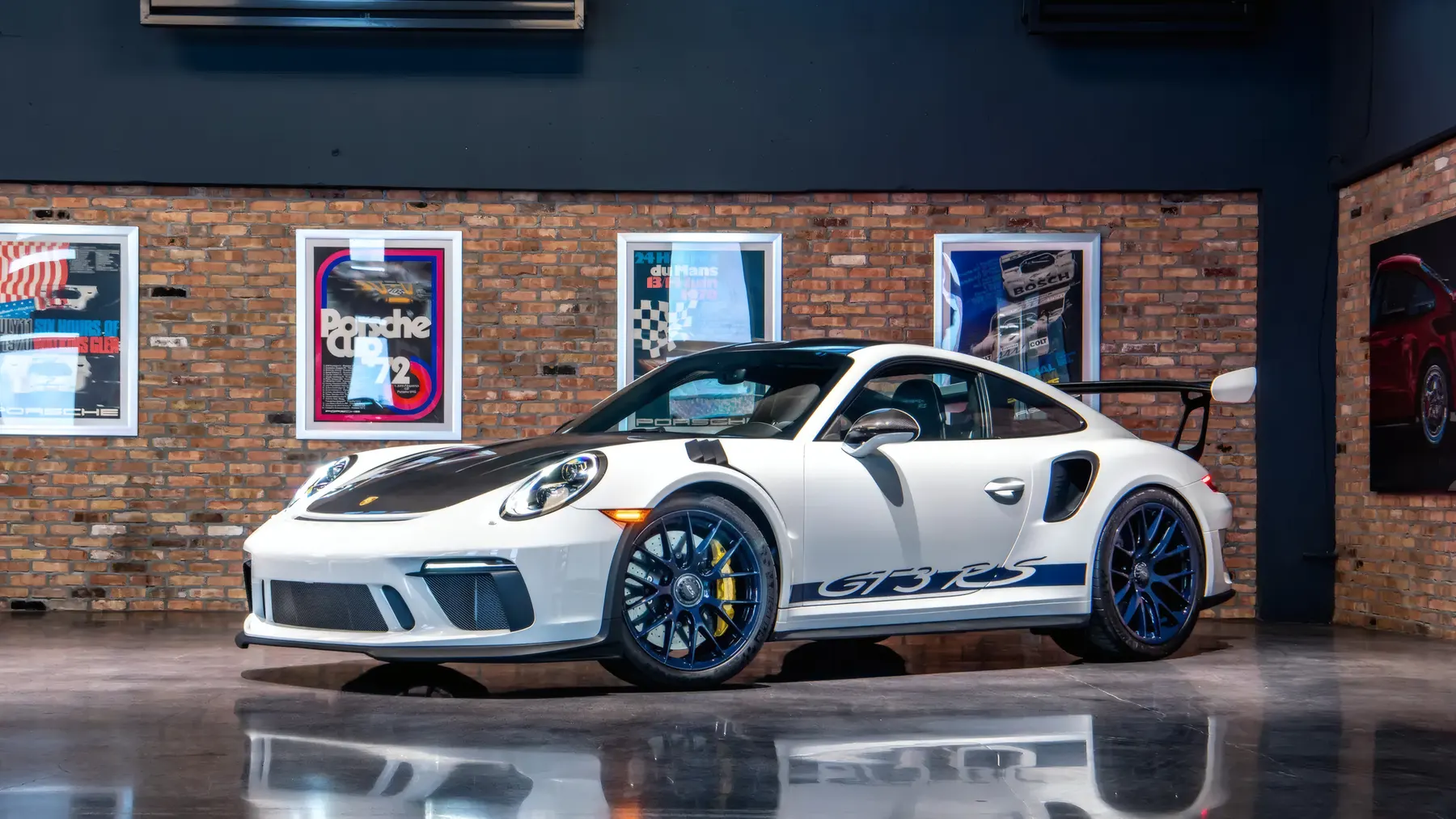
Images: Jorge Guasso / RM Sotheby's
Most options exist to add something: leather, electronics, badges, colour. The Weissach Package, offered on Porsche’s 991.2-generation 911 GT3 RS between 2018 and 2019, worked the other way round. Buyers paid extra to have things taken away - carbon fibre in place of steel and aluminium, magnesium in place of forged alloy, titanium in place of chromoly - and the name on the options list wasn’t a marketing invention but the identity of the small town west of Stuttgart that houses Porsche’s motorsport and development campus. That the company chose to badge a subtraction after its engineering department, rather than a place, a colour, or a person, says something about what it thought it was actually selling: not a trim level, but a statement from the people who build the racing cars about what a road-legal 911 could still shed. Porsche had tried the idea once before, on the 918 Spyder hypercar, where a Weissach-badged option stripped weight from an already extreme machine at a similarly extreme price. The GT3 RS version was the concept’s first outing on something resembling a conventional 911, bringing hypercar-level obsession with mass down to a car that, six-figure price tag notwithstanding, ordinary enthusiasts could actually order from a dealer.
It arrived on a GT3 RS that was already about as extreme as a naturally aspirated 911 had ever been. The 991.2 RS was the third GT-badged road car Porsche launched within roughly a year, following the 991.2-generation GT3 and the turbocharged GT2 RS, and it sat at the top of the atmospheric tree: a 4.0-litre flat-six related in architecture to the engines used in Porsche’s GT3 Cup and RSR racing programmes, tuned for revs rather than low-down muscle. Porsche’s own marketing quoted 520bhp for the engine, though the figure most contemporary British testers arrived at, and the one used throughout this piece, was 513bhp; the two numbers describe identical hardware, the gap most likely down to Porsche’s rounded international marketing figure versus a more precise imperial conversion rather than any real difference in tune. Torque sat at a little over 346 lb-ft, unremarkable by turbocharged standards but delivered with an urgency that only really woke up as the tachometer swept past 7,000rpm on its way to a 9,000rpm cut-out. Porsche claimed 0-62mph in 3.2 seconds and a 193mph top speed, gains of roughly 20bhp and 8lb-ft over both the regular 991.2 GT3 and the previous-generation RS. The number that actually made headlines, though, was set at the Nürburgring Nordschleife in April 2018, when works driver Kevin Estre lapped the car in 6 minutes 56.4 seconds, dipping under the seven-minute mark that had, at that point, only been managed by a handful of far more powerful and far more expensive machinery.
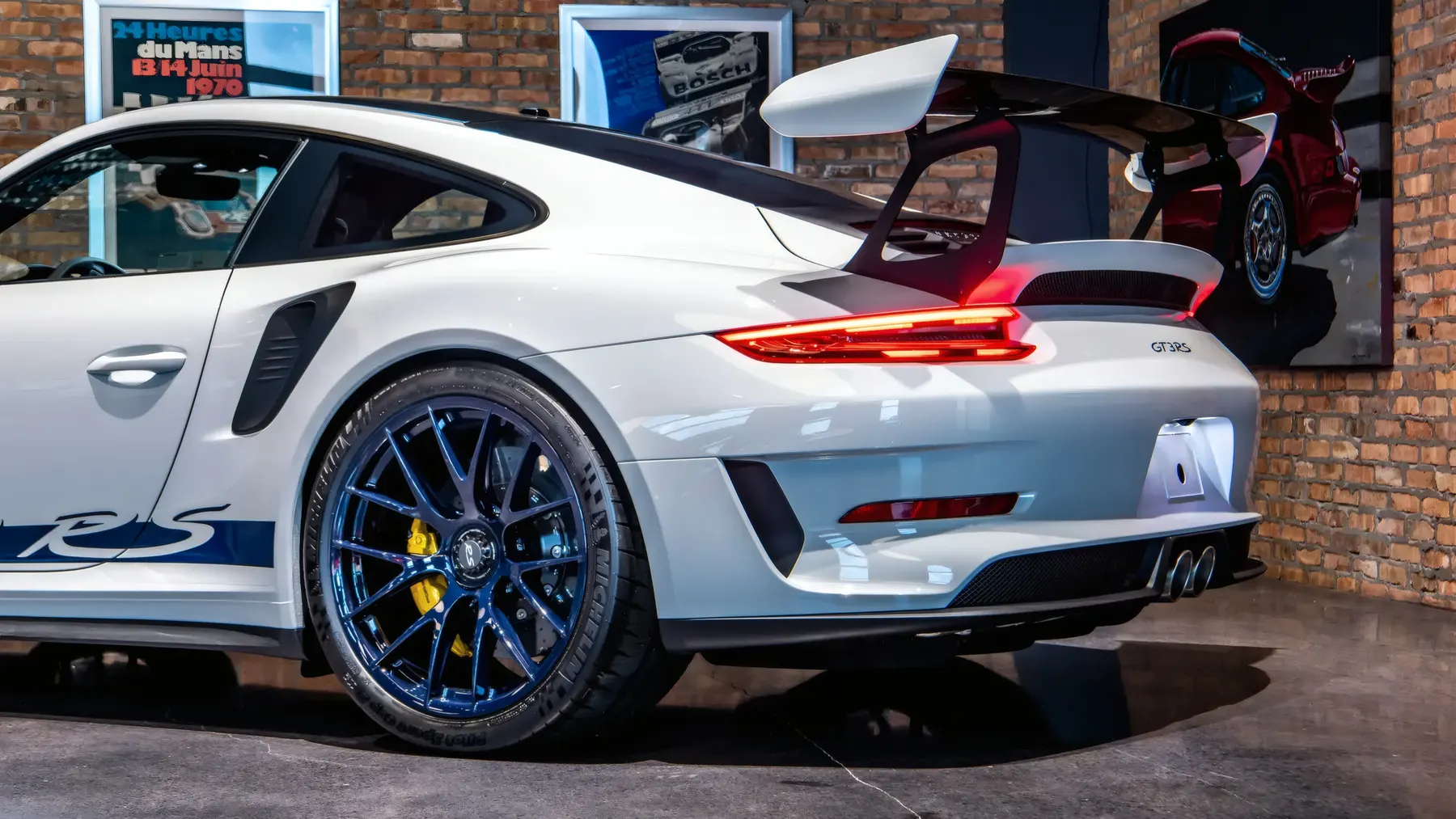
None of that strictly required the Weissach Package to exist. The standard car already carried the engineering that mattered most: a wide, Turbo-derived body, rear-axle steering, and a chassis set up noticeably stiffer than the 991.1-generation RS it replaced, with front spring rates roughly double the old car’s and the rear around 50 per cent firmer, allied to rose-jointed suspension links for sharper, less rubbery responses. The aerodynamic package borrowed heavily from the GT2 RS, with a taller fixed rear wing, revised underbody and diffuser work delivering around 8 per cent more downforce than the previous RS while trimming drag, and the brake-cooling louvres cut into the front wings grew more aggressive to match. Standard brakes were 380mm cross-drilled iron discs front and rear; the optional Porsche Ceramic Composite Brakes swapped in 410mm front and 390mm rear rotors weighing roughly half as much. Wheels grew to 20-inch fronts on 265/35 tyres and 21-inch rears on 325/30 rubber, both running a compound specific to the naturally aspirated car rather than shared with the heavier, more torque-laden GT2 RS.
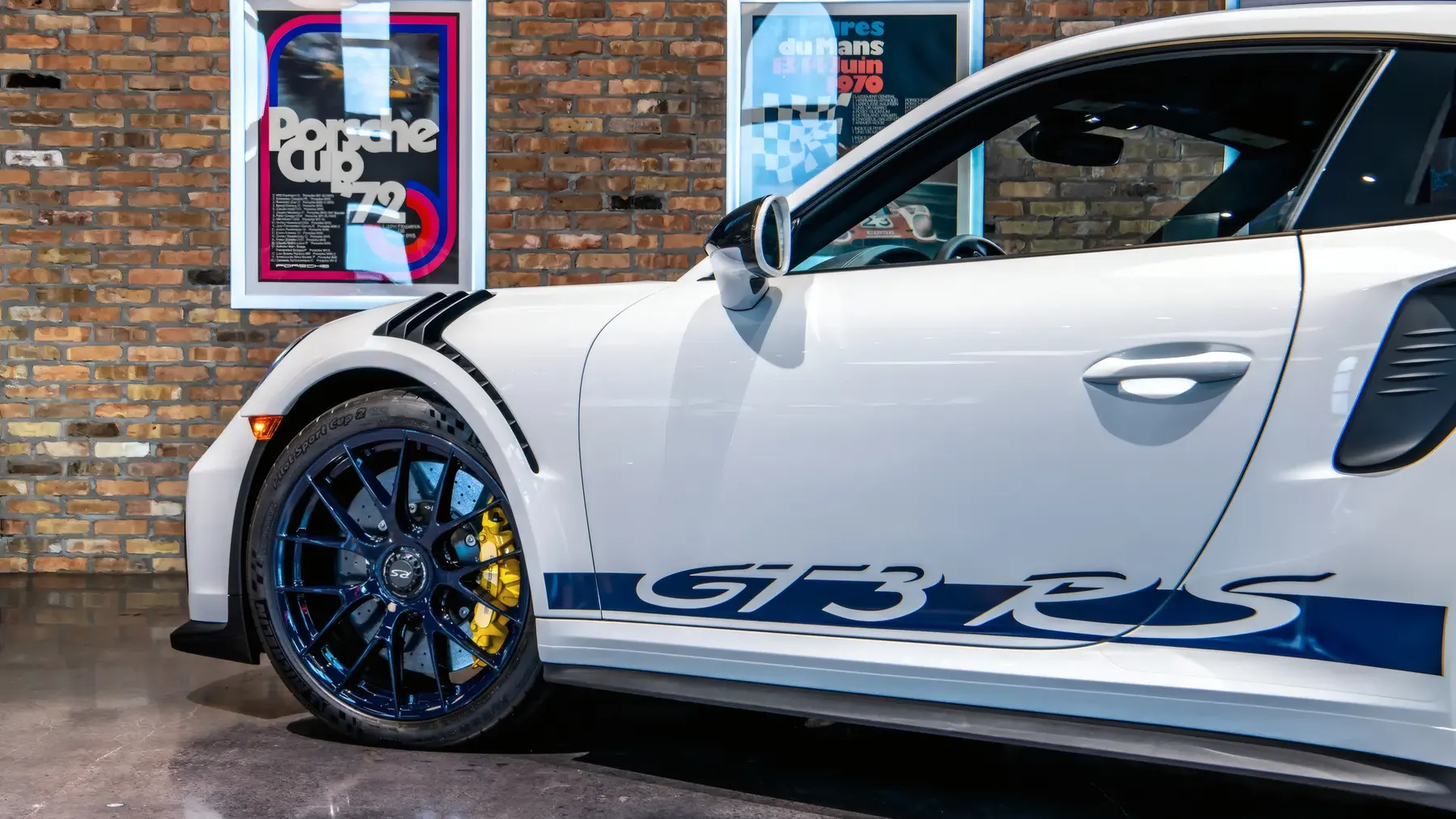
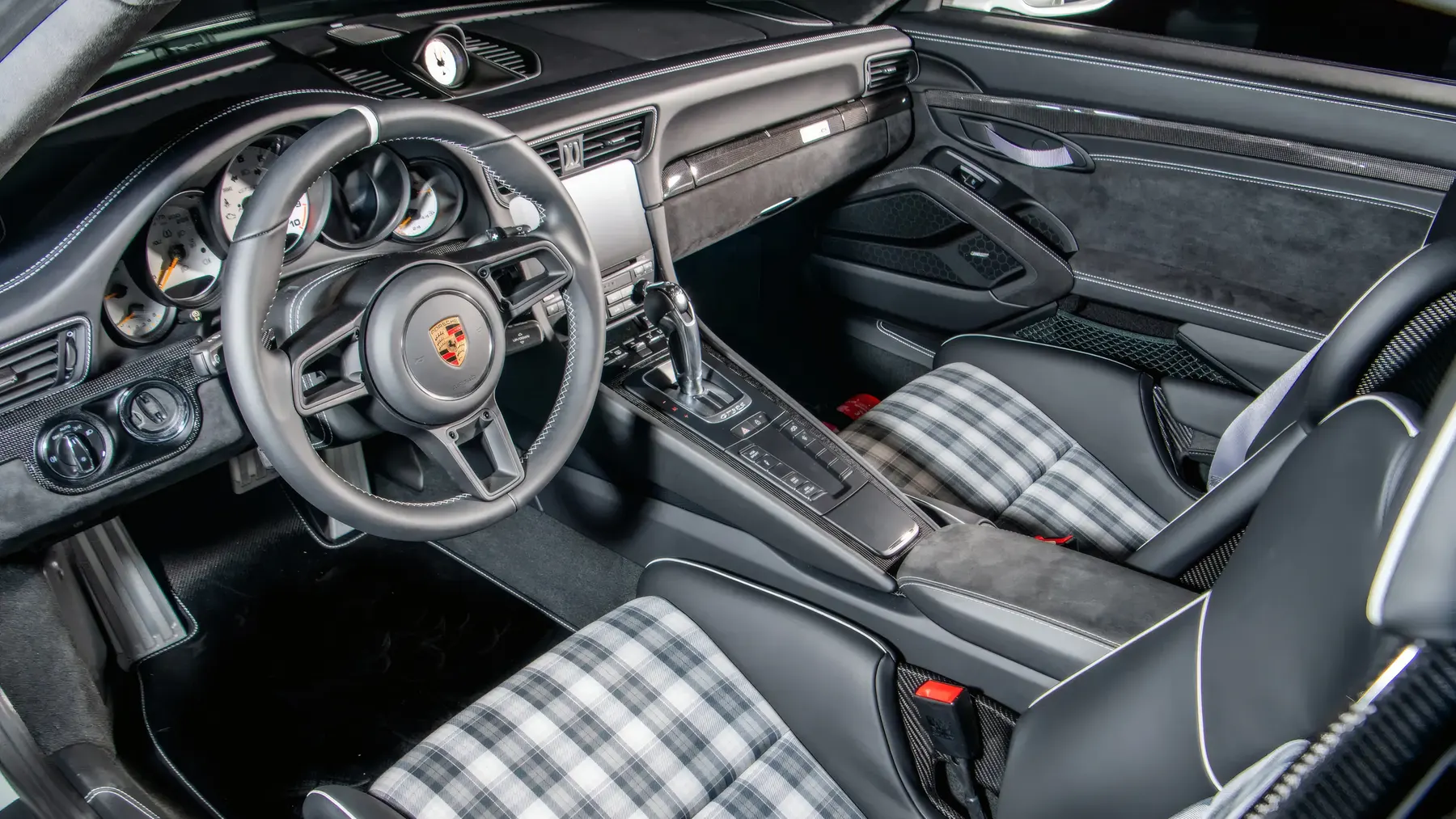
What the Weissach Package added to that foundation was subtraction with a price tag attached. For $18,000 in the US market, buyers received an exposed carbon-fibre roof lighter even than the magnesium panel fitted to the standard GT3, a carbon bonnet, a carbon front anti-roll bar, and - on cars destined for markets outside North America - a titanium half roll-cage in place of the steel item, saving around 9.5kg on its own. A further option, priced separately at around $13,000 and so popular at launch that supply of the components briefly lagged behind demand and delayed some deliveries, swapped the standard forged-aluminium wheels for forged-magnesium items drawn from the GT2 RS parts bin, cutting a further chunk of rotating and unsprung mass. Porsche’s own literature puts the lightest possible specification - Weissach Package plus magnesium wheels - at a DIN kerb weight of 1,430kg. Andreas Preuninger, the head of Porsche’s GT road-car programme, has since described that number as the sum of many small savings rather than one dramatic one: a lighter interior, a lighter exhaust, kilos shaved from cabin trim and tailpipes, all before the carbon and titanium components of the package itself are even counted. Reported figures for the package’s own isolated contribution vary by source and market, generally clustering in the high teens to high twenties of kilograms depending on whether magnesium wheels and the non-US titanium cage are included in the total. Inside, Weissach cars were distinguished by satin carbon-weave trim on the steering wheel and door handles, Race-Tex across the top of the dashboard to cut glare, and magnesium gearshift paddles borrowed from the 911 GT3 Cup racer, with a noticeably crisper action than the standard items.
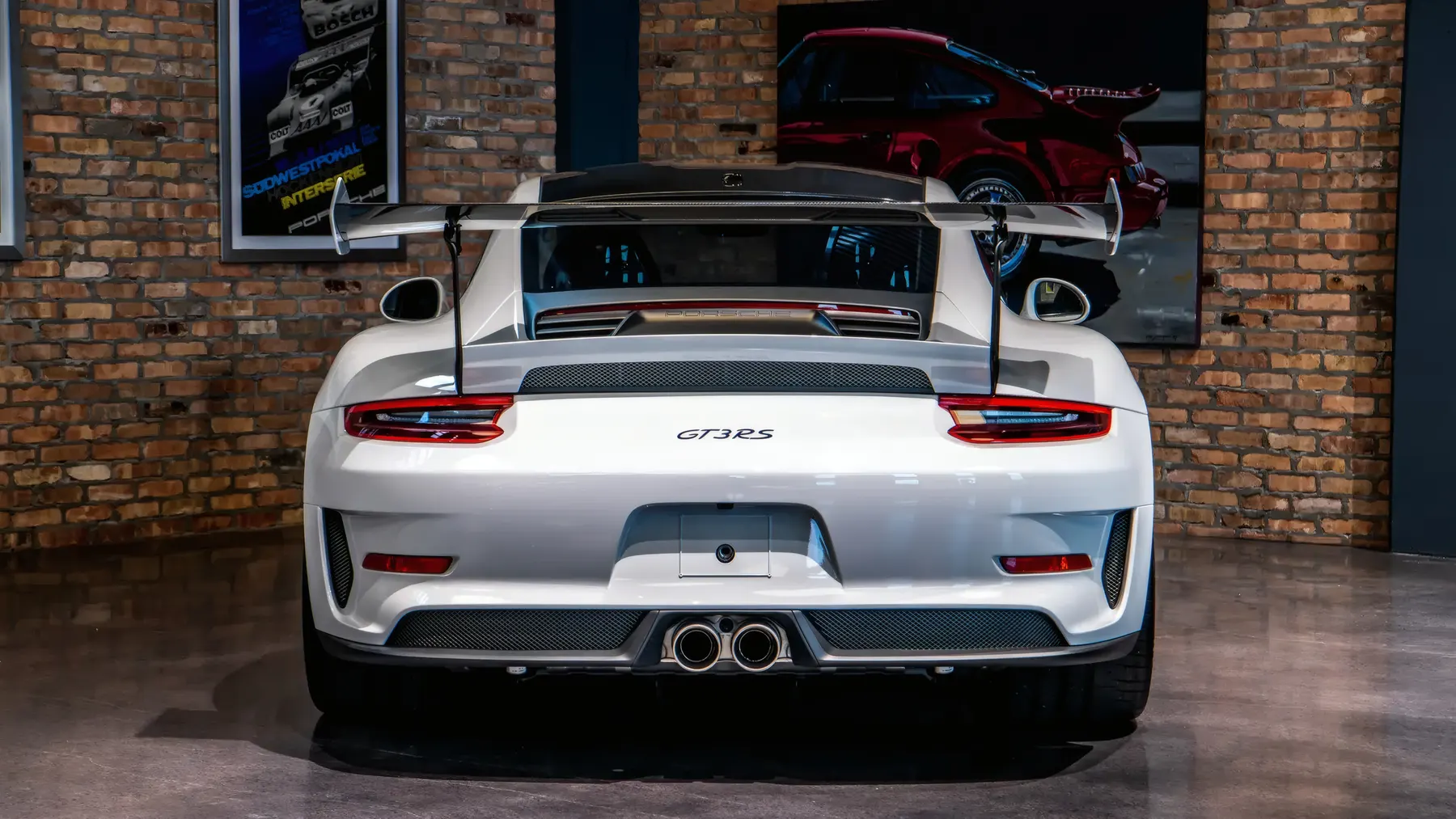
Visually, the package set out to look the part as much as perform it. Porsche paired Weissach cars with a deliberately theatrical colour and trim strategy: bright launch colours sat alongside darker, more subdued liveries where the exposed carbon-weave panels could do the talking without competing against the paintwork for attention. Crucially, the carbon itself was left in a satin rather than lacquered finish, echoing the unglamorous, purely functional composite used on Porsche’s actual racing cars rather than the glossy, decorative carbon favoured by many rivals’ options lists. It’s a small detail, but a telling one: even the texture of the carbon fibre was chosen to reinforce the idea that this was motorsport hardware wearing number plates, not a styling exercise borrowing motorsport’s visual vocabulary secondhand.
On the road, the case for all this restraint is more persuasive than it has any right to be. British testing at the time described a chassis whose stiffer springs cost the RS a degree of ride quality compared with its predecessor, a trade-off Porsche judged its buyers would accept, but one that stopped short of outright harshness on poor surfaces, thanks to damping still supple enough to round off the worst of it. The electrically assisted steering carries enough natural weighting and feedback to disguise its own assistance, telling the driver exactly what the front tyres are doing even at modest speeds. The PDK gearbox, for all the grumbling from traditionalists about the absence of a clutch pedal, shifts with a precision and immediacy that the manual-only RS models of an earlier era simply could not match. The engine remains the emotional centre of the whole experience: tractable and genuinely usable from 3,000rpm, but transformed in the last third of its rev range into something closer to a race motor than anything else sold with number plates and a warranty at the time.
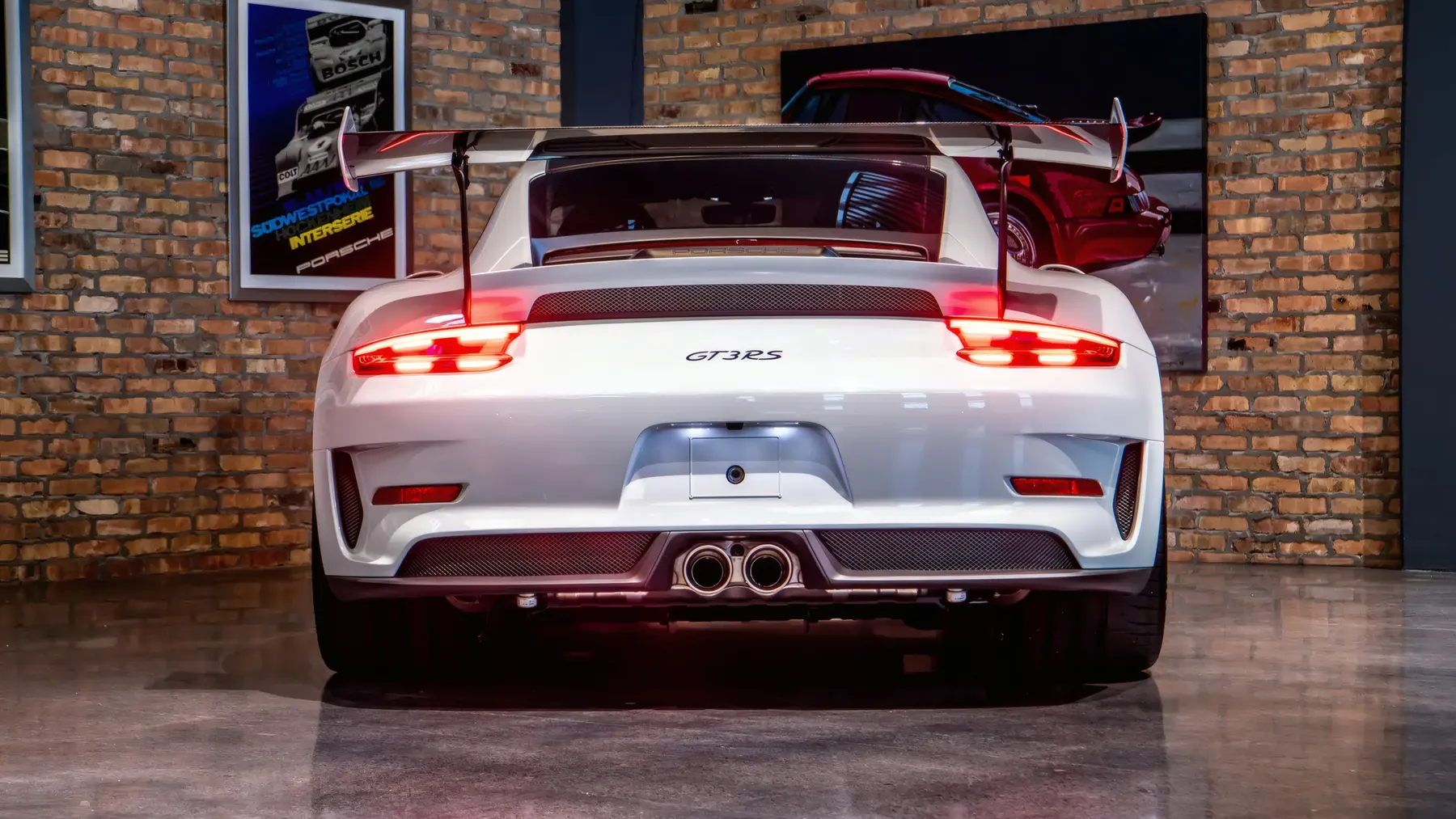
On track, where the car’s tightened responses and improved front-to-rear balance mattered most, testers who had also driven the outgoing 991.1-generation RS reported needing to wait less for the rear axle to settle into a corner, meaning more speed could be carried deeper into the apex before trusting the chassis to rotate and fire the car out the far side. Direction changes came with a similar sense of everything happening at once rather than in sequence - front end, mid-corner balance and rear-end traction working as a single, unusually cohesive system rather than three things a driver had to manage separately. It is the kind of car that rewards a driver for building trust in it gradually, then repays that trust with a level of accuracy that few naturally aspirated performance cars of the period could match.
That confidence came with real costs, and they are worth naming rather than filing away as charming eccentricities. Porsche dropped the manual gearbox from the GT3 RS line entirely with the move to the 991 generation, and the Weissach car, for all its motorsport pretensions, offered no route back to one; buyers who valued a clutch pedal and a physical shift action - still available on the previous 997-generation RS - simply were not catered for, and no amount of paddle-shift immediacy fully substitutes for that connection for drivers who prize it. The stiffer suspension, while manageable, is a genuine compromise rather than a free lunch: ride quality on a poorly surfaced road is noticeably worse than in the standard 991.2 GT3, and the RS’s thinner cabin insulation and lightweight door panels mean more road noise and surface texture reach the cabin than in a regular Carrera, an effect the Weissach car’s additional exposed carbon panels do nothing to soften. The titanium half-cage fitted to non-US Weissach cars, for all its cleverness, is explicitly not FIA-homologated, meaning buyers who actually wanted to compete under sanctioned racing rules had to retain, or revert to, the heavier steel cage - an odd asterisk on a package sold under the banner of Porsche’s own motorsport department. And the cumulative cost of building a fully specified example was substantial even by GT3 RS standards: the Weissach Package and magnesium wheels together added roughly $31,000 to a US car whose Weissach option alone already sat on top of a six-figure base price, pushing a well-equipped example comfortably past $200,000 before ceramic brakes, front-axle lift, or any of Porsche’s other options were even considered.
None of that dented demand. Positioned against its closest rival at launch, the front-engined, turbocharged Mercedes-AMG GT R, priced within a couple of thousand pounds of the RS in the UK market, Porsche’s car made its case almost entirely through engineering philosophy rather than raw numbers: fewer forced-induction cylinders, essentially no rear seats to speak of, and a naturally aspirated engine that traded outright torque for a top-end drama a turbocharged rival simply couldn’t replicate. In truth the RS’s most serious rival was arguably its own immediate predecessor, since existing owners on Porsche’s allocation lists tended to trade up rather than cross-shop - a reflection of how strong the GT3 RS nameplate had become by this point, independent of what the Weissach car specifically added.
The 991.2 GT3 RS, and Weissach-equipped examples in particular, quickly established themselves as some of the most sought-after cars in Porsche’s modern GT catalogue, prized as much for the specification on the build sheet as for outright pace, and cars carrying the full package have generally continued to command a premium over lesser-optioned examples in the years since. Its successor, the 992-generation GT3 RS, would push the same ideas much further, chasing far greater downforce through a wholesale rethink of the car’s front-end cooling and aerodynamics. That only underlines what the 991.2 car actually represented: the last GT3 RS built on the older 991 platform, but the first to wear the Weissach name on a 911, and arguably the moment Porsche’s motorsport department stopped treating lightweight construction as a footnote on the spec sheet and started selling it as the headline feature in its own right. It was never going to be the final naturally aspirated GT3 RS, whatever the speculation at launch suggested, but it remains the car that proved buyers would pay handsomely not for something new, but for the privilege of carrying less.
Technical data
Specifications
| Specification | Figure |
|---|---|
| Engine | 4.0-litre naturally aspirated flat-six, architecture related to Porsche’s GT3 Cup/RSR racing engines |
| Power | 513bhp (Porsche’s own marketing materials state 520bhp) |
| Torque | 346–347 lb-ft |
| Redline | 9,000rpm |
| Transmission | 7-speed PDK dual-clutch (no manual offered) |
| 0–62mph | 3.2 seconds |
| Top speed | 193mph |
| Kerb weight (DIN, full Weissach Package + magnesium wheels) | 1,430kg* |
| Brakes (standard) | 380mm cross-drilled iron discs, front and rear |
| Brakes (optional PCCB) | 410mm front / 390mm rear ceramic composite, roughly 50% lighter |
| Wheels/tyres | 20-inch front, 265/35; 21-inch rear, 325/30 |
| Nürburgring Nordschleife lap time | 6:56.4 (April 2018, Kevin Estre) |
| Weissach Package price at launch (US) | $18,000 |
| Magnesium wheel option (US, requires Weissach Package) | additional $13,000 |
| UK price at launch | from £141,346 |
| Production | 2018–2019 (991.2 generation) |
Sources
- Porsche Newsroom - “A clear focus on motorsport: the new Porsche 911 GT3 RS”
- Porsche Press Database - “Born from racing: the new 2019 Porsche 911 GT3 RS”
- Porsche AG - 911 GT3 RS Press Kit (PDF)
- evo - “Porsche 911 GT3 RS (991.2, 2018-2020) review” by Richard Meaden
- 000 Magazine - “Porsche 911 GT3 RS 991.2”
- Audrain Automobile Museum - “2019 Porsche GT3 RS Weissach”
- Audrain Automobile Museum - “2015 Porsche 918 Spyder Weissach Package”
Join the discussion
Comments
Loading comments…
Leave a comment
Share a detail, memory, or perspective. Every comment is reviewed before publication.