Porsche 911 Sport Classic (992): Why Porsche Built a Manual-Only Turbo
2023 Porsche 911 (992) Sport Classic
%3A%20Why%20Porsche%20Built%20a%20Manual-Only%20Turbo%20%7C%20Motor%20Archive)
Images: Jorge Guasso / RM Sotheby's
Porsche spent the better part of two decades convincing 911 Turbo buyers that all-wheel drive and a twin-clutch gearbox were simply how a fast 911 should work, the safest way of putting big turbocharged power down without drama. Then, in 2022, the same factory took that exact engine, deleted the front driveshafts, threw out the PDK, and sold the result as the 911 Sport Classic: a car built from Porsche 911 (992) Turbo S Coupé componentry that drives its rear wheels alone through a seven-speed manual gearbox. It is, in effect, Porsche’s flagship turbocharged road car with its two defining safety nets removed on purpose. That contradiction is the whole point of the Sport Classic, and it is why the car matters more than its status as a dressed-up special edition might suggest.
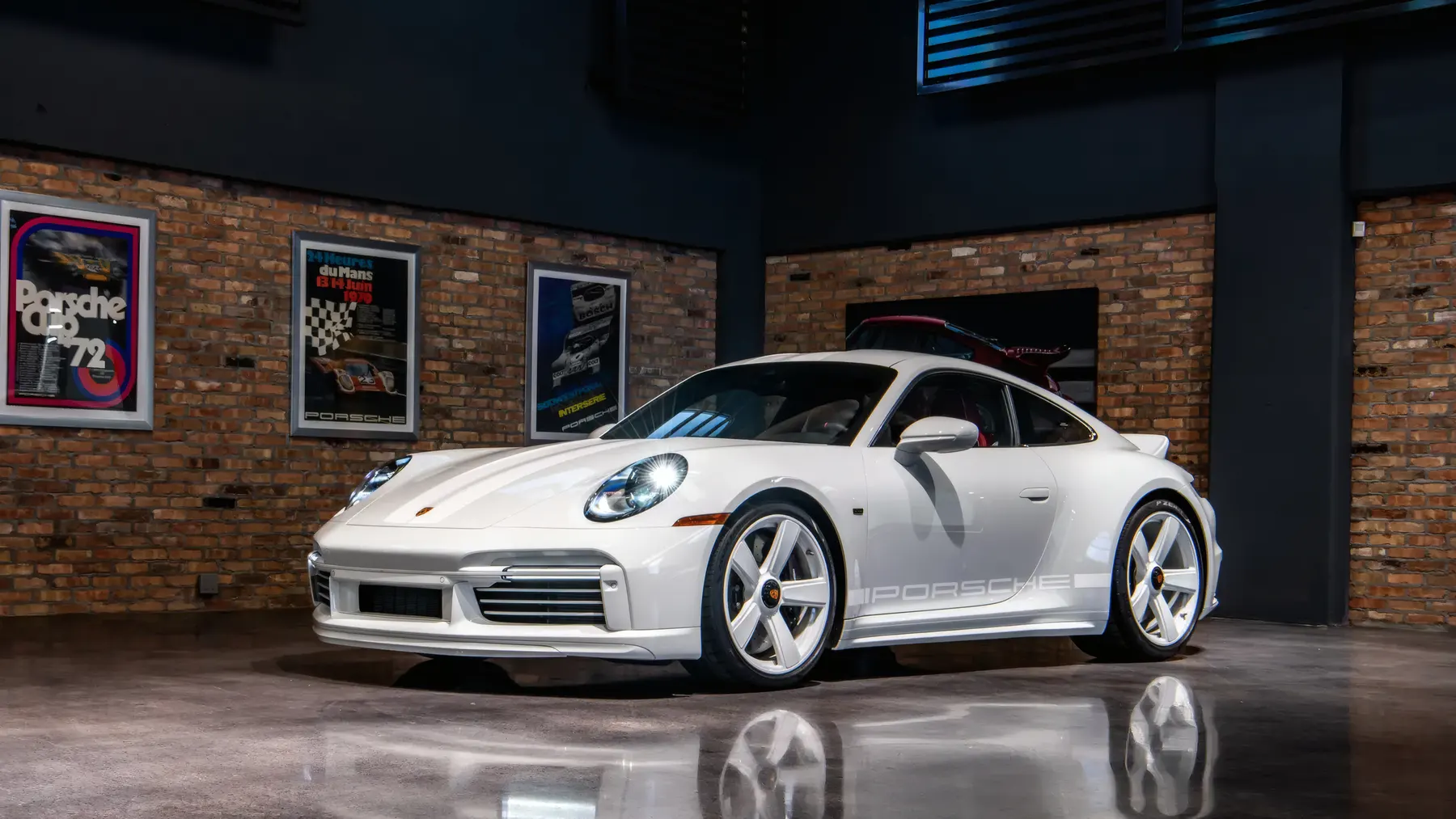
The nameplate itself is a revival. The original 911 Sport Classic appeared in 2009 on the outgoing 997-generation car, built in a run of 250 examples that reportedly sold out within 48 hours of going on sale. That car borrowed the wide body of the all-wheel-drive Carrera 4S but kept the standard car’s rear-wheel drive, added roughly 22bhp over the standard Carrera S engine to reach around 402bhp, and wrapped the package in a ducktail spoiler and double-bubble roof lifted stylistically from the 1972-73 911 Carrera RS 2.7, riding on Fuchs-style forged wheels and finished in a specially mixed grey paint. It was never officially sold in the United States, and its combination of manual gearbox, hydraulic steering (the 997 was the last 911 generation to use it) and relatively light kerb weight has made it a quietly serious collector’s car in the years since. The 992-generation Sport Classic, revealed in April 2022 as the second instalment in Porsche’s Heritage Design series, borrows the earlier car’s visual vocabulary almost point for point: the same ducktail, the same double-bubble roof, a similarly muted grey launch colour called Sport Grey Metallic that Porsche explicitly ties back to the “Fashion Grey” of the 356. What’s different this time is the mechanical basis underneath it.
Rather than starting from a Carrera, the 992 Sport Classic is built on the wide-body 911 Turbo S, using its 3.7-litre twin-turbocharged flat-six, its Porsche Ceramic Composite Brakes with black calipers, Porsche Dynamic Chassis Control active anti-roll stabilisation, rear-axle steering and Sport Chrono Package as standard fitment. Porsche’s engineers then went to considerable trouble to undo the very things that make a 911 Turbo S what it is: the all-wheel-drive hardware is gone, the PDK dual-clutch transmission is gone, replaced by a seven-speed manual, and the front axle spring rates were softened relative to the all-wheel-drive Turbo S to suit the changed weight distribution now that drive only goes rearward. The suspension is Porsche Active Suspension Management in its Sport tune, which drops ride height by 10mm. With the front driveshafts and much of the all-wheel-drive hardware removed, the Sport Classic comes in at around 1,570kg, roughly 70kg lighter than the Turbo S it borrows from, which goes some way to compensating for the power and traction it gives up. Official figures put 0-62mph at 4.1 seconds and top speed at around 196mph, figures that are genuinely quick by any real-world measure but noticeably behind the all-wheel-drive, dual-clutch Turbo S it shares an engine with.
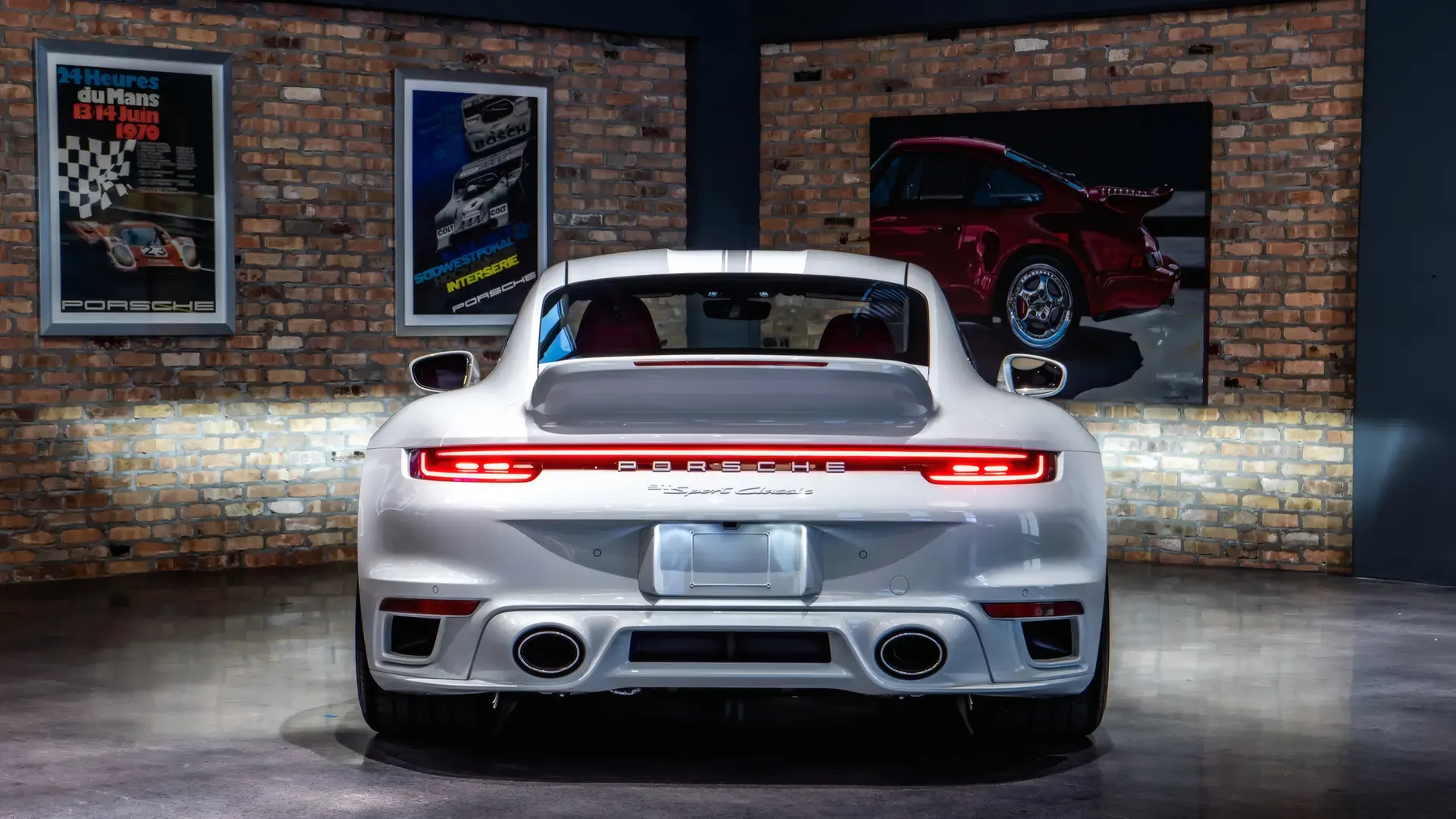
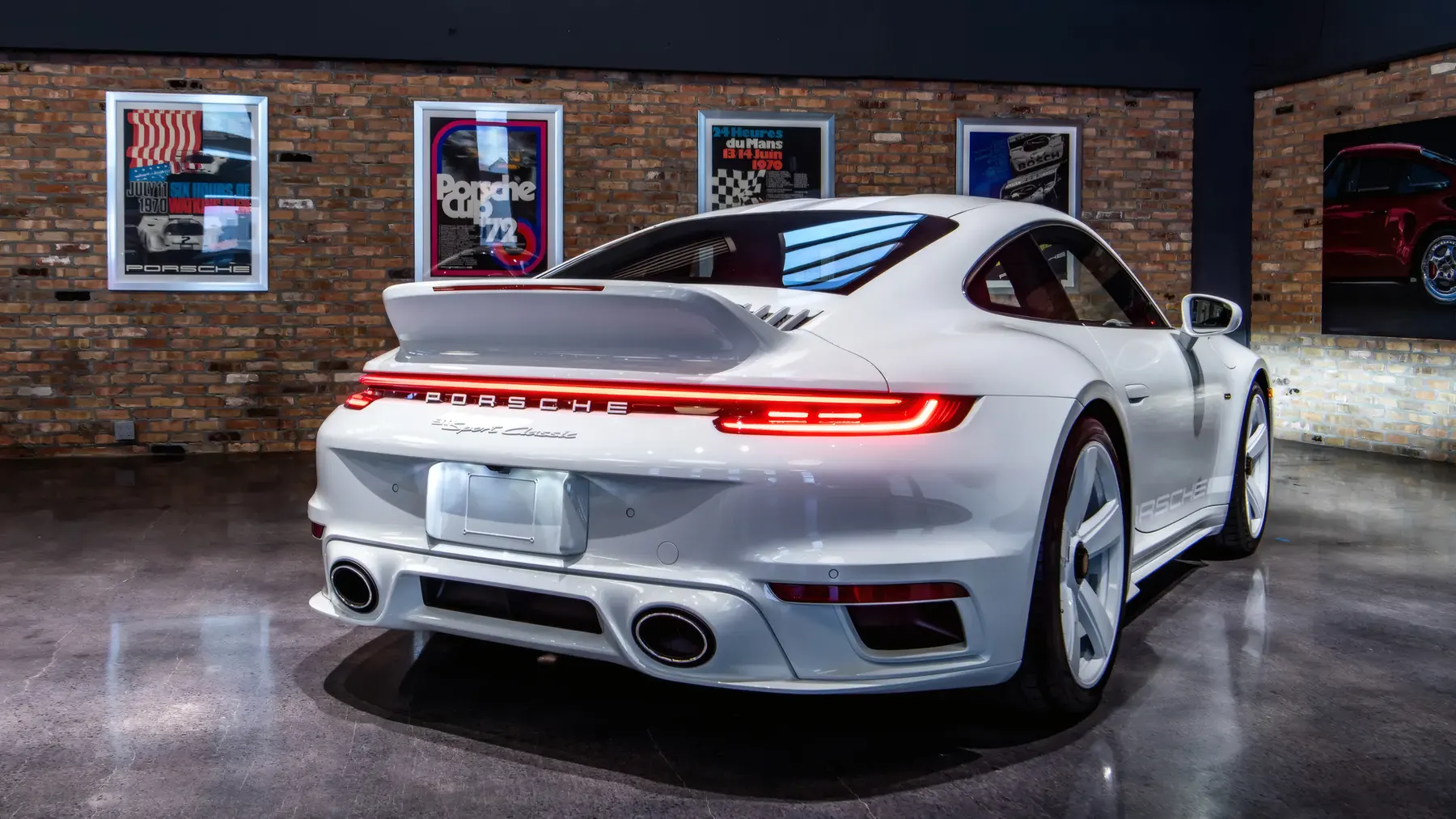
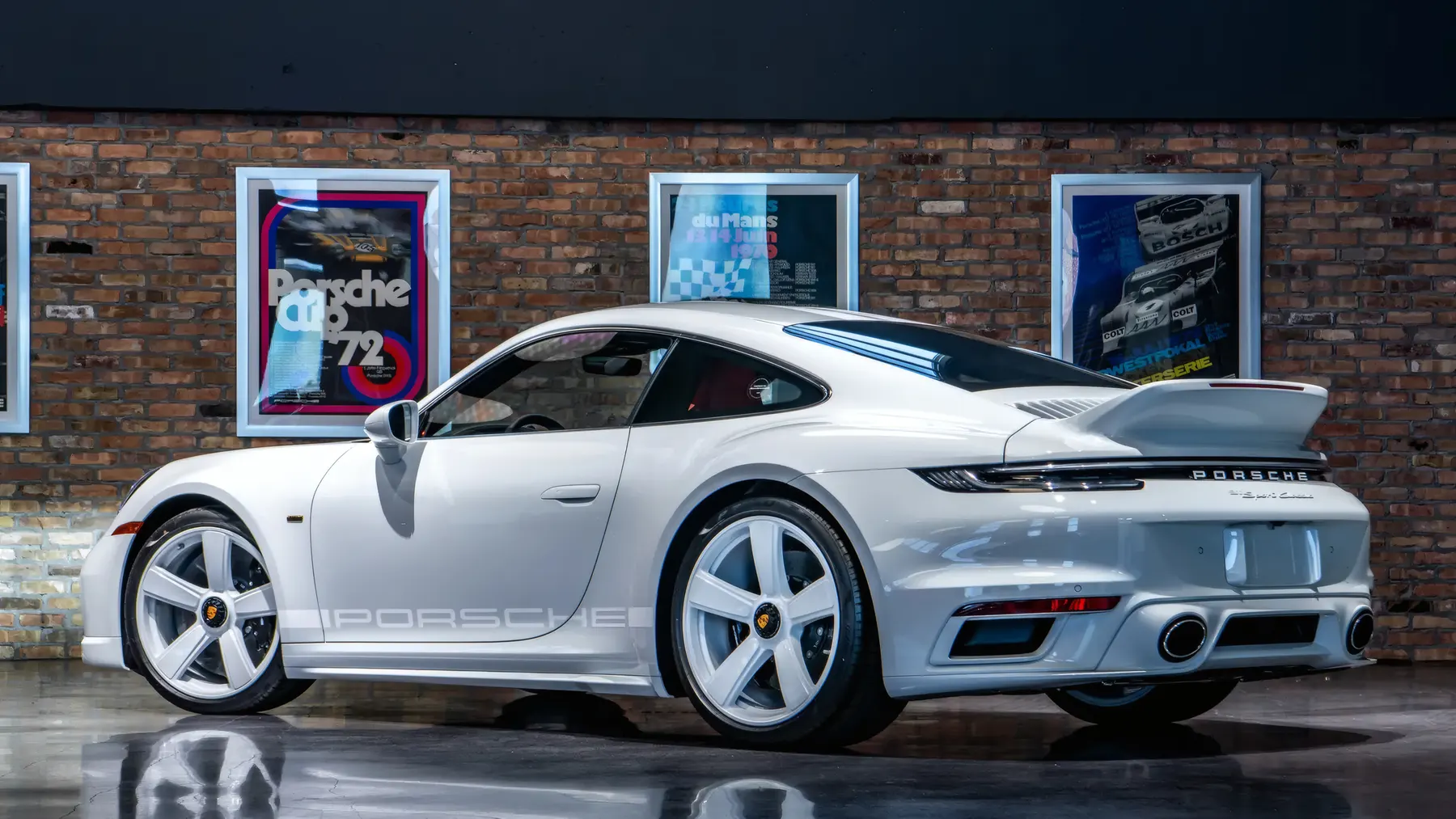
Visually, the changes required more re-engineering than a simple parts-bin exercise. The 911 Turbo’s rear wheel arches usually carry large cooling intakes; on the Sport Classic these are deleted entirely, which meant Porsche tooling a new rear quarter panel that runs unbroken from the doors to the tail, rather than simply blanking off the existing vents. With the intakes gone, engine combustion air is instead ducted in beneath the carbon-fibre-reinforced ducktail spoiler, while charge-air cooling continues to route through the grille above the engine. That ducktail, along with a double-bubble roof and a front hood with a distinctive centre dip, are all formed from CFRP. Buyers could specify Sport Grey Metallic, non-metallic black, Agate Grey Metallic, Gentian Blue Metallic, or a paint-to-sample finish, with a contrasting stripe in light Sport Grey and an optional starting-number decal between 1 and 99 that can be removed without cost, since it’s applied as vinyl rather than paint. Center-lock wheels styled after the classic Fuchs design measure 20 inches at the front and 21 inches at the rear, wrapped in 255/35 ZR20 and 315/30 ZR21 tyres respectively.
Inside, the retro theming continues with houndstooth “Pepita” cloth inserts on the seat centres and door cards, semi-aniline leather trim in either black or a two-tone Classic Cognac and black scheme (a grade of leather Porsche hadn’t used since the 918 Spyder hypercar), open-pore dark Paldao wood trim, and a numbered badge above the glovebox marking each car’s place in the production run. The Porsche crest and script badging is finished in real gold leaf, echoing a treatment used on the earlier Targa 4S Heritage Design Edition. The central tachometer gets a period-look white needle and green-accented dial. It is a genuinely lavish, well-resolved cabin, though it also sits its bespoke materials around the same PCM touchscreen infotainment system and instrument layout found in any other 992-generation 911, so the retro atmosphere is a costume applied to an otherwise thoroughly modern interior architecture rather than a wholesale reinterpretation of it.
On the road, the removal of the front driveshafts is the change testers have consistently pointed to as most significant, not the power figure. evo’s road test noted that the steering feels more detailed and natural than a standard Carrera’s, unencumbered by the tug and feed of a driven front axle, and that the car settles into corners with a calmness that sits somewhere between a Carrera and a full-blown Turbo rather than replicating either. The consensus among reviewers, including Top Gear and The Intercooler, is that the Sport Classic reads less like a stripped-back weapon and more like a grand tourer with genuine sporting depth: relaxed and comfortable enough to cover long distances, with enough front-end bite and mid-corner poise to reward being driven hard when the road allows. It is not trying to be a GT3, and none of the specialist press coverage suggests it should be judged as one.
That said, the Sport Classic carries real compromises that go beyond simply costing a lot of money, and they are worth naming plainly rather than waving away as part of its charm. To make the Turbo S engine survive being driven exclusively through a manual gearbox and a single driven axle, Porsche cut torque far more aggressively than power: peak output drops from the Turbo S’s roughly 572bhp and 553lb-ft to 543bhp and 442lb-ft in the Sport Classic, a torque reduction of well over 100lb-ft specifically to protect the transmission internals. The knock-on effect is a 0-62mph time roughly a second slower than the Turbo S it borrows from, and, more strikingly, a touch slower than a considerably cheaper, less powerful Carrera S fitted with PDK. Buyers are, in effect, paying a substantial premium over the Turbo S for a car that is measurably slower in a straight line, a trade Porsche clearly expects enthusiasts to accept in exchange for the manual gearbox and rear-drive character, but one that only makes sense if you value that specific mechanical experience over outright pace. evo’s testers also flagged that the shift action between second and third gears, and again between fourth and fifth, wasn’t as cleanly resolved as the rest of the drivetrain, a real ergonomic rough edge in a car whose entire premise rests on the quality of its manual shift. CarThrottle’s review went further, describing the engine as feeling like “just a little too much” for the rear tyres to fully absorb under full-throttle applications even with the torque cut in place, producing noticeable squirm from the back axle that demands more driver attention than the all-wheel-drive Turbo ever would. None of this makes the car dangerous or poorly sorted, but it does undercut the narrative of effortless, foolproof pace that usually accompanies a 911 Turbo-derived powertrain.
Then there’s the matter of money and how the car has actually been used since launch. At introduction, the Sport Classic carried the highest price of any 911 derivative then on sale, listed from roughly $272,300 in the United States, £214,200 in the United Kingdom, and €281,758 in Germany, comfortably more than the all-wheel-drive, quicker, and arguably more capable Turbo S it’s mechanically based on. Porsche built 1,250 examples worldwide, five times the run of the 997-generation original, and the cars were largely allocated to existing Porsche relationship customers ahead of any open sale. Because demand from collectors so heavily outstripped that allocation, a meaningful proportion of Sport Classics appear to have gone straight into collections rather than daily or even occasional use, and secondary-market values have risen well beyond the original sticker price in the years since, with some examples reportedly changing hands for double or more of their original MSRP. That’s a fine outcome for early buyers financially, but it sits in some tension with a car whose entire engineering brief was about mechanical engagement and driving pleasure rather than paddock-queen status; a manual-gearbox halo car is arguably wasted if it spends most of its life under a cover.
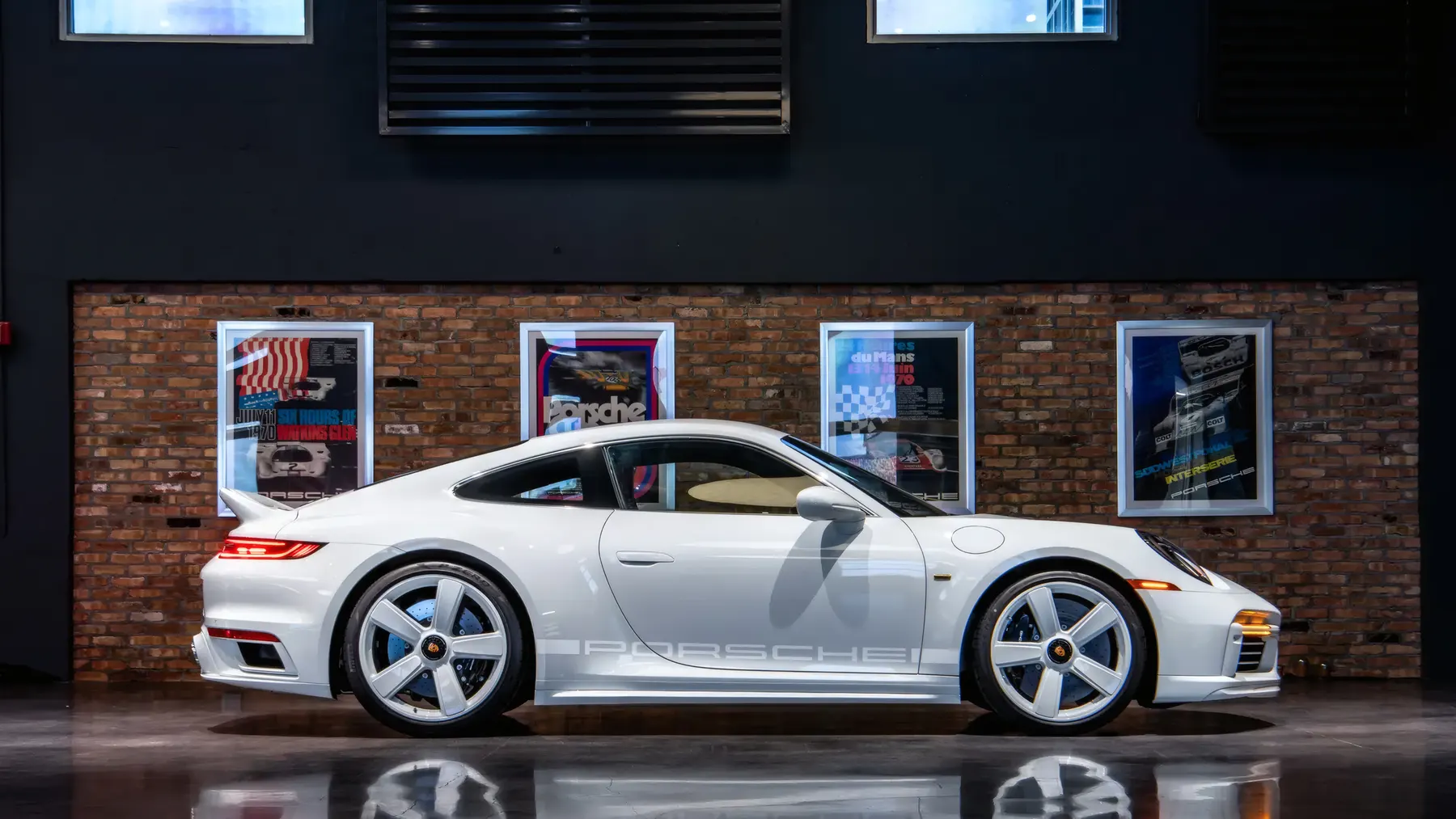
None of that erodes what the Sport Classic actually achieves as a piece of engineering. It is, as far as the historical record shows, the only time Porsche has combined a 911 Turbo-based widebody, a manual gearbox and rear-wheel-drive-only configuration in a single production car, a combination that runs directly against the trajectory the 911 Turbo line has followed since all-wheel drive became standard fitment in the early 1990s. It reconnects Porsche’s Heritage Design strategy, and by extension a meaningful slice of the modern 911 range, to the visual language of the Carrera RS 2.7 in a way that reads as considered rather than opportunistic, right down to the tooling investment required to delete those rear intakes cleanly. And it reaffirmed, at a moment when turbocharging, all-wheel drive and dual-clutch transmissions had become the default assumption for any fast 911, that Porsche’s engineers were still willing to build something that made its power harder to use rather than easier, purely because a specific slice of their customer base still wanted exactly that.
Technical data
Specifications
| Specification | Figure |
|---|---|
| Engine | 3.7-litre twin-turbocharged flat-six (3,745cc) |
| Power | 543bhp @ 6,750rpm (also cited as 542bhp depending on source/rounding) |
| Torque | 442lb-ft, 2,000-6,000rpm |
| Transmission | 7-speed manual, rear-wheel drive only |
| Kerb weight | approx. 1,570kg* |
| 0-62mph | 4.1 seconds (official) |
| Top speed | approx. 196mph* |
| Brakes | Porsche Ceramic Composite Brakes (PCCB), standard |
| Wheels | 20-inch front / 21-inch rear, center-lock |
| Tyres | 255/35 ZR20 front / 315/30 ZR21 rear |
| Production | 1,250 units worldwide |
| Production years | 2022-2023 (2023 model year) |
| Launch price | from approx. $272,300 (US) / £214,200 (UK) / €281,758 (Germany) |
Sources
- Porsche Newsroom USA: “Return of the ducktail: 2023 Porsche 911 Sport Classic revealed”
- Porsche Newsroom International: “The new Porsche 911 Sport Classic: back to the future”
- Top Gear: “Porsche 992 Sport Classic review: retro-inspired, limited-edition 911 driven”
- evo: “Porsche 911 Sport Classic 2023 review – a manual Turbo with rear-drive”
- evo: “997.2 Porsche 911 Sport Classic review”
- CarThrottle: “Porsche 911 Sport Classic Review: Borderline Cheesy, Expensive, Fabulous”
- The Drive: “2023 Porsche 911 Sport Classic First Drive Review: A Salute to Driving for Fun”
- The Intercooler: “Porsche 911 Sport Classic review”
- CarBuzz: “2023 Porsche 911 Sport Classic Pricing, Photos & Specs”
- Elferspot Magazine: “Porsche 992 Sport Classic - Out now!”
- duPont Registry News: “Porsche 911 Comparison: 997 Sport Classic Vs 992 Sport Classic”
Join the discussion
Comments
Loading comments…
Leave a comment
Share a detail, memory, or perspective. Every comment is reviewed before publication.