Porsche 964 Turbo S Lightweight: Porsche's Riskiest Bet of the Early 1990s
1993 Porsche 911 Turbo S Lightweight

Images: RM Sotheby's
Strip out the air conditioning, the power steering, the rear seats, the radio, most of the sound deadening, and a carmaker should, in theory, hand you back some money. Porsche did the opposite. The 964 Turbo S Lightweight cost vastly more than the standard Turbo it was based on, even as it shed nearly everything that wasn’t strictly necessary to go fast. That inversion - subtraction priced like addition - is the cleanest way to understand a car born inside a company that, at the time, could barely afford to take chances at all.
The early 1990s were lean years at Zuffenhausen. The Porsche 964 Turbo S Lightweight comes from a time when Porsche was struggling economically, with the company on the verge of serious financial difficulty. Sales were sliding, the model range was ageing, and yet into this climate came a proposal for one of the most extreme, least compromising road cars Porsche had ever built. It is precisely that contradiction - caution everywhere else in the business, total abandon in this one small project - that makes the Lightweight worth understanding on its own terms, not just as a footnote to the 964 Turbo line.
The car’s origin sits in a January 1992 memo. Rolf Sprenger, manager of Porsche Exclusive - formerly the Sonderwünsche, or “Special Wishes,” department - wrote a three-page internal proposal suggesting a small run of 964-chassis 3.3-litre Turbo coupes built much lighter than the standard production car, and accordingly far quicker. The brief called for what were essentially road-legal versions of the racing 964 Turbo that had taken IMSA Supercar Championship honours - though period documentation is not entirely consistent on whether that title was won in 1991 or 1992, and some lot histories reference both seasons. Internally, the project was first floated under the working title 964 Turbo “RS” before settling on its eventual name. A prototype was shown at the Geneva Motor Show in March 1992, where, according to Porsche’s own air-cooled history, it generated “60 enquiries and 25 firm orders”. Management formally authorized a limited production run of 80 chassis on 22 May 1992; demand ultimately pushed the final tally to 86 cars, built between July and November of that year for the 1993 model year. Of those 86, only 19 were right-hand drive, with 11 of those destined for the UK market. Significantly, it was the first model conceived and developed entirely within Porsche Exclusive itself, rather than being a factory model dressed up with options - a meaningful step in the department’s evolution from trim-and-paint customizer to genuine vehicle developer. Several sources credit veteran Porsche test and development engineer Roland Kussmaul, whose decades-long résumé includes work on the 959, the 964 RS and the Cup racing programme, with shaping the car’s dynamic specification, drawing on lessons from Porsche’s North American supercar racing efforts.
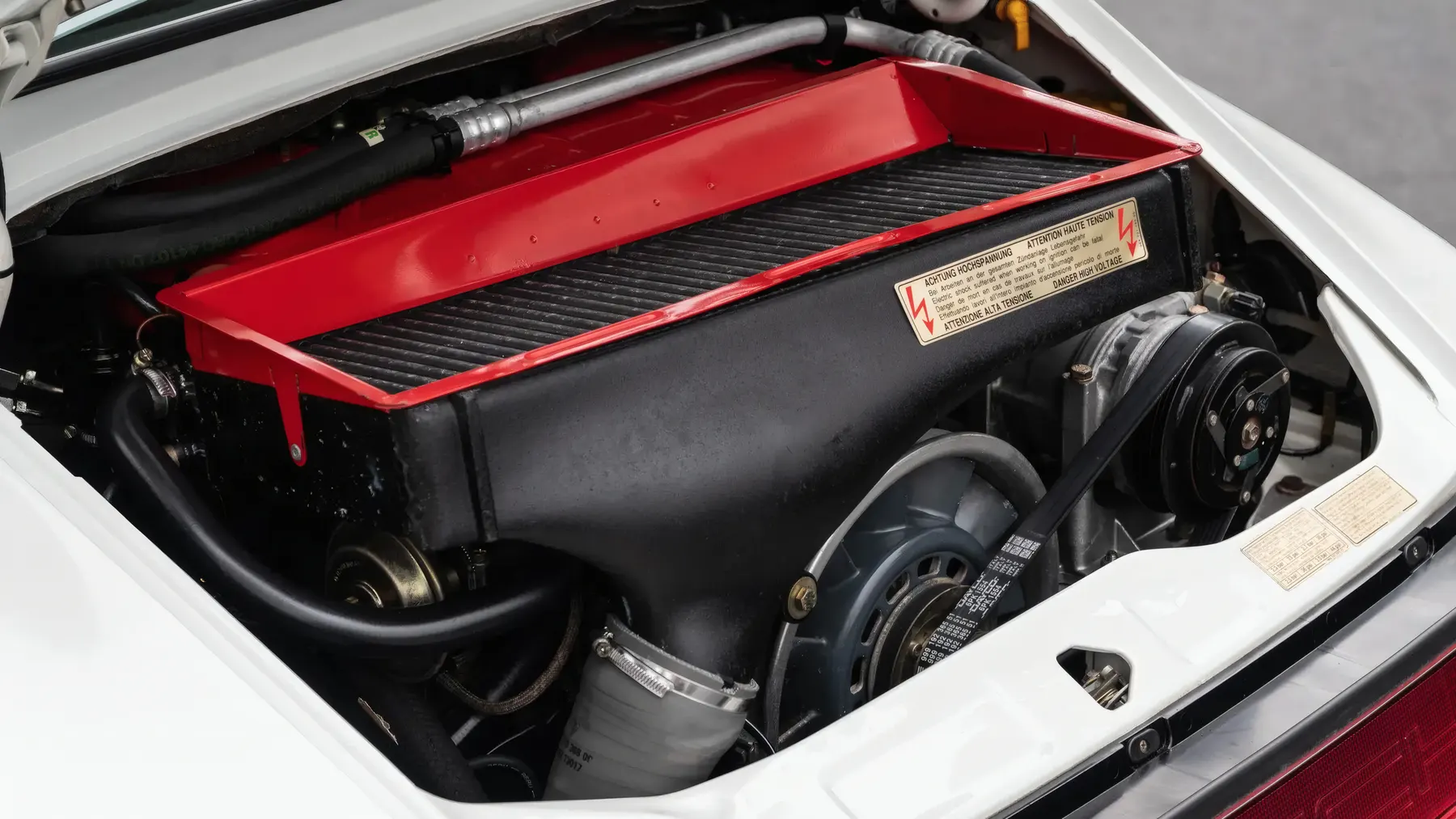
Mechanically, the Lightweight kept the 964 Turbo’s 3.3-litre architecture - itself a direct descendant of the engine that powered the 930 Turbo back into the 1970s - and wound it up considerably. The reworked Type M30/69 SL flat-six received modified intake runners and camshafts, optimized fuel injection and ignition timing, and a maximum turbocharger boost pressure of 1.0 bar, helped by a more efficient KKK turbocharger. Output rose to 381 PS (around 376 bhp) at 6,000 rpm, a 61-horsepower improvement over the standard 3.3-litre Turbo, whose own output sat at 320 PS, or 316 bhp, at 5,750 rpm. One auction listing details torque at 361 lb-ft, though that figure does not appear consistently across other sources and should be treated as reasonably reliable rather than definitively confirmed. It’s worth noting the timing here: this single-turbo 3.3-litre unit was effectively at the end of its development road. Porsche released the all-new 964 Turbo 3.6 in January 1993, barely months after the Lightweight finished production, meaning Leichtbau buyers received the ultimate, most extreme expression of an outgoing engine family rather than the company’s latest turbocharging technology.
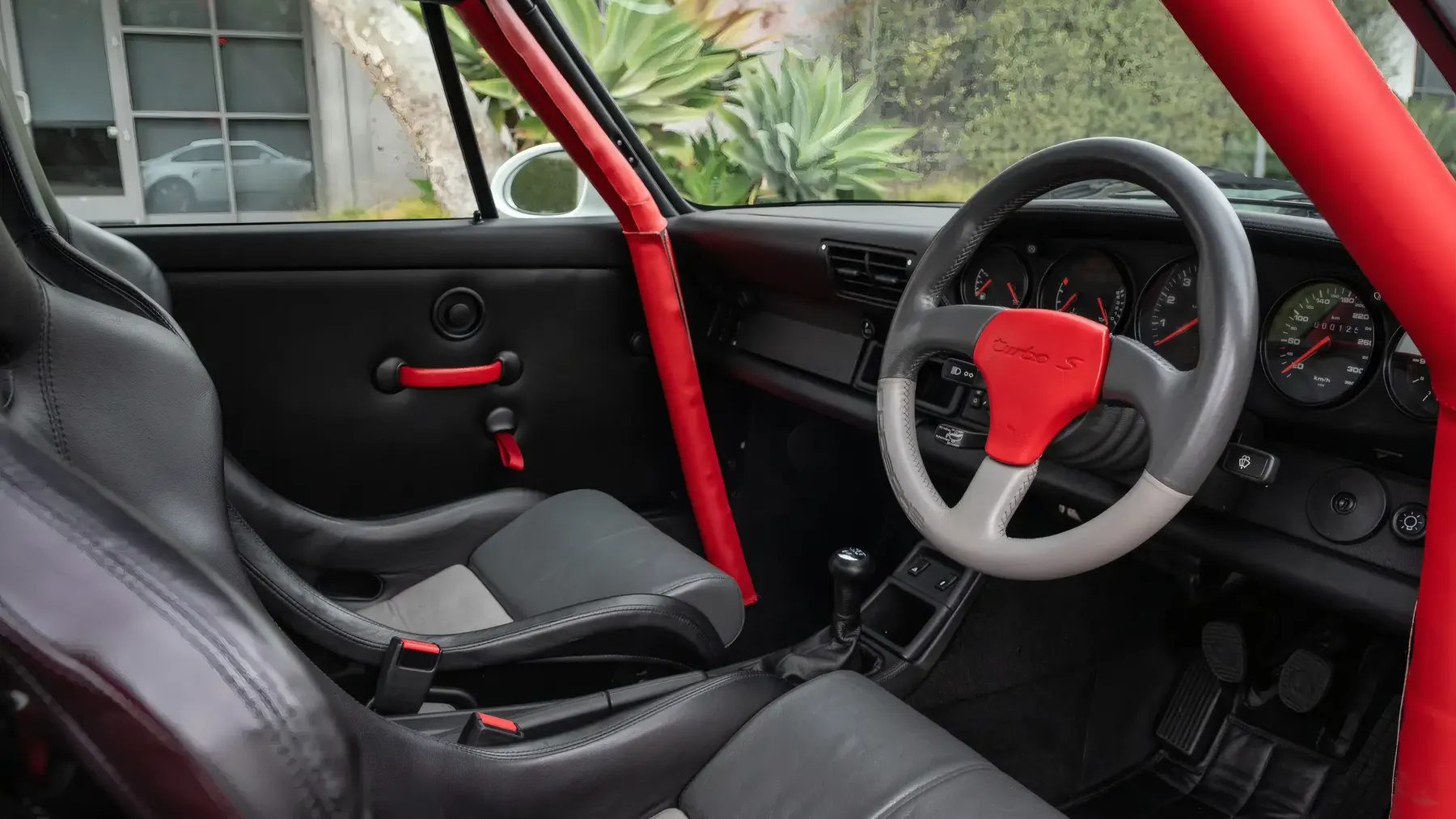
Weight, far more than power, was the point. Comfort and convenience items were stripped wholesale - air conditioning, power steering, power-adjustable seats (replaced with semi-competition buckets), electric windows, and the rear seats were all removed, with the Turbo’s standard door cards swapped for thinner items borrowed from the Carrera RS. The doors, front trunk lid, and tail spoiler were remade in glass-fibre-reinforced carbon composite, with thinner glass fitted to the rear and side windows - though it’s worth flagging that this directly contradicts another reference source, which instead describes the doors as aluminium with only the luggage compartment finished in carbon fibre; period documentation on this specific detail is not fully consistent. The bodyshell itself was seam-welded and reinforced, with a new alloy strut brace stiffening the front end, and undercoating and sound-proofing were kept to a minimum. The result, repeated consistently across specialist sources, was a curb weight of just 1,290 kg, some 180 kg lighter than a standard 964 Turbo. Interestingly, the diet wasn’t dogmatic: because power windows were standard fitment across the entire 964 range, several Lightweights retained their factory electric windows and even air conditioning, since reverting to manual winders would have forced Porsche to re-certify the model - a small but telling example of homologation paperwork outweighing purist intent.
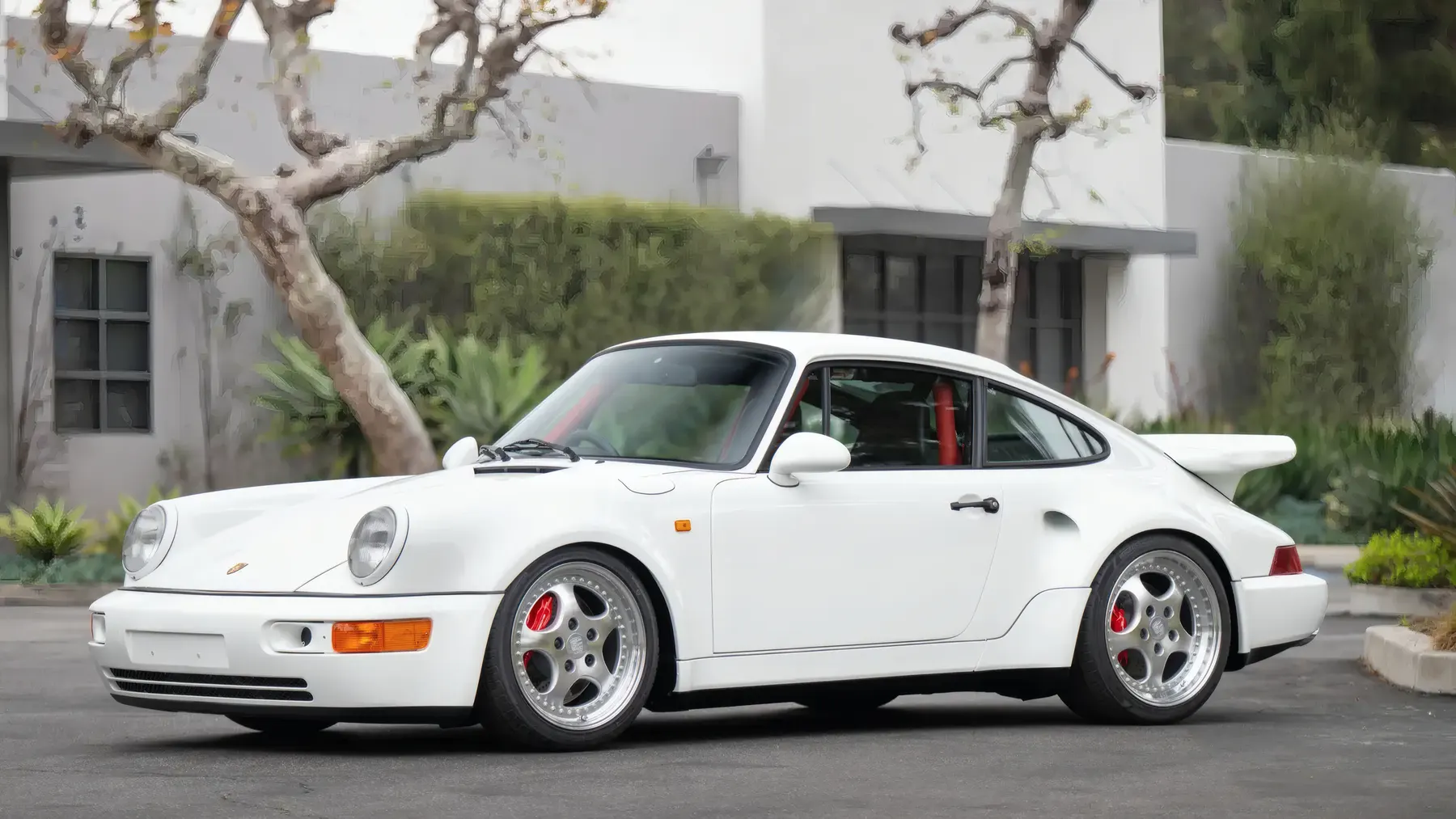
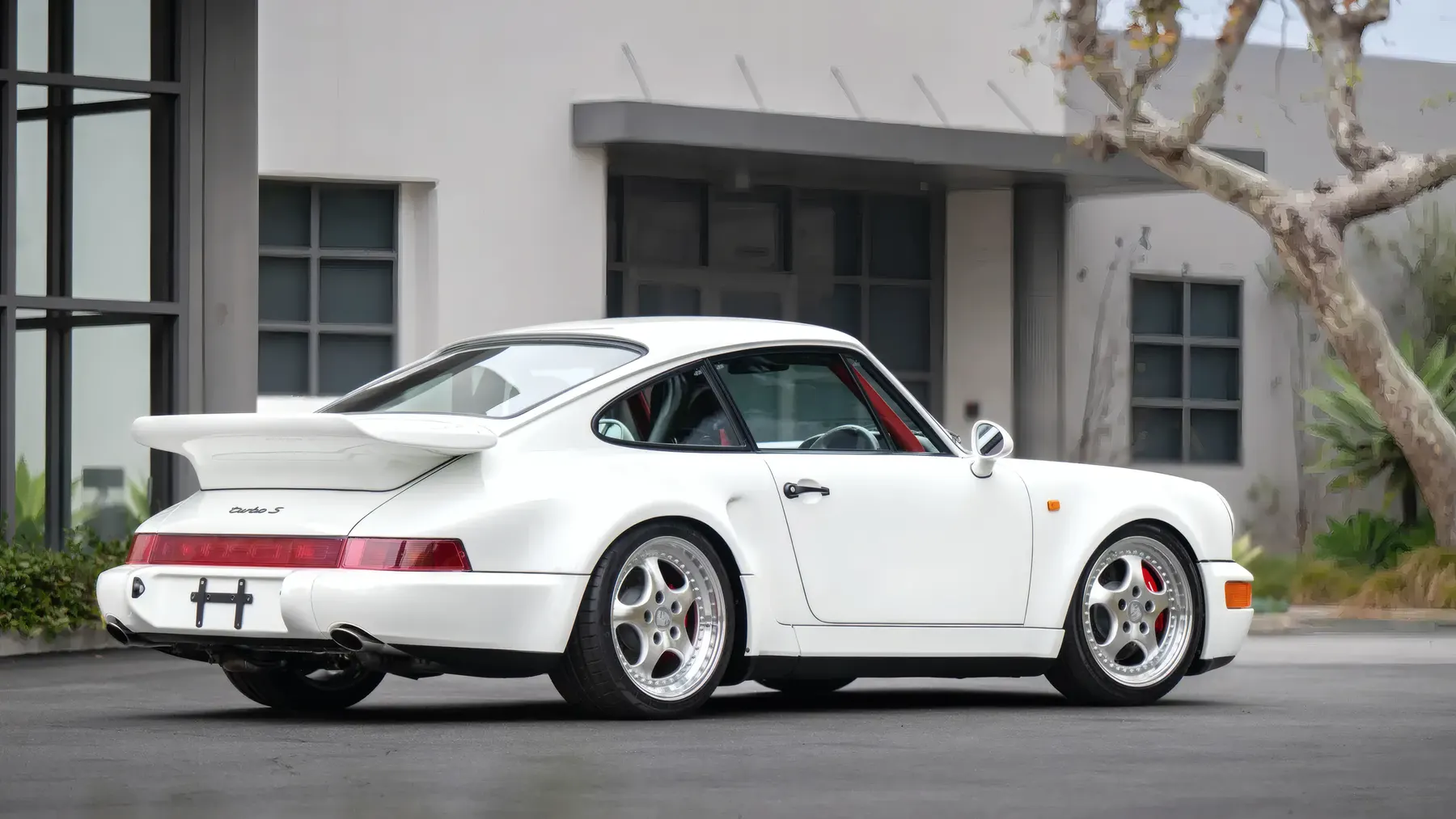
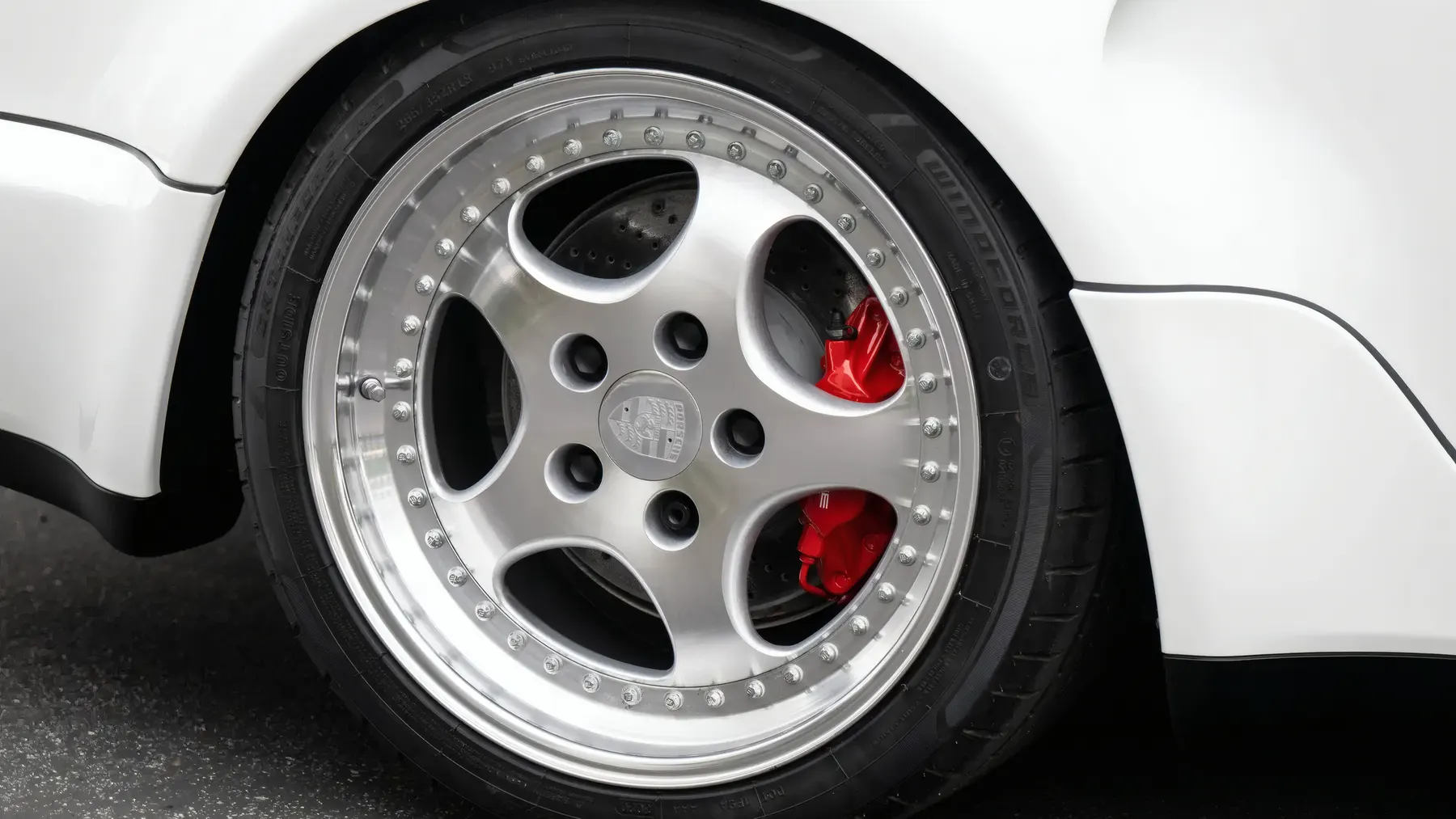
Visually, the Lightweight announced itself with details that would go on to define water-cooled 911 Turbos for years afterward. In place of the usual front fog lights sat brake-cooling air intakes, and the flared rear fenders gained their own integrated intakes - vents borrowed directly from the styling language of the flagship 959 - a styling cue that later became a hallmark of every subsequent water-cooled Turbo model. The car rode on polished 18-inch three-piece Speedline modular alloy wheels paired with the “Big Red” four-piston Turbo brakes, sitting beneath a chassis that had been lowered by 40 mm and fitted with stiffer springs, struts and shocks via the M030 European Sport Suspension package. The rear deck wore a flatter, body-coloured whale-tail spoiler in place of the standard Turbo’s taller wing, completing a profile that looked, and was, closer to a homologation special than a luxury grand tourer.
On paper the numbers were striking for their era: a 0–62 mph time of 4.7 seconds and a top speed in the region of 180 mph. The original asking price was DM 295,000, a figure that, even allowing for inflation, represented a substantial sum for a car with fewer creature comforts than the model it was based on - a paradox that defined the entire project.
Behind the wheel, period and modern accounts converge on a similar theme: this is not an easy car. Turbo lag is pronounced, boost arrives violently, and the rear-engine, rear-drive layout leaves little margin for error, demanding a level of respect and anticipation that the standard, power-steered, air-conditioned Turbo never asked for. Weight reduction throughout was aggressive and unapologetic, with thinner glass, a stripped interior, minimal sound deadening, and fixed-back seats contributing to a car that felt far closer to a competition special than a luxury supercar. With a single, large turbocharger feeding boost in a way that modern twin-turbo and electronically-managed cars simply don’t replicate, throttle response below the boost threshold is soft, followed by a hard, sudden surge once the turbo spools - exactly the character that made early 911 Turbos notorious, only delivered here with less weight to mask it and less assistance to soften it.
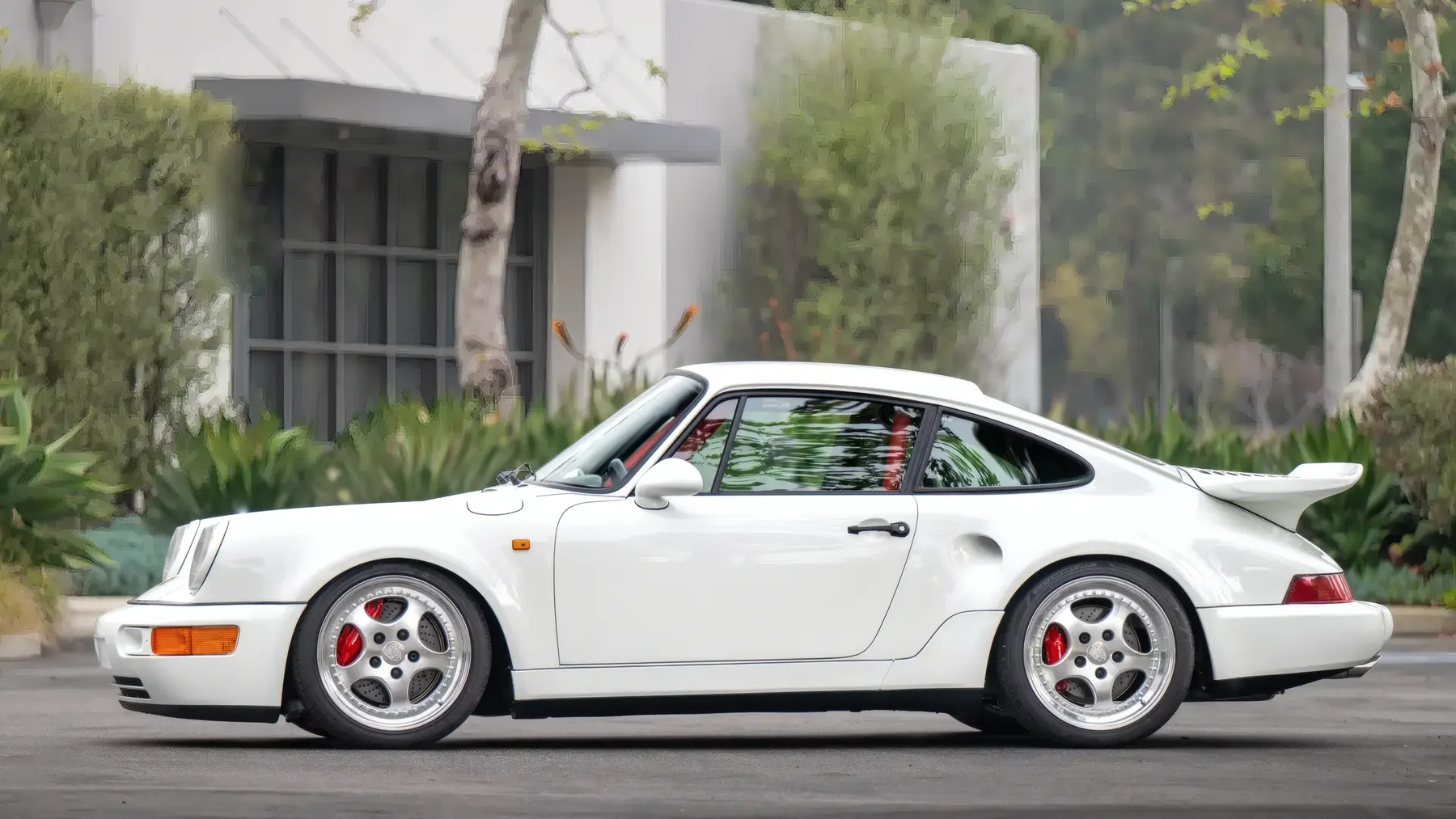
That demanding character is also where the car’s real compromises live, and they’re worth naming plainly rather than waving away as charm. The abrupt, lag-then-shove power delivery, combined with a chassis carrying its mass behind the rear axle and manual, unassisted steering, made the Lightweight a car that punished inattention in a way the contemporary, more civilized Turbo did not - this wasn’t merely “raw” in a flattering sense, it was genuinely less forgiving to drive quickly than the model it replaced in the line-up. The stripped cabin, meanwhile, made for a genuinely difficult daily companion: no air conditioning meant miserable journeys in hot climates, no power steering made parking and low-speed manoeuvring a workout, and the absence of a radio, rear seats, and meaningful sound insulation turned anything beyond a short blast into a tiring, noisy proposition. These weren’t quirks that simply added flavour - they materially reduced the car’s usability for anyone who wanted to drive it regularly rather than treat it as an occasional weapon. And from a business perspective, committing scarce development resources to an ultra-low-volume, ultra-expensive halo project, built around an engine architecture about to be superseded within months, was a considerable gamble for a company already struggling to sell its mainstream range - one that paid off in reputation far more than it ever did in volume.
None of that has dented the car’s standing among collectors; if anything, the opposite occurred. As one of the rarest 964-generation specials - sitting alongside siblings such as the Carrera RS 3.8, the RSR 3.8, and the various Flachbau Turbo S variants - the Lightweight has become recognized as among the most desirable air-cooled 911s in existence. By 2021, values were still hovering just below the million-dollar mark, before RM Sotheby’s sold examples for roughly $1.3 million and $1.1 million in January and March of 2022 respectively. Auction estimates from the period - such as $1,000,000 to $1,200,000 placed on one example at RM Sotheby’s 2018 Amelia Island sale - illustrate how quickly the Lightweight outgrew its origins as merely the priciest Turbo on the order sheet. Today it’s frequently discussed in the same breath as Porsche’s other early-1990s halo specials, a recognition that didn’t exist when DM 295,000 buyers were signing for cars stripped of their stereos.
What the Turbo S Lightweight ultimately represents is a moment of nerve inside a company that, by most measures, should have been playing it safe. It took the 964 Turbo’s already-aggressive formula, removed the parts that made it pleasant, added the parts that made it faster, and charged a serious premium for the privilege - a calculation that made sense only if you believed, as Sprenger evidently did, that a small number of buyers would pay handsomely for the purest possible expression of an idea. It also marked the practical birth of Porsche Exclusive as something more than an options counter, a department capable of conceiving and engineering an entire model rather than merely trimming one. Three decades on, the Lightweight reads less like a footnote and more like a statement: that even at its most financially exposed, Porsche was still willing to build the car nobody strictly needed, simply because it could.
Sources
- Elferspot Magazine - “Porsche 964 Turbo S Lightweight: The Wildest Turbo of Them All”
- Elferspot - 1993 Porsche 964 Turbo S Leichtbau Listing
- Elferspot - 1993 Porsche 964 Turbo S Leichtbau (RM Sotheby’s London 2024)
- Elferspot - 1994 Porsche 964 Turbo S Leichtbau Listing
- Tom Hartley Jnr - Porsche 964 Turbo S ‘Leichtbau’
- PCARMARKET - 1992 Porsche 964 Turbo S Leichtbau
- Wikipedia - Porsche 911 (964)
- RM Sotheby’s - 1993 Porsche 911 Turbo S Lightweight, Arizona 2026
- RM Sotheby’s - 1993 Porsche 911 Turbo S ‘Leichtbau’, Amelia Island 2018
- RM Sotheby’s - 1993 Porsche Turbo S ‘Lightweight’, Arizona 2023
- RM Sotheby’s - 1992 Porsche 911 Turbo S Lightweight, London 2020
- RM Sotheby’s - “Exclusively Porsche: The 964 Collection” Press Release
- Stuttcars - Porsche 911 Turbo S 3.3 (964) (1992–1993)
- Thiesen Automobile - Porsche 964 Turbo S “Leichtbau”
Join the discussion
Comments
Loading comments…
Leave a comment
Share a detail, memory, or perspective. Every comment is reviewed before publication.