Porsche 911 (964) Turbo 3.6: The Engine It Should Have Launched With
1994 Porsche 911 Turbo 3.6





Images: RM Sotheby's
The most awkward thing about the first 964 Turbo was the engine it did not have. Porsche had spent the late 1980s reworking something like 80 per cent of the 911’s parts, swapping torsion bars for coil springs, adding power steering and ABS, and developing an all-new 3.6-litre flat-six, the M64, for the Carrera; the chassis changes were aimed squarely at taming the reputation for sudden, throttle-triggered oversteer that had earned the preceding G-series 930 Turbo an unofficial nickname as a car that did not forgive mistakes. Yet when the Turbo arrived in 1990 it carried an uprated version of the old 3.3-litre unit from the 930, because the engineers had run out of time to turbocharge the new one. That car made around 320 bhp, was quick and was well received, and it was built in far greater numbers than its successor, comfortably more than three thousand. But it was always a stopgap. The Turbo 3.6 was shown at the Paris show in autumn 1992 and formally launched in early 1993 (sources differ on how to date its introduction), and it was the car the 964 Turbo had been meant to be. It also turned out to be the last rear-wheel-drive, single-turbocharger 911 Turbo Porsche ever sold.
The engine work went well beyond a simple rebore. Capacity rose from 3,299cc to 3,600cc through a bore of 100mm and a stroke of 76.4mm, up from 97mm and 74.4mm, and the Carrera’s 11.3:1 compression ratio was dropped to a boost-friendly 7.5:1, with new pistons and high-lift camshafts. A single KKK K27 turbocharger did the blowing. The result was 355 bhp at 5,500rpm and 384 lb-ft at 4,200rpm, a gain Porsche’s own historical account rounds to 40 bhp over the 3.3 though the specification sheets suggest a shade over 35, and Porsche’s own history describes the output as virtually unmatched among rivals when the car arrived. But peak power is the least interesting part of the story. Porsche’s figures show around 330 lb-ft already available from just 2,400rpm, with the turbocharger taking effect at just under 3,000rpm and, according to one specialist account, full boost arriving at about 3,500rpm. The company’s own testing recorded the 50 to 75mph fifth-gear sprint at 7.1 seconds, some 3.6 seconds quicker than the 3.3. That kind of flexibility, more than the headline figure, is what separates the 3.6 from the car that preceded it. The M64 block itself was not an unknown quantity by 1993: it had already been proven in naturally aspirated form through the fiercely contested Porsche Carrera Cup one-make series, and specialist accounts of the Turbo 3.6’s development credit those racing miles with helping validate the reliability of the larger unit before Porsche turbocharged it for the road car. Porsche quoted 0 to 62mph in 4.8 seconds and a top speed of about 174mph, up from roughly 168mph, though other sources give 0 to 62mph times a fraction quicker, in the region of 4.7 seconds. A cruising speed of around 140mph, Porsche’s own writer noted, was entirely comfortable.

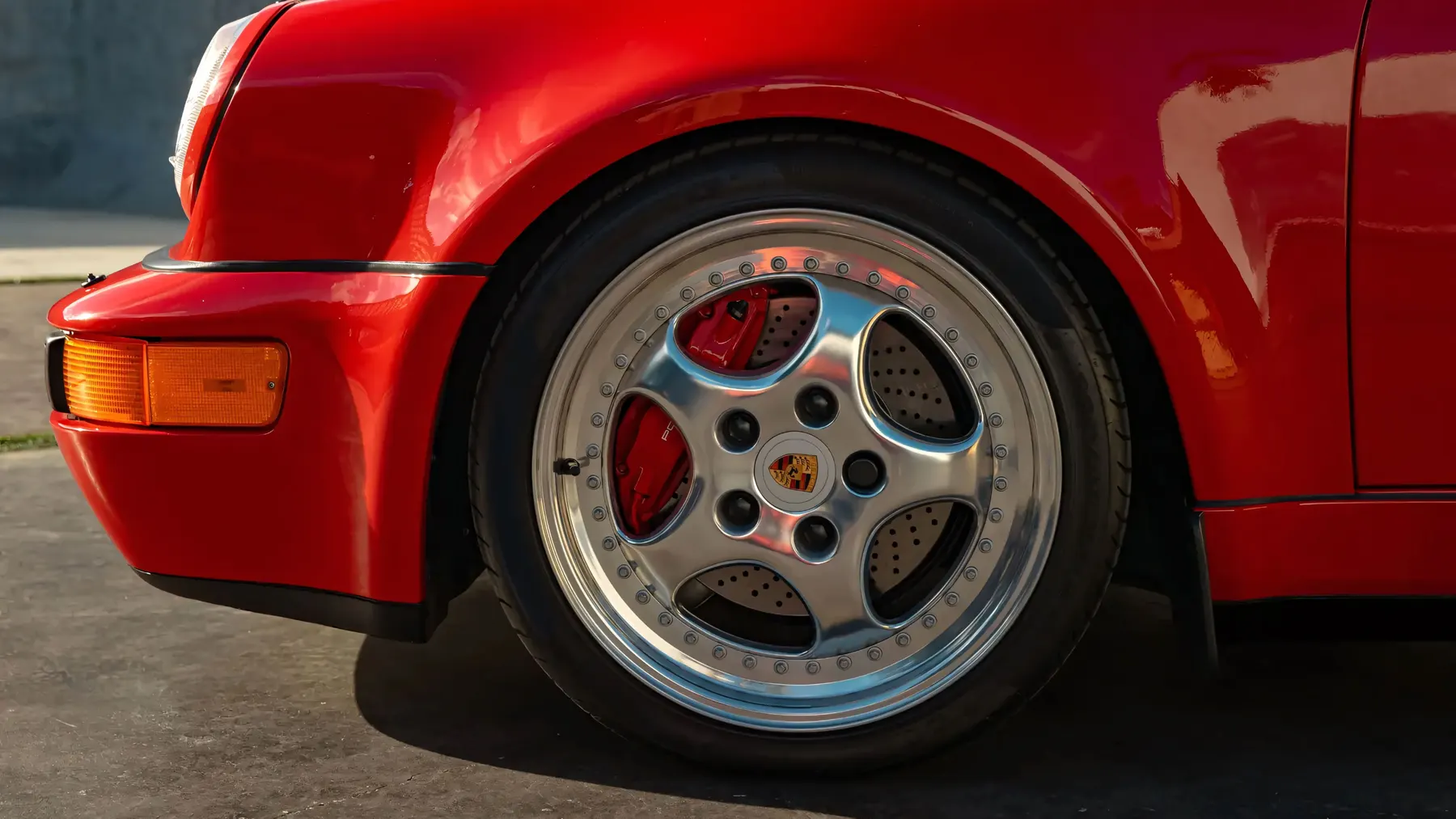
The rest of the car was built to cope with that. Like every 964 Turbo it used the rear-wheel-drive Carrera 2’s steel bodyshell, with MacPherson struts at the front, cast aluminium semi-trailing arms at the rear and coil springs all round. For the 3.6, the Sport suspension that had previously been an option became standard, lowering the ride height by 20mm and stiffening the dampers, though cars bound for North America kept a taller stance. The brakes came from the Turbo S Lightweight programme: cross-drilled, ventilated discs of 322mm at the front and 299mm at the rear, red calipers, recalibrated ABS and a hydraulic rather than vacuum servo. Three-piece Speedline wheels, 8 inches wide at the front and 10 inches at the rear and wearing 225/40 and 265/35 tyres, completed the hardware. Porsche’s stopping figure of 35.6 metres from 62mph was, in the company’s telling, the best in the world in this discipline at the time, and a locking differential was standard. Kerb weight was 1,470kg, unchanged from the 3.3, which is worth remembering when you consider how much extra performance the engine had to deliver to justify the newer car.

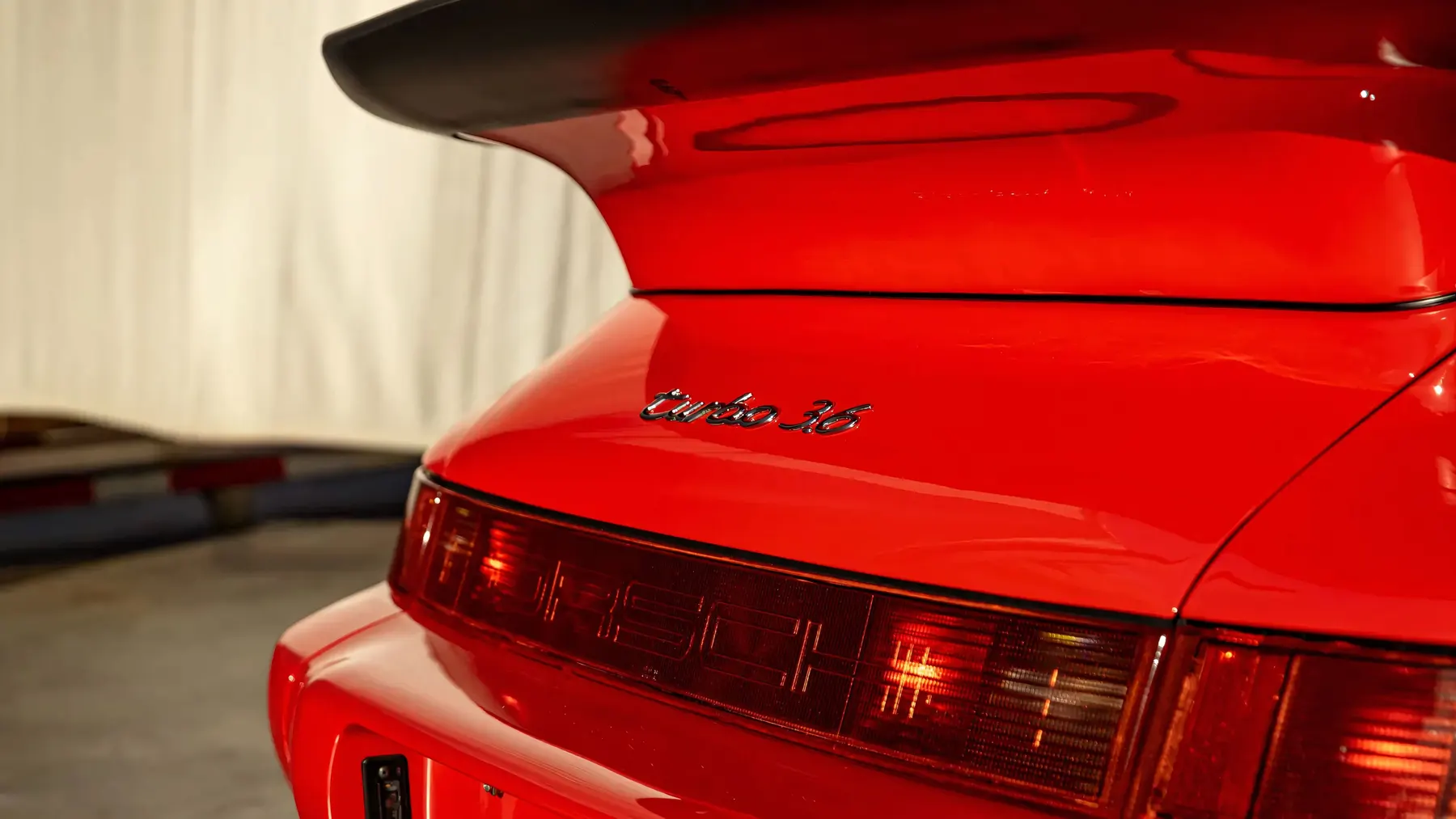
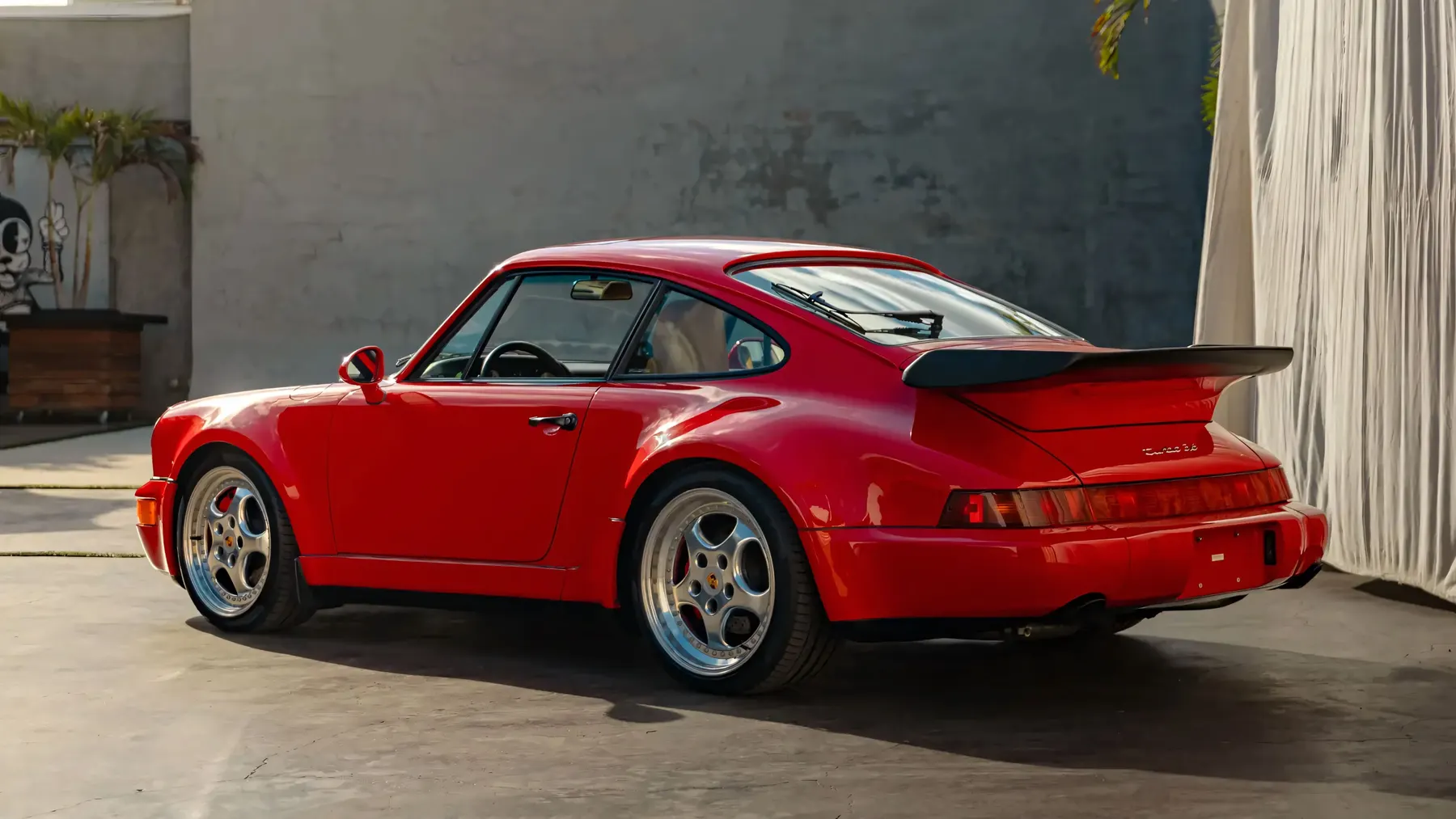
Visually the 3.6 was barely distinguishable from the 3.3 beyond its wheels, red calipers and a Turbo 3.6 script on the engine lid. At 1,775mm wide, its flared arches gave the car a squat, planted look next to the narrower-bodied Carrera, and the fixed rear wing was the same enormous shelf the Turbo had worn for years. Porsche itself points out that this was one of the last 911s with the upright headlights set into the wings. The cabin was where the age of the platform showed most. The five-dial layout would have been familiar to a 911 owner from the 1970s, with an analogue boost gauge in the centre of the instrument cluster and an on-board computer offering a digital boost readout. Airbags, air conditioning, electric windows and mirrors were standard, and the Porsche Exclusive department would happily fit ruched leather, alternative colours and a long-range 92-litre fuel tank. Porsche’s own commentators note that the 911’s design and interior feel had been frozen in time across generations, and the 3.6 Turbo is a fair example of that.

Numbers vary depending on who is counting. The figure most widely quoted is 1,437 cars, while other sources put standard production nearer 1,400 with the Turbo S conversions bringing the total closer to 1,500, and Porsche itself says fewer than 1,500. That Turbo S was a late curiosity. With the 993-based 911 arriving, Porsche found itself with around 90 unused Turbo chassis and handed them to Porsche Exclusive, which built them between September 1993 and early 1994 with the X88 Power Kit, worth roughly 380 bhp, plus a 40 per cent locking differential, a lip spoiler, rear fender air intakes and polished wheels. Most wore the slant-nosed Flachbau front end; the remaining 17, all sent to North America, kept the standard headlights. They cost a fifth more than a regular 3.6 Turbo, or around 60 per cent more in Flachbau form. There was also an earlier detour worth knowing about: around 192 customers ordered the X33 works tuning on the 3.3 Turbo, giving roughly 355 bhp and, according to specialist accounts, performance on a par with the later 3.6 but with a more explosive delivery. That is a useful reminder that the 3.6’s real advance was manners rather than raw pace.
The timing could hardly have been worse commercially. Porsche was in the early stages of a financial crisis, hit by an ageing range, inefficient production and weak trading conditions, and the recession was biting the whole industry. A new 3.6 Turbo cost 207,880 marks by June 1994, which is why few were built and why most buyers were people who could afford to have them serviced at a Porsche centre. The model’s life was also short: the 993 Turbo, with twin turbochargers and four-wheel drive, arrived in March 1995 and moved the game on again, with Porsche’s own figures showing the 993 Turbo S dropping the 0 to 62mph time to 4.1 seconds.
What was it actually like to drive? Porsche’s own retrospective account of the car is revealing precisely because it is not gushing. The torque, it says, came through the roof once the turbocharger woke up, and even with the locking differential the car felt like riding a cannonball. The stopping power was extraordinary and the traction and flexibility were transformed compared with the 3.3. Yet the writer also admits that rear-wheel drive demanded respect at the slightest hint of wet weather, and that on a drizzly autobahn night he found himself wishing for four-wheel drive, a wish Porsche granted with the 993. Other specialists agree on the essentials. Hagerty describes a very definite lag as the Turbo spools up, and Classic & Sports Car calls the 3.6 the ultimate enthusiast’s 964 Turbo, with major lag and raw performance, while warning that a skilled driver will cope and the unwary will be bitten. Elferspot’s buyer’s guide is blunter: turbo engine, rear-wheel drive, no traction control, and certainly no car for beginners. It also notes that some 964 Turbos have been drawn to guard rails like magnets, which is a nicely grim way of describing what happens when boost arrives mid-corner.
That is the point where the car’s flaws stop being character and start being consequences. The lag, though improved, never disappeared, and a rear-drive car with more than 380 lb-ft and no electronic aids can make a mistake very expensive very quickly. The ride was firm; Classic & Sports Car notes the 964 rides more harshly than you might expect, especially in turbo form, and when Autocar took a 964 Turbo to Le Mans alongside a Ferrari 348, Honda NSX and Lotus Esprit Turbo, it judged the Porsche the harshest and most uncomfortable of the four, with unacceptable tyre roar, though also the fastest. The cabin was dated next to those rivals, and the five-speed gearbox lacked the sixth ratio that the 993 gained. Fuel consumption was heavy, with Elferspot calling all 964 Turbos hard-drinking. Ownership costs are steep even by Porsche standards. Elferspot points out that disc brakes and dampers are expensive, that the 3.6’s alloy brake calipers tend to seize, that oil lines tend to leak and can even burst, and that original exhaust systems are almost a five-figure purchase; Classic & Sports Car adds that a modest 964 oil leak can turn into an engine rebuild costing several thousand pounds. Even the instruments can misbehave, with peeling paint film behind the warning lights and failing LCD displays in the tachometer. Some of this can be forgiven as age rather than design, but it does mean that the buyer who wants the fabled 3.6 has to accept an ownership experience that is as demanding as the driving.
The car’s reputation has grown regardless. Elferspot credits its starring role in Bad Boys, along with the sheer scarcity of surviving cars, for making the 3.6 a bedroom-wall poster car and pushing prices to extraordinary heights. Porsche noted in 2017 that a 3.6 was worth virtually the same in euros as it had cost in marks, and had recently seen exceptional cars change hands for more than 300,000 euros; Hagerty’s UK guide put an excellent coupé at around £215,000 in 2022. Behind the prices is a more durable argument. The 964 Turbo 3.6 marks the end of a lineage that stretches back to the 1975 930, the last time Porsche offered a single-turbocharger, two-wheel-drive Turbo with a manual gearbox and a dash of genuine menace. It fixed the biggest complaint about the earlier 964 Turbo, the dead zone below the boost threshold, without adding electronic supervision or all-wheel-drive security. That makes it faster and much easier to use than a 930, yet still as demanding as any road-going Porsche before or since. Those who love it tend to say that the demands are the point, and the ones who find them tiresome have the 993 Turbo to turn to.
Technical data
Performance Specifications
| Variant | Years produced | Engine | Power | Torque | 0–62mph | Top speed | Kerb weight | Production |
|---|---|---|---|---|---|---|---|---|
| 964 Turbo 3.3 | 1991–1992 | 3.3-litre turbocharged flat-six (M30/69) | 320 bhp @ 5,750rpm | 332 lb-ft @ 4,400rpm | 5.0–5.4s* | 168–172mph* | 1,470 kg | ~3,360–3,660* |
| 964 Turbo 3.3 WLS (X33) | 1992 | 3.3-litre turbocharged flat-six, works-tuned | 355 bhp | n/a† | n/a† | n/a† | 1,470 kg (est.)* | 192 |
| 964 Turbo 3.6 | 1993–1994 | 3.6-litre turbocharged flat-six (M64/50) | 355 bhp @ 5,500rpm | 384 lb-ft @ 4,200rpm | 4.7–4.8s* | 174–175mph* | 1,470 kg | ~1,400–1,437* |
| 964 Turbo S / Flachbau (X88 Power Kit) | 1993–1994 | 3.6-litre turbocharged flat-six, Power Kit (M64/50S) | 380 bhp @ 5,750rpm | 384 lb-ft @ 5,000rpm | n/a† | n/a† | 1,470 kg (est.)* | 93 |
Sources
- Porsche Newsroom - “White giants” (964 Turbo 3.6 retrospective)
- Porsche Newsroom - 60 Years of the Porsche 911 press kit, 3rd Generation Engines
- Supercar Nostalgia - Porsche 911 3.6 Turbo / Turbo S (964) Guide
- Elferspot Magazine - Porsche 964 Turbo Buyer’s Guide
- Classic & Sports Car - Porsche 911 (964) Buyer’s Guide
- Hagerty UK - Buying Guide: Porsche 964 (1989–1993)
- Stuttcars - Porsche 911 Turbo 3.3 (964) Coupé Ultimate Guide
Join the discussion
Comments
Loading comments…
Leave a comment
Share a detail, memory, or perspective. Every comment is reviewed before publication.