Porsche 911 (993) Turbo S: The Air-Cooled 911 Turbo's Perfect Finale
1997 Porsche 911 Turbo S
%20Turbo%20S%3A%20The%20Air-Cooled%20911%20Turbo's%20Perfect%20Finale%20%7C%20Motor%20Archive)
Images: Courtney Frisk / RM Sotheby's
When Porsche’s Exclusive department signed off on the run-out special that became the 993 Turbo S in 1997, the company was doing something it rarely did with the 911 Turbo: closing a chapter rather than opening one. Every previous Turbo had pushed the format outward, more boost, more grip, more sophistication layered onto the last one. The Turbo S did that too, but it also happened to be the final air-cooled 911 Turbo Porsche would ever build, arriving in showrooms just as the water-cooled 996 generation was starting to appear alongside it. For a brief overlap in 1998, a customer walking into a Porsche dealership could choose between the brand-new future of the 911 and this, the most expensive, most powerful send-off to everything that had come before. It is a car built at exactly that intersection of ambition and farewell.
The lineage behind it stretches back to the original 930-generation Turbo of 1975, a car whose reputation for vicious, throttle-off oversteer became so entrenched that it earned the unofficial nickname “widowmaker” among owners and journalists of the era. That single-turbo formula persisted, in 3.3-litre form, through the 964 generation’s early-1990s Turbo before Porsche fundamentally rethought the concept for the 993. Unveiled at the Geneva Motor Show in March 1995, the 993-generation 911 Turbo was the first series-production Porsche Turbo to use twin turbochargers, and the first 911 Turbo of any kind to send power to all four wheels, borrowing the lightweight four-wheel-drive hardware from the naturally aspirated Carrera 4. It was a deliberate act of taming a car that had built its reputation on being dangerous.
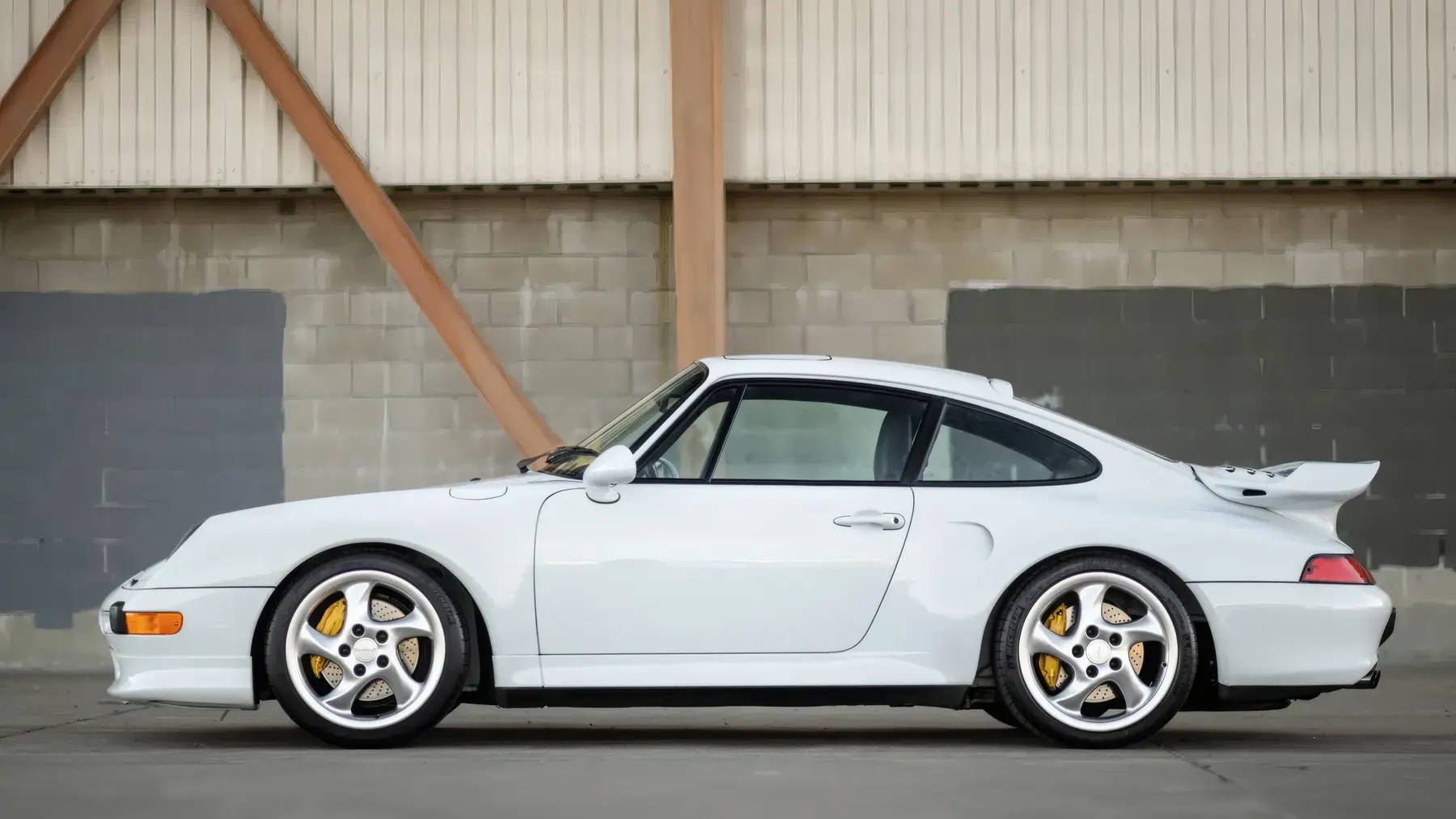
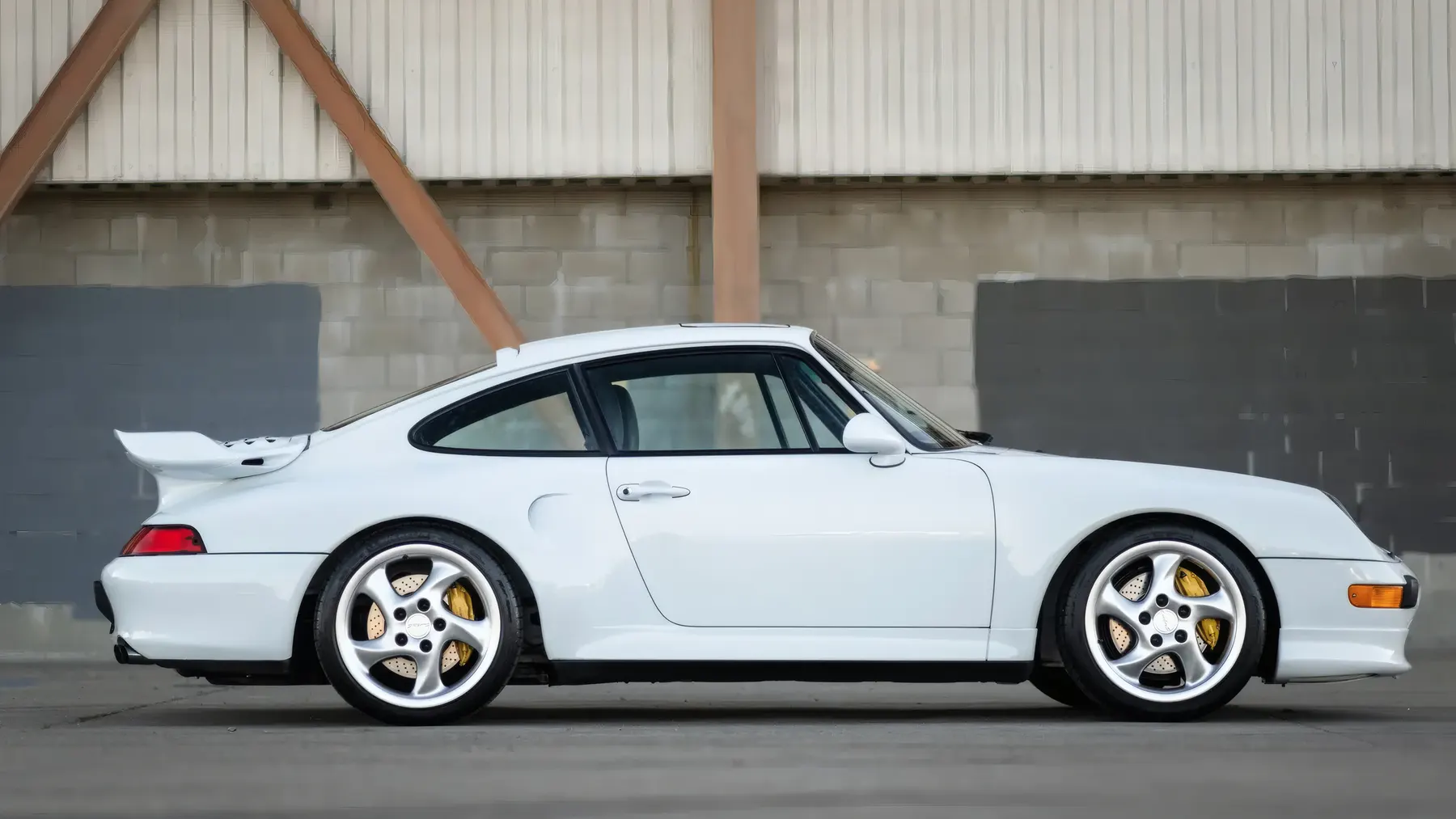
Underneath the familiar 993 bodywork sat a 3.6-litre, air-cooled flat-six known internally as the M64/60, an evolution of the long-running Porsche boxer architecture with a single overhead camshaft per bank, two valves per cylinder, and dry-sump lubrication. Bore and stroke measured 100mm and 76.4mm respectively, and compression was dropped to 8.0:1 to cope with boost from a pair of KKK K16 turbochargers feeding through twin air-to-air intercoolers mounted in the tail. In standard Turbo form, the engine produced 408bhp at 5,750rpm and 398lb-ft of torque at 4,500rpm, with a healthy 332lb-ft already on tap from just 2,500rpm, a spread that gave the car real flexibility despite the turbo lag inherent to its era. Drive went through a reinforced six-speed manual gearbox, the G64/51, with a limited-slip differential and Porsche’s Automatic Brake Differential system helping to manage traction; no automatic option was ever offered. The chassis carried over the 993’s improved steel monocoque, MacPherson struts at the front and a multi-link Weissach rear axle, with cross-drilled 322mm brake discs and red four-piston calipers borrowed from the Carrera RS, all riding on newly designed 18-inch two-piece wheels with hollow spokes to trim unsprung weight, a genuine engineering novelty for a production 911 at the time.
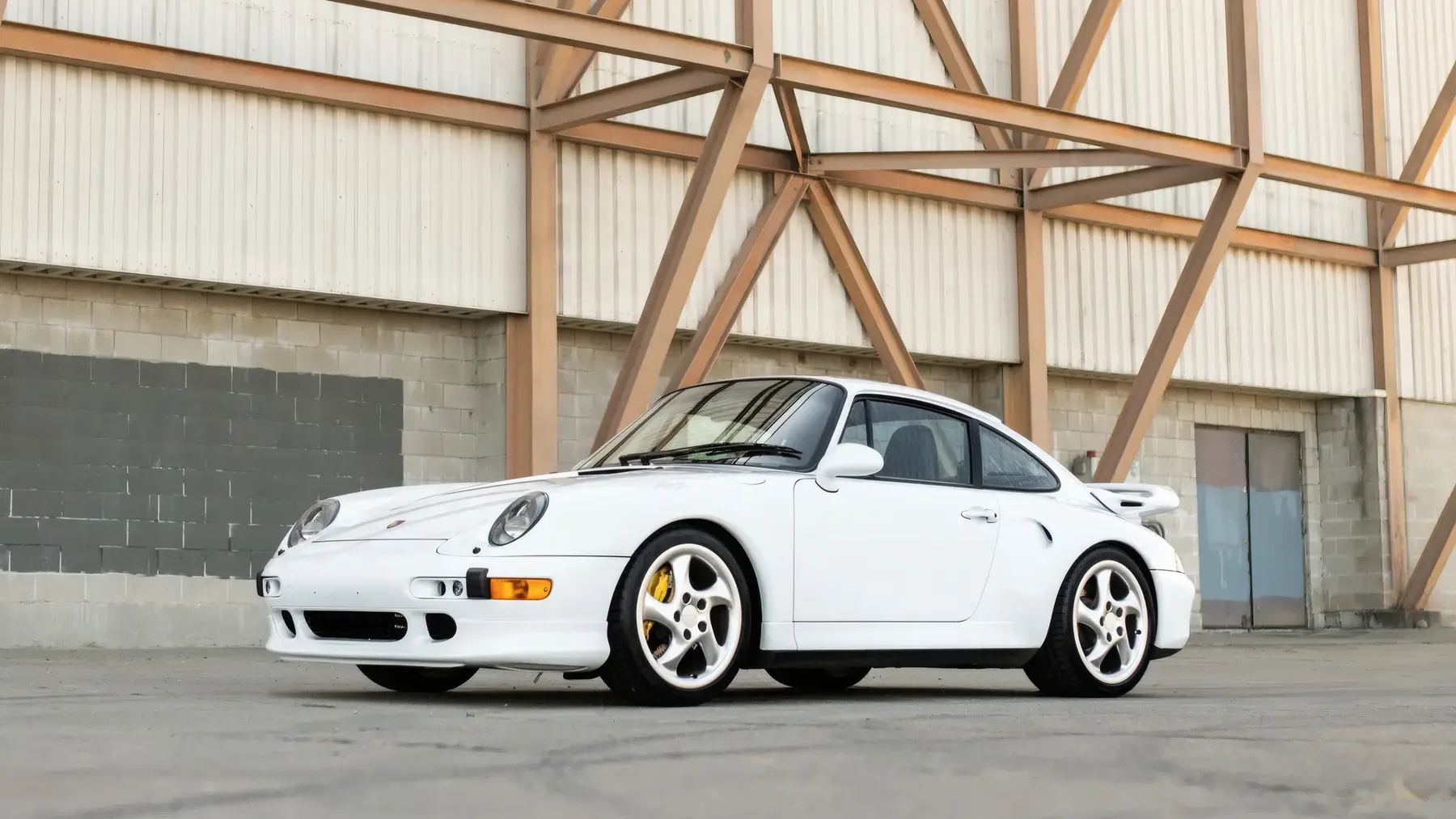
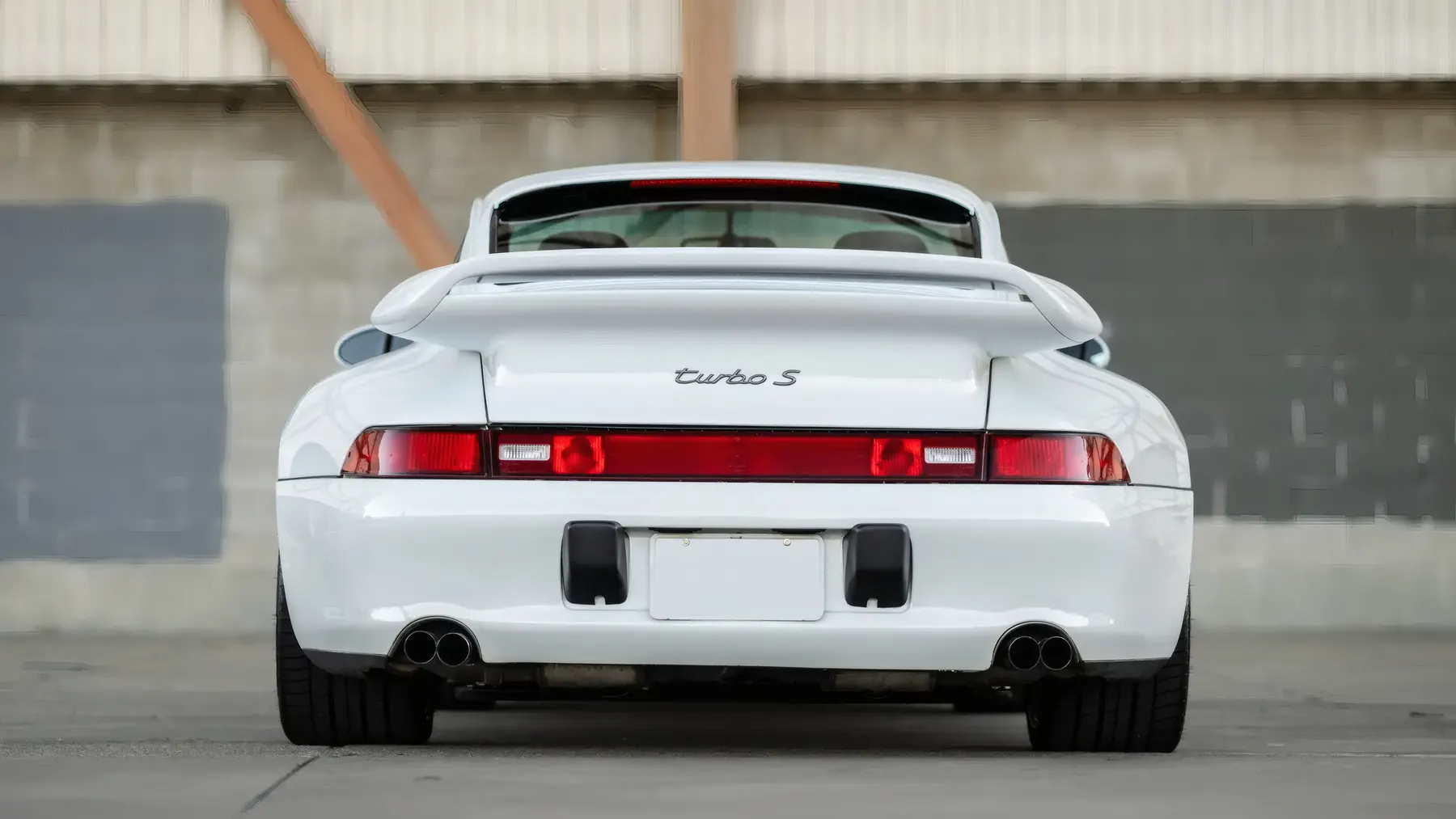
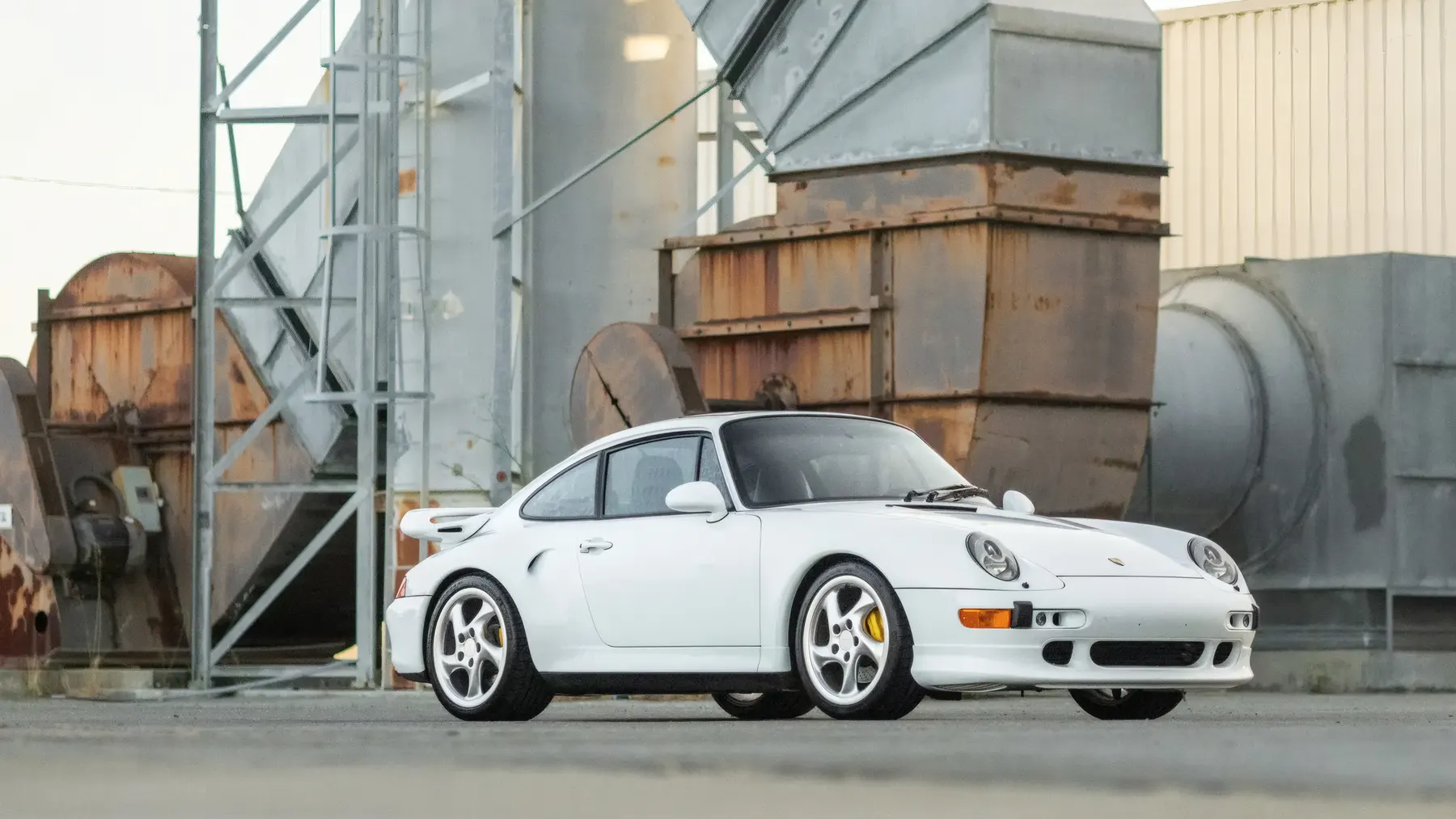
Porsche didn’t leave the formula static for long. For the 1996 model year, an optional X50 power kit added a supplementary oil cooler and a remapped ECU, lifting output to 430bhp. For 1998, the XLC package went further still, pairing the X50 hardware with larger K16 turbochargers to reach around 444bhp. The Turbo S, launched for that same final model year, essentially took this top state of tune and made it standard, while wrapping it in a package built entirely by Porsche’s Exclusive department rather than the regular production line. Every Turbo S left the factory with what had been options on lesser Turbos: Aerokit II front and rear spoilers, unique front air inlets and side ducts, distinctive yellow-painted brake calipers, quad round exhaust tips in place of the standard car’s dual ovals, matte-finished “Technologie” wheels, and a cabin trimmed almost entirely in leather and carbon fibre, down to the roof lining, gear lever, handbrake and even the door handles, which carried a finely etched “Turbo S” script. The sports suspension sat 15mm lower than a standard Turbo’s. Porsche’s own historical materials quote 444bhp from the WLS II (Werksleistungssteigerung II) engine upgrade, a 1,500kg kerb weight, a 0-62mph time of 4.1 seconds and a top speed of 186mph, making it the first 911 the factory officially rated above that threshold. US-market cars, hobbled by tighter emissions equipment, were rated lower, typically quoted at 424bhp, and a handful of period and present-day sources still cite a slightly lower top speed of around 184mph for those cars, evidence of just how much the American-spec engine gave away to its European and rest-of-world siblings.
Production was tiny and, fittingly for a car this exclusive, even the exact number is disputed. Porsche’s own newsroom archive states that 435 Turbo S models were built by the Exclusive department; the great majority of specialist marque historians, registries and price guides instead cite a total of 345, with roughly half of that figure believed to have been imported into the United States. Whichever figure is correct, this was a vanishingly rare car when new, priced around fifty percent above an already expensive standard Turbo, and rarer still today, values for surviving examples commanding close to double what a well-kept standard 993 Turbo fetches.
Visually, the Turbo S leaned into a design language the 993 generation had already perfected. Where the preceding 964 Turbo’s flared arches and upright whale-tail spoiler had felt slightly bolted-on, the 993’s wider hips were integrated into the bodywork itself, a genuinely cohesive shape rather than a standard Carrera with panels grafted on. The fixed rear wing, housing both intercoolers beneath it, sat lower and flatter than earlier Turbo spoilers, and the wide intake in each rear flank, a detail borrowed directly from the four-wheel-drive 959 supercar of the 1980s, became the single most recognisable visual cue of every 911 Turbo built since. The Turbo S simply sharpened that theme: Aerokit bodywork, yellow calipers glimpsed through the hollow-spoke wheels, and quad exhaust tips gave it a slightly more purposeful stance than a standard Turbo without abandoning the restraint that made the 993 shape so enduring. Inside, the changes were less about visual drama and more about material indulgence, full leather trim extending across surfaces that were usually painted plastic, and carbon fibre applied to the gearlever, handbrake and dashboard inserts in a way few 911s of the era attempted, giving the cabin a sense of occasion that matched the badge on the door handles.
That sense of occasion never came at the expense of usability, and this remains one of the Turbo S’s more underrated qualities. Behind the rear seats, still present as a nominal 2+2 layout despite their limited use for adult passengers, sat a genuinely useful amount of everyday practicality: a front luggage compartment sized like a proper hatchback’s boot, standard air conditioning, electric windows and mirrors, and heating and ventilation robust enough for the car to serve as genuine year-round transport, helped enormously by the all-wheel-drive system’s ability to put power down in poor weather that would have left a rear-drive 930 stranded. Few contemporaries could match that blend of everyday composure with genuine performance credentials, and it’s a large part of why period buyers were willing to pay such a substantial premium for the Turbo S over cars that, on paper, offered similar outright pace.
The 993 Turbo’s defining trick was making genuine supercar performance feel manageable, and the Turbo S simply turned that dial further in both directions at once. Behind the wheel, the four-wheel-drive system, splitting torque roughly 20 percent to the front axle and the rest to the rear, transformed the old Turbo’s knife-edge reputation into something a keen driver could actually lean on. Contemporary and retrospective reviews describe a car that still needs weight loaded onto the front tyres to avoid mild understeer through a bend, and one where the turbos remain genuinely lazy below around 4,000rpm before the engine surges hard toward its 7,000rpm redline, an old-school power delivery that rewards smart use of the gearbox to stay on boost. The unassisted, heavily geared steering is frequently singled out as close to perfect, full of the kind of unfiltered feedback that later, electrically assisted 911s would never quite recapture, while the six-speed manual demands a deliberate, physical action through a tight gate and an unusually weighted clutch pedal, nothing like the light, easy actions of a modern gearbox. Drivers who came to the car from earlier air-cooled Turbos generally found it reassuring rather than diluted: the all-wheel-drive system removed the old car’s capacity to bite an inattentive driver without erasing the sense that this was still a raw, analogue machine, with no electronic safety net beyond the mechanical hardware itself.
That reassurance came at a cost, and it’s worth being honest about what the Turbo S sacrificed to get there. Purists at the time, and plenty since, argued that the AWD system made the 993 Turbo meaningfully heavier and more of a grand tourer than the lighter, rear-drive Carreras and earlier Turbos that had defined the 911’s reputation for decades; the four-wheel-drive hardware alone added tens of kilograms over a comparable rear-drive car, and that extra mass, plus the complexity of the driveline, was the literal price of the security drivers gained. Porsche itself seemed to acknowledge as much by keeping the rear-drive, lightweight GT2 in the lineup alongside the Turbo and Turbo S for buyers who wanted the old, unfiltered thrill rather than the AWD safety net; a later GT2 Evo run even borrowed the Turbo S’s more powerful engine but kept the rawer, two-wheel-drive chassis specifically because some customers still preferred it that way. Ownership brings its own set of realities, too. Air-cooled 993 engines are known to use oil at a rate that alarms owners new to the breed, valve cover gaskets and main seals harden and weep with age, and the cars are notably prone to corrosion around the windscreen frame and jacking points, issues that specialist buying guides return to again and again regardless of how well-built the rest of the car feels. The AWD hardware itself, along with the turbo oil feed and scavenge lines that keep the K16 turbochargers alive, is expensive to maintain and unforgiving of neglect, particularly the practice of shutting the engine down hot without allowing the turbos to cool, which can cook their bearings over time. None of this makes the Turbo S unreliable by the standards of a thirty-year-old performance car; specialists routinely describe the underlying mechanicals as remarkably durable. But it does mean the ownership experience is considerably more involved, and more costly, than the car’s reputation for bulletproof German engineering sometimes suggests.
Positioned against its rivals of the mid-1990s, the Turbo S occupied a strange, almost solitary space. It was faster in the real world and vastly easier to drive quickly than a Lamborghini Diablo or a Ferrari 512 TR, cars that demanded far more commitment and forgave far less, yet it never chased the same headline numbers or the same exotic theatre. That restraint was very much the point: Porsche was selling all-weather, everyday usability alongside genuine performance, wrapped in a shape that even Porsche loyalists still argue is the prettiest 911 ever built. Within Porsche’s own range, the Turbo S sat above the standard Turbo purely as a rarer, more finished, more powerful alternative rather than a fundamentally different car, a strategy the Exclusive department would later refine into the modern Porsche personalisation programs.
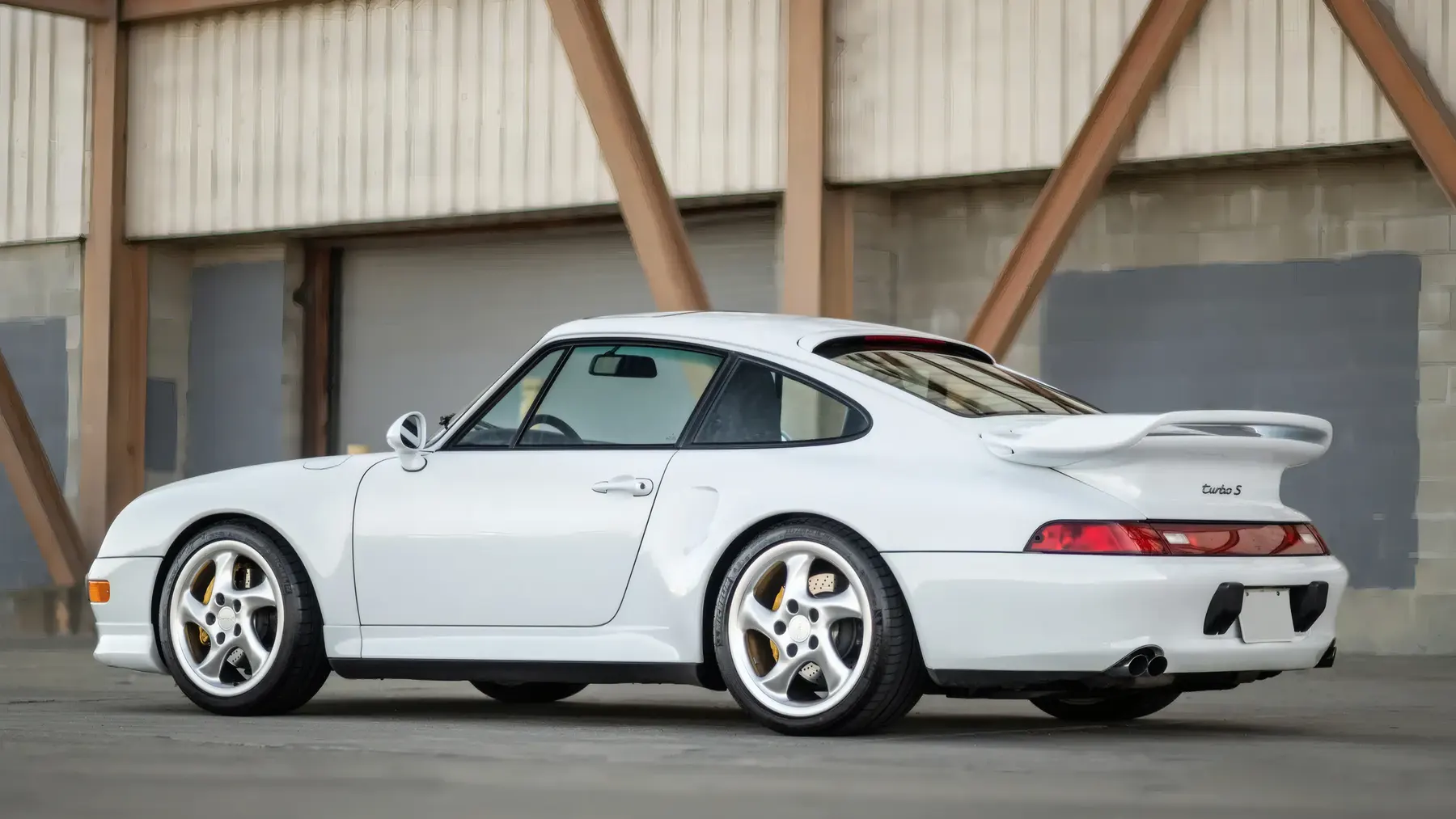
Today, the 993 Turbo S occupies a particular kind of reverence among collectors precisely because of that closing-chapter status. It represents the last point at which a 911 Turbo could be bought with an air-cooled engine, a manual-only gearbox, and hydraulic, unassisted steering, before turbocharging became a permanent, ever-present feature of every 911 Turbo that followed and before water cooling, direct injection and eventually electronic driver aids reshaped the car entirely. Later Turbos, from the 996 onward, would comfortably out-accelerate it and out-handle it on paper, but few have matched the particular tension the 993 Turbo S carries: a car engineered to be safer and more capable than everything that came before it, built in tiny numbers by hand, right at the exact moment its own engineering philosophy was being retired for good.
Technical data
Specifications
| Specification | Detail |
|---|---|
| Production | 1997–1998 model years, built by Porsche Exclusive |
| Production total | 345 units widely cited by specialist sources; Porsche’s own heritage archive states 435* |
| Engine | 3.6-litre air-cooled flat-six, twin-turbocharged, Type M64/60, SOHC per bank, dry sump |
| Bore x stroke | 100mm x 76.4mm |
| Compression ratio | 8.0:1 |
| Forced induction | Twin KKK turbochargers with twin air-to-air intercoolers (WLS II tune) |
| Power | 444 bhp @ 6,000 rpm (rest-of-world); 424 bhp (US-market, emissions-limited)* |
| Torque | Approx. 398–431 lb-ft @ 4,500 rpm; figures vary by market and source* |
| Transmission | 6-speed manual only, permanent all-wheel drive, limited-slip differential |
| Brakes | 322mm cross-drilled, ventilated discs; four-piston calipers (yellow, standard on Turbo S) |
| Wheels | 18-inch two-piece, hollow-spoke, matte “Technologie” finish |
| Kerb weight | 1,500 kg (factory) |
| 0–62 mph | 4.1 seconds (factory); some sources cite figures between 3.6 and 4.0 seconds* |
| Top speed | 186 mph (rest-of-world, factory); approximately 184 mph often cited for US-spec cars |
| Fuel tank | 73.5 litres |
Sources
- Porsche Newsroom: Porsche 911 (Type 993) Turbo S
- Porsche Newsroom: Porsche 911 Turbo S - History
- Supercar Nostalgia: Porsche 911 3.6 Turbo / Turbo S (993) Guide
- Audrain Automobile Museum: 1997 Porsche 911 Turbo S
- Hagerty Media: 50 Years of the Porsche 911 Turbo
- Hagerty Media: What to Know About the 993-Generation Porsche 911
- Octane Magazine: Porsche 993 Turbo - A Breath of Fresh Air
- Top Gear: Porsche 993 Turbo Review
- Top Gear: Porsche 993 Turbo - Driving, Engines & Performance
- ViaRETRO: Blown Away by a Youngtimer - Porsche 993 Turbo
- Autocar: Used Car Buying Guide - Porsche 911 (993)
- Revolution Porsche: Porsche 993 Buyers’ Guide
- Rennzone: 993 Turbo Value Guide - Years, Prices, Options and Pitfalls
- Exclusive Car Registry: Porsche 911 Turbo S (993)
Join the discussion
Comments
Loading comments…
Leave a comment
Share a detail, memory, or perspective. Every comment is reviewed before publication.