Porsche 911 (996) GT2: The Widowmaker That Redefined the 911 Turbo
2003 Porsche 911 GT2





Images: Jack Howells / RM Sotheby's
Porsche spent the 1990s teaching its turbocharged 911 to behave. The notoriously tail-happy 930-generation Turbo gave way to the 964 Turbo’s wider stance and reworked suspension, and then, with the 993 generation in 1995, Porsche sent power to all four wheels for the first time, taming the car’s most dangerous trait for good. By the time the water-cooled 996 generation arrived, the 911 Turbo was arguably the most usable supercar in the world - a car a competent driver could exploit fully, every day, in any weather. And then, in 2001, Porsche built the opposite of that car on purpose. It took the Turbo’s engine, widened body and formidable brakes, deleted the front driveshafts, switched off every electronic safety net, and sent it out into the world with a nickname it would spend the next two decades trying to live down: the Widowmaker.
That car was the 911 GT2, and the 996-generation version was not the first to wear the name. Porsche had introduced the GT2 designation in 1994 on the air-cooled 993, a homologation special built to satisfy the FIA’s GT2 racing category - a lighter, rear-drive-only version of the 993 Turbo that shed around 205 kg through aluminium doors and bootlid, thinner glass and a stripped cabin, while power rose from around 402 bhp to 424 bhp and later 444 bhp. Only 193 examples of that first GT2 were built. When Porsche came to plan its successor, the intent was ostensibly the same: build a road car extreme enough to satisfy racing homologation rules, following the template set by the 996-generation GT3 that had launched at Geneva in 1999. The GT2 class itself, though, was in flux. The demise of the GT1 category - accelerated by Porsche’s own devastating, barely-disguised 911 GT1 race car - had pushed GT2 to the top tier of production-based GT racing for the 1999 season, with the category renamed GT and GT3 rebranded N-GT for 2001, the year the new car was due to arrive. Porsche’s motorsport department drew up plans to contest that category against the Chrysler Viper GTS-R, the Lister Storm GTM and Prodrive’s Ferrari 550 Maranello. Those plans never happened. Porsche’s finance department had set a threshold of roughly 500 cars a year for four years to justify developing a genuine homologation special, and a market for that many stripped-out, twin-turbo road racers simply did not exist. So the racing programme was quietly shelved, Porsche’s actual GT effort of the period was carried instead by the naturally aspirated GT3-R and GT3-RS, and the 996 GT2 was developed and sold as a pure road car - a supercar wearing a competition-class name it would, in period, never actually race under works colours.

None of that dulled the ambition of the finished car. The 996 GT2 debuted at the Detroit Motor Show in January 2001, with the first customer deliveries following that summer, and it was built around the reinforced, galvanised steel bodyshell shared with the 996 Turbo and Carrera 4. Everything from there was a deliberate act of subtraction and provocation. Where the Turbo sent power to all four wheels through a viscous coupling that could shuffle up to 40 percent of torque forward, the GT2 drove only the rear wheels - a direct reversal of the very feature that had made the Turbo tolerable. The engine was the long-block, water-cooled evolution of Hans Mezger’s GT1-derived flat-six, coded M96/70S, running a dry-sump lubrication system needed simply to package the unit in the 996’s engine bay, and Porsche’s VarioCam Plus system for variable valve lift and timing. Bigger KKK K24 turbochargers than the standard Turbo’s, larger intercoolers, and boost raised to 2 bar from 0.8 bar pushed output to 456 bhp at 5,700 rpm and 457 lb-ft between 3,500 and 4,500 rpm - a 10 percent jump over the Turbo’s 414 bhp - through a reinforced six-speed Getrag manual gearbox with steel synchro rings and 20 percent shorter shift throws. There was no Tiptronic option, unlike the rest of the 996 range; a clutch pedal was compulsory.

The GT2’s real engineering pedigree lies in that Mezger-derived engine architecture, and it matters for reasons beyond outright power. The naturally aspirated 996 and early 997 Carrera models built alongside it used a related but distinct M96/M97 engine with a sealed, non-serviceable intermediate shaft bearing that has become one of the most infamous failure points in modern Porsche history. The GT2, along with the contemporaneous 996 Turbo and GT3, used the Mezger unit’s continuously oil-fed plain bearings instead, a fundamentally different design that is not prone to the same catastrophic failure. It is one of the quieter reasons Mezger-engined 996s have aged so much better, mechanically, than their naturally aspirated siblings, and a genuine engineering strength buried inside a car more commonly discussed for its temper than its durability.

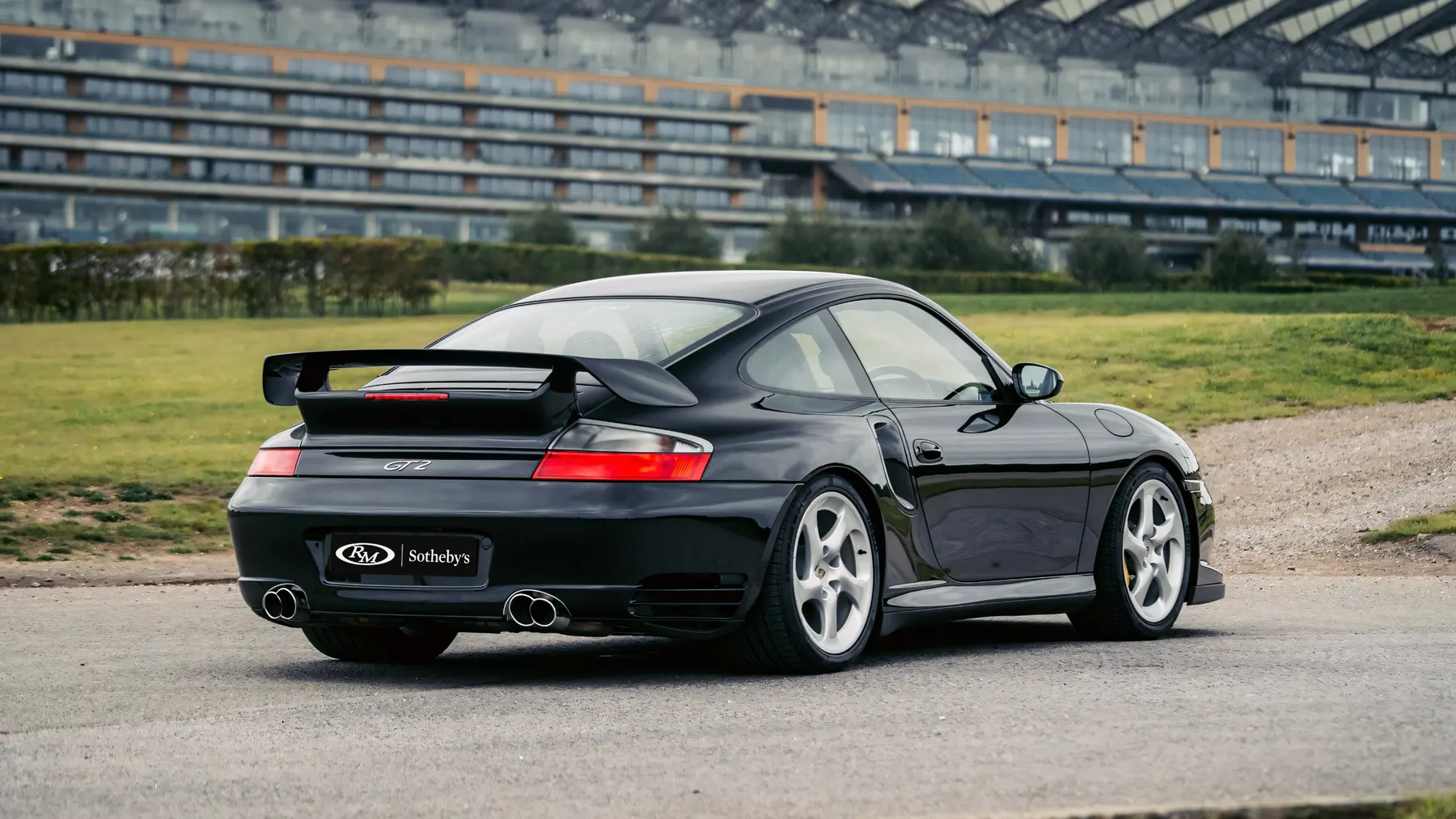
Weight came off wherever Porsche could find it without compromising strength. The GT2 tipped the scales at 1,440 kg against the Turbo’s 1,540 kg, a 100 kg saving achieved through a fixed rear wing in place of the Turbo’s retractable item, the deletion of the rear wiper, a stripped and largely carpet-free cabin, and thinner sound deadening. That fixed wing, mounted on two pylons that also ducted air to the turbochargers, pushed the drag coefficient from 0.32 to 0.34 - a small but real aerodynamic penalty accepted in exchange for stability at the car’s 196 mph claimed top speed. Suspension followed GT3 practice in its adjustability - shorter, firmer springs dropped ride height by 10 mm relative to the standard Turbo, with fully adjustable Bilstein dampers and anti-roll bars front and rear - though the GT2’s springs ran slightly heavier and its damper rates a fraction softer than the GT3’s, a concession to the extra mass and power it had to control. Braking came from Porsche Ceramic Composite Brakes as standard equipment, the first time PCCB had been fitted to any production Porsche: 350 mm rotors front and rear, up from 330 mm, gripped by new six-piston monobloc front calipers finished in yellow, the whole system weighing roughly 16.6 kg less than an equivalent steel setup, a saving of around 50 percent. Conventional steel discs remained available as a no-cost option for buyers wary of ceramic technology still new to road use.
The most consequential decision, though, was what Porsche chose not to fit. There was no traction control and no stability management of any kind - a genuine absence, not a system with a permissive threshold. To offset that, Porsche’s chassis engineers deliberately dialled additional understeer into the suspension geometry, hoping to bias the car’s cornering balance toward safety at the limit rather than outright neutrality. It didn’t fully work, or at least not for every driver. The GT2’s turbochargers brought real lag; power built gradually at low revs and then arrived in a sudden surge as boost came on, and if that surge landed mid-corner, on a wet road, or under an imprecise input, the rear end could step out with very little warning and even less to catch it. Specialist outlets that have driven the car describe it bluntly as a machine that does not forgive mistakes, and the reputation is not simply internet mythology: one feature by the UK’s PistonHeads recounts a Porsche-affiliated source describing a customer who collected a new GT2 in 2001 and never made it home. Stories like that, repeated and amplified across two decades of enthusiast forums and specialist press, are exactly how a car earns a nickname like Widowmaker and keeps it.
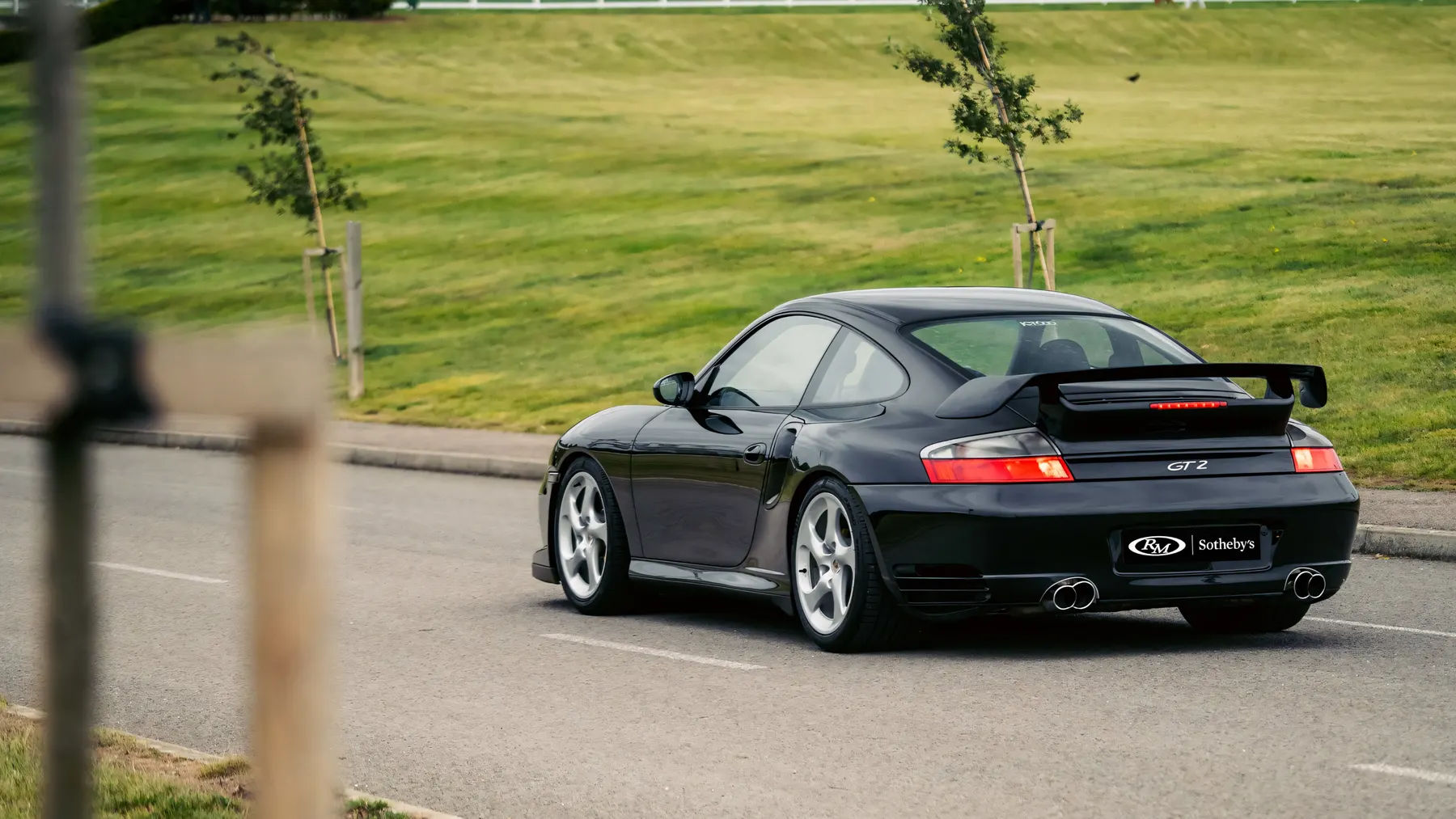
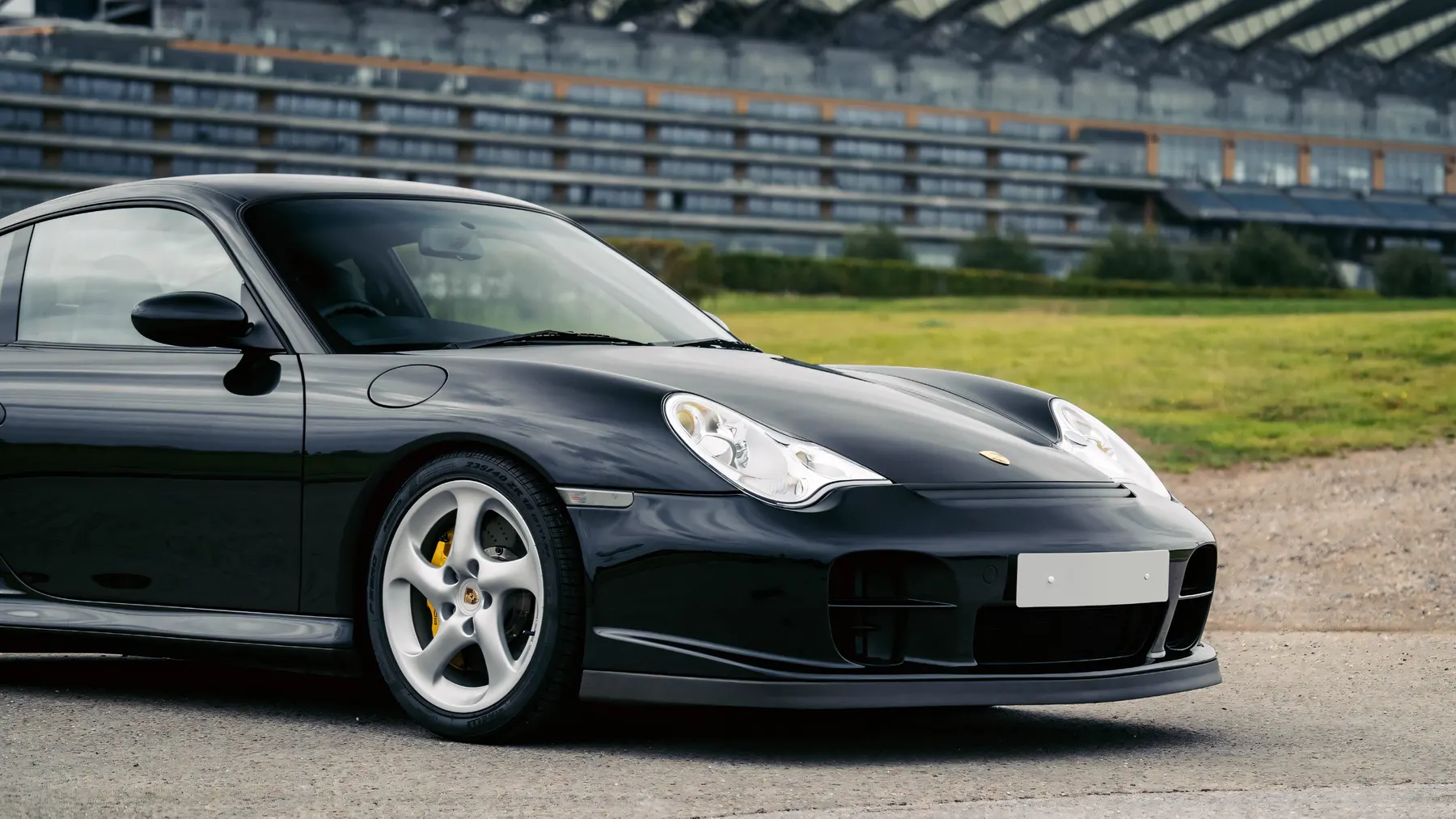
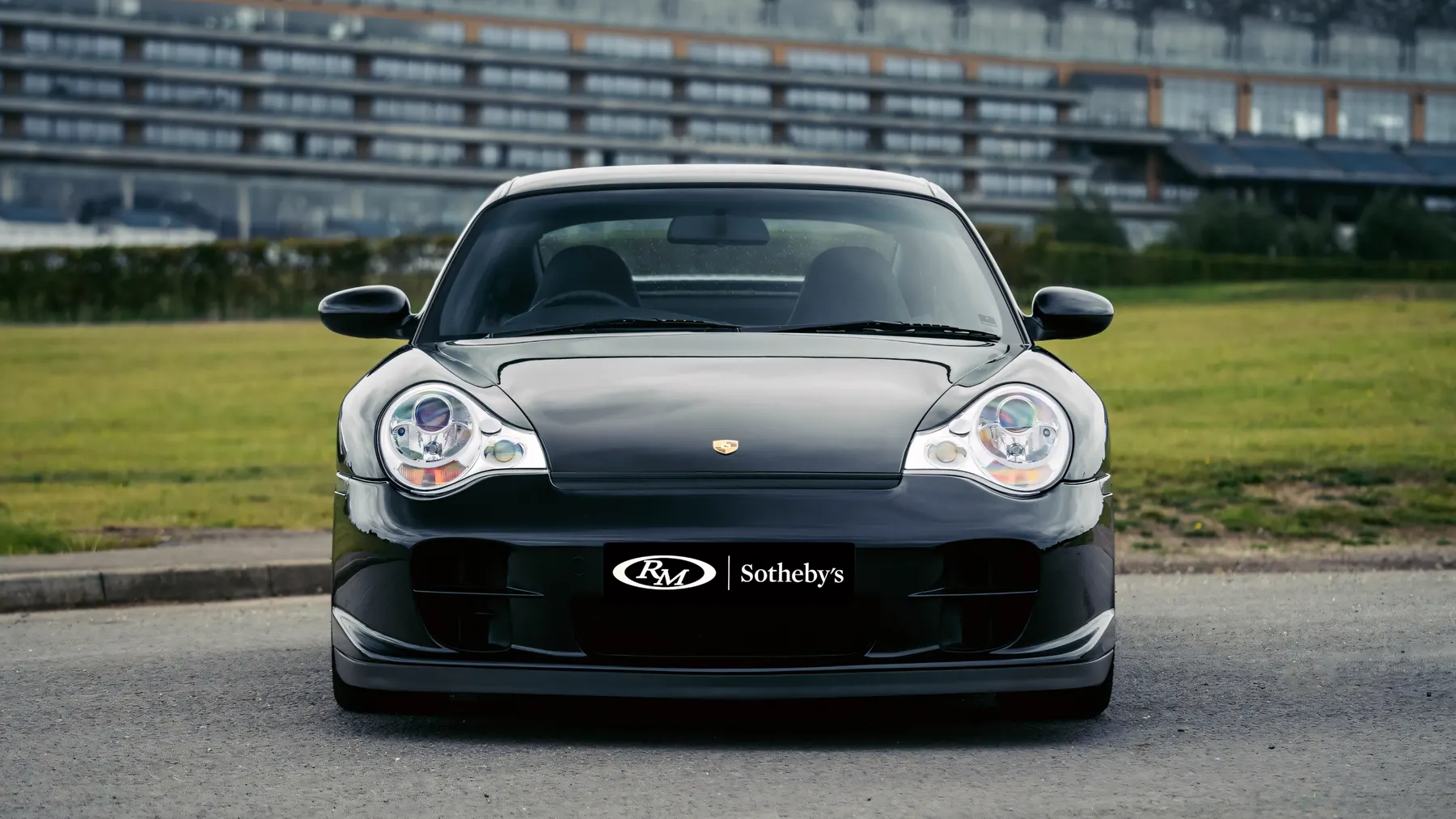
Visually, the GT2 distinguished itself from the standard Turbo with a reworked front bumper carrying three enlarged intakes, a wraparound chin spoiler, integrated canards, and a GT3 R-style vent ahead of the bonnet’s leading edge to help extract heat from the front-mounted radiators. Subtly flared rear haunches covered wider, staggered 18-inch Turbo II wheels - 8.5 inches front and a full 12 inches rear, up from 8 and 11 inches on the Turbo - wrapped in Pirelli P Zero Rosso rubber. Inside, the cabin followed the GT3’s stripped-out template rather than the Turbo’s: rear seats were removed entirely and the space carpeted over, air conditioning and a stereo were deleted as standard (both available as no-cost options for buyers who wanted them), and single-piece fibreglass-shelled Recaro seats, adjustable only fore and aft, replaced the Turbo’s power-adjustable chairs. A no-cost Clubsport package went further still, adding fire-resistant cloth-trimmed seats, six-point harnesses, a bolt-in half roll cage, a fire extinguisher and an ignition cut-off switch, with a full cage available at extra cost. Roughly 70 of the 963 pre-facelift cars were built to Clubsport specification - a genuinely rare variant within an already scarce model.
For the 2004 model year, with production beginning in September 2003, Porsche revised the GT2 rather than replacing it. New KKK K24 turbochargers and a remapped Motronic ME 7.8 control unit lifted output to around 476 bhp at an unchanged 5,700 rpm, while torque rose to 472 lb-ft and, usefully, held from 3,500 rpm all the way to 5,700 rpm rather than tailing off at 4,500 rpm as before. Top speed climbed to roughly 198 mph. Porsche fitted more sensitive four-channel ABS, revised springs and dampers, and wheels visually aligned with the contemporary 996.2 GT3, while exposed carbon-fibre trim for the rear wing, front bumper vent and mirrors - previously a Clubsport-only touch - became available across the range at no extra cost. Production ran until August 2005, by which point 1,287 examples had been built in total: 963 of the earlier 996.1 specification, including 113 right-hand-drive cars for the UK, and 324 of the later 996.2 version, including 16 right-hand-drive UK cars, with a handful more sent to markets such as Australia and New Zealand. Unusually for a car built partly to satisfy homologation aspirations, the GT2 was sold in North America throughout, in contrast to the contemporary GT3, which US and Canadian regulators kept off the market entirely on safety and emissions grounds.
None of this came cheaply. In the UK, the GT2 launched in 2001 at £114,900 - roughly £30,000 more than a contemporary 996 Turbo - while in the United States it commanded around $65,000 over the Turbo’s list price, pushing the sticker beyond $180,000 before options. That was a substantial premium for a car built on the same platform and largely the same engine as the model sitting one rung down the price list, and it positioned the GT2 not far from the territory occupied by Ferrari’s 550 and 575M Maranello or Aston Martin’s Vanquish, without any of those cars’ concessions to comfort. For the money, buyers got a car that was, in a fairly literal sense, less equipped than the Turbo it was based on and, by most period and modern accounts, considerably more dangerous to drive quickly - a trade that only made sense to a very specific kind of enthusiast, and one that more than a few contemporary buyers and journalists questioned given how close the standard Turbo came to matching its straight-line pace with vastly more margin for error.
That is the honest reckoning of the GT2’s compromises, and they are specific ones that mattered in period, not abstractions added for balance. The turbo lag that gave the car its drama also made it genuinely unpredictable at the limit for anyone without real seat time in forced-induction, rear-drive machinery, and the complete absence of stability or traction control meant there was nothing to intervene when that unpredictability turned into a spin. Ride quality suffered for the stiffer springs and lower ride height; specialist road testers have described the GT2 as capable of feeling punishing over broken surfaces, tolerable rather than comfortable on anything other than smooth tarmac. The cabin, meanwhile, gave up rear seats, standard air conditioning, a stereo and most sound deadening in the pursuit of a 100 kg weight saving, which made the GT2 a considerably less practical daily proposition than the Turbo it shared a factory with - a real sacrifice for buyers who might have wanted to use their six-figure Porsche as genuine daily transport rather than an occasional-use track weapon. And the GT2 name itself carried an implicit promise of motorsport pedigree that the 996 generation never delivered on; unlike its 993 predecessor, which existed explicitly to homologate a racing programme, the 996 GT2 never had a factory-backed competition career to point to, leaving its racing-class name as more aspiration than achievement.
None of which stopped the GT2 from becoming one of the most respected 911s of its era among drivers who understood what they were buying. Owners and specialist writers consistently describe a car that rewards commitment and punishes hesitation in roughly equal measure - hugely engaging on the right road, close in character to a stripped-out competition car, and capable of genuinely thrilling its driver in a way that later, more electronically managed 911s have found harder to replicate. Its reliability, once the correct Mezger-engine context is understood, has also aged well: freed of the IMS bearing risk that shadows the wider 996 range, and built with genuinely motorsport-adjacent internals even if it never wore a race number, the GT2’s core mechanicals have proven durable, even if servicing a ceramic-braked, low-volume turbo flat-six remains an expensive and increasingly specialist undertaking.
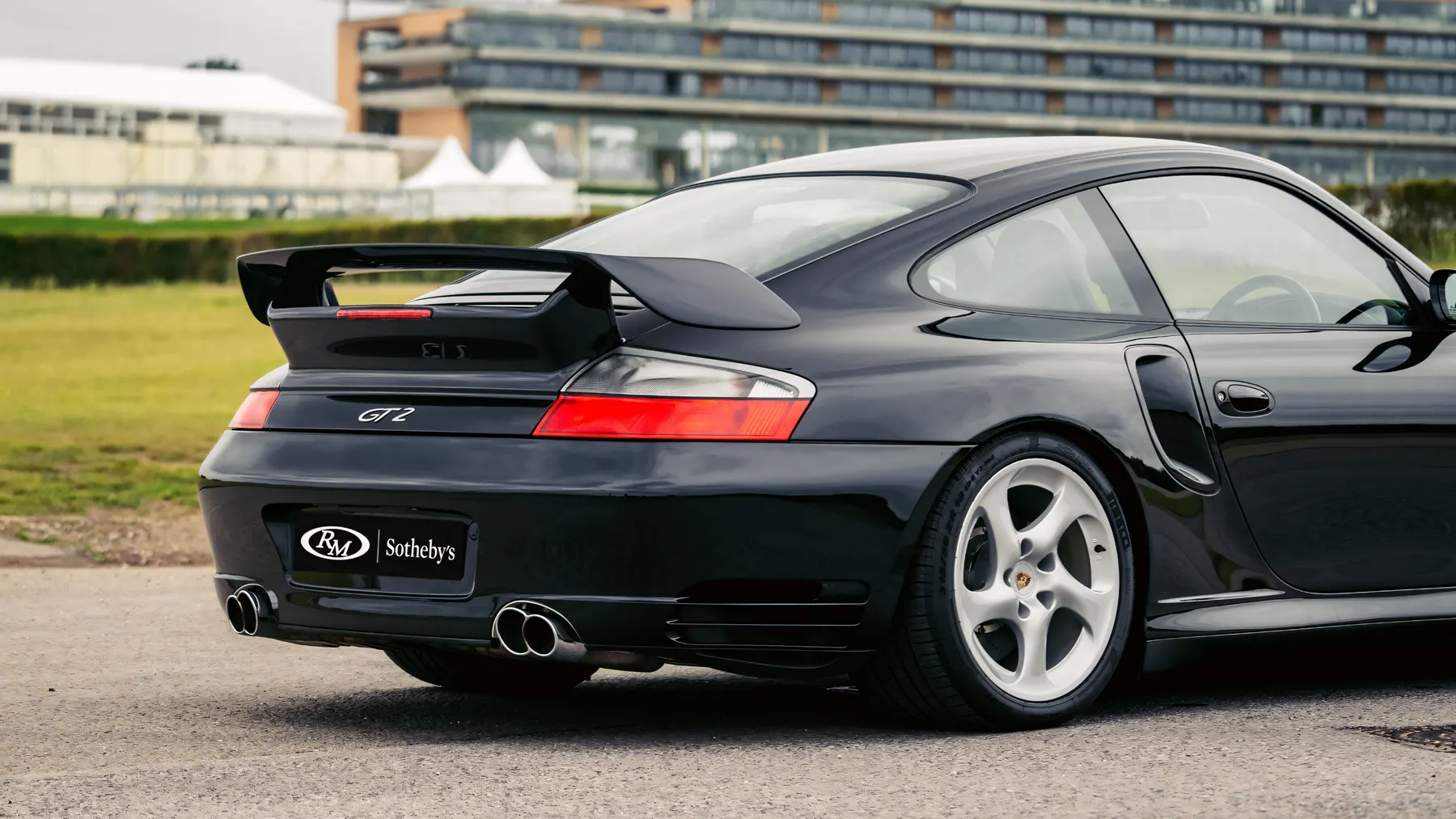
The 996 GT2 sits at a specific hinge point in the GT2 story. It was the first water-cooled car to wear the name, and at launch it was the most powerful series-production 911 Porsche had ever built. Its successor, the 997-generation GT2 that arrived at the 2007 Frankfurt show, was developed directly by Porsche’s dedicated motorsport department at Weissach and pushed power to around 523 bhp - a huge leap, but one that arrived alongside a broader industry shift toward electronic driver aids that even Porsche’s most extreme cars would eventually adopt in some form. Later GT2 RS variants, right up to the 991-generation car with around 690 bhp, kept the rear-drive, no-compromise spirit alive but layered it with rear-axle steering, sophisticated aerodynamics and, eventually, stability control systems sophisticated enough to intervene without dulling the experience. The 996 GT2 came before all of that. It remains, in a fairly precise sense, the last 911 built on the assumption that the driver alone was responsible for what happened next - a genuinely dangerous car built by a company that, for one production run, decided danger was an acceptable price for honesty.
Technical data
Performance Specifications
| Specification | 2001–2003 (996.1) | 2004–2005 (996.2) |
|---|---|---|
| Engine | 3.6-litre twin-turbocharged flat-six, M96/70S (“Mezger”) | 3.6-litre twin-turbocharged flat-six, M96/70SL |
| Power | 456 bhp @ 5,700 rpm | approx. 476 bhp @ 5,700 rpm |
| Torque | 457 lb-ft @ 3,500–4,500 rpm | 472 lb-ft @ 3,500–5,700 rpm |
| Transmission | 6-speed manual, rear-wheel drive | 6-speed manual, rear-wheel drive |
| 0–62 mph | 3.8 sec (Porsche claimed) | marginally quicker (precise factory figure disputed between sources) |
| Top speed | 196 mph (claimed) | approx. 198 mph (claimed) |
| Kerb weight | 1,440 kg | 1,440 kg (approx., unchanged) |
| Brakes | PCCB ceramic composite, 350 mm front/rear, standard | PCCB ceramic composite, 350 mm front/rear, standard |
| Production | 963 built (incl. 113 RHD UK) | 324 built (incl. 16 RHD UK) |
| Total production | 1,287 (2001–2005) |
Sources
- Porsche 911 GT2 (996) Guide - Supercar Nostalgia
- The Legend of the Porsche 911 GT2 - Porsche
- Model 911 GT2 (type 996) - Porsche USA Heritage
- Porsche 911 (996) GT2 Clubsport - PH Heroes, PistonHeads
- Twin Turbo. No Safety Net. The Last Widowmaker. - Petrolicious
- 2002 Porsche 911 Review - Edmunds
- 2002 Porsche 911 GT2 Values - Hagerty
- Porsche IMS Bearings: The Definitive Guide and FAQ - LN Engineering
- Porsche 911 (996) - Wikipedia
Join the discussion
Comments
Loading comments…
Leave a comment
Share a detail, memory, or perspective. Every comment is reviewed before publication.