Porsche 911 GT2 Clubsport (993): Where the 'Widowmaker' Legend Began
1996 Porsche 911 GT2 Clubsport
%3A%20Where%20the%20'Widowmaker'%20Legend%20Began%20%7C%20Motor%20Archive)
Images: Simon Clay / RM Sotheby's
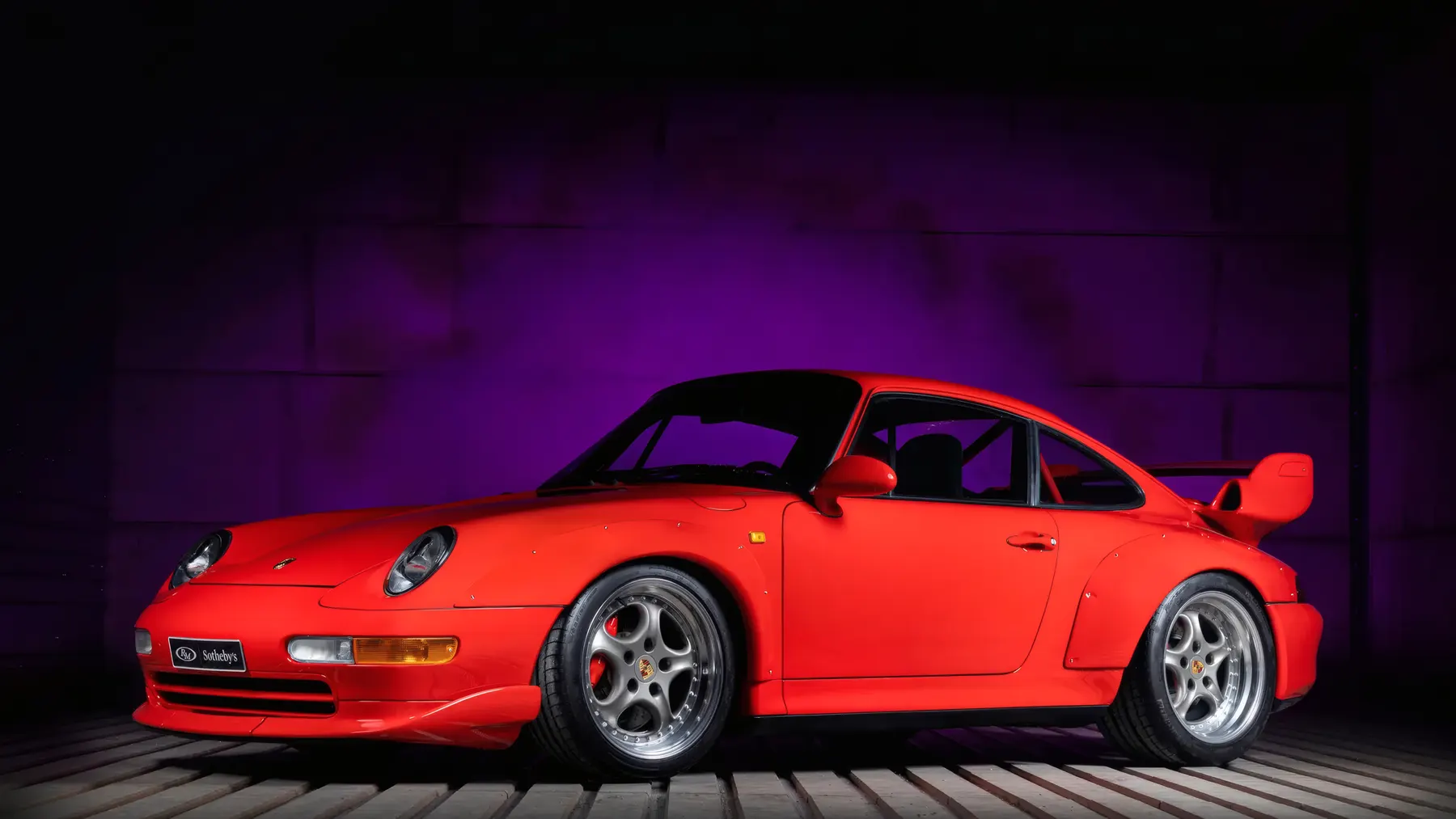
When the World Sportscar Championship folded amid collapsing budgets in the early 1990s, the racing that rushed in to fill the void wasn’t built around six-figure prototypes - it was built around production cars with the interiors ripped out. Porsche’s response to that shift wasn’t a clean-sheet racer. It was a 911 Turbo with the all-wheel-drive system removed, several hundred kilograms of comfort deleted, and just enough road-legal trim retained to satisfy a homologation inspector. What emerged, badged simply 911 GT when it appeared at the Essen Motor Show in November 1994, would become one of the most feared and most coveted 911s Porsche has ever built: the car the enthusiast world now knows as the 993 GT2, and in its most hardcore form, the GT2 Clubsport.
Porsche’s timing was opportunistic. The FIA had let the World Sportscar Championship wither by trying to force a costly 3.5-litre atmospheric formula onto teams that couldn’t afford it, and by 1993 the series had been cancelled outright. What replaced it was a return to amateur GT racing, split into GT1 through GT4 classes, with homologation rules loose enough that a single road-going example could qualify a car to race. Porsche had already been campaigning a 964-based Turbo S LM in GT1 through Larbre Compétition, and the 3.6-litre engine that car used for 1994 became the basis of a new, purpose-adapted 993-based customer racer for 1995. That car raced its debut season in the GT3 class before being promoted to GT2 for 1996 - hence the name by which it is remembered today, even though Porsche’s own paperwork simply called it the 911 GT, with a road-going Straßenversion unveiled at the Geneva Motor Show in March 1995 alongside the new production 993 Turbo.
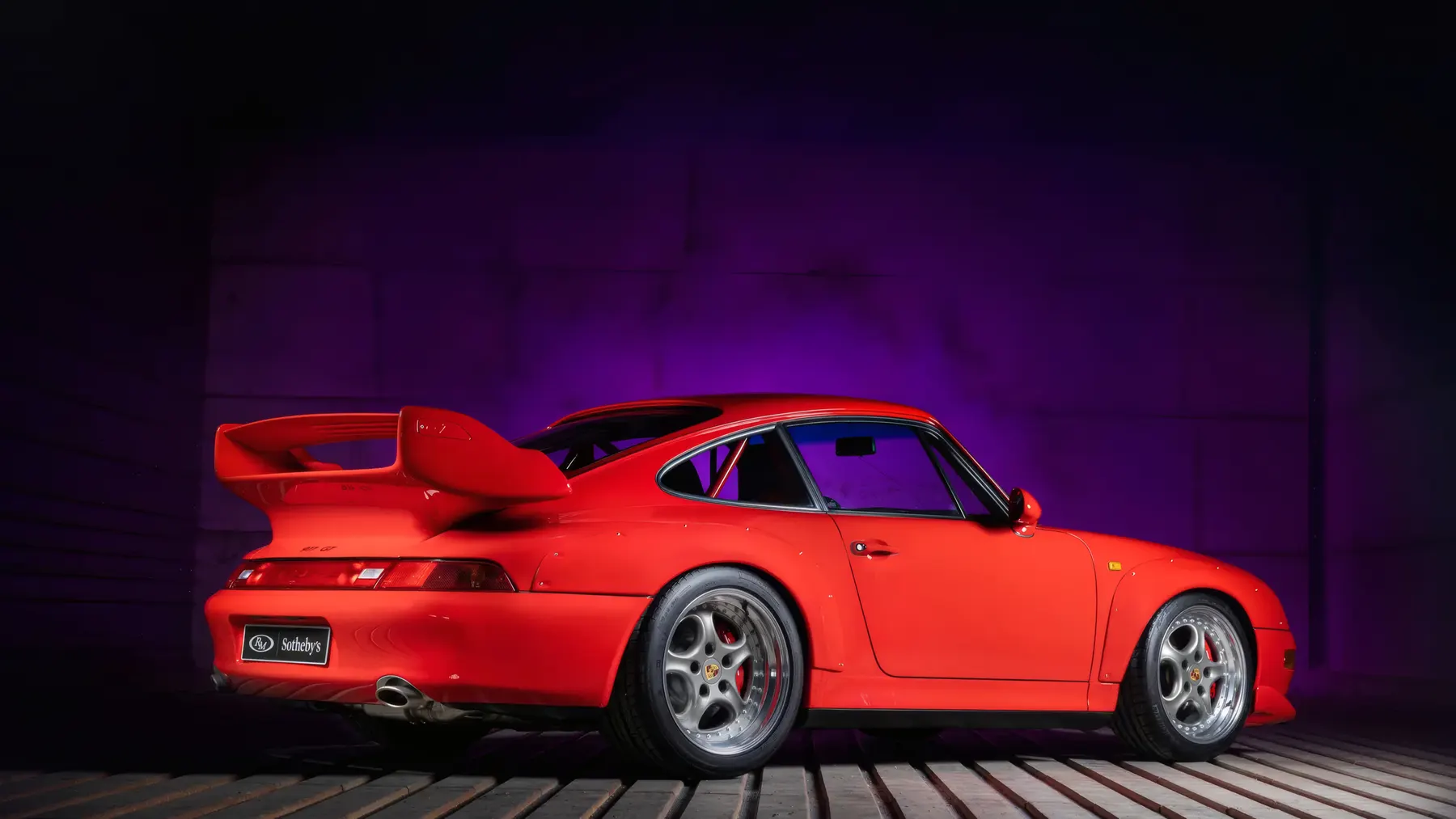
The engineering brief was pragmatic rather than exotic. Underneath, the GT2 retained the 993 Turbo’s MacPherson-strut front and multi-link rear suspension, but with stiffer springs, adjustable dampers, thicker anti-roll bars and firmer link bearings reworked from the contemporary Carrera RS, plus a front strut brace and stiffer track rods. Crucially, Porsche discarded the Turbo’s all-wheel-drive hardware entirely, reverting the car to rear-wheel drive to meet GT2 regulations and, in the process, shedding a meaningful chunk of weight. Ride height dropped by around 20mm, and the whole car sat roughly 200kg lighter than the 1,575kg standard 993 Turbo it was based on - achieved partly through an aluminium bonnet and doors, thinner glass, and, on Clubsport-spec cars, the deletion of carpet and much of the interior trim. The brakes - 322mm cross-drilled and ventilated discs with four-piston aluminium calipers - carried over from the Turbo, as did the reinforced G50/32 six-speed manual gearbox and a limited-slip differential, though the GT2’s power steering was retuned to a more direct ratio. A long-range 92-litre fuel tank replaced the standard car’s 73.5-litre unit, a detail that gave away the model’s competition ambitions more clearly than almost anything else on the specification sheet.
Power came from a reworked version of the 993 Turbo’s flat-six, redesignated Type M64/60R: an air-cooled, dry-sumped 3.6-litre unit with a single overhead camshaft per bank and, in period Porsche fashion, just two valves per cylinder. Bore and stroke measured 100mm and 76.4mm respectively, compression stayed at a modest 8.0:1, and twin KKK K16 turbochargers ran at 0.9 bar of boost - up from the standard Turbo’s 0.8 bar - feeding through a re-mapped Bosch Motronic system and free-flowing catalytic converters. Specialist sources place initial output at somewhere between 424 and 430bhp at 5,750rpm, with torque more consistently quoted around 398-400 lb-ft at 4,500rpm; the spread likely reflects rounding between different period power-measurement conventions rather than a genuine mechanical difference between individual cars. In a car this light, that was enough to feel considerably more urgent than the standard Turbo, and Porsche felt no need to offer anything but a manual gearbox.
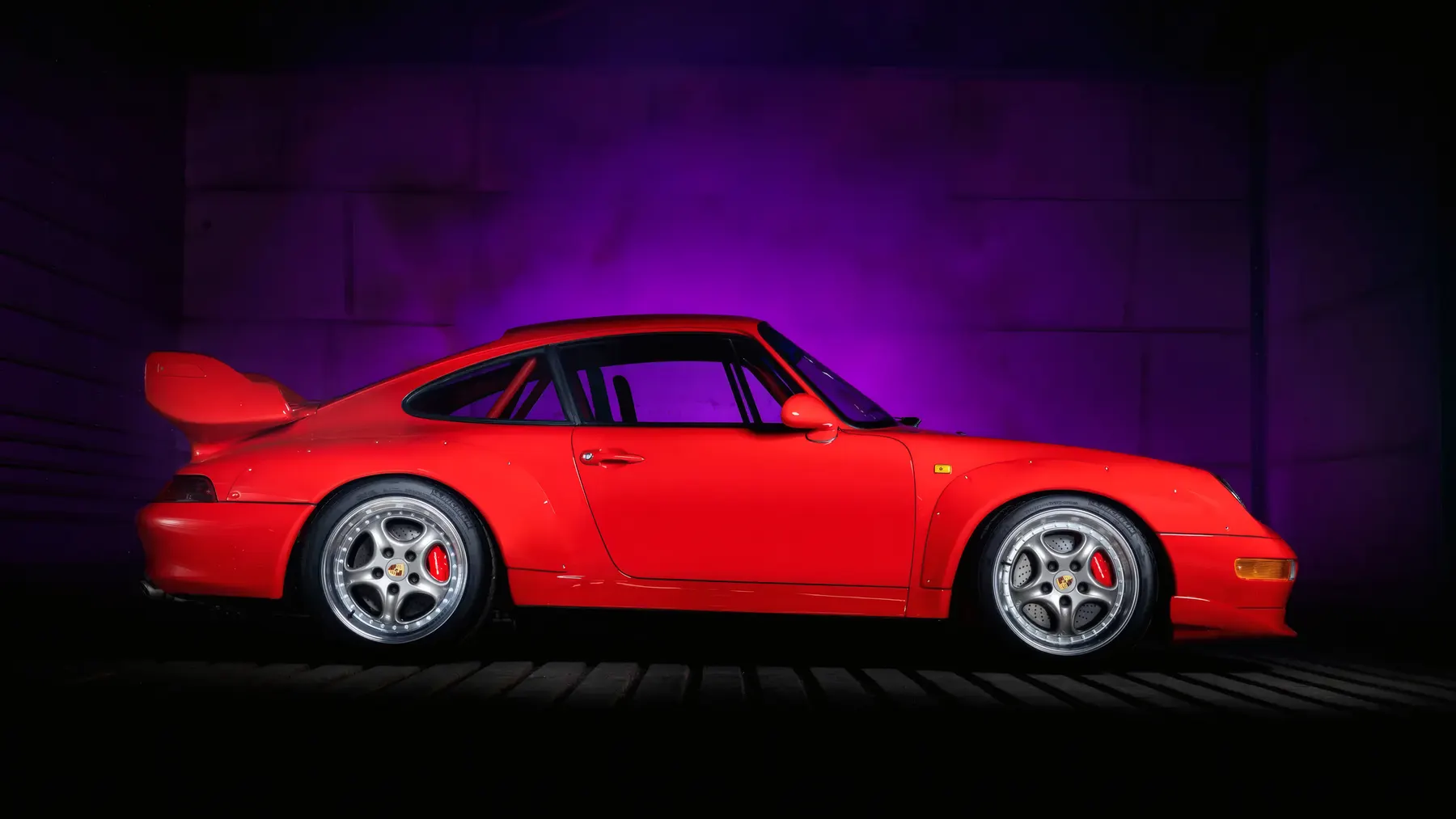
Visually, the GT2 announced its intentions with riveted, bolt-on fibreglass wheelarch extensions wide enough to cover three-piece, magnesium-centred Speedline wheels - 9x18 inches at the front and 11x18 inches at the rear, wearing 235/40 ZR18 and 285/35 ZR18 tyres respectively. A deep, RSR-influenced front splitter with turned-up edges fed air around the widened nose, while a fixed biplane rear wing, larger than the Carrera RSR’s, doubled as ductwork feeding the intercoolers. On a 993 already regarded as one of the best-resolved 911 shapes, the GT2’s stance - lower, wider, more purposeful - arguably improved on the standard car, giving it a menace the smoother-bodied Turbo never quite managed.
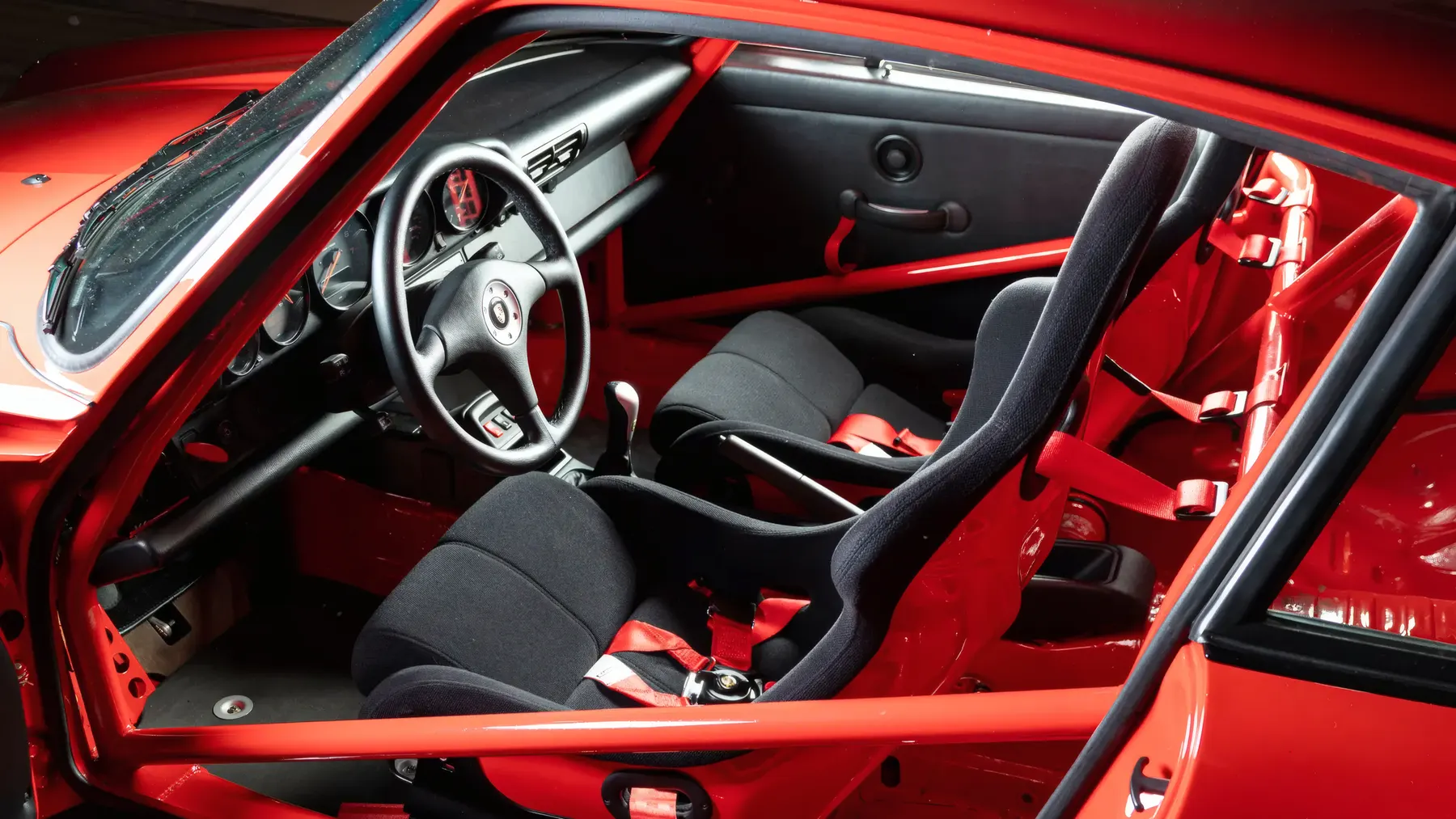
Buyers ordering a 911 GT chose between three factory specifications. M001 was reserved for the pure competition car; M002, badged Comfort, was the roadgoing default, with black-and-grey leather Recaro seats, simplified door cards using a canvas pull-cord instead of a proper handle, and a small-diameter, non-airbag steering wheel, though customers could reinstate air conditioning, a stereo, electric windows and other luxuries from the options list if they wished. M003 was the Club Sport - the version now generally remembered as the GT2 Clubsport - and it went considerably further. Clubsport cars received a fully welded, body-coloured roll cage integrated into the shell, Recaro bucket seats trimmed in fire-retardant fabric, six-point harnesses, a battery cut-off switch and a fire extinguisher, while carpet and sound deadening were deleted outright, leaving painted metal visible throughout the cabin. Even the clutch was different: Clubsport cars used a lightweight disc with torsional dampers in place of the standard car’s dual-mass flywheel, shaving a further increment of rotating mass at the expense of some drivetrain refinement. Porsche built 194 street-legal 911 GTs in total, primarily during 1995 and 1996, according to auction-house and marque-registry sources - including RM Sotheby’s, Gooding & Company and the UK-based specialist GT Classics - of which 33 were ordered with the M003 Clubsport package. A smaller, frequently repeated figure of 57 total road cars and 20 Clubsports also circulates in enthusiast media, but it is not corroborated by the auction houses or specialist registries that have cross-referenced individual chassis numbers, so the higher totals are treated here as the more reliable count.
Porsche muddied the timeline further in April 1998, when it released an Evolution upgrade package that pushed peak output to a widely quoted 450bhp at 6,000rpm - though RM Sotheby’s own catalogue material cites 444bhp for late-production cars - alongside 432 lb-ft of torque, achieved with larger turbochargers. The package also brought an adjustable front anti-roll bar, a redesigned front bumper with larger intakes, an additional front splitter, and a taller upper element on the rear wing. Sources differ on whether this represented genuinely new-build 1998 cars or an upgrade applied to late-production or existing examples, and the ambiguity is never fully resolved in period literature. The extra downforce cost the car a little at the top end - quoted top speeds range from around 183mph to 189mph depending on specification and source - but the 0-62mph sprint reportedly dropped to around 3.6 seconds, a tenth quicker than the original car, which is itself credited with times ranging from the high 3-second to low 4-second bracket depending on which contemporary test is consulted.
On track, the racing-specification GT2 - built to the M001 standard and often further optioned with Porsche’s R package - quickly became the default choice for privateer GT2-class teams, and demand comfortably outstripped Porsche’s own expectations: the factory reportedly planned for around 30 orders for the closely related GT2 R competition car but had taken 45 within a few months of its Essen debut. Squads including Roock Racing, Konrad Motorsport, Freisinger Motorsport, Larbre Compétition, Stadler Motorsport and Lanzante Motorsport ran GT2s through the BPR Global GT Series, initially in the GT3 class for 1995 before the car’s promotion to GT2 for 1996, where it won seven of eleven rounds that season. The GT2 added class victories at the 24 Hours of Le Mans in both 1996 and 1997, and continued winning races in the new FIA GT Championship even as factory-backed Chrysler Viper GTS-Rs arrived to contest the class; by 1998, though, the Vipers’ pace had become difficult to match, and GT2 class wins grew scarce. Porsche also built a small further-developed GT2 Evo run, aimed initially at the GT1 category, with larger turbochargers, wider bodywork and weight pared back to around 1,100kg, extracting as much as 600bhp from the same basic 3.6-litre unit. The GT2 Evo’s frontline ambitions were short-lived - Porsche shelved the concept in favour of a purpose-built, mid-engined 911 GT1 once it became clear the adapted road-car platform couldn’t match dedicated GT1 rivals like the McLaren F1 GTRoutright - though individual GT2 Evo cars went on competing successfully in GT2-class and national GT championships for several more seasons.
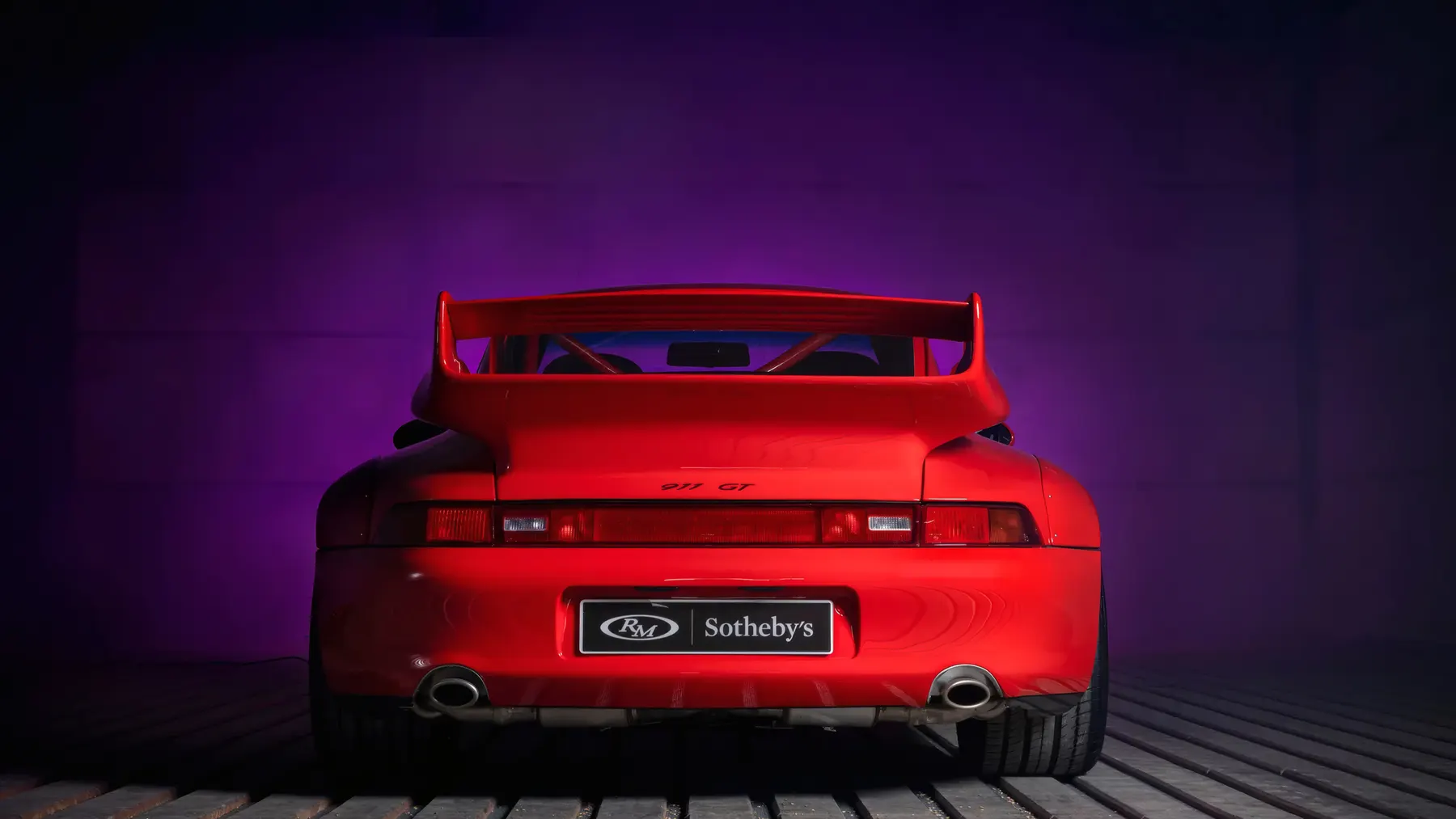
On the road, the GT2 offered none of the electronic scaffolding that would later cushion Porsche’s turbocharged cars. There was no traction control, no stability management, and - in early cars particularly - a turbocharged power delivery that arrived with a discernible pause before landing all at once. Combined with rear-wheel drive and a chassis carrying its engine well aft of the rear axle, that character demanded real commitment from the driver, especially mid-corner, where an ill-timed application of throttle could turn understeer into oversteer with very little warning. It is this combination - abrupt boost, no aids, and a driver fully responsible for managing the consequences - that gave rise to the “Widowmaker” reputation later generations of GT2 would inherit and amplify; specialist accounts of the model generally credit the 993 GT2 as the car that started that reputation, even though the nickname is now most closely associated with the far more powerful 997-generation cars. evo magazine, testing the later 997 GT2 for comparison, looked back on the original 993 as probably “the rawest of all road-going 911s” - a compliment that also, quietly, acknowledges just how uncompromising the experience was.
For all the mystique, the GT2 was a genuinely difficult car to own and, in period, a genuinely difficult car to drive well - and both points are worth taking seriously rather than filing away as charm. The interior compromises went well beyond the usual homologation-special sacrifices of rear seats and a stereo: even in Comfort trim, the door cards were reduced to simplified panels operated by a pull-cord rather than a proper handle, and Clubsport cars deleted carpet and headlining entirely, leaving painted sheet metal on show throughout the cabin. Combined with minimal sound insulation and a thin windscreen chosen purely to save weight, the result was a car that droned and boomed on the motorway in a way the standard, comparatively plush 993 Turbo never did - genuinely unpleasant for anything beyond a short blast, and a real limitation for anyone who might have wanted to use their car regularly rather than trailer it to track days. The driving experience carried its own cost, too. Without traction or stability control, and with a turbocharged power delivery that could arrive abruptly mid-corner, the GT2 was capable of catching out drivers who didn’t respect it - a real safety concern rather than a romantic footnote, and the direct root of the “Widowmaker” reputation that followed every GT2 generation after it. There is also a fair engineering critique to be made: unlike bespoke GT1 rivals such as the McLaren F1 GTR, designed from a clean sheet as a racing car first, the GT2 was fundamentally an adapted production Turbo - effective and commercially shrewd, but not the ground-up engineering exercise some of its era’s other homologation specials represented. And its rarity, central to its appeal today, meant that in period almost no ordinary enthusiast ever got near one; with well under 200 street cars built, and a third of those further restricted to Clubsport buyers willing to live with a roll cage and no radio, the GT2 functioned more as a halo exercise and racing tool than as a car that meaningfully reached Porsche’s broader customer base.
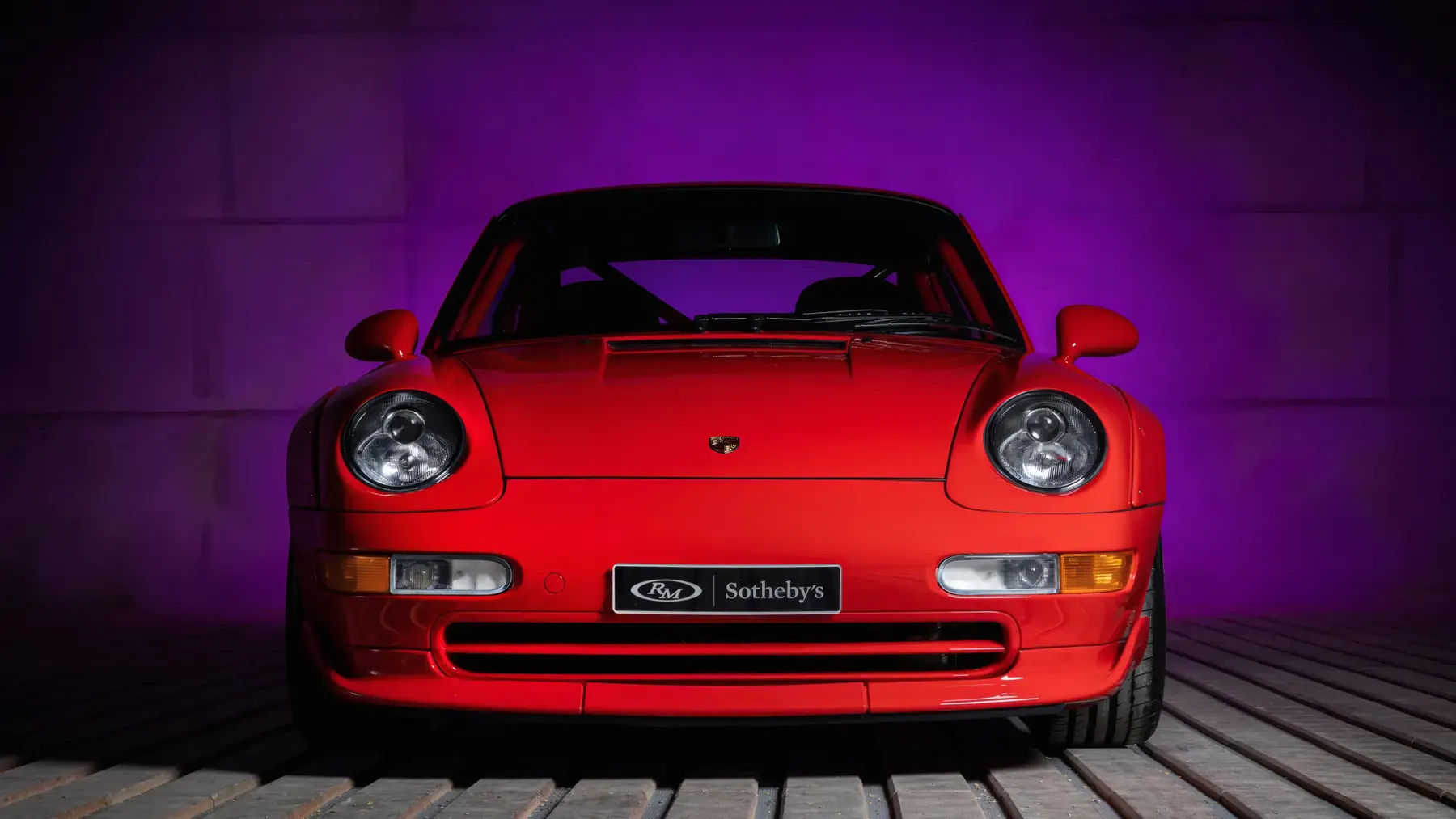
None of that has hurt its standing with collectors. As the last air-cooled 911 Turbo derivative before Porsche moved the standard Turbo and GT-badged cars to water-cooled architecture with the 996 generation, the 993 GT2 - and especially the rarer Clubsport - occupies a specific, prized place at the end of an era. Values reflect that scarcity: Clubsport examples have sold at auction for well over two million dollars in recent years, with base GT2s not far behind, prices driven as much by the model’s status as the final expression of air-cooled Porsche engineering as by its competition record. More significantly for the wider 911 story, the GT2 established a nameplate and a formula - take a Turbo, strip it, remove all-wheel drive, add power, subtract every comfort not strictly necessary - that Porsche would repeat, in ever more extreme and ever more electronically assisted form, through the 996, 997 and 991 generations, each one inheriting some version of the reputation the original 993 car created.
What the 993 GT2 Clubsport represents isn’t really a road car that happened to go racing, or a race car that happened to be road legal - it is closer to a piece of regulatory arbitrage that Porsche’s engineers turned into something genuinely thrilling almost by accident. It asked more of its driver than any other production 911 of its era, gave back very little in comfort, and rewarded almost nobody with anything resembling everyday usability. That it is remembered today not as a curiosity but as the purest expression of a whole philosophy - light weight, mechanical grip, and an engine with no interest in being tamed - says everything about why the formula it created still defines Porsche’s most extreme 911s three decades later.
Technical data
Specifications
| Item | Detail |
|---|---|
| Production | 1995-1998 (street-legal cars); 194 examples built (161 M002 Comfort, 33 M003 Clubsport) per auction-house and registry sources; a lower alternate figure of 57 total/20 Clubsport circulates but is less corroborated |
| Engine | 3.6-litre air-cooled twin-turbocharged flat-six, Type M64/60R, SOHC, 2 valves/cylinder, dry sump |
| Bore x stroke | 100mm x 76.4mm |
| Compression ratio | 8.0:1 |
| Turbochargers | Twin KKK K16, approx. 0.9 bar boost |
| Power | 424-430bhp @ 5,750rpm (1995-97 spec); 444-450bhp @ 6,000rpm (1998 Evolution spec, sources vary) |
| Torque | 398-400 lb-ft @ 4,500rpm (1995-97 spec); 432 lb-ft (1998 Evolution spec) |
| Transmission | 6-speed manual (Type G50/32), limited-slip differential |
| Kerb weight | Approx. 1,290-1,300kg (approx. 200kg lighter than the 1,575kg 993 Turbo) |
| 0-62mph | Approx. 3.6-4.4 sec (figures vary notably by source, spec and test conditions) |
| Top speed | Approx. 183-189mph (figures vary by source and spec) |
| Brakes | 322mm cross-drilled, ventilated discs; 4-piston aluminium calipers (front and rear) |
| Wheels/tyres | 9x18in front (235/40 ZR18), 11x18in rear (285/35 ZR18); 3-piece Speedline, magnesium centres |
| Fuel tank | 92-litre long-range unit (vs 73.5-litre standard Turbo tank) |
| Clubsport (M003) equipment | Welded, body-colour roll cage; fire-retardant Recaro bucket seats; 6-point harnesses; battery cut-off switch; fire extinguisher; deleted carpet/headlining; lightweight clutch disc with torsional dampers replacing dual-mass flywheel |
Sources
- RM Sotheby’s: 1996 Porsche 911 GT2 Clubsport (Monterey 2024)
- Gooding Christie’s: 1996 Porsche 993 GT2 Clubsport
- GT Classics: Model History – The 993 GT2 (Road)
- Supercar Nostalgia: Porsche 911 GT (993 GT2) Guide
- Classic.com: Porsche 911 GT2 – 993 Market
- Stuttcars: Porsche 911 GT2 Race (993) (1995-1996)
- Stuttcars: Porsche 911 GT2 Evo (993) (1996-1998)
- evo: Porsche 911 GT2 (997) v Ferrari 430 Scuderia
- RennDriver: Porsche 993 GT2 – History, Specs, and the Widowmaker Legend
- TorqueNews: Here’s Why The Porsche 997 GT2 Is Hailed As “The Widowmaker”
- Elferspot: Porsche 993 GT2 1996 (model background)
- Girardo & Co: 1995 Porsche 911 993 GT2 R
Join the discussion
Comments
Loading comments…
Leave a comment
Share a detail, memory, or perspective. Every comment is reviewed before publication.