Ford GT Carbon Series: The Half-Diet Ford Built to Prove a Point
2021 Ford GT Carbon Series


Images: Courtney Cutchen / RM Sotheby's
Ford’s engineers cut the cupholders and the driver’s-side storage bin from the second-generation GT to save weight, then turned around and left the air conditioning and the stereo in place. That single decision says more about the Carbon Series than any spec sheet. This was never meant to be a stripped, uncompromising track weapon in the mould of a McLaren Senna or a Porsche GT2 RS; it was Ford’s attempt to shave mass from an already extreme supercar while still letting a six-figure customer drive it to the circuit without roasting alive or going deaf from wind noise. The result is a car defined less by outright ferocity than by a very deliberate, very Ford kind of restraint.
To understand why that restraint mattered, it helps to remember what the second-generation GT was built to do in the first place. Unveiled at the 2015 Detroit auto show, the car existed to mark fifty years since the original GT40’s dominant 1966 Le Mans finish, and Ford had every intention of proving the point on track rather than just in a press release. The GT racing programme, run with Chip Ganassi Racing and built by Multimatic, delivered on that promise almost immediately: at the 2016 24 Hours of Le Mans, the number 68 Ford GT of Sébastien Bourdais, Joey Hand and Dirk Müller took the LM GTE Pro class win, with a sister car finishing third, exactly fifty years after Ford’s historic 1-2-3 at the same race. The victory came 395 days after the car had first turned a wheel, at a Canadian test track in May 2015, which tells you how compressed and motorsport-driven the whole programme was. The road car that followed inherited that racing-first mentality more completely than most homologation specials manage.
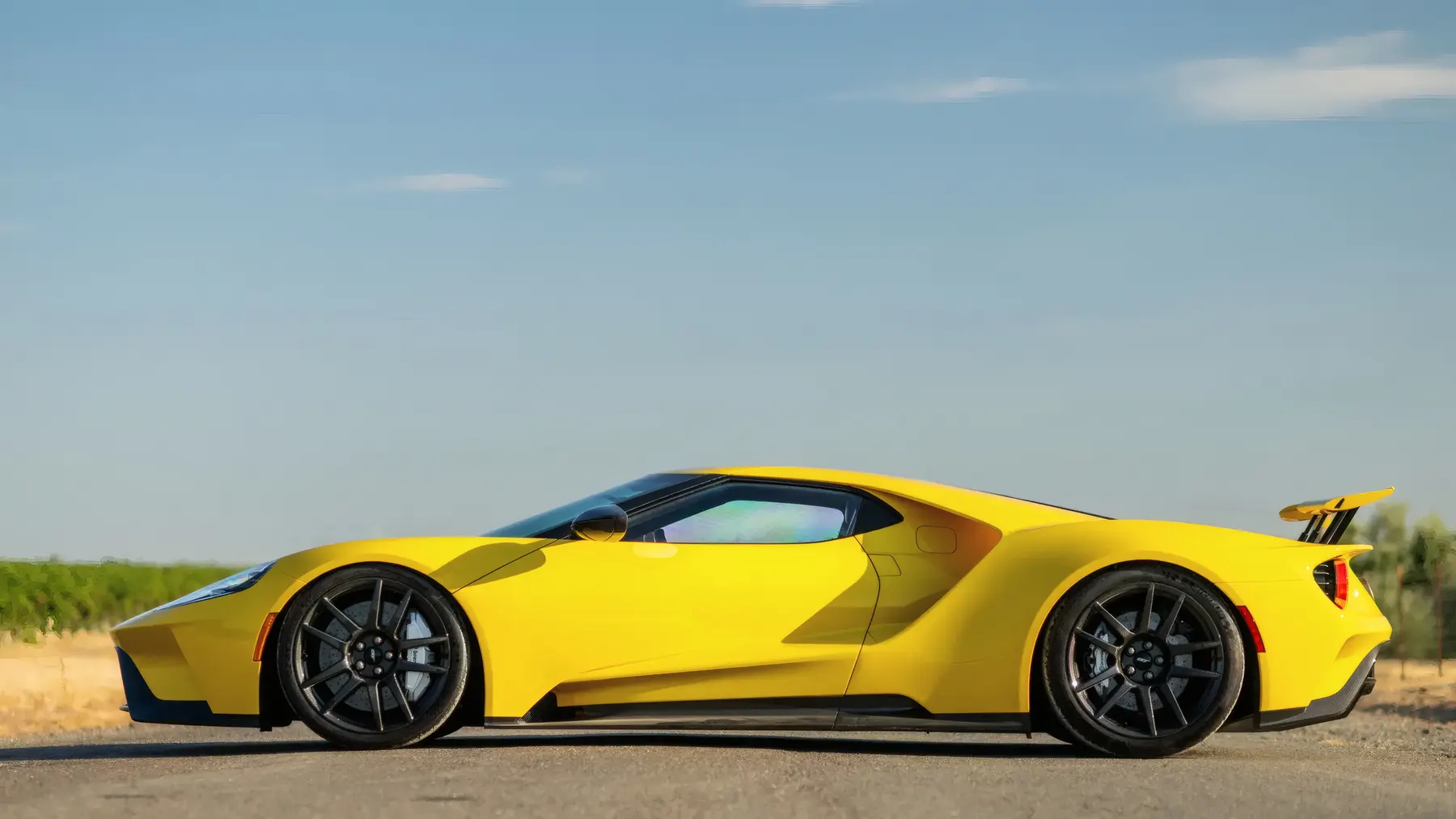
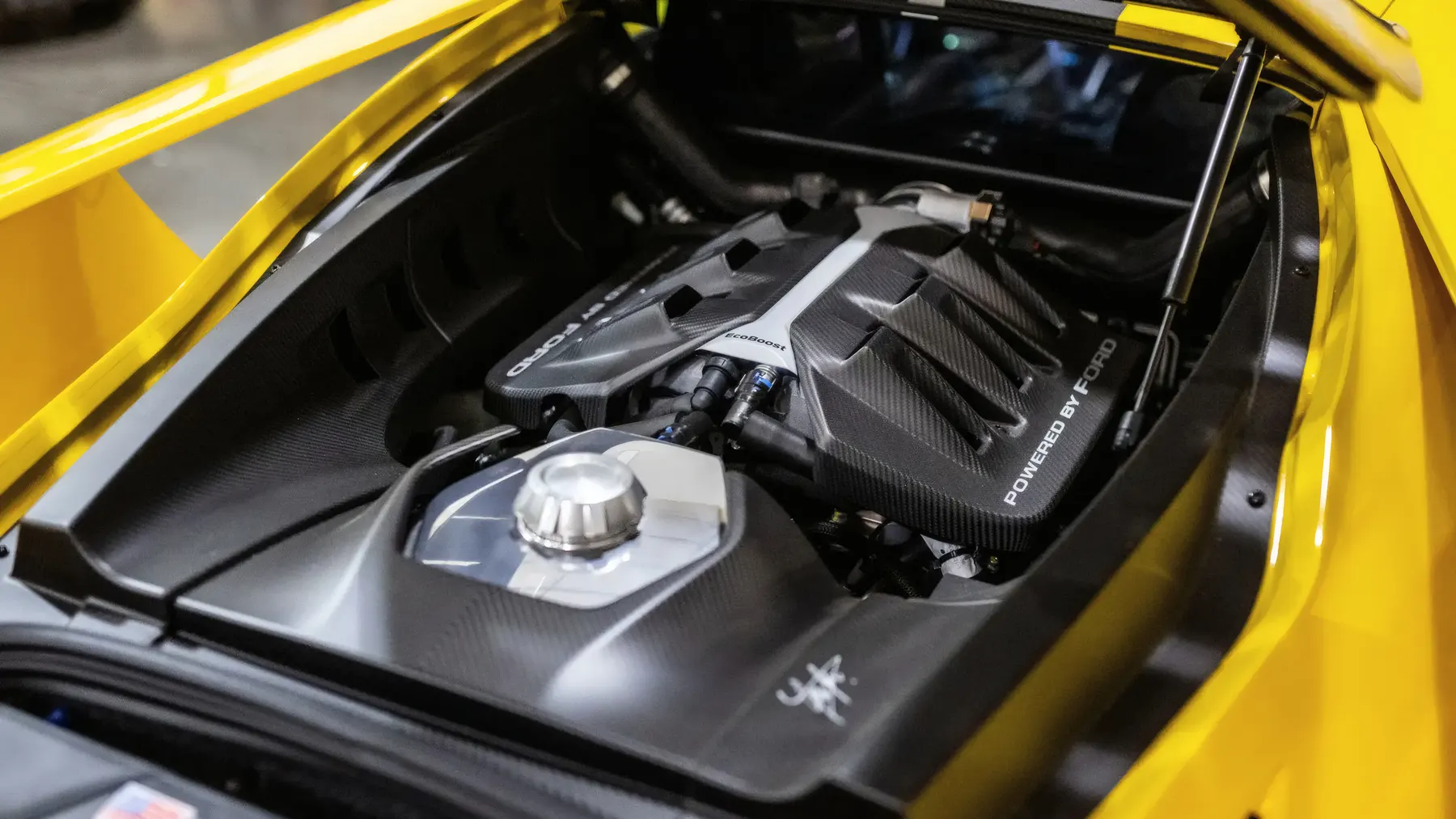
That mentality shows up most obviously under the decklid. Ford abandoned the supercharged V8 of the first-generation GT for a 3.5-litre twin-turbocharged EcoBoost V6, the same basic architecture found, in far tamer states of tune, in F-150 pickups. It was a genuinely startling choice for a car wearing a Le Mans-winning halo, and reviewers noticed. The reasoning was aerodynamic rather than sentimental: a V6 is narrower than a V8, and that narrowness let Ford’s designers pull the GT’s tail into the tight, tapering “teardrop” shape and flying buttresses that define the car’s silhouette and its underbody airflow. Everything about the second-generation GT’s shape, in other words, follows from a decision made for lap time rather than showroom drama, and the Carbon Series simply pushes that same logic a step further.
The GT itself was never going to be a volume product. Production began in December 2016 and continued in low numbers at Multimatic’s specialist facility in Markham, Ontario, with the total second-generation run eventually reaching roughly 1,350 cars across the 2017 to 2022 model years. Buyers didn’t simply order one; they applied, and Ford selected who would be allowed to buy a car based on factors including their history of Ford ownership and their public visibility, on the theory that well-known owners would generate favourable attention for the brand. Every buyer also signed an agreement not to resell their car within 24 months of delivery, a clause meant to stop speculators flipping allocations for a quick profit. It became a genuine embarrassment for Ford when wrestler and actor John Cena sold his GT within weeks of taking delivery; Ford sued him for breach of contract, and the pair settled out of court in 2018, with Cena publicly apologising and Ford donating the settlement to charity. It is an unusual footnote for a modern performance car: part of the GT’s story is a lawsuit over who was allowed to own one.
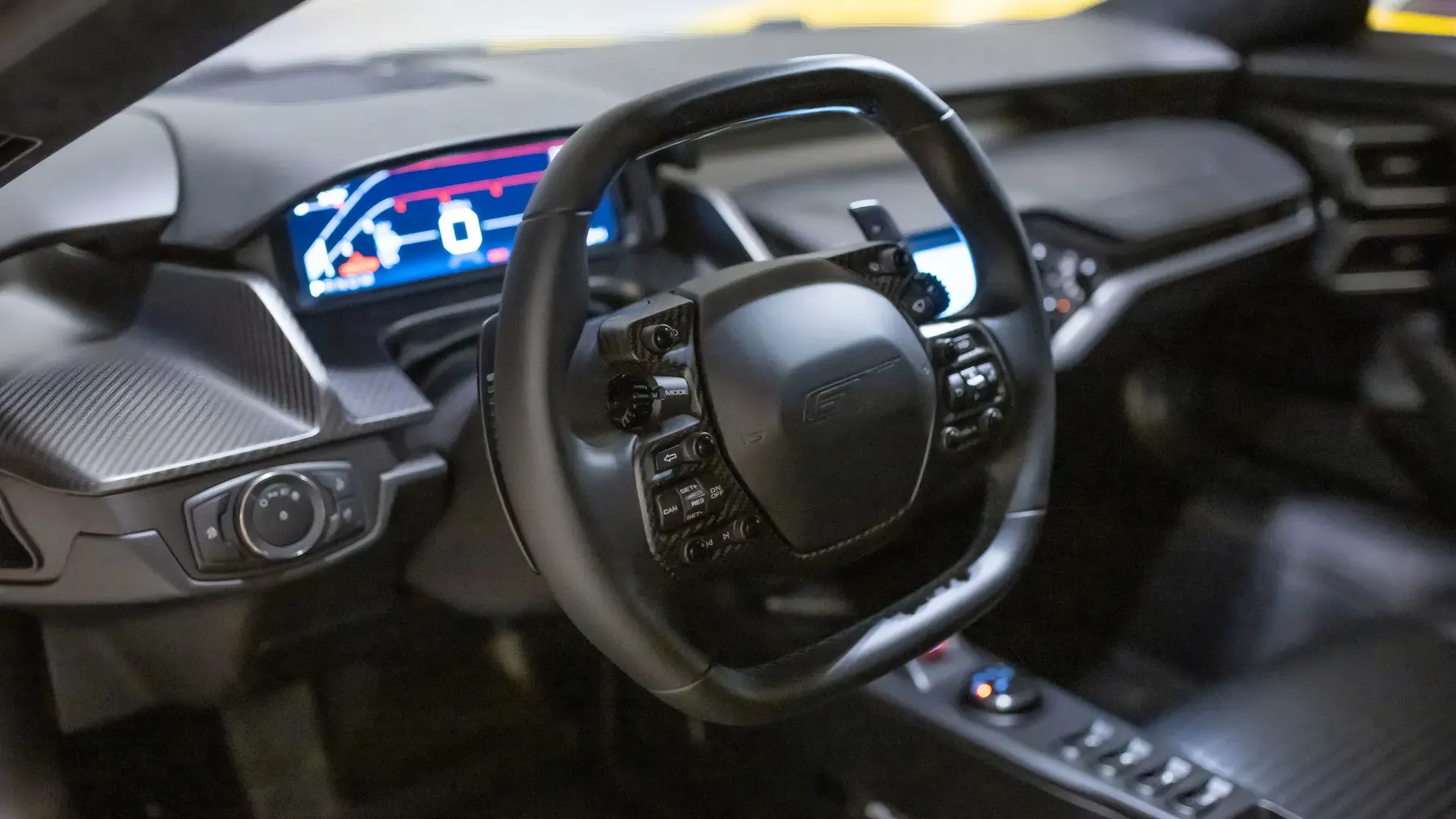
The Carbon Series arrived within that ecosystem for the 2019 model year, unveiled at the SEMA show in late 2018 as, in effect, the successor to the earlier and more spartan Competition Series package. Where the Competition Series had stripped out air conditioning and the stereo entirely to chase lap times, the Carbon Series took a more measured approach: strip what genuinely doesn’t matter to a track-day owner, keep what makes the drive there and back bearable. Ford removed the cupholders and the driver’s-side seat storage bin, small items that nonetheless represent a philosophy of not leaving weight on the table, while retaining the air conditioning and Sync 3 infotainment system to keep the car relatively civilised for road use.
The genuine engineering content sits in the materials. Carbon-fibre wheels, previously a costly option on the standard GT, came standard on the Carbon Series, paired with titanium lug nuts and a titanium exhaust system. A thinner, vented polycarbonate rear hatch replaced the standard glass engine cover, trimming further mass while improving under-bonnet cooling. Exposed, unpainted carbon fibre ran down the centre of the bodywork as a structural-look stripe, up the A-pillars, and along the lower body sills, more visible carbon than Ford had used on any previous GT variant. Inside, matte carbon trim covered the door sills, centre console and the area around the instrument cluster, with a unique seat pattern finished in silver stitching that carried through to the steering wheel. Buyers could specify an accent package in silver, orange, red or blue for the mirror caps, brake calipers and centre stripe. Altogether, Ford quoted a weight saving of roughly 18 kg over a standard GT, concentrated significantly in unsprung and rotating mass at the wheels and exhaust, which theoretically pays larger dynamic dividends than an equivalent saving in static body weight.

Underneath the visual changes, the Carbon Series relied on the same active chassis hardware that made the standard GT such a startling piece of engineering in the first place. Adjustable dampers work through five drive modes, from Wet through Normal, Sport and Track to a dedicated V-Max setting, and selecting Track triggers the car’s signature party trick: the suspension drops the body roughly 50 mm closer to the road, the front splitter and active rear wing move into their most aggressive positions for maximum downforce, and the electronics loosen their grip to let a confident driver play with the chassis balance. Brembo carbon-ceramic brakes and Michelin’s stickiest Pilot Sport Cup rubber were standard fitment. On a circuit, road testers who drove the car near its launch described it as a genuinely five-star machine, precise, planted and confidence-inspiring in a way few road cars manage. The Carbon Series’s lighter wheels, being unsprung mass, should sharpen that responsiveness marginally further, even if the effect is more likely to be felt than measured on a stopwatch.
Mechanically, nothing changed. The Carbon Series used the same 647 bhp, 550 lb-ft version of the twin-turbocharged EcoBoost V6 as the standard 2019 GT, paired with the same seven-speed dual-clutch transmission sending drive to the rear wheels only. From the 2020 model year, Ford revised the engine calibration and cooling package across the GT range, including redesigned buttress air ducts and larger intercoolers, lifting output to 660 bhp; Carbon Series cars built from that point carried the updated figure. Performance testing by Car and Driver recorded a 0-60 mph time of 3.0 seconds and a standing quarter-mile in 10.8 seconds at 134 mph, with a top speed of 216 mph, Ford’s own claimed figure and the highest of any production Ford at the time. Those numbers are worth sitting with for a moment, because they are, by most published accounts, identical to the standard GT’s. An 18 kg diet on a car weighing well over a tonne is not nothing, but it is not transformative either, and it is difficult to find independent evidence that the Carbon Series was meaningfully quicker in a straight line or measurably faster around a circuit than the GT it was based on.

That is really the honest criticism to make of the Carbon Series, and it deserves stating plainly rather than waved away as part of the car’s charm. For a package that, by most estimates, added somewhere in the region of $75,000 to a car that already started north of $450,000, the tangible performance return was modest and largely unquantified in independent testing; the appeal leaned heavily on exclusivity, unpainted carbon fibre as a status marker, and the psychological benefit of lighter unsprung mass rather than a demonstrably faster car. The Carbon Series also inherited every one of the standard GT’s everyday compromises rather than solving them. Contemporary road tests of the second-generation GT describe a cabin that is genuinely tight and can feel claustrophobic to larger drivers, a ride that stays firm even in its softest setting, and a car that generates enough wind and mechanical noise at speed to feel, in the words of one European road test, curiously unrefined for a car costing well over £400,000. The same test found the GT’s boot capacity to be barely usable, at just 11.3 litres, dramatically smaller than most mid-engined rivals, and concluded the car felt too wide and cumbersome to be properly comfortable on public roads despite being a formidable machine on circuit. None of that changed on the Carbon Series; if anything, the removal of two small cabin-storage items only underlined how little slack there already was to give up.
There is also a more subjective, but still real, criticism levelled at the whole second-generation GT lineage, and it applies just as much to the Carbon Series: the EcoBoost V6, however aerodynamically justified, never delivered the theatre that a supercar V8 or V10 offers, and plenty of enthusiasts never fully forgave Ford for the substitution, however sound the engineering logic behind it. Ford’s own defence, that the compact V6 was central to achieving the car’s aerodynamic performance in the first place, is technically convincing but does not fully answer to buyers who wanted a Le Mans-winning halo car to sound the part as well as look and drive it.
None of which erases what the Carbon Series got right. As a rolling showcase of what Multimatic and Ford Performance were prepared to do with carbon fibre, titanium and polycarbonate on a genuinely low-volume production line, it remains a striking object, and the mechanical case for shedding unsprung mass at the wheels is sound engineering rather than marketing dressing. Production was capped, by Ford’s own account, at roughly one car per week, meaning at most around fifty examples could realistically be built across a given year; reports on the exact cumulative total vary and are not consistently documented, but every account agrees the Carbon Series was one of the rarer specifications within an already rare model. It sat alongside a run of other special editions across the GT’s production life, from liveried Heritage Editions honouring specific Le Mans-winning race cars to the track-only Mk II and Mk IV, each pulling the same basic road car in a different thematic direction.
Production of the second-generation GT, Carbon Series included, ended with the 2022 model year, closing out a run that had always been more about proving Ford could still build a Le Mans winner and sell a road-going tribute to hand-picked owners than about competing on volume or outright value. In the years since, low-mileage examples of the Carbon Series have traded at auction for well over their original as-delivered price, in line with the wider strength of the second-generation GT market; scarcity, a hand-picked ownership history, and the sheer amount of visible carbon fibre have all supported values in a way the modest on-paper performance gain never could have on its own. The car sits comfortably alongside the liveried Heritage Editions that honoured specific Le Mans-winning race cars year after year, and in a different register from the track-only Mk II and Mk IV, each pulling the same basic road car in a different thematic direction without ever quite repeating another.

The Carbon Series was the version of that story told through material science and restraint: take away what a track-day owner doesn’t need, but not one item more, and dress the result in more exposed carbon fibre than Ford had ever shown before. It is a car that makes the most sense not as a quicker GT, because by the numbers it largely wasn’t, but as the clearest physical expression of the philosophy the whole second-generation programme was built on, and as a reminder that even a car engineered around a Le Mans-winning racing programme can still be shaped, in the end, by very ordinary questions about what a very rich customer will actually put up with on the way to the track.
Technical data
Specifications
| Specification | Detail |
|---|---|
| Production | 2019–2022 model years (introduced for MY2019, unveiled November 2018) |
| Body/chassis | Two-door, two-seat mid-engine coupé; carbon-fibre-intensive body panels; hand-assembled by Multimatic, Markham, Ontario, Canada |
| Engine | 3.5-litre twin-turbocharged EcoBoost V6, mid-mounted |
| Power | 647 bhp (MY2019); 660 bhp from MY2020 following a cooling and calibration update* |
| Torque | 550 lb-ft |
| Transmission | 7-speed dual-clutch automatic, rear-wheel drive |
| 0–60 mph | 3.0 seconds (independently tested) |
| Standing ¼-mile | 10.8 seconds at 134 mph |
| Top speed | 216 mph (manufacturer-claimed) |
| Weight saving vs standard GT | Approx. 18 kg (40 lb), concentrated in unsprung/rotating mass** |
| Brakes | Carbon-ceramic discs, Brembo callipers |
| Wheels | 20-inch carbon-fibre, standard fitment (optional on standard GT) |
| Drive modes | Wet, Normal, Sport, Track, V-Max; Track mode lowers ride height by approx. 50 mm and deploys active aero |
| Indicative price | Base GT roughly $450,000–$500,000 across the production run; Carbon Series option package estimated at approximately $75,000 additional (never officially itemised by Ford)*** |
Sources
- Supercars.net – Car Of The Day: 2019 Ford GT Carbon Series
- Supercars.net – Ford GT Ultimate Guide
- Motor Authority – 2019 Ford GT Adds Lightweight Carbon Series, Gets $50,000 Price Bump
- Digital Trends – 2019 Ford GT Carbon Series Sheds Weight, Adds Exclusivity
- The Drive – 2019 Ford GT Carbon Series: Losing Weight So You Don’t Have To
- TopSpeed – 2019 Ford GT Carbon Series
- autoevolution – 2019 Ford GT Gets Carbon Series Treatment to Drop Some Weight for Track Use
- Auto Express – New Ford GT 2017 Review
- Edmunds – 2017 Ford GT Review & Ratings
- evo – Ford GT (2016–2022): Review, History and Specs of an Icon
- Ford Media Center – Ford Chip Ganassi Racing Prepares to Defend Le Mans 24 Hours Title
- RM Sotheby’s – 2020 Ford GT Carbon Series (Amelia Island 2023)
- Autoblog – Ultra-Low-Mileage Ford GT Carbon Series Surfaces for Discerning Collectors
- Jalopnik – John Cena Settles Lawsuit With Ford Over Selling His Ford GT
- Hagerty Media – John Cena Settles Ford GT Lawsuit, Putting Future Out-of-Contract Sales Into Question
- Wikipedia – Ford GT
Join the discussion
Comments
Loading comments…
Leave a comment
Share a detail, memory, or perspective. Every comment is reviewed before publication.