Duesenberg Model J 'Sweep Panel' Phaeton: The LeBaron Design Behind the First Duesy
1929 Duesenberg Model J 'Sweep Panel' Dual-Cowl Phaeton by LeBaron

Images: Darin Schnabel / RM Sotheby's
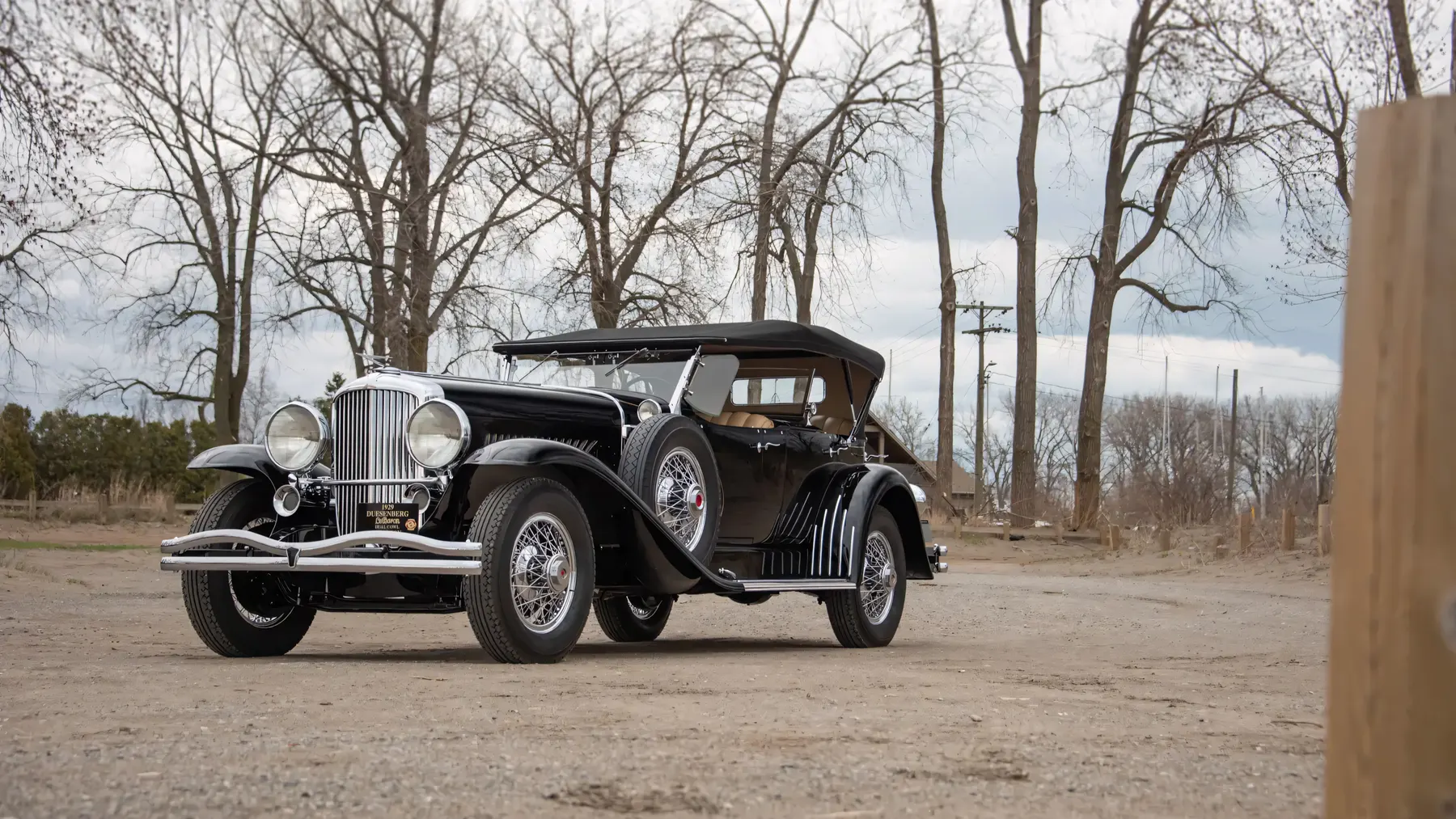
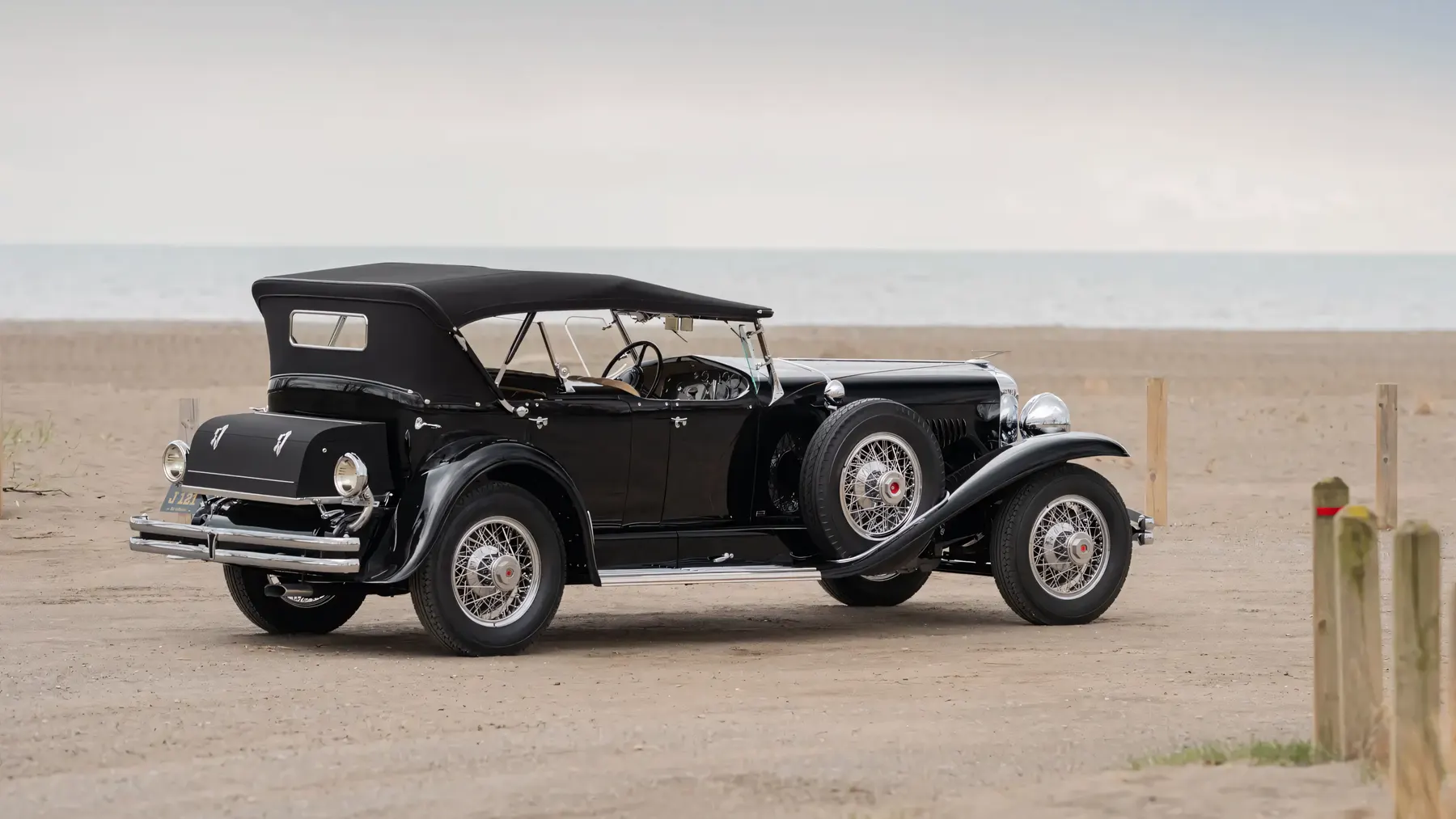
When Duesenberg wheeled its first production Model J chassis onto the stand at the New York Auto Salon on 1 December 1928, the body sitting atop it carried an outsized amount of responsibility. E.L. Cord had bought the bankrupt Duesenberg name two years earlier on the promise of building something that could stand toe-to-toe with Hispano-Suiza and Rolls-Royce, and the car the world would judge that promise by was chassis J-101, finished in silver and black, wearing a dual-cowl phaeton body by the New York coachbuilder LeBaron. That body, distinguished by a sweeping contour line that ran from the radiator cap back through the front door and curled into a reverse curve at the cowl, would go on to become the most frequently ordered open body style ever fitted to a Model J chassis: the LeBaron “Sweep Panel” Dual-Cowl Phaeton.
Duesenberg’s engineering credentials were never really in question. Fred and August Duesenberg had built their name on racing cars through the 1910s and 1920s, and when Cord acquired the firm in October 1926 he kept Fred on as vice president of engineering and turned him loose on an entirely new road car. What emerged was a 420-cubic-inch, 6.9-litre straight-eight with dual overhead camshafts and four valves per cylinder, a specification borrowed almost wholesale from Duesenberg’s competition engines and essentially unheard of on an American road car of the period. Built under licence by Lycoming, another Cord-owned company, the engine produced 265 bhp at around 4,200 rpm and roughly 374 lb-ft of torque in normally aspirated form, at a time when the next most powerful American production car managed barely half that output. Duesenberg’s own advertising claimed a top speed of 116 mph with the top up and fenders fitted, and 89 mph available in second gear alone, figures that made the Model J both the fastest and the most expensive car built in America.
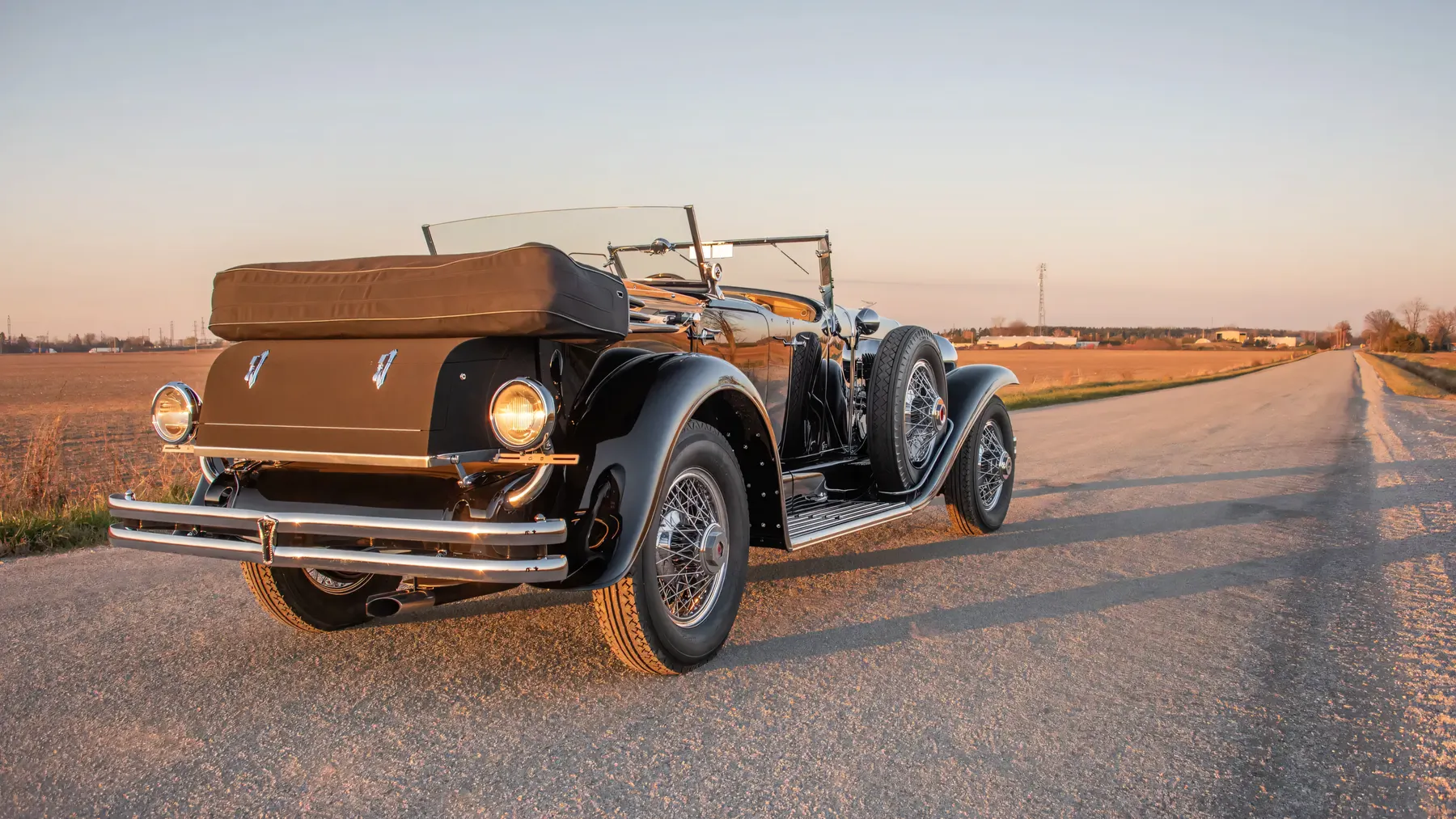
As was standard practice among the era’s grandest makers, Duesenberg supplied only a running chassis and engine; the buyer then commissioned a coachbuilder to design and construct a body to their own taste, and the chassis, fenders, radiator, and instrument panel stayed largely consistent across the range regardless of which coachbuilder finished the car. Only a handful of firms were entrusted with bodies for the very first Model Js shown at the New York launch, and LeBaron was among them, alongside Murphy and Holbrook. LeBaron would go on to build something in the region of 38 bodies across the Model J’s production run, but its most consequential contribution came early: designer Ralph Roberts submitted several dual-cowl phaeton proposals to Duesenberg in 1928, two of which were selected for production, and one of those two was the sweep panel design that debuted on J-101 itself.
Roberts’ idea was elegantly simple. An inset panel began at the radiator cap, broadened as it swept back across the hood, and ran through the middle of the front door before curling into a reverse curve where it met the cowl. The line did double duty as a styling device and a practical one: it gave painters a natural boundary for the two-tone colour schemes then fashionable on American coachwork, splitting the body into complementary shades along a crisp, purposeful edge, while lending the car’s flanks a sense of forward motion even standing still. It proved to be the most popular dual-cowl phaeton style Duesenberg ever offered, built by LeBaron through 1929 and into 1930, and by the time production of that specific body ended, something like 18 examples had been completed. The overwhelming majority sat on the standard 142.5-inch wheelbase chassis; a single example, ordered by a Chicago stockbroker, was built on the optional 153.5-inch long-wheelbase frame, its extra length given almost entirely to the rear passenger compartment.
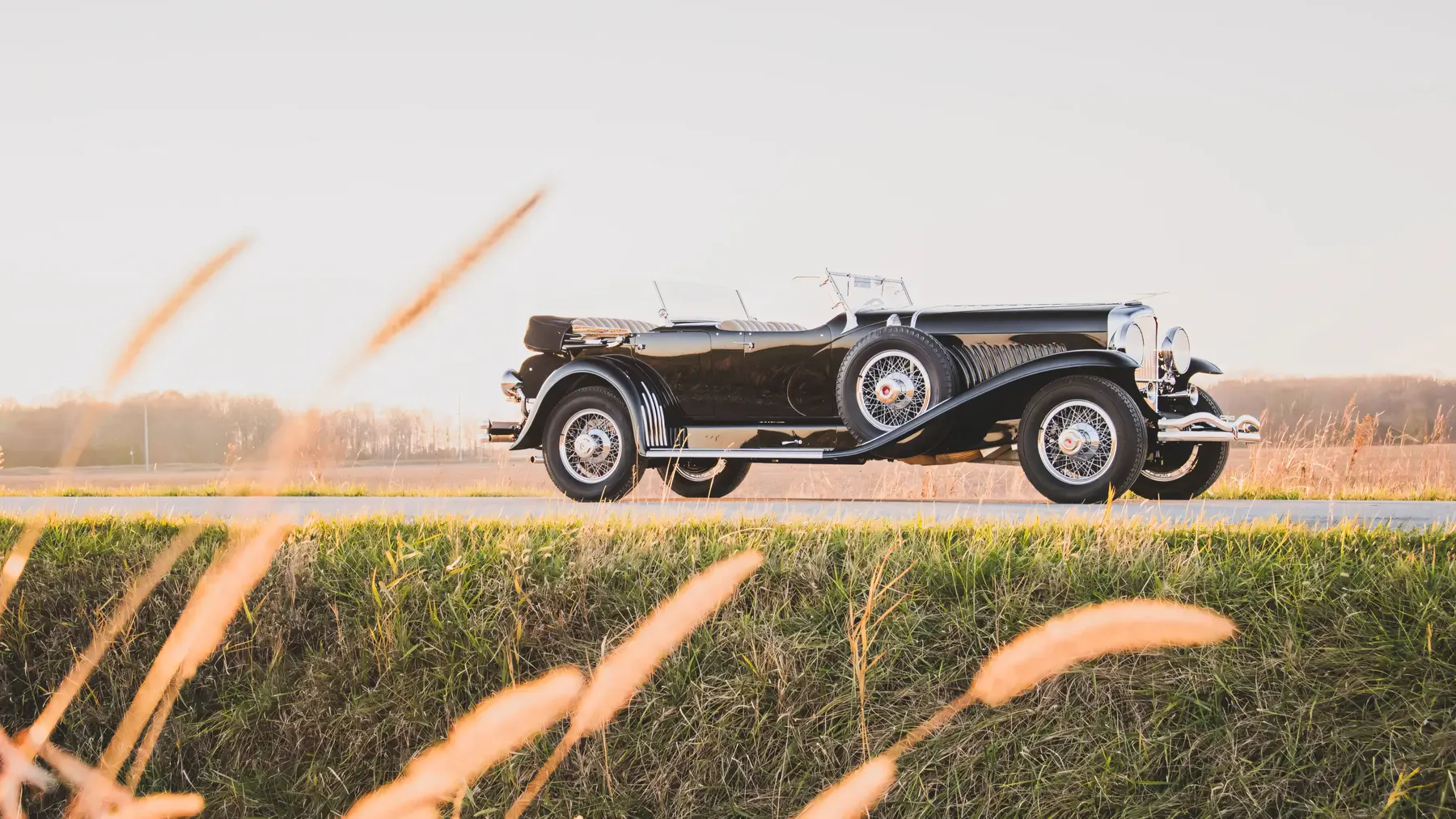
The design’s popularity did not go unnoticed by Duesenberg’s own management, and its subsequent history says as much about the economics of coachbuilding in the Classic Era as it does about styling. Company president Harold Ames decided to bring production of several of the best-selling body styles under Cord Corporation’s direct control rather than continue paying an outside firm for work the company could capture in-house, and the sweep panel phaeton was reworked by Duesenberg’s own chief body designer, Gordon Buehrig, for exactly that purpose. Buehrig raised the beltline to meet a more dramatic reverse curve at the cowl, softened the sweep panel’s own line, and redesigned the folding top so that it sat nearly flush with the tail when lowered, tidying up a body that had always looked a little busy with its top raised. Built by the Union City Body Company, another Cord subsidiary, and sold under the deliberately French-sounding LaGrande name, this second-generation sweep panel phaeton effectively absorbed Ralph Roberts’ original idea into the parent company’s own operation. LeBaron’s authorship of the shape that had introduced the entire Model J line to the public survives today mostly in the memories of historians and marque specialists rather than on any badge.
Behind the wheel, a Sweep Panel Phaeton delivers exactly the experience the Model J was engineered to provide: enormous, unhurried torque that makes acceleration feel less like effort and more like inevitability, and a straight-eight that idles and pulls with a mechanical smoothness few American contemporaries could match. It is not a small car by any measure, with a kerb weight that ran from around 2,300 kg for the lightest open bodies up toward 2,700 kg for some of the heavier closed coachwork Duesenberg offered elsewhere in the range, but the engine’s reserves of torque meant the car simply overpowered its own mass in a way that few luxury cars of the period managed. Duesenberg later made a supercharger available as a factory retrofit for earlier, unblown chassis, and at least one surviving Sweep Panel Phaeton is known to have received that conversion, though the body as LeBaron originally built and sold it was principally an unblown, 265-bhp car rather than one of the later supercharged SJ models.
Where the Model J shows its age is in the gearchange. The original four-speed transmission proved unable to cope with the engine’s torque early in the car’s development and was replaced by an unsynchronised three-speed unit, a decision Duesenberg never revisited for the rest of the model’s production life. Every Model J built after that point, including every Sweep Panel Phaeton, demands a driver competent at double-declutching to change gear cleanly, and while that was a reasonable expectation of a chauffeur or a wealthy enthusiast in 1929, it left the car looking distinctly old-fashioned by the mid-1930s, when rivals such as Cadillac and Packard had already moved to synchromesh gearboxes that made their flagship cars usable by far less practised drivers. This is a genuine mechanical shortcoming rather than a charming period quirk: a Duesenberg driven carelessly through the gears is an unpleasant, clunking thing to be inside, and the driveline simply does not forgive impatience.
The car’s commercial timing compounded the problem. Duesenberg had set itself a target of selling 500 cars a year to justify Cord’s investment, but the Model J launched in the same month that stock prices peaked before the October 1929 crash, and by the time the Depression had taken full hold the company had built only around 200 examples of the new chassis; a further 100 followed through 1930, and the pace never came close to the original goal. A complete car typically cost between $13,000 and $19,000, occasionally more, at a moment when the average American physician earned under $3,000 a year; that already narrow pool of buyers shrank sharply once the crash wiped out a meaningful share of the fortunes that might have paid for one. LeBaron’s Sweep Panel Phaeton, built almost entirely in the two years straddling the crash, is as much a monument to catastrophic timing as it is to design and engineering ambition.
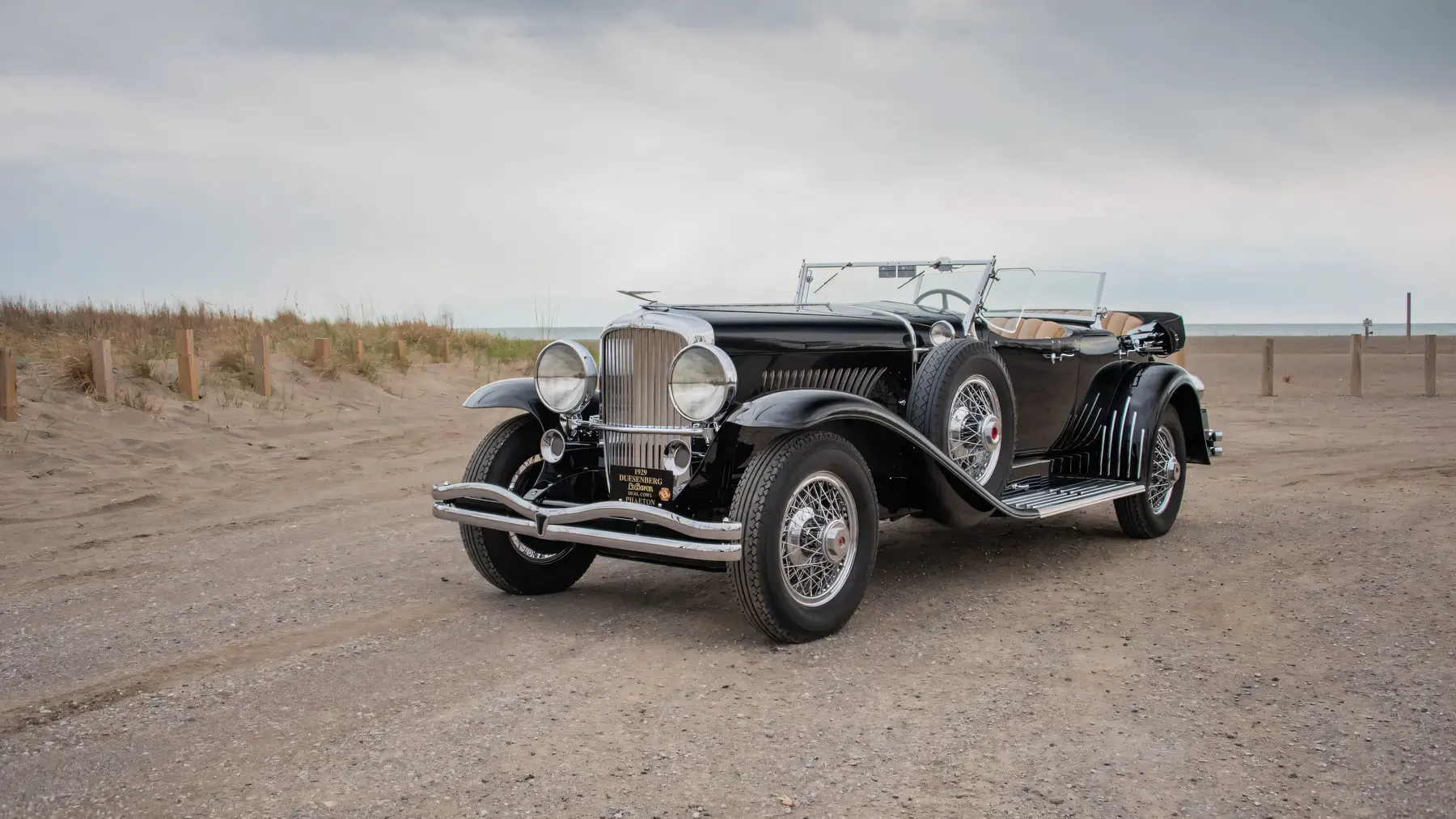
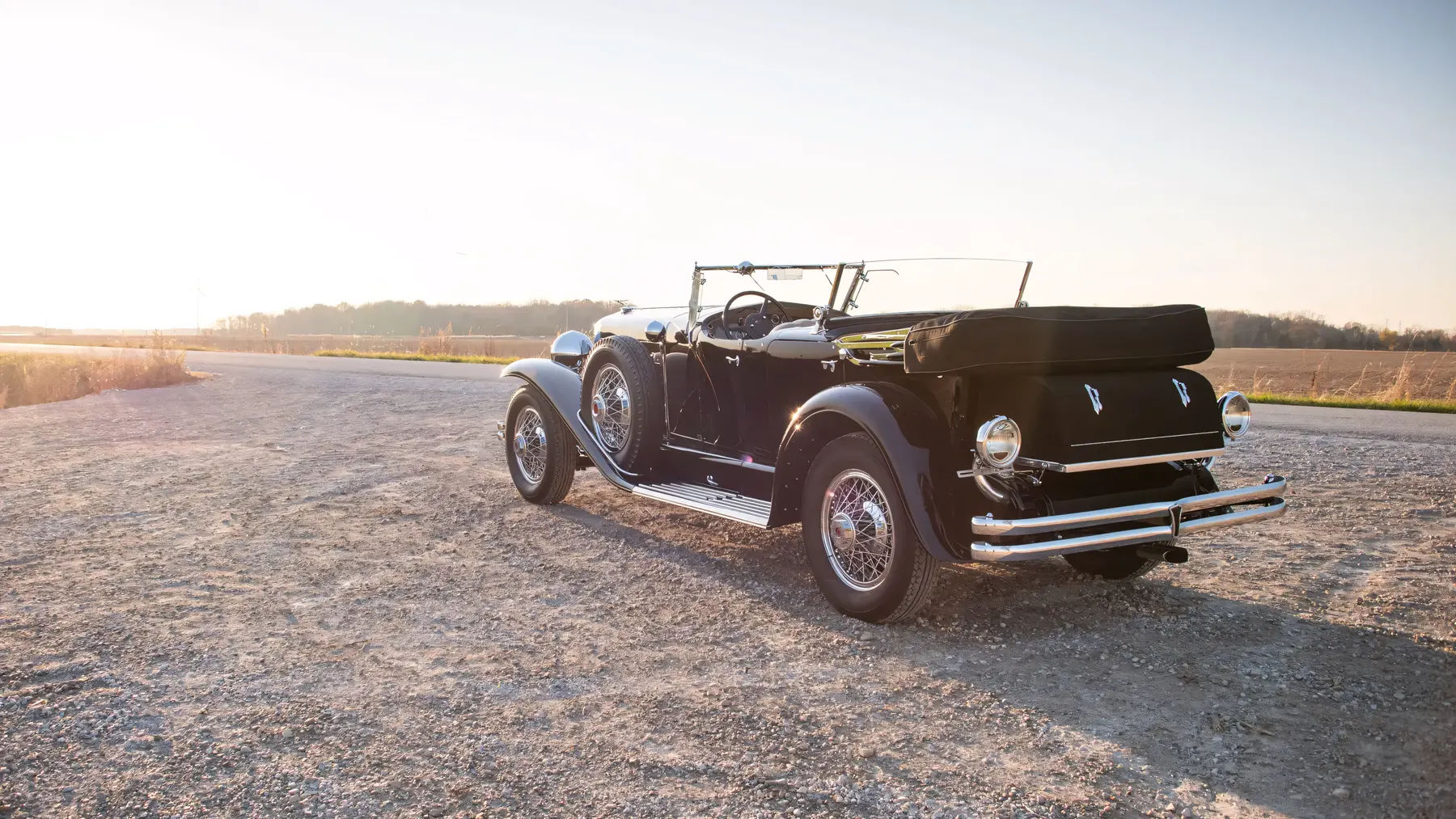
There are more mundane compromises too. As an open dual-cowl body, the Sweep Panel Phaeton offers only modest weather protection for its rear passengers, relying on a folding top and a small secondary windscreen rather than anything resembling a closed car’s isolation from wind and rain, and it was never intended as year-round transport even when new. Buyers who wanted a Model J they could use in all weathers generally specified one of the many closed body styles Duesenberg’s other coachbuilders offered instead, leaving the sweep panel phaeton and its dual-cowl siblings as fine-weather, occasion-driving cars from the outset. That was a deliberate trade-off rather than an oversight, but it is a real limitation for anyone thinking of a Model J phaeton as a usable classic rather than a static showpiece.
What survives of that story today is spread across a small number of serious collections, but the Sweep Panel Phaeton’s standing among Model J enthusiasts has never really been in question. It is generally regarded as the most recognisable of the dual-cowl phaeton styles Duesenberg offered, in part because of its central role in the car’s public debut and in part because Ralph Roberts got the basic proportions right enough that Duesenberg’s own design department chose to refine his shape rather than replace it outright. For a company whose entire reputation rested on building America’s answer to the finest cars in Europe, having the debut car’s silhouette become the template its in-house successors spent years trying to improve upon is no small achievement, even if, in the end, that achievement belonged as much to a New York coachbuilder as it did to Duesenberg itself.
Technical data
Specifications
| Specification | Detail |
|---|---|
| Engine | 420 cu in (6.9-litre) DOHC straight-eight, 4 valves per cylinder, built by Lycoming |
| Power | 265 bhp at approx. 4,200 rpm (normally aspirated)* |
| Torque | approx. 374 lb-ft* |
| Transmission | 3-speed manual, unsynchronised |
| Brakes | 4-wheel hydraulic drums |
| Wheelbase | 3,620 mm (142.5 in) standard; 3,900 mm (153.5 in) long-wheelbase (one Sweep Panel example only) |
| Kerb weight | approx. 2,300–2,700 kg depending on body/coachwork* |
| Top speed | 116 mph claimed, top up and fenders fitted; 89 mph available in 2nd gear |
| Tyres | 7.00 x 19 |
| Production (LeBaron Sweep Panel body) | approx. 18 examples, built 1929–1930* |
| Price when new | $8,500 chassis (rising to $9,500 after 1932) plus approx. $2,500–$8,000 for coachwork; complete cars typically $13,000–$19,000 |
Sources
- RM Sotheby’s - 1930 Duesenberg Model J ‘Sweep Panel’ Dual-Cowl Phaeton by LeBaron, Amelia Island 2019
- RM Sotheby’s - 1930 Duesenberg Model J ‘Sweep Panel’ Dual-Cowl Phaeton by LeBaron, Amelia Island 2015
- RM Sotheby’s - 1935 Duesenberg Model J ‘Sweep Panel’ Dual-Cowl Phaeton by LaGrande, Monterey 2021
- Bonhams - 1933 Duesenberg Model J ‘Sweep Panel’ Dual-Cowl Phaeton (LaGrande)
- Blackhawk Collection - 1929 Duesenberg J LeBaron ‘Sweep Panel’ Dual Cowl Phaeton, Supercharged
- Coachbuild.com - LeBaron Carrossiers Inc.
- Wikipedia - Duesenberg Model J
- HowStuffWorks - Introduction to the 1928-1934 Duesenberg J-Series
- Conceptcarz - Duesenberg Model J Specifications & Dimensions
- Conceptcarz - 1929 Duesenberg Model J Dual Cowl Phaeton by LeBaron, Chassis 2151
Join the discussion
Comments
Loading comments…
Leave a comment
Share a detail, memory, or perspective. Every comment is reviewed before publication.