Ferrari Testarossa Monodado: The Single-Nut Wheels That Didn't Last
1987 Ferrari Testarossa 'Monodado'

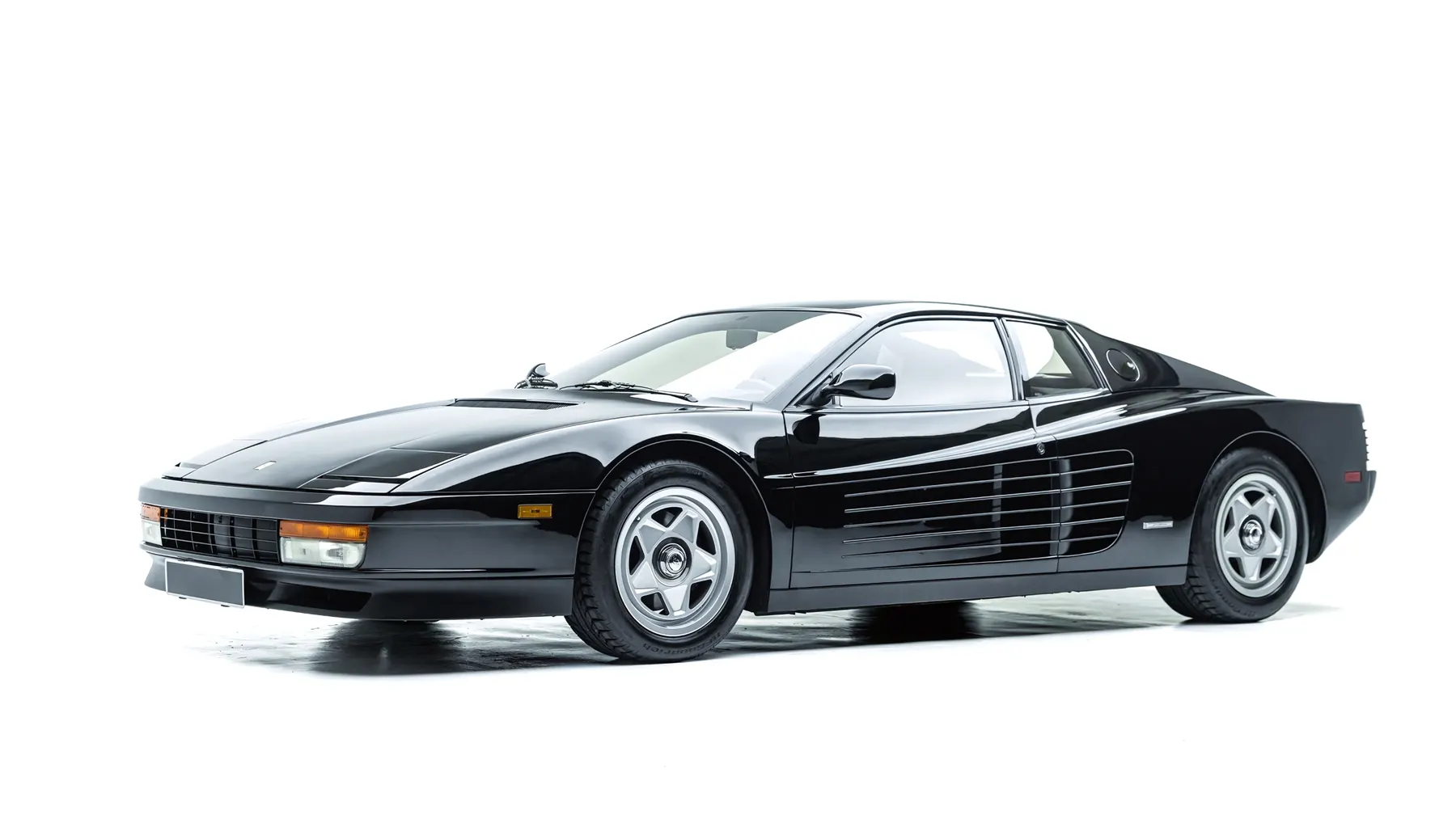
Images: Keno Zache / RM Sotheby's
Somewhere in the early months of 1988, Ferrari’s production line at Maranello began fitting a completely different wheel to cars that, from ten paces, looked identical to the ones that had been rolling out since 1984. The change had nothing to do with power, aerodynamics or price. It concerned only how each wheel attached to its hub - a single, large centre nut swapped for five conventional lug bolts - and the fact that this elegant, motorsport-flavoured detail had quietly become more of a liability than an asset on a car people actually drove every day. That detail gave an entire slice of early Testarossa production its enthusiast nickname: Monodado, Italian shorthand for “one nut.”
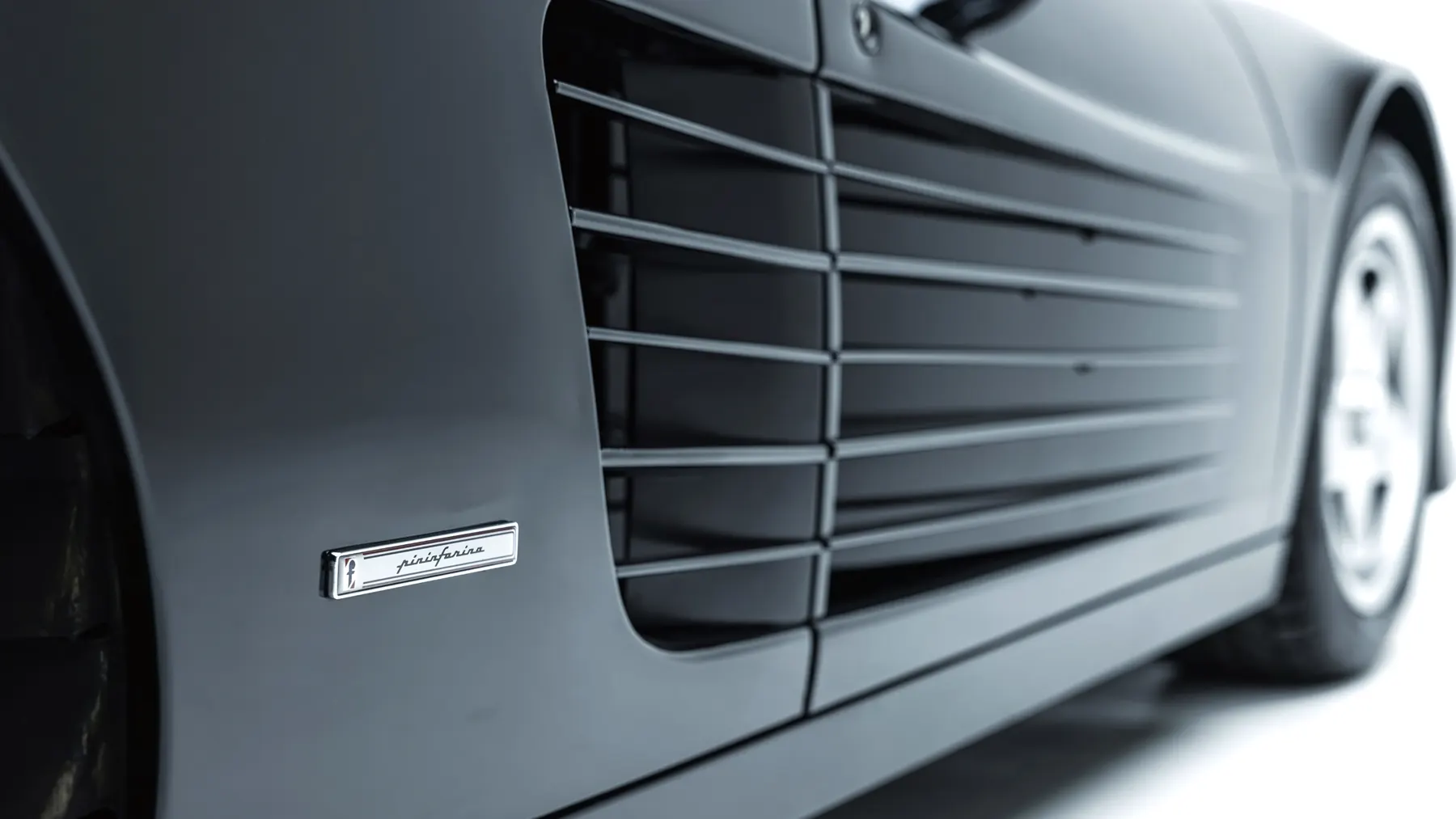
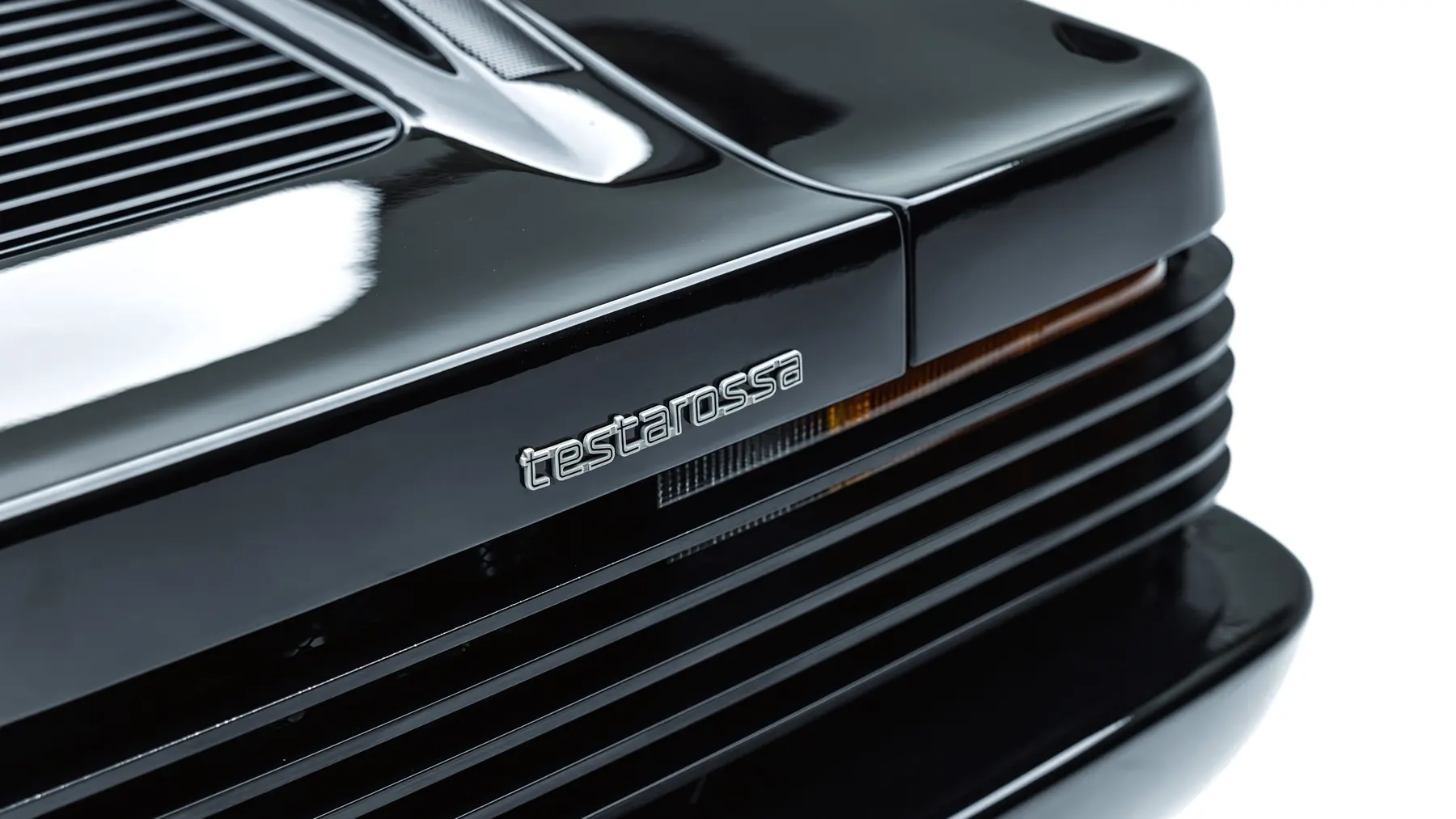
The Testarossa itself needs little introduction. Unveiled at the Paris Motor Show in October 1984 as successor to the 512 BBi and, before that, the wider Berlinetta Boxer line, it answered a specific set of complaints about its predecessor: nose-mounted radiators that cooked the cabin as hot pipework ran the length of the car, and nowhere sensible to put luggage. Pininfarina’s design team, working under Leonardo Fioravanti with the shape credited to Emanuele Nicosia, solved the heat problem by moving the radiators out to the sides of the car, feeding them through the huge intakes that became the Testarossa’s signature side strakes. Those slatted vents weren’t purely decorative - several export markets had legislation against large, unguarded body openings, so a regulatory requirement became one of the most imitated styling details of the entire decade.
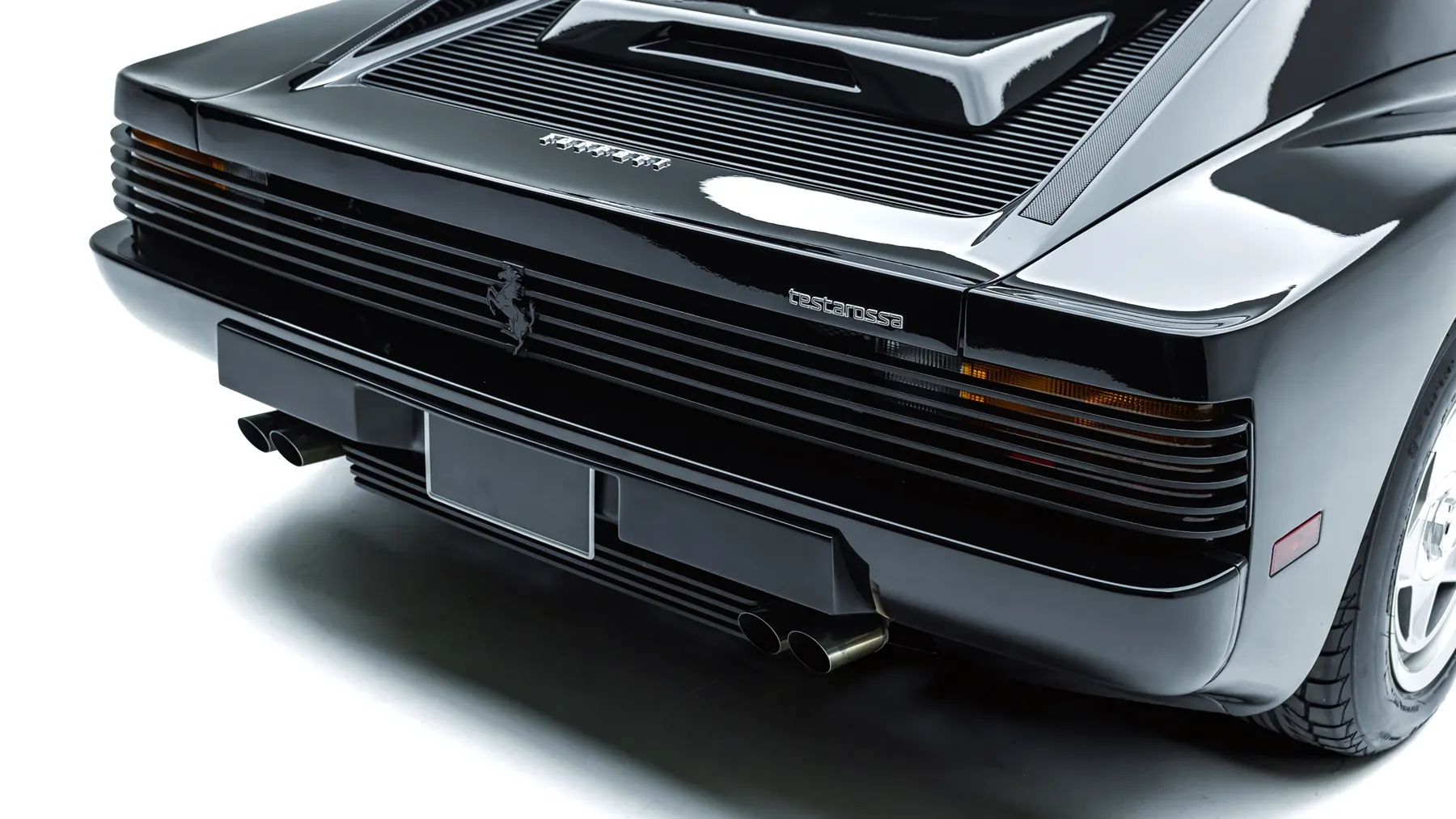
Feeding those side-mounted radiators meant pushing the rear track out dramatically, and the result was a car 1,976mm wide - over 300mm broader than a contemporary Porsche 911, and still some 150mm wider than an average new car today. Fioravanti didn’t disguise this bulk; he emphasised it, carrying the width through to a squared-off tail and a full-width rear grille that echoes the side strakes. It gave the Testarossa genuine road presence, but it also made - and still makes - the car a handful on tight European roads, one of its most consistently cited practical drawbacks.
Under that broad rear deck sat a 4.9-litre flat-12, Ferrari’s Tipo F113, developed under engineer Nicola Materazzi and closely related to the outgoing 512 BBi’s unit but fitted with new four-valve cylinder heads for an immediate jump in both power and cleanliness. In standard, pre-catalyst European tune the engine produced around 385bhp at 6,300rpm and 361lb-ft of torque at 4,500rpm, enough for a top speed in the region of 180mph and 0-60mph in the mid-to-high five-second bracket depending on which contemporary test one believes - Ferrari’s own claim was more conservative than most road testers managed. American-market cars, running different emissions equipment, made a touch less at around 380bhp. When catalytic converters became mandatory across more markets from 1986, output on affected European cars temporarily dropped to around 365bhp before recovering to roughly 376bhp by the end of the decade as Ferrari refined the calibration - a small reminder that even a supercar flagship wasn’t immune to the emissions politics of the era. Fed by Bosch K-Jetronic mechanical injection and mounted longitudinally on top of the five-speed gearbox and differential rather than ahead of them, the engine gave the Testarossa a genuinely high centre of gravity, one that both period and modern testers describe as demanding real concentration once cornering loads build. The unmistakable exhaust note owes something to deeper Ferrari history, too: the flat-12 layout traces its engineering lineage back to the units that powered Ferrari’s Formula One cars in the late 1960s and early 1970s, which is part of why the Testarossa’s soundtrack carries such a hard, multi-layered rasp rather than the smoother howl associated with the marque’s more modern V12s.
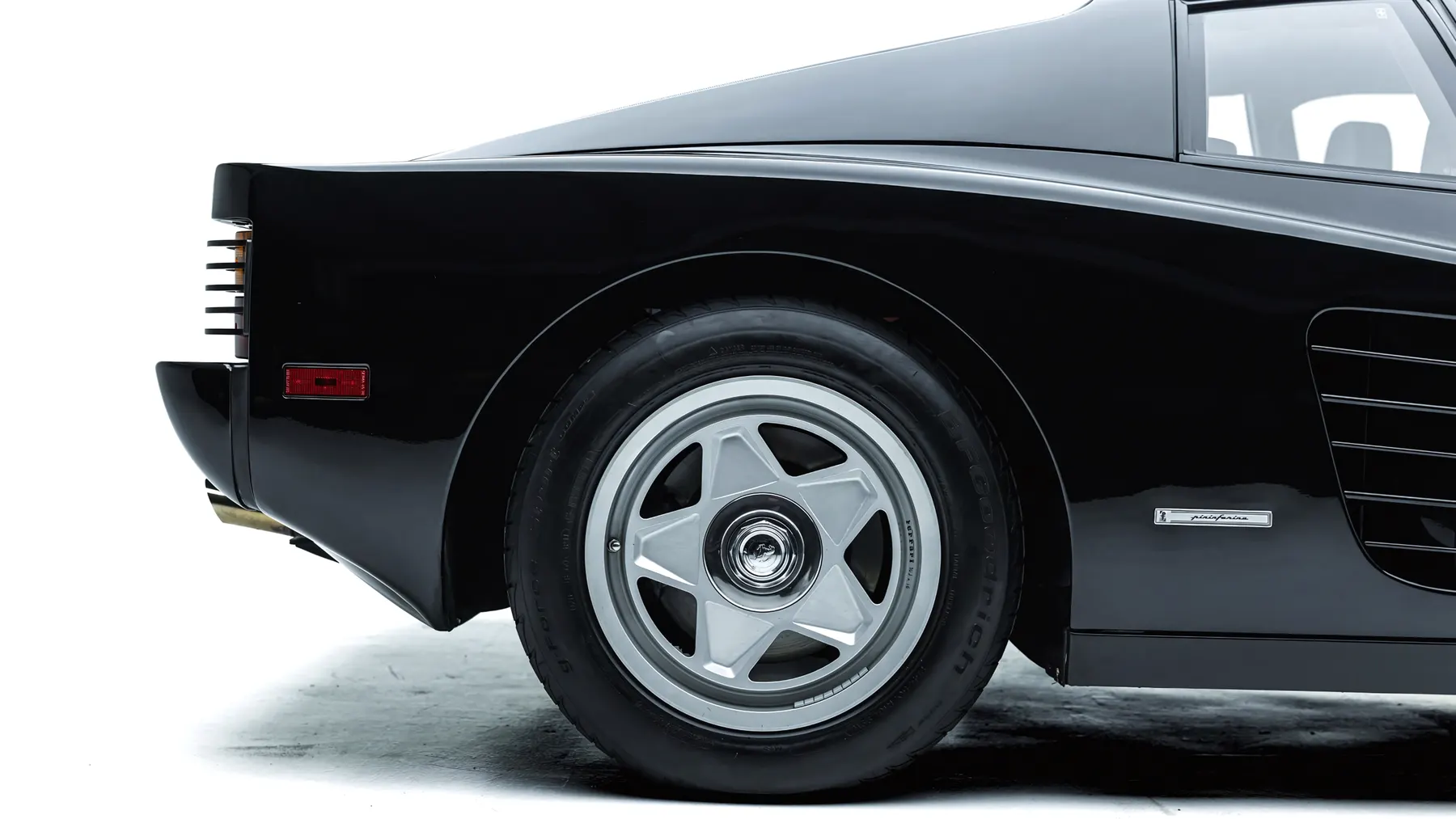
This is where the Monodado name comes in, and it’s worth being precise about what it actually describes, because market usage is looser than the story deserves. The earliest cars, built from 1984, combined the single-nut wheel fixing with another idiosyncratic detail: a single, high-mounted “flying” mirror on the driver’s door, a configuration enthusiasts call Monospecchio, or “one mirror.” American-market cars gained a conventional pair of door-level mirrors for the 1987 model year, and it is this second phase - dual mirrors, but still running the original centre-lock wheels - that some of the more careful marque histories reserve the Monodado name for specifically, treating it as a distinct middle stage between the single-mirror original and the definitive five-bolt cars that followed from 1988. In everyday market usage, though, the term is applied far more loosely, and it’s common to see the earliest single-mirror, single-nut cars advertised under a combined “Monospecchio Monodado” tag, or simply as “Monodado” regardless of mirror configuration. Either way, the wheels themselves - cast in magnesium, initially 415mm in diameter and shod with Michelin’s unusual metric TRX tyres, later standardised in Europe to a more conventional 410mm size while the American market kept its own TRX-based package for longer - draw on a design language with deep roots in Italian sports car and racing practice, where a single knock-off nut allowed for rapid wheel changes in competition. On a road car built for wealthy private owners rather than pit crews, the detail was really about heritage and visual drama rather than functional need, but it remains a lovely piece of engineering theatre all the same.
That theatre came at a real cost, and it’s the clearest, most specific weakness tied directly to this version of the car. A correctly torqued single-nut wheel is entirely secure, but the margin for error is smaller than with a conventional multi-bolt fixing, and specialists still warn today that these wheels can work loose in service if the splines are worn or the nut isn’t tightened to the exact factory specification - a genuine, safety-relevant maintenance point rather than a theoretical one. It’s one of the reasons Ferrari abandoned the design partway through the 1988 model year in favour of a conventional five-stud fitting that looked broadly similar but was simpler to service and more consistent across export markets, several of which had their own requirements around wheel fixings. A number of auction and dealer listings state that the changeover happened as early as 1986, but the more detailed, year-by-year technical histories place it firmly in early-to-mid 1988 - meaning genuine Monodado-specification cars were built for the better part of four years, not two, and the popular shorthand date circulating in the classic car trade is very likely wrong.
None of this should suggest the Testarossa was ill-conceived; quite the opposite. Contemporary and modern road tests agree that the flat-12 is the car’s defining asset - tractable and flexible low down despite its complexity, building to a genuinely thrilling, multi-layered wail as it swings past 5,000rpm on the way to its power peak. It’s also, by common consent, a more usable, better-riding car day-to-day than its great rival, the Lamborghini Countach, with a wider cabin and enough long-distance civility that Ferrari itself marketed it, in period, as what it called “the world’s most powerful and most luxurious Gran Turismo car.” The cabin itself is roomier than the low, wedge-shaped exterior suggests, with a low scuttle, a properly supportive seat, and noticeably better outward visibility than the Countach’s letterbox glasshouse; the simple three-spoke Momo steering wheel, later reused on the F40, at least gives the driver something honestly tactile to hold. But the honesty this kind of car deserves means naming its real shortcomings too, and there are several worth stating plainly rather than waving away as charm. The driving position is genuinely awkward: pedals are offset hard to one side of a narrow footwell, a consequence of the wide front wheelarch intruding into the cabin, and more than one road tester has found their left foot resting against a speaker grille rather than a proper dead pedal. Switchgear is scattered with little apparent logic, an odometer housed oddly at knee height and fog-light switches mounted up in the roof lining among the more curious placements. The unassisted steering and the notoriously heavy, occasionally obstructive dog-leg gearchange both demand a firm hand at low speed, loosening up only once the car is being driven with real commitment, which makes cold starts and town driving a genuine chore rather than an endearing quirk. And because the engine sits so high, directly above the transaxle, the Testarossa’s balance at the limit can shift from mild understeer into sudden, momentum-driven oversteer that catches out anyone who loads it up carelessly through a fast corner - manageable with experience, but not a forgiving car for the inattentive. Running costs have never been trivial either: the cambelt service alone, recommended roughly every five years or 15,000 miles, remains a significant job on a well-maintained example, on top of the general expense of keeping a forty-year-old, low-volume Italian exotic on the road.
None of that held the car back commercially. Ferrari built 7,177 Testarossas between 1984 and 1991 before the model evolved into the mechanically related but significantly revised 512 TR and, later, the F512 M, bringing combined production across all three names to just under 10,000 - a genuinely high volume by the standards of Ferrari’s flagship models up to that point, and one that broadened the marque’s customer base considerably. Launched in the UK at £62,666, it found an audience helped along by a starring role on Miami Vice from the 1986 season, an equally famous cameo in Sega’s arcade hit Out Run, and a long run of Road & Track cover appearances through the back half of the 1980s. Critical reception was broadly warm but never uncomplicated adulation: the car lost more than one head-to-head magazine comparison test of the period to rivals including the Lamborghini Countach and even fast contemporary executive saloons.
Reported weights for the model vary depending on convention: the most carefully documented dry figure sits at around 1,506kg, while some road-test kerb weights, likely measured with fluids and fuel aboard, run closer to 1,700kg - a discrepancy the sources themselves rarely explain, so both figures are worth treating with a little caution rather than picking one as definitive. Today, the Monodado - whichever precise window of production one applies the name to - occupies a particular niche in Ferrari collecting: valued less for outright numerical rarity, since no rigorously documented production split between single-nut and five-bolt cars appears to exist, and more for representing the design in its least diluted state, before running changes gradually smoothed out the character that made the earliest cars so distinctive. Subsequent development, especially in the 512 TR, addressed many of the original’s rough edges directly - a lower-mounted engine and gearbox assembly, quicker steering, a lighter clutch, a friendlier gearchange. Collector demand still skews toward the buyers who wanted one on their bedroom wall as teenagers in the 1980s, though industry data on newer insurance quotes suggests younger buyers are gradually gravitating toward the more usable, later cars in the wider Testarossa family rather than the earliest and least resolved examples. That the Testarossa name still carries enough cachet that Ferrari revived it in 2026 for an entirely new hybrid flagship says something about how firmly the silhouette, the strakes, and yes, even that single elegant wheel nut, embedded themselves in the culture. The Monodado cars are not the easiest Testarossas to live with, nor the best resolved to drive, but they carry the shape and the compromises of Ferrari’s original 1984 intent more directly than anything that came after.
Technical data
Specifications
| Specification | Detail |
|---|---|
| Engine | 4,943cc (4.9-litre) Tipo F113 flat-12, DOHC, 4 valves/cylinder, dry sump |
| Fuel system | Bosch K-Jetronic mechanical injection |
| Power (Europe, pre-catalyst, 1984–86) | c. 385bhp @ 6,300rpm |
| Power (Europe, catalyst, 1986–89) | c. 365bhp |
| Power (Europe, catalyst, 1989–91) | c. 376bhp |
| Power (US-market) | c. 380bhp |
| Torque (Europe, pre-catalyst) | c. 361lb-ft @ 4,500rpm |
| Torque (Europe, catalyst 1986–89 / 1989–91) | c. 333 / 347lb-ft |
| Torque (US-market) | c. 354lb-ft |
| Transmission | 5-speed manual, dog-leg pattern, rear-mounted transaxle |
| 0–60mph | c. 5.2–5.8 sec (varies by market/source) |
| Top speed | c. 178–181mph |
| Weight | c. 1,506kg dry (specialist sources); road-test kerb weights recorded up to c. 1,700kg* |
| Length / width / height / wheelbase | 4,485mm / 1,976mm / 1,130mm / 2,550mm |
| Wheels (Monodado-era) | Magnesium, single-nut centre-lock; 415mm dia. (1984–86), 410mm dia. (1986–88, Europe); superseded by conventional 5-stud fixing partway through 1988 model year |
| Brakes | Ventilated discs, 309mm front / 310mm rear |
| Production (Testarossa, all wheel/mirror variants, 1984–91) | 7,177 units |
Sources
- Hagerty Media - Your Handy Ferrari Testarossa (1984-1991) Buyer’s Guide
- Hagerty Media - These Three Flavors of Ferrari Testarossa Have Distinct Personalities, and Values
- Wikipedia - Ferrari Testarossa
- Ultimatecarpahttps://en.wikipedia.org/wiki/Ferrari_Testarossage.com - 1984-1991 Ferrari Testarossa Specifications (Wouter Melissen)
- evo - Ferrari Testarossa (1984-1991) Review
Join the discussion
Comments
Loading comments…
Leave a comment
Share a detail, memory, or perspective. Every comment is reviewed before publication.