Porsche 911 (930) Turbo Cabriolet: An Open-Top Widowmaker
1987 Porsche 911 Turbo Cabriolet
%20Turbo%20Cabriolet%3A%20An%20Open-Top%20Widowmaker%20%7C%20Motor%20Archive)
Images: William Walker / RM Sotheby's
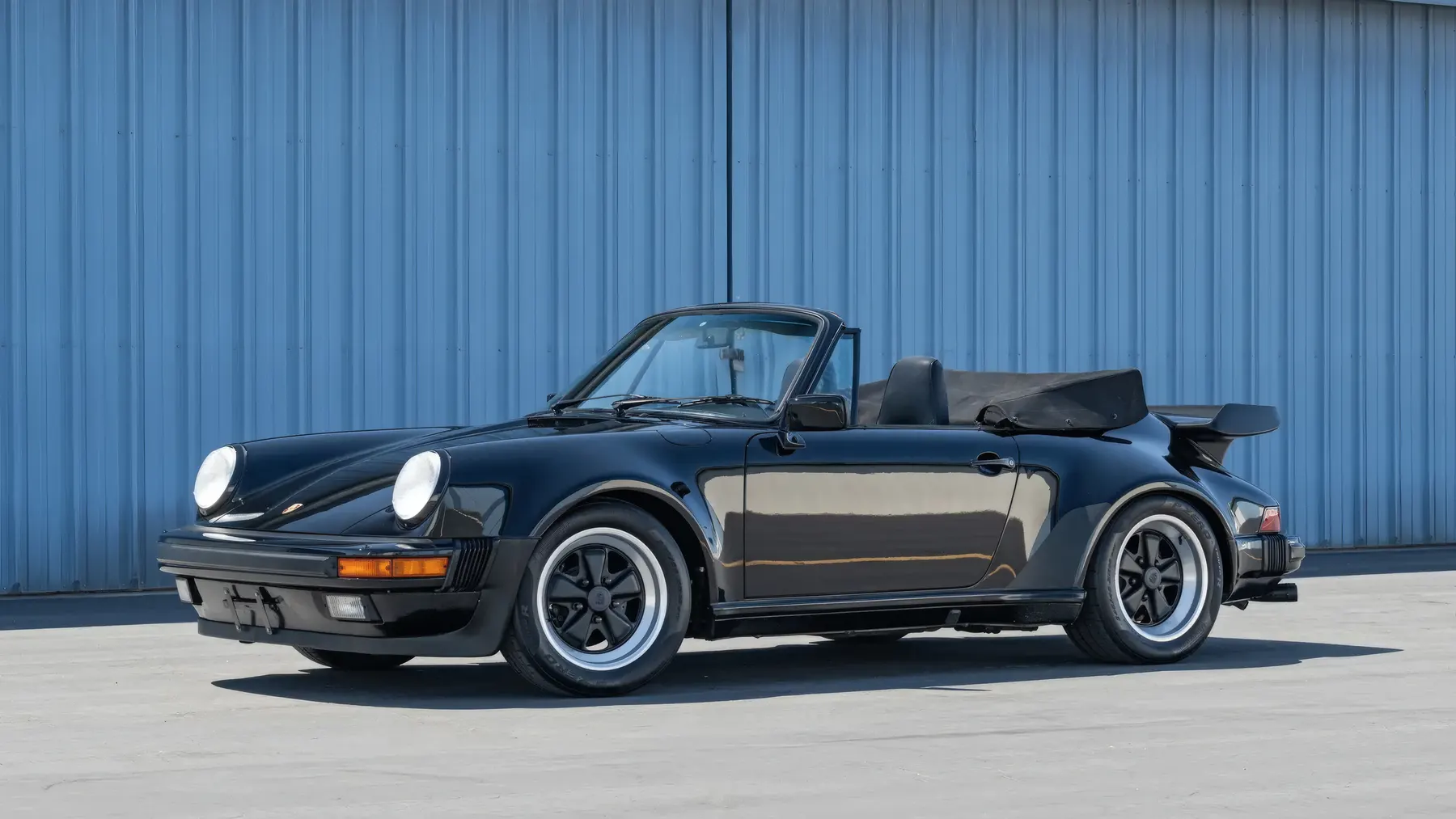
Take away a 911’s roof and something structural goes missing along with the sheet steel. The lid ties the body together, tensioning the shell against the twisting loads a monocoque experiences on real roads. Do that to an ordinary Carrera and the result is a slightly softer, thoroughly pleasant cruiser. Do it to the 930 Turbo, a car whose reputation for pitching inexperienced drivers into the scenery had already earned it the nickname “the Widowmaker,” and the result is something more curious: Porsche’s most notorious production car, sold without a lid, to buyers who wanted to hear its turbocharger spooling up with the wind in their hair. That car, offered for just three model years at the tail end of the 1980s, was the 911 (930) Turbo Cabriolet, the last and rarest body style of the original air-cooled 911 Turbo before Porsche moved the model onto an entirely new platform.
The Cabriolet’s story cannot be separated from the coupé it was built alongside, because the 930 Turbo had already lived a full and eventful life by the time Porsche finally agreed to build one without a fixed roof. The turbocharged 911 debuted at the Paris Motor Show in autumn 1974, conceived initially as a homologation special: Porsche needed roughly 400 street-legal examples to qualify a turbocharged racing 911 for FIA Group 4 and 5 competition. As with the 2.7 Carrera RS before it, demand comfortably outstripped the homologation requirement, and rather than quietly discontinue the car once its motorsport job was done, Porsche kept building it as a flagship in its own right, pitched against the Ferrari 365 GT4 Berlinetta Boxer and the Lamborghini Countach. The original 3.0-litre 930 made 256bhp at 5,500rpm and 253lb-ft of torque, reached over 155mph, and dispatched 0-62mph in 5.4 seconds — remarkable numbers for 1975, delivered with an everyday usability neither Italian rival could match.
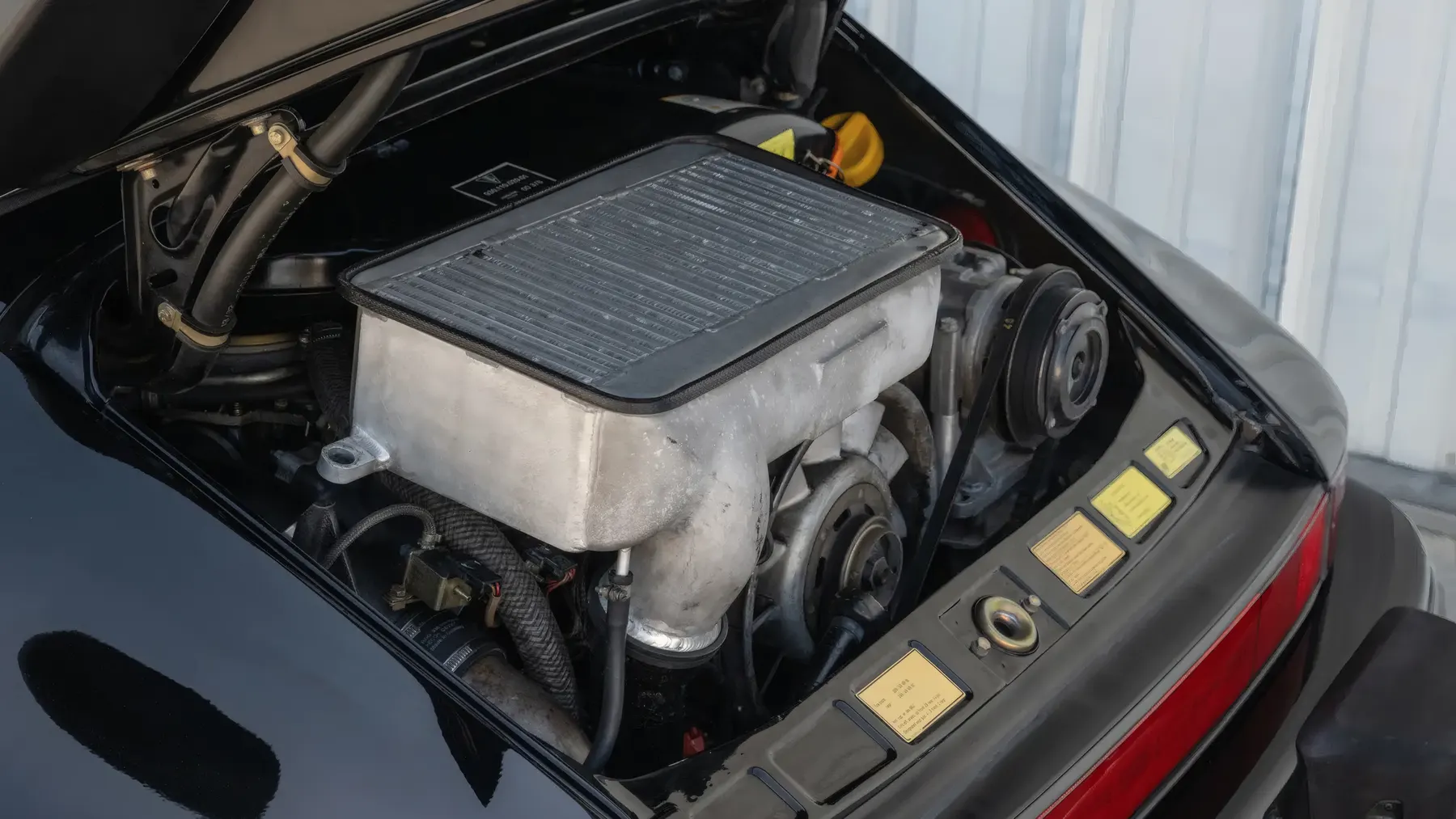
For 1978, Porsche substantially reworked the car around a larger 3.3-litre engine. Bore grew from 95mm to 97mm and stroke lengthened to 74.4mm, taking displacement to 3,299cc, while compression rose to 7.0:1 and a new air-to-air intercooler, mounted beneath a reshaped rear spoiler, replaced the earlier water-to-air unit and cooled the pressurised intake charge far more effectively. Output rose to 296bhp at 5,500rpm with 303lb-ft of torque at 4,000rpm, later increased to 318lb-ft from 1983 with a revised engine, and Porsche borrowed brake hardware developed for the 917 endurance racer — cross-drilled, ventilated discs measuring 304mm at the front and 309mm at the rear, gripped by finned four-piston aluminium calipers — to help the car stop as effectively as it accelerated. All of this added weight, pushing the 3.3-litre coupé to around 1,300kg, but the extra torque more than compensated, and the engine’s fundamental architecture — a single-overhead-camshaft, dry-sumped, air-cooled flat six fed by a single KKK turbocharger and Bosch fuel injection — remained essentially unchanged for the rest of the model’s production life.
American and Japanese buyers had a more complicated relationship with the car. US-market 930s were detuned from launch, and tightening emissions regulations forced Porsche to withdraw the model from the US and Japanese markets entirely after 1979, leaving it available only in Europe and other unregulated markets for six model years. It returned to America for 1986 fitted with a new catalyst-equipped engine producing 282bhp at 5,500rpm and around 288lb-ft of torque — a genuine performance loss against European cars, but enough of a reduction in emissions to satisfy US law, and enough power to reignite American demand. It was against this backdrop of renewed US sales that Porsche finally agreed, for the 1987 model year, to offer the 930 Turbo in Targa and Cabriolet forms alongside the existing coupé.
The timing is worth dwelling on. Porsche had already built an open 911 — the 911 SC Cabriolet, launched for the 1983 model year as the marque’s first proper soft-top since the 356, based closely on the Targa’s structure and requiring comparatively modest extra reinforcement to cope with the SC’s more modest performance. Bringing a drop-top to the far more powerful, far heavier Turbo took another four years, and while Porsche has never published a detailed engineering rationale for the gap, it isn’t hard to guess at one: a fixed steel roof does real structural work holding a monocoque together, and asking a folding fabric top to compensate for that on the widest, heaviest and most highly strung 911 in the range demanded rather more care than doing the same job on a naturally aspirated Carrera. Whatever the reasoning, when the Cabriolet finally arrived it came alongside a broader expansion of the range: Porsche’s “Exclusive” personalisation programme was formalised the same year, offering buyers everything from the slantnose “Flachbau” nose treatment, option M505, complete with 935-style pop-up headlights, a 330bhp engine and a four-outlet exhaust, to bespoke leather and paint. A Cabriolet ordered with the Flachbau nose is among the rarest 930s of all; a specialist Porsche dealer citing factory records puts total Flachbau Cabriolet production across all three model years at around 200 cars.
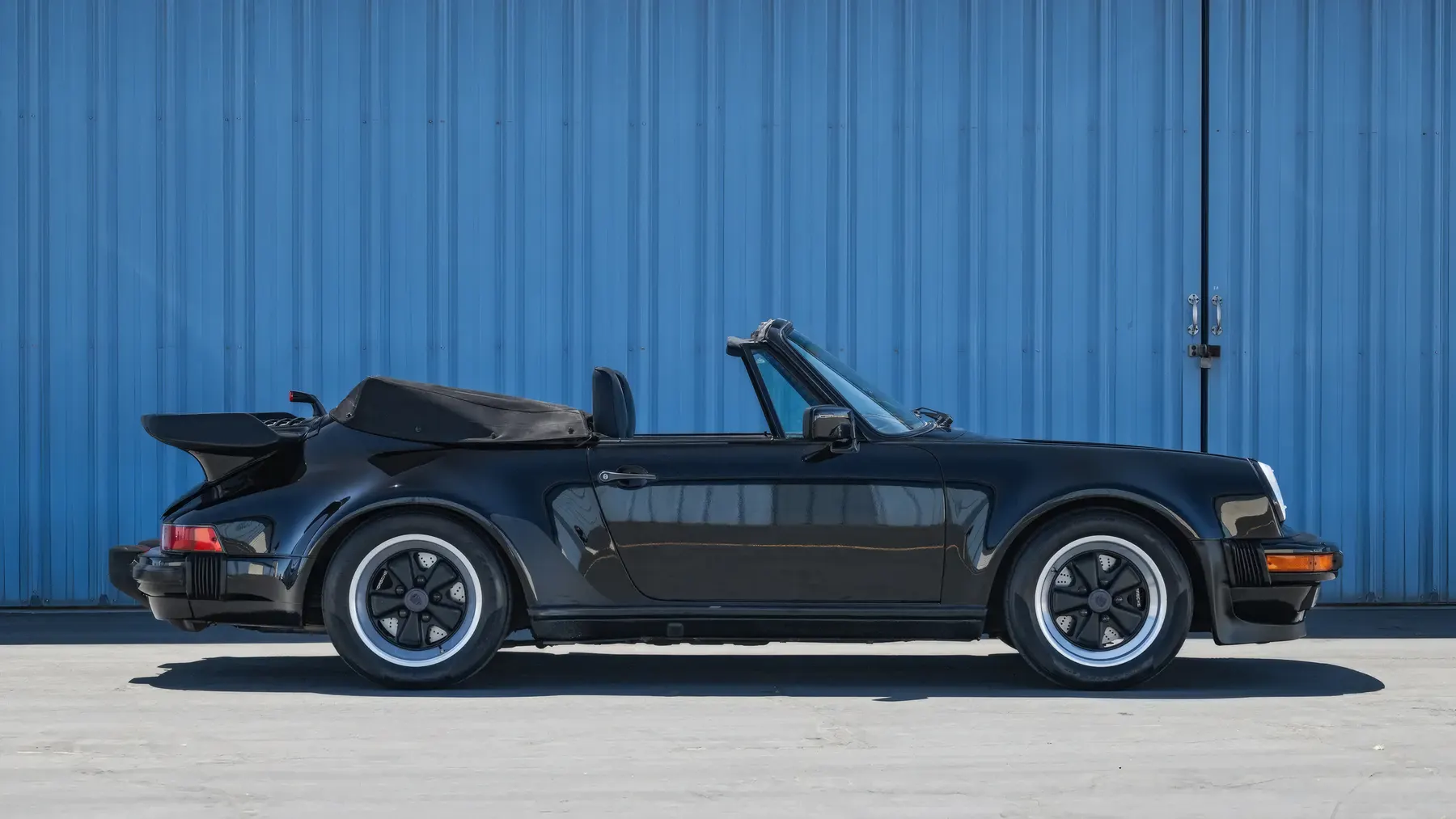
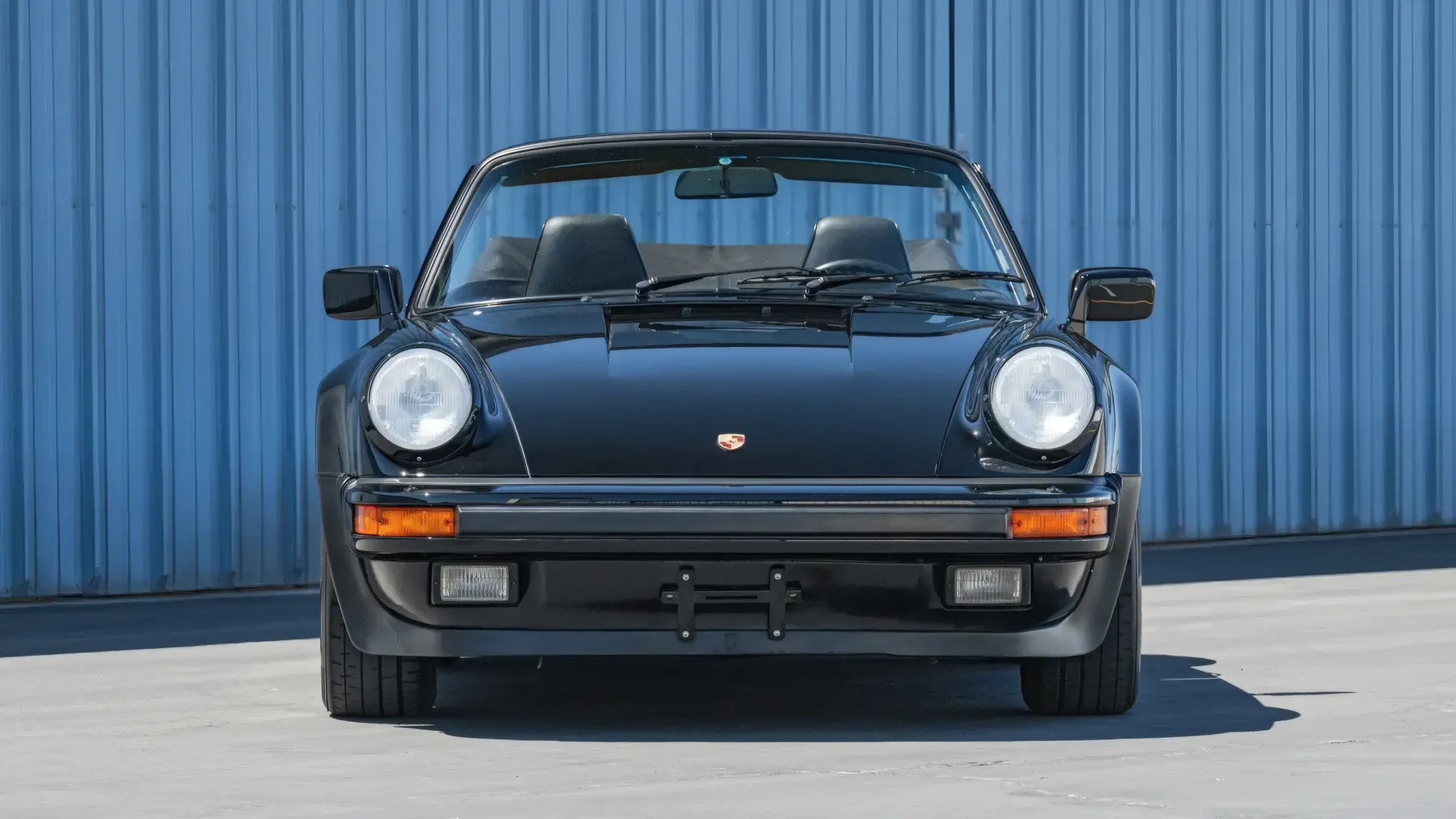
Mechanically, the Cabriolet used the same running gear as its closed siblings: 16-inch Fuchs alloys, 8 inches wide at the front and 9 at the rear, shod with 225-section front and 245-section rear tyres, the same 917-derived brakes, and the same wide, flared rear bodywork that had defined the Turbo since 1975. US-market cars, including the Cabriolet, are logged at 2,976lb, or around 1,350kg, with a quoted top speed of 157mph on the catalyst-equipped 282bhp engine — a shade down on the European coupé’s 161mph, reflecting both the lower-output engine and the car’s added mass. Porsche continued to build the Cabriolet with a four-speed manual gearbox through the 1987 and 1988 model years; only for 1989, the 930’s final year of production, did the model gain the Getrag-sourced G50 five-speed manual and a hydraulic clutch, improvements most enthusiasts and specialists consider decades overdue by that point. That makes the 1989 Cabriolet, built for a single model year before the 930 was retired, the version most collectors chase today.
To drive, the Turbo Cabriolet offered the same fundamentally binary character that made the coupé so notorious. Below around 3,000rpm the single KKK turbocharger does comparatively little, and the flat six feels almost ordinary: torquey, docile, easy to potter around town in. Ask for full throttle in that lower register and there’s a distinct pause, sometimes several seconds long, before boost finally builds and the car surges forward with a violence period road testers frequently likened to being kicked from behind. Because the 930 carries its engine and gearbox behind the rear axle on a comparatively short wheelbase, that surge of power arriving mid-corner, or a lifted throttle at the wrong moment, could unsettle the rear end enough to spin the car — the exact mechanism behind the Widowmaker reputation. None of this made the Cabriolet gentler than the coupé; if anything, the awareness that there was no roof overhead sharpened the sense of consequence for anyone pushing too hard. What the Cabriolet did add was texture the coupé couldn’t offer: the muffled, mechanical rasp of the flat six and turbo hardware becoming audible rather than distant once the fabric top was folded, and a clear view of the whale-tail spoiler doing its work in the mirrors.
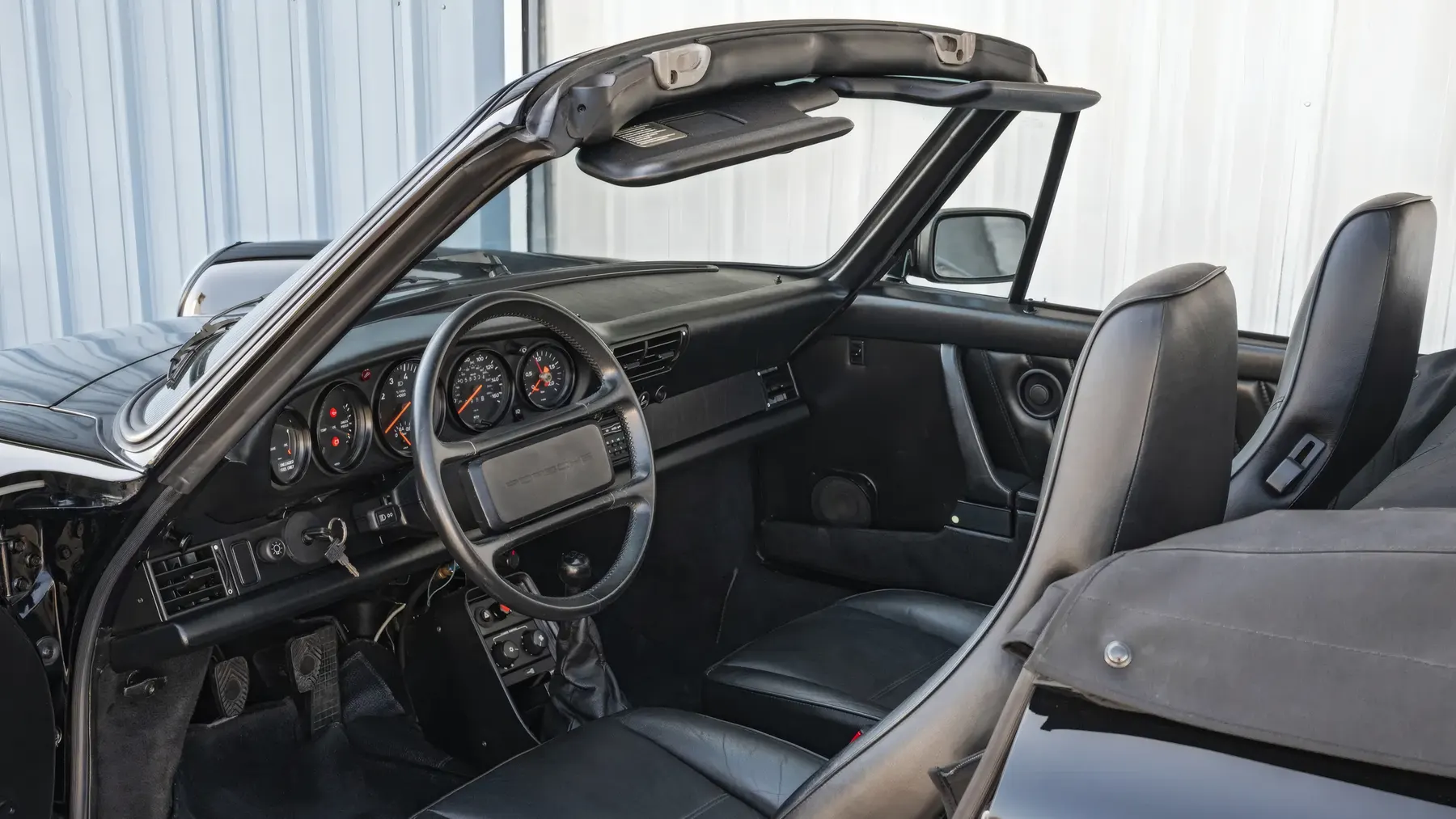
It would be dishonest to present all of this as pure entertainment, and the Turbo Cabriolet’s genuine shortcomings deserve to be named rather than waved away as charming period quirks. Turbo lag of the severity the 930 exhibited was not merely a character trait; in period it was a documented safety concern, catching out drivers who applied full throttle expecting an immediate response and instead got a multi-second delay followed by a sudden, hard-to-modulate surge, frequently while already committed to a corner. Porsche persisted with a four-speed gearbox on this car for over a decade after most rivals, and most of its own 911 range, had moved to five ratios; specialists and period commentators alike have long argued that the four-speed’s wide-spaced gearing made the lag worse rather than better, forcing drivers to hold a gear longer than they might have liked while waiting for boost to build. The Cabriolet compounded these issues with the ordinary trade-offs of any pillarless open car from this era, giving up some of the coupé’s torsional stiffness in exchange for open-air motoring, carrying extra weight in its reinforced sills and folding-top mechanism without fully replicating the rigidity of a fixed roof, and offering a more compromised rear view than the coupé even with the top back up. Ergonomically, the car was already showing its age by the late 1980s: the offset pedal box and long, notchy gearshift required real acclimatisation, the dashboard and switchgear had barely evolved since the early 1970s, the token rear seats suited only luggage or small children on short journeys, and combined fuel economy on catalyst-equipped US cars worked out to around 18mpg on the Imperial scale, a poor return even by the standards of the era. None of this stopped the Cabriolet selling relative to its low production numbers, but buyers were paying a substantial premium — over the standard Carrera Cabriolet and over the Turbo coupé alike — for a car that was, by any objective measure, less rigid, less aerodynamically efficient, and no easier to drive smoothly than the closed car it was based on.
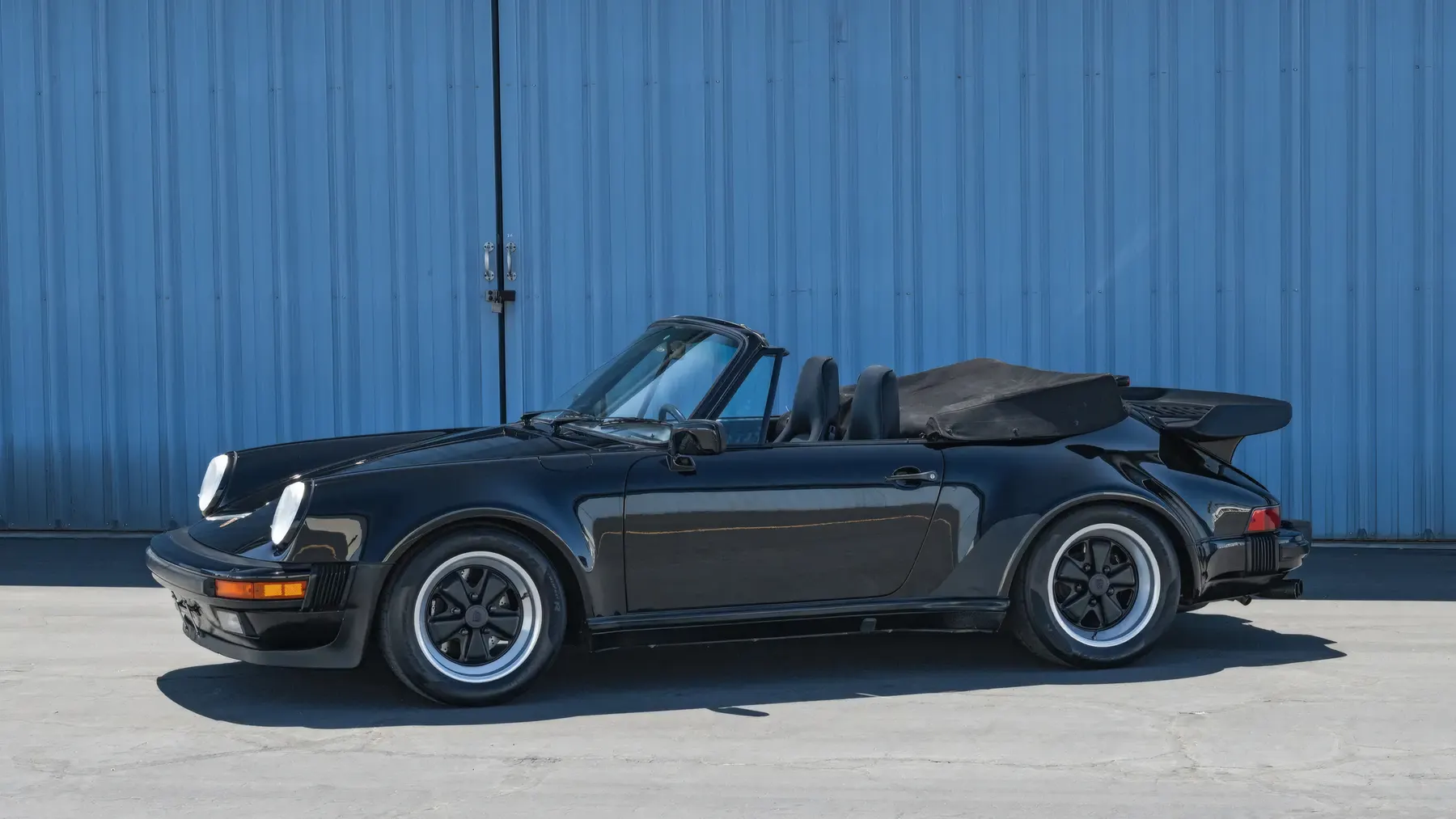
Exact Cabriolet production figures are harder to pin down than those for the coupé, which Porsche has documented fairly precisely. A Porsche Club of America production reference puts 1989 model-year Cabriolet output, excluding slantnose cars, at 724 units worldwide, with 540 of those built for the US market; other trade sources place total Cabriolet numbers for that final year somewhat higher, in the 600-to-850 range depending on how variants are counted. No single reliable source consulted for this piece gives a firm combined total across all three Cabriolet model years, though it is clear the body style, alongside the similarly late-arriving Targa, made up a small minority of total 930 Turbo production, generally reported at somewhere between roughly 20,000 and 21,500 units across the full 1975-to-1989 run. Within the wider convertible market of the late 1980s, the Cabriolet was also something of an outlier: most open two-seat GTs of the period, from Mercedes’ 560SL to Ferrari’s front-engined convertibles, were naturally aspirated and comparatively docile, leaving Porsche’s turbocharged, rear-engined drop-top with almost no direct rival that combined open-top motoring with genuinely supercar-grade urgency.
Porsche ended 930 production in 1989, its air-cooled turbocharged flagship finally undone by tightening emissions and safety requirements rather than any lack of enthusiasm from buyers. Its successor, based on the new 964-generation 911 and launched at Geneva in March 1990, initially carried over much of the same 3.3-litre turbocharged engine into a stiffer, more modern chassis with power steering and, eventually, all-wheel drive — refinements that made the newer car dramatically easier to drive quickly, and which, by extension, only reinforced how raw and unfiltered the original 930 had been. That rawness is precisely what collectors now pay for. A Turbo Cabriolet combines the rarest body style of the most notorious road-going 911 Porsche ever sold with, in 1989-model form, the mechanical upgrade that finally addressed one of the car’s longest-standing criticisms. It is not the version of the 930 Turbo an engineer would call the most complete, nor the version a driving instructor would recommend to a novice, but it may be the version that best captures what made the Widowmaker legend in the first place: a genuinely difficult, genuinely thrilling car, built without the safety net of a fixed roof, at the very end of an era when Porsche was still willing to sell customers something that could bite.
Sources
- A Brief History of the Porsche 911 Turbo — Porsche AG
- Porsche 911 Turbo 3.3 (930) (1978-1989) — Stuttcars
- Guide: Porsche 911 3.3 Turbo (930) — A Historical & Technical Appraisal — Supercar Nostalgia
- Porsche 911 Turbo Cabriolet 3.3 Liter (930) Market — Classic.com
- 1987 911 Turbo Cabriolet (930) Specifications — Excellence Magazine
- 1989 911 Turbo Cabriolet (930) Specifications — Excellence Magazine
- Tech Q&A: Production Numbers, 1989 930 Turbo Cabriolet — Porsche Club of America
- Porsche 930 Turbo 3.3 Buyer’s Guide — Elferspot Magazine
- 1988 Porsche 911 Turbo Cabriolet Flachbau — Elferspot
- 1983 Porsche 911SC Cabriolet — HowStuffWorks
- Porsche 911 SC (1978-1983) — Stuttcars
- Porsche 911 (930) — Wikipedia
Join the discussion
Comments
Loading comments…
Leave a comment
Share a detail, memory, or perspective. Every comment is reviewed before publication.