Vector Avtech WX-3R Roadster: The Last All-American Supercar Vision
1993 Vector Avtech WX-3R Roadster Prototype

Images: Zach Brehl / RM Sotheby's
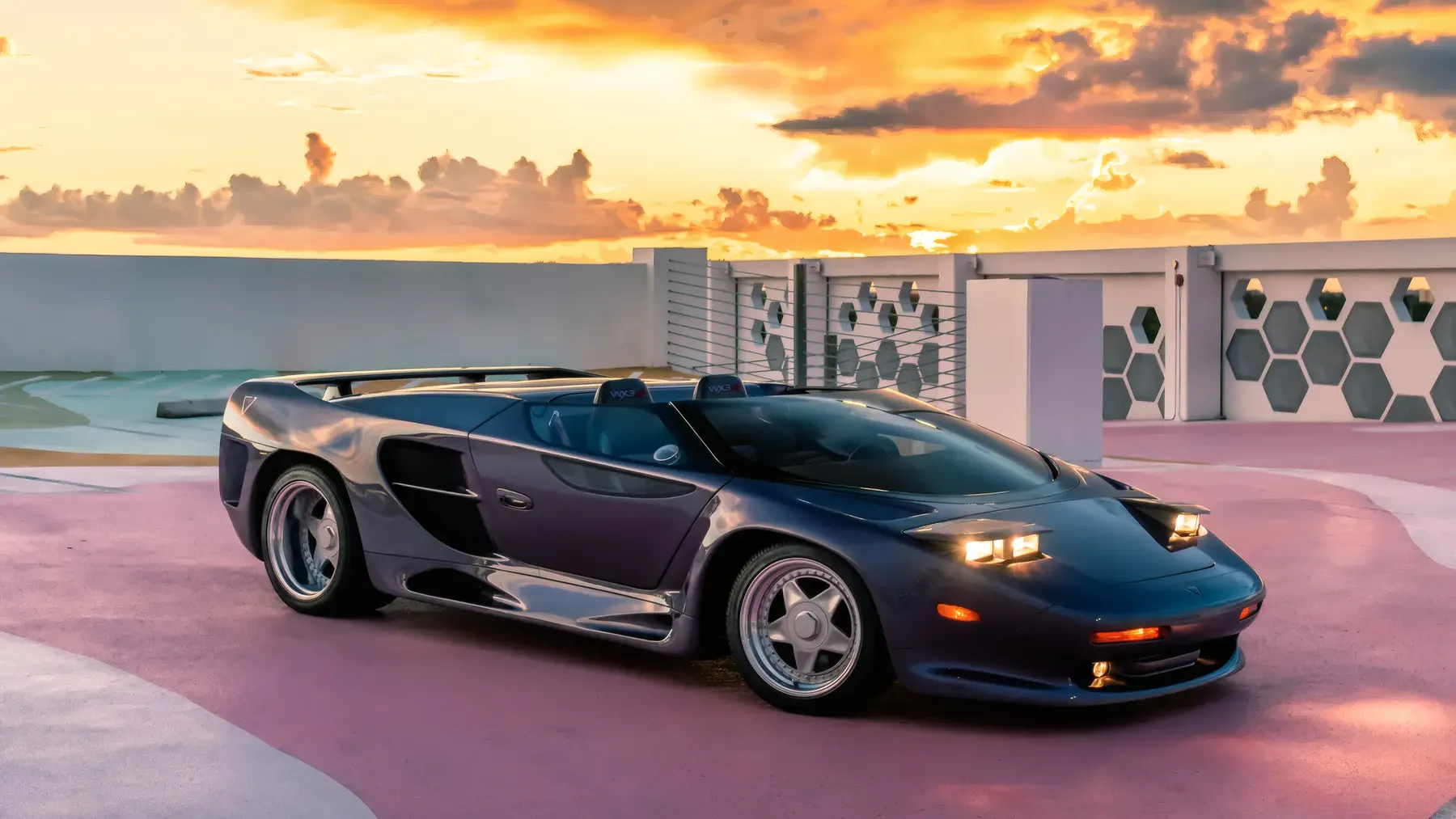
When Jerry Wiegert parked the WX-3R alongside its aquamarine coupe sibling at the 1993 Geneva International Auto Salon, the two Vector prototypes must have appeared to represent the opening act of something genuinely historic. In a sense, they did - only not in the way anyone had intended. The Amethyst purple roadster, more aggressive in its raking lines than the coupe and distinguished from it chiefly by the absence of a roof, was the last all-American Vector that Jerry Wiegert would ever complete. The company was already being taken from him as it sat under the show lights.
Understanding what made that outcome so corrosive requires understanding what Wiegert had actually built over the previous two decades. Gerald Wiegert was a Los Angeles-based industrial designer who had trained at the Art Center College of Design in Pasadena and briefly at General Motors before concluding that America could produce a supercar that would genuinely outperform the European machines it so plainly admired. His plan required aerospace-grade engineering, his own manufacturing philosophy, and an unusual degree of patience: the W8 Twin Turbo did not reach limited production until 1989, more than a decade after he first sketched the concept. What emerged from Wiegert’s Wilmington, California facility was a remarkable machine - mid-engined, built around an aluminium honeycomb monocoque reinforced with approximately 5,000 aircraft-grade rivets and clothed in carbon fibre and Kevlar bodywork, powered by a twin-turbocharged 6.0-litre Rodeck V8 producing 625 bhp. Road & Track tested one and recorded 4.2 seconds to 60 mph, a 12.0-second quarter-mile, and a lateral acceleration figure of 0.97g - the highest the magazine had recorded from a production road car at that point. Only approximately seventeen customer examples were completed across the entire production run, but their collective impact on the perception of American performance engineering was disproportionate to their numbers.
The WX-3 programme began in 1991. The designation reflected Wiegert’s expanded ambitions: Avtech stood for Aviation Aerospace Technology, the W denoted Wiegert, and the 3 signified the third generation of his supercar project. A non-running display model debuted at the 1992 Geneva Motor Show - silver, fully trimmed, and immediately distinguishable from the W8 by a more organic, rounded design language. The angular surfaces of the W8, which had consciously evoked the hard geometry of the F-117 stealth fighter, gave way to something that felt more aerodynamically coherent: a lower, broader profile with a near-horizontal windshield, pop-up headlights, and triple intakes running along each flank. The structural philosophy was unchanged - aluminium honeycomb monocoque, carbon fibre and Kevlar panels, billet-machined interior switchgear continuing the aerospace analogy through the cabin - but the WX-3 looked less like a provocation and more like a car that had been considered from the perspective of airflow rather than aggression alone. Media reception at Geneva 1992 was strongly positive.
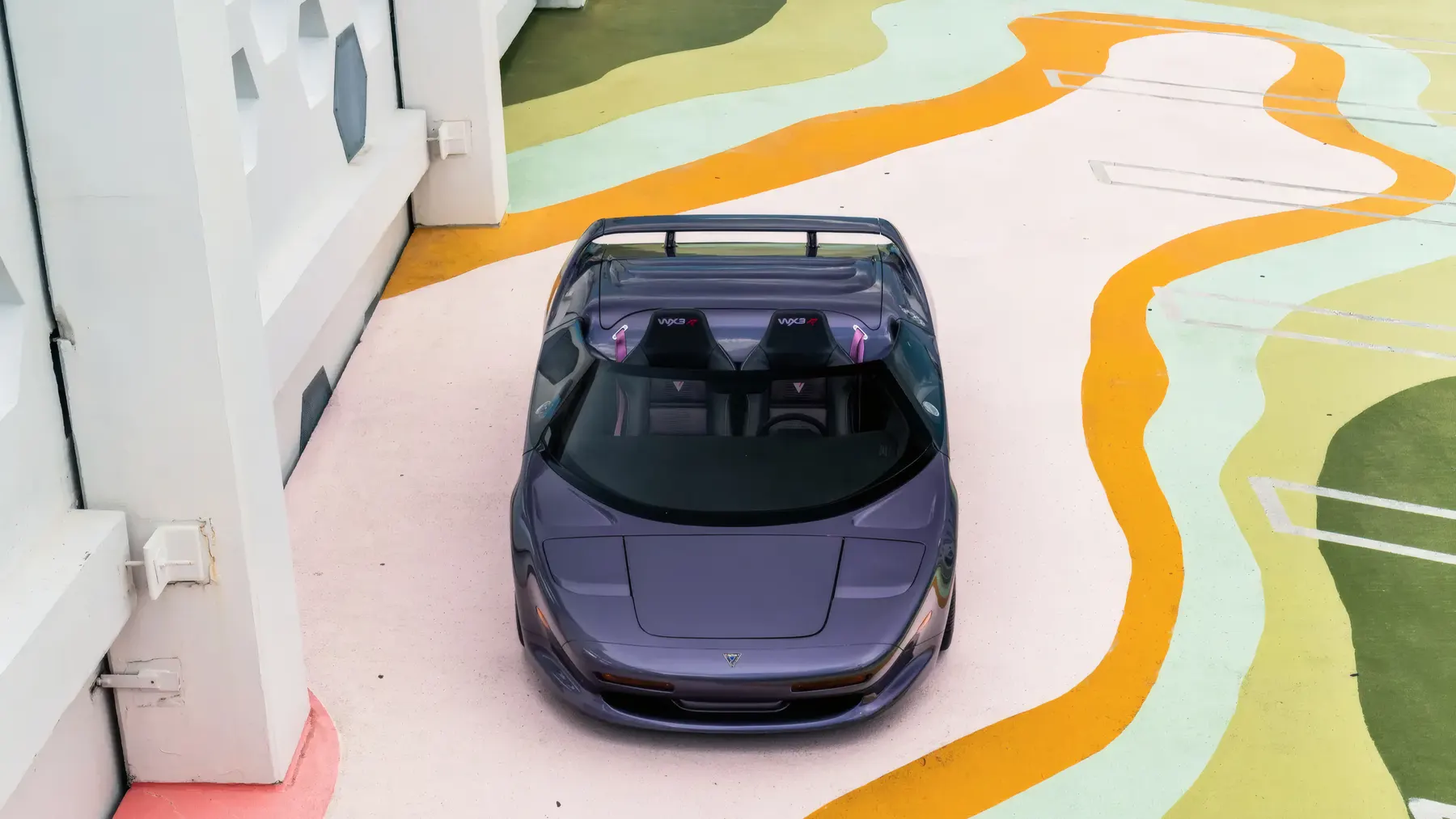
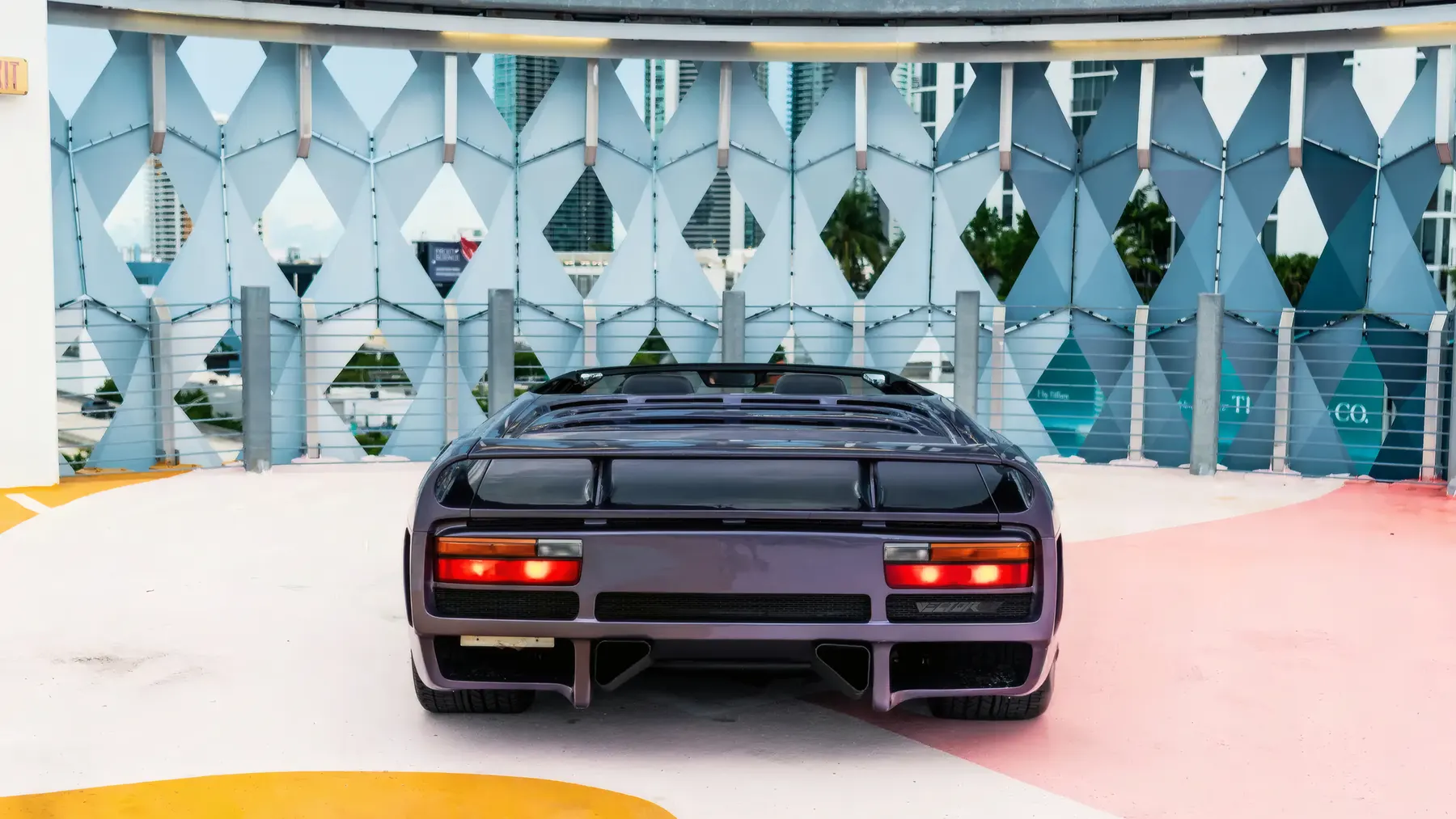
The 1993 Geneva debut arrived in two parts. The WX-3 coupe returned, now painted aquamarine and fitted with a running drivetrain: an uprated 7.0-litre Rodeck twin-turbo V8 that Vector claimed produced 1,000 bhp. Alongside it, unannounced, sat the WX-3R Roadster. In Amethyst purple - both shades chosen to match the branding of Wiegert’s Aquajet personal watercraft venture, which tells you something about how the company’s finances were structured at this point - the roadster took the coupe’s design and pressed each of its most extreme proportions further. The windshield was raked even more aggressively than the coupe’s already severe screen, sweeping forward at a near-horizontal angle and blending directly into lightweight side windows divided not by conventional B-pillars but by sections of the door’s Kevlar composite skin. The rear spoiler sat lower and flatter. The scissor doors carried over unchanged. Inside, the coupe’s peculiar three-across bench seat - an option carried over from export-specification W8s - was abandoned in favour of closely bolstered Recaro bucket seats in grey leather, giving the roadster a more focused, driver-oriented character that the coupe, for all its technical ambition, had somewhat lacked.
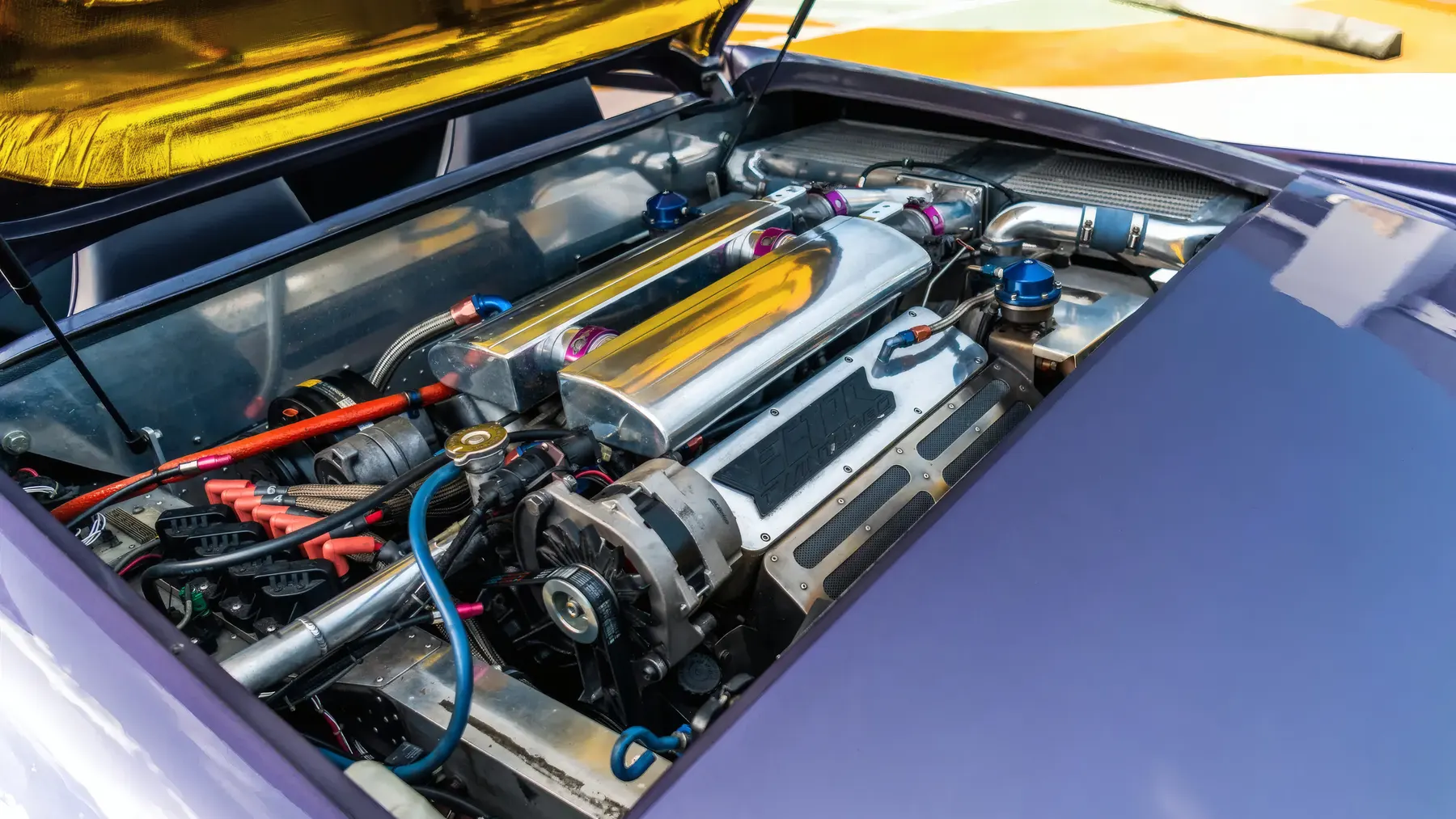
Beneath the rear clamshell, the WX-3R ran the same basic drivetrain package as the production W8: the 6.0-litre all-aluminium Rodeck V8 with revised induction - a dual-plenum, higher-flow throttle body arrangement replacing the Corvette-sourced system from production cars - mated to the heavily modified General Motors Turbo-Hydramatic 425 three-speed automatic. This is where honest evaluation of the WX-3R becomes complicated. The Turbo-Hydramatic 425 was, in its origins, the transmission that had powered front-wheel-drive Oldsmobile Toronados and Buick Rivieras during the 1960s. Vector’s engineers had rebuilt it comprehensively - every internal component uprated, a ratcheting override mechanism added to enable clutchless up and downshifts - but its fundamental architecture was decades old, and it had drawn sustained criticism throughout the W8’s production run. In a car claiming to represent America’s answer to Ferrari and Lamborghini, an automatic gearbox with those origins was a significant liability, both in perception and in the demands it placed on any driver attempting to extract maximum performance. The WX-3R offered no alternative. Vector’s production plans called for a bespoke four-cam, four-valve 7.0-litre V8 with output options ranging from 600 to a claimed 1,200 bhp, but this engine was never built; both prototypes used the Rodeck units they had available.
The transmission issue was part of a broader problem: the gap between what Vector claimed and what it had actually demonstrated. Performance figures for the WX-3R were projections rather than measurements. Top speed was stated as well in excess of 200 mph, comfortably beyond what any independent test had verified from a Vector in any form. The car’s Geneva appearance, while mechanically functional, was primarily a show-circuit exercise; the WX-3R is believed to have accumulated very few kilometres over the course of its existence, and no independent instrumented testing was ever conducted on the prototype. This matters because the W8’s production history had provided genuine reason for caution. Car and Driver’s test of the W8 descended into a difficult session when the transmission failed outright mid-run and the engine overheated on multiple occasions, the test eventually completed in the early hours of the morning on an airport service road. Andre Agassi, one of the W8’s most high-profile customers, returned his car citing exhaust heat burning the boot carpet - a complaint Wiegert disputed vigorously, but which illustrated how close to the edge of liveable refinement the production cars operated. The WX-3R, as a prototype that had never entered serious development testing, had resolved none of these questions. Its planned production pricing - initially set at $765,000 and subsequently reduced to $685,000 - placed it above the McLaren F1 then entering production at Woking, from a company whose entire production history amounted to seventeen cars.
What killed the WX-3R was not ultimately any of these engineering challenges. Megatech, an Indonesian investment group with connections to Tommy Suharto, son of Indonesia’s then-president, had been providing capital to Vector in exchange for an increasing ownership stake throughout the early 1990s. In March 1993 - concurrent with the Geneva debut of the very car the investment was nominally funding - Vector’s board voted to remove Wiegert at Megatech’s instigation. What followed was extraordinary even by the standards of automotive startup history: Wiegert changed the factory locks, hired armed guards, and attempted to hold the Wilmington facility. He lost. Megatech relocated operations to Florida, discarded the all-American engineering philosophy that had defined every Vector to that point, and produced the M12 - a car built around a Lamborghini Diablo V12 engine and adapted Italian componentry. Reports from the American automotive press at the time were scathing, with multiple publications identifying it as among the worst high-price cars they had encountered. Only fourteen production examples were completed before the enterprise collapsed. The contrast with the WX-3R, which whatever its limitations had been built as an original American engineering proposition using materials and methods Wiegert had developed over more than a decade, could not have been more direct.
Wiegert won back the Vector name and both WX-3 prototypes through litigation by 1999 and retained them for the following two decades, occasionally bringing them to Southern California automotive gatherings while continuing to pursue investment for a successor project. In 2019, he consigned both prototypes to RM Sotheby’s. The WX-3R subsequently underwent a mechanical and cosmetic restoration before passing through Canepa’s inventory in Scotts Valley, California. Wiegert died in 2021.
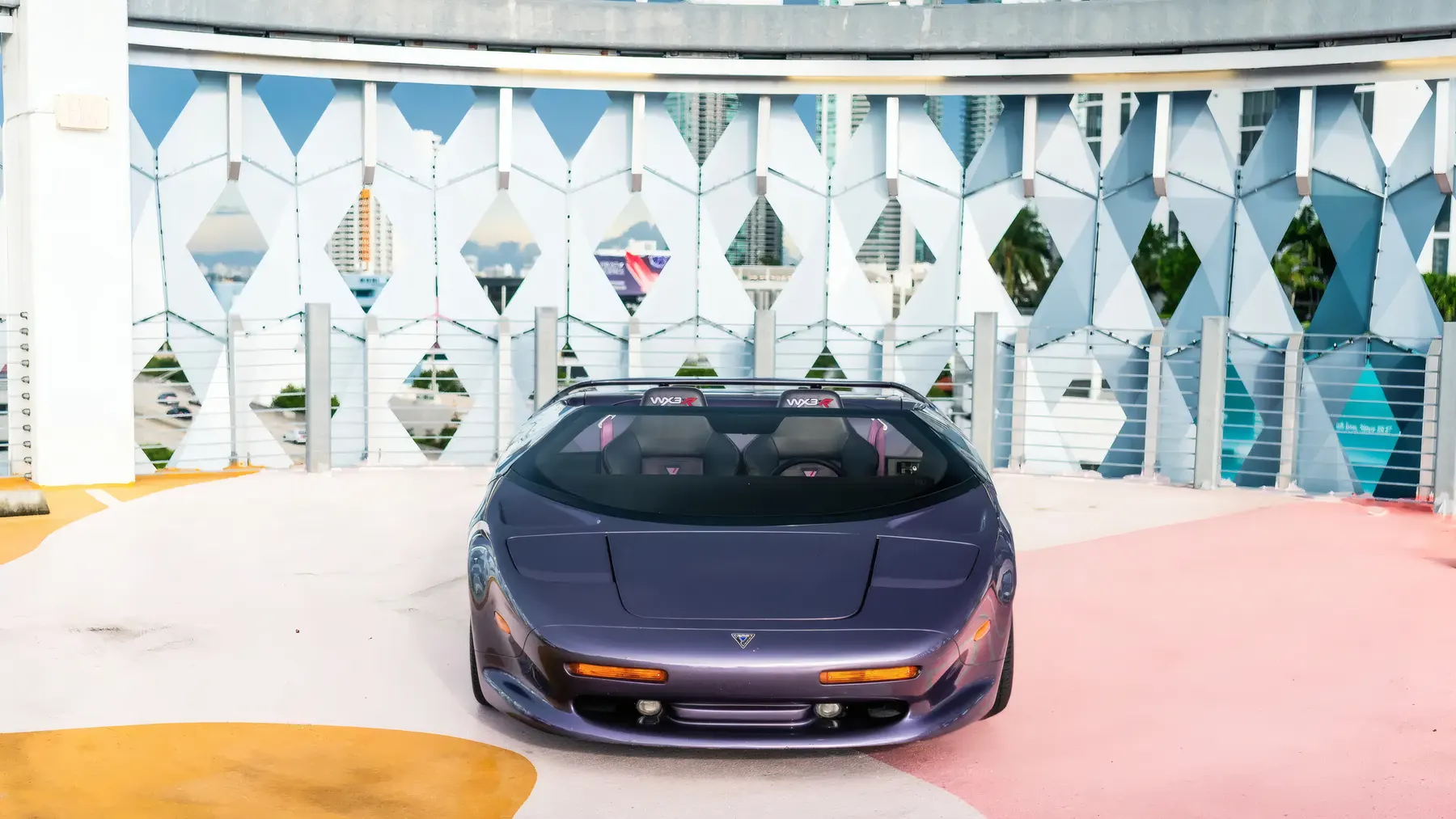
The WX-3R is, considered from almost any angle, an impossible object: more extreme than it needed to be, more ambitious than its company could support, and more fully realised than its fate had any right to allow. The automatic gearbox, the unverified performance claims, the stratospheric production price - these were real problems, each of which might or might not have been solvable given time and capital. They were never given the opportunity to be resolved. What remains is a genuinely original piece of American engineering, the only open-topped Vector ever built, and the clearest surviving evidence of what Jerry Wiegert was actually trying to do before the moment to do it was taken away from him.
Sources
- Wikipedia – Vector WX-3
- RM Sotheby’s Monterey 2024 – WX-3R Roadster Prototype lot
- RM Sotheby’s Arizona 2019 – WX-3R Roadster Prototype lot
- RM Sotheby’s Monterey 2024 – WX-3 Coupe Prototype lot
- Supercars.net – 1993 Vector Avtech WX-3R Roadster Prototype
- Exotic Car List – 1993 Vector Avtech WX-3R Roadster Prototype
- Secret Classics – Vector Avtech WX-3 & WX-3R
- Grokipedia – Vector WX-3
- Classic Driver – 1993 Vector WX-3 / Avtech WX-3R Roadster Prototype listing
Join the discussion
Comments
Loading comments…
Leave a comment
Share a detail, memory, or perspective. Every comment is reviewed before publication.