Ferrari 275 GTS: Pininfarina's Spider That Maranello Held Back
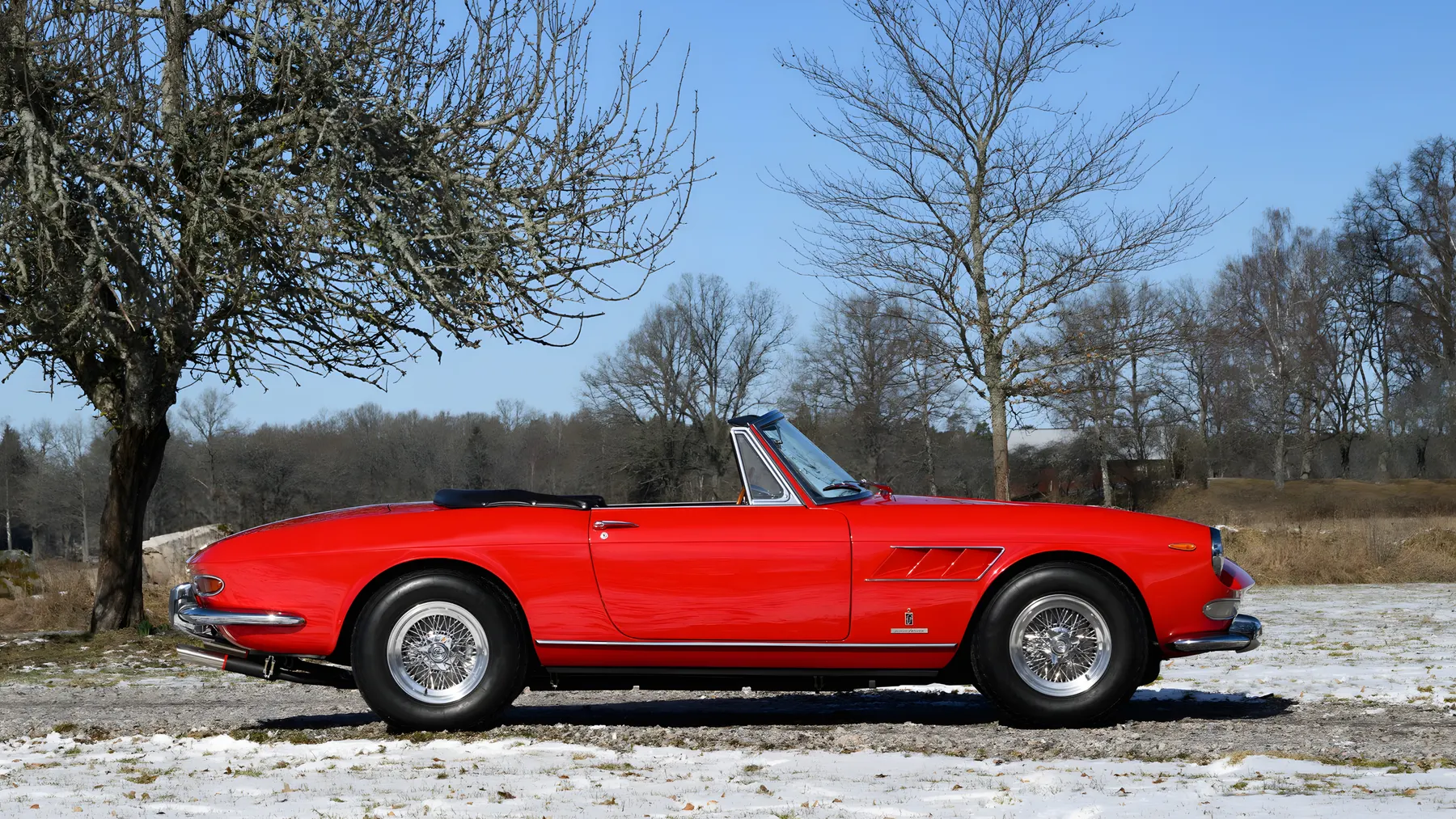
1965 Ferrari 275 GTS by Pininfarina

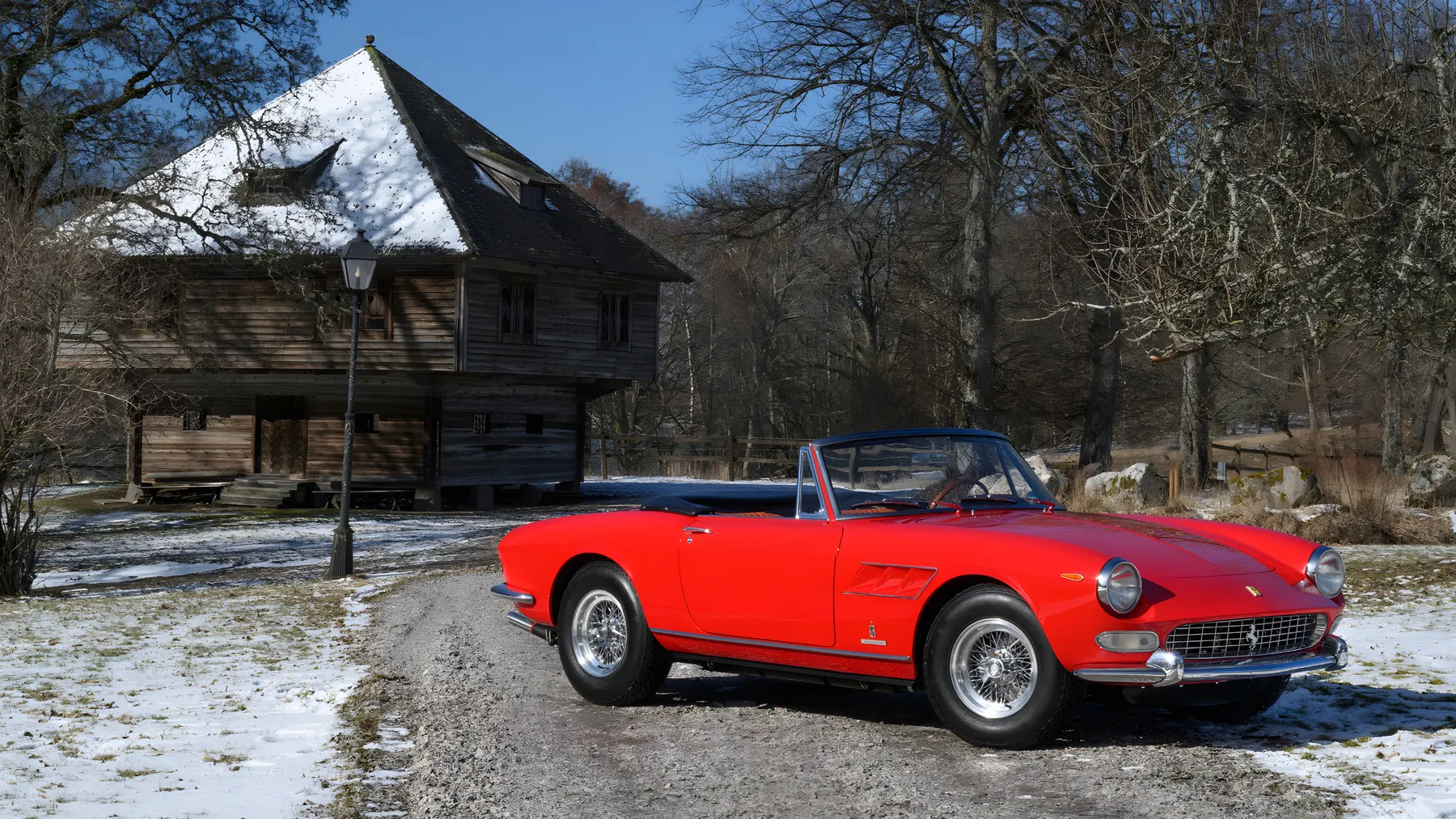
Images: Tim Scott / RM Sotheby's
When Ferrari revealed the 275 GTB and 275 GTS side by side at the Paris Salon in October 1964, both cars left the factory with essentially the same 3.3-litre V12 underneath, yet Maranello quoted the open car twenty horsepower shy of its coupé sibling before a single customer had asked for anything softer. Ferrari’s own record books, in fact, suggest there was likely no meaningful mechanical difference between the two engines at all. The GTS’s claimed 260 bhp, set against the GTB’s claimed 280 bhp, looks less like a technical fact than a decision about who each car was for. That is the quiet contradiction sitting at the heart of the 275 GTS: a genuinely rapid Ferrari that Ferrari itself chose to present as the gentler one.
The car arrived at an important juncture. It replaced the 250 GT Cabriolet, and its debut marked the return of an open model to Ferrari’s catalogue after roughly two years without one, since 250 GT California Spyder production had ended in early 1963. That gap mattered commercially: rivals had not been standing still, and by the mid-1960s a wealthy buyer wanting an open-top continental grand tourer could cross-shop the Jaguar E-Type roadster, the Aston Martin DB5, and Maserati’s Mistral Spyder, with Lamborghini’s 350 GT beginning to circle the same territory. The 275 series as a whole, comprising the GTB coupé and GTS spider, replaced the storied 250 line and represented Ferrari’s most significant technical reset of the decade for its road cars. The naming followed Ferrari’s usual logic of the era, with “275” denoting the approximate displacement in cubic centimetres of each of the twelve cylinders, a convention that told an educated buyer exactly what sat under the bonnet before they had even opened the door.
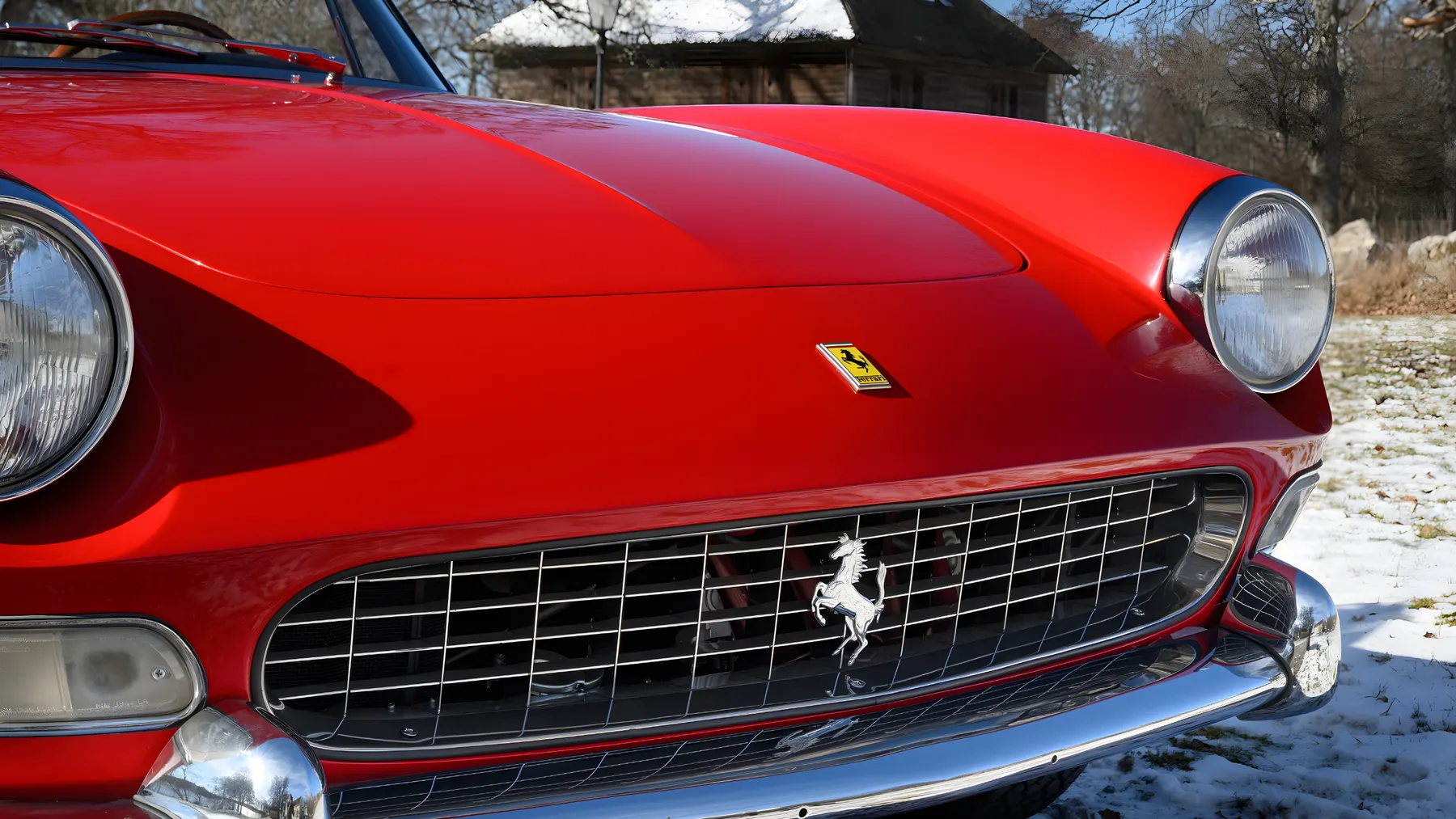
That reset centred on the chassis rather than the engine. The 275 GTS used the familiar Colombo-designed 60-degree V12, internally coded Tipo 213, displacing 3,286cc from a 77mm bore and 58.8mm stroke, breathing through three twin-choke Weber 40 DCZ/6 or 40 DFI/1 carburettors and running wet-sump lubrication. What was new, and genuinely significant, was everything behind it: the 275 series was the first Ferrari road car fitted with a rear-mounted transaxle and fully independent suspension at all four corners, ending the era of Ferrari road cars riding on live rear axles. Mike Parkes led the suspension development, drawing on lessons from the 250 Testa Rossa and 250 LM competition programmes, with double wishbones, coil springs and Koni dampers at each wheel. Mounting the five-speed gearbox at the rear, in unit with the differential, pulled weight rearward for a more even front-to-rear balance than earlier live-axle Ferraris had managed. Both GTB and GTS shared this Tipo 563 platform and its 2,400mm wheelbase, along with Dunlop disc brakes at all four corners.
Much of the engine’s internal specification was not new for its own sake but inherited from cars with serious credentials. The Tipo 213’s internals drew on parts developed for the 250 GT/E 2+2, the 250 GT Lusso and, notably, the 250 GTO, meaning the GTS’s V12 carried genuine competition ancestry even though the car itself was never conceived as a racer. Ferrari built no factory competition programme around the GTS specifically; unlike the GTB, which spawned the Competizione Speciale and later the purpose-built GTB/C for GT-class racing, the spider’s brief stayed resolutely road-focused throughout its production life.
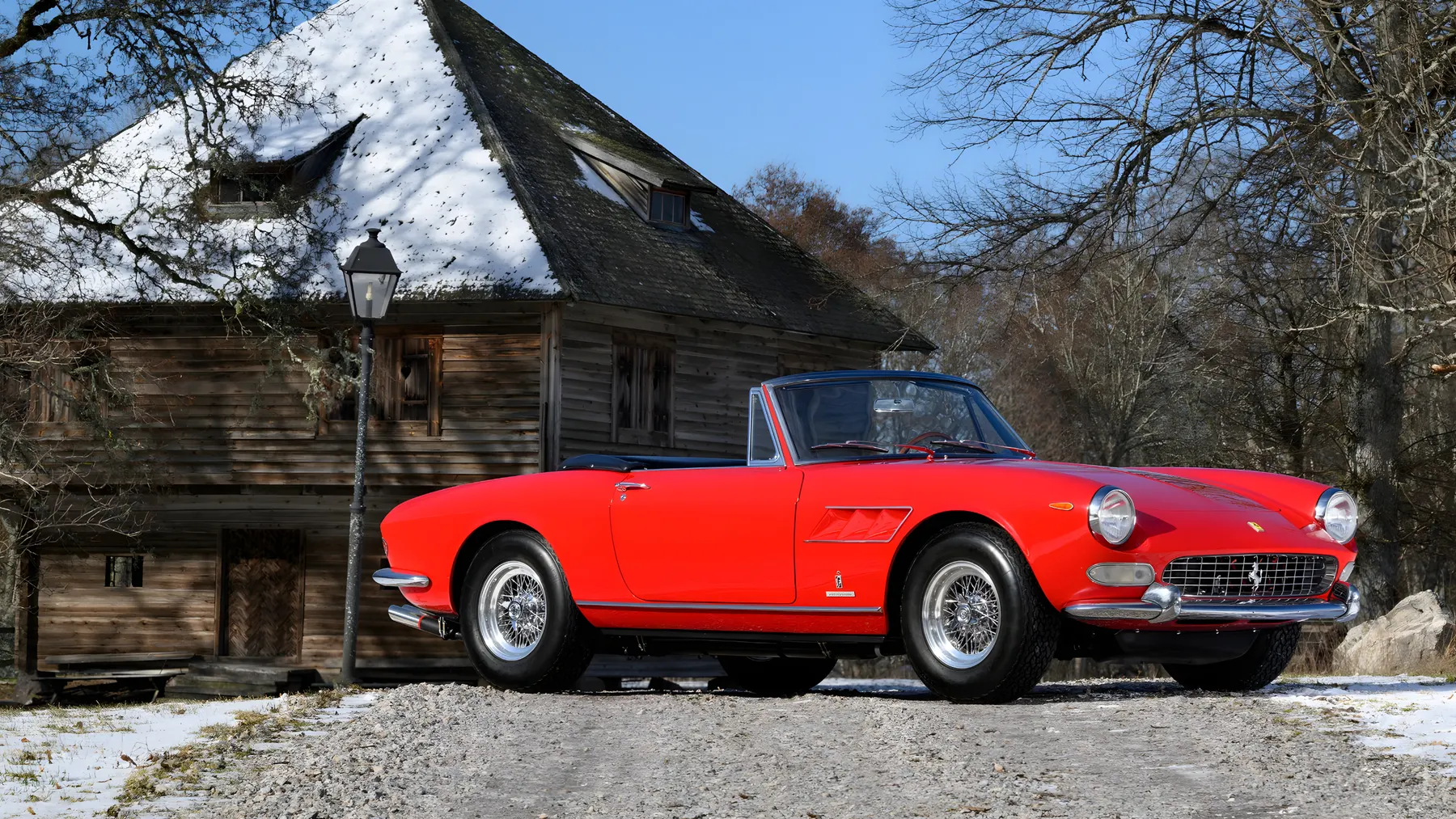
Where the two cars parted ways entirely was the bodywork, and this is where Pininfarina’s role went well beyond styling. The GTB coupé was designed by Pininfarina but built by Scaglietti in Modena; the GTS spider was not only styled differently, with a shorter front hood, smaller uncovered headlights and softer, more balanced proportions recalling the earlier 250 Pininfarina cabriolets, it was also fabricated at Pininfarina’s own works in Turin and delivered to Maranello fully trimmed. It was an all-steel body with no lightweight alloy option, unlike the GTB, which could be specified with aluminium doors, bonnet and boot lid, or ordered as a full aluminium-bodied car by customers chasing every possible kilogram. The GTS came standard on Borrani wire wheels rather than the GTB’s cast alloy rims, a detail that suited the car’s more relaxed brief. A folding cloth top sat in a recess behind the cabin, and a detachable hardtop was offered as a factory option, though it was rarely ordered and remains scarce today.
On the road, the detuning story, real or not on paper, translates into a genuine difference in character. Contemporary appraisal by Auto Italia magazine described the GTS as more user-friendly than the GTB thanks to stronger torque at lower engine speeds, with the car capable of just under seven seconds to 60mph and a top speed in the region of 145mph, close enough to make it, in that publication’s words, almost a match for the period’s benchmark open Grand Tourer, the Jaguar E-Type. Other sources place the GTS’s claimed top speed closer to 150mph and its 0-60mph time nearer 7.2 seconds, and the spread across these figures reflects how little independent, repeatable period testing exists for this specific model compared with its more written-about coupé sibling. What comes through consistently is the personality: this was never meant to be the last word in ferocity. Enthusiast road tests describe a car with a trace of initial understeer through faster bends that settles into a neutral stance once power is applied, though the GTS rides noticeably softer, rolling and pitching more than the later four-cam long-nose GTB, in keeping with its brief as the touring-focused half of the 275 family. The five-speed gated shifter rewards a deliberate hand and needs both engine and gearbox oil to reach working temperature before it shifts cleanly, a ritual any owner of a 1960s Ferrari V12 will recognise, and one that begins with a small piece of theatre: holding down a dashboard priming switch to fill the Weber float chambers before the starter is even asked to turn the engine over. Unassisted steering feels notably heavy manoeuvring at low speed but lightens and sharpens once underway, tall-geared enough to suit fast cruising rather than tight switchbacks. What buyers were really being sold, in period, was restraint with the option of speed rather than speed as the headline, with enough elbow room and understated presence in the cabin that the car could plausibly be driven hard one weekend and to a smart dinner the next without feeling like a compromise either way.
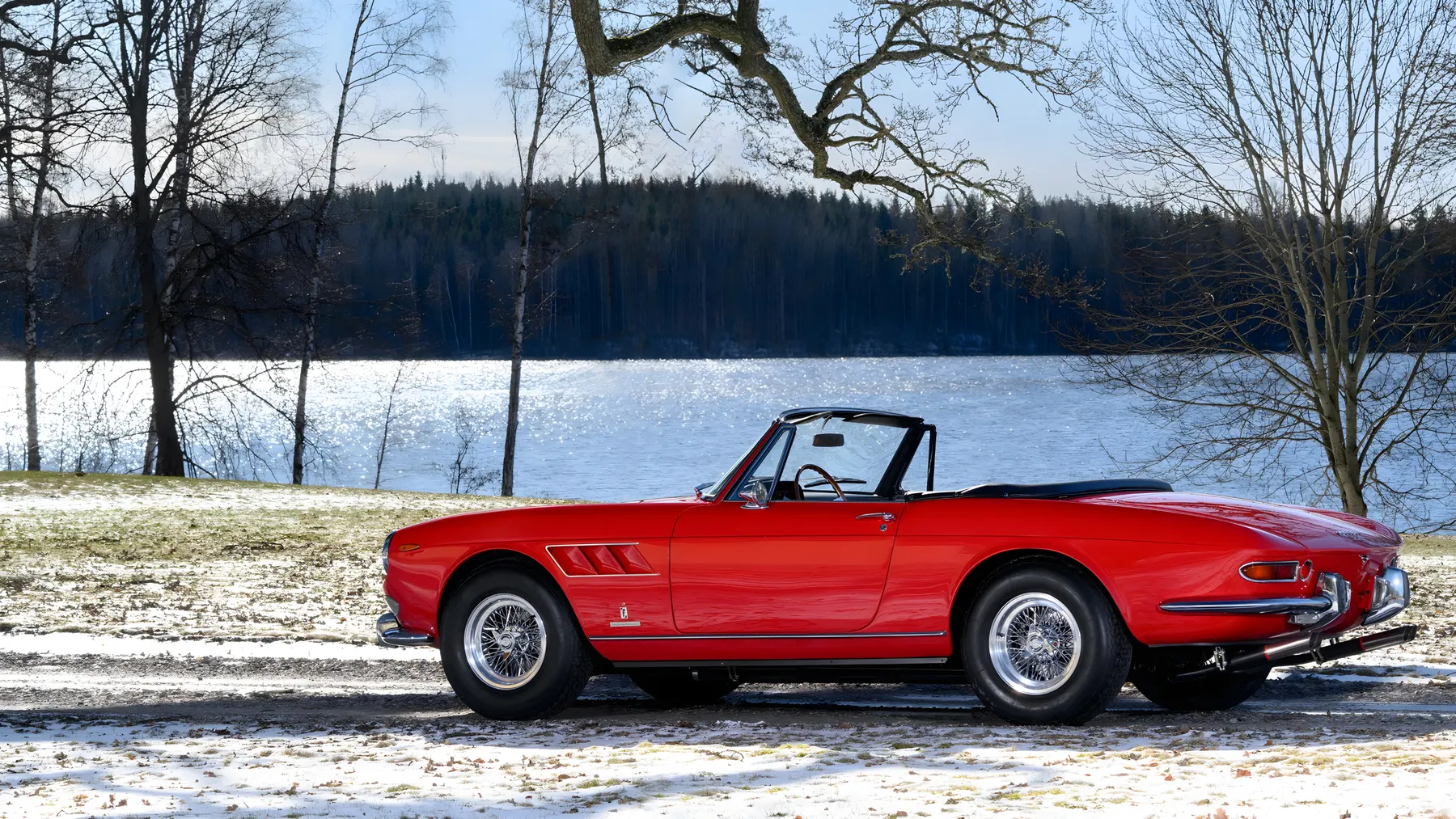
The compromises are worth naming plainly rather than waved away as period charm. The Dunlop disc brakes fitted to every 275, GTS included, were considered undersized even by contemporaries: small in diameter, unventilated, and paired with a servo and caliper that struggled to match the performance the V12 could generate, a criticism echoed by period road testers and modern buyer’s guides alike. The gearchange, while mechanically satisfying, was genuinely slow in operation next to rivals of the era, a real drawback rather than mere character for anyone trying to press on. More structurally, the GTS never received the torque-tube driveline revision that Ferrari introduced on the series two “long-nose” GTB in 1966 specifically to cure noise, vibration and alignment problems inherent to the original stressed-member engine-and-transaxle mounting; every 275 GTS built, across its entire run, retained the earlier, less refined arrangement, meaning the car’s driveline character stayed fixed while its coupé sibling was quietly improved around it. Add to that the all-steel-only construction, which denied GTS buyers the weight-saving aluminium bodywork option available to GTB customers, and the questionable honesty of the 20 bhp “penalty” itself, and a picture emerges of a car whose softness was, in places, a genuine mechanical shortfall rather than purely a deliberate design choice. The cabin, too, prioritised driver focus over outright comfort in a way that reads as spartan today: simple instrumentation, a thin-rimmed wheel, and switchgear whose labelling was never Ferrari’s strong suit in this era, sitting well behind what era rivals were beginning to offer buyers moving upmarket into open-top grand touring. A six-carburettor, higher-output tune was technically available across the 275 range, but it went to relatively few cars and does little to change the standard GTS’s everyday character. None of this is helped by the wider realities of running a 1960s Ferrari V12 today or in period: no power steering, no assistance of any kind, minimal creature comforts, and, for a modern owner, running and insurance costs that scale with a car now comfortably into seven-figure territory at auction.
Only 200 examples of the 275 GTS were built, between late 1964 and early 1966, including 19 in right-hand drive, making it considerably rarer than the roughly 450-car combined run of GTB variants. In 1966 it was replaced by the larger-engined 330 GTS, which left no direct 3.3-litre spider in Ferrari’s range for a period, a gap that would only be filled by the extraordinarily rare 275 GTB/4 NART Spider, commissioned by Ferrari’s North American importer Luigi Chinetti and built by Scaglietti rather than Pininfarina, using the later four-cam engine and sharing the GTB/4’s coupé-derived styling rather than the standard GTS’s own bodywork. Those NART cars, of which only around ten were completed, are a distinct and separate model from the 275 GTS proper, however often the two are mentioned in the same breath by auction houses today. The original 275 GTS earned its own recognition on merit, with Motor Trend Classic placing the GTB coupé and GTS spider jointly among its list of the greatest Ferraris ever built, a rare instance of a manufacturer’s more restrained variant sharing top billing with the car it was deliberately built to sit beneath. In the collector market it has settled into a role that suits its original brief rather neatly, valued by specialists and owners for its everyday usability and open-top drivability as much as for outright rarity, and it remains one of the more attainable routes into genuine 1960s two-cam 275 ownership, even as values for the wider series have climbed into seven figures.
What the 275 GTS leaves behind is a template as much as a car. It marked the first time Ferrari took a genuinely modern road-car chassis, independent all round and finally free of the live rear axle, and used it as a shared foundation from which to build two distinctly different personalities for two distinctly different customers, one sharper and more overtly competition-flavoured, one softer, quieter and dressed by Pininfarina’s own hands rather than Scaglietti’s. That the softer of the two may have needed no engine changes at all to justify its lower horsepower rating says less about any shortfall in the GTS and more about how deliberately Ferrari was, by the mid-1960s, learning to sell the same engineering twice.
Sources
- Ferrari 275 – Wikipedia
- Ferrari 275 GTS (1964) – Ferrari.com Official Heritage
- Ferrari 275 GTB (1964) – Ferrari.com Official Heritage
- Ferrari 275 GTS Specifications – SBR Race Engineering
- Ferrari 275: Models, Specs, and Buyer’s Guide – Car & Classic
- 1965 Ferrari 275 GTS Base – Hagerty Valuation Tool
- The Ferrari 275 On Road and Track – Classic Driver Magazine (Auto Italia extract)
- Ferrari 275 at 60: Live Fast, Die Young – Classic & Sports Car
- Ferrari 275 GTB/GTS Buyer’s Guide – Goodwood Classic Solutions
- 1965 Ferrari 275 GTS: Detailed Specifications – Carfolio
- Ferrari 275 GTS 3.3 V12 Performance Figures – Autosnout
Join the discussion
Comments
Loading comments…
Leave a comment
Share a detail, memory, or perspective. Every comment is reviewed before publication.