BMW 600: The Microcar That Flopped but Saved BMW's Future
1959 BMW 600

Images: Josh Bryan / RM Sotheby's
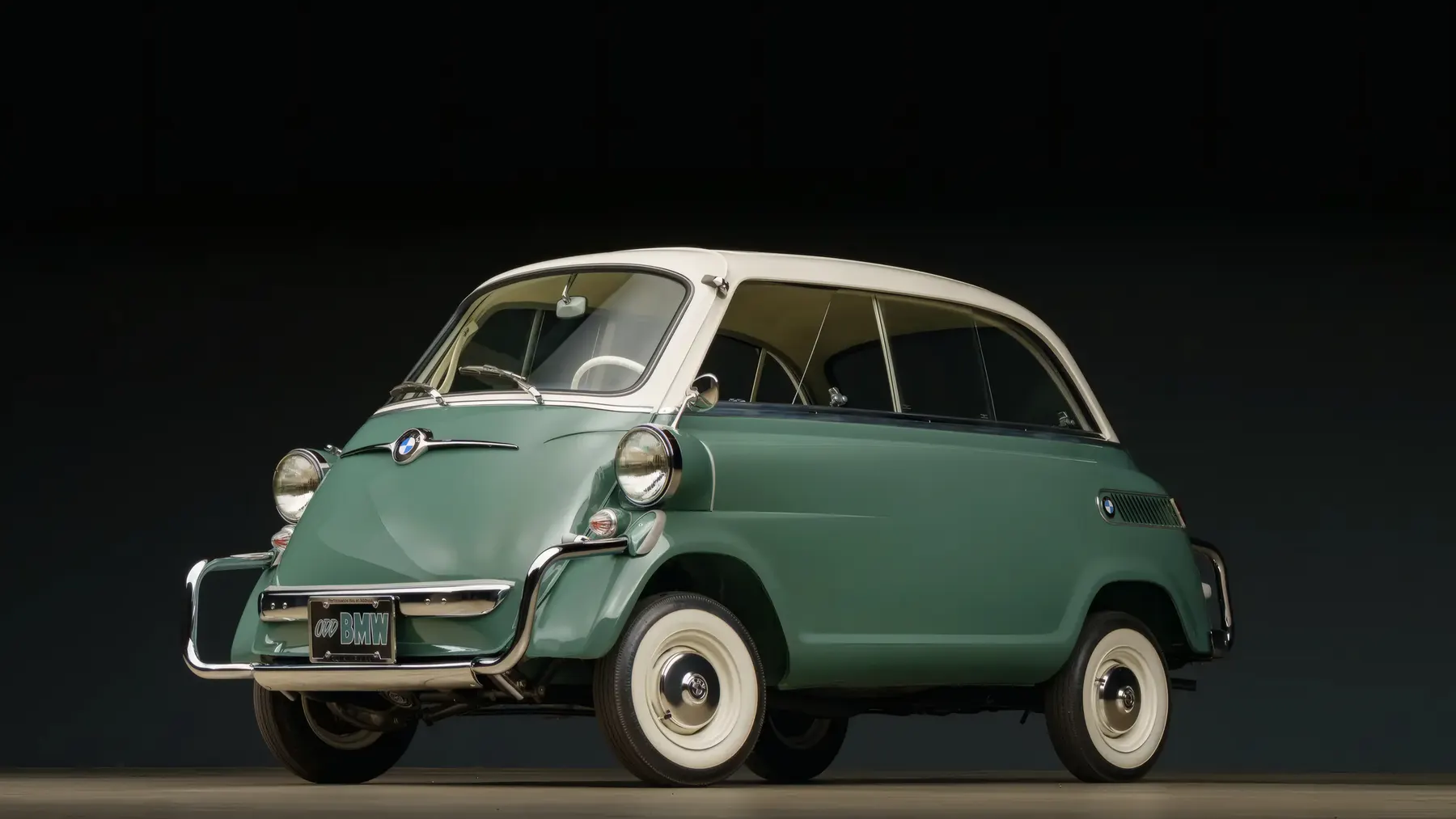
BMW built the 600 to save itself, and for a couple of anxious years in the late 1950s it looked instead like the car that might finish the job. By the middle of the decade the company’s motorcycle business had collapsed, its 501 and 507 luxury cars were priced far beyond what the shrunken postwar market could bear, and the little Isetta bubble car, whose design and tooling BMW had bought outright from the Italian firm Iso in 1954, was proving harder to sell in real volume than anyone had budgeted for. BMW’s answer was to stretch the Isetta concept into something that looked and worked more like an actual car: four seats, four wheels planted properly at the corners, and just enough performance to keep pace with real traffic. That car was the 600, and its short, unhappy production run is one of the more instructive episodes in BMW’s history, a commercial failure serious enough to help push the company toward bankruptcy, yet one that quietly laid down the mechanical groundwork the marque would build on for the next four decades.
Money, or the lack of it, dictated almost every decision behind the car. BMW could not afford to design an entirely new model from scratch, so the 600 borrowed the Isetta’s forward-hinged door, its folding steering column, and its leading-arm front suspension, reinforced to cope with the extra weight of two more passengers. Everything behind the front axle was new. A conventional perimeter chassis of box-section side members and tubular crossmembers replaced the Isetta’s simple A-shaped tube frame, and at the back BMW fitted an independent semi-trailing arm rear suspension, the first time that layout had appeared on any BMW. It was a modest, unglamorous piece of engineering for a modest, unglamorous car, but it proved so effective that some version of it underpinned nearly every BMW built over the following four decades, right up until the multi-link “Z-axle” arrived on the Z1 in the late 1980s. Power came from a 582cc flat-twin adapted from the R67 motorcycle and sidecar engine, mounted behind the rear axle and rated at a broadly agreed 19.5bhp. Unlike the Isetta’s engine, which drove through a sequential gearbox with no differential, the 600 used a proper four-speed, all-synchromesh transaxle with a conventional H-pattern shift, and buyers could specify the clutchless Saxomat semi-automatic transmission as an option. The engine itself retained a motorcycle-derived Dynastart unit, a combined starter and generator that spun up the twin without a separate starter motor, a neat piece of parts-bin engineering that kept costs down but was one more reminder that this was a car built on a shoestring. The running gear grew only incrementally over the Isetta’s: wheel diameter stayed at 10 inches, though the rims widened by half an inch to three inches to cope with the extra load. The 600’s name, like those of several 1950s European economy cars sharing the same “600cc class” positioning, referred loosely to its engine displacement rather than any model code, a naming habit BMW would abandon once the numbered-series cars of the following decade arrived.
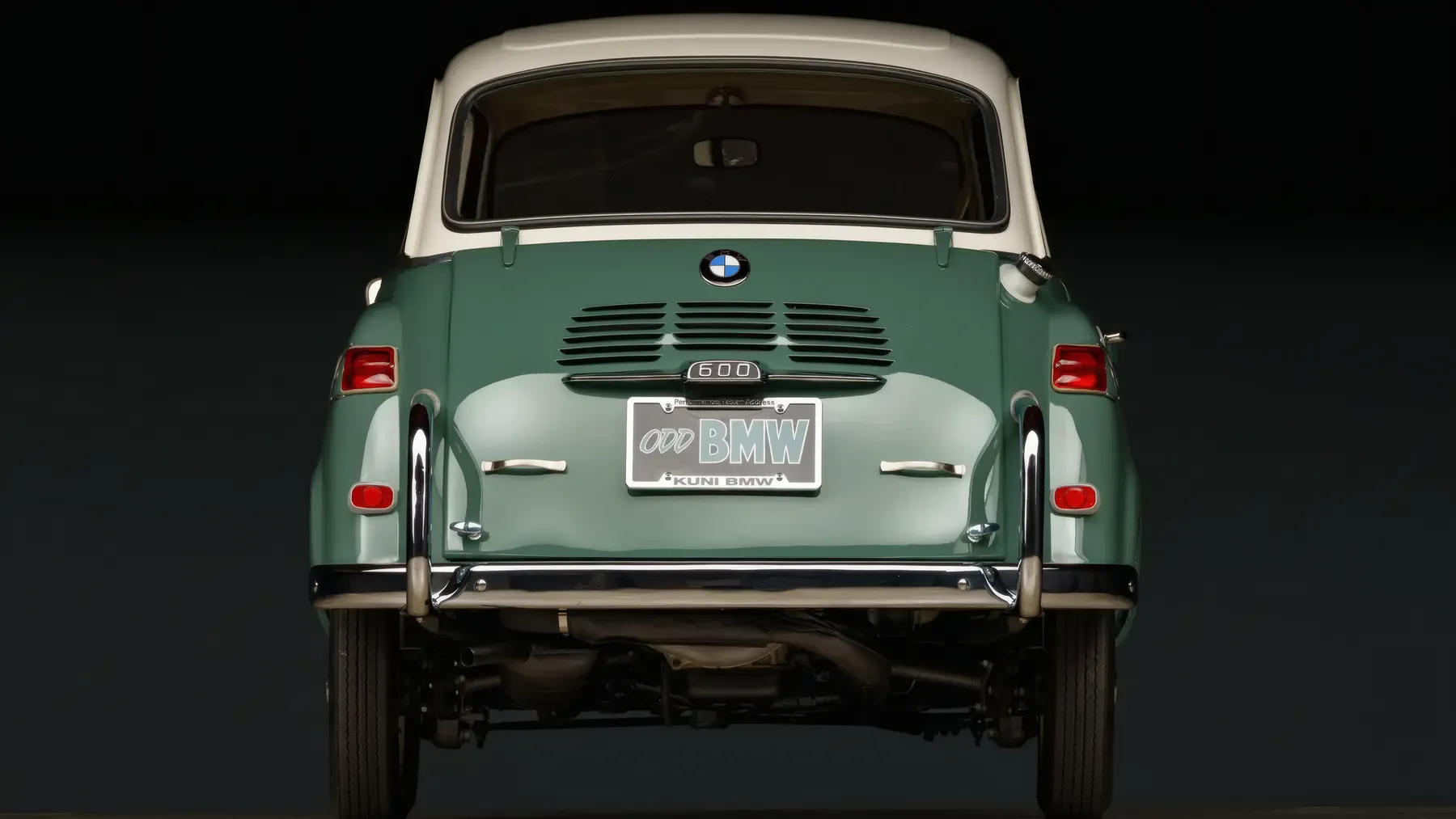
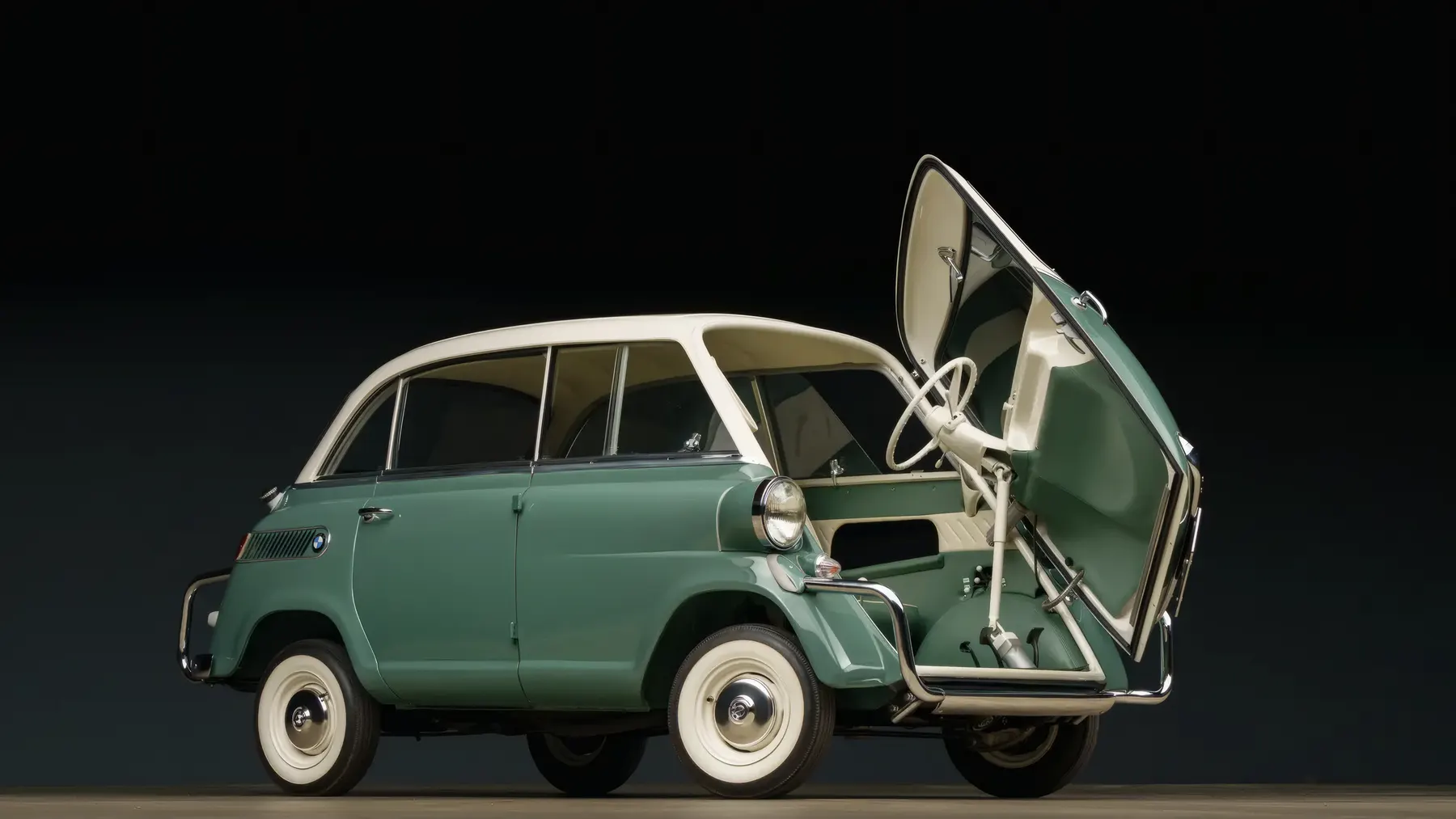
Giovanni Michelotti was brought in to smooth over the Isetta’s fairground-ride styling, and the 600 that appeared in September 1957 showed his touch in sharper “knife-edge” bumpers, a restyled dashboard, and a more resolved, Pininfarina-influenced treatment around the headlamps. The forward-hinged front door survived intact from the Isetta, swinging out to 90 degrees and taking the steering wheel and instrument binnacle with it so occupants could step in rather than clamber over a sill. Where the 600 earned its four-seat billing was the addition of a second door, hinged conventionally on the car’s right-hand side, giving rear passengers their own way in rather than forcing them to fold themselves past the front seats. A longer wheelbase and wider track than the Isetta’s let BMW fit a proper bench in the back, and the glasshouse was generous enough that period reviewers praised the view out and the sense of space inside a car barely 2.9 metres long overall, a package efficient enough that contemporary journals cited it as an example of packing four adults into less length than the Mini would later manage. Details still gave away the car’s motorcycle-adjacent roots: there was no fuel gauge, just two taps on the 20-litre tank, one positioned lower than the other so it could serve as a de facto low-fuel warning once the higher tap ran dry.
On the road the 600 delivered exactly what BMW had promised: real, if unhurried, usability. When The Motor tested one in 1959, the magazine was impressed enough to describe it as a genuine mile-a-minute four-seater, noting that it was some 22 inches shorter than any comparable British four-seat car while still swallowing four adults and their luggage. Fuel economy was the standout figure, with the testers recording just over 45 miles per gallon overall and close to 60mpg at a steady 40mph, numbers that shamed every conventional small saloon they had tried. Acceleration was leisurely rather than urgent: getting from rest to 50mph took the better part of 25 seconds, and top speed hovered around 62mph depending on which contemporary source is consulted. The testers were less complimentary about the steering, which they found heavier and slower to respond than expected even after a worn bush in the linkage had been replaced, a criticism that suggests the compact, wheel-at-each-corner chassis needed a sharper steering box to fully exploit the composure of its new suspension.
It is on the business side of the ledger that the 600’s real problems show up, and they are worth naming specifically rather than waved away as period quirks. BMW had reportedly borrowed around 7 million deutschmarks against a projection of selling 400,000 units a year; the entire three-year run produced just 34,813 cars, with 1958, the only full calendar year of production, accounting for roughly 27,000 of them. The core miscalculation was price. In Germany the 600 cost around 200 marks more than a Volkswagen Beetle, a car with a stronger dealer network, a stronger reputation, and none of the Isetta’s bubble-car baggage. In Britain the mismatch was starker still: a 600 cost roughly £676 against a Morris Minor some £50 cheaper and a Ford Anglia fully £105 less, and BMW never once built the car in right-hand drive, so the small number of UK buyers had to drive left-hand-drive cars whose sole rear door opened onto the traffic side of the road rather than the kerb. BMW tried to offset the price gap with an unusually long options list, including a heater, a Blaupunkt radio, individual front seats and automatic transmission, but every extra simply widened the gap it was trying to close. The Isetta’s image did the rest of the damage: buyers who wanted a genuine four-seat car associated the 600 with the bubble car parked next to it in the showroom, while buyers who wanted a cheap economy runabout bought the more conventionally styled Fiat 500, Glas T600, NSU Prinz or Goggomobil instead. BMW never offered the 600 in any alternative body style either, with no estate, cabriolet or van, unlike the Isetta, which had spawned pickup and convertible versions in Britain, so there was no way to chase a different slice of the market once the standard saloon stalled. Ideas for a more versatile, Fiat Multipla-style variant with flexible seating were reportedly discussed internally but never left the drawing board, a missed opportunity that might have broadened the car’s appeal beyond a straightforward four-seat saloon. A brief tailwind from the fuel-conscious mood of the mid-1950s Suez crisis gave early demand a lift, but it faded quickly once buyers refocused on cars that simply looked and drove like everyone else’s.
The scale of that miscalculation fed directly into the crisis that nearly ended BMW’s independence altogether. By the end of 1959 the company’s sales problems across both its car and motorcycle businesses had pushed it to the edge of financial collapse, and at a tense shareholders’ meeting that December a takeover by Daimler-Benz, which would have reduced BMW to a body supplier for Mercedes, appeared close to certain before small shareholders forced a last-minute reprieve. The 600 was not the sole cause of that crisis, but its failure to get anywhere near its sales targets was a significant contributor to the losses that brought BMW to the table. What kept BMW’s economy-car ambitions alive through the turmoil was the 600’s own successor. Austrian importer Wolfgang Denzel, convinced that BMW needed the 600’s running gear wrapped in sharper, more conventional bodywork, commissioned Michelotti to sketch a coupe on a lengthened 600 chassis; BMW eventually built both that coupe and a related two-door saloon as the BMW 700, launched in 1959 with a monocoque body built by Vignale and a larger, 697cc version of the 600’s flat-twin engine. Where the 600 had been an outright commercial failure, the 700 went on to sell well over 180,000 units and turned enough of a profit to help persuade the Quandt family to recapitalise BMW rather than let it be absorbed by its rival.
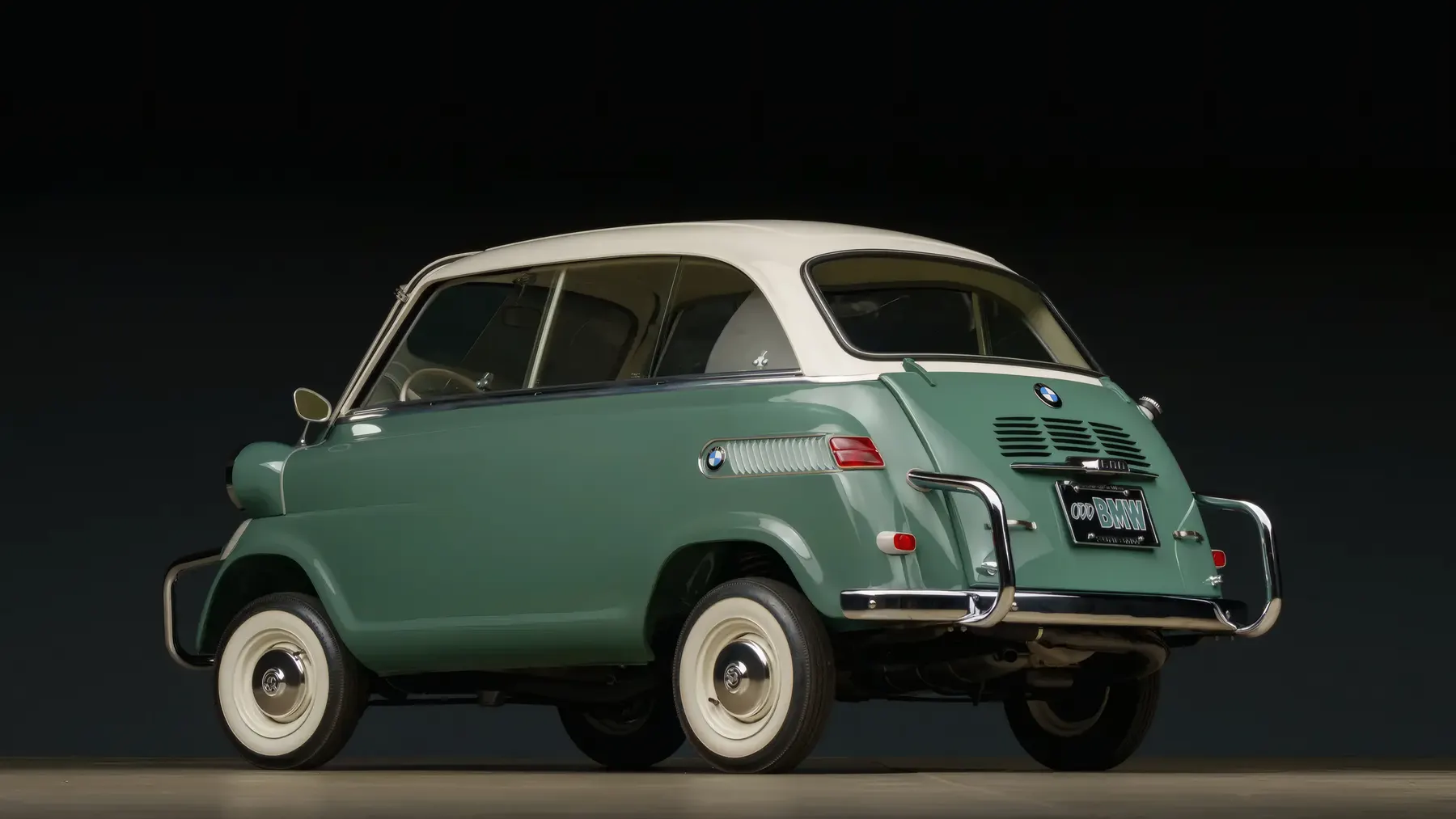
Judged purely on its own numbers, the 600 was a flop: a car built to save its maker that instead helped push the company toward the brink, and one so quickly overshadowed that most casual accounts of BMW’s history skip straight from the Isetta to the 700 without registering the car in between. But almost everything that made the 700 viable, and by extension much of what made the recovery of BMW as an independent, driver-focused manufacturer possible, traces back through the 600’s engineering rather than around it: the perimeter chassis, the reworked packaging, and above all a semi-trailing arm rear suspension that would go on to define how BMWs rode and handled for the next four decades. Few cars illustrate so clearly the gap between commercial verdict and engineering consequence. BMW’s least successful postwar model turned out to be one of its most quietly influential.
Sources
- BMW 600 - Wikipedia
- The Story of the BMW 600 Microcar - Below The Radar
- BMW 600, the Forgotten Microcar from BMW - Klassiekerweb
- BMW 600 Guide, History and Timeline - ClassicCars.co.uk
- 1958 BMW 600, The Bruce Weiner Microcar Museum - RM Sotheby’s
- 1957 BMW 600 - Microcar Museum
- Learning from Crises: Mastering Challenges - BMW Group PressClub
- 1958 BMW Isetta 600 - Conceptcarz
- The Plucky 1955–62 BMW Isetta Isn’t Going Anywhere - Hagerty Media
- 1962 BMW Isetta 600 - Hagerty Valuation Tools
Join the discussion
Comments
Loading comments…
Leave a comment
Share a detail, memory, or perspective. Every comment is reviewed before publication.